An Investigation into Providing Additional Parking to Solve Stellenbosch's Parking and Congestion Dilemma
Abstract
Stellenbosch, a small university town in South Africa, experiences severe parking shortages and traffic congestion. In response to the increasing parking demand, the local municipality proposed the development of a new multi-level parking facility next to the Eikestad shopping centre, located in the central business district of Stellenbosch. However, for this proposed solution to be viable, it must satisfy the needs of all affected stakeholders. To integrate stakeholder input more easily into the planning process, a product development evaluation tool, called the "house of quality", was used. This tool enables the key stakeholder requirements, relevant design attributes, and potential site locations for the proposed multi-level parking facility to be identified. The house of quality's results demonstrated its effectiveness in generating valuable insights for informed decision-making. Nevertheless, to ensure that the proposed parking facility accurately reflects the needs of the affected stakeholders, further studies are necessary.
Abstract
Stellenbosch, 'n klein universiteitsdorp in Suid-Afrika, ervaar ernstige tekort aan parkeerplekke en verkeersopeenhopings. In reaksie op die toenemende parkeerbehoefte, het die plaaslike munisipaliteit die ontwikkeling van 'n nuwe meerverdieping-parkeerfasiliteit langs die Eikestad-winkelsentrum, geleë in die sentrale sakekern van Stellenbosch, voorgestel. Om hierdie voorgestelde oplossing lewensvatbaar te maak, moet dit egter aan die behoeftes van alle geraakte belanghebbendes voldoen. Om belanghebbende-insette makliker in die beplanningsproses te integreer, is 'n produkontwikkelings-evalueringshulpmiddel, die sogenaamde "house of quality", gebruik. Hierdie hulpmiddel stel in staat om die sleutelbelanghebbendes se vereistes, relevante ontwerpeienskappe en potensiële terreinliggings vir die voorgestelde meerverdieping-parkeerfasiliteit te identifiseer. Die resultate van die house of quality het sy doeltreffendheid getoon om waardevolle insigte vir ingeligte besluitneming te genereer. Nietemin, om te verseker dat die voorgestelde parkeerfasiliteit die behoeftes van die betrokke belanghebbendes akkuraat weerspieël, is verdere studies nodig.
1. INTRODUCTION
1.1.
BackgroundStellenbosch was the focus of this study, as it is a small university town with a large population. According to 2022 census information, Stellenbosch (including the surrounding areas of Pniel, Franschhoek, and local farms) has a population of 175 411 people and a population density of 245 people/km2 (the highest of all its neighbouring areas) [1]. The town is thus faced with major traffic congestion and parking scarcity problems. The Stellenbosch Comprehensive Integrated Transport Plan (CITP) reported results from a national household travel survey of local households in 2020. Of the 12 identified transport issues, the residents ranked congestion third and parking ninth [2]. The CITP also states that 93% of the vehicles travelling in and around Stellenbosch are private light motor vehicles (including minibus taxis) [2], which only worsens the traffic congestion and parking scarcity issues in Stellenbosch.
Undoubtedly, students are a major contributing factor to the town's congestion, particularly during peak university seasons. Because there is insufficient on-campus parking for students, they begin to use either on- or off-street parking spaces around town [2]. The existing single-level, open parking lot next to the Eikestad shopping centre demonstrates this phenomenon. Owing to its central location and proximity to many university buildings, it is very likely that students would make use of this parking lot during class times. This would take away valuable parking spaces from recreational users. With less parking available, drivers cruise the streets surrounding the shopping centre in search of parking, creating more congestion in Stellenbosch's central business district (CBD).
The Stellenbosch CITP presents the results from bulk parking studies conducted in 2021. Parking usage studies predicted that there would be a shortage of 113 parking spaces by 2023, and an additional shortage of 222 parking space by 2028 in the Stellenbosch CBD [2]. Unfortunately, this means that the municipality now faces an imminent parking supply crisis. To fix the parking shortage, the CITP recommended that a new multi-level parking facility be built on the location of the existing single-level parking lot next to the Eikestad shopping centre [2].
1.2.
Research problem and objectivesThe proposed multi-level parking facility is planned to help alleviate the parking scarcity issues in the Stellenbosch CBD. However, providing a new parking facility would not come without certain problems. As traffic volumes increase in the four streets surrounding the new parking facility, changes may need to be introduced on those streets for them to be able to handle the new, increased travel demands.
The objectives of this study were to:
1. Identify and investigate alternative parking options in Stellenbosch, including existing options such as on-street and illegal parking.
2. Investigate a way to obtain stakeholder input on the multi-level parking facility and use this input to guide the development of the parking facility. Notable stakeholders are Stellenbosch University students, the municipality, and local residents.
3. Develop a tool or framework that could be used to shed light on the optimal location and design for such a multi-level parking facility.
Concepts related to traffic congestion, the implementation of parking facilities, parking theory, and non-motorised transport (NMT) were explored in the literature relating to this study.
2.1. Parking considerations
2.1.1. Dynamic parking information
It is a common trend that adding more parking simply attracts more drivers [3]. This, in turn, creates the same congestion problems that existed before additional parking was provided. Because of this phenomenon, it is argued that simply adding more parking is not sufficient to solve traffic congestion issues [4]. Instead, additional parking should be implemented along with management strategies to ensure that traffic congestion and parking scarcity problems are resolved permanently. An example of an effective management strategy is one that uses machine learning algorithms and equipment to predict available parking spaces in a parking facility. Such infrastructure and equipment are already implemented in the underground parking facility of the Eikestad shopping centre. This real-time information is invaluable as it informs drivers, before entering, about the availability of parking spaces. This results in more efficient use of parking, decreased traffic congestion, and less cruising of vehicles inside the parking facility and on the adjacent roads [4]. It is for these reasons that a similar management strategy would be beneficial for the proposed multi-level parking facility.
2.1.2. Pricing
The price of parking is an important factor that contributes to the success of any new parking facility [5]. To prevent unwanted users, such as Stellenbosch University (SU) students, from using recreational (non-university) parking facilities for extended periods of time, the municipality would need to charge parking users a substantial enough rate that would discourage students from using the facilities. The additional multi-level parking facility would also affect on-street parking on the adjacent roads. To ensure that on-street parking is still used, the new multi-level parking facility should charge slightly higher prices than those for on-street parking. Drivers who are willing to pay higher prices for the new parking facility would use it, while those who are unwilling to pay the higher prices would be forced to use the available on-street parking on adjacent roads or search for alternative transport options, such as cycling, walking, carpooling, or other transit services [5].
The right price to charge for parking spaces should be established so that the parking demand always balances the parking supply [3]. "Parking demand" refers to the amount of parking required at any given time, which changes throughout the day, while "parking supply" refers to the total number of available parking spaces, which is fixed [3]. Traffic engineers generally recommended that a parking facility remain 15% vacant to allow motorists easy access to the remaining parking spaces [3]. Pricing should thus be based on achieving this 15% vacancy at all times throughout the day. If the pricing were too high, there would be more empty spaces; and if the pricing were too low, there would be a shortage of spaces. Therefore, a variable pricing system should be implemented to ensure that the parking facility is never at full capacity (100%) or that it is never too empty (more than 15% vacancy). This is called demand-responsive pricing because it fluctuates as the parking demand changes throughout the day [3].
2.1.3. On-street parking
There are both positive and negative impacts of on-street parking on minor roads in an urban environment [6]. The first positive impact is the economic growth of a commercial area [6]. On-street parking allows drivers to park their vehicles next to roadside businesses and shops, putting valuable customers in close proximity to the businesses. Without on-street parking, people would have to find alternative off-street parking further away, which might discourage them from visiting the business. According to a study of on-street parking, people become unwilling to walk from their parking location if their destination is more than 200 m away [6]. In Stellenbosch, this is particularly true for the cluster of restaurants and businesses near Eikestad shopping centre, along Plein, Ryneveld, Bird, and Dorp Streets. The on-street parking in these streets brings valuable customers to local businesses and restaurants, boosting the economy and the commercial activity of the area.
The second major benefit of on-street parking is the provision of additional road safety for all road users. On-street parking acts as a traffic calming tool, forcing motorists to reduce their speed and to drive more consciously, leading to fewer collisions and fatalities [6]. On-street parking also serves as a buffer between pedestrians and moving vehicles, keeping pedestrians and cyclists safer [6].
There are, however, certain negative impacts that arise from having on-street parking. These include a reduced road capacity and potentially hazardous traffic situations [6]. The on-street parking reduces the road width, creating more congestion and the potential for small, low-speed accidents. Despite these potential minor accidents, on-street parking still creates roads with significantly fewer serious and fatal collisions owing to their numerous safety benefits [6]. This means that, for minor roads with low speeds, on-street parking has more advantages than disadvantages and that it should, therefore, be preserved on busy streets.
2.2.
Parking theory and decision-makingMany factors influence drivers' choices when looking for an available parking space, according to a 2010 study by Sana Hassine in Tunisia of drivers' parking choice behaviours [7]. These factors can be categorised into three main areas:
1 Socio-economic characteristics of drivers, such as their age, class and gender. For example, most of the female participants in the study listed security and safety as their main criteria when searching for a parking space. In contrast to this, fewer males selected security and safety as their top concern [7].
2 Reason for travel, which typically determined which type of parking drivers chose, whether on-or off-street parking. If the duration of the participants' activity was short, on-street parking was the preferred parking option. Conversely, if the duration of the activity was long, the preferred parking option was off-street parking [7].
3 Parking conditions, such as the walking distance between the drivers' parking location and destination, parking fees, and the availability of parking spaces. Of the participants, 44% stated that their top reason for choosing a parking space was its closeness to their destination. The study also found that an "acceptable" amount of time to walk between parking space and destination was 9.9 minutes. Beyond this time, most people tended to look for alternative, closer parking spaces. Twenty per cent of the participants stated that the safety of a parking facility was their top concern, while 15% listed price as their top priority when looking for parking [7].
2.3.
Non-motorised transport and micro-mobilityThe World Energy Council predicted a global growth in motorised transport (specifically private vehicles) by a factor of 2.4 from 2014 to 2050 [8]. To combat the harsh effects of motorised transport (such as increased traffic congestion, lower travel speeds, and noise and air pollution), more focus should be placed on using NMT [9], which includes many modes of transport that are not motorised, such as bicycling, walking, rollerblading, or skateboarding. There are direct advantages to using NMT, such as improved physical and mental health and reduced carbon emissions [9]. The most prominent benefit of NMT, relating to this study specifically, is the decreased traffic congestion it creates, particularly in concentrated urban areas. NMT also serves as the missing link when public or private transport fails to provide users with door-to-door connections between their place of origin and destination [9]. This creates a multi-modal transport network, referred to as micro-mobility [9].
However, there will always be some resistance to the implementation of NMT. Vaishnavi Shinde conducted a study in Nashik, India, that collected survey data from local residents on topics related to NMT [10]. Some prominent issues that prevented people from using NMT were:
• Health issues;
• Feeling unsafe walking in certain areas;
• Lack of roads allocated to cyclists or paths allocated to walkers;
• Distance to the destination being too far to use NMT;
• Lack of safety and privacy compared with using a private vehicle; and
• Harsh weather conditions that prevent people from walking or cycling [10].
The top reason for respondents being hesitant to use NMT was a lack of safety, which was selected by 93% of the women [10]. The second-biggest issue was the distance between people's homes and destinations (or nearest public transport) being too great [10]. However, the respondents seemed more willing to shift to NMT if improvements were made that supported NMT users. For example, 16.24% of the respondents were willing to switch to NMT for work, 17.9% for education, and 12.82% for recreational activities [10]. These statistics indicate a move towards a multi-modal transport system that attempts to integrate both motorised and non-motorised transport seamlessly for a sustainable future.
3. RESEARCH DESIGN
3.1. The "house of quality" as an evaluation tool
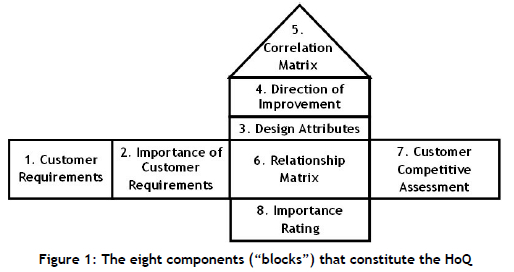
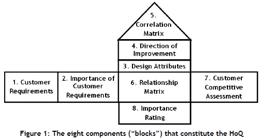
The house of quality (HoQ) forms part of a broader product development technique called the quality function deployment (QFD) [11]. The main purpose of QFD is to obtain accurate customer requirements and to convert them into specific design specifications to make a final product or service that most accurately fulfils the specified customer requirements. Essentially, QFD turns the "voice of the customer" into the "voice of the engineer or designer" [11]. There are eight different components (or "blocks") that constitute the HoQ [12], as seen in Figure 1.
3.1.1. House of quality blocks
Block 1: Customer requirements. This block represents the "voice of the customer" [11].
Block 2: Importance of customer requirements. Here, the customer requirements are ranked according to their importance to the customer [12]. This ranking could be achieved through numerous calculation methods, depending on the researcher's choice and the desired outcome.
Block 3: Design attributes. This block highlights appropriate design attributes that satisfy each customer requirement [13].
Block 4: Direction of improvement. Here, it is indicated whether it is favourable for a particular design attribute to be maximised or minimised [12]. Upward and downward facing arrows are typically used to indicate maximisation or minimisation respectively.
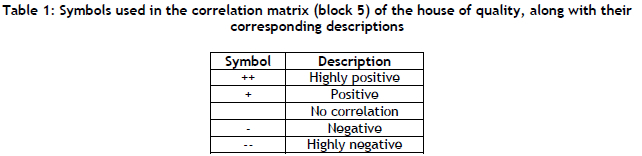
Block 5: Correlation matrix. Each cell in this matrix is a measure of how correlated two design attributes are [13]. To simplify the cell entries, each description is given a corresponding symbol, shown in Table 1. The motivation for symbol and description choice comes from the fact that the design attributes are either positively or negatively related to each other [12].
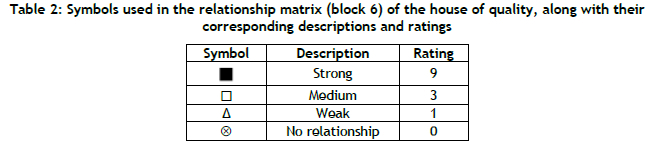
Block 6: Relationship matrix. Here, a relationship is created between the design attributes and the customer requirements. The literature recommends the use of a standard "9-3-1-0" strength relationship. This relationship was first successfully used for horse race betting at the Kobe Shipyards in 1972 [13]. This means that each symbol has a corresponding numerical value of 9, 3, 1 or 0, noting the relationship strength, as seen in Table 2.
Block 7: Customer competitive assessment. Typically, in the product development sector this section of the HoQ is used to compare various competitors' designs to see which one best serves the customer requirements [13].
Block 8: Importance rating. These ratings demonstrate the relative measure of importance of the customer requirements and design attributes to the overall product development (or service delivery) [13]. The importance ratings are invaluable, as they inform the engineers and designers of the most desirable design attributes and customer requirements for their product or service [12]. For this study, the importance ratings indicated which design attribute would be most necessary to maximise and perfect so that the most valued customer requirements could be met. These importance ratings could be achieved through numerous calculation methods, depending on the researcher's choice and the desired outcome.
4. METHODOLOGY
In this study, "the customer" refers to the main stakeholders that would be invested in the multi-level parking facility. The stakeholders' input for the prospective parking facility would be invaluable, as they would be most affected by its implementation. They would also be the ones using the product/service, thereby determining its success or failure. The HoQ, therefore, becomes an ideal tool to use, as it promotes satisfying customer requirements through appropriate design attributes to optimise the product or service. The HoQ also has a customer competitive assessment section, which could be used to compare different parking location options to suggest the most appropriate option for the desired multi-level parking facility.
4.1. House of quality blocks for the multi-level parking facility
4.1.1. Block 1: Customer requirements
The four main customer requirements for a parking facility, identified in section 2, are the following:
1 The price of the parking facility;
2 The safety of the parking facility;
3 The proximity of the parking facility to the drivers' destination; and
4 The availability of spaces in a parking facility.
4.1.2. Block 2: Importance of customer requirements
For the purpose of this study, the importance ratings were achieved using multi-attribute value theory (MAVT). MAVT recognises that different attributes should be assigned varying degrees of importance [14]. Therefore, it allows alternative options to be compared fairly by assigning different weightings to the various attributes [14]. For example, if safety is the most valued customer requirement, it should be allocated a higher weighting. The MAVT formula can be seen in Equation 4.1:

where W=weighted sum of all attributes, n=total number of attributes to be summed, Wi=the weight applied to the ith attribute and x¡=the ith attribute in the list of total terms [15].
4.1.3. Block 3: Design attributes
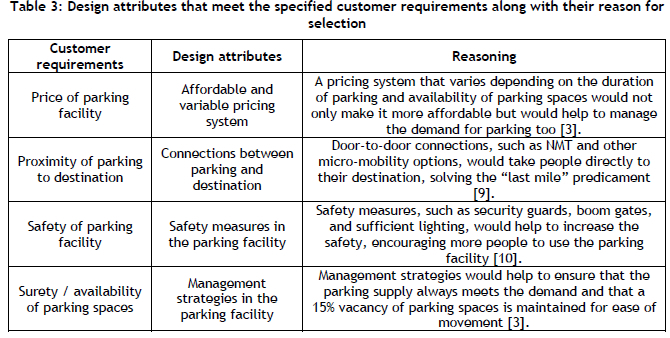
The design attributes are obtained using a combination of the literature reviewed in section 2 and logical inferences. The design attributes and reasons for selection are presented in Table 3.
4.1.4. Block 4: Direction of improvement
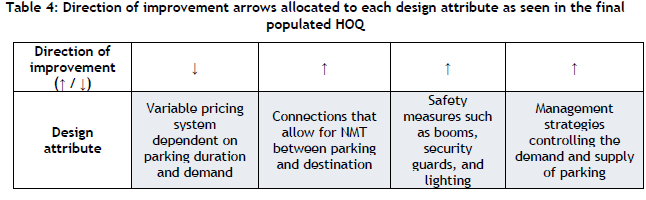
An upward facing arrow indicates that the design attribute should be maximised, while a downward facing arrow indicates that it should be minimised. Through logical inference about what would most benefit the potential customer, it is clear that the variable price of the parking facility should be minimised (or at least made affordable), while the NMT connections between the drivers' parking and destination, the safety of the parking, and the management strategies should all be maximised. These results are shown in Table 4.
4.1.5. Block 5: Correlation matrix
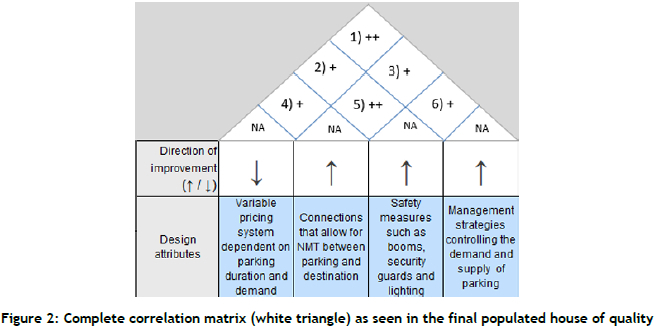
The symbols in Figure 2 are numbered for reference so that explanations for each entry in the correlation matrix can be provided below (according to the section 2 literature review and logical inferences):
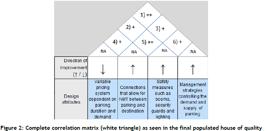
1 ++ = There is a highly positive relationship between the "variable pricing system" and "management strategies" of a parking facility. A variable pricing system is an example of an effective management strategy being used to control the demand in a parking facility. When the demand for parking is higher than that which the facility can handle, the pricing could be increased to deter drivers who are unwilling to pay increased prices [3].
2 + = There is a positive relationship between the "variable pricing system" and the "safety" of the parking facility. The literature reviewed in section 2 establishes that safety is of major importance to parking facility users, particularly females [7]. Therefore, if the safety of a parking facility increased, so too would the parking demand. This increase in demand would then affect the variable pricing system, which would change to ensure that the parking demand always matched the supply [3].
3 + = There is a positive relationship between the "connections" from drivers' parking locations to their destinations and the "management strategies" used in a parking facility. Section 2 demonstrated that NMT is a possible solution for the "last mile" problem that leaves people stranded at the first and last mile of their journeys [10]. Therefore, having door-to-door connections for drivers to travel between their parking spaces and destinations (ie. the last mile) may lead to more use of that particular parking facility. This increased demand creates more of a need for management strategies in the parking facility [3].
4 + = There is a positive relationship between a "variable pricing system" and the "connections" between drivers' parking location and destinations. It was proved in point 3 (above) that, if people were provided with safe and adequate connections between their parking and destinations, they would be more willing to use the parking facility. This would increase the demand for parking, thereby increasing the need for a variable pricing system to ensure that the parking demand and supply remained balanced [3].
5 ++ = There is a highly positive relationship between the "safety" of a parking facility and having sufficient "connections" between drivers' parking location and destination. The literature reviewed in section 2 demonstrated that people would be more willing to use NMT to get to their destinations if there were safe connective routes [10].
6 + = There is a positive relationship between the "safety measures" and the "management strategies" of a parking facility. Safety is a top priority for parking users [7]. Therefore, using safety features would increase the parking demand, creating a greater need for management strategies in the parking facility [3].
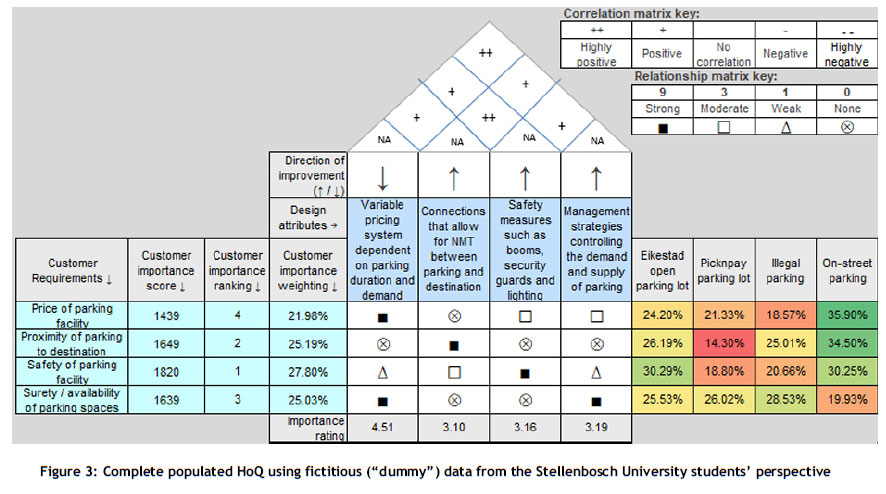
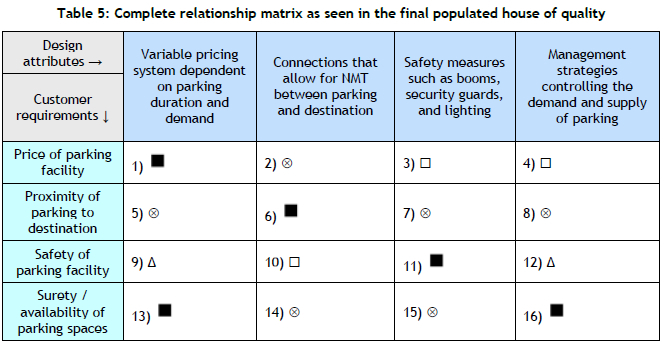
The symbols in Table 5 are numbered for reference so that explanations for each entry in the relationship matrix can be provided below (according to the section 2 literature review and logical inferences):
1 ■ - There is a strong relationship between the "price" and a "variable pricing system" in a parking facility. The variable pricing system directly influences the customer requirement of having a reasonable/affordable price for parking.
2 x - The "price of parking" has no relationship with the "connections" between drivers' parking location and destination.
3 □ - There is a medium relationship between the "price of parking" and "safety measures" as a design attribute. If a parking facility became safer, demand for parking would likely increase, and a variable pricing system would need to react accordingly to control the demand [3].
4 □ - A medium relationship exists between the "price of parking" and "management strategies" in a parking facility. The price of parking could be used as a management strategy to control the demand for parking
5 x - The "proximity of [the] parking" to drivers' destinations has no relationship with a "variable pricing system" used in a parking facility.
6 ■ - There is a strong relationship between the "proximity of [the] parking" to the drivers' destination and providing "connections" that allow for NMT between the drivers' parking and their destination. As the distance between drivers' parking and their destination increases, the need for safe and efficient connections between the two locations becomes greater.
7 x - There is no relationship between the "proximity of [the] parking" to the drivers' destination and the "safety measures" in a parking facility.
8 x - The "proximity of [the] parking" to the drivers' destination has no relationship with the "management strategies" used in a parking facility to control demand.
9 Δ- A weak relationship exists between the "safety" and a "variable pricing system" of a parking facility. Demand for parking would increase as a parking facility became safer. A variable pricing system would then be needed to control this increase in demand.
10 □ - Drivers are more inclined to use NMT if there are safe connections between their parking and their destinations [10]. Therefore, the "safety of [a] parking facility" has a medium relationship with the use of NMT "connections" between drivers' parking and their destinations.
11 ■ - A strong relationship exists between the "safety of [the] parking facility" and the implementation of "safety measures". These design attributes are specifically used to meet the customer requirement of having a safe parking facility.
12 Δ - There is a weak relationship between the "safety" and the "management strategies" of a parking facility. The safer a parking facility is, the greater the demand for parking, which creates a need for management strategies in the parking facility.
13 ■ - A strong relationship exists between the "surety/availability of parking spaces" in a facility and a "variable pricing system" based on demand. A variable pricing system could be used to manage the availability of parking spaces [3]. When demand is too high, the price for parking should increase to deter drivers who are unwilling to pay increased prices. This ensures that the parking supply always matches the demand.
14 x - The "surety/availability of parking spaces" has no relationship with the "connections" that allow for NMT between drivers' parking and their destination.
15 x - There is no relationship between the "surety/availability of parking spaces" and the "safety measures" adopted in a parking facility.
16 ■ - A strong relationship exists between the "surety/availability of parking spaces" and the "management strategies" used in parking facilities. Management strategies are used specifically to control the availability of parking spaces and to ensure that the parking supply always meets the demand [3].
4.1.6. Block 7: Customer competitive assessment
Four parking locations (three more than the initial location suggested by the municipality) have been identified to be sufficient to ascertain which option would best satisfy customers' needs. The results from this comparison would then be presented in this block of the HoQ.
4.1.7. Block 8: Importance rating
The MAVT formula (Equation 4.1) and principles were applied in this block to calculate the overall importance ratings, considering the different attributes with varying weightings.
5. FINDINGS AND CONCLUSIONS
5.1. Application of the house of quality
To demonstrate the potential application of the HoQ as an evaluation tool, fictitious ("dummy") data was used in this study to populate the HoQ. This approach highlighted how the HoQ could effectively assess multiple options. In future studies, the HoQ could be used to compare different products or services in order to determine the most suitable choice. Similarly, for projects aiming to optimise a product or service to meet customer needs better, the HoQ would be highly applicable. It would also be useful in identifying which aspects of a product or service were most valued by customers.
The results of this study (shown in Figure 3) confirm that the HoQ is not confined to a single research field. Its versatility allows it to be used in various sectors. For example, a 2017 study by Yendery Ramirez applied the HoQ as a tool to evaluate saltwater pretreatment technologies [16]. The tool helped to identify critical customer requirements related to water quality and technology characteristics, while also comparing different pretreatment methods to determine which option best met the customers' needs [16].
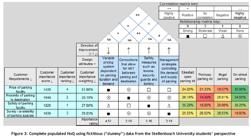
Although the HoQ is traditionally used in product development to refine designs based on customer requirements [13], its application in this study - to analyse and compare parking facilities - is novel. This is a unique use of the product development technique to evaluate the delivery of a service, namely parking provision. As long as customer requirements can be translated into corresponding design attributes, the HoQ remains a valuable evaluation tool for identifying optimal solutions. The work presented in this study demonstrates the HoQ's effectiveness and contributes to the broader body of knowledge.
6. RECOMMENDATIONS FOR FUTURE WORK
6.1. Considerations for data collection
In future work, online user preference surveys could be used to obtain true data from the three identified stakeholders. The collected survey data could then be used to replace the fictitious ("dummy") data used in this study and to populate an HoQ for each stakeholder. It is expected that the HoQs for each stakeholder would vary depending on their specific requirements. For example, SU students might demand an affordable price for the parking facility, as the majority of them do not earn an income, whereas the municipality might value the safety of the parking facility, as it is in their best interest to have a safe town. In contrast, Stellenbosch's residents might value having a close proximity between their parking and their destinations for convenience and ease. The three stakeholders might also favour different parking locations for the potential multi-level parking facility, as they would have varying requirements, demographics, and socioeconomic stances. Therefore, the competitive analysis section of the HoQ might also differ between the three stakeholders. However, what would remain the same between the different stakeholders' HoQs would be the structure, layout, and presentation.
6.1.1. Survey techniques
If surveys were to be used, important data analysis techniques would need to be considered. The first survey consideration is the method of sampling (or "selecting") the survey respondents, which would be either probability or non-probability sampling. Probability sampling randomly selects a sample group, whereas non-probability sampling involves non-random selection of a sample group [17]. Future work on this study would most likely use non-probability sampling, as the survey would have to be distributed among non-random groups of people (that is, the three specific stakeholder groups).
The second survey consideration is how it would be circulated. Two prominent methods could be used for this: purposive and snowball sampling. In purposive sampling, the sample group that best serves the study and is most representative of the target population is chosen [18]. The three main stakeholders would best serve the purpose of this study, which would make purposive sampling an accurate choice for circulating the survey during the future work. Snowball sampling involves recruiting participants through other participants [17]. That would work well for this study because of how interconnected the stakeholders are through online social media applications. As of 2025, WhatsApp could have groups with up to 1,024 online members [19]. Therefore, by initially spreading the survey to a few carefully chosen people who would then spread it in their respective WhatsApp groups, a snowball sampling effect could be created.
Another survey consideration is what type of questions to ask. Most surveys use Likert-type scale questions, which prompt survey respondents to indicate how strongly they agree or disagree with a statement or question. Likert scales are used in research when it is necessary to express people's attitudes in ordinal-level categories (e.g., agree or disagree) that are ranked along a continuum [20]. This would make Likert scales an obvious choice, as it would be necessary to obtain the stakeholders' stances on the multi-level parking facility.
REFERENCES
2. LITERATURE REVIEW
-
[1] WesternCapeGovernment, "The 2023 Socio-Economic Profile", 2023. [Online]. Available: https://dxp.westerncape.gov.za/treasury/files/wcg-blob-files?file=2025-03/stellenbosch-municipality-sep-lg-2023.pdf&type=file [Accessed 30 May 2025].
» https://dxp.westerncape.gov.za/treasury/files/wcg-blob-files?file=2025-03/stellenbosch-municipality-sep-lg-2023.pdf&type=file -
[2] AECOM, "Review of the Stellenbosch Comprehensive Integrated Transport Plan", 13 March 2023. [Online]. Available: https://stellenbosch.gov.za/download/review-of-the-stellenbosch-comprehensive-integrated-transport-plan-for-public-comment/?ind=1680160221231&filename=Stellenbosch-CITP-Activity-4-Final-Draft-2-Report-13-Mar-2023.pdf&wpdmdl=20734&refresh=692d1eb3e7ee51764 [Accessed 2 February 2025].
» https://stellenbosch.gov.za/download/review-of-the-stellenbosch-comprehensive-integrated-transport-plan-for-public-comment/?ind=1680160221231&filename=Stellenbosch-CITP-Activity-4-Final-Draft-2-Report-13-Mar-2023.pdf&wpdmdl=20734&refresh=692d1eb3e7ee51764 - [3] D. Shoup, "Parking on a Smart Campus: Lessons for Universities and Cities", UCLA: Luskin School of Public Affairs, nr. California Policy Options, pp. 117-149, 2005.
- [4] M. D. Esfahani, L.-W. Jun and T.-K. Lee, "Predicting open parking space using deep learning and support vector regression", in Association for Computing Machinery, New York, NY, USA, pp. 20-27, 2023.
- [5] M. Manville and D. G. Chatman, "Theory versus implementation in congestion-priced parking: An evaluation of SFpark", Research in Transportation Economics, vol. 44, pp. 52-60, 2014.
- [6] S. Biswas, S. Chandra and I. Ghosh, "Effects of on-street parking in urban context: A critical review", Transportation in Developing Economies, vol. 3, pp. 1-14, 2017.
- [7] S. B. Hassine, R. Mraihi and E. Kooli, "Drivers' parking choice behavior", in Proceedings of the 2019 International Colloquium on Logistics and Supply Chain Management (LOGISTIQUA), Montreuil -Paris, France, 2019.
- [8] World Energy Council, Global transport scenarios 2050, World Energy Council, London, 2011.
- [9] U. Mansoor, S. M. Rahman, F. Safi and M. T. Kashifi, "A review of factors and benefits of non-motorized transport: A way forward for developing countries", Environment, Development and Sustainability, vol. 24, pp. 1560-1582, 2021.
- [10] V. Shinde, O. Sonavane and S. Dadhich, "Study to shift from motorised to non-motorised transport: A case of Nashik City", E3S Web of Conferences, vol. 405, 02029, 2023.
-
[11] J. Hauser, "How Puritan-Bennet used the house of quality", Sloan Management Review, vol. 34, no. 3, pp. 61-70, 1993. Available: https://mitsloan.mit.edu/shared/ods/documents?PublicationDocumentID=5951 [Accessed 20 May 2025].
» https://mitsloan.mit.edu/shared/ods/documents?PublicationDocumentID=5951 -
[12] IONOS, "HOQ: House of quality", IONOS Digital Guide, 13 July 2020. [Online]. Available: https://www.ionos.co.uk/digitalguide/online-marketing/web-analytics/house-of-quality-hoq/ [Accessed 16 May 2025].
» https://www.ionos.co.uk/digitalguide/online-marketing/web-analytics/house-of-quality-hoq/ - [13] K. Yang and B. El-Haik, "Design for six sigma: Roadmap to product development", 2nd ed, McGraw-Hill, 2008.
-
[14] FasterCapital, "Multi attribute utility theory: MAUT: Evaluating alternatives: The power of MAUT in decision analysis", 2 April 2025. [Online]. Available: https://fastercapital.com/content/Multi-Attribute-Utility-Theory--MAUT---Evaluating-Alternatives--The-Power-of-MAUT-in-Decision-Analysis.html [Accessed 5 June 2025].
» https://fastercapital.com/content/Multi-Attribute-Utility-Theory--MAUT---Evaluating-Alternatives--The-Power-of-MAUT-in-Decision-Analysis.html -
[15] C. Kolmar, "How To Calculate Weighted Average (With Examples)", Zippia, 29 August 2022. [Online]. Available: https://www.zippia.com/advice/how-to-calculate-weighted-average/ [Accessed 16 May 2025].
» https://www.zippia.com/advice/how-to-calculate-weighted-average/ - [16] Y. Ramirez, L. A. Cisternas and A. Kraslawski, "Application of house of quality in assessment of seawater pretreatment technologies", Journal of Cleaner Production, vol. 148, pp. 223-232, 2017.
-
[17] S. McCombes, "Sampling Methods! Types, Techniques & Examples", Scribbr, 19 September 2019. [Online]. Available: https://www.scribbr.com/methodology/sampling-methods/ [Accessed 20 May 2025].
» https://www.scribbr.com/methodology/sampling-methods/ - [18] A. de Vos, H. Strydom, C. Fouché en C. and Delport, Research at Grass Roots: For the Social Sciences and Human Service Professions, Pretoria: Van Schaik, 2011.
-
[19] Meta, "Help Center: faq Whatsapp", 2025. [Online]. Available: https://faq.whatsapp.com/7179561392143247/?cms_platform=web [Accessed 16 May 2025].
» https://faq.whatsapp.com/7179561392143247/?cms_platform=web - [20] W. Neuman, Social Research Methods: Qualitative and Quantitative Approaches, Allyn and Bacon, 2000.
ORCID® identifiers
B.C.M. Hughes
https://orcid.org/0009-0009-6874-4210
C.B. Visagie
https://orcid.org/0009-0001-7773-5983