Enhancing Facility Reliability with Backup Options and Budget Constraints
Abstract
This study considers facility failures in supply chain networks in which facilities must be located at candidate sites to serve customers. To enhance reliability, we incorporate backup options and a limited fortification budget. Customers assigned to fortified facilities do not require backup, while those assigned to unfortified ones do. The problem is formulated as a linear integer model and solved using Lagrangian relaxation. The relaxed model yields a variant of the binary knapsack problem, addressed through a novel solution method. The proposed approach achieves an average optimality gap of 0.1% with a computational time of 20 seconds.
Abstract
Hierdie studie ondersoek fasiliteitsfalings in voorsieningsketting netwerke waarin fasiliteite by kandidaatliggings geplaas moet word om kliënte te bedien. Om betroubaarheid te verhoog, word bystandsopsies en 'n beperkte versterkingsbegroting ingesluit. Kliënte wat aan versterkte fasiliteite toegewys word, benodig nie bystand nie, terwyl kliënte wat aan onversterkte fasiliteite toegewys word, wel bystandsopsies benodig. Die probleem word as 'n lineêre heeltallige model geformuleer en met behulp van Lagrange-ontspanning opgelos. Die ontspanne model lewer 'n variant van die binêre knapsakprobleem, wat deur middel van 'n nuwe oplossingsmetode hanteer word. Die voorgestelde benadering behaal 'n gemiddelde optimaliteitsgaping van 0.1% met 'n berekeningstyd van 20 sekondes.
1. INTRODUCTION
In today's dynamic market environment, organisations are increasingly enhancing the operational effectiveness of their supply chain networks to sustain competitive advantage. These networks are pivotal to efficiently delivering products and services from suppliers to end consumers, aligning with modern trade requirements. By optimising these networks, organisations aim to meet consumer expectations, reduce costs, and enhance profitability by adopting supply chain management principles. According to Daskin et al. [1], supply chain management extends beyond mere logistics, encompassing critical areas such as facility location, production, inventory management, and information exchange. Ganeshan and Harrison [2] also emphasised the significance of these decisions, highlighting their role in shaping supply chain efficiency. The strategic placement of facilities, such as manufacturing centres and warehouses, significantly influences production, transportation, and inventory decisions in these networks.
Among these decisions, facility location stands out as the cornerstone of supply chain management, representing a long-term strategic decision made during network design. Optimal facility placement not only enhances transportation efficiency and minimises inventory levels but also optimises the production processes throughout the network. However, traditional network design models often assume uninterrupted facility operations and overlook vulnerabilities to disruption and failure. In response, organisations commonly resort to reactive strategies, deploying alternative facilities located at a distance, which is both costly and inefficient. A proactive approach to enhance supply chain reliability involves integrating reliability considerations into facility-location decisions during the design phase. Two primary research streams could achieve this: deploying backup facilities, which are alternative facilities assigned to serve demand when a primary facility fails; and fortifying critical facilities, which refers to investing protective resources in selected facilities to reduce their probability of failure during disruption events.
This study addressed the difficulty of designing a reliable supply chain network under budget constraints for facility fortification. Specifically, it considers a scenario in which vulnerable facilities could be located at candidate sites to serve demand points. Owing to budget limitations, some facilities remain unfortified, necessitating the assignment of their demand points to backup facilities. The goal is to determine the optimal number and placement of open facilities, to decide which ones should be fortified, and to allocate demand points effectively among fortified and unfortified facilities. To address this problem, we propose a novel linear integer programming model that integrates facility location decisions with reliability considerations. Unlike previous studies, which often used complex nonlinear formulations, our approach simplifies the problem formulation while ensuring high-quality solutions using the Lagrangian relaxation procedure. This is an optimisation technique that relaxes selected constraints and incorporates them into the objective function using penalty multipliers to simplify large-scale integer programmes [3]. Furthermore, the relaxed problem is a variation of the binary knapsack problem, for which we develop an efficient solution procedure to achieve optimal solutions with reasonable computation times.
The remainder of this paper is structured as follows: Section 2 provides a comprehensive review of the literature; Section 3 introduces the necessary notation; Section 4 outlines the problem and its assumptions; Section 5 presents our proposed model formulation; Section 6 details our solution approach; Section 7 discusses the results; and Section 8 concludes the paper with implications and avenues for future research.
This section discusses facility location models, with a particular focus on reliability - an essential factor in strategically placing facilities in supply chain networks to ensure the efficient delivery of products and services from suppliers to customers. The literature includes numerous studies that evaluate various models, their benefits, and extensions to support decision-making.
Daskin et al. (2004) examined healthcare facility planning models, emphasising the optimisation of healthcare centre placements to improve accessibility and service coverage [4]. In a subsequent study, Daskin et al. (2005) highlighted the critical role of facility placement decisions in supply chain management, exploring traditional models such as the fixed-charge facility location problem and its extensions, which incorporate robustness and reliability [1]. While robustness addresses uncertainties in demand and costs, reliability focuses on mitigating risks such as facility failures to ensure continuity and resilience in supply chain operations.
Classical network design models often neglect potential disruptions, assuming uninterrupted facility operations. As a result, organisations are frequently forced into reactive and costly deployments of alternative facilities at distant locations, which might be ineffective in mitigating risks. A more proactive approach involves integrating reliability considerations into the facility location decision process from the outset. Shi et al. (2024) demonstrated that implementing resilient supply chain strategies can significantly reduce the ripple effects of disruptions - such as capacity losses and production cost fluctuations - thereby lowering total costs and improving operational reliability [5].
Recent research on disruption-aware facility location models focuses on two primary strategies: increasing facility availability through redundancy and backup facilities, and fortifying critical facilities in the supply chain network. Alazemi et al. (2025) contributed to this domain with a flexible facility location model that allows each demand point to be assigned to a primary facility along with up to two backup facilities [6]. Their large-scale integer programming formulation accounts for simultaneous facility failures and lost sales costs, achieving near-optimal solutions (within a 0.11% optimality gap) using Lagrangian relaxation. Their analysis indicated that a two-backup configuration would offer an optimal balance, achieving 99.2% service reliability without the added complexity and diminishing returns of three-backup models.
Other studies have explored similar strategies to address facility disruptions. For example, Snyder et al. (2005) and Hamdan et al. (2024) examined customer allocation to primary and backup facilities to minimise failure costs while ensuring system resilience [7][8]. Lim et al. (2010) and Razan et al. (2024) developed models addressing facility reliability using mixed-integer programming and fixed-charge location approaches to optimise distribution centre placements and reliability levels [9][10]. Scaparra et al. (2007) and Li Qingwei et al. (2013) contributed by optimising protection resource allocation and designing reliable distribution networks under disruption scenarios, using models such as the reliable P-median and reliable uncapacitated fixed-charge facility location problems [3][11]. Additional studies are Ratnayake et al. (2020), who focused on fortifying warehouse facilities in flood-prone areas, and Monzón et al. (2020), who optimised humanitarian logistics for disaster response efficiency [12][13].
Further, the concept of fortification strategies for improving network resilience has been widely explored. For instance, Costa et al. (2024) proposed a framework for network resilience optimisation by introducing the RES-OPT problem, which fortifies systems through immunisation and mitigation strategies to prevent or minimise disruption impacts while controlling costs [14]. Similarly, Saffarinia et al. (2025) presented an integrated model for locating backup facilities during flood disasters, leveraging the conditional value at risk measure to reduce costs and enhance resilience [15]. Their findings underscored the value of combining backup facilities with supportive strategies to improve supply chain reliability.
Alavi et al. (2024) extended the resilience concept by proposing a tri-level optimisation model for facility location protection, integrating design and redesign decisions under disruption [16]. This model takes a multi-level approach to optimise facility placement and fortification. Harnnarong and Boonperm (2024) investigated the two-level capacitated facility location problem under disruption and fortification, proposing an integer nonlinear programming model that enhances resilience through targeted fortification within a fixed budget [17]. Mohammadi and Gheidar-Kheljani (2024) introduced a multi-objective stochastic model for designing resilient supply chains by considering disruption risks, fortification budgets, and backup suppliers [18]. Their model showed how integrating uncertainty, outsourcing, and fortification strategies improves resilience in complex product systems. Starita and Scaparra (2022) explored strategic protection investment to improve supply system reliability under random disruptions, applying their model to hospital networks to inform resource distribution during crises [19]. Najafi-Ghobadi and Sherafati (2022) also contributed with a Lagrangian relaxation algorithm for solving reliable location-inventory models, focusing on both proactive fortification and reactive backup strategies [20].
Unlike previous studies that often use complex nonlinear formulations, our approach simplifies the problem while maintaining solution quality through Lagrangian relaxation. In addition, the relaxed problem results in a variation of the binary knapsack problem, for which we propose an efficient solution procedure. This approach offers a practical and computationally efficient method for solving facility location problems with embedded reliability considerations.
NOTATIONI set of demand points indexed by i.
J set of candidate sites indexed by j and k
fj fixed cost of locating a facility at a candidate site j.
cij transportation cost from a facility located at a candidate site j to customer i.
μi annual demand of customer i.
qj probability of failure associated with a facility at candidate site j.
Aj fortification cost function of a facility located at a candidate site j.
B fortification budget.
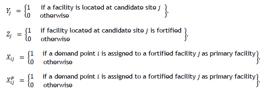
DECISION VARIABLES:

3. PROBLEM STATEMENT
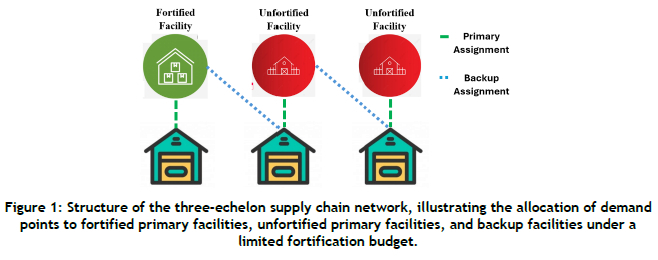
In this study, we consider finding the optimal locations for facilities in the supply chain network when fortification budgets are limited. Specifically, we consider a three-echelon supply chain network consisting of a set of candidate facility sites and a set of demand points. At each candidate site, we can locate a facility that is vulnerable to failure to meet the demands of a set of customers. Given the limited fortification budget, some facilities are fortified, while others remain unfortified. Customers primarily assigned to a fortified facility do not require additional allocation to a backup facility, whereas customers primarily assigned to an unfortified facility do require such allocation. Figure 1 illustrates the relationship in the three-echelon supply chain system, and emphasises the structure of the problem - specifically, the allocation of demand points to primary and secondary distribution centres.
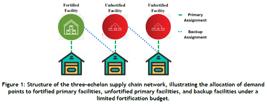
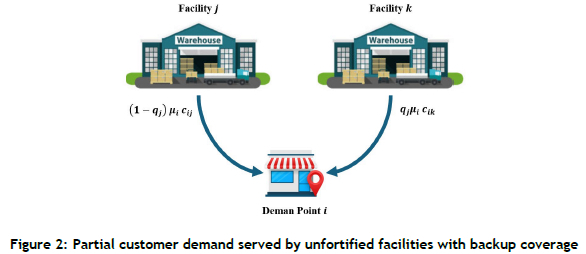
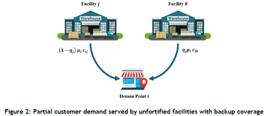
Let m represent the number of candidate sites and n represent the number of demand points indexed by j and i respectively. Facilities are vulnerable to failure with probability qj, and the cost of locating a facility at candidate site j is equal to fj. Facilities can be fortified with a limited fortification budget B, and the fortification cost for each facility follows a linear function of its failure rate as follows: Aj = a + b qj, where a and b are constants. Only a fortified facility can meet the entire customer demand μi that it primarily serves. In contrast, an unfortified facility primarily serves a portion of customer demand, (1 - qj)μi, with a backup facility of any type fulfilling the remaining portion, qj μi (see Figure 2).
4. MODEL FORMULATION
The problem of a reliable facility location with a limited fortification budget is formulated as a linear integer, as follows:

subject to
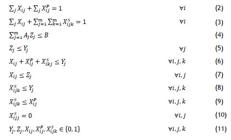
The objective function presented in (1) minimises the overall cost by considering facility location and transportation costs from primary and backup facilities. The term ∑j=1m fj Yj represents the cost of opening a facility. The second term ∑i=1n ∑j=1m cij μi Xij and the third term ∑i=1n ∑j=1m (1 - qj) cij μi XPij respectively represent the transportation cost to demand points from primarily fortified and unfortified facilities. The final term ∑i=1n ∑j=1m ∑k=1m qj cik μi XSijk represents the transportation cost for the remaining demand, which is fulfilled by backup facilities when the demand points are only partially served by unfortified facilities.
The first set of constraints (2) assigns each demand point to a primary facility that is either fortified or unfortified. Similarly, the second set of constraints (3) ensures that, if a demand point is already allocated to a primarily fortified facility, it does not need to be allocated to a backup facility; otherwise, it is allocated to one backup facility. Budget constraint (4) guarantees the fortification of facilities within the available budget. A fortified facility must be an operating facility, as shown by the set of constraints in (5). Constraint (6) guarantees that a fortified primary facility, an unfortified primary facility, or a backup facility serves the demand point. The sets of constraints (7), (8), and (9) are the linkage constraints. Constraint (10) guarantees that the same facility cannot serve a given demand point as a primary and a backup facility simultaneously. Finally, the set of constraints in (11) is binary constraints.
5. SOLUTION PROCEDURE
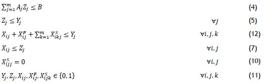
The solution procedure begins by adding redundant constraints to strengthen the model and to improve the solution. According to Chardaire et al. (1999) and Hamdan et al. (2024), such constraints tighten the gap between the upper and lower bounds [21][8]. Therefore, we have replaced the sets of constraints (6), (8), and (9) with the sets of constraints (12)-(14). The final model formulation is as follows:

subject to
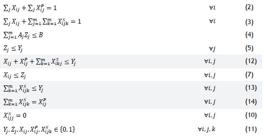
By replacing redundant constraints, the complexity of the model is significantly reduced in respect of the number of constraints. For example, in the original model, with 200 demand points and 30 candidate site locations, there are typically 552,431 constraints. However, in the revised model, this number decreases to 30,431 constraints, representing a 94.5% reduction in the number of constraints.
The final model of the reliable facility location with a limited fortification budget is solved effectively by developing a Lagrange relaxation algorithm. This algorithm operates by determining the lower and upper bounds for the optimal solution, as shown in the subsections that follow.
5.1. Finding a lower bound:
Obtaining a lower bound begins by relaxing the sets of constraints in (2), (3), (13), and (14). Thus, we obtain the following Lagrange problem:
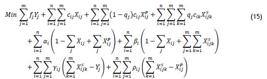
The objective function can be written as follows:
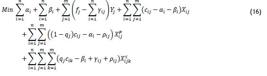
The model can be further simplified as follows:

subject to
where
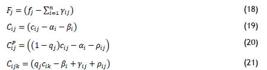
To approach the solution of the model better, we can redefine the variable as Yj = YFj + YUj, where YFj and YUj respectively represent whether a fortified or an unfortified facility is located at site j. Here the relaxation problem can be reformulated using the following approach:

where
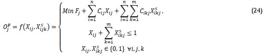
The first sub-problem for each fortified facility at candidate site j is defined as
and the second sub-problem for each unfortified facility at candidate site j is defined as
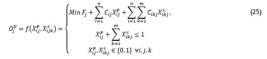
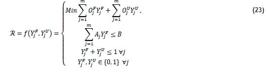
To obtain the lower-bound solution for the Lagrange problem (22), the two sub-problems (24) and (25) need to be solved first. Each of these sub-problems is solved using the following proposition:
Proposition: if Xij, Xijk ∈; {0, 1} ∀ i, j, k, then the following optimisation problem:
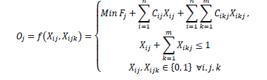
is simplified as follows:
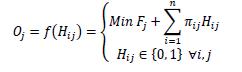
where
πij = mink { Cij, Cijk }.
Proof: Given the constraint that, at most, one variable Xij, and Xijk can be selected for each customer i, and that these decision variables are binary variables, the optimal minimum objective can be obtained by selecting the variable with the minimum objective coefficient (i.e., πij = mink { Cij, Cijk }) and πij < 0. □;
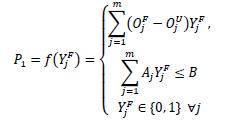
The solutions of the two sub-problems (24) and (25) are obtained and then used as input to the special-case knapsack problem (23), which is eventually used to obtain the lower-bound solution for the Lagrange problem (22). The special-case knapsack problem (23) is a 0-1 knapsack problem with additional constraints that consider a variation of the binary knapsack problem (BKP). This sub-problem is solved using the following theorem:
Theorem: There is an optimal solution (Z*, Y*) to problem R, in which the following properties hold:
YF*j = 0, if OFj ≥ 0, and YU*j = 0, if OUj ≥ 0 ∀ j.
Define OUj = 0 if OUj ≥ 0.
The optimal solution YF*j is obtained by solving the following binary knapsack problem P1:
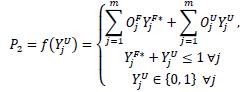
Then, the optimal solution YU*j is obtained by solving the following problem P2:
Proof: To complete the proof, let us explicitly outline the steps for both cases when solving problem R.
Case 1: Unlimited budget constraint (B = ∞)
When the budget constraint is unlimited, the original problem R is equivalent to sub-problem P2.
Optimal solution for Z*j:
Set YF*j = 1 if OFj ≤ OUj, and OFj < 0 ∀ j.
Set YF*j = 0 otherwise.
This means that YF*j is chosen to include the fortified facility j where OFj (the benefit for including in Y) is less than or equal to OUj (the benefit for including in Y), and OFj is negative, indicating its contribution to the objective function.
Optimal solution for YU*j:
Set YU*j = 1 if OUj ≤ OFj, and OUj < 0 ∀ j.
Set YU*j = 0 otherwise.
This means that YU*j is chosen to include the unfortified facility j where OUj (the benefit for including in Y) is less than or equal to OFj (the benefit for including in Y), and OUj is negative.
Case 2: Unlimited budget constraint (B < ∞)
When the budget constraint is limited, the original problem R is not equivalent to P2. Therefore, in the optimal solution (YF*, YU*) of the original problem R, the following must hold for a given jth variable:
Case OFj < 0, OUj < 0, and OUj ≤ OFj:
Set YF*j = 0 and YU*j = 1.
Case OFj < 0, OUj < 0, and OFj ≤ OUj:
Exactly one of YF*j and YU*j must equal 1.
If YF*j = 0, then YU*j = 1.
To set YF*j = 1, OFj must be less than or equal to OUj. Not only must OFj ≤ OUj, but it should contribute more to the objective function than other variables. This contribution was measured using the OFj - OUj.
Case OFj ≥ 0 and OUj ≥ 0:
Set YF*j = 0 and YU*j = 0.
Case OFj ≥ 0 and OUj < 0:
Set YF*j = 0 and YU*j = 1.
Case OFj < 0 and OUj ≥ 0:
Set YU*j = 0.
YF*j to be decided by the knapsack problem, either 0 or 1, based on its negative contribution OFj to the objective function compared with other variables. To calculate the incremental contribution OFj - OUj, we set OUj to zero if OUj ≥ 0.
In cases 2 and 5, the value of the variable is YF*j decided by the knapsack problem, either 0 or 1, based on its incremental negative contribution OFj - OUj to the objective function compared with other variables. Then, solve the knapsack problem P1 to determine YF*j, based on its incremental negative contribution OFj - OUj to the objective function. Subsequently, the results from solving P1 are used as the input to solve problem P2 to obtain the value of YU*j in the original problem R. □
Therefore, the optimal solution of the relaxed problem for fixed values of Lagrange multipliers can be obtained using the following procedure:
Step 1: Compute the values of Fj, Cij, CPij, and Cijk using equations (18) to (21) for each pairing of demand point i and candidate site location j.
Step 2: Compute the values of πij = mink { Cij, Cijk } for each combination of demand point i and candidate site location j, considering both fortified and unfortified facility options.
Step 3: Obtain the value of OFj for each candidate site location j by solving sub-problem (24).
Set HFij = 1 if πFij ≤ 0.
Set HFij = 0 otherwise.
Step 4: Obtain the value of OUj for each candidate site location j by solving sub-problem (25).
Set HUij = 1 if πUij ≤ 0.
Set HUij = 0 otherwise.
Step 5: Set OUj = 0, if OUj ≥ 0.
Step 6: Solve the binary knapsack problem (i.e., sub-problem P1) using a dynamic programming algorithm [22].
Step 7: Using the results from step 4, solve sub-problem P2 to obtain the solution to problem R (23).
Step 8: Obtain the lower-bound solution in equation (22).
The lower-bound procedure is solved iteratively to obtain the maximum lower bound for the optimal solution. Therefore, the Lagrange multipliers αi, βi, ρij, and γij are updated in each iteration using the following equations, as illustrated by Fisher (1985) [23]:
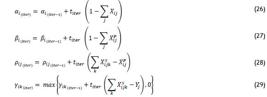
The following sub-gradient equation is used to calculate the step size titer.

where the scalar τ is initialised as 2 and then updated using the following equation [24][21]:

5.2. Finding an upper bound
At each iteration of the Lagrange relaxation procedure, the lower-bound solutions, LB (ZLBj, YLBj, XLBij, XP,LBij, XS,LBijk), are tested for feasibility. If they satisfy the constraints of the original problem, the optimal solution is obtained. Otherwise, a feasible solution (i.e., an upper bound solution, UB (ZUBj, YUBj, XUBij, XP,UBij, XS,UBijk)) is constructed from the current lower bound using the following procedure:
Step 1: Set ZUBj = ZLBj, YUBj = YLBj, XUBij = 0, XP,UBij = 0, and XS,UBijk = 0.
Step 2: Compute ∑j YUBj,
If ∑j YUBj = 0, set YLB1 = 1, ZLB1 = 1, and XUBi1 = 1 ∀ i. Exit.
If ∑j YUBj = 1, search for j*, where YUBj* = 1. Set ZLBj* = 1, and XUBij* = 1 ∀ i. Exit.
If ∑j YUBj > 1, go to step 3.
Step 3: Find the most cost-efficient assignment for each demand point i to open facilities, including the primary assignment and backup assignment, as needed.
Step 4: Calculate the upper bound cost, UB. Exit.
6. EXPERIMENTAL RESULTS
Experiments were conducted to evaluate the performance of a reliable facility location model with limited fortification budget. Scenarios are generated on a compact area of {[0,100],[0,100]} with uniformly distributed data. Different problem sizes were created, including 20, 25, and 30 candidate sites (m) and 100, 150, and 200 customers (n), with annual demand uniformly distributed on the interval [50, 500]. Each problem size was replicated three times to ensure robustness.
To evaluate the impact of the facility failure rate (q) on the model performance, various upper limits on the facility failure rate were tested: 5%, 10%, 15%, 20%, and 25%. The failure rate for each facility was randomly generated within the specified upper limit. The fortification budget (B) was fixed at 5,000, and the facility fortification cost followed a linear function (K = a + b q) with parameters a = 400 and b = 5,000. The Lagrange relaxation procedure was coded in Matlab to solve the reliable facility location model with a limited fortification budget programme.
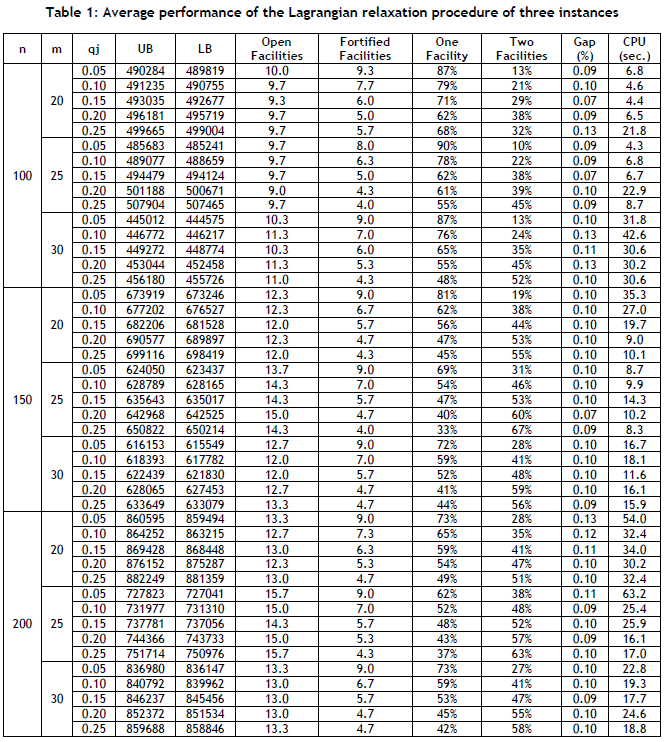
Table 1 reports the average performance of the solution procedure for the three instances for each combination of problem size and the upper limit of the facility failure rate. This includes the following metrics.
Average upper and lower bounds of the optimal solution.
Average number of open facilities.
Average number of fortified facilities.
Average percentage of demand points served by primary facility only.
Average percentage of demand points served by primary and backup facilities.
Average gap between the upper and lower bounds.
Average CPU times.
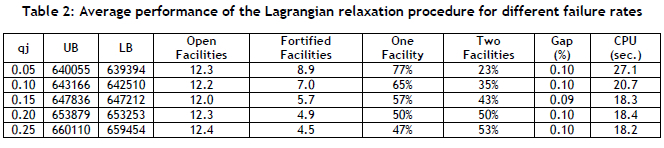
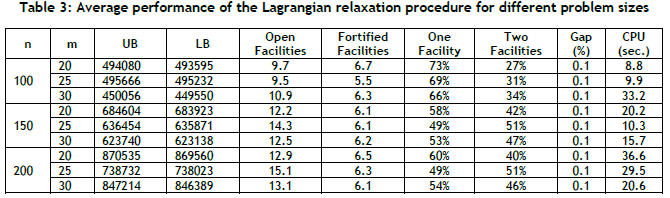
Similarly, Tables 2 and 3 present the average performance of the solution procedure for the upper limit of the facility failure rate and each combination of problem sizes respectively. Overall, the Lagrange relaxation procedure achieved an average gap between the upper and lower bounds of 0.1%, with an average CPU time of 20.5 seconds. The maximum average gap between the upper and lower bounds was 0.13%, and the maximum average CPU time was 63.2 seconds. In addition, the algorithm demonstrated consistent performance in respect of the average gap between the upper and lower bounds for various upper limits of the facility failure rate and each combination of problem sizes, as illustrated in Tables 2 and 3. However, the average CPU times maintained consistent performance for different upper limits of the facility failure rate, and generally increased as the problem size increased.
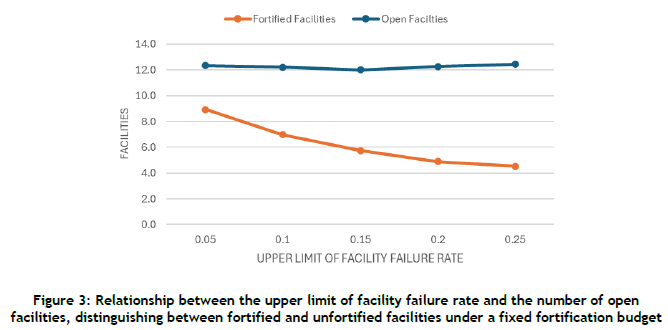
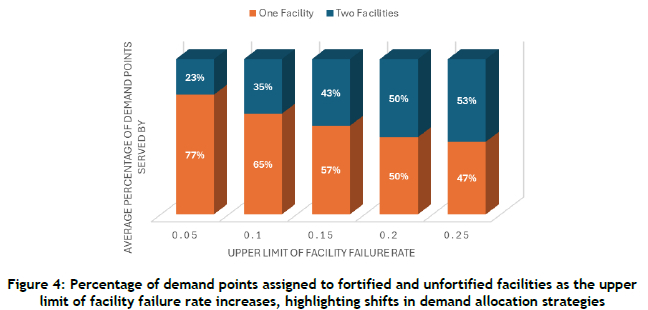
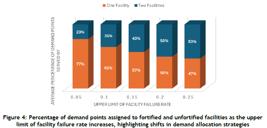
Figures 3 and 4 visually summarise how changes in the upper limit of facility failure rates influence fortification decisions and demand allocation patterns under budget constraints.
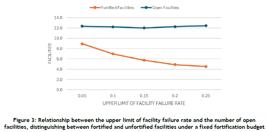
As shown in Figure 3, there is an inverse relationship between the average number of fortified facilities and the upper limit of the failure rate of the facility. As the upper limit of the facility failure rate increases, the average number of fortified facilities decreases. This trend arises because the cost of fortification of the facility follows a linear function of the failure rate and the available fortification budget is limited. In contrast, the average number of open facilities does not seem to be affected by the change in the upper limit of the facility failure rate because this change is accommodated by the options for allocating demand points for open facilities.
7. CONCLUSIONS AND FUTURE DIRECTIONS
A reliable facility location model with a limited fortification budget has been the primary focus of this study, which incorporates reliability considerations into the facility location problem. The model incorporates backup facilities and fortifies vital facilities to improve their availability in supply chain networks. This guarantees that demand points can be served by either fortified facilities or multiple facilities, thereby improving overall reliability. The model is formulated as a large-scale linear integer programme.
To enhance the efficiency of the model, complexity is substantially reduced by introducing redundant constraints, which leads to a 94.5% decrease in the number of constraints. Subsequently a novel solution algorithm is developed by using a Lagrangian relaxation procedure. In addition, a variation of the BKP is generated by the relaxed problem, for which an efficient optimal solution is proposed.
Testing on large-scale scenarios, such as 20, 25, and 30 candidate site locations and 100, 150, and 200 demand points, has demonstrated the effectiveness of the Lagrangian relaxation procedure. Within reasonable computation periods, the solution algorithm consistently delivers high-quality solutions. A notable finding is that, although changes in the upper bound of facility failure rates do not affect the average number of open facilities, they do have a noticeable effect on the allocation of demand points among these open facilities.
From a managerial perspective, the proposed model provides decision-makers with a structured framework for allocating limited fortification budgets while maintaining high levels of service reliability. The results enable supply chain managers to identify which facilities should be prioritised for fortification, where backup assignments are most critical, and how demand should be allocated in the face of facility failure risks. By explicitly linking fortification investment decisions to demand allocation outcomes, the model supports informed trade-offs between cost efficiency and resilience, making it particularly relevant for strategic supply chain design in disruption-prone environments.
To improve the model, it is possible to incorporate multiple levels of fortification rather than assuming that facilities are either fortified or not. This involves the classification of fortification into levels such as 'low', 'medium', and 'high', which enables the model to determine the most suitable level of protection for each facility on an individual basis. The model can also include a non-linear relationship that reflects the cost-effectiveness of fortification in relation to the facility failure rate. This acknowledges that the marginal benefit of fortification might decrease as protection levels increase because of diminishing returns or increased costs.
The current study adopts several simplifying assumptions to maintain computational tractability, including perfectly reliable backup facilities, a fixed fortification budget, and the use of synthetic data for numerical testing. While these assumptions allow the fundamental trade-offs between fortification and backup strategies to be examined clearly, future research might extend the model by incorporating correlated facility failures, capacity constraints, dynamic or multi-period fortification budgets, and empirical case studies based on real-world supply-chain data.
Another extension of the reliable facility location model with a limited fortification budget would be to incorporate other supply chain decisions such as inventory management, transportation mode selection, and production decisions. This integration would aim to maximise the overall system reliability and cost effectiveness of the supply chain networks. For instance, by incorporating inventory management decisions into reliable facility location problems, the model could improve facility reliability while simultaneously lowering inventory holding costs and stockout risks. Furthermore, the model might discover the most efficient and reliable transportation methods, optimise delivery routes between facilities and customers to reduce costs, and increase service levels by integrating transportation mode selection decisions. In addition, integrating production decisions would allow the model to maximise production capacity for all sites while considering fortification requirements. Integrating these aspects into the model would provide decision-makers with a comprehensive framework for optimising resource allocation, improving operational performance and enhancing overall supply chain resilience.
REFERENCES
ACKNOWLEDGEMENTS
This work was supported and funded by Kuwait University Research Grant No. EI02/24.
2. LITERATURE REVIEW
- [1] Daskin, M.S., Snyder, L.V. & Berger, R.T. 2005. Facility location in supply chain design. In: Langevin, A. & Riopel, D. (eds). Logistics systems: Design and optimization. Boston, MA: Springer, pp. 39-65.
- [2] Ganeshan, R. & Harrison, T.P. 1995. An introduction to supply chain management. Production and Operations Management, 4(3), pp. 1-10.
- [3] Li, Q., Zeng, B. & Savachkin, A. 2013. Reliable facility location design under disruptions. Computers & Operations Research, 40(4), pp. 901-909.
- [4] Daskin, M.S. & Dean, L.K. 2004. Location of health care facilities. In: Brandeau, M.L., Sainfort, F. & Pierskalla, W.P. (eds). Operations research and health care: A handbook of methods and applications. Boston, MA: Springer, pp. 43-76.
- [5] Shi, H., Ni, Y. & Yang, M. 2024. Resilient supply chain network design with proactive and reactive strategies under major disruptions. Journal of Industrial and Management Optimization, 20(10), pp. 3123-3147.
- [6] Alazemi, W., Alenezi, A. & Almutairi, J. 2025. Facility location model with up to two-backup facilities. International Journal of Operational Research. (Accepted for publication).
- [7] Snyder, L.V. & Daskin, M.S. 2005. Reliability models for facility location: The expected failure cost case. Transportation Science, 39(3), pp. 400-416.
-
[8] Hamdan, L. & Alenezi, A. 2024. Reliable location models with transportation mode selection (RLM TMS). International Journal of Industrial and Systems Engineering, 50(4), pp. 465-491. https://doi.org/10.1504/IJISE.2024.10063710
» https://doi.org/10.1504/IJISE.2024.10063710 - [9] Lim, M., Daskin, M.S., Bassamboo, A. & Chopra, S. 2010. A facility reliability problem: Formulation, properties, and algorithm. Naval Research Logistics, 57(1), pp. 58-70.
-
[10] Alenezi, R. & Alenezi, A. 2024. A multi-reliability facility location problem. International Journal of Logistics Systems and Management. https://doi.org/10.1504/IJLSM.2024.10065678
» https://doi.org/10.1504/IJLSM.2024.10065678 - [11] Scaparra, M.P. & Church, R.L. 2008. An exact solution approach for the interdiction median problem with fortification. European Journal of Operational Research, 189(1), pp. 76-92.
- [12] Monzón, J., Liberatore, F. & Vitoriano, B. 2020. A mathematical pre-disaster model with uncertainty and multiple criteria for facility location and network fortification. Mathematics, 8(4), 529.
- [13] Ratnayake, S.N. & Starita, S. 2020. Reliable supply chain network design and fortification. A case study on luxury fashion retail in Thailand. In: 2020 IEEE 7th International Conference on Industrial Engineering and Applications (ICIEA), pp. 447-453. IEEE.
- [14] Costa, A., Ng, T.S., Kang, J., Wu, Z. & Su, B. 2024. Modelling fortification strategies for network resilience optimization: The case of immunization and mitigation. IISE Transactions, 56(4), pp. 411-423.
- [15] Saffarinia, A., Barzinpour, F., Makui, A. & Fathi, M.R. 2025. An integrated model for locating backup facilities in flood disaster considering supportive strategies and conditional value at risk measures. Journal of Industrial and Management Optimization, 21(2), pp. 1300-1327.
- [16] Alavi, S., Bozorgi-Amiri, A. & Seyedhosseini, S.M. 2024. A tri-level optimization model for facility location-protection problem considering design and redesign decisions under disruption. Kybernetes, 53(10), pp. 3568-3590.
- [17] Harnnarong, D. & Boonperm, A.A. 2024. Two-level capacitated facility location problem under disruption and fortification. Asia-Pacific Journal of Science and Technology, 29(2), pp. 1-10.
- [18] Mohammadi, M. & Gheidar-Kheljani, J. 2024. A multi-objective stochastic model for designing a resilient supply chain network in complex product systems considering disruption risks. International Journal of Systems Science: Operations & Logistics, 11(1), 2402797.
- [19] Starita, S. & Scaparra, M.P. 2022. Improving supply system reliability against random disruptions: Strategic protection investment. Journal of the Operational Research Society, 73(6), pp. 1307-1324.
- [20] Najafi-Ghobadi, S. & Sherafati, M. 2022. Providing a Lagrangian relaxation algorithm to solve a reliable location-inventory model by considering disruption. Journal of Industrial Engineering and Management Studies, 9(1), pp. 49-62.
- [21] Chardaire, P., Lutton, J.L. & Sutter, A. 1999. Upper and lower bounds for the two‐level simple plant location problem. Annals of Operations Research, 86, pp. 117-140.
- [22] Bellman, R. 1957. Dynamic programming. Princeton, NJ: Princeton University Press.
- [23] Fisher, M.L. 1985. An applications oriented guide to Lagrangian relaxation. Interfaces, 15(2), pp. 10-21.
- [24] Alenezi, A.R. & Darwish, M.A. 2014. Integrated location model with risk pooling and transportation mode selection. International Journal of Industrial and Systems Engineering, 16(2), pp. 200-222.
Accepted for publication 28 Mar 2026
Available online 22 May 2026