An allocation model framework for a capacity-constrained port: a case for citrus exports at the port of Durban
Abstract
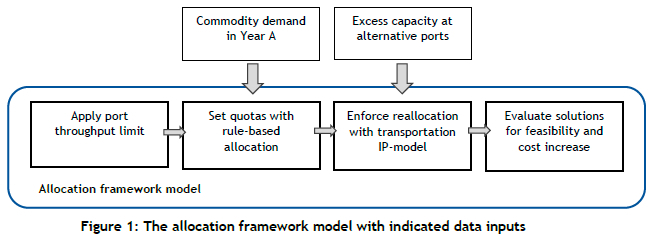
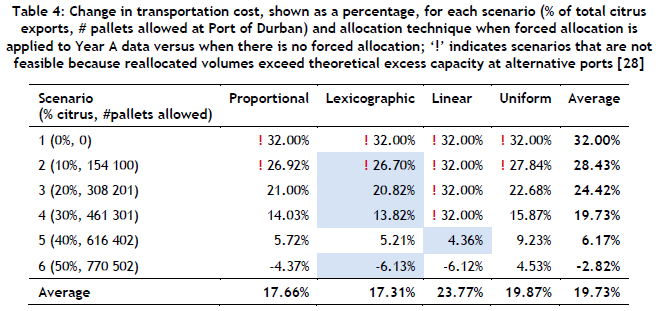
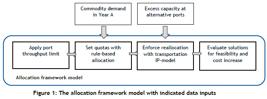
This article investigates the viability of using forced allocation as a mechanism to alleviate capacity challenges through scenarios of varying allowable citrus throughput at the Port of Durban. Rule-based resource allocation techniques are used to divide the allowable citrus throughput at the constrained port between production regions by setting quotas. The allocation model framework minimises the impact of the forced allocation on the citrus export cold chain by setting the quotas as constraints in an integer programming (IP) formulation of a minimum cost transportation problem (TP) for the system. The results show that forced allocation is feasible under at least one resource allocation technique for four of the scenarios tested.
 Thumbnail
 Thumbnail
 Thumbnail