Influence of Sn on the microstructure and mechanical properties of Ti-Mo-Nb alloys for orthopaedic applications
Abstract
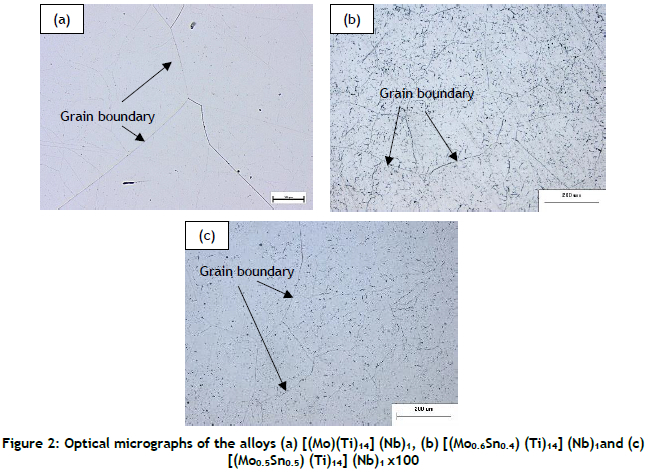
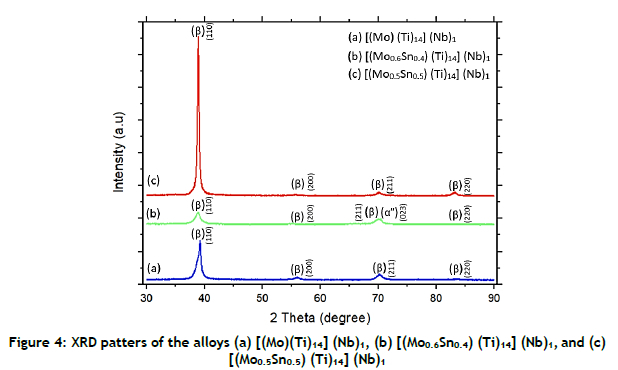
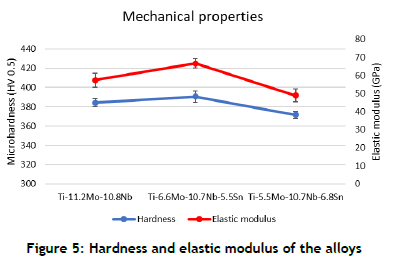
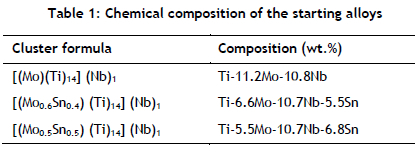
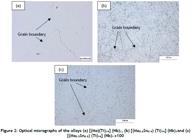
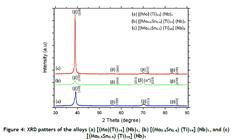
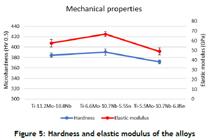
Metastable β-Ti alloys intended for orthopaedic implants typically possess undesirable d, a", w precipitates, which increase the elastic modulus. Non-toxic Sn was reported as an effective suppressor of d, a" and w precipitates. Furthermore, increasing Sn content was reported to decrease the elastic modulus. In this study, the cluster plus glue atom (CPGA) model was used to develop structurally stable β-Ti alloys through the addition of Sn. Arc melting was conducted to fabricate the alloys. The effect of substituting Mo atoms with 0.4 and 0.5 Sn atoms on the microstructure and mechanical properties of [(Mo,Sn)(Ti)14](Nb)1 alloys was investigated. The microstructure of the alloys exhibited large equiaxed beta grains with the [(Mo0.6Sn0.4)(Ti)14](Nb)1 and [(Mo0.5Sn0.5)(Ti)i4](Nb)1 alloys showing substructures. The XRD results showed that the alloys consisted of the B phase; however, the presence of a" was observed in the [(Mo0.6Sn0.4)(Ti)14](Nb)1 alloy. The study showed that substitution of 0.5 Mo atoms with 0.5 atoms of Sn to form the [(Mo0.5Sn0.5)(Ti)14](Nb)1 cluster resulted in an elastic modulus of 49 GPa.
 Thumbnail
 Thumbnail
 Thumbnail
 Thumbnail
 Thumbnail