Conceptualising a Grid Resilience Framework for Renewable Energy Integration
Abstract
Given their variability and intermittency, renewable energy sources need a robust and resilient grid framework. With increasing renewable integration in South Africa, grid instability and infrastructure vulnerability become significant problems. This paper explores the complexities of the South African energy system while balancing operator requirements in the Southern African region's unique context. Through a multidisciplinary approach, it develops a framework that includes various levels of renewable penetration. It proposes technical and operational solutions for ecological grid resilience. The framework draws on contemporary research, case studies, and energy system modelling, emphasising advanced grid infrastructure, smart grid technologies, flexible operations, real-time monitoring, and predictive analytics. It provides practical insights for engineers, policymakers, and industry stakeholders to develop resilient energy systems, ensuring grid resilience and energy security in Southern Africa.
Abstract
Gegewe hul veranderlikheid en onderbroke beskikbaarheid, benodig hernubare energiebronne 'n robuuste en veerkragtige netwerkraamwerk. Met toenemende hernubare-energie-integrasie in Suid-Afrika, word netwerk-onstabiliteit en infrastruktuurkwesbaarheid beduidende probleme. Hierdie artikel ondersoek die kompleksiteite van die Suid-Afrikaanse energiestelsel terwyl dit die vereistes van operateurs in die unieke konteks van die Suider-Afrikaanse streek in balans bring. Deur 'n multidissiplinêre benadering ontwikkel dit 'n raamwerk wat verskeie vlakke van hernubare-penetrasie insluit. Dit stel tegniese en operasionele oplossings voor vir ekologiese netwerkveerkragtigheid. Die raamwerk steun op kontemporêre navorsing, gevallestudies en energiestelselmodellering, met die klem op gevorderde netwerk-infrastruktuur, slimnetwerktegnologieë, buigsame bedrywighede, intydse monitering en voorspellende analise. Dit bied praktiese insigte vir ingenieurs, beleidmakers en belanghebbendes in die bedryf om veerkragtige energiestelsels te ontwikkel, wat netwerkveerkragtigheid en energiesekuriteit in Suider-Afrika verseker.
1. INTRODUCTION
South Africa's energy system is highly vulnerable to disruptions - a situation that is not unique to the country and that calls for greater stability [1], [2]. Globally, energy utilities are increasingly concerned about the resilience of their systems [3]. The pressing need for comprehensive energy resilience strategies in South Africa is the result of a confluence of problems that threaten the country's energy security and socioeconomic stability [4], [5]. These problems include a range of factors, such as an overreliance on fossil fuels with a simultaneous rapid increase in variable renewable energy, an ageing and unreliable energy infrastructure, underinvestment in domestic and regional transmission networks, suppressed energy demand, the impacts of climate change, and persistent load-shedding.
Given the increase in variable renewable energy in Southern Africa and the increasing risks to energy system resilience, this paper conceptualises the development of a framework to manage the integration of renewable energy in Southern Africa.
2. REGIONAL ENERGY LANDSCAPE
BMI Fitch [5] states that numerous markets in Sub-Saharan Africa face similar issues in their domestic power sectors. These create investment opportunities to diversify the power mix, increase power capacity, and improve the grid. Among the difficulties that these markets face are an unstable power supply, inefficiencies in grid systems, inadequate policies and regulatory frameworks, and high electricity prices.
This is crucial for South Africa as it deals with frequent load shedding; further threats to the power system's resilience are cable theft, worsening system adequacy, increased use of variable renewable energy (VRE), constrained transmission, and fires in substation [1]. The volatility of the energy grid in South Africa caused by these issues inadvertently has an impact on the regional grid [5], revealing the interconnectedness and shared vulnerability of the grid.
While the number of wind and solar power installations continues to soar, some researchers [6], [7] caution that, at higher penetration levels, developing these renewables might be more difficult. They have an intermittency problem, meaning that they cannot provide energy consistently at all times of the day. Thus, they require back-up capacity, a massive expansion of transmission lines, and a change in how electricity markets are organised.
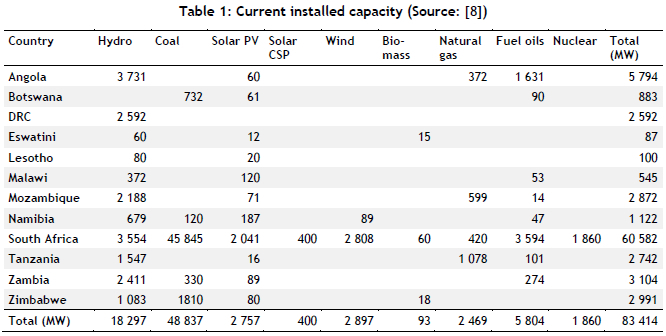
According to [8], the region expects 26 589 MW of new capacity between 2025 and 2027. The majority of this is likely to come from VRE. The current installed capacity is 80 659 MW, with the dominant technologies being coal (48 837 MW), hydro (18 298 MW), and fuel oil (5 803 MW). A breakdown is given in Table 1:
There is a growing penetration of renewable energy in the region, both grid-tied and behind the meter. Grid-tied installations are those that are connected to the grid and that must adhere to a grid code. In contrast, behind-the-meter installations are not visible to the system operator and are usually residential or commercial or industrial (C&I) installations.
The generation connection capacity assessment for 2025 [9] states that, in 2023, the South African system operator observed behind-the-meter embedded generation of 4 700 MW, predominantly from residential rooftop PVs, C&I, and small-scale and large-scale PVs. In 2025, this has been estimated at 6 207.8 MW [10] - a growth of 32.08% in just two years. This adds complexity to a system already strained by a capacity shortfall in the region.
This regional landscape provides an overview of the planned projects, but also highlights the increasing reliance on VRE, which, as we see in Section 3, has grid and system implications for resilience.
3. VARIABLE RENEWABLE ENERGY IN SOUTH AFRICA
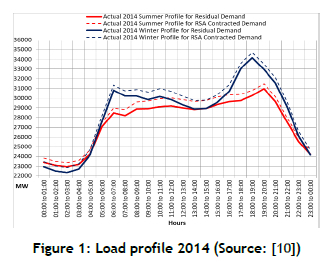
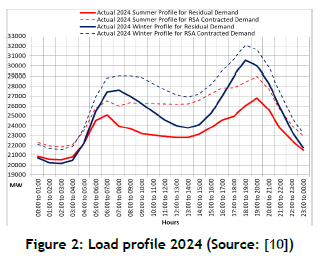
Figures 1 and 2 summarise 10 years of adding variable renewable energy to South Africa's energy system. Figure 1 depicts the system in 2014, when there was minimal renewable energy. There was an evident morning and evening peak in both summer and winter; however, the peaks were more pronounced in winter. Residual1 and Republic of South Africa (RSA)-contracted2 demand tracked closely, indicating less penetration of renewables.
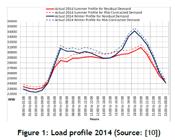
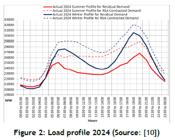
In 2024, however (Figure 2), we see a pronounced morning and evening peak and a huge variance between residual and RSA-contracted demand in winter and especially in summer. Figure 2 shows a more pronounced duck curve, with a midday demand difference of about 6 000 MW between 2014 and 2024; this can be attributed to an increase in renewable energy. It is worth mentioning that peak winter evening demand in 2014 was over 34 000 MW; however, in 2024 it was 32 000 MW; in summer it was 31 000 MW (2014) and 27 000 MW (2024) [10]. Demand had come down considerably despite an increase in generating capacity from self-generation, loadshedding, and load curtailment [1].
The increase in VRE introduces significant threats to energy system resilience. This is because the sun does not always shine, and the wind does not always blow, which is known as intermittency [11]. This variability in power generation can lead to dips in supply, especially during peak demand periods. Extreme weather events such as storms, droughts, or heat waves can have a significant impact on VRE output and bring about weather dependence [12]; for instance, a crippling heatwave could reduce solar panel efficiency. Traditional power plants can adjust their output to match demand. VRE sources lack this flexibility, creating problems in maintaining grid stability [7], [13], especially with high VRE penetration. Last, solar and wind resources are not always located near population centres, and so require extra transmission infrastructure to move the power where it is needed; this geographical dispersion [5], [14] adds complexity and potential vulnerability to the system.
The threats of integrating VRE to energy resilience can therefore be categorised as the following:
■ Intermittency because of changing weather conditions;
■ Variability of supply, which causes dips;
■ Uncertainty related to curtailment, ramp, and dispatch;
■ Problems with grid integration.
4. DEFINING ENERGY RESILIENCE
According to [15], the most widely recognised and frequently used definition of energy system resilience is given by the International Energy Agency (lEA): "The capacity of the energy system and its components to cope with a hazardous event or trend, to respond in ways that maintain its essential functions, identity and structure as well as its capacity for adaptation, learning and transformation. It encompasses the following concepts: robustness, resourcefulness, recovery."
In the Power Sector Resilience Planning Guidebook [16], the power sector's resilience is defined as its capacity to foresee, ready itself for, and adjust to evolving circumstances. It involves enduring, addressing, and promptly recovering from disruptions by using flexible and comprehensive planning strategies and technical solutions.
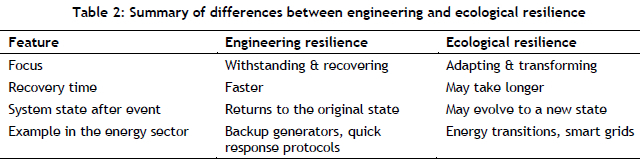
An analysis of the above definitions highlights two main perspectives on energy resilience: Engineering resilience:
■ Focuses on withstanding and recovering from disruptions (e.g., [15], [17]);
■ Emphasises rapid recovery and maintaining continuous electricity flow (e.g., [16], [18]).
■ Aligns with the initial definition of Holling [19].
Ecological resilience:
■ The taxonomy calls for transformability, highlighting a fundamental change in energy systems [21];
■ Emphasises the ability to adapt and transform after disruptions (e.g., [21]);
■ Considers the system's ability to learn and evolve (e.g., [22]);
■ Draws on Holling's ([19]) later argument about the value of adaptation for long-term resilience.
Table 2 summarises the key differences:
Both perspectives acknowledge resilience's complexity as a multifaceted concept with various dimensions [23], [24]. Despite there being no complete consensus about the definitions of energy resilience, their essence is the same. Therein lies an overarching concept that looks at the performance of an energy system before and after a critical, non-normal event. Energy resilience is often defined as a system's ability to "anticipate, resist, absorb, respond to, adapt to, and recover from a disturbance". At its core, resilience is about considering all disaster scenarios and having efficient restoration measures [17].
This article defines energy system resilience as an energy system that can withstand and recover from non-normal disruptions (engineering resilience aspect). This involves measures to absorb disturbances, maintain functionality during disruptions, and quickly restore normal operations. It can also adapt and transform in response to changing conditions (ecological resilience aspect). This emphasises the system's ability to learn from disruptions, evolve, and potentially transition to a new state that is better equipped to handle future problems.
Having given a clear definition, section 5 reviews existing resilience frameworks to determine which of them has the best outcomes for energy system resilience, particularly for Southern Africa.
5. REVIEW OF FRAMEWORKS
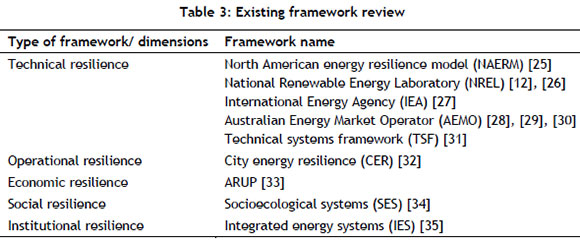
Following a thorough examination of the various energy resilience frameworks, distinct themes highlighting best practices, gaps, and areas of overlap have been identified. As a result, the framework review (Table 3) uses a hybrid approach of qualitative comparative analysis and gap analysis to determine a holistic framework for energy system resilience.
This approach should provide insights into how different frameworks have been developed and applied, highlighting their strengths and limitations in integrating variable renewable energy sources. Ultimately, this analysis should inform efforts to enhance the resilience of electricity grids and to guide future research in this critical area.
The NREL framework focuses on a holistic approach that looks at flexible resources (dispatchable generation, storage, demand-side management), grid modernisation (smart grids, transmission expansion), and system planning and operation (forecasting, operational strategies). It is a well-rounded approach that considers various aspects of VRE integration and provides a strong foundation for assessing technical and planning aspects of VRE growth.
The IEA framework emphasises system-wide VRE integration, including planning and investment (siting, transmission), market design (flexibility value, location-based pricing), and flexible grid operations (smart grids, demand response). It addresses market design and system-wide considerations, and is valuable for assessing the market design adaptations that are needed for VRE integration.
The NAERM model focuses on developing reliability standards for bulk power systems in North America. While relevant for grid stability, NAERM's framework is less specific to VRE than either NREL or lEA.
The ARUP framework is a broad framework for energy resilience in various contexts, considering interconnectedness, long-term planning, and adaptation strategies. lt addresses the global context and long-term considerations for VRE integration in South Africa. lt is valuable for understanding the broader context of South Africa's VRE plans in the interconnected global energy landscape.
The CER framework focuses on building resilience in urban energy systems, considering critical infrastructure, distributed generation, emergency preparedness, and community engagement. However, the framework is only valuable if the assessment focuses on urban areas that integrate VRE.
The AEMO framework addresses the difficulties of geographically dispersed systems, emphasising firming capacity (dispatchable generation, storage), transmission expansion (new lines, upgrades), and market mechanisms (capacity markets, fast reserves). lt addresses geographically dispersed renewable resources, and provides valuable insights into transmission and capacity needs in South Africa's VRE expansion.
The key takeaways are:
■ AEMO is the most balanced and comprehensive option, suitable for regions seeking a holistic approach.
■ NAERM and NREL are best for technical and operational resilience, but need more social and policy integration.
■ IEA is strong for market and system-wide integration, but less useful for local engagement.
■ TSF is best for disaster recovery, not for broader resilience.
■ CER and SES are ideal for urban and social-ecological contexts, but not for technical grid problems.
■ ARUP is best for economic and strategic planning, less useful for technical implementation.
■ IES is strong for integrated, cross-sector systems, but needs more policy and social focus.
A critical review of the frameworks revealed a gap in the literature. The current frameworks do not consider the complexity of sub-Saharan Africa, and do not provide for a complex energy landscape with increased exposure to VrE. Section 6 proposes a revised energy resilience framework that incorporates the abovementioned dimensions. However, owing to the specificity of incorporating dimensions for renewable energy integration, this article considers the dimension of technical resilience.
6. FRAMEWORK DEVELOPMENT
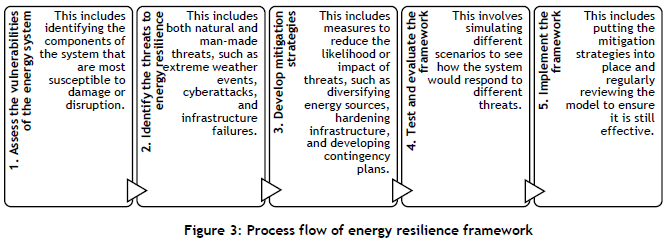
There are basic steps in developing an energy resilience framework. This approach was followed by [32], [33], [36], [37], and its key steps are illustrated below (Figure 3):
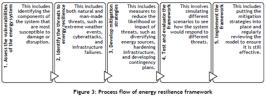
1. Assess the vulnerabilities of the energy system.
2. Identify the threats to energy resilience.
3. Develop mitigation strategies.
4. Test and evaluate the model.
5. Implement the model.
6.1. Research methodology
The problem statement involves conceptualising an energy resilience framework, considering the increasing use of VRE in South Africa. To do this, understanding the vulnerabilities and threats of the system would be essential in developing mitigation strategies.
A mixed-methods research design was used in this study. To warrant a mixed-method approach, a few fundamental questions were addressed, summarised as follows:
1. Is using qualitative or quantitative research alone insufficient to understand fully the increase in VRE and its impact on resilience?
2. Is there a framework that looks at the resilience of the energy system related to increasing VRE and the challenge of integrating it into the grid?
The mixed methods design was chosen because the threats to resilience could not be answered by either qualitative or quantitative research alone; because information related to the challenges of integrating VRE into the grid existed in the form of literature and case studies; and because the data applied globally, it benefitted from a Delphi survey to understand the southern African context better. The mixed methods approach is also regarded as a triangulated research design because, during the analysis stage, there is a combination of qualitative and quantitative data to help one to understand the different ramifications of the research problem.
Below is the proposed process.
1. Qualitative analysis for the literature review;
2. Quantitative analysis for the variability of renewable energy;
3. Delphi survey.
In developing their frameworks, [33], [34], [37], and [38] started by assessing the vulnerabilities and identifying the threats to energy resilience. Hamborg et al. [36] framed them as "resilience concerns", while [33] called them "shocks and stresses". The above-mentioned authors contend that threats to the energy system are either natural or man-made. Bie [38] argues that a resilient energy system should deal with "low probability but high-risk events", which include natural and man-made threats such as extreme weather events, cyberattacks, and infrastructure failures. Bie [38] adds that an understanding of these threats has become a top priority for many countries. This article uses the word "threats" because some are not yet known or understood, and, with increasing VRE penetration, there is no framework to guide technocrats and policymakers.
The findings of these authors formed the basis for this study. In addition to the literature, this study uses a network diagram to map the risks and threats to energy system resilience, assuming an energy system with an increasing risk of VRE. Next, the article prioritises the threats using a rank ordering approach, based on their likelihood and impact. This classifies the risks and frames the process for how these risks could be mitigated. The risks are not static, and may change or increase in severity depending on numerous variables, as the increasing penetration of VRE is considered.
Network diagrams are used in this article to map threats because there are interconnected systems or networks. The diagrams show nodes and connections, highlighting potential points of failure or attack in the network. This visualisation is essential to understand the broader impact of localised threats.
Last, the results of a Delphi survey have been used. This survey gathered expert opinions on the most significant risks to energy system resilience, particularly in the context of increasing VRE sources. Because the topic is complex and needs a fair level of consensus, a Delphi approach was found to be most suitable.
6.2. Assess the vulnerabilities of the energy system
According to [26], complex network theory is a statistical domain of mathematics that is based on graph theory. Within this framework, systems are represented by nodes and their relationships as connections that facilitate energy or data transfer (as seen in power and communication networks).
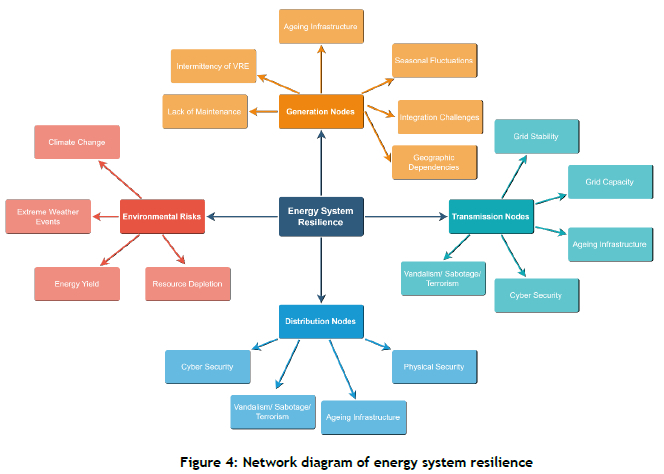
This study uses a simple network diagram to indicate the interrelated parts of an integrated energy system and where resilience is required for increasing VRE. This network diagram considers the technical environment, which includes generation, transmission, and distribution. It then finds external environmental risks.
Following a critical assessment of the literature and of case studies that look at resilience failures, a broad range of threats was identified. The threats were classified under a central node (energy system resilience) and four broad sub-nodes (threats/risks): generation nodes, transmission nodes, distribution nodes, and environmental threats. The network diagram (Figure 4) describes the threats.
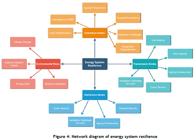
These four sub-nodes provide an exhaustive list of threats to the energy system. Most of these threats are part of multiple sub-nodes; for instance, ageing infrastructure could relate to the generation, transmission, or distribution nodes.
By visualising these aspects, an energy system resilience network diagram could help energy system planners and operators to identify potential risks, to develop mitigation strategies, and to enhance the overall resilience of the energy infrastructure.
This energy system resilience network diagram highlights the interdependencies between the sub-nodes and how different energy system components (e.g., power plants, transmission lines, distribution networks) are connected to and reliant on one another.
It also shows the system's vulnerabilities or critical infrastructure that, if compromised, could significantly disrupt the system's operation. For instance, the grid is vulnerable, as it is the backbone of the sub-nodes.
It illustrates potential cascading effects and how a failure in one part of the system could lead to failures in other interconnected components. This is exemplified by how an environmental risk or resource depletion could have an impact on seasonal generation, typically seen with hydro-electric power.
When extrapolated further, this network diagram could provide an assessment of the impact on various stakeholders, including consumers, businesses, and industries, which could help with stakeholder mapping. It could also provide resilience pathways or backup systems that can be activated to maintain energy supply in the case of failures or disruptions.
Last, the network diagram could assist in prioritising investments in areas where upgrades or redundancies could improve the system's resilience and reliability. This could be increased maintenance and grid capacity.
6.3. Identify the threats to energy resilience
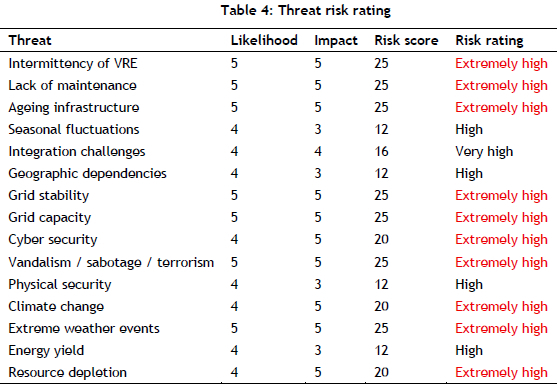
Following the classification of threats using the literature and case studies, it was essential to introduce a system to sort the risks according to their likelihood and impact. This would yield a risk rating to determine the energy system's most important risks. Therefore, a risk matrix scoring was developed to classify the risks using a value score derived from probability and impact. Risks were categorised as low (0 to 10), high (11 to 15), very high (16 to 20), and extremely high (21 to 25).
Next, a process of providing a risk rating and risk score was followed, based on the likelihood and impact of the threat. This is summarised in Table 4.
Given the subjective nature of the risk matrix, a Delphi survey with 17 participants was conducted, which brought more objectivity and convergence to the identified risks and their classification. Using a Delphi survey, the key risks that threaten energy resilience were identified by relevant experts:
■ Grid instability
■ Infrastructure vulnerability
■ Regulatory and policy changes
■ Intermittency
■ Extreme weather
Extreme weather as a threat was removed from the conceptual framework because its direct impact is on the intermittency of renewable energy.
6.4. Develop mitigation strategies
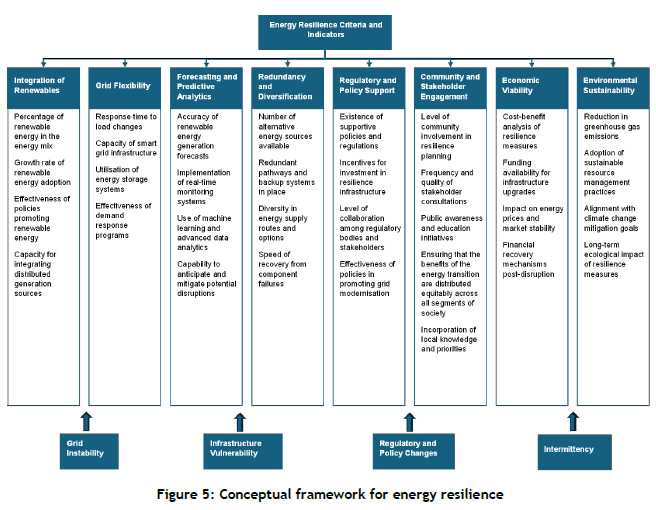
According to the World Energy Council Dynamic Resilience Framework Toolkit [39], a resilience framework is a multilayered and integrated approach to emerging energy sector risks, considering engineering (technical), operational, economic, community resilience (social), and institutional capabilities. The following are the emergent criteria for energy system resilience:
■ Integration of renewables
■ Grid flexibility
■ Forecasting and predictive analytics
■ Redundancy and diversification
■ Regulatory and policy support
■ Community and stakeholder engagement
■ Economic viability
■ Environmental sustainability
Integration of renewables: Integrating renewable energy sources into the grid enhances its resilience, increases reliability, reduces reliance on fossil fuels, and diversifies the energy mix [29]. Frameworks such as those of [12], [26], [30], [41], and [42], which incorporate renewables such as solar, wind, and hydroelectric power, could reduce dependence on fossil fuels and diversify energy sources. This integration could help to maintain the energy supply during disruptions and to reduce the environmental impact of energy generation. This criterion evaluates how well the framework addresses the integration of variable renewable energy sources, such as solar and wind, which are inherently intermittent and require specific strategies to ensure reliability.
Grid flexibility: Grid flexibility is essential for adapting to changing loads and integrating various energy sources. Resilience frameworks that emphasise grid flexibility facilitate the absorption of energy supply and demand fluctuations, particularly from intermittent renewable sources [42]. According to [35], grid flexibility is enhanced by smart grids, demand response systems, and energy storage solutions. This criterion assesses the framework's capacity to enhance grid flexibility, accommodating fluctuations in renewable energy generation. This includes using advanced technologies such as smart grids and energy storage systems.
Forecasting and predictive analytics: Accurate forecasting and predictive analytics enable better preparation for and response to potential disruptions [33]. Resilience frameworks that leverage advanced data analytics, machine learning, and real-time monitoring provide valuable insights into grid performance, weather patterns, and potential threats [43]. This allows for proactive measures to mitigate the risks and to ensure a stable energy supply. This criterion examines the framework's provisions for robust forecasting methods and predictive analytics to anticipate renewable energy generation and demand patterns, thereby minimising the impact of variability.
Redundancy and diversification: Redundancy and diversification refers to the inclusion of multiple energy sources and pathways to ensure that, if one component fails, others can maintain the energy supply, thereby enhancing the system's ability to withstand and recover from disruptions [28], [35]. Gasser [44] refers to this redundancy as "substitutability". This criterion overlaps with "integration of renewables"; however, it considers various technologies that are present in the region and transmission redundancy.
Building redundancy and diversification into the energy infrastructure enhances its resilience. Frameworks such as those of [26], [29], and [36], which incorporate redundancy, ensure that alternative sources or routes are available in the case of failure. For instance, the diversification of energy sources and supply routes through a natural redundancy reduces the risk of widespread outages and increases the robustness of the energy system. This criterion examines how the framework promotes redundancy and diversification of energy sources and infrastructure, ensuring that the energy system can withstand and quickly recover from disruptions.
Regulatory and policy support: Effective regulatory and policy support is critical for implementing and sustaining resilience frameworks [34]. Policies that promote renewable energy adoption, grid modernisation, and investment in resilience infrastructure create an enabling environment for resilience initiatives [28], [29]. Collaboration between regulatory bodies, energy providers, and stakeholders ensures better alignment and more effective implementation of resilience strategies. These criteria consider the support for regulatory frameworks and policies that facilitate the integration and resilience of renewable energy systems, including incentives for innovation and investment in resilient infrastructure.
Community and stakeholder engagement: Engaging communities and stakeholders in resilience planning and implementation fosters transparency, cooperation, and local support [34]. According to [34], frameworks that involve community input and consider local needs and priorities are more likely to succeed, provided that they follow a bottom-up approach that cascades to the regional and national levels. Public awareness campaigns, stakeholder consultations, and community-based initiatives contribute to building a resilient energy system that benefits all [33]. This criterion evaluates the framework's emphasis on engaging communities and stakeholders in resilience planning, ensuring that social dimensions and local knowledge are incorporated into resilience strategies.
Economic viability: Evaluating and ensuring the economic viability of resilience frameworks is essential for their long-term success and sustainability [33]. Economic analyses that assess the cost-benefit ratios of implementing resilience measures against the potential economic losses from disruptions provide a clear picture of the financial implications [25], [42]. Investing in resilience protects against immediate threats and contributes to long-term economic stability by preventing costly outages and ensuring a continuous energy supply [25]. This criterion assesses the framework's approach to ensuring the economic viability of renewable energy integration, including the ability to recover financially from disruptions and their impact on energy prices and market stability.
Environmental sustainability: Resilience frameworks prioritising environmental sustainability contribute to long-term resilience by reducing the ecological impact and promoting sustainable practices [43]. According to Gasser [44], integrating renewable energy, reducing greenhouse gas emissions, and adopting sustainable resource management practices ensure that resilience measures are aligned with environmental goals. This approach enhances resilience and supports broader ecological and social sustainability objectives. This criterion ensures that the framework aligns with broader environmental goals, considering the long-term sustainability of energy systems and their impact on climate change mitigation efforts.
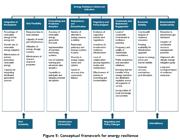
The framework in Figure 5 includes the generation, transmission, distribution, and consumption elements of the energy system. It considers the threats to energy resilience and their potential disruptions. It proposes eight energy resilience criteria, such as grid flexibility, redundancy, and diversification, and 33 sub-criteria. The desired outcome is a resilient energy system that ensures a continuous supply, quick restoration, and adaptability to new conditions.
7. NEXT STEPS
The objective of the conceptual framework is to enhance the resilience of the southern African energy system, following the penetration of increased VRE, by assessing how well the resilience indicators respond to the identified threats. This is done by ranking the criteria and indicators in the conceptual framework using diverse expert opinions from within the energy sector via a multi-criteria decision-making (MCDM) approach. Using MCDM, decision-makers can weigh up the quantitative and qualitative factors such as technical, economic, environmental, and social aspects, ensuring that all relevant dimensions are considered in the decision-making process. Once the conceptual framework has been populated using the MCDM approach, it is tested and evaluated via the national system operator. This approach is particularly beneficial in identifying and prioritising vulnerabilities and developing effective mitigation strategies to enhance the resilience of energy systems [45].
8. CONCLUSION
To enhance resilience, Fan et al. [46] advocate integrating advanced technologies such as smart grids and renewable energy sources, fostering community engagement, and strengthening policy frameworks to support adaptive governance. They also highlight the importance of continuous monitoring and of updating resilience metrics to reflect changing conditions and emerging threats.
The specific resilience needs and priorities vary, depending on the country or region in the Southern African Development Community. Conducting thorough assessments and developing tailored strategies to ensure effective implementation would be crucial. This is an integral feature of the proposed energy resilience framework.
While VRE offers significant environmental benefits and contributes to reducing greenhouse gas emissions, its successful integration into the energy system requires a comprehensive approach to enhance resilience. This involves technological advancements, strategic investments, and supportive policies to manage variability and to ensure a stable and reliable energy supply.
A critical review of the frameworks has revealed a gap in the literature. The current frameworks do not consider the complexity of sub-Saharan Africa, and do not provide for a complex energy landscape with increased exposure to VRE. The proposed energy resilience framework incorporates the abovementioned indicators.
Grid instability, infrastructure vulnerability, regulatory and policy changes, intermittency, and extreme weather have been identified as the key threats to energy system resilience. However, there needs to be an emphasis on proactive measures to address the growing threats to power systems. Strengthening and maintaining infrastructure, diversifying energy sources, and embracing technological advancements are crucial steps towards preventing future blackouts and ensuring a reliable, resilient energy future.
Addressing these high-priority threats would ensure the energy system's resilience in the face of increasing VRE penetration.
REFERENCES
-
[1] Eskom, "2023 Eskom Integrated Report," 2023. Accessed: Aug. 24, 2025. [Online]. Available: https://www.eskom.co.za/wp-content/uploads/2023/10/Eskom_integrated_report_2023.pdf
» https://www.eskom.co.za/wp-content/uploads/2023/10/Eskom_integrated_report_2023.pdf -
[2] International Energy Agency, "Africa faces both major challenges and huge opportunities as it transitions to clean energy," International Energy Agency. Accessed: Jun. 06, 2025. [Online]. Available: https://www.iea.org/news/africa-faces-both-major-challenges-and-huge-opportunities-as-it-transitions-to-clean-energy
» https://www.iea.org/news/africa-faces-both-major-challenges-and-huge-opportunities-as-it-transitions-to-clean-energy -
[3] Enel, "Profiting From Energy Flexibility Finding and Unlocking the Revenue Potential in Your Energy Infrastructure," 2023. Accessed: Nov. 26, 2025. [Online]. Available: https://www.enelnorthamerica.com/insights/ebooks/profiting-from-energy-flexibility
» https://www.enelnorthamerica.com/insights/ebooks/profiting-from-energy-flexibility -
[4] International Energy Agency, "Annual variable renewable energy share and corresponding system integration phase in selected countries/regions, 2022," IEA. Accessed: Aug. 25, 2025. [Online]. Available: https://www.iea.org/data-and-statistics/charts/annual-variable-renewable-energy-share-and-corresponding-system-integration-phase-in-selected-countries-regions-2022
» https://www.iea.org/data-and-statistics/charts/annual-variable-renewable-energy-share-and-corresponding-system-integration-phase-in-selected-countries-regions-2022 - [5] Fitch Solutions Business Monitor International, "Sub-Saharan Africa Power & Renewables Market Overview," 2025. Unpublished presentation
-
[6] I. J. Pérez-Arriaga, S. Burger, and T. Gómez, "Electricity Services in a More Distributed Energy System," 2016. Accessed: Aug. 25, 2025. [Online]. Available: https://energy.mit.edu/wp-content/uploads/2016/08/CEEPR-WP-2016-005.pdf
» https://energy.mit.edu/wp-content/uploads/2016/08/CEEPR-WP-2016-005.pdf -
[7] E. Delarue, J. Morris, R. G. Prinn, and J. M. Reilly, "Renewables Intermittency: Operational Limits and Implications for Long-Term Energy System Models," 2015. Accessed: Aug. 24, 2025. [Online]. Available:https://www.researchgate.net/publication/279827853_Renewables_Intermittency_Operational_Limits_and_Implications_for_Long-Term_Energy_System_Models/citations
» https://www.researchgate.net/publication/279827853_Renewables_Intermittency_Operational_Limits_and_Implications_for_Long-Term_Energy_System_Models/citations - [8] Southern African Power Pool, "Planning Subcommittee Presentation to Plenary," Mar. 2025. Presented by Kandara Mukusuka at Victoria Falls on 11 March 2025. Unpublished presentation
-
[9] R. Marais et al., "Generation Connection Capacity Assessment 2025 Connection Capacity for IPP Generators Development Team," Oct. 2023. Accessed: Aug. 25, 2025. [Online]. Available: https://www.eskom.co.za/wp-content/uploads/2023/10/Generation_Connection_Capacity_AssessmentGCCA-2025finalfinal_rev0003.pdf
» https://www.eskom.co.za/wp-content/uploads/2023/10/Generation_Connection_Capacity_AssessmentGCCA-2025finalfinal_rev0003.pdf - [10] H. Bower, "Hendri Bower Renewable Energy Slides," May 2025. Unpublished presentation
-
[11] M. Burnett, "Energy Storage and the California 'Duck Curve,'" Jun. 2016. Accessed: Aug. 24, 2025. [Online]. Available: http://large.stanford.edu/courses/2015/ph240/burnett2/
» http://large.stanford.edu/courses/2015/ph240/burnett2/ -
[12] E. Hotchkiss, N. Grue, and M. Petty, "Understanding Resilience Valuation for Energy Systems: An Overview of the NREL-NYSERDA Research Collaboration," Oct. 2023. Accessed: Aug. 24, 2025. [Online]. Available: https://www.nyserda.ny.gov/-/media/Project/Nyserda/Files/Publications/Research/Electic-Power-Delivery/Understanding-Resilience-Valuation-for-Energy-Systems.pdf
» https://www.nyserda.ny.gov/-/media/Project/Nyserda/Files/Publications/Research/Electic-Power-Delivery/Understanding-Resilience-Valuation-for-Energy-Systems.pdf -
[13] M. Theku, C. Mushwana, and C. Ndlhovu, "Accelerating Grid Connection for IPPs and Generators - Grid Connections Enablement," May 2025, Accessed: Nov. 26, 2025. [Online]. Available: https://www.eskom.co.za/distribution/wp-content/uploads/2025/05/IPP-Conference-Day-2-Presentation-Pack.pdf
» https://www.eskom.co.za/distribution/wp-content/uploads/2025/05/IPP-Conference-Day-2-Presentation-Pack.pdf -
[14] P. Naicker and G. A. Thopil, "A framework for sustainable utility scale renewable energy selection in South Africa," J Clean Prod, vol. 224, pp. 637-650, Jul. 2019, doi: 10.1016/j.jclepro.2019.03.257.
» https://doi.org/10.1016/j.jclepro.2019.03.257 - [15] J. Jasiunas, P. D. Lund, and J. Mikkola, "Energy system resilience - A review," Oct. 01, 2021, Elsevier Ltd. doi: 10.1016/j.rser.2021.111476.
-
[16] S. Stout, N. Lee, S. Cox, J. Elsworth, and J. Leisch, "Power Sector Resilience Planning Guidebook: A Self-Guided Reference for Practitioners," 2019. Accessed: Aug. 25, 2025. [Online]. Available: https://docs.nrel.gov/docs/fy19osti/73489.pdf
» https://docs.nrel.gov/docs/fy19osti/73489.pdf -
[17] Z. Bie, Y. Lin, G. Li, and F. Li, "Battling the Extreme: A Study on the Power System Resilience," Proceedings of the IEEE, vol. 105, no. 7, pp. 1253-1266, Jul. 2017, doi: 10.1109/JPROC.2017.2679040.
» https://doi.org/10.1109/JPROC.2017.2679040 - [18] R. Arghandeh, A. Von Meier, L. Mehrmanesh, and L. Mili, "On the definition of cyber-physical resilience in power systems," May 01, 2016, Elsevier Ltd. doi: 10.1016/j.rser.2015.12.193.
-
[19] C. S. Holling, "Resilience and Stability of Ecological Systems," 1973. Accessed: Aug. 24, 2025. [Online]. Available: https://pure.iiasa.ac.at/id/eprint/26/1/RP-73-003.pdf
» https://pure.iiasa.ac.at/id/eprint/26/1/RP-73-003.pdf -
[20] A. Gatto and C. Drago, "A taxonomy of energy resilience," Energy Policy, vol. 136, p. 111007, Jan. 2020, doi: 10.1016/J.ENPOL.2019.111007.
» https://doi.org/10.1016/J.ENPOL.2019.111007 -
[21] C. Folke, S. R. Carpenter, B. Walker, M. Scheffer, T. Chapin, and J. Rockström, "Resilience Thinking: Integrating Resilience, Adaptability and Transformability," 2010. [Online]. Available: https://www.jstor.org/stable/26268226?seq=1&cid=pdf-
» https://www.jstor.org/stable/26268226?seq=1&cid=pdf- -
[22] L. Hughes, "The effects of event occurrence and duration on resilience and adaptation in energy systems," Energy, vol. 84, pp. 443-454, May 2015, doi: 10.1016/j.energy.2015.03.010.
» https://doi.org/10.1016/j.energy.2015.03.010 -
[23] A. E. Quinlan, M. Berbés-Blázquez, L. J. Haider, and G. D. Peterson, "Measuring and assessing resilience: broadening understanding through multiple disciplinary perspectives," Journal of Applied Ecology, vol. 53, no. 3, pp. 677-687, 2016, doi: 10.1111/1365-2664.12550.
» https://doi.org/10.1111/1365-2664.12550 - [24] S. Carpenter, B. Walker, J. M. Anderies, and N. Abel, "From Metaphor to Measurement: Resilience of What to What?," in Ecosystems, 2001, pp. 765-781. doi: 10.1007/s10021-001-0045-9.
-
[25] United States Department of Energy and Electricity, "North American Energy Resilience Model," 2019. Accessed: Aug. 25, 2025. [Online]. Available: https://www.energy.gov/oe/articles/north-american-energy-resilience-model-july-2019
» https://www.energy.gov/oe/articles/north-american-energy-resilience-model-july-2019 -
[26] L. Leddy et al., "Measuring and Valuing Resilience: A Literature Review for the Power Sector," 2023. [Online]. Available: www.nrel.gov/publications.
» www.nrel.gov/publications -
[27] International Energy Agency, "Strengthening Power System Security in Kyrgyzstan: A Roadmap," Jun. 2022. [Online]. Available: www.iea.org/t&c/
» www.iea.org/t&c/ -
[28] Australia Electricity Market Operator, "2022 Integrated System Plan For the National Electricity Market," Jun. 2022. Accessed: Aug. 24, 2025. [Online]. Available: https://www.aemo.com.au/energy-systems/major-publications/integrated-system-plan-isp/2022-integrated-system-plan-isp
» https://www.aemo.com.au/energy-systems/major-publications/integrated-system-plan-isp/2022-integrated-system-plan-isp -
[29] Australia Electricity Market Operator, "Renewable Energy Integration-SWIS Update," 2021. [Online]. Available: https://www.aemo.com.au/-/media/Files/Electricity/WEM/Security_and_Reliability/2019/Integrating-Utility-scale-Renewables-and-DER-in-the-SWIS.pdf.
» https://www.aemo.com.au/-/media/Files/Electricity/WEM/Security_and_Reliability/2019/Integrating-Utility-scale-Renewables-and-DER-in-the-SWIS.pdf -
[30] North American Electric Reliability Corporation, "2023 Long-Term Reliability Assessment," 2023. Accessed: Aug. 25, 2025. [Online]. Available: https://www.nerc.com/pa/RAPA/ra/Reliability%20Assessments%20DL/NERC_LTRA_2023.pdf
» https://www.nerc.com/pa/RAPA/ra/Reliability%20Assessments%20DL/NERC_LTRA_2023.pdf -
[31] H. Zhang, H. Yuan, G. Li, and Y. Lin, "Quantitative resilience assessment under a tri-stage framework for power systems," Energies (Basel), vol. 11, no. 6, Jun. 2018, doi: 10.3390/en11061427.
» https://doi.org/10.3390/en11061427 -
[32] Resilient Cities Network, "City Energy Resilience Framework," Mexico City, Jul. 2023. Accessed: Aug. 25, 2025. [Online]. Available: https://resilientcitiesnetwork.org/city-energy-resilience-framework/
» https://resilientcitiesnetwork.org/city-energy-resilience-framework/ -
[33] ARUP, "Future-proofing energy systems: The Energy Resilience Framework," 2019. Accessed: Aug. 24, 2025. [Online]. Available: https://www.arup.com/globalassets/downloads/insights/e/energy-resilience-framework/energy-resilience-framework.pdf
» https://www.arup.com/globalassets/downloads/insights/e/energy-resilience-framework/energy-resilience-framework.pdf -
[34] L. S. E. van der Merwe, "Advancing resilience assessments: the social dimensions of electricity supply in South Africa Resilience Assessment of Electricity Supply in South Africa View project," 2019. Accessed: Aug. 25, 2025. [Online]. Available: https://scholar.sun.ac.za/items/2c2025a6-2502-4480-a296-74aac7652bf2
» https://scholar.sun.ac.za/items/2c2025a6-2502-4480-a296-74aac7652bf2 - [35] Y. Lin and Z. Bie, "Study on the Resilience of the Integrated Energy System," in Energy Procedia, Elsevier Ltd, Dec. 2016, pp. 171-176. doi: 10.1016/j.egypro.2016.11.268.
-
[36] S. Hamborg, J. N. Meya, K. Eisenack, and T. Raabe, "Rethinking resilience: A cross-epistemic resilience framework for interdisciplinary energy research," Energy Res Soc Sci, vol. 59, Jan. 2020, doi: 10.1016/j.erss.2019.101285.
» https://doi.org/10.1016/j.erss.2019.101285 - [37] J. Phillips, M. Finster, J. Pillon, F. Petit, and J. Trail, "State Energy Resilience Framework," Argonne, IL (United States), Dec. 2016. doi: 10.2172/1344905.
-
[38] H. Zhang, Z. Bie, G. Li, and Y. Lin, "Assessment method and metrics of power system resilience after disasters," The Journal of Engineering, vol. 2019, no. 16, pp. 880-883, Mar. 2019, doi: 10.1049/joe.2018.8661.
» https://doi.org/10.1049/joe.2018.8661 -
[39] S. Charani Shandiz, G. Foliente, B. Rismanchi, A. Wachtel, and R. F. Jeffers, "Resilience framework and metrics for energy master planning of communities," Energy, vol. 203, Jul. 2020, doi: 10.1016/j.energy.2020.117856.
» https://doi.org/10.1016/j.energy.2020.117856 -
[40] M. Joshi and S. Inskeep, "Institutional framework of variable renewable energy forecasting in India," 2023. [Online]. Available: www.nrel.gov/publications.
» www.nrel.gov/publications -
[41] International Energy Agency, "Renewables 2023: Analysis and Forecast to 2028," 2023. Accessed: Aug. 25, 2025. [Online]. Available: https://www.iea.org/reports/renewables-2023
» https://www.iea.org/reports/renewables-2023 -
[42] NREL, "Variable Renewable Energy: a Regulatory Roadmap (Fact Sheet), 21st Century Power Partnership," 2014. Accessed: Aug. 25, 2025. [Online]. Available: https://docs.nrel.gov/docs/fy15osti/63027.pdf
» https://docs.nrel.gov/docs/fy15osti/63027.pdf -
[43] International Energy Agency, "Integrating Solar and Wind Global Experience and Emerging Challenges," Sep. 2024. Accessed: Aug. 25, 2025. [Online]. Available: https://www.iea.org/events/integrating-solar-and-wind-global-experience-and-emerging-challenges
» https://www.iea.org/events/integrating-solar-and-wind-global-experience-and-emerging-challenges - [44] P. Gasser et al., "A review on resilience assessment of energy systems," 2021, Taylor and Francis Ltd. doi: 10.1080/23789689.2019.1610600.
-
[45] D. Streimikiene, J. Sliogeriene, and Z. Turskis, "Multi-criteria analysis of electricity generation technologies in Lithuania," Renew Energy, vol. 85, pp. 148-156, Jan. 2016, doi: 10.1016/j.renene.2015.06.032.
» https://doi.org/10.1016/j.renene.2015.06.032 -
[46] W. Fan, W. Lv, and Z. Wang, "How to measure and enhance the resilience of energy systems?," Sustain Prod Consum, vol. 39, pp. 191-202, Jul. 2023, doi: 10.1016/j.spc.2023.05.015.
» https://doi.org/10.1016/j.spc.2023.05.015
ORCID® identifiers
L.M.M. Mashele
https://orcid.org/0000-0002-7184-1777
G.A. Thopil
https://orcid.org/0000-0002-4196-2455
L. Oerlemans
https://orcid.org/0000-0002-7495-4515
1 Demand less renewables
2 Actual demand