Reduced order topology optimisation of a planar honeycomb defined by a linear elastic Ti6al4V (ELI) material model
Abstract
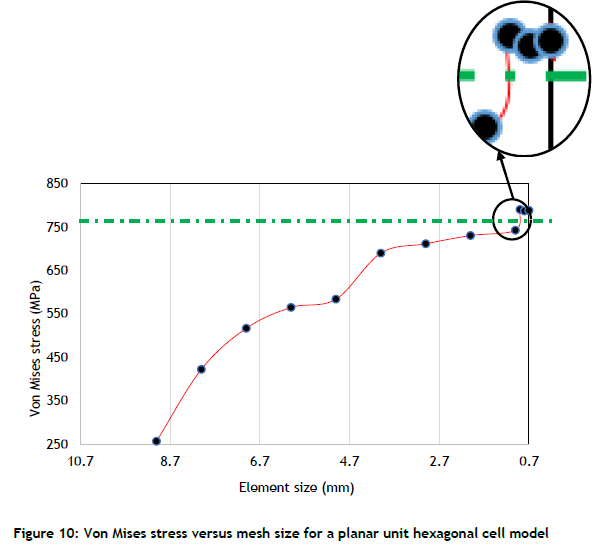
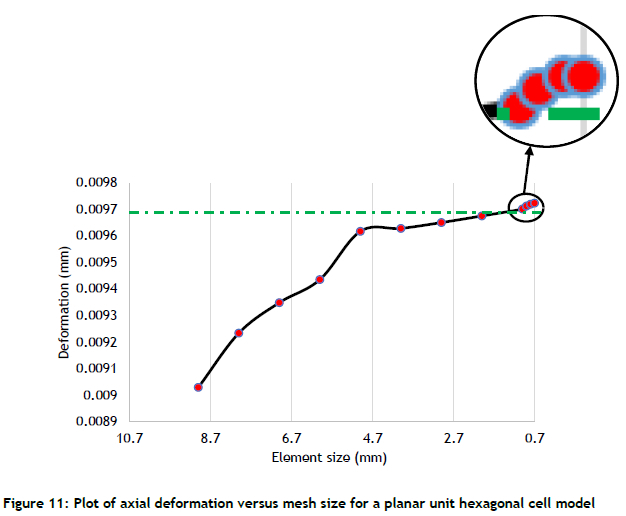
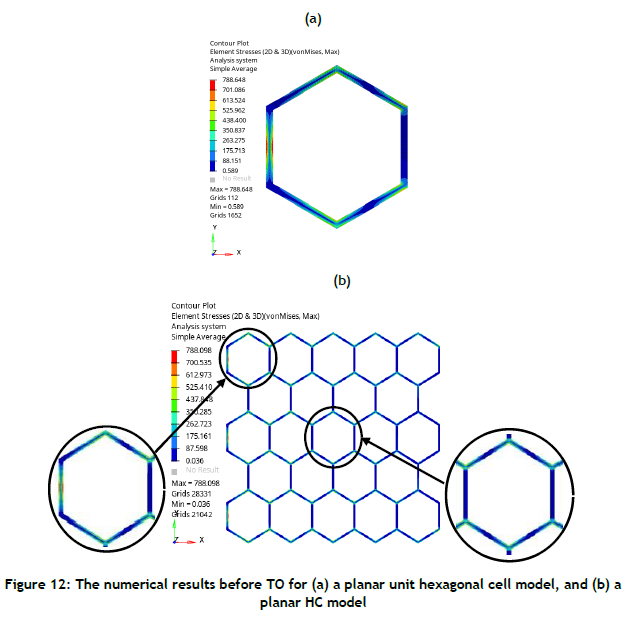
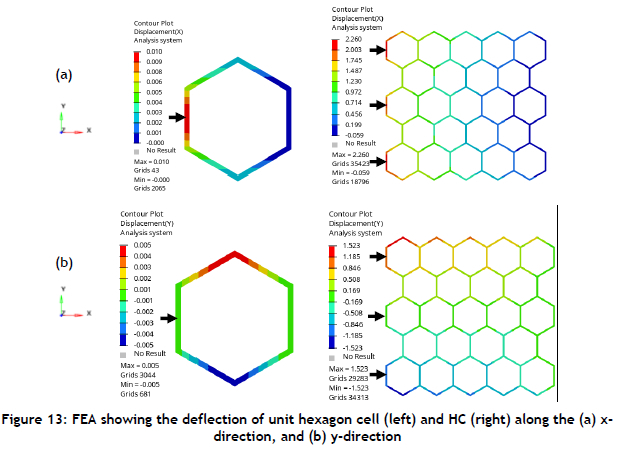
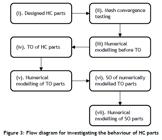
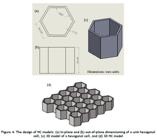
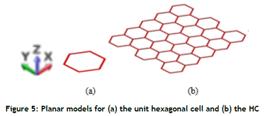
Combined numerical modelling and topology optimisation methods are useful in the design and analysis of engineering structures. The two tools are used to predict and optimise the mechanical properties of structures. Numerical modelling and optimisation of three-dimensional honeycomb structures is challenged by the sharp angles in its geometry. This reduces effective iterations in topology optimisation at the vertices and edges. The alternative - generating effective iterations at the vertices and edges in planar honeycombs of Ti6Al4V (ELI) - is presented in this paper. Mesh convergence tests with varying mesh densities were conducted on planar unit hexagonal cells at the start. The results obtained from planar unit hexagonal cells under out-of-plane compression loads before and after topology optimisation were compared. This was followed by shape optimisation and numerical analysis, and the results were compared with the numerical analysis before topology optimisation. The same procedure was followed for a planar honeycomb model. Acceptable predictions were obtained for the planar numerical models. Material reductions of 30% and 8% for the planar unit hexagon cell and for the honeycomb model respectively were obtained in topology optimisation. The maximum stresses in these numerical models after shape optimisation reduced by 58% and 4% respectively.
 Thumbnail
 Thumbnail
 Thumbnail
 Thumbnail
 Thumbnail
 Thumbnail
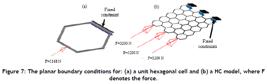 Thumbnail
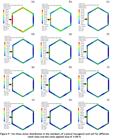 Thumbnail
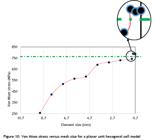 Thumbnail
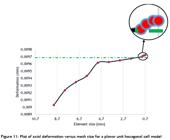 Thumbnail
 Thumbnail
 Thumbnail
 Thumbnail
 Thumbnail
 Thumbnail
 Thumbnail
 Thumbnail
 Thumbnail