Digital Innovation Management in Developing Economies: Challenges and Emerging Strategies in the Financial Services Sector of South Africa
Abstract
Digital innovations have become increasingly central to economic growth worldwide. This study investigates the challenges, success factors, and emerging strategies related to digital innovation management in developing economies, focusing on South Africa's financial services sector. It reviews the relevant literature, evaluates existing models for innovation management, and introduces a conceptual framework, 'digital innovation management in developing economies' (DIM-DE), that incorporates elements such as dynamic capability development and external collaboration. The research includes qualitative interviews with five financial sector leaders, analysing problems such as talent scarcity and unreliable infrastructure, alongside success factors such as strategic alignment and customer focus. The findings validate the DIM-DE framework, and present strategies such as skills development and operational enhancements. Implications for stakeholders and recommendations for future research are discussed.
Abstract
Innovasies in die digitale ruimte raak wêreldwyd toenemend belangrik vir ekonomiese groei. Hierdie studie ondersoek die uitdagings, suksesfaktore en ontluikende strategieë wat verband hou met digitale innovasiebestuur in ontwikkelende ekonomieë, met 'n fokus op Suid-Afrika se finansiëledienstesektor. Dit bevat 'n relevante literatuurstudie, evalueer bestaande modelle vir innovasiebestuur, en stel 'n konseptuele raamwerk, 'digitale innovasiebestuur in ontwikkelende ekonomieë' (DIB-OE of 'DIM-DE' in Engels) voor wat elemente soos dinamiese vermoë-ontwikkeling en eksterne samewerking bevat. Die navorsing sluit kwalitatiewe onderhoude met vyf leiers in die finansiële sektor in, en analiseer probleme soos talenttekorte en onbetroubare infrastruktuur, tesame met suksesfaktore soos strategiese belyning en kliëntefokus. Die bevindinge valideer die DIM-DE-raamwerk, en stel strategieë soos vaardigheidsontwikkeling en operasionele verbeteringe voor. Implikasies vir belanghebbendes en aanbevelings vir toekomstige navorsing word bespreek.
1. INTRODUCTION
The digital age has transformed the global business landscape, creating substantial opportunities for companies to enhance growth and competitiveness through digital innovation. This phenomenon serves as a key driver of long-term economic development, improving productivity, jobs, and economic resilience [1]. The positive impacts are supported by data such as the World Bank's company-level adoption of technology (FAT) survey, which illustrates a strong correlation between a company-level technology index and the value added per worker in eleven countries [2].
At a country level, there is a positive correlation between digital adoption and both economic development and labour productivity [3]. A report from the World Bank Group estimates that increasing digital adoption in Africa could add $1 trillion to the continent's GDP by 2030 and create up to 60 million jobs [4]. This suggests that substantial opportunities exist to improve productivity and to facilitate economic growth through better use of digital technology. However, although access to technological advances is an important condition for growth, it is not a sufficient one [2].
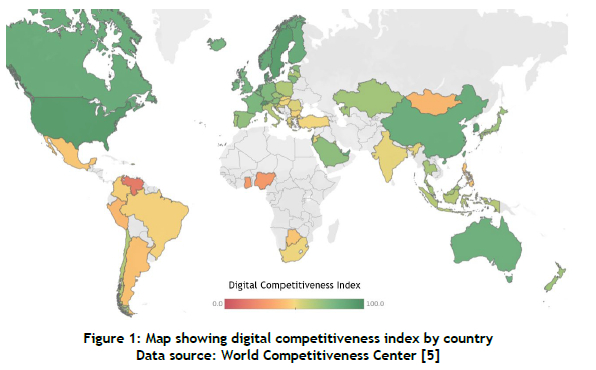
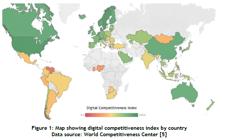
Despite these advancements, a significant gap - the 'digital divide' - exists between companies in developing versus developed (or high-income) countries regarding the effective adoption and use of innovative digital technologies. Figure 1 illustrates this divide by comparing countries across the globe according to the digital competitiveness index (DCI) [5]. This development indicator measures the extent to which countries adopt and explore digital technologies that lead to transformation, assuming that digital transformation takes place mainly at the enterprise level.
A study by Comin and Mestieri [6] suggests that, while access to technological innovations in developing countries has improved, the effective use of these technologies remains a challenge [6]. This 'implementation gap' or 'utilisation problem' results in a significant opportunity cost to companies. Recognising and understanding this issue is critical, requiring companies in developing economies to reevaluate their approach to digital innovation management in order to ensure effective use of the potential that these innovations have to offer.
Notably, South Africa ranked 54th out of the 67 countries measured by the DCI [5]. This study investigates the management of digital innovation in South Africa's financial services sector - defined here as organisations involved in banking, insurance, investments, and related activities that facilitate capital flow and manage financial risks in the broader context of a developing economy - that is, in a nation with relatively lower levels of industrialisation, infrastructure, and per capita income than those of developed countries [2].
Understanding these conditions is important for organisations or professionals seeking strategies to design, implement, and sustain digital innovations in resource-constrained contexts. The aim is to examine the challenges, success factors, and strategies for effective digital innovation management in such environments.
The study is guided by the following research questions:
I. What are the key challenges faced by companies in developing economies when it comes to implementing and managing digital innovations?
II. What are the key factors that influence the successful adoption and implementation of digital innovations in organisations?
III. What strategies could companies in developing economies adopt to overcome the barriers to the effective use of digital technology innovations?
In addressing these questions, the study seeks not only to identify the main barriers and facilitators, but also to examine how digital innovation could be effectively managed under the resource constraints that are typical of developing economies. To build this context-specific understanding, we review the relevant literature and evaluate existing innovation management approaches to see how well their principles apply in low-resource settings. Drawing on these insights, a conceptual model for digital innovation management is established. Interviews with industry leaders provide insight into the research questions and validate the conceptual model. Ultimately, this research aims to enhance our understanding of navigating digital transformations in economically challenging environments.
This section contextualises the study by reviewing the key literature on digital innovation management, with a focus on the financial services sector in developing economies.
2.1.
Digital innovation'Digital innovation' refers to the process of creating and implementing new or significantly improved products, services, processes, or business models, driven by digital technologies and by collaboration in digital ecosystems, resulting in transformative impacts on organisations, industries, and economies [7, 8, 9, 10]. It can be incremental, making modest improvements, or radical, causing significant market disruptions [11, 12]. In addition, innovations can be classified as closed - that is, controlled by one organisation - or as open - that is, involving collaboration among multiple stakeholders [13].
The financial services sector is currently undergoing a significant transformation, largely driven by the integration of emerging digital technologies. Artificial intelligence (AI) and machine learning (ML) stand at the forefront, offering unprecedented predictive and analytical capabilities [14]. JPMorgan Chase, for example, is using AI the better to detect fraudulent activities by analysing transaction data [15]. In addition, generative AI is reshaping the sector by advancing automated content creation, decision-making, and customer interactions. This technology empowers businesses to produce a variety of outputs from extensive datasets, thereby facilitating product customisation and improving risk assessment [16].
The shift towards digital-first financial services is further illustrated by the rise of mobile and digital banking platforms [17] and by large companies strategically transitioning to cloud solutions [18]. The Internet of Things (IoT) is making strides in detailed data collection and product personalisation, allowing for advancements such as tailored insurance premiums based on individual driving patterns [19], and big data and analytics continue to prove valuable for financial decision-making [20]. Blockchain technology promises secure, transparent transaction recording, and fintech innovations continue to democratise access to financial tools [21, 22]. Collectively, these technological advancements mark pivotal shifts in the business landscape, demanding agility and adaptability from companies that seek to capitalise on the opportunities they offer.
2.2.
Innovation managementInnovation management has evolved significantly from early 20th century scientific management principles, which were initially focused on operational efficiency [23], to more collaborative and dynamic models. The period from the 1960s to the 1980s was marked by the rise of corporate research and development (R&D) and technology management (TM) [24], with the introduction of stage-gate models [25] and technology roadmaps [26]. Subsequently, the late 20th century saw a shift towards open innovation [13] and knowledge management [27]. The current era is centred on digital innovation and disruptive models, driven by advancements in technologies such as AI and IoT [28], and supported by methodologies such as agile and design thinking [29].
Digital innovation management differs from traditional innovation management by placing digital technologies at the core of product, service, and process development [28]. This focus introduces new challenges for organisations, including the rapid pace of technological change [30], managing the complexity of multiple technologies and stakeholders [10], addressing the digital skill gap in the workforce [2], and heightened cybersecurity risks [2]. Furthermore, changing organisational processes and culture to embrace these digital shifts is often met with resistance [31]. However, strategies have been documented to address these challenges. Examples of these strategies are adopting agile methodologies [32], embracing open innovation and collaboration [33], investing in developing digital skills [2], and emphasising change management and organisational culture [34].
2.3. Impact of economy on innovation management
Economic context plays a significant role in shaping innovation management practices, impacting the availability of resources, market opportunities, and the competitive environment. Developed economies benefit from established infrastructure and skilled workforces, supporting a focus on advanced technologies and substantial R&D investments [2, 34]. Collaborative efforts between banks, tech giants, academic institutions, and governments are common, creating mature innovation ecosystems [30]. In contrast, developing economies navigate innovation amid multiple constraints, including limited resources, inadequate infrastructure, and a relatively unskilled workforce. These factors shape their innovation strategies towards frugal and incremental innovations that adapt existing technologies to local needs rather than introducing disruptive changes [35, 36]. The informal sector often plays a key role in grassroots innovation [37]. Large, financially stable companies in developing contexts might access global networks, potentially merging the advantages of both economic settings.
In financial services, developing economies offer major opportunities for digital innovation. Digital tools such as mobile banking and microfinance platforms can extend financial services to previously underserved populations, enabling financial inclusion and allowing these economies to bypass traditional developmental stages, a process known as 'leapfrogging' [37, 38]. The rapid growth in internet usage and smartphone ownership boosts these opportunities [2]. However, challenges such as resource limitations, regulatory hurdles, and cybersecurity threats impede innovation efforts. The emigration of skilled professionals further depletes local expertise, and the presence of large international companies increases competition, adding to the problems faced by local businesses in developing innovative solutions [30].
3. PROPOSED CONCEPTUAL FRAMEWORK
Building on the insights from the literature review, a conceptual framework designed for digital innovation management in developing economies is proposed. This framework is informed by existing frameworks in the innovation management field, and validated against the answers to the research questions in Section 5.4.
3.1. Overview and evaluation of existing theoretical frameworks for innovation management
The frameworks for this study were selected using a multi-criteria approach, assessing the relevance, applicability, breadth, and depth of each framework. Specifically, the following criteria were considered:
I. Relevance to digital innovation
II. Applicability to the financial services sector
III. Adaptability to developing economies
IV. Academic and industrial acceptance
Based on these criteria, five frameworks were selected:
a) Stage-gate model: Driven by a phased approach, this model guides new product or service development through sequential stages, separated by assessment 'gates' to manage risk and ensure project viability [25].
b) Open innovation: This model shifts from the traditional closed approach and taps into external sources for both idea generation and implementation, promoting collaboration between the company and external entities [13].
c) Dynamic capabilities: In rapidly changing environments, organisations need to adapt. This model focuses on an organisation's ability to reconfigure its resources and capabilities to address shifting landscapes [40].
d) Dual operating system: This model ensures stability through a traditional hierarchy, while simultaneously promoting agility through a separate network-like structure focused on innovation [41].
e) Technology management process framework: Tailored for technology-driven sectors, this framework aligns technological capabilities with business objectives [26].
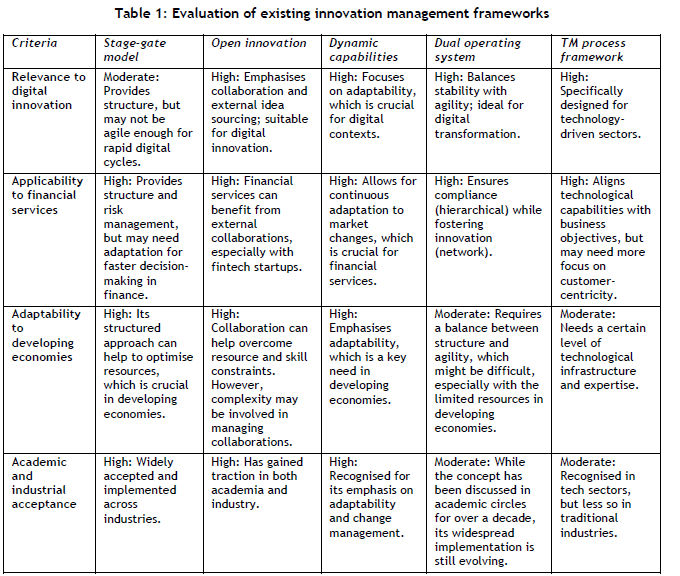
These frameworks were evaluated on the basis of their relevance for the financial services sector in developing economies. A summary of this analysis is presented in Table 1.
Each framework reflects distinct strengths in the context of managing digital innovation initiatives in developing economies, but certain gaps are left unaddressed. The stage-gate model offers a sequential, resource-efficient approach to innovation, but may not be suitable in scenarios where rapid decision-making is necessary. The dual operating system model addresses the need to balance agility with structure, but may be difficult to implement when resources are limited. Open innovation channels external resources, ideas, and partnerships effectively, although organisational complexities may be underemphasised. The dynamic capabilities model fosters adaptability in volatile environments, but does not address the practical aspects of managing innovation projects. Last, the technology management process framework aligns technology investments with business objectives, yet may place less immediate emphasis on user-centric outcomes. Viewed together, these observations suggest that selectively combining elements from each could produce a more complete model of digital innovation management in developing contexts.
Building on this comparative analysis, the study selectively adopts strengths from each framework, such as the emphasis on adaptability from dynamic capabilities and the dual operating system, structured risk management from stage-gate, and collaborative focus from open innovation, while also drawing on the technology management process framework's alignment of technical and business objectives. To address the unique resource constraints and infrastructural gaps that are typical in developing economies, we extend these concepts with an additional resilience element. The result is an integrated framework that aims to overcome the limitations identified in Table 1.
3.2. The 'digital innovation management in developing economies' framework
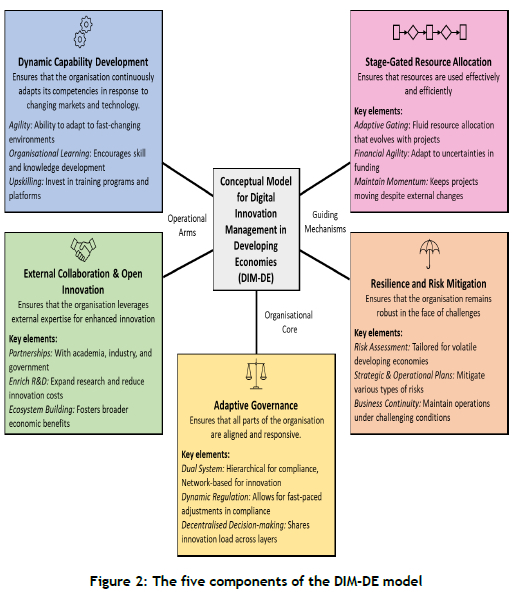
We propose the digital innovation management in developing economies (DIM-DE) framework, illustrated in Figure 2, which synthesises the insights from Section 3.1 and introduces additional resilience-focused measures that are tailored to developing contexts. Rather than functioning as a prescriptive blueprint, the DIM-DE framework provides a flexible, system-level perspective that leaders, practitioners, and industrial engineers can adapt to local circumstances. By integrating the most relevant insights from existing innovation models, it emphasises agility (drawing on dynamic capabilities and the dual operating system), external collaboration (open innovation), structured risk management (stage-gate), and resilience features specific to resource-constrained settings. This holistic approach helps to align strategy, technology, and operations in a way that remains adaptable over time. In practice, organisations can use DIM-DE as a reference for identifying gaps in current innovation processes, prioritising investments, and systematically mitigating risks, ensuring that digital initiatives are both sustainable and impactful in developing economies.
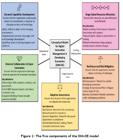
The model consists of the following five components:
a) Adaptive governance (adapted from dual operating system [42])
In a rapidly evolving digital landscape, balancing compliance and innovation becomes a challenging task, particularly in developing economies such as South Africa. Adaptive governance draws inspiration from Kotter's dual operating system, which integrates a hierarchical structure for day-to-day operations and a network-based system for innovation [42]. This dual system provides the flexibility needed for innovation while maintaining a structured foundation for compliance and control.
b)
External collaboration and open innovation (based on open innovation [13])Companies in developing economies often lack the full spectrum of resources and skills needed for innovation [13]. This component integrates Chesbrough's open innovation framework, emphasising partnerships with universities, industry peers, and governmental bodies. Such collaborations can enrich research and development, reduce the cost and risk associated with innovation, and accelerate implementation.
c)
Dynamic capability development (adapted from dynamic capabilities [40])The rapidly changing digital landscape in developing economies necessitates agile responses. Integrating Teece's work on dynamic capabilities [40], this component underlines the importance of a company's ability to reconfigure internal and external competencies to address rapidly changing environments. It stresses the need for organisational learning, skill development, and aligning technological investments with strategic business goals.
d)
Stage-gated resource allocation (adapted from stage-gate model [25])Resource allocation becomes significantly challenging in developing economies, given the uncertainties and limited sources of funding. Adapting Cooper's stage-gate model [25], this component introduces the concept of 'adaptive gating'. It calls for a more fluid and dynamic allocation process that can be adjusted as projects evolve or conditions change. This adaptability can help companies to navigate financial and operational uncertainties while maintaining project momentum.
e)
Resilience and risk mitigation (new component)Given the volatility of developing economies - be it political instability, fluctuating currencies, or sudden regulatory shifts - resilience becomes critical. This component focuses on risk assessment methodologies that are tailored to such volatile conditions.
The next sections illustrate how data from industry leaders was gathered and analysed (Section 4), and then demonstrate how the resulting insights (Section 5) both answer the research questions and validate the DIM-DE framework in a real-world context.
4. RESEARCH DESIGN AND METHODOLOGY
The research approach was designed to ensure a systematic and nuanced investigation of the research questions.
4.1.
Sampling strategyA purposive sampling method was adopted, allowing for the selection of specific organisations and individuals that were most likely to provide valuable insights. Focus companies included large financial services companies that have been in operation for over five years and that have undertaken digital innovation initiatives. Participants were selected on the basis of their experience in leadership positions related to digital innovation, technology, or strategy in their respective organisations. The sample size for this study was five participants, allowing for a focused and detailed qualitative analysis. All five participants held senior leadership roles such as chief executive officer, chief financial officer, chief risk officer, and senior solution architect. Each had direct oversight of digital innovation initiatives, ensuring that their insights reflected both the strategic and the operational dimensions of digital innovation in financial services.
4.2.
Data collectionSemi-structured, qualitative interviews served as the main method of data collection for this research. The interview questions were designed to align with the study's three main research questions, ensuring that the collected data was directly relevant to the goals of the research. Before starting each interview, written consent for voice recording was obtained from the participants to ensure data accuracy. These voice recordings were initially transcribed using OtterAI software. However, owing to inaccuracies in the automated process, each transcript underwent manual audio review and correction to ensure data precision.
4.3.
Data analysisData analysis took place at several stages of the research. The data collected from the literature review was analysed by summarising and organising the findings. This involved identifying key themes and concepts related to digital innovation, innovation management, and existing frameworks for digital innovation management, focusing on the context of developing economies. The full transcripts from the qualitative interviews were analysed manually using text coding and thematic analysis centred on the respective research questions. Microsoft Word and Excel were used for the data organisation and analysis.
4.4.
Reliability and validityFor reliability, a consistent interview protocol was used with all participants, and each interview recording was reviewed multiple times to verify transcription accuracy. For validity, the interview questions were carefully designed to align with the research questions. The participants were chosen from diverse senior leadership roles to provide multiple perspectives. An industry expert reviewed the research design and interview questions, thus enhancing their validity. Furthermore, the findings from the interviews were cross-checked, when possible, with other sources such as company reports. These procedures aimed to produce results that were both dependable and relevant to the research objectives.
5. RESULTS
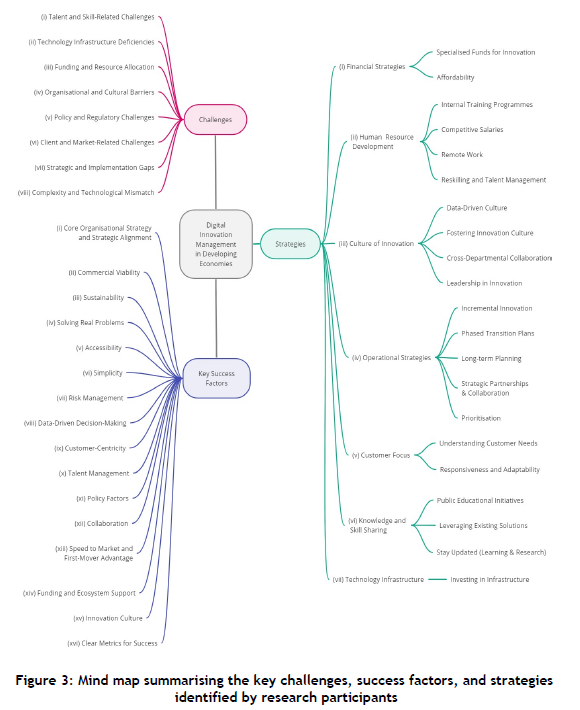
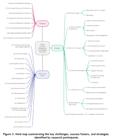
The results of the study are organised in line with the three primary research questions, integrating the data from all the participants. Distinct themes and insights emerged, shedding light on the challenges, success factors, and strategies associated with managing digital innovations in developing economies, as was our goal. These key insights are described below and summarised in Figure 3.
5.1. Key challenges in digital innovation management
This section reviews the research findings addressing Research Question I: What challenges do companies in developing economies face in implementing and managing digital innovations?
i) Talent and skill challenges: A recurring issue identified by research participants was the scarcity of skilled workers. Three interviewees highlighted difficulties in retaining individuals with essential technical skills, exacerbated when these talents seek opportunities abroad.
ii) Infrastructure issues: Four interviewees emphasised technology infrastructure problems, from unreliable systems to the need for cloud solutions, which raise other issues such as data latency and increased costs. Limited high-speed internet can also be a problem.
iii) Funding and resource constraints: Participants identified difficulty in securing funding for digital innovation, making it difficult for companies effectively to allocate the necessary resources for digital innovation initiatives.
iv) Organisational and cultural barriers: Internal resistance to change, especially during the early stages of implementation, was identified by four participants.
v) Policy and regulatory concerns: While one respondent questioned whether regulations really posed substantial challenges in innovation management, others argued that slow policy adaptation and requirements such as data localisation could sometimes be barriers.
vi) Client and market issues: Slower client technology adoption and a bias for cash transactions pose difficulties. Despite surveys indicating customer interest, actual market adoption lags, suggesting a need for enhanced market research and consumer education.
vii) Strategic and implementation gaps: Three participants highlighted a lack of sufficient planning, with companies often claiming 'strategy' without having concrete plans in place, leading to inefficient projects or outright failures.
viii) Technological complexity: Participants mentioned that older companies face challenges in updating legacy systems. However, multiple participants also cautioned against adopting 'trendy' technology merely to seem innovative.
The interviews made it clear that companies in developing economies face a wide range of challenges when it comes to managing digital innovation. These also often overlap and interact in ways that make them even more difficult to address. We illustrate the challenges and group them in the diagram in Figure 3.
5.2. Key factors influencing successful adoption
In this section, we address Research Question II: What are the key factors that influence the successful adoption and implementation of digital innovations in organisations? We summarise the findings as follows:
i)
Core organisational strategy and strategic alignment: Strategic alignment of digital innovations with overarching organisational goals was identified as an essential factor by all respondents. This element allows companies to determine which innovations to prioritise and how to allocate resources effectively.ii) Commercial viability: Four out of five respondents emphasised the necessity of a digital innovation having a strong commercial rationale. An innovation must not only align with an organisation's goals, but also have a financially sound basis for its implementation.
iii) Sustainability and long-term viability: Participants emphasised that digital solutions need to be cost-effective and sustainable for the long term, especially in developing economies where resources may be limited.
iv) Solving real problems: The importance of addressing actual client problems, or at least substantially improving existing processes, was identified by three participants as a key factor for the successful adoption of digital innovations.
v) Accessibility: Especially relevant in developing economies, the accessibility of the technology to its intended users was identified as an important factor for success. If an innovation is too complex or expensive, its chances of successful implementation are diminished.
vi) Simplicity: Simplicity in design and implementation emerged as a critical factor. For innovations to be adopted widely, they should be easy to understand. This is especially true in environments where familiarity with advanced digital solutions might be limited.
vii) Risk management: Four respondents highlighted the importance of robust risk management frameworks in successful digital adoption. These frameworks help organisations to anticipate potential setbacks and to create strategies to mitigate those risks.
viii) Data-driven decision-making: Linked to risk management, but distinct as a factor, data-driven decision-making was mentioned by three respondents. The use of data analytics and other tools allows for more nuanced decisions, positively influencing the long-term success of digital innovations.
ix) Customer-centricity: Customer-centricity and an understanding of customer behaviour were cited by all participants. Digital innovations must serve customers' needs and improve their interaction with the organisation.
x) Talent management: Talent management emerged as a recurring theme, highlighted by all five respondents. Effective management of human resources, from recruitment to reskilling, is essential for driving digital initiatives.
xi) Policy factors: Government policies and policy responsiveness were identified by two respondents as external factors that can influence the success of innovation initiatives.
xii) Collaboration: Internal and external collaboration were emphasised by three participants. Whether it is through cross-functional teamwork in the organisation or through partnerships with external entities, collaboration significantly boosts the potential for success.
xiii) Speed to market and first-mover advantage: One respondent highlighted that being first to market allows a company to capture the entire market share from the start. While this advantage diminishes over time as competitors enter the market, the first-mover advantage can provide a valuable boost in the adoption phase.
xiv) Funding and ecosystem support: The availability of sufficient early-stage funding and a supportive ecosystem were cited by two respondents as necessary conditions for successful digital adoption. These factors can provide the initial momentum required to get digital projects off the ground and to guide them towards successful implementation.
xv) Sub-themes: A few emerging sub-themes arose. These factors included a culture of innovation and clear metrics for success.
The data suggested an intricate landscape of factors influencing the successful implementation of digital innovations. Each factor provided a unique lens through which to understand the complexities involved in digital innovation management in a developing economy context.
5.3. Strategies for overcoming barriers
Considering the key challenges in innovation management, and the key factors influencing the successful adoption of digital technologies, we now review the findings for Research Question II: What strategies could companies in developing economies adopt to overcome the barriers to the effective use of digital technology innovations? Our respondents highlighted the following:
i)
Financial strategiesSpecialised funds for innovation: Establishing specialised funds can safeguard financial resources specifically for innovation. This strategy could help to address the barrier of lacking initial capital investment to kick-start innovative projects.
Affordability: Making digital solutions more affordable could help to lower the cost barrier and make technology more accessible to a broader user base, encouraging wider adoption.
ii)
Human resource developmentInternal training programmes: A recurring recommendation was the introduction of internal training programmes aimed at upskilling current employees. This strategy is particularly relevant for companies facing local talent shortages.
Reskilling and talent management: Employee potential could also be maximised through reskilling programmes, thereby managing the existing human resources more effectively.
Competitive salaries: Offering competitive salaries is a key strategy for addressing attraction and retention, potentially overcoming the talent scarcity barrier.
Remote work: Introducing or expanding remote work options could tap into global talent pools, which could help to overcome the challenges of local talent shortages.
iii)
Culture of innovationData-driven culture: Instituting a culture that emphasises data-driven decision-making could provide a more structured and evidence-based approach to innovation. This would be particularly useful for managing the risks associated with new digital initiatives.
Fostering innovation culture: Several interviewees recommended establishing internal platforms on which employees could propose and collaborate on new projects. This would create fertile ground for grassroots-level innovation in the company.
Cross-departmental collaboration: Innovation should be a company-wide endeavour. By encouraging cross-departmental collaboration, companies could increase the likelihood that innovative solutions would be comprehensive and sustainable.
Leadership in innovation: Having senior leaders who are well-versed in fostering a culture of innovation could guide teams effectively, acting as a compass during the company's innovation journey.
iv)
Operational strategiesIncremental innovation: Smaller, more manageable changes can accumulate over time to yield substantial benefits. This approach would reduce the risk and cost associated with larger, more disruptive innovations.
Phased transition plans: Participants recommended structured, step-by-step plans for implementing new digital innovations. A phased approach could make transitions more manageable and less jarring for both employees and customers.
Long-term planning: The need for a long-term view in planning was emphasised, allowing for better resource allocation and reducing the chances of scope creep and budget overruns.
Strategic partnerships and collaboration: Partnering externally could provide access to additional resources and expertise. These partnerships could include agreements with universities, third-party vendors, startups, or other established companies.
Prioritisation: Strategic choices should be made on the basis of both immediate needs and available resources, facilitating the effective allocation of resources.
v)
Customer focusUnderstanding customer needs: A customer-centric approach is vital. By understanding and addressing customer pain points, companies could develop innovations that were not only novel but also truly needed.
Responsiveness and adaptability: Using agile methodologies could facilitate rapid testing and adaptation, helping companies to adjust their digital offerings more quickly in response to customer needs and market changes.
vi)
Knowledge and skill sharingEducational initiatives: Public educational initiatives could raise general awareness about the benefits of digital innovation, addressing the barrier of limited public understanding.
Leveraging existing solutions: Using pre-existing platforms and solutions could significantly speed up the implementation process. This strategy could overcome barriers related to development time and technical challenges.
Stay updated: Regular time for learning and research is crucial for staying current with new developments in digital technology, helping companies to adapt and remain competitive.
vii)
Technology infrastructureInvesting in infrastructure: Companies could actively invest or collaborate with governmental agencies or other companies to improve digital infrastructure such as network coverage, addressing one of the most basic barriers to digital adoption in developing economies.
By thoroughly understanding and applying these multifaceted strategies, companies in developing economies could position themselves better to overcome the various barriers they face by effectively using digital technology innovations.
5.4. Validation of the conceptual framework
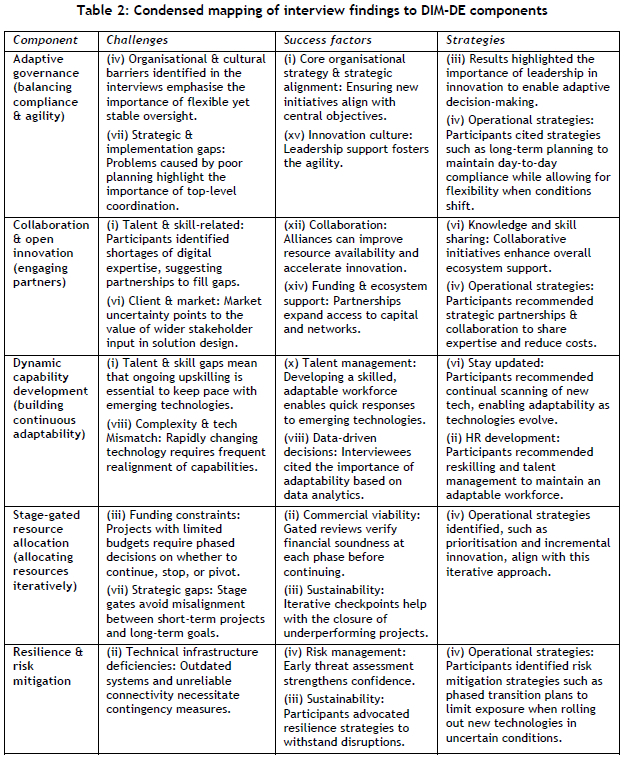
Having reviewed the main challenges (Section 5.1), success factors (Section 5.2), and practical strategies (Section 5.3) identified by leaders in innovation management, we were able to connect these empirical observations to the DIM-DE framework by mapping each finding to the framework's core components, validating how DIM-DE aligns with real-world insights from the financial services sector. Table 2 provides a summary of a selection of these mappings.
Overall, our interview results indicate that each component of the framework is supported by participant feedback.
i)
Adaptive governanceThe research results support the adaptive governance element of the DIM-DE framework. The participants emphasised the importance of agile governance in striking a balance between structure and innovation. The suggestion of combining more rigid structures for operational tasks with network-based systems for innovation illustrates how this balance could be achieved.
ii)
Collaboration and open innovationIt is evident from the interview data that external partnerships can help to bridge internal talent gaps, accelerate the innovation process, and bring in valuable market insights, emphasising the need for a culture of openness and sharing.
iii)
Dynamic capability developmentOrganisations in developing economies face a pressing challenge in equipping themselves with the necessary skills for digital innovation. The findings suggest an emphasis on continuous learning, organisational strategy, and talent management to address this gap. These results support the dynamic capability development component of the framework.
iv)
Stage-gated resource allocationThe importance of efficient and flexible resource allocation is highlighted by the research results, suggesting the 'adaptive gating' method as a promising approach to ensure continuity and responsiveness in resource allocation amid evolving project demands.
v)
Resilience and risk mitigationThe data provides insight into the difficulties created by an unpredictable economic environment, and underlines the importance of aligning risk strategies with business objectives. The findings also highlight the important role of technological infrastructure in enhancing resilience.
6. CONCLUSION AND RECOMMENDATIONS
Our research addressed critical questions about the challenges and factors that influence the adoption and management of digital innovations in developing economies, using the financial services sector of South Africa as an example. The findings indicate that companies in these contexts face a complex array of obstacles, including skill shortages, cultural resistance to change, inadequate infrastructure, and funding and resource constraints. These issues are often interconnected, making the adoption of new technologies significantly more difficult.
From the study, it is evident that successful digital innovation depends on several key factors: the alignment of innovations with strategic business goals, the practicality and relevance of these innovations in solving real-world problems, and ensuring that they are user-friendly and economically viable. Equally important is the establishment of a risk-aware culture that promotes data-driven decision-making and prioritises customer needs.
To navigate these challenges, companies should consider diverse strategies. Developing talent through competitive remuneration and continuous training, fostering a culture of innovation, and adopting incremental implementation strategies could all contribute to a more effective digital transformation. Strategic partnerships and a strong focus on customer feedback could also play critical roles in overcoming barriers to technology adoption.
The study provides valuable academic and practical insights into digital innovation management in a less-developed market. Academically, it addresses a research gap by exploring unique local challenges and introducing the DIM-DE model, which could serve as a reference for future studies in this area. Practically, it offers actionable recommendations for companies.
Although the qualitative approach provided rich insights, the small sample of five senior leaders limited the range of perspectives. In addition, the scope was confined to a single sector (financial services) and a single national context (South Africa), which may not have captured the diversity of experiences in other industries or regions. These factors limit the generalisability of the conclusions. In future research, expanding the scope to include a larger sample size and more geographic locations, industry sectors, and employee roles could provide broader insights and more generalisable results. Surveys and observations could complement the qualitative interviews and address potential biases, offering a more rounded perspective. Further studies might explore the application and effectiveness of the strategies identified here, helping to refine our understanding of digital innovation management in developing economies.
By continuing to explore these themes, we could enhance our understanding of digital innovation and its critical role in economic development.
REFERENCES
2. LITERATURE REVIEW
-
[1] Broughel, J. & Thierer, A. 2019. Technological innovation and economic growth: A brief report on the evidence. Mercatus Research Paper. Available: http://dx.doi.org/10.2139/ssrn.3346495
» http://dx.doi.org/10.2139/ssrn.3346495 - [2] Cirera, X., Comin, D. & Cruz, M. 2022. Bridging the technological divide: Technology adoption by companies in developing countries. Washington DC: World Bank Group.
- [3] Aly, H. 2020. Digital transformation, development and productivity in developing countries: Is artificial intelligence a curse or a blessing? Review of Economics and Political Science, 7(4).
- [4] Choi, J., Dutz, M. & Usman, Z. 2020. The future of work in Africa: Harnessing the potential of digital technologies for all. Washington DC: International Bank for Reconstruction and Development, The World Bank.
- [5] IMD. 2024. IMD world digital competitiveness ranking 2024: The digital divide: Risks and opportunities. Lausanne, Switzerland: Institute for Management Development (IMD).
- [6] Comin, D.A. & Mestieri, M. 2018. If technology has arrived everywhere, why has income diverged? American Economic Journal: Macroeconomics, 10(3):137-178.
- [7] Fichman, R.G., Dos Santos, B.L. & Zheng, Z. 2014. Digital innovation as a fundamental and powerful concept in the information systems curriculum. MIS Quarterly, 38(2):329-343.
- [8] Nylén, D. & Holmström, J. 2015. Digital innovation strategy: A framework for diagnosing and improving digital product and service innovation. Business Horizons, 58(1):57-67.
- [9] Yoo, Y., Henfridsson, O. & Lyytinen, K. 2010. The new organizing logic of digital innovation: An agenda for information systems research. Information Systems Research, 21(4):724-735.
- [10] Gobble, M.M. 2018. Digital strategy and digital transformation. Research-Technology Management, 61(5):66-71.
- [11] Garcia, R. 2002. A critical look at technological innovation typology and innovativeness terminology:A literature review. Journal of Product Innovation Management, 19(2):110-132.
- [12] Christensen, C.M. 1997. The innovator's dilemma: When new technologies cause great firms to fail.
- [13] Chesbrough, H. 2003. Open innovation: The new imperative for creating and profiting from technology. Boston MA: Harvard Business Press.
- [14] Russell, S. & Norvig, P. 2020. Artificial intelligence: A modern approach 4th ed. Pearson.
- [15] JPMorgan Chase. 2018. JPMorgan Chase Annual Report 2018. JPMorgan Chase & Co.
-
[16] Chen, B., Wu, Z. & Zhao, R. 2023. From fiction to fact: The growing role of generative AI in business and finance. Journal of Chinese Economic and Business Studies, 21(4):471-496. Available: https://doi.org/10.1080/14765284.2023.2245279
» https://doi.org/10.1080/14765284.2023.2245279 - [17] Agnihotri, A. & Bhattacharya, S. 2023. Chime Neobank: A new business model in the banking sector. SAGE Publications: SAGE Business Cases Originals.
-
[18] Perkel, A. 2022. Doing the hard things first: Lessons from our cloud journey. Capital One [Online]. Available: https://www.capitalone.com/software/blog/doing-the-hard-things-first [Accessed June 17, 2023].
» https://www.capitalone.com/software/blog/doing-the-hard-things-first -
[19] Progressive. 2015. Safer drivers pay less for car insurance with Snapshot Pay As You Drive insurance program from Progressive. [Online]. Available: https://progressive.mediaroom.com/2015-05-20-Safer-Drivers-Pay-Less-for-Car-Insurance-with-Snapshot-Pay-As-You-Drive-Insurance-Program-from-Progressive [Accessed July 16, 2023].
» https://progressive.mediaroom.com/2015-05-20-Safer-Drivers-Pay-Less-for-Car-Insurance-with-Snapshot-Pay-As-You-Drive-Insurance-Program-from-Progressive - [20] Davenport, T.H. 2014. Big data at work: Dispelling the myths, uncovering the opportunities. Boston MA: Harvard Business Review Press.
- [21] Narayanan, A., Bonneau, J., Felten, E., Miller, A. & Goldfeder, S. 2016. Bitcoin and cryptocurrency technologies: A comprehensive introduction. Princeton NJ: Princeton University Press.
- [22] Zavolokina, L., Dolata, M. & Schwabe, G. 2016. The FinTech phenomenon: Antecedents of financial innovation perceived by the popular press. Financial Innovation, 2(1):16.
- [23] Taylor, F.W. 1911. The principles of scientific management. Harper & Brothers.
- [24] Rothwell, R. 1994. Towards the fifth-generation innovation process. International Marketing Review, 11(1):7-31.
- [25] Cooper, R.G. 1990. Stage-gate systems: A new tool for managing new products. Business Horizons, 33(3):44-54.
- [26] Phaal, R., Farrukh, C.J.P., & Probert, D.R. 2004. Technology roadmapping: A planning framework for evolution and revolution. Technological Forecasting and Social Change, 71(1-2):5-26.
- [27] Nonaka, I. & Takeuchi, H. 1995. The knowledge-creating company: How Japanese companies create the dynamics of innovation. Oxford University Press.
- [28] Nambisan, S., Lyytinen, K., Majchrzak, A. & Song, M. 2017. Digital innovation management: Reinventing innovation management research in a digital world. MIS Quarterly, 41(1):223-238.
- [29] Brown, T. 2008. Design thinking. Harvard Business Review, 86(6):84-92.
- [30] Yee, L., Chui, M., & Roberts, R. 2024. Technology trends outlook 2024. 16 July 2024. New York: McKinsey & Company.
-
[31] Kane, G.C., Palmer, D., Phillips, A.N., Kiron, D., & Buckley, N. 2015. Strategy, not technology, drives digital transformation. MIT Sloan Management Review and Deloitte University Press [Online]. Available: https://sloanreview.mit.edu/projects/strategy-drives-digital-transformation [Accessed August 14, 2023].
» https://sloanreview.mit.edu/projects/strategy-drives-digital-transformation - [32] Sutherland, J. 2014. Scrum: The art of doing twice the work in half the time. New York: Crown Business.
- [33] Chesbrough, H. 2006. Open innovation: A new paradigm for understanding industrial innovation. In Chesbrough, H., Vanhaverbeke, W., & West, J. (Eds.), Open innovation: Researching a new paradigm, 1-12. Oxford University Press.
- [34] Fagerberg, J. & Srholec, M. 2008. National innovation systems, capabilities, and economic development. Research Policy, 37(9):1417-1435.
-
[35] Bhatti, Y.A. & Ventresca, M. 2013. How can 'frugal innovation' be conceptualized? Available: http://dx.doi.org/10.2139/ssrn.2203552
» http://dx.doi.org/10.2139/ssrn.2203552 - [36] Govindarajan, V. & Ramamurti, R. 2011. Reverse innovation, emerging markets, and global strategy. Global Strategy Journal, 1(3-4):191-205.
-
[37] Chen, M.A. 2005. Rethinking the informal economy: Linkages with the formal economy and the formal regulatory environment. World Institute for Development Economic Research (UNU-WIDER), Working Papers. Available: https://www.wider.unu.edu/sites/default/files/rp2005-10.pdf
» https://www.wider.unu.edu/sites/default/files/rp2005-10.pdf - [38] Demirguc-Kunt, A., Klapper, L., Singer, D., Ansar, S. & Hess, J. 2018. Global Findex Database 2017: Measuring financial inclusion and the fintech revolution. Washington DC: World Bank.
- [39] Aker, J.C. & Mbiti, I.M. 2010. Mobile phones and economic development in Africa. Journal of Economic Perspectives, 24(3):207-232.
- [40] Teece, D.J. 1997. Dynamic capabilities and strategic management. Strategic Management Journal, 18(7):509-533.
- [41] Kotter, J. 2014. Accelerate: Building strategic agility for a faster-moving world. Boston MA: Harvard Business Review Press.
- [42] Kotter, J. 2012. Accelerate! Harvard Business Review, 90(11):45-58.
Accepted for publication 6 Feb 2025
Available online 30 May 2025
M. Higgo
https://orcid.org/0009-0005-5159-3613
L. Botha
https://orcid.org/0009-0000-2974-9451
* Corresponding author: