Contemporaneous varicella and zoster or disseminated zoster? A diagnostic challenge in an HIV-positive child
Abstract
Primary infection with Varicella-Zoster virus causes varicella (chickenpox). Thereafter, following reactivation after a period of latency, it can cause zoster (shingles). Simultaneous occurrence of varicella and zoster is rare, particularly in children. CONTRIBUTION: We describe an 11-year-old girl, HIV-positive, but not receiving antiretrovirals, who presented with contemporaneous varicella and zoster, with the possibility of disseminated zoster also considered
varicella; zoster; Varicella-Zoster virus; contemporaneous; disseminated
Introduction
Varicella-Zoster virus (VZV) is a globally distributed, highly infectious herpes virus. It is airborne, with transmission via respiratory droplets or through direct contact with fluid within the blisters it causes. It causes two clinically distinguishable diseases, varicella (chickenpox) and zoster (shingles).12
Zoster occurs with reactivation of latent VZV infection. During primary infection, VZV migrates to the dorsal root ganglia or sensory ganglia of cranial nerves, where it remains dormant until reactivation. With reactivation, it moves down to the axon to cause skin lesions in the relevant dermatome. Skin lesions may be preceded by a painful, burning sensation, followed by evolution to vesicles.3
Rapid reactivation of VZV resulting in zoster prior to resolution of varicella lesions is very rare in children and has only been reported in a few cases. Most published cases describe zoster in children who have received VZV vaccine.4,51,6
Case report
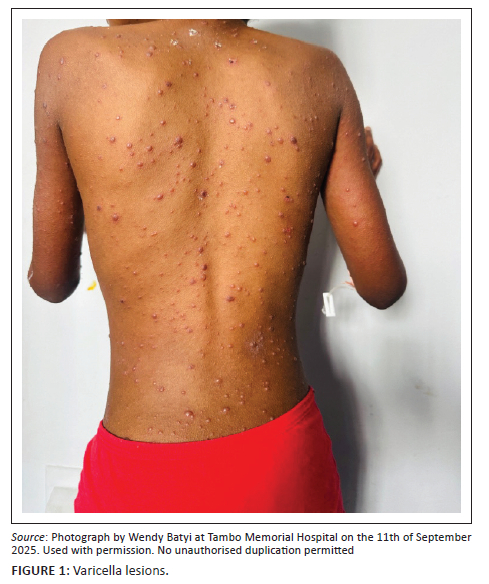
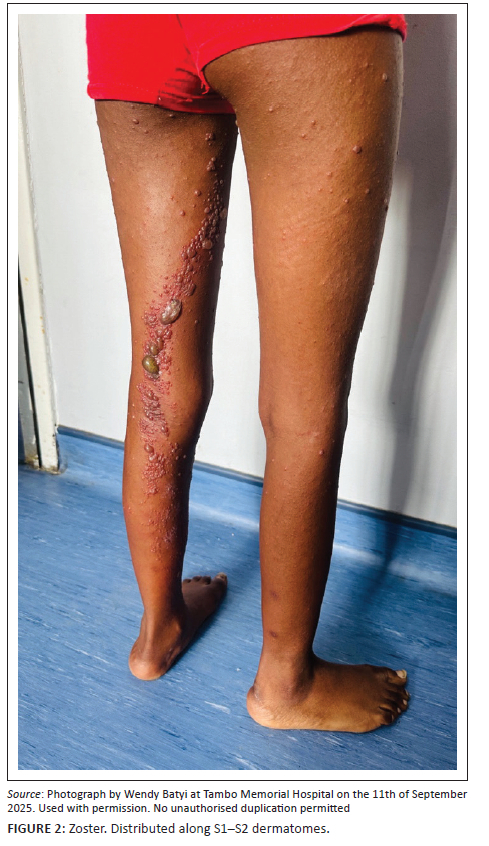
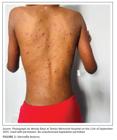
An 11-year- old girl presented with a 5-day history of skin lesions. Her initial symptoms were a fever and pain in her left hip, which limited her ability to walk. After 2 days, scattered papular and vesicular lesions appeared on her left hip, spreading to the lower trunk, upper limbs, face and then the rest of the lower limbs (Figure 1 and Figure 2). When the lesions spread to both lower limbs, that is when blisters in a linear pattern were observed on the posteromedial aspect of the left lower limb.
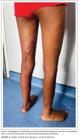
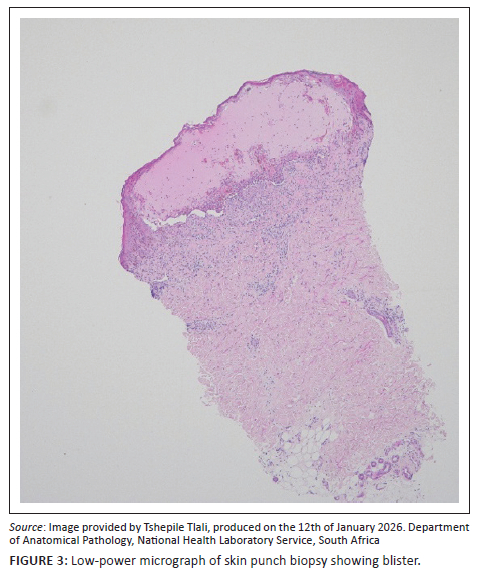
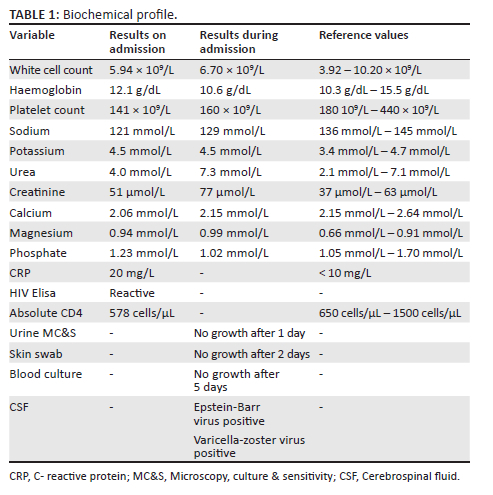
No previous history of varicella infection or vaccination could be elicited. She did not have any close contacts infected with varicella. Her mother was known to be HIV-positive, and the patient received nevirapine and zidovudine postnatally. Her birth and 10-week HIV polymerase chain reaction (PCR) were negative. She was breast-fed for 18 months but was not retested following cessation of breastfeeding. On presentation, she had generalised vesicular lesions and linear left leg vesicular lesions (S1-S2 dermatomes). She did not have mucosal involvement. Initial investigations included an HIV ELISA, which was reactive. A full blood count, urea and electrolytes, C-reactive protein, blood culture, urine microscopy, culture and sensitivity were done because the patient was suspected of having sepsis, considering the accompanying fever and tachypnoea she had. Subsequent testing revealed an absolute cluster of differentiation 4 (CD4) count = 578/µL and an HIV viral load = 19 287 copies/mL. Cerebrospinal fluid analysis was positive for Varicella-Zoster virus and Epstein- Barr virus. A skin swab cultured no pathogenic bacteria (see Table 1). Chest and left leg X-rays were normal. Skin biopsy of a leg and trunk lesion revealed histological features of VZV infection with an intra- epidermal blister containing serous fluid and neutrophils (Figure 3).
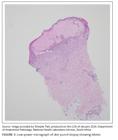
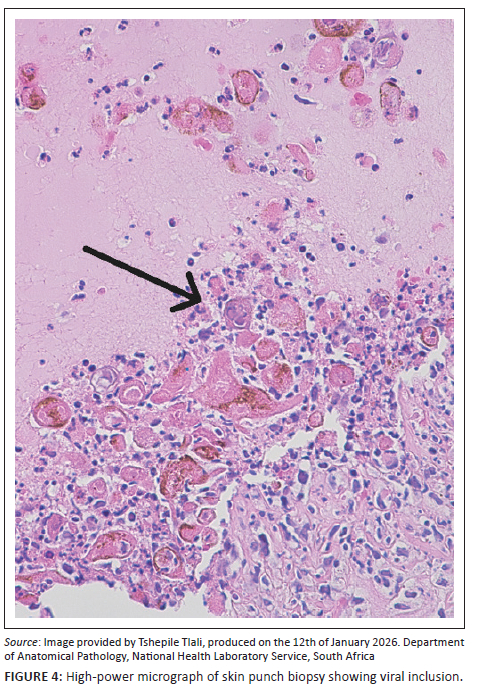
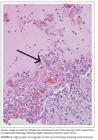
Adjacent keratinocytes demonstrated eosinophilic intranuclear inclusions with chromatic margination, nuclear moulding and multinucleation (Figure 4, arrow). Immunochemistry was positive for varicella-zoster virus and negative for the herpes simplex virus (images not shown). She received 400 mg of intravenous acyclovir 8-hourly. Ampicillin and gentamicin were started for suspected sepsis but were discontinued after 2 days.
Subsequently amoxicillin-clavulanic acid was given for 5 days while waiting for blood culture results. Carbamazepine (200 mg) was initially prescribed for neuropathic pain but was replaced with amitriptyline (10 mg) after 1 day, as this is the recommended drug for herpetic neuralgia. The patient received acyclovir for 7 days and was then discharged with healing skin lesions to start antiretroviral treatment as an outpatient.
Discussion
Zoster is less common in children than in adults, and risk factors include primary VZV infection in infancy and immunosuppressive state, e.g. chemotherapy, other immunosuppressive drugs and HIV infection.1,4,7
Two immunocompetent children with simultaneous varicella and zoster have been reported.1,61
Conclusion
Though rare, contemporaneous varicella and zoster occur in children. It can affect immunocompetent and immunocompromised children. Disseminated zoster is not uncommon in HIV-positive children who are not on antiretrovirals. Clinical vigilance is especially important for the immunocompromised child, such as in our newly diagnosed HIV patient, so as to institute prompt treatment with acyclovir, as the risk of complications is higher in this group of patients.
Competing interest
The authors declare that they have no financial or personal relationships that may have inappropriately influenced them in writing this article.
CRediT authorship contribution
Wendy Batyi: Conceptualisation, Writing - original draft. Tshepile Tlali: Resources, Writing - review & editing. Preethi John: Writing - review & editing. Matilda Mphahlele: Conceptualisation, Writing - review & editing. All authors reviewed the article, contributed to the discussion of results, approved the final version for submission and publication, and take responsibility for the integrity of its findings.
Ethical considerations
Ethical clearance to conduct this study was obtained from the Human Research Ethics Committee of the University of the Witwatersrand (Ref. No. M251178).
Funding information
This research received no specific grant from any funding agency in the public, commercial or not-for-profit sectors.
Data availability
The authors confirm that the data supporting the findings of this study are available within the article.
Disclaimer
The views and opinions expressed in this article are those of the authors and are the product of professional research. They do not necessarily reflect the official policy or position of any affiliated institution, funder, agency or that of the publisher. The authors are responsible for this article's results, findings and content.
Acknowledgements
The authors wish to thank the dedicated staff in the Paediatrics Department at Tambo Memorial Hospital for their collaboration and carrying out the treatment recommendations made by the Dermatology team.
References
-
1.Miranda MF, Guerra APB, De Oliveira e Castro TSM, Godinho SMGG. Concomitant presentation of varicella and herpes zoster - Is it possible? Pediatric Oncall J. 2018;15(4):103-105. https://doi.org/10.7199/ped.oncall.2018.49
» https://doi.org/10.7199/ped.oncall.2018.49 -
2.Saleh HM, Ayoade F, Kumar S. Varicella-Zoster virus (Chickenpox) [homepage on the Internet]. Treasure Island, FL: StatPearls Publishing; 2025 [cited 2026 Feb 18]. Available from: https://pubmed.ncbi.nlm.nih.gov/28846365/
» https://pubmed.ncbi.nlm.nih.gov/28846365/ -
3.Nair PA, Patel BC. Herpes zoster [homepage on the Internet]. Treasure Island, FL: StatPearls Publishing; 2025 [cited 2026 Feb 16]. Available from: https://pubmed.ncbi.nlm.nih.gov/28722854/
» https://pubmed.ncbi.nlm.nih.gov/28722854/ -
4.Alghamdi F, Dajam M, Abualola A, Alomari A. Herpes zoster in a 4-year-old immunocompetent child: A case report. Authorea. 2025;1:1-3. https://doi.org/10.22541/au.174295995.50215948/v1
» https://doi.org/10.22541/au.174295995.50215948/v1 -
5.Moodley A, Swanson J, Grose C, Bonthius DJ. Severe herpes zoster following varicella vaccination in immunocompetent young children. J Child Neurol. 2019;34(4):184-188. https://doi.org/10.1177/0883073818821498
» https://doi.org/10.1177/0883073818821498 -
6.Memarian S, Khodabandeh M, Gharib B. The very rare concurrency of herpes zoster and varicella in a 4-year-old boy. Int J Pediatr. 2020;8(6):114257-114428. https://doi.org/10.22038/ijp.2020.46220.3765
» https://doi.org/10.22038/ijp.2020.46220.3765 -
7.Strozak A, Misztela-Lisiecka E, Waska G, Nowakowski P, Miernik-Skrzypczak MA. Risk factors and clinical features of herpes zoster in children: A case series. Cureus. 2025;17(9):e92147. https://doi.org/10.7759/cureus.92147
» https://doi.org/10.7759/cureus.92147

Accepted: 06 Apr. 2026
Published: 25 May 2026