Factors associated with Klebsiella pneumoniae colonisation in adults hospitalised in Johannesburg, South Africa
Abstract
BACKGROUND: There is a paucity of data on gastrointestinal colonisation with Klebsiella pneumoniae (KPn) in African adults, although it is a known risk factor for developing KPn invasive disease (KPn-ID). OBJECTIVES: We investigated the risk factors for KPn gastrointestinal colonisation among a cohort of hospitalised adults without KPn-ID in South Africa, and described their clinical outcomes. METHOD: A cohort of hospitalised adults without KPn-ID was enrolled between 15 May 2023 to 14 May 2024 across three hospitals in Johannesburg, South Africa. Study participants had rectal swab cultures performed once, at enrolment, to determine the presence or absence of KPn gastrointestinal colonisation, and were followed up until in-hospital death or discharge. RESULTS: Among the cohort of hospitalised adults without KPn-ID (n = 651), the rate of KPn gastrointestinal colonisation was 34.4% (224/651). Risk factors for KPn colonisation were peptic ulcer disease (adjusted odds ratio [aOR] 7.75; 95% confidence interval [CI]: 1.34-44.78), a central venous catheter (aOR 3.07; 95% CI: 1.00-9.40), a presumed healthcare-associated infection (pHAI) (aOR 3.13; 95% CI: 1.06-9.28), and length of stay more than seven days prior to enrolment (aOR 1.84; 95% CI: 1.23-2.75). There was no difference in in-hospital case fatality risk (CFR) between participants with (3.1%; 7/224) and without (3.0%; 13/427, p = 0.955) KPn colonisation. CONCLUSION: KPn gastrointestinal colonisation rates among hospitalised adults without KPn-ID were higher than that of high-income settings and also varied between study sites. Length of hospital admission prior to swabbing and pHAI were associated with KPn colonisation, suggesting that infection prevention control measures play a significant role in KPn colonisation. CONTRIBUTION: Large prospective cohort studies and community surveillance studies are required in settings such as ours to further investigate KPn colonisation dynamics and explore preventive strategies against KPn-ID.
Klebsiella pneumoniae; invasive disease; gastrointestinal colonisation; infection prevention and control; presumed healthcare-associated infection; central venous catheter
Introduction
The rise in Klebsiella pneumoniae (KPn) antimicrobial resistance (AMR) has contributed to high mortality rates from KPn-invasive disease (KPn-ID), including bloodstream infections (BSIs).123
Klebsiella pneumoniae is ubiquitous in the environment and can be present as a commensal in the gastrointestinal tract and nasopharynx of humans.45,67895,6,85,10
There is a paucity of data on the prevalence of colonisation with antimicrobial-susceptible or 'wild-type' KPn in hospitalised adults in Africa. A systematic review and meta-analysis of gut mucosal colonisation with extended-spectrum beta-lactamase (ESBL) producing Enterobacterales in sub-Saharan Africa (of which 60.0% of participants were adults) reported a pooled community colonisation prevalence of 18.0% (95% confidence interval [CI]: 12.0% - 28.0%).1111Enterobacterales (CRE) infections and colonisation in mainly African hospital settings (92.9%), identified Klebsiella species as the most prevalent CRE pathogen in most invasive and colonising isolates (72.2%; n = 11315/15666).121213
We investigated the risk factors for KPn gastrointestinal colonisation amongst hospitalised adults without KPn-ID in Johannesburg, South Africa. Furthermore, we compared clinical outcomes in colonised versus uncolonised participants. The findings on the 'clinical and microbiological epidemiology of KPn-ID' of the participants with KPn-ID have been previously reported.14
Research methods and design
Study design and study population
We undertook a prospective observational study from 15 May 2023 to 14 May 2024 across three academic hospitals in Johannesburg, South Africa, with study sites as previously described1414,151414,1614,1714
Microbiological identification
Traditional microbiology culture methods were performed for the identification of KPn, and confirmation done with Analytical Profile Index (API) (bioMereux, France) 20E. At the University of the Witwatersrand-Vaccines and Infectious Diseases Analytics Research Unit (Wits-VIDA) laboratory, rectal swab samples were transferred to brain heart infusion (BHI) broth prior to being vortexed for 60 s to release microorganisms into the nutrient broth. The swabs were then incubated in the BHI broth for 24 h at 37 °C.
Following enrichment, 50 uL of the BHI broth was inoculated onto Colorex Orientation Agar plates (Media Mage, South Africa) and then incubated at 37 °C for up to 48 h. Following growth, colonies were identified by morphology, as well as a chromogenic colour change, and presumptive KPn identification was confirmed on isolates with API (bioMereux, France) 20E (for Gram-negative bacteria). Phenotypic antimicrobial susceptibility testing (AST) was not performed on KPn isolated from rectal swabs.
Record review
As per the main study, hospitalised adults without KPn-ID were approached to consent for study participation.1414
Participants were classified as having pHAIs if the sample from which a non-KPn organism was cultured was obtained ≥ 48 h after admission to the hospital, or if there was previous contact with a healthcare service in the preceding 2 weeks. Presumed community-associated infections (pCAIs) were defined as a non-KPn organism cultured from a sample obtained < 48 h after admission, and no record of previous contact with a healthcare service in the preceding 2 weeks. The quick Sepsis Related Organ Failure Assessment (qSOFA) score was used to compare the severity of illness in the colonised and uncolonised participants. The qSOFA score uses three criteria, assigning one point for low blood pressure (systolic blood pressure [SBP] ≤ 100 mmHg), high respiratory rate (≥ 22 breaths per minute), or altered mentation (Glasgow coma scale < 15). The Charlson Comorbidity Index (CCI) was calculated by extracting information on comorbidities from the clinical records of all participants at enrolment.141414
Statistical analysis
Continuous variables were described using medians and interquartile ranges (IQRs). Categorical variables were summarised using frequencies and percentages. To test for significant differences between two groups (colonised and uncolonised participants), the chi-squared test was used for categorical variables, while the independent t-test was used for continuous variables. Logistic regression was used to determine risk factors for gastrointestinal colonisation amongst hospitalised adults without KPn-ID. Adjusted odds ratios [aORs] and 95% CIs for gastrointestinal colonisation were reported. Variables included in the multivariable logistic regression were variables in which the unadjusted p-value was < 0.1. Statistical analysis was performed using Stata/Standard Edition (SE) version 19.5SE.0 (StataCorp, College Station, Texas, United States [US]). A p-value < 0.05 was considered statistically significant.
Ethical considerations
Ethical clearance to conduct this study was obtained from the Human Research Ethics Committee (HREC), University of the Witwatersrand (No. M220960), and registered on the South African National Health Research Database (reference number: GP202209026). Written informed consent was obtained for all participants enrolled during their hospital admission.
Results
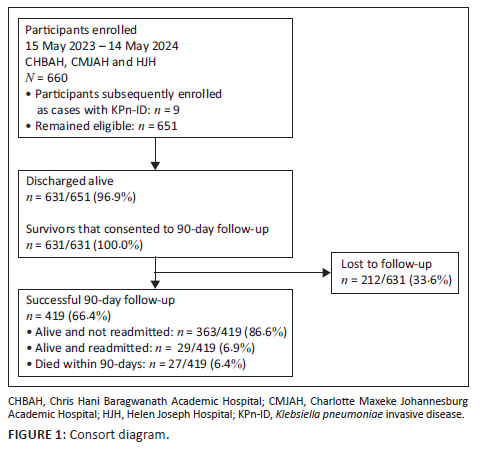
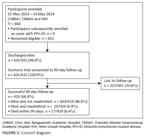
Six hundred and sixty participants without KPn-ID were enrolled. Nine individuals subsequently developed KPn-ID, including three with and six without KPn rectal colonisation at the time of enrolment as controls; Figure 1. All nine were subsequently re-enrolled as cases in the main cohort investigating KPn-ID,14
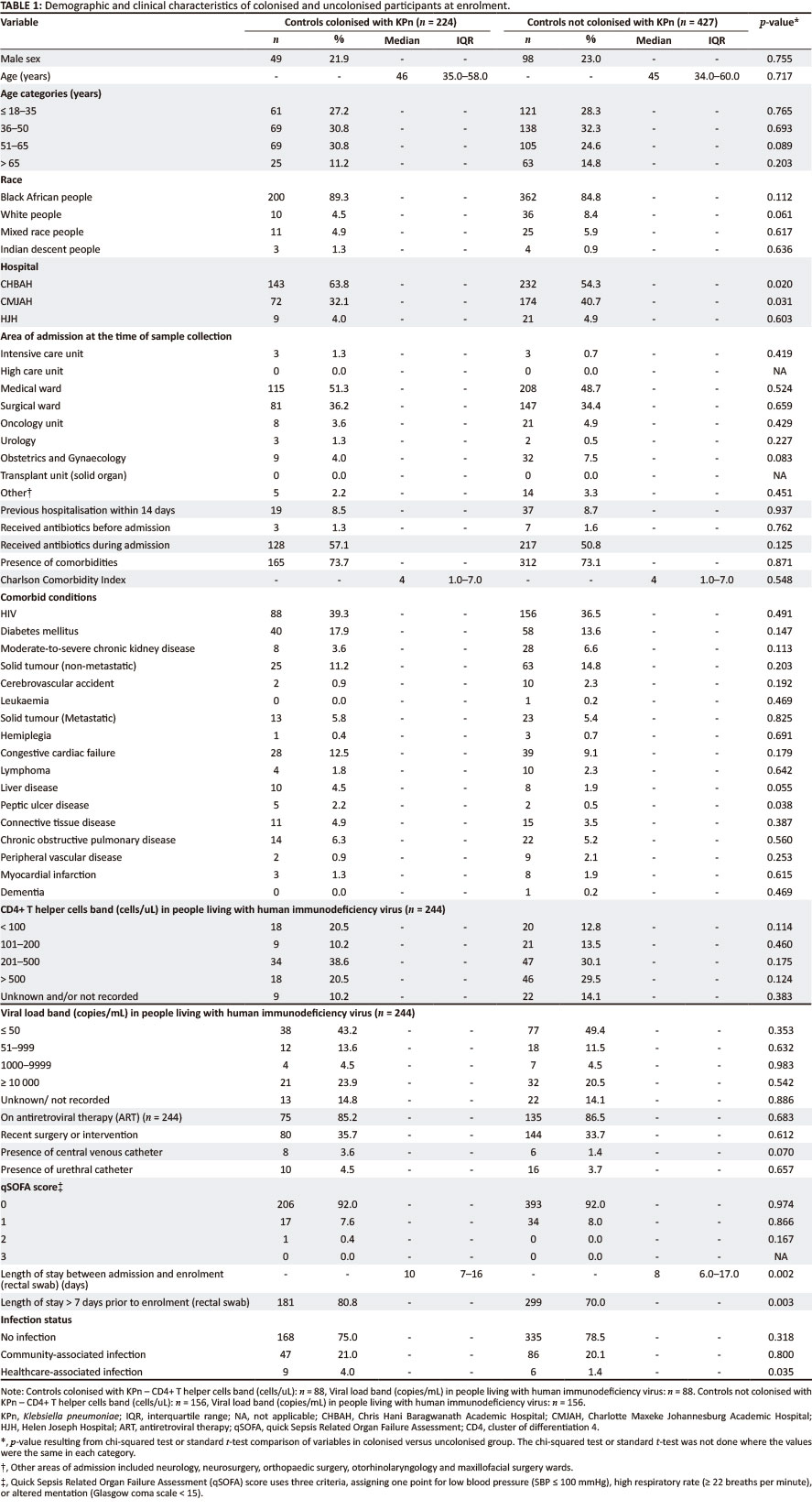
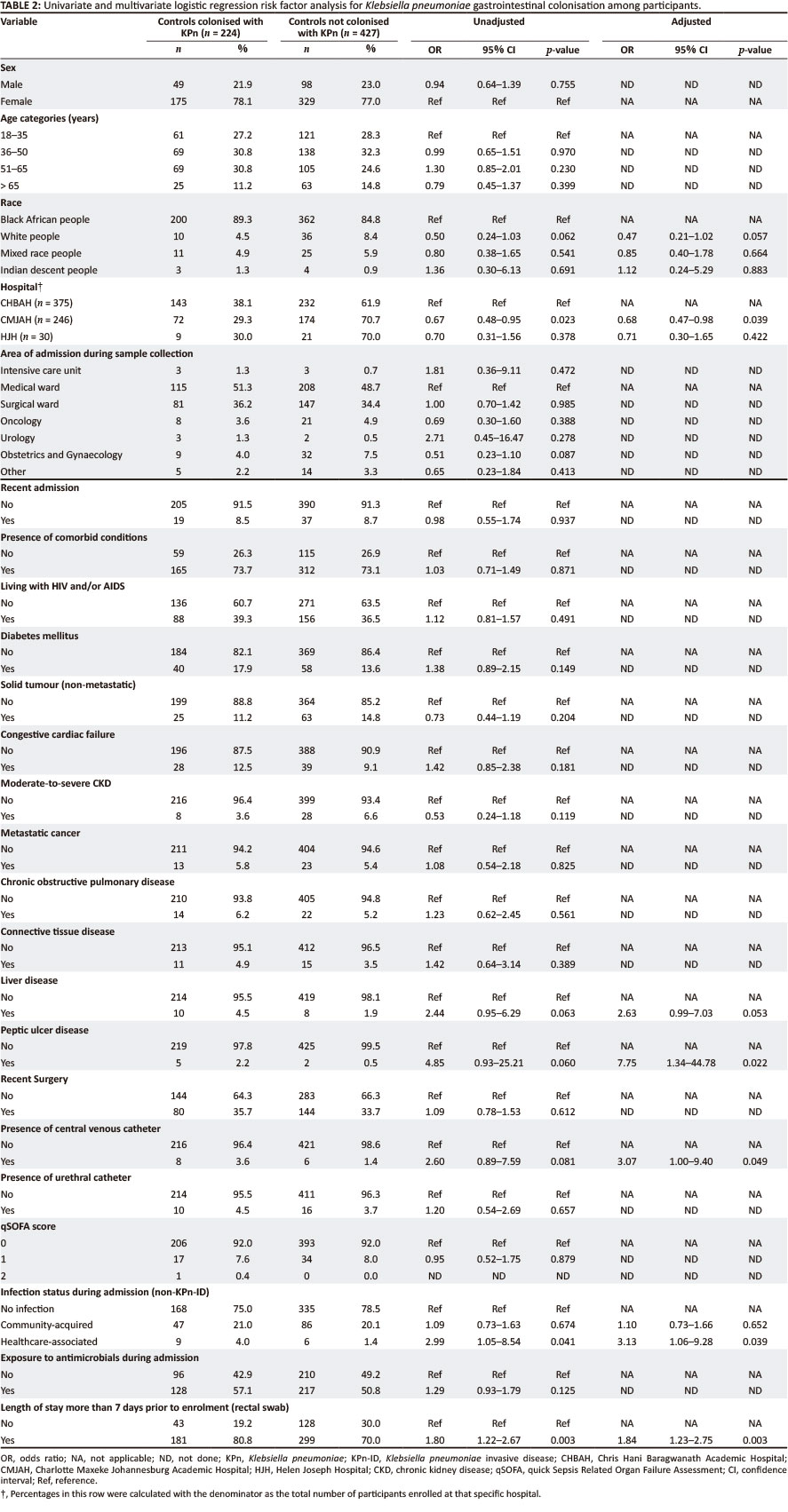
There were no differences in the demographic characteristics of gender, age and race between participants with and without KPn colonisation (Table 1). Rates of colonisation varied depending on the hospital study site (Table 1). Among the cohort of hospitalised adults without KPn-ID (n = 651), the rate of KPn gastrointestinal colonisation was 34.4% (95% CI: 30.4% - 37.6%; n = 224/651) overall, including 38.1% (95% CI: 33.1% - 42.9%; n = 143/375) at CHBAH, 29.3% (95% CI: 23.3% - 34.7%; n = 72/246) at CMJAH, and 30.0% (95% CI: 13.6% - 46.4%; n = 9/30) at HJH (Table 2). There was a lower odd of being colonised with KPn in participants enrolled at CMJAH (29.3%, n = 72/246) compared with those enrolled at CHBAH (38.1%, n = 143/375; aOR 0.68; 95% CI: 0.47-0.98) (Table 2).
There were no significant differences in the colonised versus uncolonised participants with regard to area of admission at the time of swab collection, previous hospitalisation 14 days prior to the current admission, receipt of antimicrobials prior to or during admission, the presence of comorbidities, and the CCI (Table 1).
Colonised and uncolonised participants had the same median CCI (4, IQR 1-7). There were no significant differences between the colonised and uncolonised people living with human immunodeficiency virus, even after stratification by cluster of differentiation 4 (CD4) count, viral load and exposure to antiretroviral therapy; Table 1. Although HIV, diabetes, metastatic cancer, congestive cardiac failure (CCF), connective tissue disease and chronic obstructive pulmonary disease (COPD) were more prevalent in colonised participants, the associations were not statistically significant (Table 1 and Table 2). Similarly, moderate-to-severe chronic kidney disease (CKD) and non-metastatic cancer were more frequent in uncolonised participants, but the associations were insignificant (Table 1 and Table 2). There were no significant differences between the colonised and uncolonised participants regarding exposure to recent surgery or interventions, urethral catheters, or severity of illness measured with qSOFA scores; Table 1 and Table 2. Length of stay (in days) between admission and enrolment (rectal swabbing) was longer in colonised versus uncolonised participants (median = 10, IQR 7-16 vs median = 8, IQR 6-17; p = 0.002); Table 1. Similarly, a length of hospital stay of more than 7 days prior to enrolment (rectal swabbing) was more likely in colonised vs uncolonised participants (80.8%; n = 181/224 vs 70.0%; n = 299/427; p = 0.003).
On multivariate regression analysis, risk factors for KPn colonisation were peptic ulcer disease (2.2%; n = 5/224 vs 0.5%; n = 2/427; aOR 7.75; 95% CI: 1.34-44.78), a CVC (3.6%; n = 8/224 vs 1.4%; n = 6/427; aOR 3.07; 95% CI: 1.00-9.40), a pHAI (4.0%; n = 9/224 vs 1.4%; n = 6/427; aOR 3.13; 95% CI: 1.06-9.28), and length of stay more than 7 days prior to enrolment (80.8%; n = 181/224 vs 70.0%; n = 299/427; aOR 1.84; 95% CI: 1.23-2.75); Table 2.
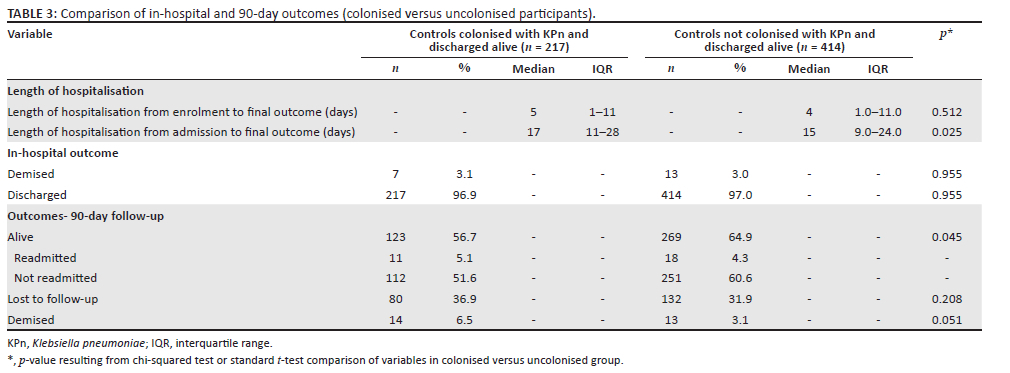
There was no difference in in-hospital case fatality risk (CFR) between participants with (3.1%; n = 7/224) and without (3.0%; n = 13/427, p = 0.955) KPn colonisation (Table 1). Of the participants, 96.9% (n = 631/651) were discharged alive, and a successful 90-day post-discharge follow-up was achieved in 66.4% (n = 419/631) (Figure 1). Participants colonised with KPn had a higher 90-day CFR compared to the uncolonised (6.5%; n = 14/217 vs 3.1%; n = 13/414, p = 0.051) and were more likely to be readmitted at 90-day follow-up (5.1%; n = 11/217 vs 4.3%; n = 18/414, p = 0.045) (Table 3). Total length of hospitalisation in days was significantly longer in colonised (median 17; IQR 11-28) compared to uncolonised (median 15; IQR 9-24) participants, p = 0.025; Table 3.
Discussion
This multicentre observational study adds important evidence on risk factors associated with KPn colonisation in South Africa, a setting where the colonisation rate appears higher than in most high-income countries. We demonstrated a KPn colonisation rate amongst hospitalised adults without KPn-ID that ranged from 29.3% to 38.1% across three hospitals, substantially higher than that reported in European79
There is a paucity of data on drug-susceptible KPn colonisation in Africa, as most high-quality studies from the region focus on AMR-related KPn colonisation and KPn-ID.11,18,19 The observed KPn colonisation rate in our study (34.4%) is markedly higher than rates reported in hospitalised Australian (6.0% - 19.0%)972021n = 489/874).
Gastrointestinal colonisation rates also differ according to different KPn AMR profiles. A 2019 South African point-prevalence study investigating CRE gastrointestinal colonisation in hospitalised adults reported a prevalence of 0.2% (n = 1/439) of CRKp.22n = 14/97 swabs from n = 5/31 patients).23n = 15/71).247,19,25
Risk factors for KPn gastrointestinal colonisation have been reported primarily in high-income settings and include ICU admission and exposure to antimicrobial therapy.7,9,10 While there was an increased risk for KPn colonisation associated with CVCs, we did not demonstrate an increased risk with ICU admission, surgery or urethral catheters, although this may be because of the relatively small number of critically ill participants enrolled from the ICU. In keeping with published literature, we found a length of hospital stay of more than 6 days prior to enrolment (rectal swabbing) and a pHAI to be independently associated with KPn colonisation,107721
There is scarce regional data on the clinical outcomes of KPn colonised individuals. Although gastrointestinal colonisation is widely recognised as a prerequisite for invasive disease,7,8,9,10,26,2710,2829
Limitations of our study include that participants were not randomly selected but matched to invasive cases based on age group, duration of hospitalisation prior to enrolment and study site, leading to inadvertent bias in participant selection and estimation of colonisation rate. Additionally, gastrointestinal colonisation is dynamic9
Our study has several important implications. The high burden of KPn colonisation in South African hospitals suggests that prevention strategies must extend beyond antimicrobial stewardship to include stricter infection-prevention practices. To accurately determine KPn gastrointestinal colonisation rates in South Africa, prospective surveillance studies should be undertaken in both community and hospital settings, with a one-health approach to investigating risk factors for KPn colonisation. Given the dynamic nature of KPn gastrointestinal colonisation, longitudinal surveillance in both community and hospitalised cohorts is essential to understand transmission pathways and to design interventions that interrupt progression from colonisation to disease.
This article is based on data from a larger study. One other article has been published from the same thesis. The first article focusing on clinical and microbiological epidemiology of Klebsiella pneumoniae invasive disease in hospitalised adults in Johannesburg, South Africa: A multicentre observational study has been published in JAC-Antimicrobial Resistance, Volume 8, Issue 1.
The authors thank staff at the NHLS laboratories and clinicians at Chris Hani Baragwanath Academic Hospital (CHBAH), Charlotte Maxeke Johannesburg Academic Hospital (CMJAH) and Helen Joseph Hospital (HJH). We also thank the clinical and laboratory teams at Vaccines and Infectious Diseases Analytics Research Unit (Wits-VIDA).
Competing interests
The author reported that they received funding from South African Medical Research Council, the Wits-VIDA and the University of the Witwatersrand Faculty Research Committee Individual Research Grant 2023, which may be affected by the research reported in the enclosed publication. The author has disclosed those interests fully and has implemented an approved plan for managing any potential conflicts arising from their involvement. The terms of these funding arrangements have been reviewed and approved by the affiliated university in accordance with its policy on objectivity in research.
CRediT authorship contribution
Denasha L. Reddy: Conceptualisation, Data curation, Formal analysis, Funding acquisition, Investigation, Methodology, Project administration, Resources, Software, Visualisation, Writing - original draft, Writing - review & editing. Ziyaad Dangor: Conceptualisation, Data curation, Funding acquisition, Project administration, Resources, Supervision, Validation, Writing - review & editing. Lyle Murray: Data curation, Writing - review & editing. Jacob M. Tsitsi: Data curation, Writing - review & editing. Jeremy S. Nel: Data curation, Writing - review & editing. Trusha Nana: Data curation, Writing - review & editing. Jeannette Wadula: Data curation, Writing - review & editing. Rispah Chomba: Data curation, Writing - review & editing. Sinenhlanhla Ndzabandzaba: Data curation, Writing - review & editing. Vicky L. Baillie: Data curation, Project administration, Writing - review & editing. Courtney P. Olwagen: Conceptualisation, Supervision, Writing - review & editing. Shabir A. Madhi: Conceptualisation, Data curation, Funding acquisition, Project administration, Resources, Supervision, Validation, Writing - review & editing. All authors reviewed the article, contributed to the discussion of results, approved the final version for submission and publication, and take responsibility for the integrity of its findings.
Funding information
This work was supported by the South African Medical Research Council (grant number: RCD CRP 2023), the Wits-VIDA (grant number: RM03/ E798) and the University of the Witwatersrand Faculty Research Committee Individual Research Grant 2023 (grant number: FRC2023).
Data availability
The data that support the findings of this study are not openly available because of reasons of sensitivity and are available from the corresponding author, Denasha L. Reddy, upon reasonable request.
Disclaimer
The views and opinions expressed in this article are those of the authors and are the product of professional research. They do not necessarily reflect the official policy or position of any affiliated institution, funder, agency or that of the publisher. The authors are responsible for this article's results, findings and content.
Acknowledgements
This article is based on research originally conducted as part of Denasha L. Reddy's doctoral thesis titled 'Clinical and molecular epidemiology of Klebsiella pneumoniae invasive disease in adults', which is still to be submitted to the Department of Internal Medicine, Faculty of Health Sciences, University of the Witwatersrand in 2026. The thesis is currently unpublished and not publicly available. The thesis was supervised by Ziyaad Dangor, Shabir Madhi and Courtney Olwagen. The author confirms that the content has not been previously published or disseminated and complies with ethical standards for original publication.
References
-
1.Li D, Huang X, Rao H, et al. Klebsiella pneumoniae bacteremia mortality: A systematic review and meta-analysis. Front Cell Infect Microbiol. 2023;13:1157010. https://doi.org/10.3389/fcimb.2023.1157010
» https://doi.org/10.3389/fcimb.2023.1157010 -
2.Murray CJL, Ikuta KS, Sharara F, et al. Global burden of bacterial antimicrobial resistance in 2019: A systematic analysis. Lancet. 2022;399:629-655. https://doi.org/10.1016/S0140-6736(21)02724-0
» https://doi.org/10.1016/S0140-6736(21)02724-0 -
3.Sartorius B, Gray AP, Weaver ND, et al. The burden of bacterial antimicrobial resistance in the WHO African region in 2019: A cross-country systematic analysis. Lancet Glob Health. 2024;12(2):e201-e216. https://doi.org/10.1016/s2214-109x(23)00539-9
» https://doi.org/10.1016/s2214-109x(23)00539-9 -
4.Gonzalez-Ferrer S, Penaloza HF, Budnick JA, et al. Finding order in the chaos: Outstanding questions in Klebsiella pneumoniae pathogenesis. Infect Immun. 2021;89(4):e00693-20. https://doi.org/10.1128/IAI.00693-20
» https://doi.org/10.1128/IAI.00693-20 -
5.Chang D, Sharma L, Dela Cruz CS, Zhang D. Clinical epidemiology, risk factors, and control strategies of Klebsiella pneumoniae infection. Front Microbiol. 2021;12:750662. https://doi.org/10.3389/fmicb.2021.750662
» https://doi.org/10.3389/fmicb.2021.750662 -
6.Wyres KL, Lam MMC, Holt K. Population genomics of Klebsiella pneumoniae. Nat Rev Microbiol. 2020;18:344-359. https://doi.org/10.1038/s41579-019-0315-1
» https://doi.org/10.1038/s41579-019-0315-1 -
7.Raffelsberger N, Hetland MAK, Svendsen K, et al. Gastrointestinal carriage of Klebsiella pneumoniae in a general adult population: A cross-sectional study of risk factors and bacterial genomic diversity. Gut Microbes. 2021;13(1):1939599. https://doi.org/10.1080/19490976.2021.1939599
» https://doi.org/10.1080/19490976.2021.1939599 -
8.Martin RM, Cao J, Brisse S, et al. Molecular epidemiology of colonizing and infecting isolates of Klebsiella pneumoniae. mSphere. 2016;1(5):e00261-16. https://doi.org/10.1128/msphere.00261-16
» https://doi.org/10.1128/msphere.00261-16 -
9.Gorrie CL, Mirceta M, Wick RR, et al. Gastrointestinal carriage is a major reservoir of Klebsiella pneumoniae infection in intensive care patients. Clin Infect Dis. 2017;65(2):208-215. https://doi.org/10.1093/cid/cix270
» https://doi.org/10.1093/cid/cix270 -
10.Martin RM, Bachman M. Colonization, infection, and the accessory genome of Klebsiella pneumoniae. Front Cell Infect Microbiol. 2018;8:4. https://doi.org/10.3389/fcimb.2018.00004
» https://doi.org/10.3389/fcimb.2018.00004 -
11.Lewis JM, Lester R, Garner P, Feasey N. Gut mucosal colonisation with extended-spectrum beta-lactamase producing Enterobacteriaceae in sub-Saharan Africa: A systematic review and meta-analysis (version 2; peer review: 2 approved). Wellcome Open Res. 2020;4:160. https://doi.org/10.12688/wellcomeopenres.15514.2
» https://doi.org/10.12688/wellcomeopenres.15514.2 -
12.Moloto K, Dube P, Dramowski A, Whitelaw A, Newton-Foot M. Epidemiology, risk factors, and clinical outcomes of carbapenem-resistant Enterobacterales in Africa: A systematic review. J Glob Antimicrob Resist. 2023;35:297-306. https://doi.org/10.1016/j.jgar.2023.10.008
» https://doi.org/10.1016/j.jgar.2023.10.008 -
13.Tesfa T, Mitiku H, Edae M, Assefa N. Prevalence and incidence of carbapenem-resistant K. pneumoniae colonization: Systematic review and meta-analysis. Syst Rev. 2022;11(1):240. https://doi.org/10.1186/s13643-022-02110-3
» https://doi.org/10.1186/s13643-022-02110-3 -
14.Reddy DL, Dangor Z, Murray L, et al. Clinical and microbiological epidemiology of Klebsiella pneumoniae invasive disease in hospitalized adults in Johannesburg, South Africa: A multicentre observational study. JAC Antimicrob Resist. 2026;8(1):dlag003. https://doi.org/10.1093/jacamr/dlag003
» https://doi.org/10.1093/jacamr/dlag003 -
15.Chris Hani Baragwanath Hospital. General information [homepage on the Internet]. [cited 2024 Dec 17]. Available from: https://www.chrishanibaragwanathhospital.co.za/
» https://www.chrishanibaragwanathhospital.co.za/ -
16.Wikipedia. Charlotte Maxeke Johannesburg Academic Hospital [homepage on the Internet]. No date [cited 2024 Dec 17]. Available from: https://en.wikipedia.org/wiki/Charlotte_Maxeke_Johannesburg_Academic_Hospital
» https://en.wikipedia.org/wiki/Charlotte_Maxeke_Johannesburg_Academic_Hospital -
17.South African Doctors (General information). Helen Joseph Hospital General information [homepage on the Internet]. No date [cited 2024 Dec 17]. Available from: https://doctors-hospitals-medical-cape-town-south-africa.blaauwberg.net/hospitals_clinics_state_hospitals/state_public_hospitals_ clinics_gauteng_south_africa/helen_joseph_hospital_auckland_park_johannesburg_gauteng_south_africa
» https://doctors-hospitals-medical-cape-town-south-africa.blaauwberg.net/hospitals_clinics_state_hospitals/state_public_hospitals_ clinics_gauteng_south_africa/helen_joseph_hospital_auckland_park_johannesburg_gauteng_south_africa -
18.Lewis JM, Mphasa M, Banda R, et al. Genomic and antigenic diversity of colonizing Klebsiella pneumoniae isolates mirrors that of invasive isolates in Blantyre, Malawi. Microb Genom. 2022;8(3):000778. https://doi.org/10.1099/mgen.0.000778
» https://doi.org/10.1099/mgen.0.000778 -
19.Sammarro M, Rowlingson B, Cocker D, et al. Risk factors, temporal dependence, and seasonality of human extended-spectrum β-lactamases-producing Escherichia coli and Klebsiella pneumoniae colonization in Malawi: A longitudinal model-based approach. Clin Infect Dis. 2023;77(1):1-8. https://doi.org/10.1093/cid/ciad117
» https://doi.org/10.1093/cid/ciad117 -
20.Lin YT, Siu LK, Lin JC, et al. Seroepidemiology of Klebsiella pneumoniae colonizing the intestinal tract of healthy Chinese and overseas Chinese adults in Asian countries. BMC Microbiol. 2012;12:13. https://doi.org/10.1186/1471-2180-12-13
» https://doi.org/10.1186/1471-2180-12-13 -
21.Huynh BT, Passet V, Rakotondrasoa A, et al. Klebsiella pneumoniae carriage in low-income countries: Antimicrobial resistance, genomic diversity and risk factors. Gut Microbes. 2020;11(5):1287-1299. https://doi.org/10.1080/19490976.2020.1748257
» https://doi.org/10.1080/19490976.2020.1748257 -
22.Nel P, Roberts LA, Hoffman R. Carbapenemase-producing Enterobacteriaceae colonisation in adult inpatients: A point prevalence study. S Afr J Infect Dis. 2019;34(1):129. https://doi.org/10.4102/sajid.v34i1.129
» https://doi.org/10.4102/sajid.v34i1.129 -
23.Madni O, Amoako DG, Abia ALK, Rout J, Essack S. Genomic investigation of carbapenem-resistant Klebsiella pneumonia colonization in an intensive care unit in South Africa. Genes. 2021;12(7):951. https://doi.org/10.3390/genes12070951
» https://doi.org/10.3390/genes12070951 -
24.Shamhuyashe G, Van Zyl N, Van Rooyen C, Bisiwe F, Musoke J. Colonisation with multidrug-resistant organisms among dialysis patients at Universitas Academic Hospital. S Afr J Infect Dis. 2024;39(1):607. https://doi.org/10.4102/sajid.v39i1.607
» https://doi.org/10.4102/sajid.v39i1.607 -
25.Gagliotti C, Giordani S, Ciccarese V, et al. Risk factors for colonization with carbapenemase-producing Klebsiella pneumoniae in hospital: A matched case-control study. Am J Infect Control. 2014;42:1006-1008. https://doi.org/10.1016/j.ajic.2014.05.028
» https://doi.org/10.1016/j.ajic.2014.05.028 -
26.Gorrie CL, Mirceta M, Wick RR, et al. Antimicrobial-resistant Klebsiella pneumoniae carriage and infection in specialized geriatric care wards linked to acquisition in the referring hospital. Clin Infect Dis. 2018;67(2):161-170. https://doi.org/10.1093/cid/ciy027
» https://doi.org/10.1093/cid/ciy027 -
27.Tubb CM, Tubb M, Hooijer J, Chomba R, Nel J. Carbapenem-resistant Enterobacterales (CRE) colonisation as a predictor for subsequent CRE infection: A retrospective surveillance study. S Afr J Infect Dis. 2025;40(1):687. https://doi.org/10.4102/sajid.v40i1.687
» https://doi.org/10.4102/sajid.v40i1.687 -
28.Gorrie CL, Mirceta M, Wick RR, et al. Genomic dissection of Klebsiella pneumoniae infections in hospital patients reveals insights into an opportunistic pathogen. Nat Commun. 2022;13(1): 3017. https://doi.org/10.1038/s41467-022-30717-6
» https://doi.org/10.1038/s41467-022-30717-6 -
29.Wang X, Liu J, Li A. Incidence and risk factors for subsequent infections among rectal carriers with carbapenem-resistant Klebsiella pneumoniae: A systematic review and metaanalysis. J Hosp Infect. 2024;145:11-21. https://doi.org/10.1016/j.jhin.2023.12.002
» https://doi.org/10.1016/j.jhin.2023.12.002

Accepted: 15 Mar. 2026
Published: 05 May 2026