Factors predicting the outcome of patients admitted with COVID-19 infection at Pietersburg Hospital, Polokwane, Limpopo province
Abstract
BACKGROUND: The emergence of the novel coronavirus disease 2019 (COVID-19), in late 2019 in Wuhan City, has led to a global outbreak of COVID-19, culminating in the declaration of a pandemic by the World Health Organization. OBJECTIVES: The aim of the study was to evaluate the factors predicting the outcome in patients with COVID-19 infection. METHOD: This was a retrospective study using secondary data of patients admitted with laboratory-confirmed severe acute respiratory syndrome coronavirus 2 (SARS-CoV-2) polymerase chain reaction (PCR) results at Pietersburg Hospital between 01 March 2020 and 31 March 2021, which were extracted from DATCOV portal. RESULTS: There were 444 eligible study participants, of which 225 (50.7%) were female and 219 (49.3%) were male patients. Their median age was 57 years. A total of 159 (36%) in-hospital deaths related to COVID-19 infection were reported. Using the logistic regression model, two predictor variables, age and intensive care unit (ICU) admission were independently associated with mortality. An increase in patient's age per year, increased the odds of dying. The ICU admission had a three-fold odds for non-survival. In-hospital mortality was associated with shorter length of hospitalisation because of disease severity and late patient presentation, with a median duration of 4 days (interquartile range [IQR] 2.0-9.0). CONCLUSION: Age and ICU admission were significantly related to non-survival, with hypertension being the common factor in all deaths reported. CONTRIBUTION: The study emphasises the importance of pandemic preparedness and strengthening healthcare services to protect vulnerable groups such as the elderly population.
SARS-CoV-2; COVID-19; outcomes; comorbidities; pandemic
Introduction
In December 2019, the new coronavirus outbreak caused by severe acute respiratory syndrome coronavirus 2 (SARS-CoV-2) infection was classified as a major global health threat.12,32,43
The effects of comorbidities on a variety of diseases have been extensively studied globally.4,56
Non-communicable diseases (NCDs) such as hypertension, type 2 diabetes, obesity and being overweight, are prevalent and contribute to the burden of disease in South Africa.787
Most hospitalised COVID-19 infected patients required respiratory care because of pneumonia. Those with comorbidities developed severe form of COVID-19 disease that necessitated high or intensive care unit (ICU) admission.
The primary cause of COVID-19 admissions at Pietersburg hospital was pneumonia with many having concomitant conditions. The goal of the study was to investigate factors that predicted the outcome of patients with COVID-19 infection and any associated negative consequences at Pietersburg Hospital.
Research methods and design
Study design and setting
The study was performed from 01 March 2020 until 31 March 2021 at Pietersburg Hospital, a tertiary centre in Polokwane. It was a retrospective study using secondary data accessed from DATCOV portal developed by National Institute for Communicable Diseases (NICD).
Study population
Inclusion criteria
Population group enrolled included all adults and adolescents outside paediatric age group (i.e. > 12 years old) with a confirmed severe acute respiratory syndrome coronavirus 2 (SARS-CoV-2) polymerase chain reaction (PCR) test admitted to our isolation wards and ICU.
Exclusion criteria
Persons under investigation (PUI) without a laboratory confirmed test but suspected to have COVID-19 infection based on symptoms and signs while awaiting SARS-CoV-2 PCR results were excluded.
Data collection
Secondary data were extracted from the NICD DATCOV portal, which is a web-based disease surveillance system (version v2.4.35). The NICD approved the data collection prior to interrogating the data. The following variables were extracted: demographics, comorbidities (self-reported, based on clinical diagnosis, and/or on treatment), length of hospitalisation and patient outcomes (discharged alive, transferred to other facility, died).
Data analysis
The data were analysed with Spotfire Statistica 14.2.0 (TIBCO, Cloud Software Group Inc, United States). The median with interquartile ranges (IQR) was used to present continuous variables. Cross-tabulations, percentages, and numbers were used to present categorical variables. The Chi-square test was employed to ascertain whether categorical variables were associated. Mann-Whitney U-test was used to compare the continuous variables. Univariate analysis was used to identify variables that were significant. Using a multivariable logistic regression model, the link between risk factors identified through univariate analysis and outcome was examined. In this study, COVID-19 survival and in-hospital death were the endpoints. The odds ratio (OR) and 95% confidence interval (CI) of the chosen predictor variables were used to express the results. A p-value below 0.05 was considered statistically significant.
Ethical considerations
Ethical approval was granted by the Turfloop Research Ethics Committee (TREC/99/2022:PG) of the University of Limpopo, the Limpopo Department of Health (Ref: LP_2022-05-029), and the Polokwane-Mankweng Research Ethics Committee (PMREC 31 August UL 2022/B). The data collected was completely anonymised and no patient identifying details were documented. Because data collected was from a secondary source, application for waiver of informed consent was made as per the institutional ethics committee guidelines.
Results
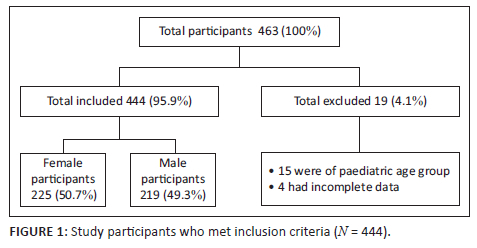
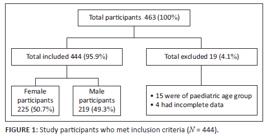
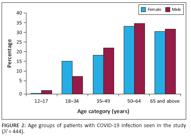
During the period of the study, a total of 463 patients with confirmed COVID-19 infection were admitted at Pietersburg hospital. Nineteen patients were excluded for not meeting the inclusion criteria. The study sample comprised 225 (50.7%) female and 219 (49.3%) male participants, with a median age of 57 (13-96) years (Figure 1).
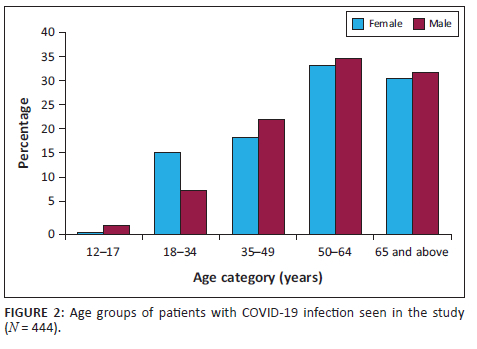
Most hospitalised patients were aged between 50 years and 64 years (34.0%). The hospitalised adolescent patients were not severely affected. The adolescent group falling within the age category of 12-17 years only contributed 1.1% of the disease versus 67.6% of the adult (18-64 years) and 31.3% of the elderly groups (65 years and above) (Figure 2).
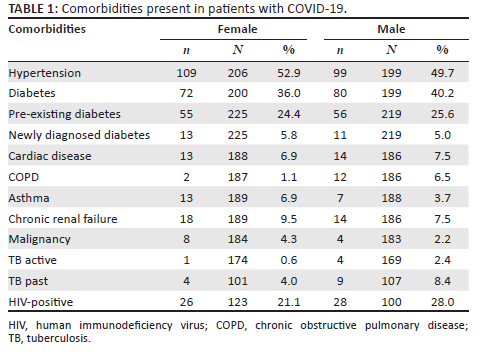
Of the 444 patients, 311 (70%) had comorbidities, namely, hypertension (n = 208 [51%]), diabetes (n = 152 [38%]), human immunodeficiency virus (HIV) (n = 54 [24%]), chronic renal failure (n = 32 [8.5%]), cardiac disease (n = 27 [7%]), asthma (n = 20 [5%]), chronic obstructive pulmonary disease (COPD) (n = 14 [3.8%]), malignancy (n = 12 [3%]) and active tuberculosis (TB) (n = 5 [1.5%]) (Table 1).
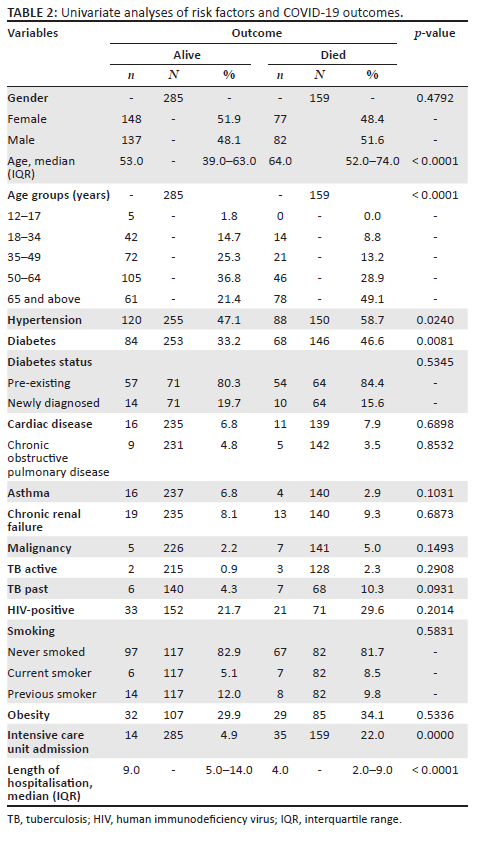
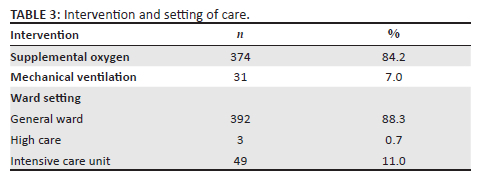
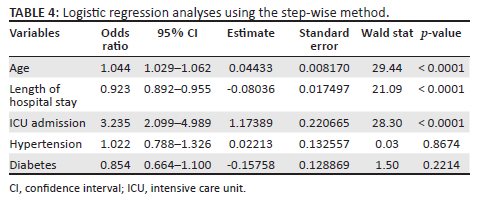
A total of 159 patients (36%) hospitalised with COVID-19 died (82 male [51.6%] and 77 female [48.4%] patients) (p = 0.48) (78 elderly patients [49.1%] and 81 adults [50.9%]). No death occurred in the adolescent group (Table 2). A total of 392 patients with COVID-19 were admitted to the general ward and 52 persons required admission to an advanced level of care (i.e. high care and ICU, respectively). The majority of patients who were hospitalised and admitted to the general ward, required supplemental oxygenation (84.2%). However, only 31 (7%) patients required mechanical ventilation in the ICU. Given the high number of patients who were admitted (N = 444), more than 31 patients surely needed escalation to ICU (Table 3). However, on a multivariable analysis, ICU admission was an independent risk factor for mortality (Table 4). The ICU admission did not improve the odds of patient survival.
In terms of comorbidities present, only hypertension and diabetes (p = 0.0240 and 0.0081, respectively) were significantly related to death on univariate analysis (Table 2). On multivariable analysis, however, hypertension and diabetes were no longer significant (Table 4). Communicable diseases, such as active tuberculosis (TB) and HIV, with only five and 54 cases reported, respectively, had no significant impact on survival (p = 0.291 and p = 0.201). Regarding respiratory illnesses, COPD and asthma collectively, fared better as they had more survival than deaths (Table 2). Smoking, as a risk factor, did not seem to contribute much negatively to the adverse outcome as expected, probably because of lesser individuals self-reporting to be current or previous smokers.
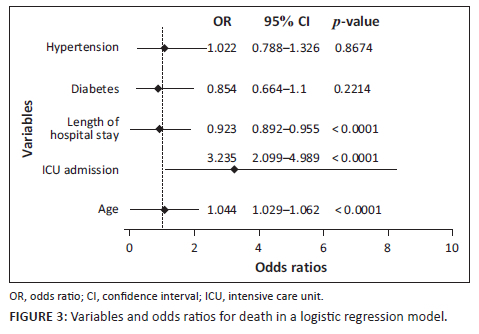
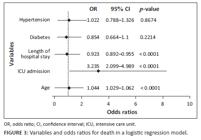
Using the logistic regression model, the two predictor variables, age and ICU admission were significantly associated with the odds of non-survival. Older age was a significant risk factor for COVID-19-related death. The odds of dying increased by 1.044-fold for every additional year of age (odds ratio [OR]: 1.044; 95% CI: 1.029-1.062). Being admitted to the ICU was an independent predictor of mortality, which increased the odds of non-survival three-fold (OR: 3.325, 95% CI: 2.099-4.989). The average length of hospitalisation to reach an endpoint of non-survival was 4 days (Figure 3 and Table 4).
Discussion
Comorbidities predispose patients with COVID-19 infection to worse clinical outcomes.1,7,9,10 Naturally, not every pre-existing comorbidity has the same dangers. For instance, in this global outbreak, the three most significant pre-existing conditions, namely hypertension, cardiovascular disease and diabetes were primarily linked to illness severity and unfavourable outcomes.49,11 The missing data might have had an impact on multivariable analysis. Tuberculosis and HIV seemingly had no negative impact on the outcome, despite available data that showed their prevalence.10,12,13 The plausible explanation could be because of under-investigation of these conditions during the pandemic because of the lockdown restrictions and staff shortage in health facilities. This created a barrier for healthcare access and led to reduction in HIV and TB testing.14
In certain studies, being ≥ 60 years of age was associated with an increased risk of disease severity.1,15,16 Furthermore, we demonstrated increased risk of death for each additional year of age (OR: 1.044; 95% CI: 1.029-1.062). The OR below one was considered a protective factor. The majority of patients treated throughout the study period were adults (between 50 years and 64 years old) and elders (65 years and above) with coexisting disorders, increasing their risk of developing severe disease. In South Africa, the second wave of COVID-19 saw increased hospitalisation of patients between 40 years and 64 years and above 65 years.1017
In our study, 49 patients (11%) required ICU admission, with 31 (7%) requiring mechanical ventilation. As compared to the data emanating from the US, one study reported that 809 (14.2%) patients received ICU care, with 695 (12.2%) of them receiving mechanical ventilation.916
Our in-hospital mortality was 36%. This was associated with a shorter length of hospitalisation, with an average of 4 days. This could be because of severe disease on admission, late patient presentation or delay in receiving urgent medical care as a result of an overwhelmed healthcare facility. In comparison, a regional hospital in Mthatha, Eastern Cape province, which also serves a similar mainly rural population as Pietersburg Hospital, had 46% mortality rate, way above the provincial rate (27.5%) and national rate (18.3%).1818191020
There was no significant association between non-survival and communicable diseases such as active TB and HIV, respiratory illnesses such as asthma and chronic obstructive pulmonary disease. This correlates with the findings by ACCCOS multicentre cohort study with the exception that in their case, HIV was associated with increased mortality in adults admitted with COVID-19.16
Obesity has been strongly associated with COVID-19 mortality in the literature.55
Study limitations and strengths
This was a retrospective study; therefore, limitations are unavoidable. The collection of data relied mostly on healthcare personnel to enter data onto the portal; therefore, some pertinent information might have not been captured. Data were from a convenient sample of hospitalised adult patients from a single centre, not a representation of a whole population. Patients were not followed up post discharge in this study, hence the study outcome might have been under-reported as some patients who were discharged or transferred to other facilities could have suffered the adverse events thereafter. As noted above, obesity was not objectively measured and together with underestimation of TB and HIV, could have influenced the association with outcomes. However, the strength of the study is that it utilised a large sample size.
Conclusion
According to the study, the risk factors that were independently associated with in-hospital mortality were older age and ICU admission. Comorbidities did not contribute significantly to the outcome in this study, as reported elsewhere.9,11
Competing interests
The authors declare that they have no financial or personal relationships that may have inappropriately influenced them in writing this article.
CRediT authorship contribution
Koena J. Moabelo: Conceptualisation, Writing - original draft. Phetho Mangena: Supervision, Writing - review & editing. Musa E. Setati: Supervision, Writing - review & editing. Mokibe J. Nchabeleng: Supervision, Writing - review & editing. All authors reviewed the article, contributed to the discussion of results, approved the final version for submission and publication, and take responsibility for the integrity of its findings.
Funding information
This research received no specific grant from any funding agency in the public, commercial, or not-for-profit sectors.
Data availability
The data that support the outcome of this study are available from the corresponding author, Koena J. Moabelo, on request.
Disclaimer
The views and opinions expressed in this article are those of the authors and are the product of professional research. The article does not necessarily reflect the official policy or position of any affiliated institution, funder, agency or that of the publisher. The authors are responsible for this article's results, findings and content.
Acknowledgements
This article is based on Koena J. Moabelo's partial fulfilment of Master of Medicine degree in Internal Medicine thesis titled 'The impact of comorbidities on outcome of patients admitted with Coronavirus disease 2019 infected at Pietersburg Hospital, Polokwane, Limpopo Province' in the Faculty of Health Sciences at the University of Limpopo (TREC/99/2022:PG) in 2025. The thesis was supervised by Phetho Mangena, Musa E. Setati and Mokibe J. Nchabeleng. The thesis was reworked, revised, and adapted into a journal article for publication. The original thesis is available at: http://ul.netd.ac.za/handle/10386/5155. Koena J. Moabelo would also like to kindly acknowledge the National Institute for Communicable Diseases (NICD) for sharing of data from their DATCOV portal.
References
-
1.Ye C, Zhang S, Zhang X, et al. Impact of comorbidities on patients with COVID-19: A large retrospective study in Zhejiang, China. J Med Virol. 2020;92(11):2821-2829. https://doi.org/10.1002/jmv.26183
» https://doi.org/10.1002/jmv.26183 -
2.Bajgain KT, Badal S, Bajgain BB, Santana MJ. Prevalence of comorbidities among individuals with COVID-19: A rapid review of current literature. Am J Infect Control. 2020;49(2021):238-246. https://doi.org/10.1016/j.ajic.2020.06.213
» https://doi.org/10.1016/j.ajic.2020.06.213 -
3.Rothan HA, Byrareddy SN. The epidemiology and pathogenesis of coronavirus disease (COVID-19) outbreak. J Autoimmun. 2020;109(2020):102433. https://doi.org/10.1016/j.jaut.2020.102433
» https://doi.org/10.1016/j.jaut.2020.102433 -
4.Callender LA, Curran M, Bates SM, et al. The impact of pre-existing comorbidities and therapeutic interventions on COVID-19. Front Immunol. 2020;11(1991):1-16. https://doi.org/10.3389/fimmu.2020.01991
» https://doi.org/10.3389/fimmu.2020.01991 -
5.Gasmi A, Peana M, Pivina L, et al. Interrelations between COVID-19 and other disorders. J Clin Immunol. 2021;224(108651):1-12. https://doi.10.1016/j.clim.2020.108651
» https://doi.10.1016/j.clim.2020.108651 -
6.Badawi A, Ryoo SG. Prevalence of comorbidities in the Middle East Respiratory Syndrome coronavirus (MERS-CoV): A systematic review and meta-analysis. Int J Infect Dis. 2016;49(2016):129-133. https://doi.org/10.1016/j.ijid.2016.06.015
» https://doi.org/10.1016/j.ijid.2016.06.015 - 7.Hofman K, Madhi S. The unanticipated costs of COVID-19 to South Africa's quadruple disease burden. S Afr Med J. 2020;110(8):698-699.
-
8.Lalkhen H, Mash R. Multimorbidity in non-communicable diseases in South African primary healthcare. S Afr Med J. 2025;105(2):134. https://doi.org/10.7196/samj.8696
» https://doi.org/10.7196/samj.8696 -
9.Richardson S, Hirsch JS, Narasimhan M, et al. Presenting characteristics, comorbidities, and outcomes among 5700 patients hospitalized with COVID-19 in the New York City Area. JAMA. 2020;323(20):2052-2059. https://doi.org/10.001/jama.2020.6775
» https://doi.org/10.001/jama.2020.6775 -
10.Jassat W, Mudara C, Ozougwu L, et al. Difference in mortality among individuals admitted to hospital with COVID-19 during the first and second waves in South Africa: A cohort study. Lancet Glob Health. 2021;9(9):1216-1225. https://doi.org/10.1016/S2214-109X(21)00289-8
» https://doi.org/10.1016/S2214-109X(21)00289-8 -
11.Huang C, Wang Y, Li X, et al. Clinical features of patients infected with 2019 novel coronavirus in Wuhan, China. Lancet. 2020;395(10223):497-506. https://doi.org/10.1016/S0140-6736(20)30183-5
» https://doi.org/10.1016/S0140-6736(20)30183-5 -
12.Jassat W, Cohen C, Tempia S, et al. Risk factors for COVID-19-related in-hospital mortality in a high HIV and tuberculosis prevalence setting in South Africa: A cohort study. Lancet HIV. 2021;8(9):554-567. https://doi.org/10.1016/s2352-3018(21)00151-x
» https://doi.org/10.1016/s2352-3018(21)00151-x -
13.Mash RJ, Presence-Vollenhoven M, Adeniji A, et al. Evaluation of patient characteristics, management and outcomes for COVID-19 at district hospitals in the Western Cape, South Africa: Descriptive observational study. BMJ Open. 2021;11(1):e047016. https://doi.org/10.1136/bmjopen-2020-047016
» https://doi.org/10.1136/bmjopen-2020-047016 -
14.Jardim CGR, Zamani R, Akrami M. Evaluating the impact of the COVID-19 pandemic on accessing HIV services in South Africa: A systematic review. Int J Environ Res Public Health. 2022;19(19):11899. https://doi.org/10.3390/ijerph191911899
» https://doi.org/10.3390/ijerph191911899 -
15.Ratshikhopha E, Muvhali M, Naicker N, et al. Disease severity and comorbidities among healthcare worker COVID-19 Admissions in South Africa: A retrospective analysis. Int J Environ Res Public Health. 2022;19(9): 5519. https://doi.org/10.3390/ijerph19095519
» https://doi.org/10.3390/ijerph19095519 -
16.Biccard BM, Gopalan PD, Miller M, Michell WL, et al. Patient care and clinical outcomes for patients with COVID-19 infection admitted to African high-care or intensive care units (ACCCOS): A multicentre, prospective, observational cohort study. Lancet. 2021;397(10288):1885-1894. https://doi.org/10.1016/S0140-6736(21)0044-4
» https://doi.org/10.1016/S0140-6736(21)0044-4 -
17.Kadir NA, Andarin MD. The effectiveness of COVID-19 vaccines among elderly: A systematic review. Int J Infect Dis. 2023;134:S18. https://doi.org/10.1016/j.ijid.2023.05.062
» https://doi.org/10.1016/j.ijid.2023.05.062 -
18.Kaswa R, Yogeswaran P, Cawe B. Clinical outcomes of hospitalised COVID-19 patients at Mthatha Regional Hospital, Eastern Cape, South Africa: A retrospective study. S Afr Fam Pract. 2021;63(1):e1-e5. https://doi.org/10.4102/safp.v63i1.5253
» https://doi.org/10.4102/safp.v63i1.5253 -
19.Finelli L, Gupta V, Petigara T, et al. Mortality among US patients hospitalized with SARS-CoV-2 infection in 2020. JAMA Netw Open. 2021;4(4):e216556. https://doi.org/10.1001/jamanetworkopen.2021.6556
» https://doi.org/10.1001/jamanetworkopen.2021.6556 -
20.Tshitangano TG, Setati ME, Mphekgwana PM, et al. Epidemiological characteristics of COVID-19 inpatients deaths during the first and second waves in Limpopo Province, South Africa. J Respir. 2022;2(2):111-122. https://doi.org/10.3390/jor2020009
» https://doi.org/10.3390/jor2020009

Accepted: 01 Dec. 2025
Published: 18 Feb. 2026