Hepatitis C missed diagnostic opportunities: The role of reflex viral load testing in the era of direct acting antivirals, a descriptive South African study from 2017 to 2021
Abstract
BACKGROUND: The hepatitis C virus (HCV) testing algorithm used in South African laboratories involves two tests; a serology test to detect anti-HCV antibodies and a confirmatory test to detect the presence of HCV ribonucleic acid (RNA). These tests usually require consecutive blood samples taken at more than one hospital visit, leaving patients with inconclusive diagnosis for weeks. OBJECTIVES: This study aimed to describe the prevalence and proportion of HCV seropositive cases where diagnostic opportunities were missed among patients who attended public healthcare facilities in Johannesburg, South Africa METHOD: This descriptive study was conducted as a retrospective analysis of laboratory data from the Department of Medical Virology, National Health Laboratory Service, Johannesburg, South Africa. Patients for whom HCV diagnosis were requested from 2017 to 2021 were included in the study. RESULTS: Over the five-year period, a total of 212 670 patients were tested for HCV antibodies and 8575 (4.04%) tested positive. The HCV seropositivity was recorded for 74.8% (6421/8575) of males compared to females (23.6%; 2030/8575; p < 0.001). Only 25% (2183/8575) of HCV seropositive patients had a linked HCV RNA quantitative PCR test result. CONCLUSION: Despite an overall HCV seroprevalence of 4% in this study, only one quarter received a definitive diagnosis. This highlights that most patients are lost to follow-up because of the two-step diagnostic process, which requires them to return to the health facility for confirmatory tests. CONTRIBUTION: The study highlights the need to adopt HCV reflex testing as the standard in South Africa to meet the 2030 elimination targets.
HCV; serology; viral load; missed diagnoses; testing; public sector
Introduction
In 2022, it was estimated that 50 million people were chronically infected with hepatitis C virus (HCV), with an average of just over a million new infections occurring annually.1122,331,3456,76,786,96,7,108
The HCV testing algorithm used in South African laboratories involves two tests: an initial serological test to detect anti- HCV antibodies and if positive, followed by a confirmatory test to detect the presence of HCV viral RNA.888118,11,128,12
Objectives
This study described: (1) the seroprevalence of HCV from samples submitted for testing in a public sector, Gauteng in South Africa from 2017 to 2021; (2) the proportion of HCV antibody-positive patients who received or did not undergo a follow-up HCV RNA PCR test to diagnose viraemia from 2017 to 2021.
Research methods and design
Study design
This is a cross-sectional retrospective descriptive study that used routine laboratory data from Gauteng, South Africa. Criteria for inclusion in this study were all patients for whom HCV diagnostic testing were requested from the National Health Laboratory Service (NHLS) Virology Laboratory at Charlotte Maxeke Johannesburg Academic Hospital (CMJAH), from 01 January 2017 to 31 December 2021. During this study period the Elecsys Anti-HCV II assay (Roche Diagnostics, Mannheim, Germany) processed on the automated Roche Cobas e602 analyser was used to detect antibodies to HCV in human serum and plasma samples. The anti-HCV serology results were interpreted as follows; (absorbance values categorised as negative [< 0.9], equivocal [> 0/9 - < 1], low positive [≥ 1 - < 10] and positive [≥ 10]). Hepatitis C virus viral RNA was determined using the COBAS AmpliPrep/COBAS TaqMan HCV Test (Roche Molecular Systems, New Jersey, United States) for automated nucleic acid extraction followed by amplification and detection on the COBAS TaqMan 96 analyzer. Hepatitis C virus viral RNA results are reported in international units per millilitre (IU/mL), with ≤ 15 IU/mL as a limit of detection.
All anti-HCV serology and HCV RNA results were extracted from the NHLS Corporate Data Warehouse (CDW), the central data repository for laboratory results within the public health sector in South Africa.
Data collection and statistical analysis
Data were extracted from the NHLS CDW as Excel spreadsheet and imported into Statistica software version 14.0.0.10 for analysis; p ≤ 0.05 was considered statistically significant. The variables included in the analysis were age, sex, hospital admission, anti-HCV serology results and HCV viral RNA results. Hepatitis C virus viral RNA results were categorised as individuals with or without HCV RNA test. Among those with HCV RNA test, results were further categorised as viraemic (> 15 IU/mL) or below the limit of detection. Descriptive statistics were used to summarise the data; categorical variables were presented as frequencies and proportions. While non-parametric continuous variable was described using median and interquartile ranges at a 95% confidence interval (CI). Box whisker plot with the Kruskal-Wallis test was used for analysis of the distribution.
Ethical considerations
Ethical clearance was obtained from the Human Research Ethics Committee of the University of Witwatersrand (reference number: M201074). Data were extracted from the NHLS CDW as a Microsoft Excel spreadsheet. Patient identifiers were anonymised, and the password-protected file was only accessible to the principal investigator and the main researcher. All data were securely stored in accordance with ethical research guidelines and confidentiality standards.
Results
Overall hepatitis C virus serology and nucleic acid testing
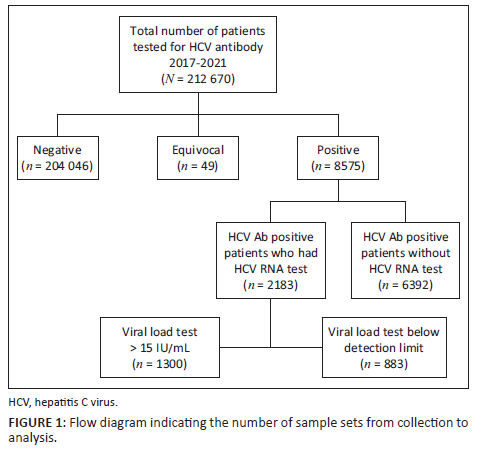
A total of 212 670 patients were tested for HCV infection from 01 January 2017 to 31 December 2021 at NHLS (Figure 1). A total of 8575 (4.04%) tested seropositive for HCV. Low positives were overall present at 0.20% (n = 427/212 670) and represent 5.0% (n = 427/8575) of HCV seropositive cases (Table 1). A linked follow-up quantitative HCV RNA test was performed for 25% (n = 2183/8575) of which 59.55% (n = 1300/2183) had detectable viral RNA (Figure 1).
Annual variations in hepatitis C virus serology
Of the 212 670 patients who were tested for HCV infection, the highest numbers for HCV serology were tested in 2017 (22.7%; n = 48 314), 2018 (22.2%; n = 46 790), and 2019 (21.9%; n = 46 661) at similar rates (Table 1). In 2020, fewer patients were tested and represented 18.6% (n = 39 650/212 670), while 2021 only represented 14.6% (n = 31 255/212 670). The annual HCV antibody positivity rate was lowest in 2021 at 16.5% (n = 1416/31 255) and was 21.3% (n = 1821/39 650) in 2020. The highest HCV antibody positivity rate of 24.1% (n = 2072/46 661) was observed in 2019.
Demographic and clinical characteristics of hepatitis C virus seropositive patients
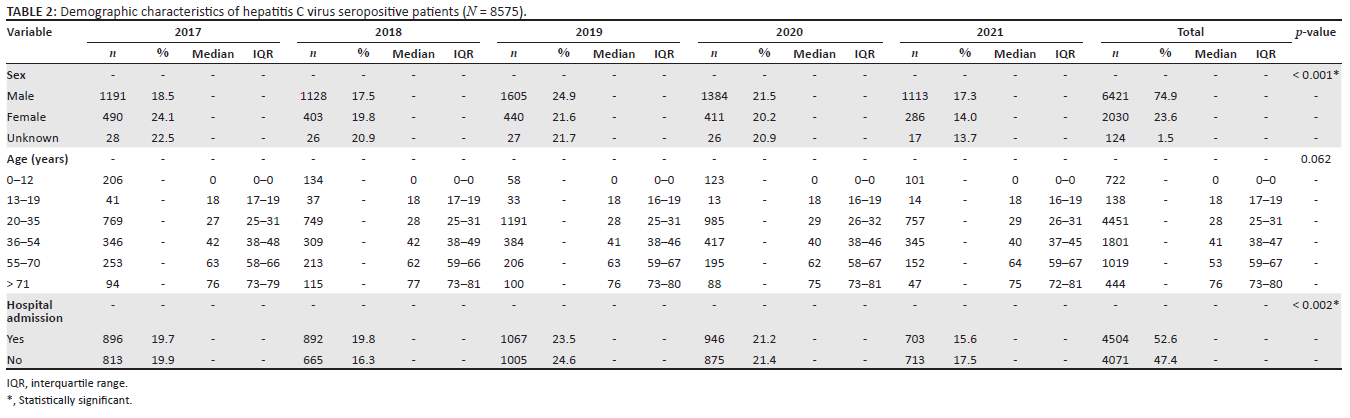
Of the 8575 HCV-seropositive patients, males were significantly higher than females (n = 6421, 74.8% vs n = 2030, 23.6%; p < 0.001), while for 1.5% (n = 124/8575) sex was not recorded (Table 2).
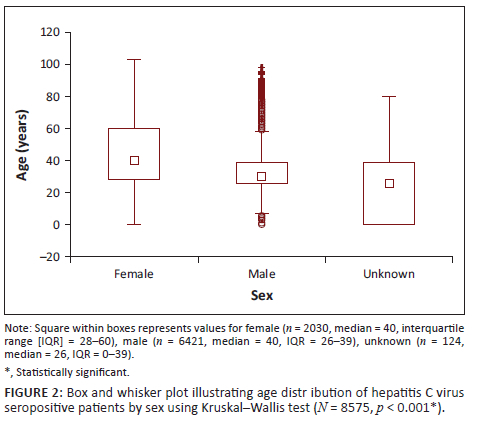
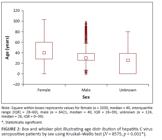
Males were also significantly younger than females (median age 30 [26-39] years vs 40 [28-60] years; p < 0.001) (Figure 2). The year 2019 reported the highest number of males, while 2018 reported the lowest number of females. Among HCV seropositive patients, the age group 20-35 years with a median age of 28 years old dominated (52%; n = 4451/8575), and seropositivity was the highest in 2019, (26.7%; n = 1191/4451), followed by age groups 36-54 years (21%; n = 1801/8575) and 55-70 years (12%; n = 1019/8575). Among children 12 years and younger HCV seropositivity was 8.4% (n = 722/8575) with the lowest seropositivity observed among the 13-19 years age group (median 18 years).
The overall number of HCV-seropositive patients with hospital admission (n = 4504/8575, 52.6%) was significantly higher compared to those without hospital admission (n = 4071/8575, 47.4%; p < 0.002) (Table 2). The highest number of admissions was reported in 2019 (23.5%), whereas the lowest was reported in 2021 (15.6%) (Table 2).
Discussion
Previously in South African practice, the diagnosis of HCV required at least two visits to screen and diagnose HCV infection; as a result, a proportion of patients will be lost to follow-up and they could not be linked to care.8,14 Improving access to rapid, simple and affordable HCV diagnostics is critical to advancing global HCV elimination efforts. In 2019, a laboratory-based HCV reflex testing algorithm was introduced to address issues related to inconclusive results and patient loss to follow-up.86,7,11,12,13,14 Research describing HCV seroprevalence in South Africa has largely been directed to the high-risk populations, including people who inject drugs (PWID), men who have sex with men (MSM), HCV and HIV concurrently infected patients, the homeless, and the incarcerated because of their high HCV prevalence rates.11,12,13,14 The accurate seroprevalence data in a broader population is necessary for South Africa to track progress and refine elimination strategies towards the WHO's target of eliminating HCV as a public health threat by 2030.112,14,15 However, what is particularly concerning is that in our study, a staggering 75% of seropositive patients did not have a linked HCV RNA result. This finding substantiates our hypotheses that the HCV diagnostic algorithm recommended by the WHO and by the South African Hepatitis National Guidelines are not adhered to in clinical practice. Failure to confirm active HCV infection delays crucial interventions, such as timely initiation of treatment in the DAA era, thereby prolonging disease progression and increasing the risk of complications.6,16
Furthermore, undiagnosed individuals with detectable HCV RNA may continue to transmit the virus especially among high-risk groups and at a population-based level.16
These results correlate with several studies conducted on HCV prevalence.5,1718195,2011,12,13,14621,2223,24p < 0.002), although this occurrence may not be directly linked to HCV infection. Over the years, observational studies conducted in high-income countries have shown that among HCV infected individuals, hospitalisation related to HCV infection was gradually increasing. However, since the introduction of DAAs, hospitalisation rates have markedly declined, thereby reducing the overall healthcare burden.25,26
Conclusion
This study highlights a gap in the current HCV diagnostic algorithm in South Africa. Even with reflex testing having been implemented in South Africa, there are still gaps in patients' linkage after a positive HCV antibody result. Therefore, if follow-up systems are not strengthened, the benefits of reflex testing are not fully exploited. With a seroprevalence of 4.04% among the general population, our findings underscore the need to frequently update seroprevalence data to inform elimination strategies. Our findings also suggest an ongoing transmission in the general South African population. The lack of follow-up HCV RNA testing highlights a setback in implementing recommended diagnostic algorithms and patients' linkage to care.
Limitations of the study
It is important to observe that data from NHLS CDW was used, which reflects testing practices within the South African public health sector only. Clinicians requesting HCV testing in the private sector may have a different approach because of better resources, and therefore, including private sector data may reflect different testing outcomes. Our data could not be stratified by high-risk groups; therefore, we were unable to specifically analyse outcomes for individuals considered to be high-risk groups. Moreover, the seroprevalence findings from routine laboratory data from one province may not be representative of other South African provinces.
Competing interests
The authors declare that they have no financial or personal relationships that may have inappropriately influenced them in writing this article Nishi Prabdial-Sing serve as an editorial board member of this journal. The authors have no other competing interests to declare.
CRediT authorship contribution
Hloniphile Mthiyane: Conceptualisation, Methodology, Formal analysis, Investigation, Writing - original draft, Data curation, Writing - review & editing, Supervision. Bonolo Mashishi: Writing - review & editing. Mamodiane A. Patjane: Methodology, Formal analysis, Investigation, Data curation, Writing - review & editing. Ntwanano Honwana: Methodology, Formal analysis, Data curation, Writing - review & editing. Nishi Prabdial-Sing: Writing - review & editing. Lucia Hans: Writing - review & editing. Nonhlanhla Mbenenge: Writing - review & editing. Bhaveshan Reddy: Writing - review & editing. Avania Bangalee: Conceptualisation, Methodology, Formal analysis, Project administration, Data curation, Writing - review & editing, Supervision. Florette K. Treurnicht: Methodology, Data curation, Writing - review & editing. All authors reviewed the article, contributed to the discussion of results, approved the final version for submission and publication, and take responsibility for the integrity of its findings.
Funding information
This research received no specific grant from any funding agency in the public, commercial or not for profit sectors.
Data availability
The data that support the findings of this study are available on request from the corresponding author, Hloniphile Mthiyane.
Disclaimer
The views and opinions expressed in this article are those of the authors and are the product of professional research. They do not necessarily reflect the official policy or position of any affiliated institution, funder, agency or that of the publisher. The authors are responsible for this article's results, findings and content.
Acknowledgements
References
-
1.World Health Organization. Global hepatitis report 2024: Action for access in low- and middle-income countries [homepage on the Internet]. Geneva: World Health Organization; 2024 [cited 17 Nov 2025]. Available from: http://www.who.int/health-topics/hepatitis
» http://www.who.int/health-topics/hepatitis -
2.World Health Organization. Hepatitis C [homepage on the Internet]. Geneva: World Health Organization; 2023 [cited 17 Nov 2025]. Available from: https://www.who.int/news-room/fact-sheets/detail/hepatitis-c
» https://www.who.int/news-room/fact-sheets/detail/hepatitis-c -
3.Fasano M, Ieva F, Ciarallo M, Caccianotti B, Santantonio TA. Acute hepatitis C: Current status and future perspectives. Viruses. 2024;16(11):1739. https://doi.org/10.3390/v16111739
» https://doi.org/10.3390/v16111739 -
4.Lingala S, Ghany MG. Natural history of hepatitis C. Gastroenterol Clin North Am. 2015;44(4):717-734. https://doi.org/10.1016/j.gtc.2015.07.003
» https://doi.org/10.1016/j.gtc.2015.07.003 -
5.O'Brien TR, Yang HI, Groover S, Jeng WJ. Genetic factors that affect spontaneous clearance of hepatitis C or B virus, response to treatment, and disease progression. Gastroenterology. 2019;156(2):400-417. https://doi.org/10.1053/j.gastro.2018.09.052
» https://doi.org/10.1053/j.gastro.2018.09.052 -
6.Sonderup MW, Gogela N, Nordien R, et al. Direct-acting antiviral therapy for hepatitis C: The initial experience of the University of Cape Town/Groote Schuur Hospital Liver Clinic, South Africa. S Afr Med J. 2020;110(2):112. https://doi.org/10.7196/SAMJ.2020.v110i2.14195
» https://doi.org/10.7196/SAMJ.2020.v110i2.14195 -
7.Sonderup MW, Horak J, Smuts H, Saayman J, Boretti L, Black J. Expanding the epidemiological understanding of hepatitis C in South Africa: Perspectives from a patient cohort in a rural town. S Afr Med J. 2021;111(8):783. https://doi.org/10.7196/SAMJ.2021.v111i8.15477
» https://doi.org/10.7196/SAMJ.2021.v111i8.15477 -
8.National Department of Health, South Africa. National guidelines for the management of viral hepatitis [homepage on the Internet]. Pretoria: National Department of Health; 2019 [cited 17 Nov 2025]. Available from: https://sahivsoc.org/Files/SA%20NDOH_Viral%20Hepatitis%20guidelines%20final.pdf
» https://sahivsoc.org/Files/SA%20NDOH_Viral%20Hepatitis%20guidelines%20final.pdf -
9.Bhattacharya D, Aronsohn A, Price J, et al. Hepatitis C guidance 2023 update: American Association for the study of liver diseases - Infectious Diseases Society of America recommendations for testing, managing, and treating hepatitis C virus infection. Clin Infect Dis. 2023:ciad319. https://doi.org/10.1093/cid/ciad319
» https://doi.org/10.1093/cid/ciad319 -
10.Baumert TF, Berg T, Lim JK, Nelson DR. Status of direct-acting antiviral therapy for hepatitis C virus infection and remaining challenges. Gastroenterology. 2019;156(2):431-445. https://doi.org/10.1053/j.gastro.2018.10.024
» https://doi.org/10.1053/j.gastro.2018.10.024 -
11.Prabdial-Sing N, Gaelejwe L, Makhathini L, Thaver J, et al. The performance of hepatitis C virus antibody point-of-care tests on oral fluid or whole blood and dried blood spot testing for serology and viral load among individuals at higher risk for in South Africa. Health Sci Rep. 2021;4(1):e229. https://doi.org/10.1002/hsr2.229
» https://doi.org/10.1002/hsr2.229 -
12.Trickey A, Fajardo E, Alemu D, Artenie AA, Easterbrook P. Impact of hepatitis C virus point-of-care RNA viral load testing compared with laboratory-based testing on uptake of RNA testing and treatment, and turnaround times: A systematic review and meta-analysis. Lancet Gastroenterol Hepatol. 2023;8(3):253-270. https://doi.org/10.1016/S2468-1253(22)00346-6
» https://doi.org/10.1016/S2468-1253(22)00346-6 -
13.Chang KV. Efficacy and safety of direct-acting antiviral regimens for hepatitis C virus infection: Protocol for a network meta-analysis. INPLASY. 2024;2024(11):0056. https://doi.org/10.37766/inplasy2024.11.0056
» https://doi.org/10.37766/inplasy2024.11.0056 -
14.Kassa GM, Walker JG, Alamneh TS, et al. Prevalence, trends, and distribution of hepatitis C virus among the general population in sub-Saharan Africa: A systematic review and meta-analysis. Liver Int. 2024;44(12):3238-3249. https://doi.org/10.1111/liv.16170
» https://doi.org/10.1111/liv.16170 -
15.Gogela NA, Sonderup MW, Rebe K, Chivese T, Spearman CW. Hepatitis C prevalence in HIV-infected heterosexual men and men who have sex with men. S Afr Med J. 2018;108(7):568. https://doi.org/10.7196/SAMJ.2018.v108i7.13041
» https://doi.org/10.7196/SAMJ.2018.v108i7.13041 -
16.Saayman E, Hechter V, Kayuni N, Sonderup MW. A simplified point-of-service model for hepatitis C in people who inject drugs in South Africa. Harm Reduct J. 2023;20(1):7. https://doi.org/10.1186/s12954-023-00759-0
» https://doi.org/10.1186/s12954-023-00759-0 -
17.Stroffolini T, Stroffolini G. Prevalence and modes of transmission of hepatitis C virus infection: A historical worldwide review. Viruses. 2024;16(7):1115. https://doi.org/10.3390/v16071115
» https://doi.org/10.3390/v16071115 -
18.Van de Laar TJW, Van der Bij AK, Prins M, et al. Increase in HCV incidence among men who have sex with men in Amsterdam most likely caused by sexual transmission. J Infect Dis. 2007;196(2):230-238. https://doi.org/10.1086/518796
» https://doi.org/10.1086/518796 -
19.Jin F, Matthews GV, Grulich AE. Sexual transmission of hepatitis C virus among gay and bisexual men: A systematic review. Sex Health. 2017;14:28. https://doi.org/10.1071/SH16141
» https://doi.org/10.1071/SH16141 -
20.Scheibe A, Young K, Versfeld A,. Hepatitis B, hepatitis C and HIV prevalence and related sexual and substance use risk practices among key populations who access HIV prevention, treatment and related services in South Africa: Findings from a seven-city cross-sectional survey (2017). BMC Infect Dis. 2020;20(1):655. https://doi.org/10.1186/s12879-020-05359-y
» https://doi.org/10.1186/s12879-020-05359-y -
21.World Health Organization. WHO publishes updated guidance on hepatitis C infection - With new recommendations on treatment of adolescents and children, simplified service delivery and diagnostics [homepage on the Internet]. World Health Organization. 2022 [cited 2025 Nov 17]. Available from: https://www.who.int/news/item/24-06-2022-WHO-publishes-updated-guidance-on-hepatitis-C-infection
» https://www.who.int/news/item/24-06-2022-WHO-publishes-updated-guidance-on-hepatitis-C-infection -
22.Tamandjou Tchuem C, Cotton MF, Nel E, et al. Viral hepatitis B and C in HIV-exposed South African infants. BMC Pediatr. 2020;20:1. https://doi.org/10.1186/s12887-020-02479-x
» https://doi.org/10.1186/s12887-020-02479-x -
23.Nwaohiri A, Schillie S, Bulterys M, Kourtis AP. Hepatitis C virus infection in children: How do we prevent it and how do we treat it? Expert Rev Anti Infect Ther. 2018;16(9):689-694. https://doi.org/10.1080/14787210.2018.1509707
» https://doi.org/10.1080/14787210.2018.1509707 -
24.Ades AE, Gordon F, Scott K, et al. Spontaneous clearance of vertically acquired hepatitis C infection: Implications for testing and treatment. Clin Infect Dis. 2023;76(5):913-921. https://doi.org/10.1093/cid/ciac255
» https://doi.org/10.1093/cid/ciac255 -
25.Ng M, Carrieri PM, Awendila L, Socías ME, Knight R, Ti L. Hepatitis C virus infection and hospital-related outcomes: A systematic review. Can J Gastroenterol Hepatol. 2024;2024:1-23. https://doi.org/10.1155/2024/3325609
» https://doi.org/10.1155/2024/3325609 -
26.Hofmeister MG, Zhong Y, Moorman AC, Samuel CR, Teshale EH, Spradling PR. Temporal trends in hepatitis C - Related hospitalizations, United States, 2000-2019. Clin Infect Dis. 2023;77(12):1668-1675. https://doi.org/10.1093/cid/ciad425
» https://doi.org/10.1093/cid/ciad425

Accepted: 20 Nov. 2025
Published: 27 Mar. 2026