Unexpected non-reactive nontreponemal serology in secondary syphilis: The prozone phenomenon and clinician-laboratory communication
Abstract
We describe a case of a 22-year-old woman living with human immunodeficiency virus (HIV) who presented with classical features of secondary syphilis. Initial Rapid Plasma Reagin (RPR) testing was unexpectedly non-reactive; however, repeat RPR testing with serum dilution yielded a reactive result, illustrating the prozone phenomenon. CONTRIBUTION: The prozone phenomenon is uncommon. We aim to encourage clinician-laboratory communication when there is a high pretest probability of syphilis, with serological discordance, to facilitate prompt diagnosis and treatment
secondary syphilis; prozone phenomenon; syphilis serology; serological discordance; Treponema pallidum
Introduction
Syphilis is an infectious disease caused by the spirochaete Treponema pallidum subspecies pallidum (T. pallidum). It is transmitted predominantly through sexual activity or vertically from mother to child, resulting in congenital syphilis. Since the introduction of syndromic management of sexually transmitted infections in South Africa, the prevalence of syphilis has reduced.12,3
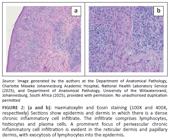
The laboratory diagnosis of syphilis is primarily serological and relies on a combination of treponemal and nontreponemal tests. It is important to note that nontreponemal tests can yield unexpectedly non-reactive results, occasionally as a consequence of the prozone phenomenon.4,5,6,7
Case
A 22-year-old woman living with HIV presented with a 2-month history of a body rash. She admitted to interrupting her antiretroviral therapy 2 months before presenting to the hospital. Upon further enquiry, she reported a history of a painless genital ulcer approximately 3 weeks before the onset of the body rash. The ulcer had spontaneously resolved. The patient was haemodynamically stable and apyrexial. On general examination, she had cervical lymphadenopathy. The rash consisted of polymorphous skin lesions, including hyperpigmented macules, violaceous plaques with surface scale and violaceous macules and plaques with collarette scale.

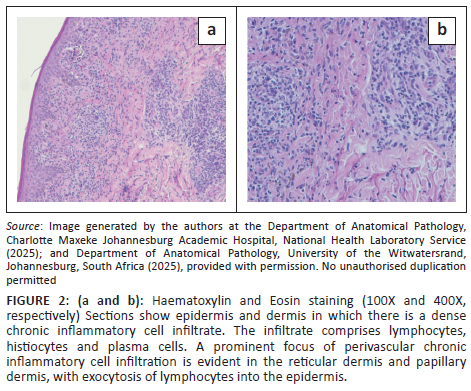
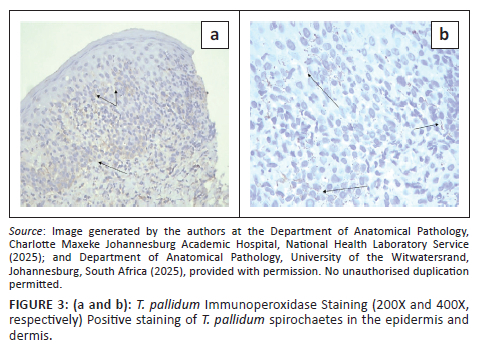
Consequently, a skin biopsy was done, and a second blood sample was collected within 24 h of the initial specimen and submitted for repeat RPR testing with serum dilution following clinician-laboratory communication. The skin biopsy confirmed secondary syphilis as demonstrated in Figure 2 and Figure 3, and the repeat RPR test with serum dilution was reactive with a titre of 512. The patient was treated with a single dose of Benzathine Penicillin G 2.4 million units intramuscularly according to the Southern African HIV Clinicians Society Guideline,1
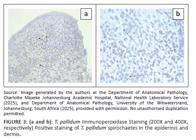
Discussion
Syphilis can broadly be classified into early and late syphilis. Early syphilis includes primary, secondary and early latent syphilis. Late syphilis includes tertiary syphilis and late latent syphilis.89968T. pallidum, or late, if diagnosed more than 12 months after infection with T. pallidum.5,65,6
Due to the variability in the presentation of syphilis, laboratory testing is necessary. Laboratory tests can either be direct detection methods or serology. Direct detection methods include nucleic acid amplification tests, dark-field microscopy and histology, but are costly, require specialised equipment and technical expertise.4,54,5
Treponemal tests are qualitative tests that detect the presence of immunoglobulin G and immunoglobulin M (IgG and IgM) antibodies against T. pallidum. They cannot be used to monitor response to treatment, nor can they be used to detect re-infection. Once a treponemal test is reactive, it remains reactive indefinitely despite treatment.4
Examples of treponemal tests commonly available in South Africa are the enzyme immunoassay, chemiluminescent immunoassay IgG/IgM, fluorescent treponemal antibody-absorption test, T. pallidum Haemagglutination Assay (TPHA) and the T. pallidum Particle Agglutination Assay (TPPA).1
Nontreponemal tests are quantitative assays that report antibody titres. They are used to assess disease activity, monitor treatment response and detect re-infection.4164,5,6,7
Reported associations of the prozone phenomenon include patients with secondary syphilis and certain clinical populations such as individuals living with HIV.10,115,12,13
There are unfortunately no studies that have measured the incidence of the prozone phenomenon in South African cohorts. While HIV infection has been hypothesised to increase the risk of the prozone phenomenon through immune dysregulation and excess antibody production,11,14
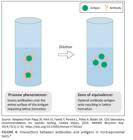
Furthermore, using the reverse sequence algorithm (in which a treponemal test is performed first, if reactive, a nontreponemal test is then performed) as opposed to the traditional sequence algorithm (in which a nontreponemal test is performed first and only if reactive, a treponemal test is then performed) has the advantage of detecting serological discordance.15
Interpretation of serological discordance requires a structured diagnostic framework comprising of clinical factors, pre-analytical factors, analytical factors and post-analytical factors. Clinical factors include the stage of the disease (particularly early infection with seroconversion if there is a temporal gap between specimens) and previous syphilis infection.4,6,1516
Analytical factors include the prozone phenomenon and false-positive treponemal results.1516
Conclusion
The prozone phenomenon can present a diagnostic dilemma. Undiagnosed and untreated syphilis can result in ongoing transmission of syphilis, an increased risk of HIV transmission or acquisition, as well as progression of syphilis to advanced disease, which is associated with significant morbidity and mortality.8,17
Competing interests
The authors declare that they have no financial or personal relationships that may have inappropriately influenced them in writing this article.
CRediT authorship contribution
Mahomed A. Aboo: Conceptualisation, Investigation, Methodology, Project administration, Resources, Visualisation, Writing - original draft and Writing - review & editing. Matilda Mphahlele: Conceptualisation, Resources, Supervision and Writing - review & editing. Melanie Louw: Resources, Supervision and Writing - review & editing. Nicholas Aikman: Investigation, Resources and Writing - review & editing. All authors reviewed the article, contributed to the discussion of results, approved the final version for submission and publication, and take responsibility for the integrity of its findings.
Ethical consideration
Ethical clearance to conduct this study was obtained from the Human Research Ethics Committee (Medical) of the University of the Witwatersrand (No. M250488).
Funding information
This research received no specific grant from any funding agency in the public, commercial or not-for-profit sectors.
Data availability
The authors confirm that the data supporting the findings of this study are available within the article.
Disclaimer
The views and opinions expressed in this article are those of the authors and are the product of professional research. It does not necessarily reflect the official policy or position of any affiliated institution, funder, agency or that of the publisher. The authors are responsible for this article's results, findings and content.
Acknowledgements
References
-
1.Peters RPH, Nel JS, Sadiq E, et al. Southern African HIV clinicians society guideline for the clinical management of syphilis. S Afr J HIV Med. 2024;25(1):1577. https://doi.org/10.4102/sajhivmed.v25i1.1577
» https://doi.org/10.4102/sajhivmed.v25i1.1577 -
2.Kufa T, Thabane E, Leshaba D, Makhubele M, Puren A. Congenital syphilis annual surveillance report, South Africa 2023. Public Health Bull S Africa [serial online]. 2025 [cited 2025 May 31];3(1). Available from: https://www.phbsa.ac.za/wp-content/uploads/2025/01/Congenital-syphilis-annual-surveillance-report-South-Africa-2023.pdf
» https://www.phbsa.ac.za/wp-content/uploads/2025/01/Congenital-syphilis-annual-surveillance-report-South-Africa-2023.pdf -
3.Khaliq OP, Jassen A, Tabane N, Moodley J. Prevalence and management of syphilis at primary healthcare level in the Free State, South Africa. S Afr J Infect Dis. 2025;40(1):724. https://doi.org/10.4102/sajid.v40i1.724
» https://doi.org/10.4102/sajid.v40i1.724 -
4.Satyaputra F, Hendry S, Braddick M, Sivabalan P, Norton R. The laboratory diagnosis of syphilis. J Clin Microbiol. 2021;59(10):e0010021. https://doi.org/10.1128/JCM.00100-21
» https://doi.org/10.1128/JCM.00100-21 -
5.Cao W, Thorpe PG, O'Callaghan K, Kersh EN. Advantages and limitations of current diagnostic laboratory approaches in syphilis and congenital syphilis. Expert Rev Anti Infect Ther. 2023;21(12):1339-1354. https://doi.org/10.1080/14787210.2023.2280214
» https://doi.org/10.1080/14787210.2023.2280214 -
6.Papp JR, Park IU, Fakile Y, Pereira L, Pillay A, Bolan GA. CDC laboratory recommendations for syphilis testing, United States, 2024. MMWR Recomm Rep. 2024;73(1):1-32. https://doi.org/10.15585/mmwr.rr7301a1
» https://doi.org/10.15585/mmwr.rr7301a1 -
7.Treger RS, Menza TW, Truong TT, Lieberman JA. Advances in syphilis diagnostics to address the 21st-century epidemic. Clin Chem. 2025;71(9):935-948. https://doi.org/10.1093/clinchem/hvaf072
» https://doi.org/10.1093/clinchem/hvaf072 -
8.Chevalier FJ, Bacon O, Johnson KA, Cohen SE. Syphilis: A review. J Am Med Assoc. 2025;334(21):1927-1940. https://doi.org/10.1001/jama.2025.17362
» https://doi.org/10.1001/jama.2025.17362 -
9.Whiting C, Schwartzman G, Khachemoune A. Syphilis in dermatology: Recognition and management. Am J Clin Dermatol. 2023;24(2):287-297. https://doi.org/10.1007/s40257-022-00755-3
» https://doi.org/10.1007/s40257-022-00755-3 -
10.Smith G, Holman RP. The prozone phenomenon with syphilis and HIV-1 co-infection. South Med J. 2004;97(4):379-382. https://doi.org/10.1097/01.SMJ.0000121204.58881.60
» https://doi.org/10.1097/01.SMJ.0000121204.58881.60 -
11.Awake P, Angadi K, Sen S, Bhadange P. Prozone phenomenon in secondary syphilis with HIV co-infection: Two cases. Indian J Sex Transm Dis AIDS. 2022;43(2):183-185. https://doi.org/10.4103/ijstd.ijstd_43_22
» https://doi.org/10.4103/ijstd.ijstd_43_22 - 12.el-Zaatari MM, Martens MG, Anderson GD. Incidence of the prozone phenomenon in syphilis serology. Obstet Gynecol. 1994;84(4):609-612.
-
13.Liu LL, Lin LR, Tong ML, et al. Incidence and risk factors for the prozone phenomenon in serologic testing for syphilis in a large cohort. Clin Infect Dis. 2014;59(3):384-389. https://doi.org/10.1093/cid/ciu325
» https://doi.org/10.1093/cid/ciu325 -
14.Moir S, Fauci AS. B cells in HIV infection and disease. Nat Rev Immunol. 2009;9(4):235-245. https://doi.org/10.1038/nri2524
» https://doi.org/10.1038/nri2524 - 15.Centers for Disease Control and Prevention (CDC). Discordant results from reverse sequence syphilis screening - Five laboratories, United States, 2006-2010. MMWR Morb Mortal Wkly Rep. 2011;60(5):133-137.
-
16.World Health Organization. Laboratory quality management system: Handbook [homepage on the Internet]. Geneva: World Health Organization; 2011 [cited 2026 Feb 15]. Available from: https://www.who.int/publications/i/item/9789241548274
» https://www.who.int/publications/i/item/9789241548274 -
17.Gandla S, Nakka R, Khan RA, Salboukh F, Ghebremichael M. The association between syphilis infection and HIV acquisition and HIV disease progression in sub-Saharan Africa. Trop Med Infect Dis. 2025;10(3):65. https://doi.org/10.3390/tropicalmed10030065
» https://doi.org/10.3390/tropicalmed10030065
Accepted: 09 Mar. 2026
Published: 24 Apr. 2026