Developing ambidexterity and resilience: The predictive role of high-performance work systems
Abstract
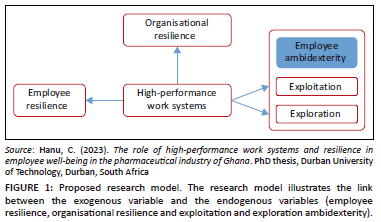
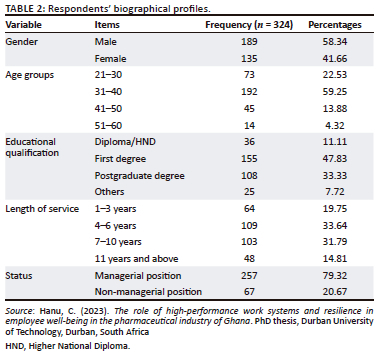
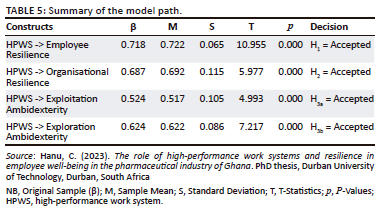
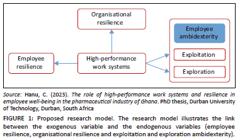
ORIENTATION: Organisations and employees face crises at a point in time that may disrupt their normal work activities. High-performance work systems (HPWSs) help develop and enhance individuals' and firms' ability to respond to crises effectively RESEARCH PURPOSE: This study examined the differential impact of HPWS on employee resilience, employee ambidexterity and organisational resilience during crises in pharmaceutical manufacturing firms in Ghana MOTIVATION FOR THE STUDY: Limited studies have examined how HPWSs predict employee ambidexterity and employee and organisational resilience in separate studies. Nevertheless, knowledge regarding the differential impact of these outcomes in a single study is sparse, particularly during crises RESEARCH APPROACH/DESIGN AND METHOD: A quantitative research approach was used in this study. Data for this study were gathered through a cross-sectional survey utilising a structured online questionnaire. A total of 324 participants formed the sample for data collection. The measure and structural models were assessed using Partial Least Squares Structural Equation Modeling (PLS-SEM MAIN FINDINGS: The results show that HPWS positively and significantly affects employee and organisational resilience and ambidexterity during crises within the research context PRACTICAL/MANAGERIAL IMPLICATIONS: The outcomes from the study provide helpful information for pharmaceutical firms' managers to enhance their employees' resilience and ambidexterity and the organisations' resilience CONTRIBUTION/VALUE-ADD: This study contributes to the HPWS literature by enriching the understanding of its effects on employee resilience, employee ambidexterity and organisational resilience in the context of an emerging economy
high-performance work systems; resilience; exploitation; exploration; ambidexterity
 Thumbnail