Country ownership and sustainable programming of the HIV response in South Africa: A scoping review
Abstract
BACKGROUND: Concerns have arisen regarding the extent to which South Africa's HIV response can be country-owned and sustainable given substantial foreign investment and technical support. OBJECTIVES: To assess the extent to which South Africa's national HIV response is country-owned. METHOD: We conducted a scoping review of South African literature using the Global Health Initiative Framework for country ownership. RESULTS: South Africa has clear aspirations for what should be accomplished and strategies are aligned with national and international priorities. Although South Africa has leveraged community-based strategies to reach key populations (KPs), most are supported by international donors, which poses a sustainability challenge. Despite robust capacity strengthening and training programmes, South Africa continues to face healthcare worker shortages. While it is commendable that South Africa funds nearly 70% of the national HIV response, the funds mainly support HIV treatment. This may create dependency on international partners. CONCLUSION: South Africa appears to be progressing well along the spectrum of country ownership, but sustained efforts are required to combat HIV. Greater ownership over KP programming and prevention services are especially needed to achieve greater impact.
country ownership; HIV response; sustainable programming; South Africa; political ownership; institutional and community ownership; capabilities; mutual accountability
Introduction
Country ownership and sustainable programming of the HIV response came to the forefront of discussions on international investments in health and development in the early 2000s. For example, the 2005 Paris Declaration cites country ownership as one of the core tenets of aid effectiveness.1234,5
In addition to coordinating government programmes, which is spearheaded by SANAC, the United States President's Emergency Plan for AIDS Relief (PEPFAR) is one of the largest actors in the HIV response, funding 24% of all HIV programmes in South Africa in 2020.6,77,8
Reflecting on the importance of championing a sustainable HIV programme in South Africa, the SAG works in tandem with local and global partners to create a bi-annual Sustainability Index and Dashboard (SID).99
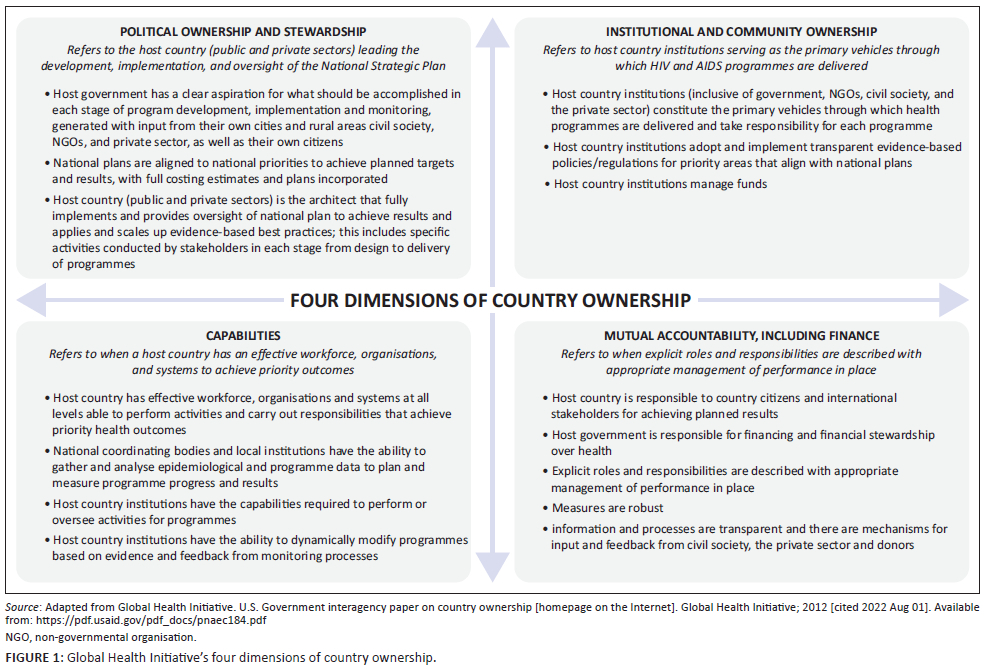
The GHI produced a conceptual framework that defines and characterises four dimensions of country ownership: (1) political ownership and stewardship; (2) institutional and community ownership; (3) capabilities; and (4) mutual accountability, including finance.88
This article assesses the extent to which South Africa's national HIV response is country-owned, according to the GHI framework. This article may strengthen the national HIV response by providing insights into gaps in country-owned HIV programming and practical recommendations for closing them. This is feasible, provided that South Africa considers and implements the findings from this article. A multisectoral response remains critical as no single agency can effectively respond sustainably to the HIV epidemic alone. This review has implications for future pandemic preparedness.
Methods
We conducted a scoping review of available literature and reports (both published and unpublished) on HIV programmes in South Africa to ensure a comprehensive and up-to-date review. In addition, a manual search on the SANAC, Human Sciences Research Council, The Joint United Nations Programme on HIV/AIDS (UNAIDS), and local implementing partners' websites was conducted. The following search terms were used: 'political ownership and stewardship in South Africa', 'institutional and community ownership in South Africa', 'capabilities', 'mutual accountability', 'finance', 'South Africa', 'HIV response in South Africa', 'country ownership in South Africa'. However, it should be noted that the search terms did not elicit adequate information as some reports were not available in the public domain. We relied on technical reports, annual reports, policies, notes, and related programmatic information provided by stakeholders, some of whom served as co-authors. Given the fact that this was a scoping rather than a systematic review, we do not claim that all documents relating to the subject were used. However, care was taken to ensure that key documents, as provided by stakeholders, were used.
Data have been presented in tables where applicable. RefWorks software was used to manage the articles and reports that were identified. After identifying relevant documents to include in our analysis, we used thematic content analysis to apply the GHI criteria for meeting the four dimensions of country ownership (Figure 1)8
Ethical considerations
This scoping review falls under the umbrella study entitled 'Harnessing big heterogeneous data to evaluate the potential impact of HIV responses among key populations in generalized epidemic settings in sub-Saharan Africa (The Boloka Project)', which was approved by the Research Ethics Committee of the Faculty of Health Sciences, University of Johannesburg (REC-1504-2022). This review included the use of published and unpublished literature.
Results
The evidence of South Africa's country ownership of the HIV response, according to the Global Health is available in Table 1.
Dimension 1: Political ownership and stewardship
The SAG has shown a high level of political ownership and stewardship. This political commitment is crucial as it underpins the subsequent three dimensions.
Criterion 1.1: Host government has a clear aspiration for what should be accomplished in each stage of programme development, implementation, and monitoring, generated with input from their own cities and rural areas, civil society, non-governmental organisations, and private sector, as well as their own citizens
Country ownership is demonstrated by the fact that South Africa has a clear aspiration for what should be accomplished, and strategies are informed by various stakeholders. The NSP has four strategic goals:
• Break down barriers to achieving outcomes for HIV, TB and STIs.
• Maximise equitable and equal access to services and solutions for HIV, TB and STIs.
• Fully resource and sustain an efficient NSP led by revitalised, inclusive and accountable institutions.
• Build resilient systems for HIV, TB and STIs that are integrated into systems for health, social protection, and pandemic response.4
In this regard, the NSP highlights the importance of KPs, as they are particularly affected. In this regard, South Africa is a signatory of a series of UNAIDS declarations, including the Fast-Track strategy to accelerate HIV epidemic control.11,12111314
As the fulcrum of the country's response to the HIV epidemic, the NSP is generated with input from South African citizens, the private sector and development partners, the SAG, and civil society.41044
Criterion 1.2: National plans are aligned to national priorities to achieve planned targets and results, with full costing estimates and plans incorporated
Country ownership is one of the focus areas of the new NSP.4444
Conditional grants are regulated through the Division of Revenue Act. Each grant has a Framework, which is an annexure in the Act Document. Funds are transferred to Provinces in line with Approved Business Plans. Provinces implement approved activities and report back to the transferring National Department. Challenges are usually experienced with compliance by provinces on provisions of the Act. Spending is usually not a major challenge due to high demand for financial resources or resources in general.15
Criterion 1.3: Host country (public and private sectors) is the architect that fully implements and provides oversight of national plan to achieve results and applies and scales up evidence-based best practices; this includes specific activities conducted by stakeholders in each stage from design to delivery of programmes
Another sign of a country-owned response is that both public and private stakeholders are intimately involved in the implementation of the NSP. Although support from international donors should not be minimised, South African organisations are primarily responsible for carrying out the NSP. The NSP outlines evidence-based strategies needed to accomplish targeted goals which include:
Scaling up HIV testing and Universal Test and Treat (UTT), investing in long-acting ART regimens and adherence support, voluntary medical male circumcision (VMMC), pre-exposure prophylaxis (PrEP), condom distribution, She Conquers and the Determined, Resilient, Empowered, AIDS-free, Mentored and Safe (DREAMS) programme for adolescent girls and young women (AGYW).4
Dimension 2: Institutional and community ownership
In the words of internationally recognised HIV researchers and advocates, Chris Collins and Chris Beyrer: 'country ownership must not come to mean simply government ownership; if it does, the voices of affected communities might not be heard, and accountability will suffer'.16Nothing for Us Without Us and Leave No One Behind' reflect the ideal of amplifying marginalised voices. Involving communities in the response will strengthen the long-term sustainability of HIV services, especially among KPs.
Criterion 2.1: Host country institutions (inclusive of government, NGOs, civil society, and the private sector) constitute the primary vehicles through which health programmes are delivered and take responsibility for each programme
Communities have been the main responders in the HIV response through advocacy, community-led monitoring, and service delivery for over three decades. The active participation of communities in the HIV response is in line with commitment seven of the Global AIDS Monitoring (GAM) report. The GAM report showed that South Africa met the goal of having at least 30% of all service delivery be community-led by 2020.10
• AIDS Foundation of South Africa provided a core package of prevention programmes to reduce human rights-related barriers to HIV to over 25 000 AGYW in 2021. The organisation is overseeing the implementation of the sex work module in the current Global Fund grant.6
• Beyond Zero is present in seven provinces; in addition to providing services directly to MSM and transgender people, they also provided small grants and capacity building to 77 other South African organisations.6
• Networking HIV and AIDS Community of Southern Africa distributes its funds to 2500 community-based organisations (CBOs) in seven provinces to deliver services to sex workers. In 2021, NACOSA's services reached 40 352 sex workers, 40 618 children and youth, 65 301 AGYW, and 9979 PWUD. The organisation also provides economic empowerment and other structural services to improve the health, psychosocial, and socio-economic well-being of KPs.6
These three organisations, as well as others, are supported through conditional grants from PEPFAR and the Global Fund, not from SAG funds.6,101718
Community leaders of KP groups and PLHIV also contribute substantially to the national response through community-led monitoring of HIV services and holding the SAG accountable for the provision of high-quality services. For example, Ritshidze is a community-led monitoring system established by organisations representing PLHIV. Through this mechanism - which is utilised in 400 clinics and community healthcare centres across 27 districts in eight provinces - the community can systematically identify and document HIV service delivery and monitor challenges.66,18
Criterion 2.2: Host country institutions adopt and implement transparent, evidence-based policies/regulations for priority areas that align with national plans
The country has policies and legislation that support community service delivery approaches spearheaded by NGOs.46,1061910
Capacity strengthening programmes on human rights, non-discrimination, violence prevention, and gender-based violence are provided to law enforcement personnel, HCWs, and judiciary members at both the national and subnational levels.32020,21,224
Criterion 2.3: Host country institutions manage funds
The SAG largely relies on donor funds for KP programming led by CBOs. For example, Beyond Zero and NACOSA serve as grant managers, determining which sub-recipient organisations will receive funding towards KPs programmes across South Africa.106
Dimension 3: Capabilities
Criterion 3.1: Host country has effective workforce, organisations and systems at all levels able to perform activities and carry out responsibilities that achieve priority health outcomes
The World Health Organization (WHO) African Region has historically faced chronic healthcare worker (HCW) shortages for the provision of routine health and HIV services. The SAG and international donors have continued to invest in human, financial, and organisational resources. The funding is aimed at empowering local CBOs to deliver HIV services, which in the long run will contribute to sustainability. South Africa is one of three African countries with a favourable HCW-to-population ratio of 60.46 skilled health professionals per 10 000 population in 2016.64232364,1010
South Africa has also experienced procurement and supply issues. For example, there have been challenges related to PrEP affordability and accessibility due to high out-of-pocket costs, poor awareness, stigma, discrimination, as well as stockouts requiring more commitment of local resources.24,25
Criterion 3.2: National coordinating bodies and local institutions having ability to gather and analyse epidemiological and programme data to plan and measure programme progress and results
South Africa is committed to building robust information management and monitoring systems. A range of HIV surveillance systems provide the strategic information necessary to guide the HIV response.44,106,10
Numerous gaps to strengthen and harmonise data systems exist. For example, Synch and other important data sets that measure programme progress do not interface with existing data sets and are not linked and until recently have not been country-owned and have been set up in parallel. Further, the National Department of Health (NDoH) still does not collect data disaggregated by KPs due to the lack of unique identifiers. Substantial evidence supports the move toward unique identifiers to preserve privacy while allowing for longitudinal case-based surveillance. It should also be noted that the data that are being collected have several data quality limitations, such as completeness, timeliness, integrity and reliability. Due to staff shortages, sometimes the data are not captured on time from the paper-based registers into the electronic system. Late data capturing affects reporting data on time to be used to inform planning and programming.6,10
Criterion 3.3: Host country institutions have the capabilities required to perform or oversee activities for programmes
The previous criteria have demonstrated the ability of South African institutions to perform and oversee programmatic activities. Furthermore, the Programme Review Committee brings together programme implementers in South Africa to address technological advances during NSP implementation. Regarding oversight, South Africa has robust M&E strategies and plans, and dedicated personnel at SANAC to carry out this out. National and provincial M&E personnel are responsible for producing quarterly factsheets, which highlight progress towards quarterly targets. SANAC is also responsible for coordinating the compilation of the GAM report which documents the country's progress.6,10
Criterion 3.4: Host country institutions have the ability to dynamically modify programmes based on evidence and feedback from monitoring processes
In addition to M&E plans, SANAC is developing the Situation Room - an interactive software platform that will enable global health actors to use the HIV-related data from various stakeholders for real-time decision-making. The platform will enable visualisation of the national and subnational health data and show progress towards NSP targets. The web-based KP Master Tool, developed by SANAC in 2017, will feed information into the Situation Room.2627
Dimension 4: Mutual accountability, including finance
Criterion 4.1: Host country is responsible to country citizens and international stakeholders for achieving planned results
In addition to SANAC's role of fostering dialogue between various stakeholders, the Global Fund Country Coordinating Mechanism (CCM) also plays an oversight role. The CCM meets quarterly to review progress made by principal recipients and provides guidance where there are bottlenecks in implementation.4,1028
Criterion 4.2: Host government is responsible for financing and financial stewardship over health
HIV consistently receives the most international aid of any single disease (with the exception of COVID-19 emergency funding in 2020), amounting to $9 billion in 2020 alone.296,10105,29296,293029
The Resource Mobilisation Committee (RMC) provides comprehensive country-wide oversight of all funding arrangements related to NSP implementation. The RMC assesses funding opportunities, aligns with NSP goals and objectives, recommends NSP funding, and identifies interventions to assist in the allocation of sufficient funding. Unfortunately, the 2020 National Spending Assessment revealed that KPs receive minimal funding from the HIV response.6
Criterion 4.3: Explicit roles and responsibilities are described with appropriate management of performance in place
There appears to be country ownership with respect to clear-cut roles and responsibilities in the HIV response. Among others, SANAC advocates for proposals from civil society, provincial and local governments, the private sector, technical experts, and partners regarding policy or programmatic changes. Further, SANAC engages all organisations, partners, and stakeholders in the national response to ensure implementation of the multisectoral approach, co-ownership, and accountability.36
Criterion 4.4: Measures are robust
There is also a national framework and scorecard that specifies processes, data sources, human resources, stakeholders, and related items for the NSP. Strategic information serves to assess the country's performance toward set targets.3
Criterion 4.5: Information and processes are transparent and there are mechanisms for input and feedback from civil society, the private sector and donors
To ensure mutual accountability, and transparency, there are structures that collectively monitor progress and implementation of the NSP. The SANAC commissions external evaluators to conduct the NSP Mid-Term Review and End-Term Review.15,31
Discussion
In this article, we analysed South Africa's ownership of the national HIV response using published and unpublished reports and literature, as well as the authors' subject matter expertise. The analysis revealed South Africa's substantial progress towards achieving country ownership of the national HIV response. The recommendations that follow include actionable steps that would allow South Africa to progress further along the spectrum of country ownership.
Dimension 1: Political ownership and stewardship
Political commitment and stewardship are fundamental to the HIV response.41010
For South Africa to fully own its HIV response and achieve the largest population-level impact, a better understanding of the HIV burden and patterns of HIV transmission among KPs is required. Not addressing the unmet HIV prevention and treatments needs of KPs has negative epidemic consequences.10,3131
Dimension 2: Institutional and community ownership
The limited funding for KP programmes is a critical issue; more resources for KPs need to be lobbied to contain HIV. These resources should prioritise integrated health service delivery and differentiated models of care. South Africa can also utilise organisations trusted by KPs to promote a differentiated approach to service delivery and improve engagements as one of the ways to adopt and implement transparent, evidence-based policies/regulations for priority areas that align with national plans.1024,2510
Dimension 3: Capabilities
The review highlighted a need for capacitation and sensitisation of HCWs for South Africa to adequately respond to the HIV.4,10
Provision of additional human resources and skills support for the development of activity-based costing of M&E plans; ensuring adequate availability of human resources to support the supply chain and procurement system and consider a decentralised procurement system and integration with relevant programmes and departments.4.
South Africa needs to prioritise building robust information management and monitoring systems. There are several considerations that may enable national coordinating bodies and local institutions to gather and analyse epidemiological and programme data to plan and measure progress. Considerations include understanding how existing data systems can be linked or consolidated, improving data quality and assurance, and establishing both data repository and surveillance to provide the strategic information necessary to guide the HIV response.4
A centralised system to gather and monitor KP data would allow South African institutions to respond to the distinct needs of these populations more adequately. The DHIS should have HIV-specific unique identifier codes (UIC) for KPs to link their records for testing, treatment, and laboratory services across geographies and programmes. Unique identifier codes are already utilised for all individuals to protect privacy, but at present these UICs do not identify KPs or other marginalised identities.3233
Dimension 4: Mutual accountability, including finance
In the absence of a massive decline in the HIV incidence rate, the absolute numbers of people acquiring HIV will remain alarmingly high. Providing decades-long treatment to ever-growing numbers of PLHIV will remain a financial responsibility for the government, with overall consequences on the ability to achieve epidemic control.324
Strengths and limitations
The findings of this review should be interpreted in the context of the strengths and limitations of the nature of the review. The authors had many consultative interviews with stakeholders (some of whom are co-authors) throughout the compilation of this manuscript. The manuscript also benefited from the inputs of the global community as it was presented at AIDS 22 in Montreal, Canada at the symposium entitled 'Quest to Reach HIV Epidemic Control: Country Ownership and Sustainable Programming in South Africa'. The conceptual framework used to evaluate country ownership was developed in 2012 by the GHI. Recognising the progress made in country and global responses to HIV, the framework could be improved and updated. The criteria for each dimension often overlapped, making it difficult for the authors to determine the appropriate location for evidence and discussion. Further, although Dimension 2 considers CBOs and civil society involvement, the framework has a strong focus on the government's role. Another limitation of this review is the nature of the framework's subjective inputs; although the inter-disciplinary author team engaged in many discussions about each of the dimensions, our points of view are influenced by our experience and knowledge, and therefore are up for debate. Having more specific criteria or benchmarks for objectively deciding when a given aspect of country ownership has been achieved would have improved the objectivity of our review. Our manuscript sought to give a high-level view of the status quo, but we encourage follow-up manuscripts to delve deeper into certain areas with subject matter experts.
Conclusion
While country ownership is critical for South Africa, it is also important to highlight some of the unique challenges the country faces. Sustainability remains a critical issue for South Africa due to reliance on donor funds. Additionally, the availability of donor funding may disincentivise South Africa to accept sole financial responsibility for its HIV response. However, continued donor support and investments in technical capacity may be necessary to avoid a rapid transition into full country ownership.44
This article draws on the most recent evidence regarding the South African HIV epidemic and the extent to which the response is country-owned. We provided practical, evidence-based recommendations on how South Africa can progress further along the spectrum of country ownership. Encouraging continued local investment in financial, human, and organisational resources should be a priority for South Africa.
Competing interests
The authors declare that they have no financial or personal relationships that may have inappropriately influenced them in writing this article. Some of the co-authors are directly involved in coordinating the national HIV response. However, they refrained from inappropriately influencing the content of this article.
Authors' contributions
R.N.P.-M. conceptualised the scoping review, initial draft of the article and provided overall leadership for executing the review to completion. R.N.P.M., E.P., H.S. and K.J. contributed to the methodology of the study. H.S., was responsible for management and coordination of review activities. R.N.P-M., E.P., H.S. and K.J., V.D., L.M., J.S. and P.R. contributed to database searches, data extraction and appraisal, requesting of unpublished documents from key stakeholders, data presentation and draft reviews. E.P. compiled the in-text and list of references as well as submission of the manuscript to the journal. All authors discussed the results and contributed to the final article.
Funding information
The work reported herein was made possible through funding by the South African Medical Research Council (SAMRC) received from the South African National Treasury. The content hereof is the sole responsibility of the authors and does not necessarily represent the official views of the SAMRC.
Data availability
Unpublished data supporting the finding of this study are available from the corresponding author, R.P.M., on request.
Disclaimer
The views expressed in the submitted article are those of the authors and not an official position of their respective institutions.
Acknowledgements
This article and its contents are derived from the symposium entitled 'Quest to Reach HIV epidemic control: Country ownership and sustainable programming in South Africa' presented by Prof. Refilwe Phaswana-Mafuya at the 24th International AIDS Conference held in Montreal, Canada, from 29 July 2022 to 02 August 2022.
References
-
1.Organisation for Economic and Co-operation Development (OECD). Paris Declaration on Aid Effectiveness [homepage on the Internet]. 03 March 2005 [cited 2023 May 23]. Available from: https://www.oecd-ilibrary.org/development/paris-declaration-on-aid-effectiveness_9789264098084-en
» https://www.oecd-ilibrary.org/development/paris-declaration-on-aid-effectiveness_9789264098084-en -
2.Organisation for Economic and Co-operation Development (OECD). The Accra Agenda for Action (AAA) 2005/2008 [homepage on the Internet]. 04 September 2008 [cited 2022 Apr 19]. Available from: https://www.oecd.org/dac/effectiveness/45827311.pdf
» https://www.oecd.org/dac/effectiveness/45827311.pdf -
3.The Joint United Nations Programme on HIV/AIDS (UNAIDS). Fact sheet 2022 [homepage on the Internet]. 2022 [cited 2022 Sep 12]. Available from: https://www.unaids.org/sites/default/files/media_asset/UNAIDS_FactSheet_en.pdf
» https://www.unaids.org/sites/default/files/media_asset/UNAIDS_FactSheet_en.pdf -
4.South African National AIDS Council (SANAC). National strategic plan for HIV, TB, STIs 2023-2028 [homepage on the Internet]. [cited 2023 May 09]. Available from: https://sanac.org.za/wp-content/uploads/2023/05/NSP-Document.pdf
» https://sanac.org.za/wp-content/uploads/2023/05/NSP-Document.pdf -
5.Statistics South Africa (Stats SA). 2022. Mid-year population estimates [homepage on the Internet]. [cited 2023 May 09]. Available from: https://www.statssa.gov.za/publications/P0302/P03022022.pdf
» https://www.statssa.gov.za/publications/P0302/P03022022.pdf -
6.South African National AIDS Council: Bello B, Ndagurwa P, Omogiate S, Luwaca B, Motsieloa L. Republic of South Africa: 2020 Global AIDS Monitoring Report (GAM) [homepage on the Internet]. Johannesburg: CESAR; 2021 [cited 2023 May 23]. Available from: https://sanac.org.za/south-africa-global-aids-monitoring_gam-report-2020/
» https://sanac.org.za/south-africa-global-aids-monitoring_gam-report-2020/ -
7.The U.S. President's Emergency Plan for AIDS Relief (PEPFAR) South Africa. South Africa Sustainability & Index Dashboard (SID) [homepage on the Internet]. Pretoria: PEPFAR South Africa; 2021 [cited 2022 Aug 01], 58 p. Available from: https://www.state.gov/wp-content/uploads/2022/06/South-Africa.pdf
» https://www.state.gov/wp-content/uploads/2022/06/South-Africa.pdf -
8.Global Health Initiative. U.S. Government interagency paper on country ownership [homepage on the Internet]. Global Health Initiative; 2012 [cited 2022 Aug 01]. Available from: https://pdf.usaid.gov/pdf_docs/pnaec184.pdf
» https://pdf.usaid.gov/pdf_docs/pnaec184.pdf -
9.Sustainability & Index Dashboard Report. 2021 South Africa Sustainability & Index Dashboard [homepage on the Internet]. [cited 2023 Sep 12]. Available from: https://www.state.gov/wp-content/uploads/2022/06/South-Africa.pdf
» https://www.state.gov/wp-content/uploads/2022/06/South-Africa.pdf - 10.South African National AIDS Council: Pisa PT, Chikandiwa A, et al. Republic of South Africa: 2021 Global AIDS monitoring report Dashboard [homepage on the Internet]. Johannesburg: AROWANA; 2022.
-
11.Joint United Nations Programme on HIV/AIDS (UNAIDS). Political Declaration on HIV and AIDS: On the fast-track to accelerating the fight against HIV and to ending the AIDS epidemic by 2030. Geneva (CH): UNAIDS; 2016. 26 p. Available from: https://www.unaids.org/sites/default/files/media_asset/JC2686_WAD2014report_en.pdf
» https://www.unaids.org/sites/default/files/media_asset/JC2686_WAD2014report_en.pdf -
12.Joint United Nations Programme on HIV/AIDS (UNAIDS). Fast-Track: Ending the AIDS epidemic by 2030. Geneva (CH): UNAIDS; 2014. 38 p. Available from: https://www.unaids.org/sites/default/files/media_asset/2016-political-declaration-HIV-AIDS_en.pdf
» https://www.unaids.org/sites/default/files/media_asset/2016-political-declaration-HIV-AIDS_en.pdf -
13.South African National AIDS Council (SANAC). South African National LGBTI HIV Plan 2017-22. Pretoria (SA): SANAC; 2017. 27 p. Available from: https://sanac.org.za/wp-content/uploads/2017/06/LGBTI-HIV-Plan-Final.pdf
» https://sanac.org.za/wp-content/uploads/2017/06/LGBTI-HIV-Plan-Final.pdf -
14.Department of Health, Republic of South Africa. Guidelines for the Management of Tuberculosis, Human Immunodeficiency Virus and Sexually Transmitted Infections in Correctional Centres. Pretoria (SA): NDoH; 2013. 45 p. Available from: http://section27.org.za/wp-content/uploads/2013/05/Guidelines-for-the-management-of-Tuberculosis-Human-Immunodeficiency-Virus-and-Sexually-Transmitted-Infections-in-Correctional-Centres-2013.pdf.
» http://section27.org.za/wp-content/uploads/2013/05/Guidelines-for-the-management-of-Tuberculosis-Human-Immunodeficiency-Virus-and-Sexually-Transmitted-Infections-in-Correctional-Centres-2013.pdf -
15.Republic of South Africa: Government Gazette. Act_No_5_of_2023_Division_of_Revenue_Act [homepage on the Internet]. [cited 2023 Sep 26]. Available from: https://www.parliament.gov.za/storage/app/media/Acts/2023/Act_No_5_of_2023_Division_of_Revenue_Act.pdf
» https://www.parliament.gov.za/storage/app/media/Acts/2023/Act_No_5_of_2023_Division_of_Revenue_Act.pdf -
16.Collins C, Beyrer C. Country ownership and the turning point for HIV/AIDS. Lancet: Global Health. 2013;1(6):E319-E320. https://doi.org/10.1016/S2214-109X(13)70092-5
» https://doi.org/10.1016/S2214-109X(13)70092-5 -
17.Schneider H, Kredo T, Odendaal WA, Abdullah F. What are health policy and systems research priorities for universal health coverage in South Africa? S Afr Med J. 2023;113(2):61-64. https://doi.org/10.7196/SAMJ.2023.v113i2.16798
» https://doi.org/10.7196/SAMJ.2023.v113i2.16798 -
18.National Department of Health. Health research priorities (revised) for South Africa 2021-2024 [homepage on the Internet]. [cited 2023 Sep 27]. Available from: https://knowledgehub.health.gov.za/system/files/elibdownloads/2023-04/National-Health-Research-Strategy-2021-2024-compressed.pdf
» https://knowledgehub.health.gov.za/system/files/elibdownloads/2023-04/National-Health-Research-Strategy-2021-2024-compressed.pdf -
19.National Department of Health. Policy framework and strategy for ward based primary healthcare outreach teams, 2018/19 - 2023/24 [homepage on the Internet]. [2023 May 23]. Available from: https://www.health.gov.za/wp-content/uploads/2020/11/policy-wbphcot-4-april-2018_final-copy.pdf
» https://www.health.gov.za/wp-content/uploads/2020/11/policy-wbphcot-4-april-2018_final-copy.pdf -
20.Cloete A, Mabaso M, Maseko G, et al. Study report: The people living with HIV Stigma Index 2.0 in six districts of South Africa 2020-2021 [homepage on the Internet]. Cape Town: Human Sciences Research Council; 2022 [cited 2023 Sep 12]. Available from: http://hdl.handle.net/20.500.11910/19551
» http://hdl.handle.net/20.500.11910/19551 -
21.Ncitakalo N, Mabaso M, Joska J, Simbayi L. Factors associated with external HIV-related stigma and psychological distress among people living with HIV in South Africa. SSM Popul Health. 2021;14(000809):2352-8273. https://doi.org/10.1016/j.ssmph.2021.100809
» https://doi.org/10.1016/j.ssmph.2021.100809 -
22.Global Health Advocacy, Access, and Equity. For women in South Africa, HIV stigma still runs strong [homepage on the Internet]. [cited 2023 Sep 25]. Available from: https://avac.org/blog/for-women-in-south-africa-hiv-stigma-still-runs-strong/
» https://avac.org/blog/for-women-in-south-africa-hiv-stigma-still-runs-strong/ -
23.South African National Department of Health. Human Resources for Health South Africa (HRH) strategy for the health sector: 2012/13 - 2016/17 [homepage on the Internet]. [cited 2023 May 16]. Available from: https://www.hst.org.za/publications/NonHST%20Publications/hrh_strategy-2.pdf
» https://www.hst.org.za/publications/NonHST%20Publications/hrh_strategy-2.pdf -
24.Makhakhe NF, Sliep Y, Meyer-Weitz A. 'Whatever is in the ARVs, is also in the PrEP' Challenges associated with oral pre-exposure prophylaxis use among female sex workers in South Africa. Front Public Health. 2022;10:691729. https://doi.org/10.3389/fpubh.2022.691729
» https://doi.org/10.3389/fpubh.2022.691729 -
25.Wyatt MA, Pisarski EE, Kriel Y, et al. Influences on PrEP uptake and adherence among South African women during periconception and pregnancy: A qualitative analysis. AIDS Behav. 2023;27(1):208-217. https://doi.org/10.1007/s10461-022-03757-8
» https://doi.org/10.1007/s10461-022-03757-8 -
26.South African National AIDS Council (SANAC). Midterm review of the national strategic plan for HIV, TB and STIs 2017-2022 [homepage on the Internet]. Pretoria; 2021 [cited 2022 Sep 12]. Available from: https://sanac.org.za/wp-content/uploads/2021/05/NSP-MTR-Full-Report-2017-2022-FINAL.pdf
» https://sanac.org.za/wp-content/uploads/2021/05/NSP-MTR-Full-Report-2017-2022-FINAL.pdf -
27.The Joint United Nations Programme on HIV/AIDS (UNAIDS). Health Situation Room evaluation report. 2020. [cited 2023 May 16]. Available from: https://www.unaids.org/sites/default/files/media_asset/HSR%20Evaluation.pdf
» https://www.unaids.org/sites/default/files/media_asset/HSR%20Evaluation.pdf -
28.National Department of Health. South African national welcome back campaign strategy 2021 [homepage on the Internet]. [cited 2023 May 16]. Available from: https://knowledgehub.health.gov.za/system/files/elibdownloads/2023-04/A5_Welcome%2520Back%2520Campaign_070222_22520FINAL%2520%25281%2529.pdf
» https://knowledgehub.health.gov.za/system/files/elibdownloads/2023-04/A5_Welcome%2520Back%2520Campaign_070222_22520FINAL%2520%25281%2529.pdf -
29.South African National AIDS Council (SANAC). National AIDS Spending Assessment plus (NASA+): HIV and TB spending in South Africa 2017/18-2019/20 [homepage on the Internet]. Pretoria: SANAC; 2020 [cited 2022 Sep 12]; 91 p. Available from: https://www.unaids.org/sites/default/files/media/documents/NASAreport_southafrica_2017-2020_en.pdf
» https://www.unaids.org/sites/default/files/media/documents/NASAreport_southafrica_2017-2020_en.pdf -
30.South African National AIDS Council (SANAC). Annual report 2021/2022 Dashboard [homepage on the Internet]. 2022 [cited 2022 Sep 12]. Available from: https://sanac.org.za/wp-content/uploads/2023/05/SANAC-AR-2022-V13.pdf
» https://sanac.org.za/wp-content/uploads/2023/05/SANAC-AR-2022-V13.pdf -
31.Mishra S, Silhol R, Knight J, et al. Estimating the epidemic consequences of HIV prevention gaps among key populations. J Int AIDS Soc. 2021;24(S3):e25739. https://doi.org/10.1002/jia2.25739
» https://doi.org/10.1002/jia2.25739 -
32.Family Health International (FHI) 360. FHI 360 and USAID collaboration provides HIV services to key populations [homepage on the Internet]. Durham, NC: FHI 360; 2014 [cited 2023 Sep 01]. Available from: http://www.fhi360.org/news/fhi-360-and-usaid-collaboration-provides-hivservices-key-populations
» http://www.fhi360.org/news/fhi-360-and-usaid-collaboration-provides-hivservices-key-populations -
33.Ghana AIDS Commission. National HIV & AIDS strategic plan 2021 - 2025 [homepage on the Internet]. 2022 [cited 2023 Aug 29]. Available from: https://www.ghanaids.gov.gh/mcadmin/Uploads/GAC%20NSP%202021-2025%20Final%20PDF(4).pdf
» https://www.ghanaids.gov.gh/mcadmin/Uploads/GAC%20NSP%202021-2025%20Final%20PDF(4).pdf

Accepted: 04 Oct. 2023
Published: 30 Nov. 2023