Hypertriglyceridaemia and the risk of pancreatitis six months post lopinavir/ritonavir initiation
Abstract
BACKGROUND: Hypertriglyceridaemia (HTG) is an important risk factor for pancreatitis and cardiovascular disease (CVD), depending on severity. Hypertriglyceridaemia is common in human immunodeficiency virus (HIV) infection and is also a common complication of lopinavir/ritonavir (LPV/r). OBJECTIVES: To evaluate the risk of pancreatitis associated with HTG in patients six months post initiation of LPV/r-based therapy in a regional public hospital. METHODS: Triglyceride (TG), serum amylase (s-amylase) and CD4+ count values were retrospectively investigated six months post LPV/r-based initiation. Age, gender, previous antiretroviral regimen and period since HIV diagnosis were also recorded. RESULTS: The final sample consisted of 194 patients, 50 males and 144 females; mean (± standard deviation [s.d.]) age was 39.52 (± 9.98) years, and the mean (± s.d.) period since HIV diagnosis was 91.32 (± 25.18) months. Normal TG levels (< 1.70 mmol/L) were detected in only 55% of patients and the rest presented with some degree of HTG. The mean (± s.d.) TG for the entire sample was elevated at 1.94 (± 1.30) mmol/L with the mean (± s.d.) of the males at 2.36 (± 1.74) - statistically higher compared to the females at 1.79 (± 1.08) mmol/L (p = 0.034). No cases of pancreatitis were recorded and the time since HIV diagnosis did not indicate any statistically significant differences in the means of the TG, serum amylase or CD4 count values. CONCLUSION: Triglyceride levels were not substantially elevated to induce pancreatitis at six months post initiation of LPV/r, but were elevated above the accepted upper normal limit of 1.70 mmol/L which may have implications for cardiovascular risk.
Introduction
Significant advancements in the understanding and treatment of the human immunodeficiency virus (HIV) have changed the prognosis of HIV infection from a fatal disease to a chronic illness.122,34,5,6inter alia, the pancreas and cardiovascular system become important in order to correctly manage and treat the related risks that may arise in the long term.2,72
The LPV/r combination is useful in decreasing the probability of the development of viral resistance.8,9,10,11,123,13314,151617
Triglyceride plasma concentrations above 1.7 mmol/L, 2.3 mmol/L and 5.6 mmol/L are classified as mild, moderate and severe, respectively,5,184194,6154,5,20
In acute pancreatitis, serum amylase and serum lipase (s-amylase and s-lipase, respectively) are elevated three times higher than the upper normal limit.21,22
At mild to moderate HTG, the risk for cardiovascular disease (CVD) becomes more prevalent.18235,6156
The focus of this study was on the effects of the combination of LPV/r on TG levels and to assess the risk of TG-induced pancreatitis six months post initiation.
Methods
This was a cross-sectional, retrospective, observational study and was conducted at a public sector hospital of approximately 500 beds. The following data were collected from patients' medical history: age, gender, s-amylase, TG, CD4+ count, period since date of HIV diagnosis to present and prior antiretroviral regimens. Data used from the pharmacy dispensing statistics indicated that as of August 2015, 807 adult patients received LPV/r-based treatment from the hospital. A power analysis based on chi-square analysis of association indicated that a minimum sample size of 197 was required for an effect size of at least 0.2. The TIER.Net system (previously known as the HIV electronic register or eRegister) is a database of all patients receiving ART countrywide and is maintained by the National Department of Health (NDoH). Simple random sampling was used to select 200 patients from the TIER.Net database. The database numbered each of the patients on the list that represented the study population. The head of department at the Centre for Disease Control (CDC) then generated random numbers that fell in the numerical range of the list. For each number that was generated, a patient was selected and the process repeated until the required sample size was achieved. The data were retrospectively collected during April 2016 by two medical officers permanently appointed at the CDC of the hospital.
The CDC, a department within this hospital, is dedicated to the management and treatment of patients suffering from HIV and/or acquired immune deficiency syndrome (AIDS) on an outpatient basis. All adult Black patients older than 18 years who were on LPV/r-based treatment that accessed the services of the CDC at any time in the past with all of TG, s-amylase and CD4+ results six months post LPV/r initiation were eligible to be included. If this information was not available, it was regarded as incomplete. The selection process therefore had to be repeated every time a patient with incomplete data was selected.
This study population was kept of homogenous Black race by design in order to rule out genetic confounders as both Raza and coworkers24251822
Non-fasting TG values had to be used because fasting values were not available. Perceived disadvantages of non-fasting lipid assays are that the values are less standard and less accurate and that it is unclear at which level intervention is warranted.262626
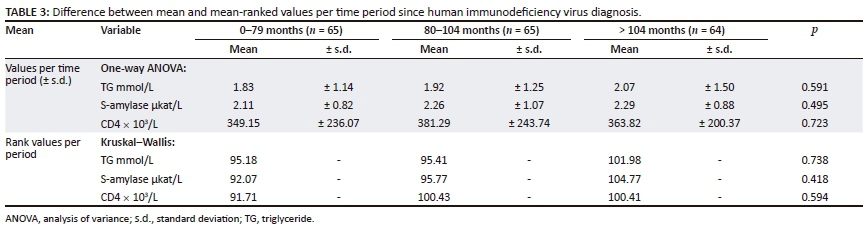
Descriptive statistics mean (standard deviation [± s.d.]) and median (interquartile range [IQR]) were calculated for all the variables for the entire sample and separately for males and females. An independent t-test was performed to investigate a possible significant difference in TG, s-amylase and CD4 counts between males and females. In addition, the duration since HIV diagnosis was categorised to investigate any differences in the means of the TG, s-amylase and CD4 counts. The three categories chosen (0-79 months, 80-104 months and > 104 months) were to ensure the same number of participants in each group (n = 65, 65 and 64). Statistical significance was set at p < 0.05, and practical significance was tested with Cohen's d-value (0.2 = small effect, 0.5 = medium effect and 0.8 = large effect).
Ethical consideration
This study was approved by the HREC-NWU on 14 March 2016 (NWU-00356-15-A1) and also by the KwaZulu-Natal Department of Health's Directorate of Health Research and Knowledge Management (KZ_2015RP22_110), and by the Medical Manager at the facility where the study was conducted.
Results
The TG, s-amylase and CD4 counts for 194 out of the sample of 200 patients were statistically analysed, as six patients had to be removed from the original sample because they were already on LPV/r-based regimens for more than six months.
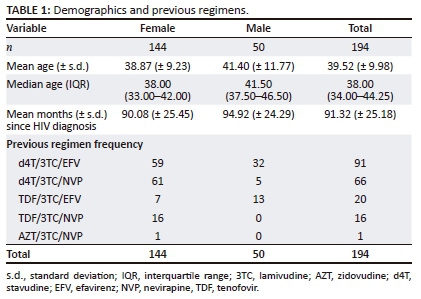
Table 1 reflects the demographic details of 144 (74%) female and 50 (26%) male patients. The mean (± s.d.) age for the entire sample was 39.52 (± 9.98) years. The mean (± s.d.) period for all the patients since first diagnosis of HIV infection until the time of data collection was 91.32 (± 25.18) months. All the patients were on antiretroviral treatment before the rollout of the fixed drug combination of tenofovir/emtricitabine/efavirenz and were therefore still taking individually formulated drugs. The patients were on a previous regimen consisting of stavudine (d4T) or tenofovir (TDF) or zidovudine (AZT) plus lamivudine (3TC) plus efavirenz (EFV) or nevirapine (NVP). The majority of patients were on a stavudine-based combination (n = 157, 81.93%), and since 2010, stavudine was phased out and replaced with tenofovir (n = 36, 18.56%).
Table 2 summarises the mean (± s.d.) values of TG, s-amylase and CD4+ count of the female, male and total group and also indicates the statistical and practical significance between the two genders. The mean (± s.d.) TG was 1.94 (± 1.30) mmol/L, and the median (IQR) for the whole population was 1.48 (1.35) mmol/L. The mean (± s.d.) TG values for females and males were 1.79 (± 1.08) mmol/L and 2.36 (± 1.74) mmol/L, respectively, which was statistically significant (p = 0.034).
Only 1% of the patients in this study had severe HTG values of above 5.6 mmol/L. A further 26% had moderate HTG with values between 2.3 mmol/L and 5.6 mmol/L. Mild HTG with values between 1.7 mmol/L and 2.3 mmol/L occurred in 19% of the patients. The remaining 55% were all below 1.7 mmol/L. Although the TG levels were taken at random without fasting and may therefore render slightly higher TG values, a significant total of 45% of the patients had some degree of HTG with 42% of females and 54% of the male population presenting with HTG.
The criterion for pancreatitis for this study was an elevation of s-amylase three times above the upper normal limit of 2.08 µkat/L. No cases of pancreatitis were recorded after six months of LPV/r treatment; the mean (± s.d.) s-amylase value for the entire sample was 2.22 (± 0.93) µkat/L and the median (IQR) value was 2.04 (± 1.05) µkat/L. There was a small and insignificant difference (p = 0.463) in the mean (± s.d.) s-amylase values between female patients (2.19 [± 0.90] µkat/L) and male patients (2.31 [± 1.01] µkat/L).
The mean (± s.d.) CD4 count for the entire sample after the first six months of LPV/r-based therapy was 365 (± 227) cells/mm3p = 0.004) as well as a practical significant difference (0.47) in the mean (± s.d.) CD4 counts between the female and male patients [392 (± 222) cells/mm33
Discussion
The results from this study suggest that the risk for TG-induced pancreatitis after the first six months of LPV/r is improbable because no case of acute pancreatitis was recorded. None of the TG values recorded were > 11.3 mmol/L in order to possibly induce pancreatitis. In fact, the mean TG value was only 1.94 mmol/L. For the purposes of assessing the risk of HTG-induced pancreatitis in this population, the difference between a fasting and a non-fasting TG value is not relevant because the mean TG value was only 1.94 mmol/L - well below 11.33 mmol/L. However, outliers above 5 mmol/L would warrant a fasting value to serve as a baseline to monitor those patients with a genetic predisposition for HTG.26n = 6) of the patients had s-amylase values above double the upper normal value. However, according to Oliveira and coworkers72727202877
Factors such as age, gender and ethnicity affect TG values.44
The difference in mean s-amylase levels between males and females was small and insignificant, suggesting that neither gender was more susceptible to pancreatitis than the other in this study. However, Oliveira and coworkers725
Where CD4 counts are concerned, it has been well established that lower CD4 counts correlate with higher risk of pancreatitis.7,2572529
Furthermore, in the HIV clinical cohort study conducted by Riedel and coworkers25p = 0.058). This would suggest that ethnicity could be an influencing factor. The median population age in the study by Riedel and coworkers25
In this study, a significant number of 45% of the patients had some degree of HTG, which may largely be attributed to LPV/r therapy, because factors that may independently increase TG values were excluded from the sample as far as possible. This was slightly lower than the results of Calza,3
Other risk factors include the total period infected with HIV (mean of 91.3 months in this study population) and a CD4 count of less than 200 cells/mm37
Study limitations
The lack of baseline values for TG, s-amylase and CD4 counts meant that the effect of LPV/r on the change of these variables could not be quantified. In addition, the TG values were taken randomly and were not after fasting. The mild HTG may therefore be overestimated. Body mass index values and dietary habits (including alcohol consumption) were also not consistently and reliably available, which could influence TG values. The more specific s-lipase instead of s-amylase would have enabled a more accurate diagnostic criterion for cases of pancreatitis. Patients with hypothyroidism and diabetes mellitus were not excluded from the sample. The observation period of six months was too short to predict the long-term effects of LPV/r-induced HTG and possibly pancreatitis; therefore, future studies should be expanded to include, at minimum, 12 months duration on LPV/r-based regimens.
Conclusion and recommendations
Almost half (45%) of the patients in this study had mild elevated TG values after the first six months of LPV/r treatment. Triglyceride values were not clinically elevated to cause a realistic risk of pancreatitis. However, comorbidities and drugs that increase TG in uncontrolled circumstances should not be disregarded. Severe HTG was rare, but mild to moderate HTG was more common. Mild to moderate HTG is linked to cardiovascular risk (but no causal effect yet established), starting at values lower than required to cause pancreatitis. A considerable part of the study population may therefore be at risk of developing CVD. The current guidelines from the NDoH30327
Competing interests
The authors declare that there were no conflicts of interest during the writing of this article.
Authors' contributions
The project was part of the M. Pharm study and thus the responsibility of W.P.G. J.M.D.P. and M.V. were the study supervisor and co-supervisor, respectively. M.C. provided the statistical output of the results.
Acknowledgements
The authors would like to thank F.B. Amod and M.S. Sultana for their contribution towards the data collection.
References
-
1. Volberding PA, Deeks SG. Antiretroviral therapy and management of HIV infection. Lancet. 2010;376(9734):49-62. https://doi.org/10.1016/S0140-6736(10)60676-9
» https://doi.org/10.1016/S0140-6736(10)60676-9 -
2. Warriner AH, Burkholder GA, Overton ET. HIV-related metabolic comorbidities in the current ART era. Infect Dis Clin North Am. 2014;28(3):457-476. https://doi.org/10.1016/j.idc.2014.05.003
» https://doi.org/10.1016/j.idc.2014.05.003 -
3. Calza L, Manfredi R, Farneti B, Chiodo F. Incidence of hyperlipidaemia in a cohort of 212 HIV-infected patients receiving a protease inhibitor-based antiretroviral therapy. Int J Antimicrob Agents. 2003;22(1):54-59. https://doi.org/10.1016/S0924-8579(03)00100-6
» https://doi.org/10.1016/S0924-8579(03)00100-6 -
4. Berglund L, Brunzell JD, Goldberg AC, Goldberg IJ, Stalenhoef A. Treatment options for hypertriglyceridemia: From risk reduction to pancreatitis. Best Prac Res Clin Endocrinol Metab. 2014;28(3):423-437. https://doi.org/10.1016/j.beem.2013.10.002
» https://doi.org/10.1016/j.beem.2013.10.002 -
5. Sahebkar A, Watts GF. Challenges in the treatment of hypertriglyceridemia: Glass half empty or half full? Expert Rev Clin Pharmacol. 2015;8(4):363-366. https://doi.org/10.1586/17512433.2015.1045880
» https://doi.org/10.1586/17512433.2015.1045880 -
6. Rosenson RS. Approach to the patient with hypertriglyceridemia [homepage on the Internet]. UpToDate; 2016 [cited 2016 Jul 27]. Available from: http://nologin.dohkzn.co.za/contents/approach-to-the-patient-with-hypertriglyceridemia?source=search_result&search=approach+to+the+patient+with +hypertriglyceridemia&selectedTitle=1%7E150
» http://nologin.dohkzn.co.za/contents/approach-to-the-patient-with-hypertriglyceridemia?source=search_result& search=approach+to+the+patient+with +hypertriglyceridemia& selectedTitle=1%7E150 -
7. Oliveira NM, Ferreira FA, Yonamine RY, Chehter EZ. Antiretroviral drugs and acute pancreatitis in HIV/AIDS patients: Is there any association? A literature review. Einstein (São Paulo). 2014;12(1):112-119. https://doi.org/10.1590/S1679-45082014RW2561
» https://doi.org/10.1590/S1679-45082014RW2561 -
8. Camacho Á, Rivero A. Posicionamiento de lopinavir/ritonavir en los esquemas de la terapia antirretroviral. Enferm Infecc Microbiol Clin. 2014;32:31-34. https://doi.org/10.1016/S0213-005X(14)70166-1
» https://doi.org/10.1016/S0213-005X(14)70166-1 -
9. De Lagarde Sebastián M, Pardo OB, Ortega FP. Lopinavir/ritonavir en nuevas estrategias de simplificación del tratamiento antirretroviral. Enferm Infecc Microbiol Clin. 2014;32:12-17. https://doi.org/10.1016/s0213-005x(14)70162-4
» https://doi.org/10.1016/s0213-005x(14)70162-4 -
10. Kearney BP, Mathias A, Mittan A, Sayre J, Ebrahimi R, Cheng AK. Pharmacokinetics and safety of tenofovir disoproxil fumarate on coadministration with lopinavir/ritonavir. J Acquir Immune Defic Syndr. 2006;43(3):278-283. https://doi.org/10.1097/01.qai.0000243103.03265.2b
» https://doi.org/10.1097/01.qai.0000243103.03265.2b -
11. Ribera E, Tuset M, Martín M, Del Cacho E. Características de los fármacos antirretrovirales. Enferm Infecc Microbiol Clin. 2011;29(5):362-391. https://doi.org/10.1016/j.eimc.2011.02.004
» https://doi.org/10.1016/j.eimc.2011.02.004 -
12. Croxtall JD, Perry CM. Lopinavir/ritonavir. Drugs. 2010;70(14):1885-1915. https://doi.org/10.2165/11204950-000000000-00000
» https://doi.org/10.2165/11204950-000000000-00000 -
13. Arathoon E, Schneider S, Baraldi E, et al. Effects of once-daily darunavir/ritonavir versus lopinavir/ritonavir on metabolic parameters in treatment-naive HIV-1-infected patients at week 96: ARTEMIS. Int J STD AIDS. 2013;24(1):12-17. https://doi.org/10.1258/ijsa.2012.012120
» https://doi.org/10.1258/ijsa.2012.012120 -
14. Friedewald VE, Ballantyne CM, Bays HE, Jones PH. The editor's roundtable: Hypertriglyceridemia. Am J Cardiol. 2013;112(8):1133-1141. https://doi.org/10.1016/j.amjcard.2013.07.033
» https://doi.org/10.1016/j.amjcard.2013.07.033 -
15. Lederle FA, Bloomfield HE. Drug treatment of asymptomatic hypertriglyceridemia to prevent pancreatitis: Where is the evidence? Ann Intern Med. 2012;157(9):662-664. https://doi.org/10.7326/0003-4819-157-9-201211060-00011
» https://doi.org/10.7326/0003-4819-157-9-201211060-00011 -
16. Valdivielso P, Ramírez-Bueno A, Ewald N. Current knowledge of hypertriglyceridemic pancreatitis. Eur J Intern Med. 2014;25(8):689-694. https://doi.org/10.1016/j.ejim.2014.08.008
» https://doi.org/10.1016/j.ejim.2014.08.008 -
17. Toth PP, Grabner M, Ramey N, Higuchi K. Clinical and economic outcomes in a real-world population of patients with elevated triglyceride levels. Atherosclerosis. 2014;237(2):790-797. https://doi.org/10.1016/j.atherosclerosis.2014.09.029
» https://doi.org/10.1016/j.atherosclerosis.2014.09.029 -
18. Berglund L, Brunzell JD, Goldberg AC, et al. Evaluation and treatment of hypertriglyceridemia: An Endocrine Society clinical practice guideline. J Clin Endocrinol Metab. 2012;97(9):2969-2989. https://doi.org/10.1210/jc.2011-3213
» https://doi.org/10.1210/jc.2011-3213 -
19. Sandhu S, Al-Sarraf A, Taraboanta C, Frohlich J, Francis GA. Incidence of pancreatitis, secondary causes, and treatment of patients referred to a specialty lipid clinic with severe hypertriglyceridemia: A retrospective cohort study. Lipids Health Dis. 2011;10(1):1-7. https://doi.org/10.1186/1476-511X-10-157
» https://doi.org/10.1186/1476-511X-10-157 -
20. Bush ZM, Kosmiski LA. Acute pancreatitis in HIV-infected patients: Are etiologies changing since the introduction of protease inhibitor therapy? Pancreas. 2003;27(1):e1-e5. https://doi.org/10.1097/00006676-200307000-00016
» https://doi.org/10.1097/00006676-200307000-00016 -
21. Freedman SD. Overview of pancreatitis [homepage on the Internet]. Merck manuals 2012. Kenilworth, NJ: Merck; 2012 [cited 2016 Aug 15]. Available from: http://www.merckmanuals.com/professional/gastrointestinal-disorders/pancreatitis/overview-of-pancreatitis
» http://www.merckmanuals.com/professional/gastrointestinal-disorders/pancreatitis/overview-of-pancreatitis - 22. Friedman LS. Liver, biliary tract and pancreas disorders. In: Papadakis MA, McPhee SJ, editors. Current medical diagnosis and treatment. New York: McGraw-Hill, 2013; p. 662-717.
-
23. Rizzo M, Perez-Martinez P, Nikolic D, Montalto G, Lopez-Miranda J. Emerging approaches for the treatment of hypertriglyceridemia. Expert Opin Pharmacother. 2013;14(14):1869-1873. https://doi.org/10.1517/14656566.2013.823402
» https://doi.org/10.1517/14656566.2013.823402 -
24. Raza S, Chaudhry NA, Brown JD, et al. To study the clinical, biochemical and radiological features of acute pancreatitis in HIV and AIDS. J Clin Med Res. 2013;5(1):12-17. https://doi.org/10.4021/jocmr1040w
» https://doi.org/10.4021/jocmr1040w -
25. Riedel DJ, Gebo KA, Moore RD, Lucas GM. A ten-year analysis of the incidence and risk factors for acute pancreatitis requiring hospitalization in an urban HIV clinical cohort. Aids Patient Care STDS. 2008;22(2):113-121. https://doi.org/10.1089/apc.2007.0034
» https://doi.org/10.1089/apc.2007.0034 -
26. Nordestgaard BG, Langsted A, Mora S, et al. Fasting is not routinely required for determination of a lipid profile: Clinical and laboratory implications including flagging at desirable concentration cut-points - A joint consensus statement from the European Atherosclerosis Society and European Federation of Clinical Chemistry and Laboratory Medicine. Eur Heart J. 2016;37(25):1944-1958. https://doi.org/10.1093/eurheartj/ehw152
» https://doi.org/10.1093/eurheartj/ehw152 - 27. Manfredi R, Calza L, Chiodo F. A case-control study of HIV-associated pancreatic abnormalities during HAART era. Focus on emerging risk factors and specific management. Eur J Med Res. 2004;9(12):537-544.
-
28. Manfredi R, Calza L. HIV infection and the pancreas: Risk factors and potential management guidelines. Int J STD AIDS. 2008;19(2):99-105. https://doi.org/10.1258/ijsa.2007.007076
» https://doi.org/10.1258/ijsa.2007.007076 -
29. Jiang H, Yin J, Fan Y, et al. Gender difference in advanced HIV disease and late presentation according to European consensus definitions. Sci Rep. 2015;5:1-10. https://doi.org/10.1038/srep14543
» https://doi.org/10.1038/srep14543 - 30. National Department of Health, Republic of South Africa. National consolidated guidelines for the prevention of mother-to-child transmission of HIV (PMTCT) and the management of HIV in children, adolescents and adults. Pretoria: National Department of Health; 2015.

Accepted: 20 Dec. 2017
Published: 26 June 2018