Evaluation of antenatal rapid human immunodeficiency virus testing in rural South Africa
Abstract
INTRODUCTION: South African guidelines recommend two rapid tests for diagnosing human immunodeficiency virus (HIV) using the serial HIV testing algorithm, but the accuracy and compliance to this algorithm is unknown in rural clinics. We evaluated the accuracy of HIV rapid testing and the time to receiving test results among pregnant women in rural KwaZulu-Natal (KZN). METHOD: We observed the accuracy of rapid HIV testing algorithms for 208 consenting antenatal patients accessing voluntary HIV testing services in nine rural primary healthcare (PHC) clinics in KZN. A PHC-based HIV counsellor obtained finger-prick whole blood from each participant to perform rapid testing using the Advanced Quality™ One Step anti-HIV (1&2) and/or ABON™ HIV 1/2/O Tri-Line HIV test. A research nurse obtained venous blood for an enzyme-linked immunosorbent assay (ELISA) HIV test, which is the gold standard diagnostic test. We recorded the time of receipt of HIV test results for each test. RESULTS: Among 208 pregnant women with a mean age of 26 years, 72 women from nine rural PHC clinics were identified as HIV-positive by two rapid tests with an HIV-prevalence of 35% (95% Bayesian credibility intervals [BCI]: 28% - 41%). Of the 208 patients, 135 patients from six clinics were tested with the serial HIV testing algorithm. The estimated sensitivity and specificity for the 135 participants were 100% (95% confidence interval [CI]: 93% - 100%) and 99% (CI: 95% - 100%), respectively. The positive predictive value and negative predictive value were estimated at 98% (CI: 94% - 100%) and 95% (CI: 88% - 99%), respectively. All women received their HIV rapid test results within 20 min of testing. Test stock-out resulted in poor test availability at point-of-care, preventing performance of a second HIV test in three out of nine PHC clinics in rural KZN. CONCLUSION: Despite the poor compliance with national guidelines for HIV rapid testing services, HIV rapid test results provided to pregnant women in rural PHC clinics in KZN were generally accurate and timely. Test stock-out was shown to be one of the barriers to test availability in rural PHC clinics, resulting in poor compliance with guidelines. We recommend a compulsory confirmation HIV rapid test for all HIV-negative test results obtained from pregnant patients in rural and resource-limited settings.
Introduction
The World Health Organization's (WHO) 2016 Consolidated Antiretroviral (ARV) Drugs Guidelines for treating and preventing human immunodeficiency virus (HIV)123,4,5,6,7,83,4,5,6,7,89
Human immunodeficiency virus testing is an essential element of antenatal care in South Africa.1011,121314
The South African and WHO guidelines recommend the use of a serial testing algorithm for performing HIV rapid testing in resource-limited settings.15,1616,17181619
Research shows the need for good quality assurance programmes to ensure accuracy of point-of-care (POC) diagnostics in resource-limited settings.201515152122
Material and methods
Study design
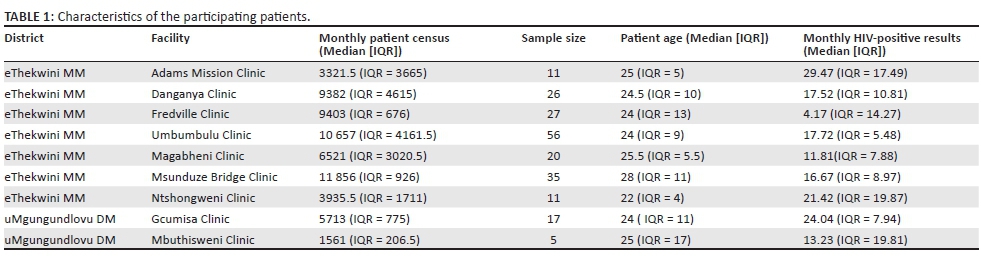
This manuscript was produced as part of a large research study entitled 'Evaluating the accessibility and utility of HIV-related point-of-care diagnostics for maternal health in rural South Africa'.23Table 1). All participating clinics were located within 60 km of the testing laboratory and were part of large POC diagnostic survey study.23
Antenatal nurses providing antenatal services assisted with identification of potential study participants and referred them to the research team. After informing the women about the purpose of the study, consenting women were screened for participation. We included pregnant women 18 years of age and older. Consenting patients received voluntary HIV counselling and testing conducted by trained HIV counsellors who were part of PHC clinics' staff members at no additional cost and as part of standard antenatal services. The HIV rapid testing was carried out as part of the routine antenatal clinic service. PHC clinic-based HIV lay counsellors met privately with each patient, obtained a sexual history and discussed the risks as well as benefits of HIV testing and obtained informed consent before conducting the HIV rapid tests. All patients were offered post-test counselling. Those who tested HIV-positive on HIV rapid tests were referred for ART initiation and PMTCT services, which were provided as part of standard antenatal services.
Human immunodeficiency virus rapid testing methods
The two HIV rapid tests used by the clinics were Advanced Quality™ One Step Anti-HIV 1&2 (InTec Products, Inc. Xiamen, China) and ABON™ HIV 1/2/O Tri-Line lateral immunoassays rapid test (ABON Biopharm Co. Ltd. Hangzhou, China). The HIV rapid tests were performed according to the manufacturer's package inserts and the results were interpreted by trained HIV counsellors. The South African rapid HIV testing service guidelines recommend that rural PHC clinics perform regular quality control to ensure accurate HIV rapid testing.15
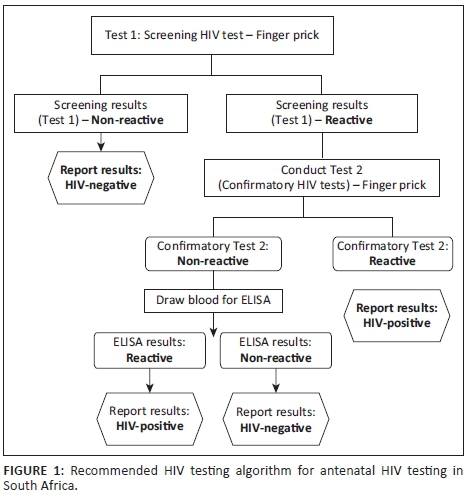
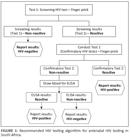
To assess the accuracy of HIV rapid testing services in rural PHC clinics, clinic-based nurses and HIV lay counsellors performed serial HIV rapid testing as recommended by the national HIV rapid testing guidelines24Figure 1). Using the serial HIV rapid testing algorithm, each patient was tested using the Advanced Quality™ HIV rapid test, and those who tested positive were then retested using the ABON™ HIV rapid test. If the first test was positive, then the second HIV rapid test was performed. If the first HIV test was negative, the second test was not performed and participants were counselled to return in three months for repeat HIV testing. Where patients tested positive on first test and negative on second test, a third test was provided using ABON rapid test. The HIV testing procedure stipulated that a 20-min timer should be set after adding drawn whole blood specimen (about 50 µL) from the patient. The blood is then immersed onto the specimen well of the test device, followed by two drops of buffer (approximately 80 µL).
Laboratory methods
For all participants, a professional research nurse obtained at least 5 mL of venous whole blood in a serum separator tube for HIV ELISA testing. Laboratory personnel were blinded to clinic HIV rapid test results. The tube was kept on ice before being transported within 3 h of being collected to the Department of Virology in the National Health Laboratory Services (NHLS) at Inkosi Albert Luthuli Central Hospital (IALCH) in Durban.
A laboratory technician centrifuged the specimen at 10 000 rpm for 5 min and stored the serum sample at 2 °C - 8 °C before testing. Upon HIV ELISA testing, sera were thawed to room temperature, and HIV ELISA testing was performed using the Combi PT HIV-1/2 Antigen and total antibodies using a cobas® e601 machine (Roche Diagnostics, Manneheim, Germany).16
Statistical methods
We calculated the sample size for the evaluation at individual participant level using Buderer's formula.2526
The accuracy of the 208 HIV RT results from the selected rural PHC antenatal clinics was evaluated using serial (where a second test is required only when the initial test is positive) or single testing algorithms. We used R version 3.2.3 (2015), CRAN bdpv-package,2728Appendix 1). Once convergence was achieved, the chains were then sampled until a sample size of 10 000 iterations were attained to estimate the final parameter point estimates and 95% BCI for HIV-prevalence.
Ethical consideration
Ethical approvals for the study were received from the KZN Department of Health's Ethics Committee (HRKM 40/15) and the University of KZN Biomedical Research Ethics Committee (BE484/14). Written informed consent was obtained from all study participants.
Results
We enrolled 208 pregnant women from nine rural antenatal clinics with a total monthly census ranging from 18 794 to 140 152 patients. The age of the participants ranged from 18 to 51 years. The estimated HIV-prevalence for the sampled population was 34.5% (BCI: 28.3% - 41.1%). A summary of the study population is presented in Table 1.
Accuracy of serial human immunodeficiency virus rapid testing
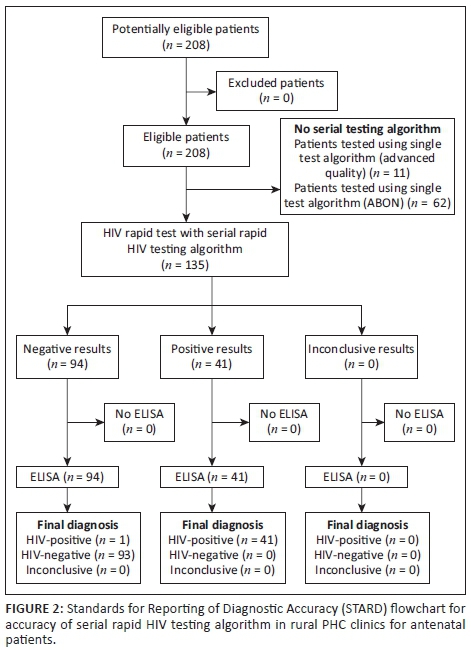
A total of 135 (65%) antenatal specimens from six out of nine PHC clinics were tested by the HIV rapid testing serial algorithm, and the results were compared to the results of the serum ELISA reference testing. The diagnostics tests accuracy results are illustrated by the Standards for Reporting of Diagnostic Accuracy (STARD) flowchart (Figure 2).
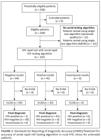
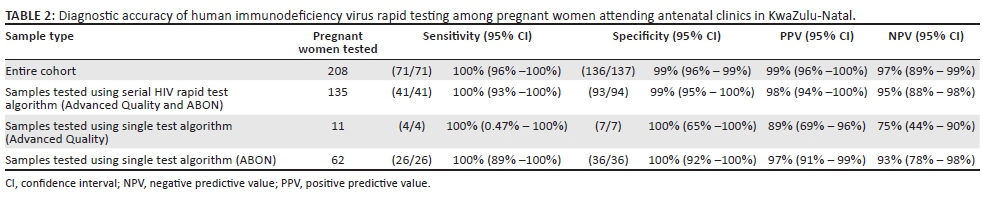
The Advanced Quality HIV test was used for an initial screening of 135 tests and initially detected 41 HIV antibody-reactive specimens and 83 antibody-negative reactions, as well as one false-negative. The one false-negative result was tested using the Advanced Quality HIV rapid screening test, following the serial HIV rapid testing algorithm, which stipulated no obligation for a confirmation test for HIV-negative results from the screening test. Secondary testing of the initial reactive samples was performed using ABON (n = 49). A total of 41 HIV antibody-reactive samples were found using ABON as a second test. A total of 10 samples were tested by ABON test as a confirmation of the previous HIV antibody non-reactive test by Advanced HIV RT. The estimated sensitivity, specificity, PPV and NPV are shown in Table 2.
Compliance to the human immunodeficiency virus testing guidelines
The routine serial testing algorithm with a screen and confirmatory rapid test has been recommended for use in the health clinics.15,16 However, the use of this algorithm is dependent on test availability; three of the nine participating PHC clinics (Adams, Fredville and Mzunduze Bridge) were experiencing test shortages owing to stock-outs and therefore they offered only one HIV rapid test (ABON or Advanced Quality) for the diagnosis of HIV.
The Advanced Quality HIV rapid test was the only HIV rapid test offered to antenatal patients in Adams clinic (n = 11) constituting 5.3% of the total sample size. Because of a shortage of the ABON HIV rapid test, four HIV antibody-reactive specimens and nine antibody-negative reactions were identified. The ABON rapid test was used as the only HIV rapid test for 62 (29.8%) of the participants from Fredville and Msunduze Bridge clinic, owing to a shortage of the Advanced Quality HIV rapid test, and 27 HIV antibody-reactive specimens and 35 antibody-negative reactions were identified.
Time of results receipt
Following the pre-test counselling, which includes training the patient on how to accurately interpret the HIV rapid test results, all HIV rapid test results were read to the participants within 20 min.
Discussion
In this cross-sectional study of rural antenatal clinics in KwaZulu-Natal, the HIV rapid tests using the serial HIV rapid testing algorithm were accurate when performed by nurses and HIV counsellors at the clinical POC.162416
The findings of this study support the results of a recent (2017) study which was aimed at evaluating the quality management systems of HIV rapid testing services in rural PHC clinics in KwaZulu-Natal.21212930311616
Our study included nine rural antenatal clinics across a large province in South Africa. We have demonstrated that the use of one HIV rapid test offers quick and reliable HIV results for HIV diagnosis to allow linkage to ART and PMTCT services for HIV-infected pregnant women at their first visit to antenatal clinics. Sample mismatch and sample loss have been reported as some of the pre-analytical errors that can occur during sample transportation from the POC to the hospital-based laboratory.3233,343524
Limitations
Our study had several strengths and limitations. One of the unavoidable limitations is the availability of the HIV POC tests which prevented 35% of our study population from following the recommended serial rapid HIV testing algorithm, leading to a reduction in sample size used to report accuracy, from 208 to 135 patients. In this study, data on CD4+ count or duration of pregnancy were not collected; this information would have provided more nuance information about the patients to enable early detection of ARV resistance and HIV co-infections. Furthermore, this study excluded remote rural antenatal clinics outside the 60 km radius of the testing laboratory. The more remote clinics may have greater difficulties in stocking rapid HIV tests and more difficulty accessing laboratory testing. Therefore, our findings may not be generalisable to more remote (> 60 km from the testing laboratory) rural PHC clinics in KZN. Other important quality control criteria such as quality systems3621
Conclusion
Human immunodeficiency virus rapid testing services can be accurately performed at the clinical POC for pregnant women in resource-limited settings, and we suggest that one HIV rapid test should be sufficient. If viable, then moving to a single rapid HIV test algorithm has the potential to save limited resources. This study also demonstrated HIV rapid tests stock-outs in KZN rural PHC clinics. Based on these findings, further efforts to optimise the availability of HIV rapid testing services in settings with poor access to laboratory infrastructure are needed.
Competing interests
The authors declare no potential conflict of interest.
Authors' contributions
T.P.M.-T., B.S. and P.K.D. conceptualised and designed the study. T.P.M.-T. supervised the fieldwork and P.M. supervised the laboratory analysis. T.P.M.-T. produced the first draft of the manuscript. B.S. contributed to the statistical analysis and to the interpretation of the results. B.S., P.K.D. and P.M. commented on this draft and contributed to the final version. All authors read and approved the final manuscript.
Acknowledgements
The authors would like to thank the following people: Nombulelo Magula, Internal Medicine, University of KwaZulu-Natal; Khanyisile Msomi, Thamaray Pillay, Keith Mjoli and all the staff in the Department of Virology, NHLS at IALCH in Durban, KZN, for their valuable contribution to the study. The authors would also like to thank all the PHC members of staff who assisted in the recruitment of study participants and data collection, as well as all patients who agreed to take part in this study. Finally, the authors would like to thank eThekwini and uMgungundlovu health district management for granting them permission to conduct this study in the rural PHC clinics. They would also like to thank the following institutions: College of Health Sciences, University of KwaZulu-Natal; South African Centre for Epidemiological Modelling and Analysis as well as the African Population Health Research Centre; and National Institute of Allergy and Infectious Disease of the National Institutes of Health (K23 AI108293) for their support in facilitating access to resources used in conducting this study.
References
-
1. World Health Organization. Consolidated guidelines on the use of antiretroviral drugs for treating and preventing HIV infection: Recommendations for a public health approach [homepage on the Internet]. 2016 [cited 2016 Aug 12]. Available from: http://apps.who.int/iris/bitstream/10665/208825/1/9789241549684_eng.pdf?ua=1
» http://apps.who.int/iris/bitstream/10665/208825/1/9789241549684_eng.pdf?ua=1 -
2. UNAIDS. 90-90-90: An ambitious treatment target to help end the AIDS epidemic [homepage on the Internet]. 2014 [cited 2016 Nov 30]. Available from: http://www.unaids.org/en/resources/documents/2017/90-90-90
» http://www.unaids.org/en/resources/documents/2017/90-90-90 -
3. Heller T, Kunthea S, Bunthoeun E, et al. Point-of-care HIV testing at antenatal care and maternity sites: Experience in Battambang Province, Cambodia. Int J STD AIDS. 2011;22(12):742-747. https://doi.org/10.1258/ijsa.2011.011262
» https://doi.org/10.1258/ijsa.2011.011262 - 4. Kissin DM, Akatova N, Rakhmanova AG, et al. Rapid HIV testing and prevention of perinatal HIV transmission in high-risk maternity hospitals in St. Petersburg, Russia. Am J Obstet Gynecol. 2008;198(2):183 e181-187.
-
5. Dennis RL, Negron TJ, Lindsay M, Nesheim SR, Lee FK, Jamieson DJ. Rapid human immunodeficiency virus testing in labor and delivery: A comparison of implementation models between 2 hospitals. J Perinat Neonatal Nurs. 2007;21(4):298-306. https://doi.org/10.1097/01.JPN.0000299787.24291.8d
» https://doi.org/10.1097/01.JPN.0000299787.24291.8d -
6. Kizito D, Woodburn PW, Kesande B, et al. Uptake of HIV and syphilis testing of pregnant women and their male partners in a programme for prevention of mother-to-child HIV transmission in Uganda. Trop Med Int Health. 2008;13(5):680-682. https://doi.org/10.1111/j.1365-3156.2008.02052.x
» https://doi.org/10.1111/j.1365-3156.2008.02052.x - 7. Nogueira SA, Lambert JS, Albuquerque AL, et al. Assessment of a rapid HIV test strategy during labor: A pilot study from Rio de Janeiro, Brazil. J Hum Virol. 2000;4(5):278-282.
-
8. Smith A, Sabido M, Camey E, Batres A, Casabona J. Lessons learned from integrating simultaneous triple point-of-care screening for syphilis, hepatitis B, and HIV in prenatal services through rural outreach teams in Guatemala. Int J Gynaecol Obstet. 2015;130(Suppl 1):S70-S72. https://doi.org/10.1016/j.ijgo.2015.04.009
» https://doi.org/10.1016/j.ijgo.2015.04.009 -
9. Shott JP, Galiwango RM, Reynolds SJ. A quality management approach to implementing point-of-care technologies for HIV diagnosis and monitoring in sub-Saharan Africa. J Trop Med. 2012;2012:1-8. https://doi.org/10.1155/2012/651927
» https://doi.org/10.1155/2012/651927 -
10. Barron P, Pillay Y, Doherty T, et al. Eliminating mother-to-child HIV transmission in South Africa. Bull World Health Organ. 2013;91(1):70-74. https://doi.org/10.2471/BLT.12.106807
» https://doi.org/10.2471/BLT.12.106807 -
11. TM Publications. Point of care diagnostics testing world markets. [homepage on the Internet]. 2013 [cited 2016 Aug 14]. Available from: https://www.prnewswire.com/news-releases/point-of-care-diagnostic-testing-world-markets-300358818.html
» https://www.prnewswire.com/news-releases/point-of-care-diagnostic-testing-world-markets-300358818.html - 12. Garvey M, Garvey AJ. Philosophy and opinions of Marcus Garvey or Africa for the Africans. Philosophy and opinions of Marcus Garvey, or, Africa for the Africans. London: Frank Cass & Co., Ltd.; 1967.
-
13. Khan M, Pillay T, Moodley JM, Connolly CA, Group DPTH-S. Maternal mortality associated with tuberculosis-HIV-1 co-infection in Durban, South Africa. AIDS. 2001;15(14):1857-1863. https://doi.org/10.1097/00002030-200109280-00016
» https://doi.org/10.1097/00002030-200109280-00016 -
14. Amnesty International. Struggle for maternal health barriers to antenatal care in South Africa [homepage on the Internet]. 2014 [cited 2016 Aug 12]. Available from: https://www.health-e.org.za/wp-content/uploads/2014/10/Struggle-for-Maternal-Health-.pdf
» https://www.health-e.org.za/wp-content/uploads/2014/10/Struggle-for-Maternal-Health-.pdf -
15. Department of Health South Africa. Guidelines for assuring the accuracy and reliability of HIV rapid testing [homepage on the Internet]. 2009 [cited 2016 Aug 12]. Available from: http://policyresearch.limpopo.gov.za/bitstream/handle/123456789/897/Guidelines%20for% 20as suring%20the%20accura cy%20and%20reliability%20of%20HIV%20rapid%20testing%2C.pdf?sequence=1
» http://policyresearch.limpopo.gov.za/bitstream/handle/123456789/897/Guidelines%20for% 20as suring%20the%20accura cy%20and%20reliability%20of%20HIV%20rapid%20testing%2C.pdf?sequence=1 -
16. World Health Organization. Rapid HIV tests: Guidelines for use in HIV testing and counselling services in resource-constrained settings [homepage on the Internet]. 2004 [cited 2016 Nov 14]. Available from: http://apps.who.int/iris/bitstream/10665/42978/1/9241591811.pdf
» http://apps.who.int/iris/bitstream/10665/42978/1/9241591811.pdf -
17. Crippen P, Demby A, Miller D, Vercauteren G, World Health Organization. Rapid HIV tests: Guidelines for use in HIV testing and counselling services in resource-constrained settings. Switzerland: World Health Organization, Department of HIV/AIDS; 2004. Available from: http://applications.emro.who.int/aiecf/web28.pdf
» http://applications.emro.who.int/aiecf/web28.pdf -
18. Peeling RW, Mabey D, Herring A, Hook EW. Why do we need quality-assured diagnostic tests for sexually transmitted infections? Nat Rev Microbiol. 2006;4(12):909-921. https://doi.org/10.1038/nrmicro1555
» https://doi.org/10.1038/nrmicro1555 -
19. World Health Organization. Annex 9: Technical guidance update on quality assurance for HIV rapid diagnostic tests. 2015 [cited 12 Nov 12]. Available from: http://apps.who.int/iris/bitstream/10665/181244/1/WHO_HIV_2015.28_eng.pdf
» http://apps.who.int/iris/bitstream/10665/181244/1/WHO_HIV_2015.28_eng.pdf -
20. Yager P, Domingo GJ, Gerdes J. Point-of-care diagnostics for global health. Annu Rev Biomed Eng. 2008;10:107-144. https://doi.org/10.1146/annurev.bioeng.10.061807.160524
» https://doi.org/10.1146/annurev.bioeng.10.061807.160524 -
21. Jaya Z, Drain PK, Mashamba-Thompson TP. Evaluating quality management systems for HIV rapid testing services in primary healthcare clinics in rural KwaZulu-Natal, South Africa. PLoS One. 2017;12(8):e0183044. https://doi.org/10.1371/journal.pone.0183044
» https://doi.org/10.1371/journal.pone.0183044 -
22. Banoo S, Bell D, Bossuyt P, et al. Evaluation of diagnostic tests for infectious diseases: General principles. Nat Rev Micro. 2008;6:S16-S28. https://doi.org/10.1038/nrmicro1523
» https://doi.org/10.1038/nrmicro1523 -
23. Mashamba-Thompson T, Drain P, Sartorius B. Evaluating the accessibility and utility of HIV-related point-of-care diagnostics for maternal health in rural South Africa: A study protocol. BMJ Open. 2016;6(6):e011155. https://doi.org/10.1136/bmjopen-2016-011155
» https://doi.org/10.1136/bmjopen-2016-011155 -
24. Department of Health South Africa. National HIV counselling and testing policy guidelines [homepage on the Internet]. 2015 [cited 2016 Nov 30]. Available from: https://www.health-e.org.za/wp-content/uploads/2015/07/HCT-Guidelines-2015.pdf
» https://www.health-e.org.za/wp-content/uploads/2015/07/HCT-Guidelines-2015.pdf -
25. Buderer NMF. Statistical methodology: I. incorporating the prevalence of disease into the sample size calculation for sensitivity and specificity. Acad Emerg Med 1996;3(9):895-900. https://doi.org/10.1111/j.1553-2712.1996.tb03538.x
» https://doi.org/10.1111/j.1553-2712.1996.tb03538.x -
26. Burd EM. Validation of laboratory-developed molecular assays for infectious diseases. Clin Microbiol Rev. 2010;23(3):550-76. https://doi.org/10.1128/CMR.00074-09
» https://doi.org/10.1128/CMR.00074-09 -
27. Adachi K, Klausner JD, Xu J, et al. Chlamydia trachomatis and Neisseria gonorrhoeae in HIV-infected pregnant women and adverse infant outcomes. Pediatr Infect Dis J. 2016;35(8):894-900. https://doi.org/10.1097/INF.0000000000001199
» https://doi.org/10.1097/INF.0000000000001199 -
28. Joseph L, Gyorkos TW, Coupal L. Bayesian estimation of disease prevalence and the parameters of diagnostic tests in the absence of a gold standard. Am J Epidemiol. 1995;141(3):263-272. https://doi.org/10.1093/oxfordjournals.aje.a117428
» https://doi.org/10.1093/oxfordjournals.aje.a117428 -
29. Mbachu II, Udigwe G, Joseph I, et al. The evaluation of accuracy of serial rapid HIV test algorithm in the diagnosis of HIV antibodies among pregnant women in south east Nigeria. BMC Res Notes. 2015;8(1):557. https://doi.org/10.1186/s13104-015-1454-8
» https://doi.org/10.1186/s13104-015-1454-8 -
30. Pavie J, Rachline A, Loze B, et al. Sensitivity of five rapid HIV tests on oral fluid or finger-stick whole blood: A real-time comparison in a healthcare setting. PLoS One. 2010;5(7):e11581. https://doi.org/10.1371/journal.pone.0011581
» https://doi.org/10.1371/journal.pone.0011581 - 31. Moodley D, Moodley P, Ndabandaba T, Esterhuizen T. Reliability of HIV rapid tests is user dependent. S Afr Med J. 2008;98(9):707-709.
-
32. Carey M, Markham C, Gaffney P, Boran G, Maher V. Validation of a point of care lipid analyser using a hospital based reference laboratory. Irish J Med Sci. 2006;175(4):30-35. https://doi.org/10.1007/BF03167964
» https://doi.org/10.1007/BF03167964 -
33. Pai NP, Vadnais C, Denkinger C, Engel N, Pai M. Point-of-care testing for infectious diseases: Diversity, complexity, and barriers in low- and middle-income countries PLoS Med. 2012;9:e1001306. https://doi.org/10.1371/journal.pmed.1001306
» https://doi.org/10.1371/journal.pmed.1001306 -
34. Price CP. Point of care testing. Br Med J. 2001;322(7297):1285. https://doi.org/10.1136/bmj.322.7297.1285
» https://doi.org/10.1136/bmj.322.7297.1285 -
35. Ott JJ, Stevens GA, Wiersma ST. The risk of perinatal hepatitis B virus transmission: Hepatitis B e antigen (HBeAg) prevalence estimates for all world regions. BMC Infect Dis. 2012;12(1):1. https://doi.org/10.1186/1471-2334-12-131
» https://doi.org/10.1186/1471-2334-12-131 -
36. Dybkaer R, Jordal R, Jørgensen P, et al. A quality manual for the clinical laboratory including the elements of a quality system: Proposed guidelines. Scand J Clin Lab Invest. 1993;53(Suppl 212):60-77. https://doi.org/10.1080/00365519309085460
» https://doi.org/10.1080/00365519309085460

Accepted: 29 Mar. 2018
Published: 23 May 2018