Determinants of drop-offs in the targeted universal tuberculosis testing care cascade among people with HIV in rural and urban facilities in South Africa
Abstract
BACKGROUND: Targeted Universal Tuberculosis Testing (TUTT) is a strategy for early tuberculosis (TB) detection among people with HIV (PWH); however, drop-offs at key cascade stages limit its effectiveness OBJECTIVES: This study examines determinants of drop-offs at three stages: rapid molecular diagnostic test for TB (Xpert) TB treatment initiation, and completion METHOD: We conducted a retrospective analysis of routinely collected data in fiscal year 2022 from PWH on antiretroviral therapy (ART) in rural and urban facilities in KwaZulu-Natal, South Africa. Logistic regression identified determinants of drop-offs RESULTS: Among 104 859 PWH, 66.7% were not tested using Xpert. Drop-offs were higher among PWH already on ART (Adjusted Odds Ratio [aOR] = 60.65, 95% confidence interval [CI]: 55.11-66.75), and those in multi-month dispensing (MMD; aOR = 1.42, 95% CI: 1.33-1.52) and differentiated models of care (DMoC; aOR = 1.10, 95% CI: 1.03-1.18) versus standard of care. Symptomatic PWH were less likely to experience Xpert drop-offs (aOR = 0.009, 95% CI: 0.008-0.011) than those without symptoms recorded. Of 1746 PWH diagnosed with TB, 6.3% did not initiate treatment, with higher drop-offs in DMoC (aOR = 29.22, 95% CI: 13.29-64.23) and MMD (aOR = 8.65, 95% CI: 2.72-27.48), but lower among symptomatic PWH (aOR = 0.05, 95% CI: 0.03-0.11). Among 1636 who started TB treatment, 25.6% did not complete it. Drop-offs were higher among those with previous TB (aOR = 2.50, 95% CI: 1.71-3.66), and lower among symptomatic PWH (aOR = 0.21, 95% CI: 0.15-0.29 CONCLUSION: Findings reveal substantial drop-offs in Xpert testing and TB treatment completion, especially among PWH already on ART. Targeted strategies to identify and retain PWH at highest risk of drop-offs are important for optimising TUTT
TB screening; targeted universal TB Testing; drop-offs; TB care cascade; people with HIV; TB/HIV integration; differentiated service delivery
Introduction
Tuberculosis (TB) remains a leading cause of morbidity and mortality among people with HIV (PWH), despite longstanding global efforts to integrate TB and HIV services.1,231,3444
The TUTT care cascade consists of sequential steps: molecular testing with Xpert® MTB/RIF Ultra (Cepheid, Sunnyvale, California, United States; hereafter, 'Xpert'), TB treatment initiation, and treatment completion.5,67,898,1011,1212,1312
Previous studies have identified barriers to TB diagnosis and treatment among PWH, including systemic inefficiencies, limited diagnostic capacity, stigma, and gaps in patient retention.14,15,164
Research methods and design
Study design
We conducted a retrospective analysis of routinely collected patient-level data from healthcare facilities in South Africa, supported by the U.S. President's Emergency Plan for AIDS Relief (PEPFAR). TB/HIV programme data were extracted from a national electronic register for TB and HIV services. These data are compiled quarterly, verified at the sub-district level, and reported at higher administrative levels. Data verification occurs at facility and sub-district levels through routine validation processes led by information officers, who compare electronic records with source documents, and provide feedback for corrective action. Additional data quality assessments are conducted by Department of Health programme managers, District Support Partners, and PEPFAR staff to ensure accuracy and completeness before reporting. The implementation of TUTT among PWH is integrated into baseline antiretroviral therapy (ART) initiation and ongoing care, with annual Xpert testing recommended for PWH, regardless of symptoms. We analysed data from PWH who accessed HIV care services between October 1, 2021, and September 30, 2022 (PEPFAR fiscal year 2022). A flow diagram illustrating the derivation of the analytic cohorts has been included as Supplementary Figure 1. Data were abstracted between June and July 2024.
Study population and setting
The study included PWH starting and already on ART in PEPFAR-supported healthcare facilities in the Zululand and eThekwini districts of KwaZulu-Natal province, South Africa. In 2023, HIV prevalence in the province was estimated at 22%, with 1.6 million PWH on ART, 30% of whom were in eThekwini and 8% in Zululand.17,1819,2018,2118,2122,23
Sampling method and sample size
We selected one rural and one urban PEPFAR-supported district to reflect the heterogeneity of service delivery contexts. Within each district, a stratified random sampling approach was used to select 21 healthcare facilities, based on facility type and ART patient load. The target sample aimed to reflect approximately 50 000 PWH per district. The similar patient totals in rural and urban districts were expected as part of the sampling design.
Data collection
Data extraction was conducted by the investigator, supported by Department of Health staff and PEPFAR District Support Partners. Programmatic patient-level data line lists were anonymised through the generation of unique study IDs, formed by combining facility identifiers with truncated patient registration numbers. No personal identifiers were collected. The cleaned dataset was stored on a secure, firewall-protected server for analysis. All analyses used routinely collected programmatic TB and ART line list data, which included Xpert results; the dataset was not cross-linked with National Health Laboratory Services databases or electronic medical record systems.
Data analysis
Data were analysed using Stata version 16 (Stata Corp, College Station, Texas, United States). Descriptive statistics were used to summarise quantitative variables, including frequencies, means, medians, standard deviations (s.d.), interquartile ranges (IQR), proportions, and 95% confidence intervals (95% CI). We conducted univariable and multivariable logistic regression analysis to examine factors associated with drop-off across the three stages of the TUTT cascade. The three outcome variables were defined as follows: (1) Xpert test not done: PWH with no Xpert test documented; (2) Diagnosed with TB but not started on TB treatment: PWH with a positive Xpert result in the study period who did not initiate TB treatment; and (3) Started TB treatment but did not complete it: PWH who initiated TB treatment but did not have a recorded treatment outcome of treatment completion in programmatic data. Invalid or rejected Xpert results and Xpert trace results were excluded from the analysis because downstream eligibility for treatment initiation and completion could not be assessed. Drop-off 2 was defined using programmatic ART outcomes recorded at the time of TB diagnosis, including death, loss to follow-up ≥ 90 days, transfer-out, or no documented TB treatment start. Drop-off 3 was defined using TB programme outcomes recorded during treatment, including death, loss to follow-up, or transfer-out before TB treatment completion. For both drop-off 2 and drop-off 3, death, loss to follow-up, and transfer-out were taken directly from programme outcome fields; no assumptions were made to infer death from loss to follow-up. Deaths before TB treatment initiation were classified under drop-off 2, and deaths during TB treatment were classified as non-completion under drop-off 3. Independent variables were selected a priori based on their reasonable associations with TB testing, initiation, and treatment outcome. These were age, sex, district type, ART delivery model, ART status, WHO four-symptom screen, previous TB history within the preceding 2 years, and viral load testing. All multivariable logistic regression models adjusted for these variables. Results are presented as odds ratios (OR) and adjusted odds ratios (aOR), with 95% CI and P-values, with statistical significance P < 0.05. Clustering by facility was not applied because facility-level variance was minimal in preliminary diagnostics, and district type and ART delivery model captured major between-facility differences.
Ethical considerations
Ethical approval was granted by the University of Cape Town, Faculty of Health Sciences, Human Research Ethics Committee (HREC reference number: 037/2023) and the U.S. Centers for Disease Control and Prevention (reference number: 0900f3eb82189915). Approvals were also obtained from the South African National Department of Health and the KwaZulu-Natal Provincial and District Health Departments (reference number: KZ_202302_029). Informed consent was waived because of the use of anonymised, routinely collected data. Data were handled in accordance with national and institutional data protection guidelines.
Results
Baseline characteristics
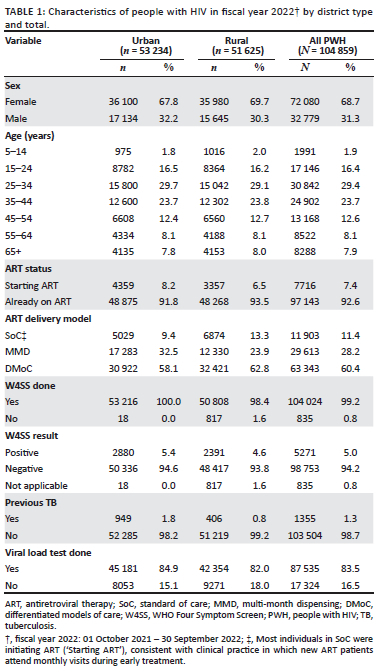
A total of 104 859 PWH were included in the analysis, with a mean age of 37.6 years (s.d. 14.3; IQR 5-71). Children (< 15 years) accounted for 1.9% (n = 1991), while adults (≥ 15 years) accounted for 98.1% (n = 102 868). Most participants were female (68.7%, n = 72 080), and the cohort was evenly distributed between urban (50.8%, n = 53 234) and rural (49.2%, n = 51 625) districts (Table 1). ART was most accessed through DMoC (60.4%, n = 63 343), followed by MMD (28.2%, n = 29 613) and SoC (11.4%, n = 11 903).
Drop-off 1: Xpert test
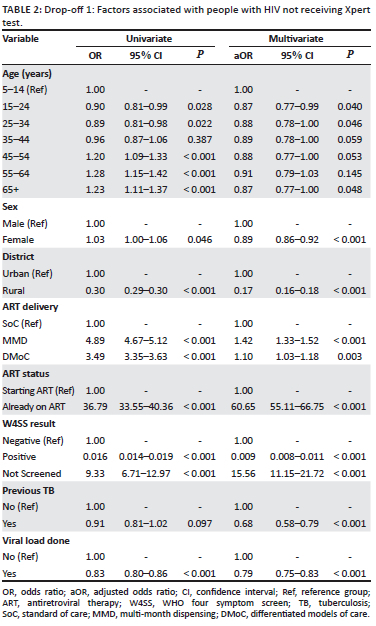
Among those who received an Xpert test (n = 34 932), 5.0% (n = 1746) were Xpert-positive. Xpert test drop-offs were substantial, with 66.7% (n = 69 927) of PWH not tested. Children aged 5-14 years had the highest drop-offs (66.8%). Among adults, drop-offs ranged from 60.6% to 72.0%, highest in the 55-64 year age group. Drop-offs were similar by sex, but higher among PWH already on ART (71.5%) compared to those starting ART (6.4%). Urban PWH had higher drop-offs (79.5%) than rural PWH (53.5%). By ART delivery model, drop-offs were highest in MMD (75.0%) and DMoC (68.1%) compared to SoC (38.1%). In multivariable analysis, already being on ART was the strongest determinant of not receiving an Xpert test (aOR = 60.65, 95% CI: 55.11-66.75). Having a positive WHO four-symptom screen was associated with lower odds of Xpert test drop-off compared to having a negative symptom screen (aOR = 0.009, 95% CI: 0.008-0.011). People with HIV who were not symptom screened had higher odds of Xpert test drop-off (aOR = 15.56, 95% CI: 11.15-21.72). People with HIV in the rural district were less likely to experience Xpert test drop-off compared to those in the urban district (aOR = 0.17, 95% CI: 0.16-0.18), while those enrolled in differentiated service delivery models were more likely to experience Xpert test drop-off MMD (aOR = 1.42, 95% CI: 1.33-1.52) and DMoC (aOR = 1.10, 95% CI: 1.03-1.18) compared to SoC. Adults were 12% - 13% less likely to drop off than children aged 5-14 years (P < 0.05) (Table 2).
Drop-off 2: Tuberculosis treatment initiation
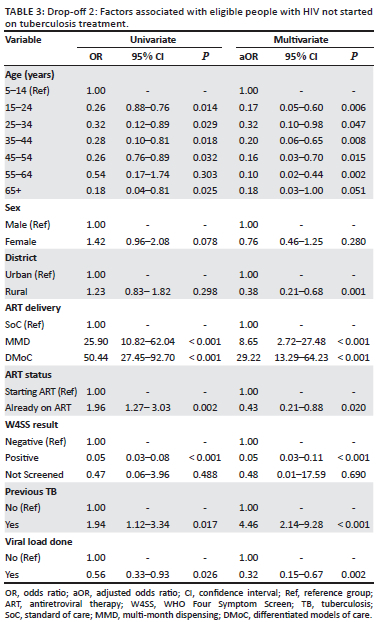
Among 1746 PWH diagnosed with TB, 6.3% (n = 110) were not initiated on treatment. Of these, 37.3% died before treatment initiation, 24.5% were lost to follow-up from the ART programme (defined as no clinic visit for ≥ 90 days), 23.6% transferred out of the facility while still receiving ART but before TB treatment could be started, and 14.5% had unknown reasons. Since these individuals had not yet started TB treatment, ART programme outcomes were applied to categorise their status at the time of drop-off. In multivariable analysis, treatment drop-off was higher among those in DMoC (aOR = 29.22, 95% CI: 13.29-64.23) and MMD (aOR = 8.65, 95% CI: 2.72-27.48) compared to SoC. A history of TB within the preceding 2 years also increased the odds of drop-off (aOR = 4.46, 95% CI: 2.14-9.28). Conversely, those with a positive WHO four-symptom screen were less likely to drop off (aOR = 0.05, 95% CI: 0.03-0.11), as were PWH already on ART (aOR = 0.43, 95% CI: 0.21-0.88). Viral load testing was associated with a lower likelihood of drop-off (aOR = 0.32, 95% CI: 0.15-0.67). Adults across all age bands had lower odds of drop-off compared to children (P < 0.05) (Table 3).
Drop-off 3: Tuberculosis treatment completion
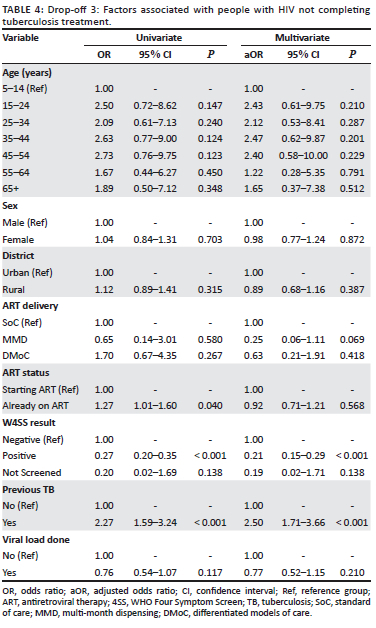
Among the 1636 PWH initiated on TB treatment, 25.6% (n = 419) did not complete treatment within the expected 6-9-month period. Of these drop-offs, 71.1% had screened positive for TB symptoms at diagnosis, and the majority were male (55.1% vs 44.9% female). Based on TB programme outcome definitions, the primary reasons for non-completion were loss to follow-up (51.3%), defined as treatment interruption for 2 or more consecutive months; death during the treatment period (32.5%); and transfer-out to another facility before completing treatment (16.2%). PWH with a positive WHO four-symptom screen were less likely to drop-off (aOR = 0.21, 95% CI: 0.15-0.29) compared to those with a negative symptom screen. Conversely, previous TB history increased the likelihood of drop-off (aOR = 2.50, 95% CI: 1.71-3.66). Other variables were not significantly associated with drop-offs in the adjusted model (Table 4).
Discussion
This study examined drop-offs in the TUTT care cascade among 104 859 PWH, focusing on three key stages: Xpert testing, TB treatment initiation, and completion. The most substantial drop-off occurred at the Xpert testing stage, where two-thirds of PWH (66.7%) were not tested. Xpert test drop-offs were particularly high among PWH already on ART, and in MMD and DMoC. Conversely, drop-offs were lower among symptomatic PWH, female patients, rural PWH, those with a history of TB within the preceding 2 years, and those who had a viral load test done. In this analysis, viral load testing was captured as a binary indicator (test done vs not done), and we interpreted its association with reduced drop-offs primarily as a marker of recent clinical engagement and integrated service delivery, rather than viral load level. Among those diagnosed with TB, 6.3% did not initiate treatment, as a result of death, loss to follow-up, and transfer-out, with drop-offs again highest in DMoC and MMD, and those with previous TB history. At the final stage, one in four PWH (25.6%) who initiated TB treatment did not complete it, with male patients and those with a previous TB history more likely to drop off.
PWH who were asymptomatic or not screened were markedly less likely to be tested, indicating sub-optimal TUTT implementation and continued reliance on symptom-based screening despite universal testing guidance. Similar findings have been reported elsewhere, citing persistent barriers such as healthcare worker shortages, high workloads, limited infrastructure, and poor service integration.24,2526,27,28
Disparities in Xpert test uptake across ART delivery models were striking. Drop-offs were highest among PWH already on ART, particularly those in MMD and DMoC, compared to those in SoC. Although differentiated models aim to improve efficiency and patient-centred care, reduced clinic contact may inadvertently limit TB testing opportunities.23,292222,23,30
Urban PWH had higher Xpert test drop-offs than their rural counterparts. This finding may reflect urban health system challenges such as overcrowded facilities, decentralised services, and competing programmatic priorities that undermine TB/HIV integration.31323334,352,36,37
Our study found that 6.3% of PWH diagnosed with TB did not initiate treatment, with the highest drop-offs observed among those enrolled in MMD and DMoC. This gap underscores key implementation challenges in integrating TB services within differentiated HIV care models. According to clinical guidance, PWH diagnosed with TB while in MMD or DMoC should be recalled and transitioned back to SoC to initiate TB treatment and ensure closer clinical monitoring.30232311,34
The most common reasons for non-initiation of TB treatment were death, loss to follow-up, and transfer-out, reflecting both structural and patient-level barriers. Early mortality before treatment initiation is a known risk among PWH with TB, especially when diagnosis is delayed.38,3940,4142,4344,45
The strong association between previous TB history and treatment initiation drop-offs in our analysis may reflect patient fatigue, stigma from repeated TB episodes, or prior negative experiences with the health system.4622,477,34,481312,3334
The 25.6% drop-off in TB treatment completion in our study, with loss to follow-up accounting for more than half of these cases, aligns with findings from numerous studies worldwide.49,5047,5114,523953
Our findings highlight two distinct challenges within the cascade: subclinical TB among asymptomatic PWH, and poor treatment completion among symptomatic individuals. Asymptomatic PWH were more likely to drop off at each stage of the cascade. This aligns with the growing recognition of subclinical TB, a condition prevalent in PWH that sits between latent and active TB, and may progress rapidly to symptomatic disease.9,549,54,5556489,48
Our study has several limitations. First, findings may not be generalisable beyond the study districts or to other high-risk populations targeted by TUTT because of differences in healthcare infrastructure and programme implementation. However, the insights remain relevant to other high-burden settings facing similar TUTT challenges. Second, as with all routine programmatic data, issues such as incomplete records and potential misclassification may have affected data quality. We mitigated these risks through rigorous quality checks during data collection and analysis. Third, individual-level factors such as socioeconomic status, stigma, or care-seeking behaviours were not assessed and may influence cascade outcomes. Fourth, clinic-level factors such as staffing levels, workflow efficiency, diagnostic capacity, and facility readiness were not available in the programmatic dataset and therefore could not be assessed as potential contributors to cascade drop-offs. Fifth, we excluded Xpert trace results (n = 42) from the drop-off analysis because of the absence of clinical follow-up data to assess alignment with the national trace algorithm. Similarly, invalid or rejected Xpert results (n = 745) were excluded because these results did not provide a definitive test outcome required to determine progression through the cascade. Sixth, we were also unable to explore associations by viral load level or suppression status, as routinely extracted programmatic data for this analysis did not include individual viral load measurements, and categorised suppression data were not incorporated into the regression models. Seventh, only Xpert results were extracted for this analysis. Drug-susceptible versus drug-resistant TB could not be assessed, as rifampicin resistance information was not consistently available in the programmatic dataset. Lastly, while we observed disparities in Xpert testing, particularly among urban PWH and those in MMD and DMoC, we did not investigate the underlying system-level barriers.
Despite these limitations, the study's strengths lie in its large sample size and use of real-world programmatic data, which enabled a robust analysis of the TUTT care cascade. The findings identified critical drop-off points and provided novel insights into the performance of ART delivery models and geographical settings. Importantly, the study highlights gaps in TB service integration within HIV differentiated care models, emphasising the need for stronger systems to support TB testing, diagnosis, and treatment among PWH. Future research should explore health system readiness, provider capacity, and integration mechanisms to inform targeted improvements in TUTT implementation. Additionally, future research should evaluate clinic-level determinants of TUTT implementation, including facility capacity, workflow processes, and diagnostic resource availability, to understand how facility-level factors may contribute to drop-offs.
Conclusion
Our study underscores persistent gaps across the TUTT care cascade among PWH, particularly at the Xpert testing and TB treatment completion stages. Disparities by ART delivery model, geographic setting, and symptom status reveal critical vulnerabilities in the current implementation of TUTT. These findings highlight the need for targeted interventions to improve TB testing and linkage to treatment, particularly among PWH enrolled in differentiated care and those accessing services in urban settings.27,5714,343527
Competing interests
Gary Maartens serves as an editorial board member of Southern African Journal of HIV Medicine. The peer review process for this submission was handled independently, and he had no involvement in the editorial decision-making process for this article. The authors have no other competing interests to declare.
CRediT authorship contribution
Katlego Motlhaoleng: Conceptualisation, Data Curation, Formal Analysis, Investigation, Methodology, Project Administration, Validation, Writing - Original Draft, Writing - Review & Editing. Kgomotso Vilakazi-Nhlapo: Conceptualisation, Writing - Review & Editing. Kate Shearer: Conceptualisation, Methodology, Writing - Review & Editing. Jonathan Golub: Conceptualisation, Methodology, Supervision, Writing - Review & Editing. Gary Maartens: Conceptualisation, Investigation, Methodology, Supervision, Writing - Review & Editing. All authors reviewed the article, contributed to the discussion of results, approved the final version for submission and publication, and take responsibility for the integrity of its findings.
Funding information
This TB/HIV programme has been supported (in part) by the U.S. President's Emergency Plan for AIDS Relief (PEPFAR) through the Centers for Disease Control and Prevention (CDC; under the terms of GH002377). Katlego Motlhaoleng was supported by the Fogarty International Center of the National Institutes of Health and the Eunice Kennedy Shriver National Institute of Child Health & Human Development (NICHD) under Award Number D43 TW010559.
Data availability
Data are not publicly available as they are derived from routine programmatic records held by the South African Department of Health. However, the data may be made available upon reasonable request from the corresponding author, Gary Maartens, and subject to relevant ethical and institutional approvals.
Disclaimer
The views and opinions expressed in this article are those of the authors and are the product of professional research. The article does not necessarily reflect the official policy or position of any affiliated institution, funder, agency, or that of the publisher. The authors are responsible for this article's results, findings, and content.
Acknowledgements
The research presented in this article formed part of Katlego Motlhaoleng's postgraduate studies and was originally conducted as part of their Doctoral thesis titled 'Optimizing tuberculosis case finding among people living with HIV in PEPFAR-supported districts in South Africa', submitted to the Faculty of Health Sciences, Department of Medicine, University of Cape Town, in 2025 under the supervision of Prof. Gary Maartens and Prof. Jonathan Golub. The thesis was submitted in partial fulfilment of the requirements for the PhD degree. Portions of the thesis have been revised, updated, and adapted for publication as a journal article. The authors thank all patients, healthcare providers, and U.S. President's Emergency Plan for AIDS Relief district support partners at the study sites. The authors are grateful to the Kwa-Zulu National Province Department of Health for supporting this study of this publication.
References
-
1. Duarte R, Lönnroth K, Carvalho C, et al. Tuberculosis, social determinants and co-morbidities (including HIV). Pulmonology. 2018;24(2):115-119. https://doi.org/10.1016/j.rppnen.2017.11.003
» https://doi.org/10.1016/j.rppnen.2017.11.003 -
2. World Health Organization. Policy on collaborative TB/HIV activities: Guidelines for national programmes and other stakeholders [homepage on the Internet]. 2012 [cited 2022 Apr 14]. Available from: https://www.who.int/publications/i/item/9789241503006
» https://www.who.int/publications/i/item/9789241503006 -
3. World Health Organization. Global tuberculosis report [homepage on the Internet]. 2024 [cited 2024 Oct 29]. Available from: https://www.who.int/publications/i/item/9789241503006
» https://www.who.int/publications/i/item/9789241503006 -
4. Martinson NA, Nonyane BA, Genade LP, et al. Evaluating systematic targeted universal testing for tuberculosis in primary care clinics of South Africa: A cluster-randomized trial (The TUTT Trial). PLoS Med. 2023;20(5):e1004237. https://doi.org/10.1371/journal.pmed.1004237
» https://doi.org/10.1371/journal.pmed.1004237 -
5. Naidoo P, Theron G, Rangaka MX, et al. The South African tuberculosis care cascade: Estimated losses and methodological challenges. J Infect Dis. 2017;216(suppl_7):S702-S713. https://doi.org/10.1093/infdis/jix335
» https://doi.org/10.1093/infdis/jix335 -
6. Subbaraman R, Nathavitharana RR, Mayer KH, et al. Constructing care cascades for active tuberculosis: A strategy for program monitoring and identifying gaps in quality of care. PLoS Med. 2019;16(2):e1002754. https://doi.org/10.1371/journal.pmed.1002754
» https://doi.org/10.1371/journal.pmed.1002754 - 7. Dhana A, Hamada Y, Kengne AP, et al. Tuberculosis screening among ambulatory people living with HIV: a systematic review and individual participant data meta-analysis. Lancet Infect Dis. 2022;22(4):507-518.
-
8. World Health Organization. Consolidated guidelines on tuberculosis: Module 2: Screening: Systematic screening for tuberculosis disease. Web annex A: Methods and expert panels [homepage on the Internet]. 2021 [cited 2023 May 25]. Available from: https://www.who.int/publications/i/item/9789240022676
» https://www.who.int/publications/i/item/9789240022676 -
9. Bajema KL, Bassett IV, Coleman SM, et al. Subclinical tuberculosis among adults with HIV: Clinical features and outcomes in a South African cohort. BMC Infect Dis. 2019;19:1-8. https://doi.org/10.1186/s12879-018-3614-7
» https://doi.org/10.1186/s12879-018-3614-7 -
10. World Health Organization. WHO consolidated guidelines on tuberculosis. Module 5: Management of tuberculosis in children and adolescents [homepage on the Internet]. 2022 [cited 2025 Mar 09]. Available from: https://www.who.int/publications/i/item/9789240046764
» https://www.who.int/publications/i/item/9789240046764 -
11. Motlhaoleng K, Vilakazi-Nhlapo K, Shearer K, Golub JE, Maartens G. Characterization of the targeted universal tuberculosis testing care cascade among people with HIV in PEPFAR-supported districts in South Africa. J Acquir Immune Defic Syndr. 2025;100(3):241-248. https://doi.org/10.1097/QAI.0000000000003729
» https://doi.org/10.1097/QAI.0000000000003729 -
12. Armstrong-Hough M, Turimumahoro P, Meyer AJ, et al. Drop-out from the tuberculosis contact investigation cascade in a routine public health setting in urban Uganda: A prospective, multi-center study. PLoS One. 2017;12(11):e0187145. https://doi.org/10.1371/journal.pone.0187145
» https://doi.org/10.1371/journal.pone.0187145 -
13. Shapiro AE, Van Heerden A, Schaafsma TT, et al. Completion of the tuberculosis care cascade in a community-based HIV linkage-to-care study in South Africa and Uganda. J Int AIDS Soc. 2018;21(1):e25065. https://doi.org/10.1002/jia2.25065
» https://doi.org/10.1002/jia2.25065 -
14. Cazabon D, Alsdurf H, Satyanarayana S, et al. Quality of tuberculosis care in high burden countries: The urgent need to address gaps in the care cascade. Int J Infect Dis. 2017;56:111-116. https://doi.org/10.1016/j.ijid.2016.10.016
» https://doi.org/10.1016/j.ijid.2016.10.016 -
15. Marley G, Zou X, Nie J, et al. Improving cascade outcomes for active TB: A global systematic review and meta-analysis of TB interventions. PLoS Med. 2023;20(1):e1004091. https://doi.org/10.1371/journal.pmed.1004091
» https://doi.org/10.1371/journal.pmed.1004091 -
16. Salomon A, Law S, Johnson C, et al. Interventions to improve linkage along the HIV-tuberculosis care cascades in low-and middle-income countries: A systematic review and meta-analysis. PLoS One. 2022;17(5):e0267511. https://doi.org/10.1371/journal.pone.0267511
» https://doi.org/10.1371/journal.pone.0267511 -
17. Human Sciences Research Council (HSRC). The Sixth South African National HIV Prevalence, Incidence, Behaviour and Communication Survey (SABSSM VI): Media Pack - Launch of key findings [homepage on the Internet]. 2023 [cited 2023 Nov 30]. Available from: https://hsrc.ac.za/special-projects/sabssm-survey-series/sabssmvi-media-pack-november-2023/
» https://hsrc.ac.za/special-projects/sabssm-survey-series/sabssmvi-media-pack-november-2023/ -
18. Ndlovu N, Padarath A, editors. District Health Barometer 2022/23 [homepage on the Internet]. Durban: Health Systems Trust; 2024 [cited 2024 Jul 21]. Available from: https://www.hst.org.za/publications/Pages/-District-Health-Barometer-2022-2023.aspx
» https://www.hst.org.za/publications/Pages/-District-Health-Barometer-2022-2023.aspx -
19. National Institute for Communicable Diseases (NICD). Center for tuberculosis: TB M&E Dashboard [homepage on the Internet]. 2024 [cited 2024 Sep 06]. Available from: https://www.nicd.ac.za/tb-surveillance-dashboard/
» https://www.nicd.ac.za/tb-surveillance-dashboard/ -
20. South Africa National Department of Health. National TB recovery plan [homepage on the Internet]. 2022 [cited 2024 Mar 23]. Available from: https://tbthinktank.org/wp-content/uploads/2022/09/TB-Recovery-Plan-for-South-Africa-version-7.pdf
» https://tbthinktank.org/wp-content/uploads/2022/09/TB-Recovery-Plan-for-South-Africa-version-7.pdf -
21. KwaZulu Natal Province - Department of Health. Referral system: Levels of health care [homepage on the Internet]. 2023 [cited 2024 Aug 08]. Available from: http://www.kznhealth.gov.za/Referral-system/
» http://www.kznhealth.gov.za/Referral-system/ -
22. World Health Organization. Updated recommendations on service delivery for the treatment and care of people living with HIV [homepage on the Internet]. 2021 [cited 2025 Mar 08]. Available from: https://www.who.int/publications/i/item/9789240023581
» https://www.who.int/publications/i/item/9789240023581 -
23. Washington R, Potty RS, Rajesham A, et al. Is a differentiated care model needed for patients with TB? A cohort analysis of risk factors contributing to unfavourable outcomes among TB patients in two states in South India. BMC Public Health. 2020;20:1-12. https://doi.org/10.1186/s12889-020-09257-5
» https://doi.org/10.1186/s12889-020-09257-5 -
24. Auld S, Moore B, Kyle R, et al. Mixed impact of xpert® MTB/RIF on tuberculosis diagnosis in Cambodia. Public Health Action. 2016;6(2):129-135. https://doi.org/10.5588/pha.16.0001
» https://doi.org/10.5588/pha.16.0001 -
25. Faust L, Naidoo P, Caceres-Cardenas G, et al. Improving measurement of tuberculosis care cascades to enhance people-centred care. Lancet Infect Dis. 2023;23(12):e547-557. https://doi.org/10.1016/S1473-3099(23)00375-4
» https://doi.org/10.1016/S1473-3099(23)00375-4 - 26. Ereso BM, Yimer SA, Gradmann C, Sagbakken M. Barriers for tuberculosis case finding in Southwest Ethiopia: A qualitative study. PLoS One. 2020;15(1):e0226307.
-
27. Fenta MD, Ogundijo OA, Warsame AAA, Belay AG. Facilitators and barriers to tuberculosis active case findings in low-and middle-income countries: A systematic review of qualitative research. BMC Infect Dis. 2023;23(1):515. https://doi.org/10.1186/s12879-023-08502-7
» https://doi.org/10.1186/s12879-023-08502-7 - 28. Westhuizen H-M, Giddy J, Coetzee R, et al. Strengthening accountability for TB policy implementation in South Africa: Perspectives from policymakers, civil society and communities. BMC Glob Public Health. 2024;2(1):48.
-
29. Mendoza-Graf A, Bogart LM, Shazi Z, et al. A qualitative assessment of South Africa's central chronic medication dispensing and distribution program for differentiated antiretroviral therapy delivery in Umlazi Township, South Africa: Client perspectives after 12 months of participation. AIDS Behav. 2024;29(2):673-683. https://doi.org/10.1007/s10461-024-04549-y
» https://doi.org/10.1007/s10461-024-04549-y -
30. South African National Department of Health. Differentiated models of care standard operating procedures [homepage on the Internet]. 2023 [cited 2025 Feb 27]. Available from: https://knowledgehub.health.gov.za/elibrary/differentiated-models-care-standard-operating-procedures
» https://knowledgehub.health.gov.za/elibrary/differentiated-models-care-standard-operating-procedures -
31. Byrne RL, Wingfield T, Adams ER, et al. Finding the missed millions: Innovations to bring tuberculosis diagnosis closer to key populations. BMC Glob Public Health. 2024;2(1):33. https://doi.org/10.1186/s44263-024-00063-4
» https://doi.org/10.1186/s44263-024-00063-4 -
32. Da Silva MP, Cassim N, Ndlovu S, et al. More than a decade of GeneXpert® Mycobacterium tuberculosis/Rifampicin (Ultra) testing in South Africa: Laboratory insights from twenty-three million Tests. Diagnostics. 2023;13(20): 3253. https://doi.org/10.3390/diagnostics13203253
» https://doi.org/10.3390/diagnostics13203253 - 33. De Vries G, Van Hest N, Baars H, Šebek M, Richardus JH. Factors associated with the high tuberculosis case rate in an urban area. Int J Tuberc Lung Dis. 2010;14(7):859-865.
-
34. Naidoo K, Gengiah S, Singh S, Stillo J, Padayatchi N. Quality of TB care among people living with HIV: Gaps and solutions. J Clin Tuberc Other Mycobact Dis. 2019;17:100122. https://doi.org/10.1016/j.jctube.2019.100122
» https://doi.org/10.1016/j.jctube.2019.100122 -
35. Shapiro AN, Scott L, Moultrie H, et al. Tuberculosis testing patterns in South Africa to identify groups that would benefit from increased investigation. Sci Rep. 2023;13(1):20875. https://doi.org/10.1038/s41598-023-47148-y
» https://doi.org/10.1038/s41598-023-47148-y -
36. South African National TB Think Tank. TB screening and testing standard operating procedure [homepage on the Internet]. 2021 [cited 2024 Mar 23]. Available from: https://tbthinktank.org/wp-content/uploads/2023/08/TB-SCREENING-AND-TESTING-SOP-2022.pdf
» https://tbthinktank.org/wp-content/uploads/2023/08/TB-SCREENING-AND-TESTING-SOP-2022.pdf -
37. World Health Organization. Guide to monitoring and evaluation for collaborative TB/HIV activities - 2015 Update [homepage on the Internet]. 2015 [cited 2024 Dec 20]. Available from: https://www.who.int/publications/i/item/9789241508278
» https://www.who.int/publications/i/item/9789241508278 -
38. Meintjes G, Maartens G. HIV-associated tuberculosis. New Engl J Med. 2024;391(4):343-355. https://doi.org/10.1056/NEJMra2308181
» https://doi.org/10.1056/NEJMra2308181 -
39. Myburgh H, Baloyi D, Loveday M, et al. A scoping review of patient-centred tuberculosis care interventions: Gaps and opportunities. PLoS Glob Public Health. 2023;3(2):e0001357. https://doi.org/10.1371/journal.pgph.0001357
» https://doi.org/10.1371/journal.pgph.0001357 -
40. Abdullahi OA, Ngari MM, Sanga D, Katana G, Willetts A. Mortality during treatment for tuberculosis; a review of surveillance data in a rural county in Kenya. PLoS One. 2019;14(7):e0219191. https://doi.org/10.1371/journal.pone.0219191
» https://doi.org/10.1371/journal.pone.0219191 - 41. Mwangwa F, Chamie G, Kwarisiima D, et al. Gaps in the child tuberculosis care cascade in 32 rural communities in Uganda and Kenya. J Clin Tuberc Other Mycobact Dis. 2017;9:24-29.
-
42. Ngari MM, Mberia JK, Kanana E, et al. Mortality and lost to follow-up among tuberculosis patients on treatment in Meru County, Kenya: A retrospective cohort study. PLoS Glob Public Health. 2025;5(3):e0003896. https://doi.org/10.1371/journal.pgph.0003896
» https://doi.org/10.1371/journal.pgph.0003896 -
43. World Health Organization. Adaptation and implementation of WHO's multisectoral accountability framework to end TB (MAF-TB): Operational guidance [homepage on the Internet]. 2023 [cited 2024 Dec 20]. Available from: https://www.who.int/publications/digital/global-tuberculosis-report-2021/featured-topics/maf-tb
» https://www.who.int/publications/digital/global-tuberculosis-report-2021/featured-topics/maf-tb - 44. Jiang Y, Chen J, Ying M, et al. Factors associated with loss to follow-up before and after treatment initiation among patients with tuberculosis: A 5-year observation in China. Front Med. 2023;10:1136094.
-
45. Birhane M, Mekonnen S, Dingeta T, Teklemariam Z. Loss to follow-up tuberculosis treatment and associated factors among adults attending at public health facilities in Warder District, Somali Regional State, Eastern Ethiopia. Front Public Health. 2023;11:1151077. https://doi.org/10.3389/fpubh.2023.1151077
» https://doi.org/10.3389/fpubh.2023.1151077 -
46. Abebe T, Angamo MT. Treatment outcomes and associated factors among tuberculosis patients in Southwest Ethiopia. Gulhane Med J. 2015;57(4):397-407. https://doi.org/10.5455/gulhane.161306
» https://doi.org/10.5455/gulhane.161306 -
47. Narasimhan P, Wood J, MacIntyre CR, Mathai D. Risk factors for tuberculosis. Pulm Med. 2013;2013:828939. https://doi.org/10.1155/2013/828939
» https://doi.org/10.1155/2013/828939 - 48. Ragonnet R, Trauer JM, Geard N, Scott N, McBryde ES. Profiling Mycobacterium tuberculosis transmission and the resulting disease burden in the five highest tuberculosis burden countries. BMC Med. 2019;17(1):1-12.
-
49. Teferi MY, El-Khatib Z, Boltena MT, et al. Tuberculosis treatment outcome and predictors in Africa: A systematic review and meta-analysis. Int J Environ Res Public Health. 2021;18(20):10678. https://doi.org/10.3390/ijerph182010678
» https://doi.org/10.3390/ijerph182010678 -
50. Eshetie S, Gizachew M, Alebel A, Van Soolingen D. Tuberculosis treatment outcomes in Ethiopia from 2003 to 2016, and impact of HIV co-infection and prior drug exposure: A systematic review and meta-analysis. PLoS One. 2018;13(3):e0194675. https://doi.org/10.1371/journal.pone.0194675
» https://doi.org/10.1371/journal.pone.0194675 -
51. Faye LM, Hosu MC, Iruedo J, et al. Treatment outcomes and associated factors among tuberculosis patients from selected rural eastern cape hospitals: An ambidirectional study. Trop Med Infect Dis. 2023;8(6):315. https://doi.org/10.3390/tropicalmed8060315
» https://doi.org/10.3390/tropicalmed8060315 -
52. Harries AD, Lin Y, Kumar AM, et al. What can national TB control programmes in low-and middle-income countries do to end tuberculosis by 2030? F1000Res. 2018;7:F1000 Faculty Rev-1011. https://doi.org/10.12688/f1000research.14821.1
» https://doi.org/10.12688/f1000research.14821.1 -
53. Tran CH, Moore BK, Pathmanathan I, et al. Tuberculosis treatment within differentiated service delivery models in global HIV/TB programming. J Int AIDS Soc. 2021;24:e25809. https://doi.org/10.1002/jia2.25809
» https://doi.org/10.1002/jia2.25809 -
54. Kendall EA, Shrestha S, Dowdy DW. The epidemiological importance of subclinical tuberculosis. A critical reappraisal. Am J Respir Crit Care Med. 2021;203(2):168-174. https://doi.org/10.1164/rccm.202006-2394PP
» https://doi.org/10.1164/rccm.202006-2394PP -
55. Moyo S, Ismail F, Van der Walt M, et al. Prevalence of bacteriologically confirmed pulmonary tuberculosis in South Africa, 2017-19: A multistage, cluster-based, cross-sectional survey. Lancet Infect Dis. 2022;22(8):1172-1180. https://doi.org/10.1016/S1473-3099(22)00149-9
» https://doi.org/10.1016/S1473-3099(22)00149-9 -
56. Drain PK, Bajema KL, Dowdy D, et al. Incipient and subclinical tuberculosis: A clinical review of early stages and progression of infection. Clin Microbiol Rev. 2018;31(4):e00021-18. https://doi.org/10.1128/CMR.00021-18
» https://doi.org/10.1128/CMR.00021-18 -
57. Sullivan A, Nathavitharana RR. Addressing TB-related mortality in adults living with HIV: A review of the challenges and potential solutions. Ther Adv Infect Dis. 2022;9:20499361221084163. https://doi.org/10.1177/20499361221084163
» https://doi.org/10.1177/20499361221084163

Accepted: 04 Dec. 2025
Published: 12 Feb. 2026