Sexual behaviours, awareness and perceptions towards voluntary medical male circumcision among students in Dr Kenneth Kaunda District, South Africa
Abstract
BACKGROUND: Voluntary Medical Male Circumcision (VMMC) is regarded as the most cost-effective intervention in reducing female-to-male transmission of HIV in countries where heterosexual transmission is the most prevalent mode of infection. OBJECTIVES: The aim of the study was to determine the awareness, sexual behaviours and perceptions of college students in Dr Kenneth Kaunda District, South Africa. METHOD: A cross-sectional design was engaged among a sample of 400 students selected using a stratified random sampling method. Descriptive data analysis was engaged to analyse data using STATA 13. RESULTS: The mean age of the respondents was 23 years. About 50% of the respondents were below the age of 23 years. The majority among the ethnic groups were black people and or African people (87.5%), followed by people of mixed race (8.1%). Most of the students belonged to the Christian religion (94.7%), and about 91.3% were single, while only 6.0% lived with their partners. Among those who were circumcised, a majority (78.0%) had undergone the MMC. About 76.5% of those residing in urban areas, and 80.6% residing in rural areas were circumcised. About 90.3% of the participants had good awareness about VMMC. About 77.3% of the participants disagreed that VMMC reduces the size of the penis, while 57.0% felt that VMMC provides an individual with the status of being a real man in society. Only 14.3% felt that VMMC exposes the penis to environmental hazards. While almost half (47.7%) of the cohort had one sexual partner, about 20.9% had three or more sexual partners. CONCLUSION: The findings suggest that there is a high level of awareness on VMMC among college students in relation to its positive role towards reducing STIs and the enhancement of penile hygiene.
Voluntary medical male circumcision; Sexual-behaviours; Awareness; Perceptions; HIV testing
Introduction
Male circumcision (MC) is regarded as one of the oldest and most common surgical procedures performed worldwide. It is undertaken for religious, cultural, social and medical reasons.11,2
A study conducted in Zimbabwe in 2013 found that 50% of the students were willing to go for VMMC, and 50.0% were willing to think about whether to do it or not.3456
In December 2014, over 9 million VMMCs were performed in all of the 14 priority countries in sub-Saharan Africa.777
The Voluntary Medical Male Circumcision programme was launched in Kenya in 2008 following the WHO/UNAID recommendation in 2007. Initially, Kenya aimed to circumcise 860 000 by 2013. The number of operations increased every year from 8000 to 190 000 between 2008 and 2013. According to literature, 80.0% of the VMMCs in Kenya were conducted in the Nyanza province, where half of the uncircumcised men live in Kenya.8,910117,12
It is now well documented that a significant portion of South Africa's indigenous population has been practicing the culture of male circumcision for centuries. For instance, male circumcision initiation schools in South Africa form part of the cultural practice. However, the integration of medical male circumcision with traditional manhood initiation rituals still seems to lack acceptability in these societies. Of note, about 70.0% of the men fear being stigmatised if they are circumcised medically in South Africa.131415,164,17
A cross-sectional study was also conducted among adults in rural Uganda, which revealed different negative perceptions about VMMC, especially in relation to its HIV protective measure. There is a concern about circumcision that is done after childhood. A study conducted among police officers in Dar es Salaam, Tanzania, raised concerns about circumcision conducted at older ages, as there is a view that pain can be felt more and penile erection post circumcision can delay wound healing.18,195,203,183,175
Within the context of eastern and southern Africa, where HIV prevalence is high, mathematical modelling has shown that circumcising 80.0% of males (aged 15-49) in five years can prevent approximately 3.4 million infections. There has been a belief that post VMMC, sexual behaviours, especially of males, can potentially reduce the expected benefits of the practice.181715,17,2018,1921
There is a very strong association between being circumcised and risky sexual behaviour; however, despite the association, men who are circumcised are less likely than those who are uncircumcised to be HIV-positive; this clearly indicates that the benefits of being circumcised outweigh the risk of predicted unwanted sexual behaviour.221
Methods
Study population and sampling method
Through the use of a cross-sectional design, a population comprising male students between the ages of 18 and 49 years were registered at Vuselela College. There were estimated 4000 male students registered in 2015 as per the Department of Higher Education report. Each campus was estimated to have the following number of male students enrolled: Potchefstroom Centre for Information Communication and Technology Studies (800), Jourbeton Centre for Engineering Studies (1800), Klerksdorp Centre for Business Studies (1200) and Matlosana Campus (200). Hence, a stratified random sampling method was found suitable, where each campus was stratified based on the number of male students enrolled. The resultant sample size arrived at was 351 participants, which was increased with a buffer of 15.0% to 400.
Data collection instrument and pretesting
A self-administered questionnaire was used as a data collection tool. The questionnaire comprised closed-ended questions. Questions were developed in English, as students were in a higher institute of learning. Data were collected until a required sample reached. The data collection instrument comprised four sections, which included socio-demographic characteristics, awareness of VMMC, sexual behaviours and perception towards VMMC. Good and/or satisfactory awareness, perceptions and practices regarding VMMC were determined through positive or preferred responses to > 75% of the questions in the questionnaire as indicated by the codes. The questionnaire was pretested among 15 students from Springfield College, who do not form part of the study sample.
Data collection process
After proper arrangements with the lecturers and college authority, students were approached in classes and briefed about the study. Those selected to take part in the study were asked to remain in class to be informed more about the study. Those who agreed to participate were asked to sign an informed consent form with detailed information about the purpose of the study and potential risks, such as being asked certain questions that they were comfortable to answer. Participants were therefore provided with the questionnaire and instructions on how to complete it. After completion, questionnaires were collected by the researcher. The process took them 20-25 min.
Validity and reliability
The reliability of the data collection tool was enhanced by conducting a pilot study among a few students. Sample size was increased by a marginal number to cater for non-responses and incomplete questionnaires. Questions were carefully developed in such a way that they address the study objectives, hence ensuring the reliability of the data collection tool. Questionnaires were checked by the supervisor to ascertain if they are relevant to the study. To ensure validity of the data collection instrument, questions were structured using simple language that participants understood. Questions were simple and explained clearly the aim of the study and its importance, thus minimising non-response. To minimise selection bias, the researcher used a stratified random sampling method, which involved the division of a population into smaller groups known as strata. Unavoidable information bias, more specifically recall bias, was expected to be encountered; however, this was borne in mind when interpreting the results of the study.
Data capture and analysis
The completed questionnaires were cross-checked to remove mistakes. Data were later entered into an Excel spreadsheet and coded, then finally imported into STATA 13 (STATA Corp, TX, USA) for statistical processing and analysis. Univariate analyses, including frequency distributions, were run to characterise the sample. Bivariate analysis was done to obtain significant association between the awareness and perception of college students in relation to their sexual practice. The chi-square test and odds ratios (OR) with 95.0% confidence intervals were used to measure the association. Summary measures were used to describe findings, and they were expressed as means (standard deviations), medians (ranges), modes and proportions.
Ethical consideration
Permission to conduct the study was granted by Sefako Makgatho Health Sciences University School of Healthcare Sciences Research Ethics Committee with clearance certificate Ref. [SMUREC/H/1112017: PG]. Furthermore, approval was granted by the Provincial Department of Higher Education and Training (DHET), as well as the Dean of Vuselela College in order to gain access at the institution for data collection. Participants were first clearly briefed about the purpose of the study prior to obtaining an informed consent. Further, participants were informed that participation in the study was voluntary and that they were free to withdraw from the study at any time without being penalized. Participants were also assured of anonymity in the completion of the questionnaires through the use of codes and not their real names or personal details. During the process of the study, confidentiality was ensured and maintained by not sharing participants' information with anyone, and by keeping all the study material in a secure place.
Results
Sample characteristics
The mean age of the respondents was 23 years, with a minimum of 18 and a maximum of 42 years of age and a standard deviation of 4.1. About 50.0% of the respondents were below 23 years. Those below 23 years were 59.5% (n = 191) as compared to those above 23 years (n = 130; 40.5%). The majority ethnic group in the study was Black people or Africans (87.5%), followed by Mixed race (8.1%). Most students belonged to the Christian religion (94.7%), and there were also Jewish (1.87%) as well as Muslim (1.87%) students. A majority of the students were single (91.3%), with around 19 (6%) living with their partners and 187 (n = 187; 58.3%) participants residing in urban areas. About 47.7% of the participants reported one sexual partner, and 35.5% reported two or more sexual partners. Of note, students who had undergone circumcision were more likely to have one sexual partner (53.3%).
Uptake of male circumcision and sexual behaviours
The proportion of circumcised men in the cohort was 77.6%. Among those circumcised, the majority (78.2%) had undertaken the medical male circumcision; the rest underwent traditional male circumcision. One reason provided by the participants for not being circumcised included fear of complications (21.1%), while about 45.1% had no specific reason for not being circumcised. About 51.8% had a single partner and was circumcised, with 22.3% having three or more partners. Participants who resided in the urban areas were mostly circumcised (76.5%), those who were uncircumcised from urban areas were only 23.5%. Those who resided in rural areas and were not circumcised constituted 19.4% compared to those who were circumcised (80.6%). A significantly high proportion of the participants rightly acknowledged health benefits of undergoing VMMC as revealed in the following percentages: 82.2% indicated that VMMC increases penile hygiene; 95.6% reported that VMMC reduces the risk of STIs; and 92.2% said that VMMC reduces the risk of penile cancer. In terms of sexual behaviours, almost half (47.7%) of the cohort had one sexual partner; about 20.9% had three or more sexual partners.
Level of awareness
The majority of the participants (90.3%) had good awareness about issues surrounding VMMC. Participants below the age of 23 years (54.8%) had a poor awareness level. Specifically, the majority of participants (97.8%) were aware that VMMC involves the removal of the foreskin. In terms of penile hygiene knowledge regarding VMMC, most participants (82.2%) scored well on this aspect. A very high number of the participants (95.6%) had a strong belief that VMMC reduces the risk of STIs. Participants who knew that there is a need for abstinence for six weeks after VMMC were about 91.9%. About 30.6% of the respondents reported that they have learnt about VMMC on television, while only a few (1.3%) reported that they have never learnt about VMMC at all. Those who learnt from the radio were about 18.4%, from newspaper 15.6%, from clinic and/or hospital 38.3%, from friend 27.1%, from neighbours 10.0%, through posters 13.7%, and from other sources 8.1%.
Perception of medical male circumcision
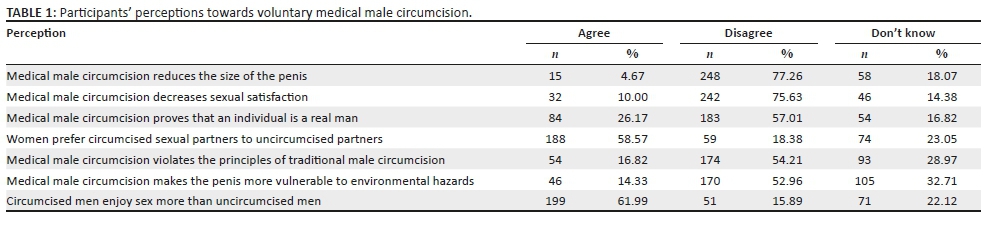
Generally, only 10.6% of the participants had positive perceptions about VMMC. In terms of the following statements: 'VMMC reduces the size of the penis', and 'VMMC decreases sexual satisfaction'; 77.26% of the participants disagreed with the former and 75.63% with the latter. When asked whether circumcised men enjoy sex more than uncircumcised men, about 61.99% agreed with this statement. In terms of whether women prefer circumcised sexual partners to uncircumcised partners, about 58.57% agreed. Further, about 54.2% disagreed that VMMC violates the principles of traditional male circumcision (as indicated in Table 1).
Discussion
Uptake and barriers towards voluntary medical male circumcision
In our study, a significantly higher (78.2%) proportion of participants had undergone VMMC. This figure is above the one recorded by HEAIDS in Southern Africa in 2014, which indicated that about 66.0% of the students were circumcised, bearing in mind that our study was conducted three years later. These developments may also be an indication of a rapid scale-up of VMMC promotion and awareness by non-governmental organisations (NGOs) targeting young people within the Dr. Kenneth Kaunda District. On another note, around 21.1% participants in our study reported fear of complications, and 16.1% said they fear pain following VMMC. These findings are consistent with findings in most literature of these barriers associated with VMMC. For instance, these barriers (fear of pain, concerns around safety issues, and the costs) were mentioned by participants in related studies.1,20,23,24,25
Voluntary medical male circumcision awareness among students
The high proportion (90.3%) in terms of good awareness on VMMC issues among students in our study seems to be in line with the findings of a study conducted among university students in Botswana, where they found that 95.4% had good knowledge about VMMC.55,182117
Some health benefits associated with voluntary medical male circumcision
There are certain health benefits associated with being circumcised, which include the reduced risk of acquiring HIV, cancer, and STIs, in addition to an increased level of penile hygiene. In all of these aspects, a significantly high proportion of the participants in our study rightly acknowledged these benefits in the following percentages: 82.2% indicated that VMMC increases penile hygiene; 95.6% reported that VMMC reduces the risk of STIs; and 92.2% said that VMMC reduces the risk of penile cancer. These ratings are closely similar to other findings conducted in a number of studies within the African region in terms of VMMC and its health benefits such as in Botswana;2624,27,282923
Perception regarding voluntary medical male circumcision
In terms of perception towards VMMC, our study results revealed that only 14.3% of the participants reported that VMMC makes the penis more vulnerable to environmental hazards, while only 10.0% reported that VMMC decreases sexual satisfaction. Such perceptions from students are consistent with some studies conducted among university students in Zimbabwe, which revealed that only a minority of them were willing to be circumcised.418
Study limitations
The study was limited to students in the selected colleges only; there were no other young people from the society included in the study to increase external validity. The study was relying mostly on self-reported information regarding the circumcision status of the participants. There was no physical examination done to confirm the circumcision status. Finally, like in most similar studies, there might be some recall bias as some participants may not accurately remember where they have learnt and/or heard about circumcision.
Competing interests
The authors declare that they have no financial or personal relationship(s) which may have inappropriately influenced them in writing this article.
Authors' contributions
S.M. and L.G.M. equally contributed to the writing and research of this article.
Acknowledgements
References
- 1.WHO/UNAIDS. Male circumcision: Global trends and determinants of prevalence, safety and acceptability. Brazzaville: WHO; 2007.
-
2.Pang MG, Kim DS. Extra-ordinarily high rates of male circumcision in South Korea: History and underlying causes. BJU Int. 2002;89(1):48-54. https://doi.org/10.1046/j.1464-410X.2002.02545.x
» https://doi.org/10.1046/j.1464-410X.2002.02545.x -
3.Jeofrey M, Zivanai S, Gwendoline S. Attitude of Midland State University students towards male circumcision as a way of reducing HIV transmission. J Hum Soc Sci. 2013;16(1):1-5. https://doi.org/10.9790/0837-1614549
» https://doi.org/10.9790/0837-1614549 - 4.Tsevere M, Pedzisai C. Attitudes of university students towards male circumcision. Int J Innov Res Dev. 2014;3(2):236-242.
-
5.Mndzebele SL, Tegegn GA. Knowledge, attitude and acceptance of voluntary male medical circumcision among male students attending Botswana University. J Public Health Epidemiol. 2015;7(1):6-14. https://doi.org/10.5897/JPHE2014.0671
» https://doi.org/10.5897/JPHE2014.0671 - 6.Higher Education and Training HIV/AIDS Programme (HEAIDS). HIV and AIDS related knowledge, attitudes and behaviours of students and staff at South African Technical and Vocational Education and Training colleges in South Africa, 2014.
-
7.Avert. Voluntary medical male circumcision for HIV prevention [homepage on the Internet]. 2015 [cited 2017 Jun 30]. Available from: https://www.avert.org/professionals/hiv-prevention-programming/voluntary-medical-male-circumcision
» https://www.avert.org/professionals/hiv-prevention-programming/voluntary-medical-male-circumcision -
8.National AIDS Control Council of Kenya (NACCK). Kenya AIDS response progress report 2014: Progress towards zero [homepage on the Internet]. 2014 [cited 2017 Sep 10]. Available from: http://www.unaids.org/sites/default/files/en/dataanalysis/knowyourresponse/ countryprogressreports/2014countries/KEN_narrative_report_2014.pdf
» http://www.unaids.org/sites/default/files/en/dataanalysis/knowyourresponse/ countryprogressreports/2014countries/KEN_narrative_report_2014.pdf -
9.Kenya National AIDS & STI Control Programme (NASCOP). Kenya AIDS indicator survey 2007: Final Report [homepage on the Internet]. 2009 [2017 Sep 10]. Available from: http://www.nacc.or.ke/nacc%20downloads/official_kais_report_2009.pdf
» http://www.nacc.or.ke/nacc%20downloads/official_kais_report_2009.pdf -
10.Galbraith JS, Ochieng A, Mwalili S, et al. Status of voluntary medical male circumcision in Kenya: Findings from 2 nationally representative surveys in Kenya, 2007 and 2012. JAIDS. 2014;10(1097):37-45. https://doi.org/10.1097/QAI.0000000000000121
» https://doi.org/10.1097/QAI.0000000000000121 -
11.Centers for Disease Control and Prevention (CDC). Progress in voluntary medical male circumcision service provision - Kenya, 2008-2011 [homepage on the Internet]. 2012 [cited 2017 Sep 10]. Available from: http://www.cdc.gov/mmwr/preview/mmwrhtml/mm6147a2.htm
» http://www.cdc.gov/mmwr/preview/mmwrhtml/mm6147a2.htm -
12.U.S. Agency for International Development (USAID). Demographic and Health Survey 2009 [homepage on the Internet]. 2010 [cited 2017 Sep 10]. Available from: http://pdf.usaid.gov/pdf_docs/PNADU407.pdf
» http://pdf.usaid.gov/pdf_docs/PNADU407.pdf -
13.Peltzer K, Kanta X. Medical circumcision and manhood initiation rituals in the Eastern Cape, South Africa: A post intervention evaluation. Cult Health Sex. 2009;11:83-97. https://doi.org/10.1080/13691050802389777
» https://doi.org/10.1080/13691050802389777 -
14.SAbreakingnews. Male students urged to get circumcised [homepage on the Internet]. 2017 [cited 2017 Jul 15]. Available from: http://www.sabreakingnews.co.za/2017/03/27/male-students-urged-to-get-circumcised/
» http://www.sabreakingnews.co.za/2017/03/27/male-students-urged-to-get-circumcised/ -
15.Nevin PE, Pfeiffer J, Kibira SPS, Lubinga SJ, Mukose A, Babigumira JB. Perceptions of HIV and safe male circumcision in high HIV prevalence fishing community on Lake Victoria, Uganda. PLoS One. 2015;10(12):1-16. https://doi.org/10.1371/journal.pone.0145543
» https://doi.org/10.1371/journal.pone.0145543 -
16.Toefy Y, Skinner D, Thomsen SC. 'What do you mean i've got to wait for six weeks?!' Understanding the sexual behaviour of men and their female partners after voluntary medical male circumcision in the Western Cape. PLoS One. 2015;10(7):1-13. https://doi.org/10.1371/journal.pone.0133156
» https://doi.org/10.1371/journal.pone.0133156 -
17.Chikutsa A, Maharaj P. Social representations of male circumcision as prophylaxis against HIV/AIDS in Zimbabwe. BioMed Central Public Health. 2015;15(603):1-9. https://doi.org/10.1186/s12889-015-1967-z
» https://doi.org/10.1186/s12889-015-1967-z -
18.Mukama T, Ndejjo R, Musinguzi G, Musoke D. Perceptions about medical male circumcision and sexual behaviours of adults in rural Uganda: A cross sectional study. Pan Afr Med J. 2015;22(354):1-7. https://doi.org/10.11604/pamj.2015.22.354.7125
» https://doi.org/10.11604/pamj.2015.22.354.7125 -
19.Tarimo EAM, Francis JM, Kakoko D, Munseri P, Bakari M, Sandstrom E. The perceptions of male circumcision as a preventive measure against HIV infection and considerations in scaling up of the services: A qualitative study among police officers in Dar es Salaam, Tanzania. BioMed Central Public Health. 2012;12(529):1-12. https://doi.org/10.1186/1471-2458-12-529
» https://doi.org/10.1186/1471-2458-12-529 -
20.Naidoo PV, Dawood F, Driver C, Narainsamy M, Ndlovu S, Ndlovu V. Knowledge attitude and perceptions of Pharmacy and nursing students towards male circumcision and HIV in a KwaZulu Natal University, South Africa. Afr J Prim Health Care Fam Med. 2012;4(1):1-7. https://doi.org/10.4102/phcfm.v4i1.327
» https://doi.org/10.4102/phcfm.v4i1.327 -
21.Engle KL, Lanham M, Loolpapit M, Oguma I. Understanding partial protection and HIV risk and behaviour following voluntary medical male circumcision rollout in Kenya. Health Educ Res. 2013;29(1):122-130. https://doi.org/10.1093/her/cyt103
» https://doi.org/10.1093/her/cyt103 - 22.Kibira SPS, Nansubuga E, Tumwesigye NM. Male circumcision, sexual behavior, and HIV status in Uganda. USAID. 2013;100:1-31.
-
23.Mattson CL, Bailey RC, Muga R, Poulussen R, Onyango T. Acceptability of male circumcision and predictors of circumcision preference among men and women in Nyanza Province in Kenya. AIDS Care. 2005;17(2):182-194. https://doi.org/10.1080/09540120512331325671
» https://doi.org/10.1080/09540120512331325671 -
24.Scott BE, Weiss HA, Viljoen JI. The acceptability of male circumcision as an HIV intervention among a rural Zulu population in KwaZulu-Natal South Africa, AIDS Care. 2005;17(3):304-313. https://doi.org/10.1080/09540120412331299744
» https://doi.org/10.1080/09540120412331299744 -
25.Skolnik L, Tsui S, Ashengo TA, Kikaya V, Lukobo-Durrell M. A cross-sectional study describing motivations and barriers to voluntary medical male circumcision in Lesotho. BioMed Central Public Health. 2014;14(1119):1-10. https://doi.org/10.1186/1471-2458-14-1119
» https://doi.org/10.1186/1471-2458-14-1119 -
26.Kebaabetswe P, Lockman S, Mogwe S, et al. Male circumcision: An acceptable strategy for HIV prevention in Botswana. Sex Transm Infect. 2003;79(3):214-219. https://doi.org/10.1136/sti.79.3.214
» https://doi.org/10.1136/sti.79.3.214 - 27.Lagarde E, Dirk T, Puren A, Reathe RT, Bertran A. Acceptability of male circumcision as a tool for preventing HIV infection in a highly infected community in South Africa. AIDS. 2003;17(1):89-95.
-
28.Rain-Taljaard RC, Lagarde E, Taljaard DJ, et al. Potential for an Intervention based on male circumcision in a South African town with high levels of HIV infection. AIDS Care. 2003;15(3):315-327. https://doi.org/10.1080/0954012031000105379
» https://doi.org/10.1080/0954012031000105379 -
29.Halperin DT, Fritz K, McFarland W, Woelk G. Acceptability of adult male circumcision for sexually transmitted disease and HIV prevention in Zimbabwe. Sex Transm Dis. 2005;32(4):238-239. https://doi.org/10.1097/01.olq.0000149782.47456.5b
» https://doi.org/10.1097/01.olq.0000149782.47456.5b

Accepted: 05 Feb. 2019
Published: 22 May 2019