Thrombotic thrombocytopaenic purpura in the era of HIV: A single-centre experience
Abstract
BACKGROUND: Thrombotic thrombocytopaenia purpura (TTP) is a rare disorder which carries a high mortality. HIV is an important cause of TTP. OBJECTIVES: We assessed the presentation and response to plasma exchange (PEX) by HIV status. METHOD: A single-centre retrospective review of all patients receiving PEX for TTP between 01 January 2010 and 31 December 2019 was undertaken. Demographics and presenting parameters were compared between HIV-associated TTP and other aetiologies using Mann-Whitney U and Kruskal Wallis analysis of variance testing, as appropriate. The effect of aetiology and presenting parameters on PEX duration was modelled using Cox proportional hazards; effect of these variables on mortality and residual renal dysfunction in survivors was analysed using stepwise multivariate regression. RESULTS: Uncontrolled HIV infection was the commonest cause (81.9%) of TTP in the 83 patients identified. Thrombocytopaenia was more severe and neurological deficit more frequent in HIV-associated TTP; but renal dysfunction was milder in this group. Aetiology did not influence mortality risk. Aetiological category and presenting parameters did not predict PEX duration. Residual renal dysfunction was less frequent in survivors of HIV-associated TTP. CONCLUSION: HIV is an important cause of TTP in the local context. Haematological and neurological involvement are more severe in HIV-associated TTP. Acceptable survival rates are achievable with PEX even in advanced HIV infection; renal sequalae are less common in this group.
TTP; HIV; plasma exchange; mortality; renal dysfunction
Introduction
The thrombotic migroangiopthies (TMA) are a group of disorders of heterogenous aetiology with a shared pathology featuring endothelial injury and microvascular occlusion by platelet-rich thrombi.11,22
Thrombotic migroangiopthies is a rare disorder in the developed world, with an estimated annual incidence of four cases per million population.34,5,678
Although the pathophysiology of HIV-associated TTP has yet to be fully elucidated, several mechanisms have been proposed. These include endothelial dysfunction from chronic inflammation or endothelial injury caused by shed HIV viral proteins and complement activation,91011
Previous case series suggest a higher mortality rate in cases of HIV-associated TTP, possibly reflecting an increased risk of infectious complications arising from the immunoparesis associated with advanced HIV infection, which is a characteristic association of the disorder.122
Residual renal dysfunction is an under-reported outcome parameter in most TMA series. Available data suggest considerable variation in the prevalence of chronic kidney disease (CKD) between aetiological categories of TMA.131415
We report the largest series of cases of HIV-associated TTP from South Africa to date. Analysis of these data provides a better characterisation of the presentation of the disorder which may facilitate improved diagnosis and earlier initiation of treatment among clinicians treating PLWH - a vital step in improving outcomes. We further show that treatment of HIV-associated TTP with PEX is associated with reasonable survival outcomes, and that residual renal dysfunction in this disorder is fortuitously rare.
Methods
A retrospective single-centre review of all suspected cases of TTP treated with PEX during the period 01 January 2010 - 31 December 2019 was undertaken. The overall prevalence rate of HIV in the local community served by this centre has been estimated to be 12.9%;1617932,6,182
Data were anonymously extracted from clinical case records and stored in an Excel (Microsoft Corp., Redmond, Washington, United States) spreadsheet which was imported into Statistica version 14.0.1 (TIBCO Software, Palo Alto, California, United States) for analysis; Stata version 17 (StataCorp, College Station, Texas, United States) was used to plot remission curves. Estimated GFR (eGFR) was recalculated from presenting serum creatinine using the CKD-EPI formula with the race coefficient removed. Median haemoglobin concentration, platelet count, lactate dehydrogenase (LDH) activity level, creatinine concentration, eGFR at presentation, and the presence of neurological deficit or pyrexia were described for the series as a whole and for HIV infection categories; the Mann-Whitney U and Fisher exact tests were used to compare parameters between categories. The effect of presenting parameters and HIV infection status on the duration of PEX required to induce remission was modelled using Cox regression analysis censored for inpatient death. In-hospital mortality and residual renal dysfunction (defined as an eGFR of less than 60 mL/min per 1.73 m2
Ethical considerations
This study was undertaken in adherence with the Declaration of Helsinki. Permission to undertake the study was obtained from the Human Research Ethics Committee of the University of the Witwatersrand (protocol number M2011116).
Results
A total of 166 cases were reviewed, of which 64 were excluded for retrospectively missing data; a further 11 patients were excluded due to retrospective review indicating the possibility of a diagnosis other than TTP. A further three patients were excluded due to the possibility of pregnancy-related haemolysis elevated liver enzymes, and low platelets (HELLP) syndrome, with an additional three patients excluded due to the presence of overlapping TTP aetiological categories (two HIV-positive patients with HIV-associated malignancies, and one patient known with systemic lupus erythematosus who presented with newly diagnosed HIV infection); a further two patients were excluded on the basis of age less than 18 years at presentation. The final cohort included in analysis therefore comprised 83 patients, including 68 PLWH and 15 HIV-negative patients.
Presenting features of the cohort are described in Table 1. Women of black African ethnicity constituted the largest patient group in this series (52 patients, 62.7% of the cohort). Renal dysfunction was not uncommon, with a presenting eGFR below 60 mL/min per 1.73 m2
Presentation with HIV-associated TTP was associated with uncontrolled HIV infection. Only 12 patients (17.6%) had been initiated onto antiretroviral therapy (ART) prior to presentation, and no patient included in this series had a suppressed viral load at presentation with TTP. CD4 count was low in this series.
Platelet count was lower, but renal function was better preserved in PLWH presenting with TTP compared to HIV-negative patients; neurological deficit was more frequently encountered in PLWH (Table 2) and PLWH were less likely to require dialysis for TTP-related AKI than HIV-negative patients (9.1% of PLWH required dialysis compared to 53.8% of HIV-negative patients; odds ratio for dialysis for PLWH 0.09, 95% confidence interval [95% CI]: 0.02-0.34, P < 0.001).
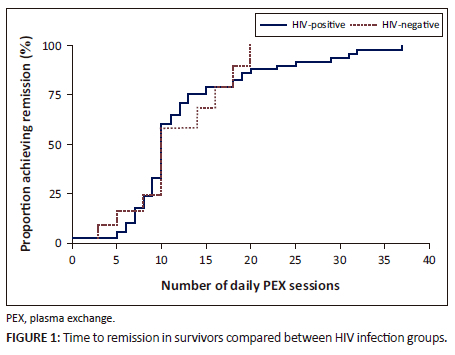
The crude inpatient mortality rate was not significantly different between HIV-positive and HIV-negative patients in this series (Table 3). There was no difference in the number of PEX sessions required to induce remission of TTP (Figure 1), nor was there a significant difference in the total duration of hospitalisation in survivors between these patient groups. Median eGFR on discharge was not significantly different between HIV-positive and HIV-negative survivors of TTP; however, eGFR below 60 mL/min per 1.73 m2
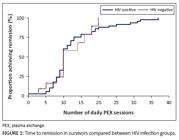
No effect was detected for presenting haemoglobin concentration (P = 0.402), platelet count (P = 0.572), LDH activity (P = 0.866), eGFR (P = 0.584), or HIV infection status on the number of PEX sessions required to induce remission; among PLWH no effect was observed for presenting CD4 count (P = 0.920) or HIV viral load (P = 0.800) on this parameter.
A significant effect for renal function at presentation was observed on the risk of inpatient mortality and on the risk of reduced renal function as defined by eGFR below 60 mL/min per 1.73 m2Table 4). No effect was observed for presenting haemoglobin concentration, platelet count, LDH activity, HIV infection status, or (among PLWH) presenting CD4 count or viral load on these two outcomes.
Discussion
This large cohort confirms reports from previous series of the importance of uncontrolled HIV infection as an aetiological factor for TTP in the local context (Table 5). HIV-associated TTP presents with haematological manifestations of greater severity and is more frequently associated with neurological deficit than other forms of the disorder, although renal function appears better preserved in the former. Response of HIV-associated TTP to PEX and emergent ARV initiation in the present study is reassuring, with the duration of PEX required to induce remission being comparable to other aetiologies. In addition, HIV-associated TTP in this study had a superior survival rate and lower rate of residual renal deficit.
The prevalence of HIV-associated TTP as an aetiological category within the TMAs is known to be high in South Africa, accounting for approximately 78% of cases in the previous series.4,5,621
Women and patients of black African descent are over-represented in thrombotic microangiopathy registries. Low frequency of HLA-DRB1*04, a human leukocyte antigen subtype known to confer protection against TMA, has been implicated as contributing to an inherited risk for the disorder in people of black African ethnicity.262728295,6,19
Variations in the clinical presentation of TMA between aetiological categories may reflect differences in comorbidities associated with the underlying primary disease process. For example, lower haemoglobin concentration and platelet count in HIV-associated TTP observed in this and other series19, 20,25 may reflect comorbid HIV-related dyshaematopoiesis.9193031
The use of PEX as a first-line therapy in this series follows recommended treatment guidelines2326,19646,194
Previous case series suggest a higher mortality rate in cases of HIV-associated TTP, possibly reflecting an increased risk of infectious complications arising from the immunoparesis associated with advanced HIV infection.126,19
Renal dysfunction has been reported to predict mortality in TMA in other studies.3334
Renal dysfunction is an under-reported outcome parameter in most TTP case series. Available data suggest considerable variation in the prevalence of residual renal dysfunction between aetiological categories.13351514
There are limitations to the present study. Although guidelines recommend ADAMTS13 measurement as part of the evaluation of the aetiology of TMA,21136
Conclusion
Our study demonstrates the significant contribution of HIV to the incidence of TTP in the South African context. HIV-associated TTP in the local setting demonstrates a predilection for young women of black African ethnicity, likely reflective of genetic and sex-related risk and of the demographics of HIV infection in South Africa. Variation in the clinical presentation of TTP may reflect comorbidities associated with underlying aetiological factors. Despite more severe haematological parameters and neurological deficit in HIV-associated TTP at presentation, response to PEX is similar to cases of TTP occurring in HIV-negative patients. Survival rates with PEX are comparable to those reported internationally, even in the setting of advanced HIV infection. Residual renal dysfunction in survivors of HIV-associated TTP appears rare, but further long-term studies are required to better evaluate this under-reported complication.
Competing interests
The authors declare that they have no financial or personal relationships that may have inappropriately influenced them in writing this article.
Authors' contributions
Y.M., Z.C., and M.D. contributed to the study design. Y.M. collected data; data were curated, edited, and analysed by M.D. The article was written by M.D. and revised by Z.C., C.D., and Y.M. S.C. and A.A. contributed to final editing.
Funding information
This research received no specific grant from any funding agency in the public, commercial, or not-for-profit sectors.
Data availability
Data supporting the findings of this study are available from the corresponding author, M.D., on request.
Disclaimer
The views and opinions expressed in this article are those of the authors and do not necessarily reflect official policy.
Acknowledgements
References
-
1.Ruggenenti P, Norris M, Remuzzi G. Thrombotic microangiopathy, hemolytic uremic syndrome, and thrombotic thrombocytopenic purpura. Kidney Int. 2001;60(3):831-846. https://doi.org/10.1046/j.1523-1755.2001.060003831.x
» https://doi.org/10.1046/j.1523-1755.2001.060003831.x -
2.Scully M, Hunt BJ, Benjamin S, et al. Guidelines on the diagnosis and management of thrombotic thrombocypenic purpura and other thrombotic microangiopathies. Br J Haematol. 2012;158(3):323-335. https://doi.org/10.1111/j.1365-2141.2012.09167.x
» https://doi.org/10.1111/j.1365-2141.2012.09167.x -
3.Levy GG, Motto DG, Ginsburg D. ADAMTS13 turns 3. Blood. 2005;106(1):11-17. https://doi.org/10.1182/blood-2004-10-4097
» https://doi.org/10.1182/blood-2004-10-4097 -
4.Louw S, Gounden R, Mayne ES. Thrombotic thrombocytopenic purpura (TTP)-like syndrome in the HIV era. Thrombosis J. 2018;16:35. https://doi.org/10.1186/s12959-018-0189-x
» https://doi.org/10.1186/s12959-018-0189-x -
5.Swart L, Schapkaitz E, Mahlangu JN. Thrombotic thrombocytopenic purpura: A 5-year tertiary care centre experience. J Clin Apheresis. 2018;34(1):44-50. https://doi.org/10.1002/jca.21673
» https://doi.org/10.1002/jca.21673 -
6.Masoet A, Bassa F, Chothia M-Y. HIV-associated thrombotic thrombocytopaenic purpura: A retrospective cohort study during the anti-retroviral therapy era. J Clin Apheresis. 2019;34(3):399-406. https://doi.org/10.1002/jca.21692
» https://doi.org/10.1002/jca.21692 -
7.Poole C, Strydom C, Van der Berg K, Vrielink H. Taking therapeutic apheresis services to patients in South Africa: An eight year review of SANBS mobile therapeutic apheresis service, 2013-2020. Transf Apheresis Sci. 2021;60(3):103167. https://doi.org/10.1016/j.transci.2021.103167
» https://doi.org/10.1016/j.transci.2021.103167 -
8.Malak S, Wolf M, Millot GA, et al. Human immunodeficiency virus-associated thrombotic microangiopathies: Clinical characteristics and outcome according to ADAMTS13 activity. Scand J Immunol. 2008;68(3):337-344. https://doi.org/10.1111/j.1365-3083.2008.02143.x
» https://doi.org/10.1111/j.1365-3083.2008.02143.x -
9.Louw S, Jacobson BF, Wiggill TM, Chapanduka Z, Mayne ES. HIV-associated thrombotic thrombocytopenic purupra (HIV-TTP): A practical guide and review of the literature. HIV Med. 2022;23(10):1-8. https://doi.org/10.1111/hiv.13305
» https://doi.org/10.1111/hiv.13305 -
10.Del Arco A, Martinez MA, Pena JM, et al. Thrombotic thrombocytopenic purpura associated with human immunodeficiency virus infection: Demonstration of p24 antigen in endothelial cells. Clin Infect Dis. 1993;17(3):360-363. https://doi.org/10.1093/clinids/17.3.360
» https://doi.org/10.1093/clinids/17.3.360 -
11.Gunther K, Garizio D, Nesara P. ADAMTS13 activity and the presence of acquired inhibitors in human immunodeficiency virus-related thrombotic thrombocytopaenic purpura. Transfusion. 2007;47(9):1710-1716. https://doi.org/0.1111/j.1537-2995.2007.01346.x
» https://doi.org/0.1111/j.1537-2995.2007.01346.x -
12.Ahmed S, Siddiqui RK, Siddiqui AK, Zaidi SA, Cervia J. HIV associated thrombotic microangiopathy. Postgrad Med J. 2002;78(923):520-524. https://doi.org/10.1136/pmj.78.923.520
» https://doi.org/10.1136/pmj.78.923.520 -
13.George JN, Nester CM. Syndromes of thrombotic microangiopathy. New Eng J Med 2014;371(7):654-666. https://doi.org/10.1056/NEJMra1312353
» https://doi.org/10.1056/NEJMra1312353 -
14.Thejeel B, Garg AX, Clark WF, Liu AR, Iansavichus AV, Hildebrand AM. Long-term outcomes of thrombotic microangiopathy treated with plasma exchange: A systematic review. Am J Haemtol. 2016;91(6):623-630. https://doi.org/10.1002/ajh.24339
» https://doi.org/10.1002/ajh.24339 -
15.Naicker S, Aboud O, Gharbi MB. Epidemiology of acute kidney injury in Africa. Semin Nephrol. 2008;28(4):348-353. https://doi.org/10.1016/j.semnephrol.2008.04.003
» https://doi.org/10.1016/j.semnephrol.2008.04.003 -
16.Van Schalkwyk C, Dorrington RE, Seatlhodi T, Valasquez C, Feissadeh A, Johnson LF. Modelling of HIV prevention and treatment progress in five South African metropolitan districts. Sci Rep. 2021;11:5652. https://doi.org/10.1038/s41598-021-85154-0
» https://doi.org/10.1038/s41598-021-85154-0 -
17.Yudelowitz G, Ive P, Fox M. An audit of HIV-infected patients admitted to Helen Joseph Hospital in Johannesburg, South Africa. Wits J Clin Med 2021;3(3):189-196. https://doi.org/10.18772/26180197.2021.v3n3a6
» https://doi.org/10.18772/26180197.2021.v3n3a6 -
18.Jamme M, Rondeau E. The PLASMIC score for thrombotic thrombocytopaenic purpura. Lancet Haematol. 2017;4(4):e148-e149. https://doi.org/10.1016/S2352-3026(17)30024-8
» https://doi.org/10.1016/S2352-3026(17)30024-8 -
19.Novitzky N, Thosom J, Abrahams L, Du Toit C, McDonald A. Thrombotic thrombocytopenic purpura in patients with retroviral infection is highly responsive to plasma infusion therapy. Br J Haematol. 2005;128(3):3730379. https://doi.org/10.1111/j.1365-2141.2004.05325.x
» https://doi.org/10.1111/j.1365-2141.2004.05325.x -
20.Gunther K, Dhlamini B. D-dimer levels are markedly raised in HIV-related thrombotic thrombocytopenic purpura. AIDS. 2007;21(8):1063-1064. https://doi.org/10.1097/QAD.0b013e328010e276
» https://doi.org/10.1097/QAD.0b013e328010e276 -
21.Gervasoni C, Ridolfo AL, Vaccarezza M, et al. Thrombotic microangiopathy in patients with acquired immunodeficiency syndrome before and during the era of introduction of highly active antiretroviral therapy. Clin Infect Dis. 2002;35(12):1534-1540. https://doi.org/10.1086/344778
» https://doi.org/10.1086/344778 -
22.Bekker S, Fusco G, Fusco J, et al. HIV-associated thrombotic microangiopathy in the era of highly active antiretroviral therapy: And observational study. Clin Infect Dis. 2004;39(suppl. 5):S267-S275. https://doi.org/10.1086/422363
» https://doi.org/10.1086/422363 -
23.Miller RF, Scully M, Cohen H. Thrombotic thrombocytopaenic purpura in HIV-infected patients. Int J STD AIDS. 2005;16(8):538-545. https://doi.org/10.1258/0956462054679241
» https://doi.org/10.1258/0956462054679241 -
24.Hart D, Sayer R, Miller R, et al. Human immunodeficiency virus associated thrombotic thrombocytopenic purpura - Favourable outcome with plasma exchange and prompt initiation of highly active antiretroviral therapy. Br J Haematol. 2011;153(4):515-519. https://doi.org/10.1111/j.1365-2141.2011.08636.x
» https://doi.org/10.1111/j.1365-2141.2011.08636.x -
25.Bade NA, Giffi VS, Baer MR, Zimrin AB, Law JY. Thrombotic microangiopathy in the setting of human immunodeficiency virus infection: High incidence of severe thrombocytopaenia. J Clin Apher. 2018;33(3):342-348. https://doi.org/10.1002/jca.21615
» https://doi.org/10.1002/jca.21615 -
26.Martino S, Jamme M, Deligny C, et al. Thrombotic thrombocytopenic purpura in Black people: Impact of ethnicity on survival and genetic risk factors. PLoS One. 2016;11(7):e0156679. https://doi.org/10.1371/journal.pone.0156679
» https://doi.org/10.1371/journal.pone.0156679 -
27.Terral DR, Williams LA, Vesely SK, Lammle B, Hovinga AK, George JN. The incidence of thrombotic thrombocytopenic purpura-hemolytic uremic syndrome: All patients, idiopathic patients, and patients with severe ADAMTS-13 deficiency. Thrombosis Haemost. 2005;3:1432-1436. https://doi.org/10.1111/j.1538-7836.2005.01436.x
» https://doi.org/10.1111/j.1538-7836.2005.01436.x -
28.Sanchez-Luceros A, Farias CE, Amaral MM, et al. von Willebrand factor-cleaving protease (ADAMTS13) activity in normal non-pregnant women, pregnant and post-delivery women. Thromb Haemost. 2004;92(6):1320-1326. https://doi.org/10.1160/TH03-11-0683
» https://doi.org/10.1160/TH03-11-0683 -
29.Mabaso M, Makola L, Naidoo I, Mlangeni LL, Jooste S, Simbayi L. HIV prevalence in South Africa through gender and racial lenses: Results from the 2012 population-based national household survey. Int J Equity Health. 2019;18:167. https://doi.org/10.1186/s12939-019-1055-6
» https://doi.org/10.1186/s12939-019-1055-6 -
30.Winston A, Spudich S. Cognitive disorders in people living with HIV. Lancet HIV 2020;7(7):e504-e513. https://doi.org/10.1016/S2352-3018(20)30107-7
» https://doi.org/10.1016/S2352-3018(20)30107-7 -
31.Strufaldi NL, De Menezes Nevez PDM, Dias CB, et al. Renal thrombotic microangiopathy associated to worse renal prognosis in lupus nephritis. J Nephrol. 2021;34:1147-1156. https://doi.org/10.1007/s40620-020-00938-3
» https://doi.org/10.1007/s40620-020-00938-3 -
32.Rock GA, Shumak KH, Buskard NA, et al. Comparison of plasma exchange with plasma infusion in the treatment of thrombotic thrombocytopenic purpura. N Eng J Med. 1991;325:393-397. https://doi.org/10.1056/NEJM199108083250604
» https://doi.org/10.1056/NEJM199108083250604 -
33.Clover T, Go RS, Antun AG, et al. Factors associated with mortality in immune-mediated thrombotic thrombocytopenic purpura: Results from the United States Thrombotic Microangiopathy TTP Registry. Blood 2017;130(suppl. 1):3624. https://doi.org/10.1182/blood.V130.Suppl_1.3624.3624
» https://doi.org/10.1182/blood.V130.Suppl_1.3624.3624 -
34.Goel R, Ness P, Takemoto CM, King KE, Tobian A. Risk-predictors of mortality in hospitalized patients with thrombotic thrombocytopenic purpura: Nationally representative data from 2007-2011. Blood. 2014;124(21):4290. https://doi.org/10.1182/blood.V124.21.4290.4290
» https://doi.org/10.1182/blood.V124.21.4290.4290 -
35.Coca SG, Singanamala S, Parikh CR. Chronic kidney disease after acute kidney injury: A systematic review and meta-analysis. Kidney Int. 2012;81(5):442-448. https://doi.org/10.1038/ki.2011.379
» https://doi.org/10.1038/ki.2011.379 -
36.Meiring M, Webb M, Goedhals D, Louw V. HIV-associated thrombotic thrombocytopenic purpura - What we know so far. Eur Onc Haematol. 2012;8(2):89-91. https://doi.org/10.17925/EOH.2012.08.02.89
» https://doi.org/10.17925/EOH.2012.08.02.89

Accepted: 03 Aug. 2023
Published: 27 Oct. 2023