Economic impact of extending reflexed cryptococcal antigenaemia CD4 threshold in South Africa
Abstract
BACKGROUND: Reflexed cryptococcal antigenaemia (CrAg) testing has been offered since 2016 in South Africa, on remnant CD4 specimens, for people with a count < 100 cells/μL. Local guidelines recommended extending testing to 200 cells/μL. OBJECTIVES: This study assessed the cost per result and annual equivalent costs (AEC) for CD4 counts < 100 cells/μL and 100 to 200 cells/μL, as well as determining the cost to find one CrAg-positive case. METHOD: An ingredients-based costing was used to determine the cost per result. The CrAg detection rate for < 100 cells/μL was obtained from operational reports of 2019. For 100 cells/μL to 200 cells/μL, a CrAg detection rate of 2% was assumed. One-way sensitivity analysis determined the impact of varying CrAg detection rates on the cost to find one case. Local data from the Western Cape province, which offers testing for counts of 100 cells/μL to 200 cells/μL, from September 2022 to January 2023, were interrogated to establish detection rates. RESULTS: There were 283 240 (AEC: $1 670 370) specimens with counts of < 100 cells/μL and 300 624 (AEC: $1 772 890) with counts of 100 cells/μL to 200 cells/μL. A cost per result of $5.897 was reported. The cost to find one CrAg case ranged from $589.74 to $73.72 for a detection rate of 1% to 8%. Local data for a count of 100 cells/μL to 200 cells/μL revealed a CrAg detection rate of 1.6%. CONCLUSION: The study findings reveal that extending reflexed CrAg testing to 200 cells/μL would double test volumes with fewer positive cases reported for those with a count of 100 cells/μL to 200 cells/μL.
HIV; cryptococcal disease; reflexed; cryptococcal antigenaemia; cost
Introduction
The National Health Laboratory Service (NHLS) is the largest diagnostic pathology service in South Africa, with the responsibility of supporting the national and provincial health departments in the delivery of healthcare.111
The 2019 national HIV guidelines recommended that people living with HIV (PLHIV) are eligible to start antiretroviral therapy (ART) regardless of age, CD4 count, and clinical stage.234425
Guidelines for cryptococcal meningitis were first released in South Africa in 2007 by the Southern African HIV Clinicians Society (SAHCS), who recommended that patients with symptoms of meningitis should be screened.66Cryptococcus species is considered as the gold standard for diagnosis and may take up to 14 days for confirmation.66
Due to difficulties in performing lumbar puncture, there was a need to migrate to antigen-based screening on blood to predict cryptococcal meningitis (CM). The antigen could either be requested by the healthcare worker when a CD4 count < 100 cells/μL was reported (provider-initiated) or as a reflexed test in the laboratory subsequent to confirmed CD4 (latter using a rule-based trigger in the laboratory information system).
Two studies were conducted to assess these screening approaches. A pilot study to offer CrAg laboratory-based reflexed testing was initiated at ~500 health facilities in the Gauteng and the Free State provinces.778
These studies generated important insights into operational challenges for a national screening programme.7,8 A cost-effectiveness analysis was conducted to compare these screening strategies.7,8 The reflexed screening strategy was based on the pilot study, while provider-initiated screening entailed the healthcare worker ordering a CrAg test during a consultation with a patient with either an available CD4 count or symptoms of CM.99
Based on this evidence, a national reflexed CrAg testing programme was introduced in 2016 for PLHIV with a CD4 count < 100 cells/μL.8,9,10 Subsequently, the National Department of Health HIV guidelines were updated to include reflexed CrAg testing.2,3 The current South African HIV guidelines recommend that a reflexed CrAg test should be done automatically by the laboratory on all CD4 counts < 100 cells/μL.555
Updated WHO guidelines of 2021 were consistent with earlier CrAg testing recommendations of the WHO since 2011.2,11,12,13 However, local SAHCS guidelines recommended that reflexed CrAg testing should be extended to include specimens with a CD4 count between 100 cells/μL and 200 cells/μL.1010,14,15 Furthermore, it was reported that offering reflexed CrAg screening for a count between 100 cells/μL and 200 cells/μL would provide an important mortality benefit.10
Aim
The objectives of this study were to assess the economic impact of extending reflexed CrAg testing to a CD4 threshold of 200 cells/μL in South Africa. Furthermore, the study aimed to assess the cost per result, annual equivalent costs (AEC), and the cost to find one CrAg-positive patient for a count of < 100 cells/μL and 100 cells/μL to 200 cells/μL.
Research methods
Context
Data are reported for reflexed CrAg testing performed across 47 CD4 laboratories within the NHLS for the 2019 calendar year.1 The CD4 laboratories are distributed across all nine provinces and use a national laboratory information system rule-based algorithm to identify specimens that require reflexed CrAg testing. CD4 testing was offered using the FC500 MPL/CellMek and Aquios CL cytometers. These platforms were supplied by Beckman Coulter (Beckman Coulter, Inc., Miami, Florida, United States) as per the national tender agreements.16,17 Irrespective of instrument used, all laboratories utilised the same CD4 PanLeucoGating (PLG) reagents and national standard operating procedures.169,10
Study design
A cross-sectional study design was used to assess the economic impact of extending reflexed CrAg screening to a CD4 threshold of 200 cells/μL.
Costing analysis
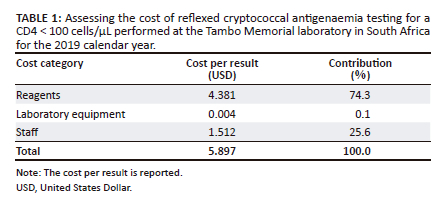
The accounting stance was as the provider of testing. An exchange rate of R14.45/$1 was assumed based on the 2019 period average reported by the International Monetary Fund.18n = 12), Sundays (testing not performed), and annual/sick leave. The nett working minutes per year were used to calculate the cost per minute. The staff cost to perform one test was multiplied by annual test volumes to determine the AEC. Reagent prices were obtained from supplier quotations. The costs reported here are for laboratory testing and exclude patient management. The consolidated health economic evaluation reporting standards were used for this costing analysis.19
Data analysis
Aggregate CD4 test volumes by result category (< 100 cells/μL, 100 cells/μL - 200 cells/μL, > 200 cells/μL) were calculated. The CrAg detection rate for a count < 100 cells/μL was determined. For a count between 100 cells/μL and 200 cells/μL, a CrAg detection rate of 2% was assumed based on local and published data.14,20,21 Based on the costing analysis, the national AEC for reflexed CrAg testing for a count < 100 cells/μL, and 100 cells/μL to 200 cells/μL, was extrapolated. A one-way sensitivity analysis was conducted to assess the cost to find one case based on varying CrAg detection rates (1% - 8%) for a count of 100 cells/μL to 200 cells/μL. The Western Cape province recently commenced offering CrAg testing for a count of 100 cells/μL to 200 cells/μL. These data were analysed to assess the detection rate for the period between September 2022 and January 2023 to determine the cost of finding a single positive case. The average cost to find one CrAg case was also determined.
Ethical considerations
Ethical clearance was obtained from the Human Research Ethics Committee (HREC) (Medical) at the University of the Witwatersrand (M220163). Specimen-level data were extracted without any patient identifiers. Patient consent was not required as secondary laboratory data were used.
Results
Data are reported for 2 875 719 CD4 tests, of which 283 240 (9.8%) reported a count of < 100 cells/μL, and 300 624 (10.5%) a count of 100 cells/μL to 200 cells/μL. For 2019, the CrAg detection rate for reflexed testing was 6.2% nationally (ranging from 5.5% to 7.5% by month).
Costing analysis
A cost per result of $5.897 was reported for reflexed CrAg testing for a count < 100 cells/μL at the Tambo Memorial laboratory (Table 1). This was based on annual CrAg test volumes of 283 240 for 2019. Due to the similar national test volumes for a count of < 100 cells/μL and 100 cells/μL to 200 cells/μL, the same cost per result was used.
National cost analysis
An AEC of $1 670 370 (< 100 cells/μL) and $1 772 890 (100 cells/μL - 200 cells/μL) was calculated. Based on the CrAg detection rates of 7% (< 100 cells/μL) and 2% (100 cells/μL - 200 cells/μL), the cost to find one case was $84.25 for < 100 cells/μL and $294.87 for 100 cells/μL to 200 cells/μL (Table 2).
One-way sensitivity analysis
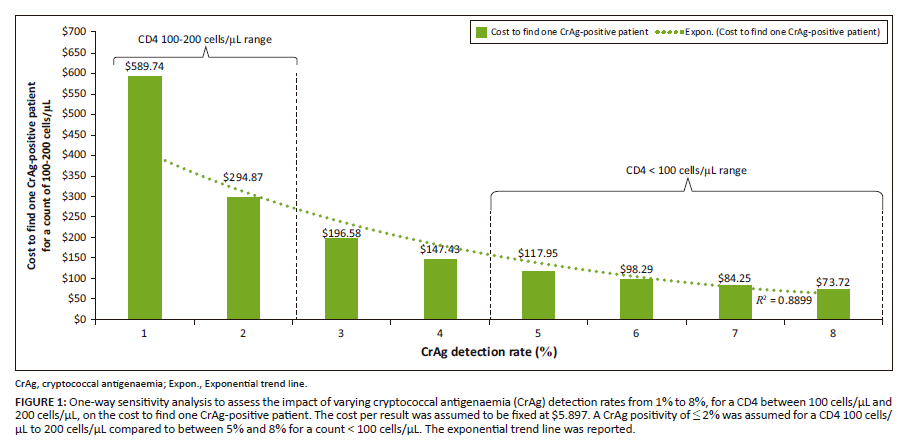
The cost to find one CrAg case ranged from $589.74 to $73.72 for a detection rate of 1% to 8%. For a CD4 of < 100 cells/μL, the cost to find one CrAg case with a detection rate of 5% was $117.95, $98.29 for 6%, and $84.25 for 7%. A detection rate of 1% to 3% would be between 7- and 2.3-fold more expensive to find a case when compared to 7% (Figure 1). For the exponential trend line, an R2
Western Cape analysis (100 cells/μL to 200 cells/μL)
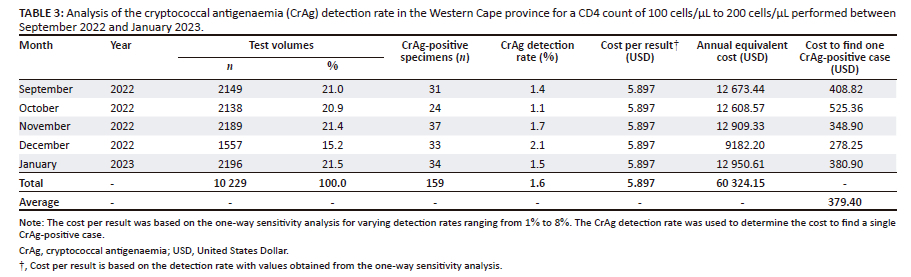
For the period September 2022 to January 2023, the percentage of specimens with a count < 100 cells/μL was 15.1% of total volumes, and 100 cells/μL to 200 cells/μL, 16.2%. CrAg test volumes for CD4 100 cells/μL to 200 cells/μL performed in the Western Cape province ranged from 1557 (December 2022) to 2190 (January 2022). The overall CrAg detection rate was 1.6%, ranging from 1.1% (October 2022) to 2.1% (December 2022). In this setting, the cost to find one case ranged from $278.25 to $525.36 (Table 3). Across this period, the average cost to find one case was $379.40.
Discussion
Extending reflexed CrAg testing to a CD4 threshold of 200 cells/μL would effectively double the AEC for the national programme. The study confirmed previous work that showed a higher CrAg detection rate in PLHIV with a CD4 count < 100 cells/μL when compared to the 100 cells/μL to 200 cells/μL group.14
The Western Cape data reported a CrAg detection rate of between 1.1% and 2.1% for a count between 100 cells/μL and 200 cells/μL. The one-way sensitivity analysis revealed that higher detection rates decreased the cost to find one CrAg-positive case, with an 8-fold change from 1% to 8%. Significantly higher costs per positive CrAg outcome were reported for a CrAg detection rate of 1% to 4% when compared to > 5%, without affecting AEC. There is an almost logarithmic increase in the cost to find one CrAg-positive case with decreasing detection rates.
These findings indicate that a national prevalence study would be of value to better determine the CrAg detection rate for a count of 100 cells/μL to 200 cells/μL. A local unpublished survey reported that the overall CrAg prevalence for all patients with a CD4 count of < 200 cells/μL was 4.6%, compared to 6.8% for < 100 cells/μL and 2.4% for 100 cells/μL to 200 cells/μL.20
A systematic review of 60 studies reported that the pooled prevalence of CrAg was 6.5% (95% confidence interval [CI]: 5.7% - 7.3%) for a CD4 count of ≤ 100 cells/μL versus 2.0% (95% CI: 1.2% - 2.7%) for a count of 101 cells/μL to 200 cells/μL.14142223
As the study did not conduct a cost-effectiveness analysis, it would be difficult to assess whether extending CrAg screening to a CD4 threshold of 200 cells/μL would result in the reduction of disability-adjusted life years saved. The post-diagnostic costs associated with treatment have not been factored into this study. These would include pre-emptive treatment to avoid hospitalisation, hospital costs, and post-hospital costs.924
Extending reflexed testing to a CD4 threshold of 200 cells/μL would also double the current workload, requiring careful planning as additional staff may need to be employed for both the pre-analytical and analytical phases within the laboratory. The current LFA assay is a manual test method with staff contributing over one-quarter of the cost per result. Doubling reflexed CrAg test volumes may require the need to migrate testing to a more automated platform, such as enzyme-linked immunosorbent assay (ELISA).25
Limitations
A limitation of this study is that only specimen-level data for reflexed CrAg testing were used, which excluded provider-initiated testing. Furthermore, data are only reported for reflexed CrAg testing, which is in line with local guidelines.26
In addition, the clinical aspects related to extending CrAg screening to a threshold of 200 cells/μL were not considered. The availability of public sector budgets to incorporate the additional costs into the national HIV and AIDS conditional grant was not considered.27
Conclusion
The study findings reveal that extending reflexed CrAg testing to a threshold of 200 cells/μL would double the AEC while finding fewer cases in the extended testing category eligible for antifungal treatment. A local prevalence study is required to provide the necessary evidence to conduct a cost-effectiveness analysis.
Competing interests
The authors declare that they have no financial or personal relationships that may have inappropriately influenced them in writing this article.
Authors' contributions
D.K.G., M.P.d.S. and W.S.S. supervised the study. N.C. developed the methodology, analysed data and prepared the first draft of the article. L.-M.C. and M.P.d.S. provided editorial comments and technical input. All authors contributed to the manuscript.
Funding information
This work was supported by the Wits Diagnostic Innovation Hub.
Data availability
The authors do not have permission to share the CrAg data.
Disclaimer
The views and opinions expressed in this article are those of the authors and are the product of professional research. It does not necessarily reflect the official policy or position of any affiliated institution, funder, agency, or that of the publisher. The authors are responsible for this article's results, findings, and content.
Acknowledgements
The authors would like to thank all CD4 laboratory staff for providing CrAg testing.
References
-
1. National Health Laboratory Service (NHLS). Annual report 2019/20 [homepage on the Internet]. Johannesburg: National Health Laboratory Service (NHLS); 2020 [cited 2022 Feb 15]. Available from: https://www.nhls.ac.za/wp-content/uploads/2021/03/NHLS_AR_2020_25_Nov.pdf
» https://www.nhls.ac.za/wp-content/uploads/2021/03/NHLS_AR_2020_25_Nov.pdf -
2. National Department of Health (NDOH). 2019 ART clinical guidelines for the management of HIV in adults, pregnancy, adolescents, children, infants and neonates [homepage on the Internet]. 2019 [cited 2022 Aug 12]. Available from: https://www.knowledgehub.org.za/system/files/elibdownloads/2020-05/2019%20ART%20Guideline%2028042020%20pdf.pdf
» https://www.knowledgehub.org.za/system/files/elibdownloads/2020-05/2019%20ART%20Guideline%2028042020%20pdf.pdf -
3. National Department of Health (NDOH). The South African antiretroviral treatment guidelines [homepage on the Internet]. 2013 [cited 2022 Aug 12]. Available from: https://sahivsoc.org/Files/2013%20ART%20Treatment%20Guidelines%20Final%2025%20March%202013%20corrected.pdf
» https://sahivsoc.org/Files/2013%20ART%20Treatment%20Guidelines%20Final%2025%20March%202013%20corrected.pdf -
4. World Health Organization (WHO). Progress report 2016: Prevent HIV, test and treat all: WHO support for country impact [homepage on the Internet]. 2016 [cited 2022 Aug 12]. Available from: https://apps.who.int/iris/bitstream/handle/10665/251713/WHO-HIV-2016.24-eng.pdf
» https://apps.who.int/iris/bitstream/handle/10665/251713/WHO-HIV-2016.24-eng.pdf -
5. National Department of Health (NDOH). ART clinical guidelines for the management of HIV in adults, pregnancy and breastfeeding, adolescents, children, infants and neonates [homepage on the Internet]. Pretoria: National Department of Health (NDOH); 2023 [cited 2024 Jan 18]. Available from: https://knowledgehub.health.gov.za/system/files/elibdownloads/2023-07/National%20ART%20Clinical%20Guideline%20AR%204.5%2020230713%20Version%204%20WEB.pdf
» https://knowledgehub.health.gov.za/system/files/elibdownloads/2023-07/National%20ART%20Clinical%20Guideline%20AR%204.5%2020230713%20Version%204%20WEB.pdf -
6. Southern African HIV Clinicians Society. Guidelines for the prevention, diagnosis and management of cryptococcal meningitis and disseminated cryptococcosis in HIV-infected patients [homepage on the Internet]. 2007 [cited 2022 Dec 22]. Available from: https://sahivsoc.org/Files/Guidelines%20for%20the%20Prevention,%20Diagnosis%20and%20management%20of%20cryptococcal%20meningitis%20and%20disseminated%20crytococcosis%20in%20HIV%20infected%20patients.pdf
» https://sahivsoc.org/Files/Guidelines%20for%20the%20Prevention,%20Diagnosis%20and%20management%20of%20cryptococcal%20meningitis%20and%20disseminated%20crytococcosis%20in%20HIV%20infected%20patients.pdf -
7. Govender NP, Chetty V, Roy M, et al. Phased implementation of screening for cryptococcal disease in South Africa. S Afr Med J. 2012;102(12):4. https://doi.org/10.7196/SAMJ.6228
» https://doi.org/10.7196/SAMJ.6228 -
8. Vallabhaneni S, Longley N, Smith M, et al. Implementation and operational research: Evaluation of a public-sector, provider-initiated cryptococcal antigen screening and treatment program, Western Cape, South Africa. J Acquir Immune Defic Syndr. 2016;72(2):e37-e42. https://doi.org/10.1097/qai.0000000000000976
» https://doi.org/10.1097/qai.0000000000000976 -
9. Larson BA, Rockers PC, Bonawitz R, et al. Screening HIV-infected patients with low CD4 counts for cryptococcal antigenemia prior to initiation of antiretroviral therapy: Cost effectiveness of alternative screening strategies in South Africa. PLoS One. 2016;11(7):e0158986. https://doi.org/10.1371/journal.pone.0158986
» https://doi.org/10.1371/journal.pone.0158986 -
10. Govender NP, Meintjes G, Mangena P, et al. Southern African HIV Clinicians Society guideline for the prevention, diagnosis and management of cryptococcal disease among HIV-infected persons: 2019 update. S Afr J HIV Med. 2019;20(1):1030. https://doi.org/10.4102/sajhivmed.v20i1.1030
» https://doi.org/10.4102/sajhivmed.v20i1.1030 -
11. World Health Organization (WHO). Rapid advice: Diagnosis, prevention and management of cryptococcal disease in HIV-infected adults, adolescents and children [homepage on the Internet]. 2011 [cited 2022 Sep 12]. Available from: https://apps.who.int/iris/bitstream/handle/10665/44786/9789241502979_eng.pdf?sequence=1
» https://apps.who.int/iris/bitstream/handle/10665/44786/9789241502979_eng.pdf?sequence=1 -
12. World Health Organization (WHO). Guidelines for the diagnosis, prevention and management of cryptococcal disease in HIV-infected adults, adolescents and children. Supplement to the 2016 consolidated guidelines on the use of antiretroviral drugs for treating and preventing HIV infection [homepage on the Internet]. 2018 [cited 2022 Aug 12]. Available from: https://apps.who.int/iris/bitstream/handle/10665/260399/9789241550277-eng.pdf?sequence=1
» https://apps.who.int/iris/bitstream/handle/10665/260399/9789241550277-eng.pdf?sequence=1 -
13. World Health Organization (WHO). Consolidated guidelines on HIV prevention, testing, treatment, service delivery and monitoring: Recommendations for a public health approach [homepage on the Internet]. 2021 [cited 2022 Aug 12]. Available from: https://iris.who.int/bitstream/handle/10665/342899/9789240031593-eng.pdf?sequence=1
» https://iris.who.int/bitstream/handle/10665/342899/9789240031593-eng.pdf?sequence=1 -
14. Ford N, Shubber Z, Jarvis JN, et al. CD4 cell count threshold for cryptococcal antigen screening of HIV-infected individuals: A systematic review and meta-analysis. Clin Infect Dis. 2018;66(suppl_2):S152-S159. https://doi.org/10.1093/cid/cix1143
» https://doi.org/10.1093/cid/cix1143 -
15. Mfinanga S, Chanda D, Kivuyo SL, et al. Cryptococcal meningitis screening and community-based early adherence support in people with advanced HIV infection starting antiretroviral therapy in Tanzania and Zambia: An open-label, randomised controlled trial. Lancet. 2015;385(9983):2173-2182. https://doi.org/10.1016/s0140-6736(15)60164-7
» https://doi.org/10.1016/s0140-6736(15)60164-7 -
16. Coetzee LM, Glencross DK. Performance verification of the new fully automated Aquios flow cytometer PanLeucogate (PLG) platform for CD4-T-lymphocyte enumeration in South Africa. PLoS One. 2017;12(11):e0187456. https://doi.org/10.1371/journal.pone.0187456
» https://doi.org/10.1371/journal.pone.0187456 -
17. National Health Laboratory Service (NHLS). National CD4 count testing programme [homepage on the Internet]. 2022 [cited 2022 Aug 18]. Available from: https://www.nhls.ac.za/priority-programmes/cd4/
» https://www.nhls.ac.za/priority-programmes/cd4/ -
18. International Monetary Fund (IMF). Exchange rates selected indicators: South Africa [homepage on the Internet]. 2022 [cited 2022 Aug 12]. Available from: https://data.imf.org/regular.aspx?key=61545850
» https://data.imf.org/regular.aspx?key=61545850 -
19. Husereau D, Drummond M, Augustovski F, et al. Consolidated Health Economic Evaluation Reporting Standards 2022 (CHEERS 2022) statement: Updated reporting guidance for health economic evaluations. BMC Health Serv Res. 2022;22(1):114. https://doi.org/10.1186/s12913-021-07460-7
» https://doi.org/10.1186/s12913-021-07460-7 -
20. Greene G, Coetzee L, Mwamba M, et al. A cross-sectional survey to determine the prevalence of antigenaemia and utility of additional reflex cryptococcal antigen screening for people with a CD4 count of 100-200 cells/μL in South Africa National Institute for Communicable Diseases (NICD) [homepage on the Internet]. 2021 [updated 2021 Aug 31; cited 2024 Mar 26]. Available from: https://www.nicd.ac.za/wp-content/uploads/2019/12/CRYPTOCOCCAL-ANTIGEN-SCREENING-SURVEILLANCE-NICD-Bulletin-Vol17-Iss3-December2019.pdf
» https://www.nicd.ac.za/wp-content/uploads/2019/12/CRYPTOCOCCAL-ANTIGEN-SCREENING-SURVEILLANCE-NICD-Bulletin-Vol17-Iss3-December2019.pdf -
21. Wake RM, Molloy SF, Jarvis JN, Harrison TS, Govender NP. Cryptococcal antigenemia in advanced human immunodeficiency virus disease: Pathophysiology, epidemiology, and clinical implications. Clin Infect Dis. 2022;76(4):764-770. https://doi.org/10.1093/cid/ciac675
» https://doi.org/10.1093/cid/ciac675 -
22. Jarvis JN, Meintjes G, Williams A, Brown Y, Crede T, Harrison TS. Adult meningitis in a setting of high HIV and TB prevalence: Findings from 4961 suspected cases. BMC Infect Dis. 2010;10(1):67. https://doi.org/10.1186/1471-2334-10-67
» https://doi.org/10.1186/1471-2334-10-67 -
23. Wykowski J, Galagan SR, Govere S, et al. Cryptococcal antigenemia is associated with meningitis or death in HIV-infected adults with CD4 100-200 cells/mm3. BMC Infect Dis. 2020;20(1):61. https://doi.org/10.1186/s12879-020-4798-1
» https://doi.org/10.1186/s12879-020-4798-1 -
24. Achoki T, Sartorius B, Watkins D, et al. Health trends, inequalities and opportunities in South Africa's provinces, 1990-2019: Findings from the Global Burden of Disease 2019 Study. J Epidemiol Community Health. 2022;76(5):471-481. https://doi.org/10.1136/jech-2021-217480
» https://doi.org/10.1136/jech-2021-217480 -
25. Moodley K, Coetzee L, Glencross D. Testing platforms for early detection of cryptococcal antigenaemia in high volume CD4 testing laboratories in South Africa. 8th International Workshop on HIV treatment, pathogenesis and prevention research in resource-poor settings; Lusaka, Zambia. 2014. Available from: https://www.researchgate.net/publication/273577376_Testing_Platforms_for_Early_Detection_of_Cryptococcal_Antigenaemia_in_High_Volume_CD4_Testing_Laboratories_in_South_Africa
» https://www.researchgate.net/publication/273577376_Testing_Platforms_for_Early_Detection_of_Cryptococcal_Antigenaemia_in_High_Volume_CD4_Testing_Laboratories_in_South_Africa -
26. National Department of Health (NDOH). ART clinical guidelines for the management of HIV in adults, pregnancy, adolescents, children, infants and neonates [homepage on the Internet]. 2019 [cited 2022 Feb 15]. Available from: https://www.knowledgehub.org.za/system/files/elibdownloads/2020-05/2019%20ART%20Guideline%2028042020%20pdf.pdf
» https://www.knowledgehub.org.za/system/files/elibdownloads/2020-05/2019%20ART%20Guideline%2028042020%20pdf.pdf - 27. Blecher MS, Kollipara A, Daven J, et al. HIV and AIDS financing in South Africa: Sustainability and fiscal space. S Afr Health Rev. 2016;2016(1):203-219.

Accepted: 14 Aug. 2024
Published: 03 Oct. 2024