
 How ready are our health systems to implement prevention of mother to child transmission Option B+?
Abstract
In January 2015, the South African National Department of Health released new consolidated guidelines for the prevention of mother to child transmission (PMTCT) of HIV, in line with the World Health Organization's (WHO) PMTCT Option B+. Implementing these guidelines should make it possible to eliminate mother to child transmission (MTCT) of HIV and improve long-term maternal and infant outcomes. The present article summarises the key recommendations of the 2015 guidelines and highlights current gaps that hinder optimal implementation; these include late antenatal booking (as a result of poor staff attitudes towards 'early bookers' and foreigners, unsuitable clinic hours, lack of transport to facilities, quota systems being applied to antenatal clients and clinic staff shortages); poor compliance with rapid HIV testing protocols; weak referral systems with inadequate follow-up; inadequate numbers of laboratory staff to handle HIV-related monitoring procedures and return of results to the correct facility; and inadequate supply chain management, leading to interrupted supplies of antiretroviral drugs. Additionally, recommendations are proposed on how to address these gaps. There is a need to evaluate the implementation of the 2015 guidelines and proactively communicate with ground-level implementers to identify operational bottlenecks, test solutions to these bottlenecks, and develop realistic implementation plans.
Introduction
Context and summary of 2015 prevention of mother to child transmission guidelines
South Africa has the highest HIV incidence rates globally, and is the largest provider of antiretroviral therapy in the world.1,233Box 1 summarises the main differences between the 2015343,43


Health systems' readiness to implement the new guidelines
System gaps that may hinder successful implementation of the 2015 South African prevention of mother to child transmission guidelines
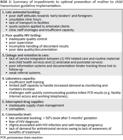
In our opinion, there are five main requirements for successful implementation of the 2015 PMTCT guidelines: (1) early presentation at the health facility to access care (i.e. early antenatal booking), (2) universal antenatal HIV testing based on high-quality standardised operating procedures, with repeat testing of HIV-negative women, (3) immediate referral into appropriate care and retention in care, (4) adequate coverage of appropriate laboratory systems and (5) uninterrupted drug supplies. These require appropriate actions within the health system and amongst sufficiently informed and empowered individual mother-infant pairs. Box 2 presents a summary of the main health system and community gaps in optimal implementation of the 2015 PMTCT guidelines; these are explained in more detail below.
Late antenatal booking
Since 2001, South Africa has improved access to antenatal care, HIV testing and ART provision for pregnant women. Currently, antenatal care uptake is over 95%; HIV testing is offered by over 95% of health facilities, and more than 87% of HIV-positive pregnant women receive some form of ART.3,566773
Late HIV testing and poor quality HIV testing
There are grave concerns about quality control of HIV counselling and testing (HCT) at facilities, as shown by a study conducted in 455 sites (primary health care clinics, community healthcare centres and hospital gateway clinics) in Limpopo Province (Adrian Puren, personal communication, 11 March 2015). Poor quality control increases the risk of false-positive and -negative HIV results within the PMTCT programme. Concerns identified included inadequate training, frequent rotation of staff, lack of supervision and on-site quality control, incorrect storage of control samples, poor adherence to standard operating procedures (SOP) and improper stock control (Adrian Puren, personal communication, 11 March 2015). Anecdotal information gathered during healthcare provider (HCP) PMTCT guideline training found that HCPs are not waiting the required time before reading the HIV result, increasing the risk of false-negatives.
Late referral into care and poor retention in care
Appropriate, timely referrals and linkages to care are needed antenatally and post delivery to facilitate uptake of and retention in care. Over 90% of facilities assessed during a national South African Medical Research Council (SAMRC) review conducted in 2010 had a referral system for infant and adult ART clients.5859
Limited laboratory capacity
Laboratory capacity is needed for (1) viral load monitoring to identify poor adherence and treatment failure - a vitally important step in PMTCT programme success, (2) CD4 cell count to identify women who need cryptococcal antigen screening or cotrimoxazole prophylaxis, (3) routine antenatal bloods for ART toxicity monitoring and (4) repeated polymerase chain reaction (PCR) testing of HIV-exposed infants from birth (for symptomatic infants) to 18 months;31010
Interrupted drug supplies
By mid-2014, an estimated 2.6 million people were on ART in South Africa.31112
Recommendations
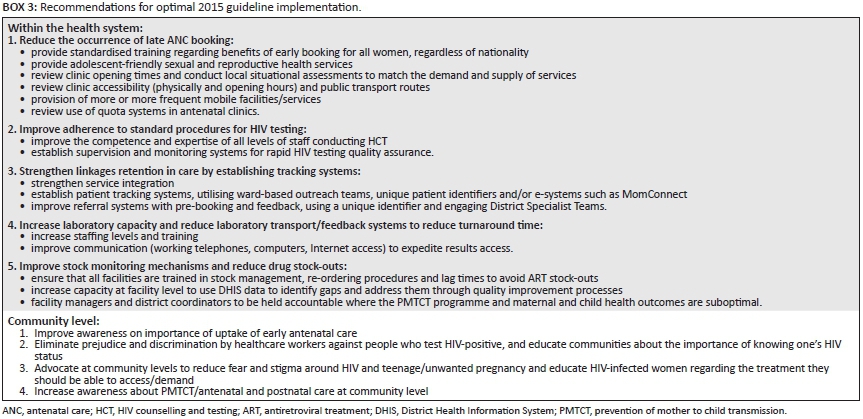
In light of the gaps identified above, we make several recommendations for optimal 2015 guideline implementation (Box 3).
Conclusion
The January 2015 PMTCT guideline recommendations are of a very high standard and based on the best intentions to improve the management of both HIV-positive and HIV-negative women. By implementing these guidelines, it should be possible to eliminate MTCT, improve maternal and infant outcomes, and ensure that women remain virologically suppressed and engaged in lifelong ART care. However, the implementation challenges might have been underestimated. Evaluation of the implementation process is needed to identify key bottlenecks and develop realistic implementation plans. A proactive process of communicating with ground-level implementers is needed to understand their challenges and to address these through well recognised, quality improvement processes.
Competing interests
The authors declare that they have no financial or personal relationships which may have inappropriately influenced them in writing this article.
Authors' contributions
P.N. (South African Medical Research Council) conceptualised and designed, drafted, wrote and finalised the article. N.D. (Wits Reproductive Health and HIV Institute) designed, contributed to and assisted with finalisation of the article. G.S. (National Institute for Communicable Diseases); S.B. (The United Nations Children's Fund) and V.R. (South African Medical Research Council), N.K.N. (South African Medical Research Council), T.R. (South African Medical Research Council), N.N. (South African Medical Research Council), V.M. (South African Medical Research Council), Y.S. (South African Medical Research Council) and D.N. (South African Medical Research Council) reviewed, commented on and approved the final version of the article. A.E.G. (South African Medical Research Council) conceptualised and designed, contributed to and assisted with finalisation of the article.
Acknowledgements
Our sincere thanks to Professor Adrian Puren from the National Institute of Communicable Diseases for help with data on the Internal Quality Control (IQC) Implementation Report in Limpopo (April 2014). This work was supported by funds from the South African Medical Research Council.
References
-
1. Human Sciences Research Council. Launch of the 2012 South African national HIV prevalence, incidence and behaviour survey report. April 2014 [cited 2015 Mar 02]. Available from http://www.hsrc.ac.za/en/media-briefs/hiv-aids-stis-and-tb/sabssm4-launch. Full report available from http://www.hsrc.ac.za/uploads/pageContent/4565/SABSSM%20IV%20LEO%20final.pdf
» http://www.hsrc.ac.za/en/media-briefs/hiv-aids-stis-and-tb/sabssm4-launch -
2. UNAIDS. Report of the global AIDS epidemic 2013 [cited 2015 Mar 02]. Available from http://www.unaids.org/sites/default/files/en/media/unaids/contentassets/documents/epidemiology/ 2013/gr2013/UNAIDS_Global_Report_2013_en.pdf
» http://www.unaids.org/sites/default/files/en/media/unaids/contentassets/documents/epidemiology/ 2013/gr2013/UNAIDS_Global_Report_2013_en.pdf -
3. South African National Department of Health. 2014 [cited 2015 Mar 02]. National consolidated guidelines for the prevention of mother-to-child transmission of HIV (PMTCT) and the management of HIV in children, adolescents and adults. Available from http://www.sahivsoc.org/upload/documents/HIV%20guidelines%20_Jan%202015.pdf
» http://www.sahivsoc.org/upload/documents/HIV%20guidelines%20_Jan%202015.pdf -
4. South African antiretroviral treatment guidelines 2013. PMTCT guidelines: Revised March 2013 [cited 2015 Aug 27]. Available from http://www.sahivsoc.org/upload/documents/2013%20ART%20Guidelines-Short%20Combined%20FINAL%20draft%20guidelines%2014%20March%202013.pdf
» http://www.sahivsoc.org/upload/documents/2013%20ART%20Guidelines-Short%20Combined%20FINAL%20draft%20guidelines%2014%20March%202013.pdf -
5. Goga AE, Dinh TH, Jackson DJ for the SAPMTCTE study group. Early (4-8 weeks post-delivery) population-level effectiveness of WHO PMTCT Option A, South Africa, 2011. South African Medical Research Council, National Department of Health of South Africa and PEPFAR/US Centers for Disease Control and Prevention. 2013 [cited 2015 Mar 12]. Available from http://www.mrc.ac.za/healthsystems/SAPMTCTE2011.pdf
» http://www.mrc.ac.za/healthsystems/SAPMTCTE2011.pdf -
6. District Health Barometer 2011/2012. Durban: Health Systems Trust; 2013 [cited 2015 Apr 02]. Available from http://www.health-e.org.za/wp-content/uploads/2013/04/DHB2011_12lowres.pdf
» http://www.health-e.org.za/wp-content/uploads/2013/04/DHB2011_12lowres.pdf -
7. Solarin I, Black V. 'They told me to come back': Women's antenatal care booking experience in inner-city Johannesburg. Matern Child Health J. 2013;17:359-367. PMID: 22527767, http://dx.doi.org/10.1007/s10995-012-1019-6
» http://dx.doi.org/10.1007/s10995-012-1019-6 - 8. Rispel LC, Peltzer K, Phaswana-Mafuya N, Metcalf CA, Treger L. Assessing missed opportunities for the prevention of mother-to-child HIV transmission in an Eastern Cape local service area. S Afr Med J. 2009;99:174-179. PMID: 19563095
-
9. Tenthani L, Haas AD, Tweya H, et al. Retention in care under universal antiretroviral therapy for HIV-infected pregnant and breastfeeding women ('Option B+') in Malawi. AIDS. 2014;28:589-598. PMID: 24468999, http://dx.doi.org/10.1097/QAD.0000000000000143
» http://dx.doi.org/10.1097/QAD.0000000000000143 -
10. Stevens WS, Marshall TM. Challenges in implementing HIV load testing in South Africa. J Infect Dis. 2010;201(suppl. 1):S78-S84. PMID: 20225952, http://dx.doi.org/10.1086/650383
» http://dx.doi.org/10.1086/650383 -
11. Bateman C. Drug stock-outs: Inept supply-chain management and corruption. S Afr Med J. 2013;103:600-602. PMID: 24344422, http://dx.doi.org/10.7196/samj.7332
» http://dx.doi.org/10.7196/samj.7332 -
12. Pasquet A, Messou E, Gabillard D, et al. Impact of drug stock-outs on death and retention to care among HIV-infected patients on combination antiretroviral therapy in Abidjan, Côte d'Ivoire. PLoS ONE. 2010;5:e13414. PMID: 20976211, http://dx.doi.org/10.1371/journal.pone.0013414
» http://dx.doi.org/10.1371/journal.pone.0013414
Palesa Nkomo
Private Bag X385
Pretoria 0002
South Africa
Email: palesa.nkomo@mrc.ac.za
Accepted: 06 Aug. 2015
Published: 07 Oct. 2015
