A prospective study of demographic features and quality of life in HIV-positive women with cervical cancer treated at Tygerberg Hospital
Abstract
BACKGROUND: Cervical cancer and human immunodeficiency virus (HIV) infection/acquired immune deficiency syndrome (AIDS) both have a high incidence in South Africa. Cervical cancer treatment of HIV-positive women poses challenges. Treatment-related changes in quality of life (QOL) of such women are important to future treatment protocols. AIM: To examine demographic data of HIV-negative and HIV-positive women at diagnosis of cervical cancer and describe their changes in QOL as a result of treatment. METHODS AND MATERIALS: All newly diagnosed patients with cervical cancer at Tygerberg Hospital were approached to participate in the study. The European Organisation for Research and Treatment of Cancer Quality of Life Core Questionnaire (EORTC QLQ-C30) and the Cervix Cancer Module (QLQ-CX24) were used. General QOL was measured with the EORTC QLQ-C30 and cervical-specific QOL with the QLQ-CX24 questionnaire. The patients completed the questionnaire at diagnosis, on completion of treatment and at 3 months' follow-up. RESULTS: The study included a total of 221 women of whom 22% were HIV-positive; the latter were younger and of higher educational level than the rest. Mean monthly income and stage distribution was similar between the two groups. HIV-positive patients underwent radiation therapy more commonly than chemoradiation. HIV-positive women showed statistically significantly higher loss to follow-up during the study. HIV-positive women experienced no improvement in insomnia, appetite loss, nausea, vomiting, diarrhoea, social role or any of the sexual domains. In contrast, HIV-negative women experienced statistically significant improvement in all sexual domains other than sexual/vaginal functioning. The QOL improvement of HIV-negative women was statistically significantly greater than their HIV-positive counterparts in the majority of QOL domains. Global health improved in both groups, with HIV-negative women experiencing greater improvement. HIV-positive women experienced an initial decline of peripheral neuropathy (PN) symptoms post treatment with a return to pretreatment values at 3 months' follow-up. The change in PN was statistically significant between the HIV-negative and HIV-positive women. CONCLUSION: Demographic differences exist between the HIV-negative and HIV-positive groups. The differential outcome in the QOL of HIV-positive and HIV-negative women treated for cervical cancer might be related to persistence of AIDS-related symptoms on completion of cervical cancer treatment.
Introduction
The quality of life (QOL) of human immunodeficiency virus (HIV)-positive women with cervical cancer is the result of both diseases and the impact of their respective treatments. Invasive cervical cancer is an acquired immune deficiency syndrome (AIDS)-defining condition (World Health Organization stage 4).1234565
A limitation of the study by Simonds et al.55
Methods and materials
Inclusion criteria
Patients referred to the Unit of Gynaecologic Oncology at Tygerberg Hospital who had newly diagnosed cervical cancer were approached to participate in the study. The unit is one of two tertiary referral units for public-sector patients in Western Cape Province. The province has a population of 5.8 million. Most (85%) of the population do not have private medical insurance and are dependent on public facilities provided by two tertiary hospitals (Tygerberg Hospital and Groote Schuur Hospital) for treatment of cervical cancer.7 8
Questionnaires
Patients completed the questionnaire in the language of their choice (isiXhosa, English or Afrikaans) after informed consent was obtained.9510119
Statistical analysis
Descriptive statistics were used to characterise the study sample in terms of the contextual factors of socio-demographic and medical variables. Data presented as medians were analysed using Kruskal-Wallis tests. Post hoc analyses were done with Fisher's least significant difference (LSD) test. Chi-square tests were used for categorical data. A p value < 0.05 was considered to be significant. Statistical analysis was performed with the use of STATISTICA version 12 software.
Results
Demographic characteristics
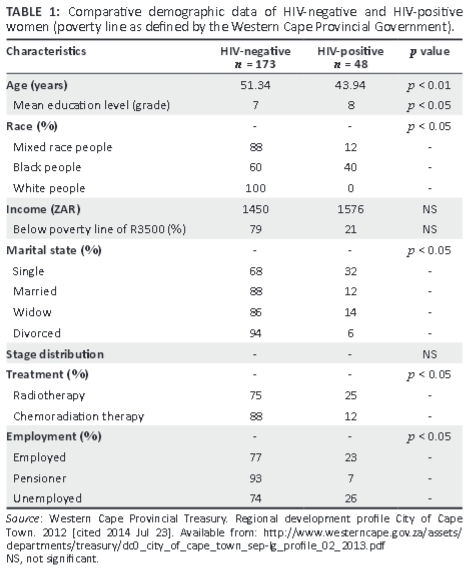
The study included a total of 221 women (Table 1). HIV-positivity of the study group was 22%. The mean age of the HIV-positive women was statistically significantly 7 years less than that of the HIV-negative women. Age had a normal distribution without any outliers. HIV-positive women had a higher educational grade. Racial distribution shows a statistically significant difference between black (40%), mixed race (12%) and white (0%) participants' HIV-positivity rates. Mean monthly income as well as the percentage of patients under the poverty line were not statistically significantly different between the HIV-positive and -negative groups. Single women had a statistically significantly higher rate of HIV-positivity than their married, widowed and divorced counterparts. The stage distribution of HIV-negative and HIV-positive cases was not statistically significantly different. HIV-positive patients underwent RT more commonly than CR.
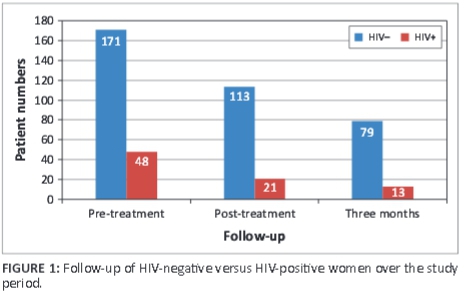
Unemployed women had a statistically significantly higher HIV-positivity rate (26%) than the employed women (23%). The loss to follow-up of HIV-positive women v. HIV-negative women during the post-treatment (56% v. 34%) and 3-month (38% v. 30%) follow-up visits was statistically significantly higher for the HIV-positive women (Figure 1). Cause and confirmation of death could be accurately determined in 20 women in the total study population.
HIV status and change in quality of life over the study period
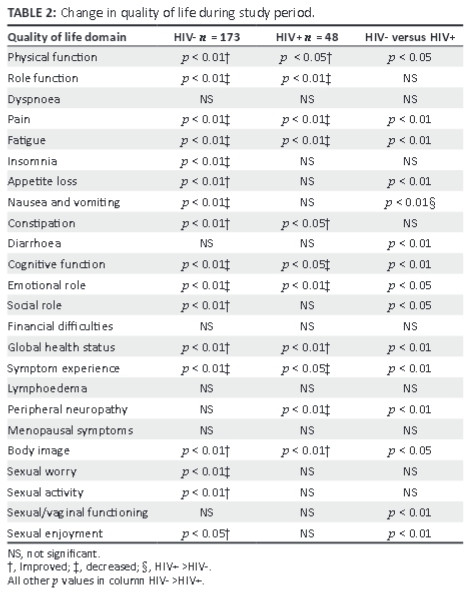
The domains of dyspnoea, financial difficulties, lymphoedema and menopausal symptoms remained unchanged during the study period. HIV-positive women experienced no improvement in insomnia, appetite loss, nausea and vomiting, diarrhoea, social role or any of the sexual domains over the study period. In contrast, HIV-negative women experienced statistically significant improvement in all sexual domains other than sexual/ vaginal function. The improvement in QOL of HIV-negative women was statistically significantly more than their HIV-positive counterparts in all domains, with the exception of role function, insomnia, constipation, sexual worry and sexual activity (Table 2). Global health improved in both groups, with HIV-negative women experiencing a greater improvement. PN did not change in HIV-negative women but HIV-positive women experienced an initial decline in this symptom at post treatment with a return to pretreatment values at the 3-month follow-up visit. The change in PN was statistically significantly different between HIV-negative and HIV-positive women.
Discussion
The results of the study show significant demographic differences between HIV-positive and HIV-negative women with a diagnosis of cervical cancer. The former group is statistically younger, and has a higher educational level and higher unemployment rate than the latter. Black women have a statistically higher HIV-positivity rate than mixed race and white women. Single women had the highest HIV-positivity rate. Monthly income is similar in both groups. RT was more frequently used than CR in HIV-positive patients. The 22% HIV-positive rate in the current study is higher than previously reported rates. This change is the result of a general change in HIV-positive rates in the total population over time.212 5,13,14 The stage distribution in the current study was similar in HIV-negative and HIV-positive women. Despite the similar stage distribution, significantly more HIV-negative than HIV-positive women received CR. The selection by the presiding clinician of the inability of HIV-positive women to tolerate the chemotherapy because of low CD4 counts, gave rise to this difference.
The majority of QOL domains in HIV-negative women improved with treatment with prolonged effect up to 3 months' follow-up. Improvement of QOL domains in HIV-positive women was statistically less than in HIV-negative women. PN domain did not change in HIV-negative women. In HIV-positive women, initial improvement occurred in PN with relapse to pretreatment level at 3 months. Appetite loss in HIV-positive women initially improved after treatment and returned to pretreatment levels at 3 months' follow-up. HIV-negative women showed an improvement in appetite loss up to 3 months' follow-up. The QOL of HIV-negative women significantly improved in the majority of domains. HIV-positive women had fewer domains improved by treatment, and the magnitude of improvement was less than that amongst HIV-negative women. Temporary improvement of pain, fatigue and appetite loss after treatment in HIV-positive women reverted to pretreatment levels at 3 months' follow-up. Pain and fatigue are AIDS-related conditions that are prevalent in AIDS patients, despite adequate treatment. Depression is associated with these symptoms, and the difference in emotional functioning in the current study underlines the element of depression in the HIV-positive women.1516217
In the present study, higher rates of loss to follow-up occurred in HIV-positive women. A meta-analysis of sub-Saharan low- and middle-income countries' antiretroviral treatment programmes reports on causes of loss to follow-up. Self-transferring care to other facilities (18.6%), unreported death (38.8%) and stopping treatment were identified as the major reasons for loss to follow-up.18
WHO AIDS stage 3 and 4 cases have a mortality rate of 72.12 per 100 person-years in the first 6 months after initiation of treatment. The mortality rate decreases to 7.9 per 100 person-years after 12 months.1912201821
Limitations of the present study include a short follow-up subsequent to completion of therapy. The short follow-up limits the conclusion to long-term effects of treatment. Prolonged follow-up may reveal an increased incidence of PN. The higher loss to follow-up rate of HIV-positive women during the study period precludes sub-analysis of smaller groups, for example treatment-related PN in those women undergoing CR.
In conclusion, the study documents the demographic difference in HIV-negative and HIV-positive women with cervical cancer with regard to a younger age in the latter group. The 5-year survival benefit of CR in comparison with RT in HIV-negative women with stage III to IVA is a statistically non-significant 3%.65
Competing interests
The authors declare that they have no financial or personal relationships which may have inappropriately influenced them in writing this article.
Authors' contributions
G.d.T. (Stellenbosch University) was the project leader and designed the study, wrote the protocol, collected the data and wrote the paper. M.K. (Stellenbosch University) performed the statistical analysis and contributed to discussions. Both authors read and approved the manuscript.
Acknowledgements
The research forms part of a PhD thesis (GCDT) with promotor Prof. T.F. Kruger, Department of Obstetrics and Gynaecology, Stellenbosch University. The members of the Unit of Gynaecological Oncology, Tygerberg Hospital and the head of the unit, Prof. M.H. Botha, are acknowledged for their assistance.
References
- 1. Black J, Conradie F, Cox V, et al. Adult antiretroviral therapy guidelines 2014 by the Southern African HIV Clinicians Society. S Afr J HIV Med. 2014;15:121-143.
- 2. Shisana O, Rehle T, Simbayi LC, et al. South African national HIV prevalence, incidence and behaviour survey, 2012. Cape Town: HSRC Press; 2014.
-
3. Arbyn M, Castellsague X, de Sanjose S, et al. Worldwide burden of cervical cancer in 2008. Ann Oncol. 2011;22:2675-2686. PMID: 21471563, http://dx.doi.org/10.1093/annonc/mdr015
» http://dx.doi.org/10.1093/annonc/mdr015 -
4. Wadley AL, Cherry CL, Price P, Kamerman PR. HIV neuropathy risk factors and symptom characterization in stavudine-exposed South Africans. J Pain Symptom Manage. 2011;41:700-706. http://dx.doi.org/10.1016/j.jpainsymman.2010.07.006
» http://dx.doi.org/10.1016/j.jpainsymman.2010.07.006 -
5. Simonds HM, Wright JD, du Toit N, Neugut AI, Jacobson JS. Completion of and early response to chemoradiation among human immunodeficiency virus (HIV)- positive and HIV-negative patients with locally advanced cervical carcinoma in South Africa. Cancer. 2012;118:2971-2979. PMID: 22072021, http://dx.doi.org/10.1002/cncr.26639
» http://dx.doi.org/10.1002/cncr.26639 -
6. Chemoradiotherapy for Cervical Cancer Meta-analysis Collaboration (CCCMAC). Reducing uncertainties about the effects of chemoradiotherapy for cervical cancer: Individual patient data meta-analysis. Cochrane Database Syst Rev. 2010;Issue 1. Art. No.: CD008285. PMID: 20091664, http://dx.doi.org/10.1002/14651858.CD008285
» http://dx.doi.org/10.1002/14651858.CD008285 -
7. Western Cape Provincial Treasury. Regional development profile City of Cape Town. 2012 [cited 2014 Jul 23]. Available from: http://www.westerncape.gov.za/assets/departments/treasury/dc0_city_of_cape_town_sep-lg_profile_02_2013.pdf
» http://www.westerncape.gov.za/assets/departments/treasury/dc0_city_of_cape_town_sep-lg_profile_02_2013.pdf -
8. Pecorelli S. Revised FIGO staging for carcinoma of the vulva, cervix, and endometrium. Int J Gynaecol Obstet. 2009;105:103-104. PMID: 19367689, http://dx.doi.org/10.1016/j.ijgo.2009.02.012
» http://dx.doi.org/10.1016/j.ijgo.2009.02.012 - 9. Du Toit GC, Nel D. Translation and validation of European Organisation for Research and Treatment of Cancer QLQ-CX24 questionnaire into the indigenous African languages of isiXhosa and Afrikaans. S Afr J Gynecol Oncol. 2012;4:59-62.
- 10. Aaronson NK, Ahmedzai S, Bergman B, et al. The European Organization for Research and Treatment of Cancer QLQ-C30: A quality-of-life instrument for use in international clinical trials in oncology. J Natl Cancer Inst. 1993;85:365-376. PMID: 8433390.
- 11. Greimel ER, Kuljanic Vlasic K, Waldenstrom AC, et al. The European Organization for Research and Treatment of Cancer (EORTC) Quality-of-Life questionnaire cervical cancer module: EORTC QLQ-CX24. Cancer. 2006;107:1812-1822. PMID: 16977652.
- 12. Du Toit GC, Smit BJ. Clinical prognostic parameters in stage III cervical carcinoma: An analysis of 732 patients. S Afr Med J. 1997;87:l434-I440.
-
13. Lomalisa P, Smith T, Guidozzi F. Human immunodeficiency virus infection and invasive cervical cancer in South Africa. Gynecol Oncol. 2000;77:460-463. PMID: 10831360, http://dx.doi.org/10.1006/gyno.2000.5775
» http://dx.doi.org/10.1006/gyno.2000.5775 -
14. Moodley M, Mould S. Invasive cervical cancer and human immunodeficiency virus (HIV) infection in KwaZulu-Natal, South Africa. J Obstet Gynaecol. 2005;25:706-710. PMID: 16263548, http://dx.doi.org/10.1080/01443610500294599
» http://dx.doi.org/10.1080/01443610500294599 - 15. Matilda B, Streinu-Cercel A, Mariana M, et al. Fatigue in Hiv/Aids patients. Ther Pharmacol Clin Toxicol. 2012;16:111-115.
-
16. Feasey NA, Healey P, Gordon MA. Review article: The aetiology, investigation and management of diarrhoea in the HIV-positive patient. Aliment Pharmacol Ther. 2011;34:587-603. PMID: 21777262, http://dx.doi.org/10.1111/j.1365-2036.2011.04781.x
» http://dx.doi.org/10.1111/j.1365-2036.2011.04781.x -
17. Grisold W, Cavaletti G, Windebank AJ. Peripheral neuropathies from chemotherapeutics and targeted agents: Diagnosis, treatment, and prevention. Neuro Oncol. 2012;14(Suppl 4):iv45-54. PMID: 23095830, http://dx.doi.org/10.1093/neuonc/nos203
» http://dx.doi.org/10.1093/neuonc/nos203 -
18. Wilkinson LS, Skordis-Worrall J, Ajose O, Ford N. Self-transfer and mortality amongst adults lost to follow-up in ART programmes in low- and middle-income countries: Systematic review and meta-analysis. Trop Med Int Health. 2015;20:365-379. PMID: 25418366, http://dx.doi.org/10.1111/tmi.12434
» http://dx.doi.org/10.1111/tmi.12434 -
19. Wubshet M, Berhane Y, Worku A, Kebede Y. Death and seeking alternative therapy largely accounted for lost to follow-up of patients on ART in northwest Ethiopia: A community tracking survey. PLoS One. 2013;8:e59197. PMID: 23527132, http://dx.doi.org/10.1371/journal.pone.0059197
» http://dx.doi.org/10.1371/journal.pone.0059197 -
20. Maranga IO, Hampson L, Oliver AW, et al. Analysis of factors contributing to the low survival of cervical cancer patients undergoing radiotherapy in Kenya. PLoS One. 2013;8:e78411. PMID: 24205226, http://dx.doi.org/10.1371/journal.pone.0078411
» http://dx.doi.org/10.1371/journal.pone.0078411 -
21. Birnbaum JK, Murray CJL, Lozanoa R. Exposing misclassified HIV/AIDS deaths in South Africa. Bull World Health Organ. 2011;89:278-285. PMID: 21479092, http://dx.doi.org/10.2471/BLT.11.086280
» http://dx.doi.org/10.2471/BLT.11.086280

Accepted: 06 Aug. 2015
Published: 18 Sept. 2015