Healthcare worker compliance with cervical cancer screening guidelines. An audit at district and regional level of care in the Pietermaritzburg Metropolitan area of KwaZulu-Natal
Abstract
BACKGROUND: In South Africa (SA) there are screening guidelines for cervical cancer in women living with HIV (WLWH). To our knowledge there is lack of data concerning the knowledge of health care workers (HCWs) about cervical cancer screening guidelines before the initiation of antiretroviral therapy (ART) in WLWH. OBJECTIVES: To investigate the knowledge and familiarity of HCWs regarding cervical cancer screening guidelines in WLWH. METHODS: A cross-sectional questionnaire-based study exploring compliance with cervical cancer screening guidelines before initiating ART was conducted with 85 HCWs in the antiretroviral (ARV) clinics of a district and regional hospitals in KwaZulu-Natal, SA. Data were analysed using Stata V13 and a p-value of ≤ 0.05 was considered statistically significant. RESULTS: Eighty-five HCWs were included in the study. Health care workers' responses to knowledge about cervical cancer screening in WLWH were suboptimal and revealed significant gaps. Most HCWs did not know the screening intervals of WLWH. Statistically significant associations were found between an HCW's occupation and responses to the Likert scale questions. CONCLUSION: Although the majority of HCWs were familiar with cervical cancer screening guidelines in WLWH, the study highlights that there are deficiencies in both knowledge and practice. Creating awareness among HCWs regarding the current methods of cervical cancer screening is a necessary to reduce morbidity and mortality from cervical cancer in WLWH.
questionnaire; Likert scale; healthcare worker; cervical cancer; HIV; guidelines
Introduction
The 'dual epidemics' of the human immunodeficiency virus (HIV) and cervical cancer have been responsible for the premature deaths of thousands of women in resource-constrained countries (RCCs).123456
Cervical screening is most effective when undertaken within an organised programme. In RCCs, including SA, screening rates and subsequent follow-up care remain suboptimal. Screening rates as low as 1% have been reported.7
Methodology
This study was a cross-sectional questionnaire-based descriptive survey of 85 HCWs in ART clinics in the Pietermaritzburg Metropolitan area of KwaZulu-Natal province, SA. The study population was stratified by profession into three groups: interns, medical officers and professional nurses. The cohort was recruited from staff members attached to the antiretroviral (ARV) clinics of the Northdale (District) and Edendale (Regional) hospitals. The study participants were randomly selected from each group. A survey cover sheet explaining the purpose of the study was attached to the questionnaire and was signed by those who completed the questionnaire. To ensure anonymity and confidentiality, personal-subject identifiers were not used in the questionnaire itself. The principal investigator enrolled only participants who willingly and voluntarily filled in and returned the questionnaire.
Data collection
A structured and pretested, self-administered questionnaire was used for data collection. The collected data were checked for completeness and consistency by the principal investigator and the supervisor. Concerning the guidelines, experts in research methodology, obstetrics and gynaecology, and oncology confirmed the validity of the questionnaire before the pilot study commenced. The instrument was pretested on 10 study participants working in other health facilities who were not part of the actual study. Findings from the pre-test were used to modify the instrument and clarify the questions. The questionnaire was divided into two parts: the first part dealt with the socio-demographic profile and professional status of the respondents and the second part dealt with knowledge about the practice of cervical cancer screening in WLWH before initiating ART. The questionnaire was written in English.
Healthcare workers' responses were assessed by asking them to rate each of the following statements on a five-point Likert scale:
•All WLWH must have a yearly pap smear.
•A pap smear must be done at the age of 21 years irrespective of HIV status.
•A pap smear in WLWH is only done after the age of 30 years.
•Cervical cancer screening in WLWH can be done anytime.
•Cervical cancer screening in WLWH can only be done after 3 years of initiating ART.
•If the results come back with high-grade squamous intraepithelial lesion (HSIL), the patient must repeat the pap smear.
•If the results come back with persistent low-grade squamous intraepithelial lesion (LSIL), keep the patient at the clinic without any further action.
•The incidence of cervical cancer in our population is very high.
Healthcare workers were asked to choose one of the following options for each of the statements listed above: 'strongly agree', 'agree', 'neither agree nor disagree', 'disagree' or 'strongly disagree'. For ease of interpreting and presenting results, responses for 'strongly agree' and 'agree' and for 'disagree' and 'strongly disagree' were combined. Participants' practices were assessed by asking specific questions about practices regarding cervical cancer screening.
Statistical analysis
A descriptive analysis of the HCW's demographic characteristics is presented. Frequencies and percentages were used to summarise categorical variables, such as the type of HCWs. Frequency distributions of numeric variables, such as age and years of experience, were examined for normality and means or medians used as appropriate. The outcome of the study was a knowledge score composed of the sum of the responses of each HCW to the questions posed and measured on the Likert scale. Subgroups were assessed by age, type of HCW and experience (years) and were compared with responses to individual questions, and an overall score was determined using the Chi-square test. Data were analysed using Stata V13 and a p-value of < 0.05 was considered statistically significant.
Ethical consideration
Ethical clearance was obtained from the Biomedical Research Ethics Committee, the University of Natal (BE: 572/18), Department of Health and the various institutions before commencing the study. All participants provided written informed consent before enrolment.
Results
Eighty-five HCWs were interviewed and enrolled in the study.
Demographic characteristics and professional standing of participants
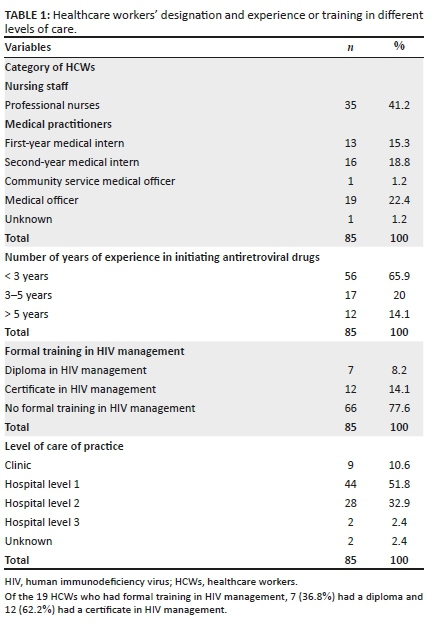
The majority of the HCWs were 35 years old or younger (60%), women (71.8%) and black people (52.9%). Professional nurses and medical officers accounted for 41.2% and 22.1% of the HCWs, respectively. A total of 66% of the HCWs had less than 3 years' experience in the initiation of ARV drugs and only 19 (22.4%) had formal training in HIV management. A total of 51.8% of the HCWs practised at a district hospital (Northdale), whereas the other half practised at the regional hospital (Edendale) (Table 1). Of the 19 HCWs who had formal training in HIV management, 7 (36.8%) had a diploma and 12 (62.2%) had a certificate in HIV management.
Awareness of cervical cancer screening guidelines and local protocols
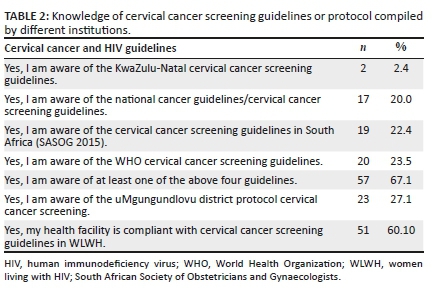
Only two (2.4%) of the HCWs were aware of the KwaZulu-Natal cervical cancer screening guidelines, and 20 (23.5%) were aware of the World Health Organization (WHO) cervical cancer screening guidelines. Fifty-one (60%) of the HCWs considered that the guidelines on screening WLWH provided by their health facilities were adequate (Table 2).
Twenty-three (27.1%) HCWs were aware of the uMgungundlovu district protocol on cervical cancer screening, of which 19 were professional nurses. Fifty-one (60.0%) HCWs felt that patients who had abnormal pap smear results should be referred for colposcopy (33 professional nurses and 17 medical officers), and 76 (89.4%) participants believed that the health facilities where they were currently working were compliant with the cervical cancer screening programme for HIV-positive patients. Only two (2.4%) participants (one first-year medical intern and one medical officer) were aware of more than one set of cervical cancer screening guidelines. The KwaZulu-Natal guidelines were the least known of all screening protocols.
The knowledge and the implementation of cervical cancer screening guidelines
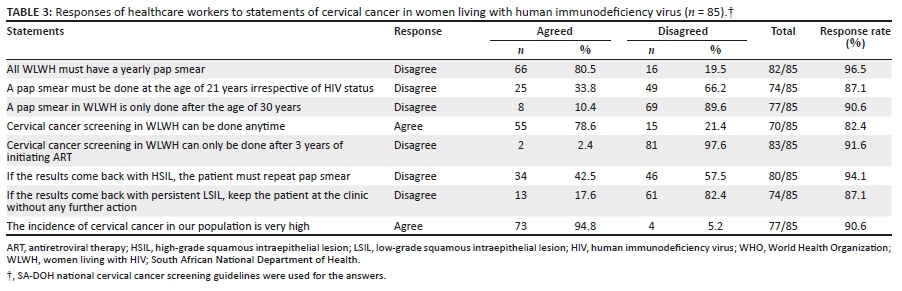
The knowledge of the respondents about cervical cancer screening in WLWH was assessed on a Likert scale. Healthcare workers' responses to the various statements that were designed to test their knowledge and implementation of cervical cancer screening varied (see Table 3).
Most of the HCWs were familiar with cervical cancer screening in WLWH infection in general; however, specific gaps in the knowledge were identified. Some of the identified gaps included lack of knowledge about screening intervals in WLWH, when to refer a patient with an abnormal pap smear or when to repeat a smear.
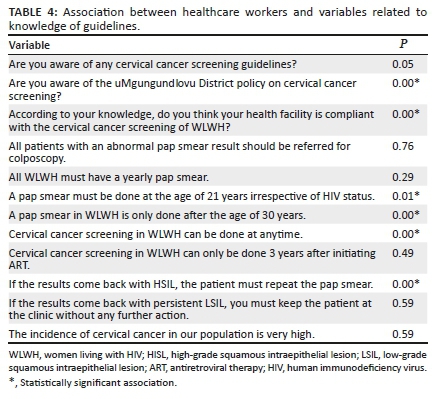
There was a statistically significant association betweenHCWs and the awareness of the uMgungundlovu District policy (only 2.1% were aware) on cervical cancer screening (p = 0.00), and the perception of oneself being compliant with the cervical cancer screening in WLWH (p = 0.00). Statistically significant associations were also found between healthcare category and certain Likert scale questions (Table 4).
Discussion
To our understanding, this is the first study to evaluate the knowledge and implementation of cervical cancer screening guidelines by HCWs in WLWH in KwaZulu-Natal province. The most crucial finding is that 70% of HCWs knew that screening in WLWH could be done at any age, including at the time of the diagnosis of HIV infection. This is important because this differs from the previous policy that all women should be screened from the age of 30 years onwards. This finding highlights an awareness that WLWH are at a higher risk and should be managed differently. The National Department of Health (NDOH) guidelines were used as the yardstick.
More than 80% of the HCWs agreed that all WLWH must have a yearly pap smear. Current South African recommendations encourage all WLWH who are at increased risk of developing cervical cancer to have yearly pap smears in high-resource settings, and 3 yearly in low-resource settings.898910
A small percentage of the HCWs agreed that a pap smear in WLWH is only performed after the age of 30 years, whereas the NDOH guidelines state that in WLWH pap smears should be done at the time of diagnosis of the HIV infection.8
More than 40% of the HCWs stated that if the results returned as HSIL, the patient must repeat the pap smear. And more than 17% of HCWs agreed that if the results returned as a persistent LSIL, the patient should be kept at the clinic without any further action. This is not what the guidelines state. It is recommended that for a persistent LSIL or worse (including ASC and atypical glandular cells [AGCs]) and HSIL, women with abnormal pap smears should be referred for a colposcopy assessment.11,12
Our study found that HCWs' responses to cervical screening in WLWH were suboptimal. Most of the HCWs had less than 3 years of experience in initiating ARV drugs and more than 20% had formal training in HIV management, which might have negatively impacted the results.
All the HCWs in our study were aware of the existence of different cervical cancer screening guidelines. In SA, these guidelines are published by the NDOH. Several South African provinces and hospitals have guidelines which they have adapted from the NDOH. It is concerning, however, to note that only 2.1% of KwaZulu-Natal HCWs in this study were familiar with their provincial guidelines. This article recommends that greater attention should be given to the continuing medical education of cervical cancer screening and cervical cancer prevention.
Most of our HCWs were in the early years of their careers. They were aware of both the NDOH and WHO guidelines. The former is used in all South African public sector hospitals and clinics. Although two HCWs answered that there were 'separate' KZN guidelines, this was an error.
The study did not find any statistically significant association between the HCWs' category and their knowledge of the guidelines. This demonstrates the need, regardless of category, for courses in the workplace that target these concerns. On the other hand, significant differences were revealed between HCWs and their awareness of district guidelines or policy, the screening intervals of WLWH and when to refer for colposcopy. Although the majority of participants indicated that their facilities were compliant with the guidelines, the gaps that have been uncovered indicate the need for ongoing education in this regard.
Limitations
The main limitations of the study are as follows:
•The small number of HCWs: results should be interpreted with caution.
•The use of a questionnaire may not reflect the actual workplace competency of the participants.
•The answers reflect a local or specific context and therefore generalisation of the study results may be limited.
•An operational bias exists in the mixing of different groups of HCWs with different levels of professional experience. Nonetheless and surprisingly, the gaps were widespread and did not link with individual categories of HCWs.
Conclusion
Healthcare workers were knowledgeable about cervical cancer screening in WLWH but displayed gaps in practice and knowledge. Most of them were well informed about the recommended screening intervals. However, a certain number of HCWs did not know when to refer a patient for further management. A delay in the management of precancerous lesions could lead to morbidity and mortality, particularly in WLWH. Healthcare workers require guidelines customised to local contexts, in particular for the care of WLWH. Recommendations emerging from this study include regular workplace refresher training that highlights the guidelines and related institutional protocols and renewed attention to the monitoring and evaluation of institutional compliance with cervical cancer screening and prevention.
Competing interests
The authors have declared that no competing interests exist.
Authors' contributions
Both authors contributed equally o this work.
Funding information
This research received no specific grant from any funding agency in the public, commercial or not-for-profit sectors.
Data availability statement
Data presented in this article can be available upon reasonable request to the corresponding author, provided that the source of data is acknowledged.
Disclaimer
The views and opinions expressed in this article are those of the authors and do not necessarily reflect the official policy or position of any affiliated agency of the authors.
Acknowledgements
We would like to thank both facilities and staff members who participated in our study.
References
-
1.FIGO. International Federation of Gynaecology and Obstetrics Cervical cancer and HIV [homepage on the Internet]. c2018 [cited 2020 May]. Available from: https://www.figo.org/news/cervical-cancer-and-hiv
» https://www.figo.org/news/cervical-cancer-and-hiv -
2.Clifford GM, Polesel J, Rickenbach M. Cancer risk in the Swiss HIV cohort study: Associations with immunodeficiency, smoking, and highly active antiretroviral therapy. J Natl Cancer Inst. 2005;97(6):425-432. https://doi.org/10.1093/jnci/dji072
» https://doi.org/10.1093/jnci/dji072 - 3.Atashili J, Smith JS, Adimora AA, Eron J, Miller WC, Myers E. Potential impact of antiretroviral therapy and screening on cervical cancer mortality in HIV-positive women in sub-Saharan Africa: A simulation. PLoS One. 2011;6(4):e18527.
-
4.Kafuruki L, Rambau PF, Massinde A, Masalu N. Prevalence and predictors of cervical intraepithelial neoplasia among HIV infected women at Bugando Medical Centre, Mwanza-Tanzania. Infect Agent Cancer. 2013;8(1):45. https://doi.org/10.1186/1750-9378-8-45
» https://doi.org/10.1186/1750-9378-8-45 -
5.Van Bogaert LJ. Age at diagnosis of preinvasive and invasive cervical neoplasia in South Africa HIV-positive versus HIV-negative women. Int J Gynecol Cancer. 2011;21(2):363-366. https://doi.org/10.1097/IGC.0b013e3182094d78
» https://doi.org/10.1097/IGC.0b013e3182094d78 -
6.Kamal EM, El Sayed GA, El Behery MM, El Shennawy GA. HPV detection in a self-collected vaginal swab with VIA for cervical cancer screening with correlation to histologically confirmed CIN. Arch Gynecol Obstet. 2014;290(6):1207-1213. https://doi.org/10.1007/s00404-014-3321-6
» https://doi.org/10.1007/s00404-014-3321-6 -
7.Van Schalkwyk SL, Maree JE, Wright SCD. Cervical cancer: The route from signs and symptoms to treatment in South Africa. Reprod Health Matters. 2008;16(32):9-17. https://doi.org/10.1016/S0968-8080(08)32399-4
» https://doi.org/10.1016/S0968-8080(08)32399-4 - 8.Botha MH, Dreyer G. Guidelines for cervical cancer screening in South Africa. S Afr J Gynaecol Oncol. 2017;9(1):8-12.
-
9.De Pokomandy A, Burchell AN, Salters K, et al. Cervical cancer screening among women living with HIV: A cross-sectional study using the baseline questionnaire data from the Canadian HIV women's sexual and reproductive health cohort study (CHIWOS). CMAJ Open. 2019;7(2):E217-E226. https://doi.org/10.9778/cmajo.20180151
» https://doi.org/10.9778/cmajo.20180151 -
10.AIDS Info. Guidelines for the prevention and treatment of opportunistic in adults and adolescents with HIV [homepage on the Internet]. No date [cited 2020 February 01]. Available from: https://aidsinfo.nih.gov/guidelines
» https://aidsinfo.nih.gov/guidelines - 11.Brogly SB, Watts DH, Ylitalo N, et al. Reproductive health of adolescent girls perinatally infected with HIV. Am J Public Health. 2007;97(6):1047-1052.
-
12.Moodley J, Constant D, Botha MH, Van der Merwe FH, Edwards A, Momberg M. Exploring the feasibility of using mobile phones to improve the management of clients with cervical cancer precursor lesions. BMC Womens' Health 2019;19(1):2. https://doi.org/10.1186/s12905-018-0702-1
» https://doi.org/10.1186/s12905-018-0702-1

Accepted: 26 June 2020
Published: 02 Sept. 2020