Outcomes of patients enrolled in an antiretroviral adherence club with recent viral suppression after experiencing elevated viral loads
Abstract
BACKGROUND: Eligibility for differentiated antiretroviral therapy (ART) delivery models has to date been limited to low-risk stable patients. OBJECTIVES: We examined the outcomes of patients who accessed their care and treatment through an ART adherence club (AC), a differentiated ART delivery model, immediately following receiving support to achieve viral suppression after experiencing elevated viral loads (VLs) at a high-burden ART clinic in Khayelitsha, South Africa. METHODS: Beginning in February 2012, patients with VLs above 400 copies/mL either on first- or second-line regimens received a structured intervention developed for patients at risk of treatment failure. Patients who successfully suppressed either on the same regimen or after regimen switch were offered immediate enrolment in an AC facilitated by a lay community health worker. We conducted a retrospective cohort analysis of patients who enrolled in an AC directly after receiving suppression support. We analysed outcomes (retention in care, retention in AC care and viral rebound) using Kaplan-Meier methods with follow-up from October 2012 to June 2015. RESULTS: A total of 165 patients were enrolled in an AC following suppression (81.8% female, median age 36.2 years). At the closure of the study, 119 patients (72.0%) were virally suppressed and 148 patients (89.0%) were retained in care. Six, 12 and 18 months after AC enrolment, retention in care was estimated at 98.0%, 95.0% and 89.0%, respectively. Viral suppression was estimated to be maintained by 90.0%, 84.0% and 75.0% of patients at 6, 12 and 18 months after AC enrolment, respectively. CONCLUSION: Our findings suggest that patients who struggled to achieve or maintain viral suppression in routine clinic care can have good retention and viral suppression outcomes in ACs, a differentiated ART delivery model, following suppression support.
Differentiated care; Retention; Viral suppression; Adherence; High-risk patients; ART delivery
Introduction
The introduction of antiretroviral therapy (ART) for the treatment of HIV has led to massive reductions in mortality and slowed the progression of disease and transmission of infection.1,23,45678,910111213
Differentiated ART delivery models such as ART adherence clubs (ACs) have been shown to be successful and cost-effective in providing treatment, care and support.14,15,16,1718,19,20,21,22,232425
Research methods and design
Study design
A descriptive retrospective cohort study was undertaken using routine data collected under programmatic conditions at Ubuntu Clinic, Khayelitsha, Western Cape, South Africa, for patients who joined ACs between February 2012 and February 2014 after viral suppression following the risk of treatment failure (ROTF) intervention.
Setting
The study was conducted at Ubuntu Clinic in Khayelitsha, South Africa. Khayelitsha is a township in Cape Town with a population of approximately half a million people and high rates of HIV and tuberculosis (TB). In 2011, the antenatal HIV prevalence was 34%.26,272829
Adherence club model and risk of treatment failure intervention
The AC model has been described in detail previously.15,16,17,183031
In 2012, the ROTF intervention was piloted at Ubuntu Clinic by Médecins Sans Frontières (MSF) and the Western Cape Department of Health.32,33, The Western Cape Department of Health has subsequently adopted the intervention to manage all patients failing or at risk of failing ART with phased implementation in all its Cape Town facilities starting at the end of 2015. The intervention was designed to provide integrated adherence support and clinical management for all patients in routine clinical care with VLs above 400 copies/mL, irrespective of treatment regimen. Patients who experienced a single VL > 400 copies/mL were enrolled in an LHCW support group, while those with two consecutive VLs > 400 copies/mL experienced more intensive counselling with a nurse trained to provide integrated adherence and clinical management. Adherence was managed through structured steps including VL monitoring and switching patients to second-line ART regimens in accordance with national guidelines (two consecutive VLs > 1000 copies/mL).
After suppression (VL < 400 copies/mL) - whether on first line, after switch to second line or on second line - patients were given the choice to enrol directly into an AC or return to routine clinician-led facility-based care. Patients who suppressed and enrolled in an AC following the ROTF intervention are hereafter referred to as 'high-risk patients' as they were regarded to be at a higher risk of interrupting their treatment again.34,35
Data collection and analysis
Analysis inclusion and exclusion
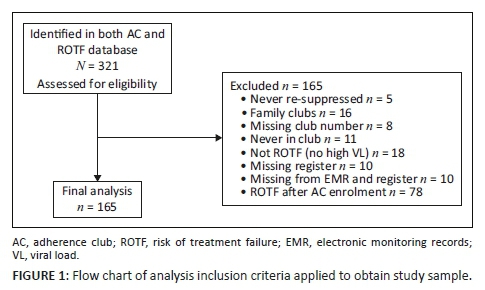
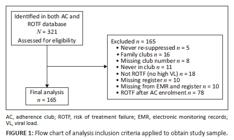
Patients who joined ACs between February 2012 and February 2014 after suppressing in the ROTF intervention were identified retrospectively by comparing the clinic's electronic monitoring records (EMR), which identified patients participating in the ROTF and AC programmes. Additional data were gathered from AC registers on those patients who were identified as having participated in both programmes. Patients were excluded if they were enrolled in an AC before the ROTF intervention, enrolled in a family AC (utilised for children and their caregivers), missing from the AC register or confirmed to have never joined an AC (indicating EMR AC participation incorrect), never suppressed after ROTF or if they never had a VL greater than 400 copies/mL (indicating EMR ROTF participation incorrect) (Figure 1). One AC register could not be found, and all patients referred to that AC were excluded from analysis. This left only high-risk patients confirmed to have joined ACs directly after participation and successful suppression following the ROTF intervention.
Data collection
Data for each patient in the analysis cohort were collected from patient visit and laboratory data from the EMR and AC registers. Missing VL results were obtained from the National Health Laboratory Service database. Patient clinic folders were consulted for patients whose most recent status was missing from the AC registers to confirm their current AC status. Key variables collected included ART regimen, ART start date, ROTF enrolment date, last unsuppressed VL and date, first suppressed VL and date, all VLs and dates after club enrolment and all clinic and club visits after suppression.
Statistical analysis
Patients entered the analysis on their first AC date (between February 2012 and February 2014) and were followed until March 24, 2015. We assessed three outcomes: retention in care, retention in club care and viral suppression. Retention in care was defined as having contact with the clinic or AC between March 24 and June 21, 2015, with retention in club care defined as attending an AC in the same period. Patients were classified as virally suppressed if their last VL before analysis closure was less than 400 copies/mL. We define viral rebound as an elevated VL above 400 copies/mL after having achieved viral suppression. Known deaths and transfers contributed retention time until they were censored at the time of death or transfer.
Patient characteristics at enrolment into an AC (gender, age at ART start, age at AC start, year of ART start, treatment regimen) and time from ART initiation to ROTF participation and from ROTF participation to AC enrolment were summarised using medians and interquartile ranges (IQRs) for continuous variables and proportions for categorical variables. Cross-sectional retention outcomes are reported at study closure. Kaplan-Meier methods were used to estimate the survival probabilities of retention, AC retention and viral suppression, and are reported at 3-monthly intervals to 18 months with 95% confidence intervals (CIs).
Data were analysed using Stata 13.0 software (STATA Corporation, College Station, TX, US).
Ethical consideration
Because of the nature of the study, individual patient consent was not obtained, consistent with the Declaration of Helsinki. All participants and data were drawn from an ongoing cohort study of routine ART outcomes in Khayelitsha, Cape Town, approved by the Human Research Ethics Committee of the Faculty of Health Sciences at the University of Cape Town (HREC 395/2005). Only routine clinical service data were used and no identifying patient information was entered into the database.
Results
Patient characteristics
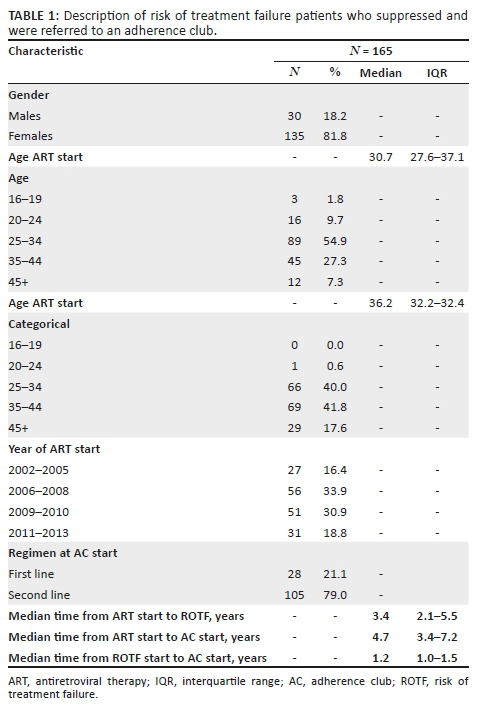
From February 2012 to February 2014, 165 high-risk patients who completed the ROTF intervention and suppressed were immediately enrolled in an AC. The cohort was predominantly female (81.8%) with a median age at ART start of 31 years (IQR: 28-37). Current treatment regimens were available for 133 patients, and of those 105 (79%) were on second-line therapy (Table 1) at the time of AC enrolment. The median time from ART initiation to enrolment in the ROTF intervention was 3.4 years (IQR: 2.1-5.5), and the median time from ROTF intervention to AC enrolment was 1.2 years (IQR: 1.0-1.5).
Cross-sectional outcomes
During the study period, two patients (1.2%) died, 15 (7.8%) were lost to follow-up and 40 (24.0%) experienced viral rebound. At the closure of the study, 148 patients (89.0%) were retained in care and 119 patients (72.0%) were virally suppressed. When stratified by known ART regimen, 26 patients (93.0%) on first line and 97 patients (92.0%) on second line were retained in care, while 20 patients (71.0%) on first line and 83 patients (79.0%) on second line were virally suppressed.
Time to event outcomes
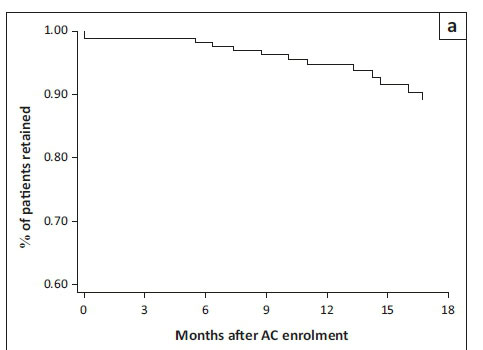
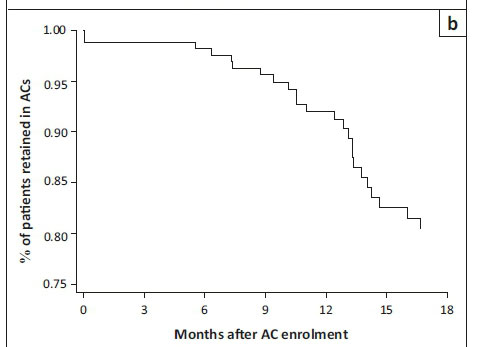
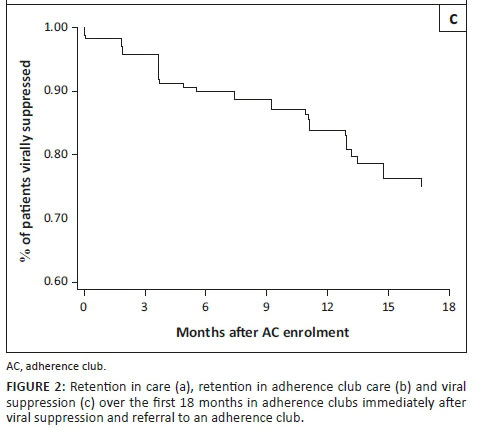
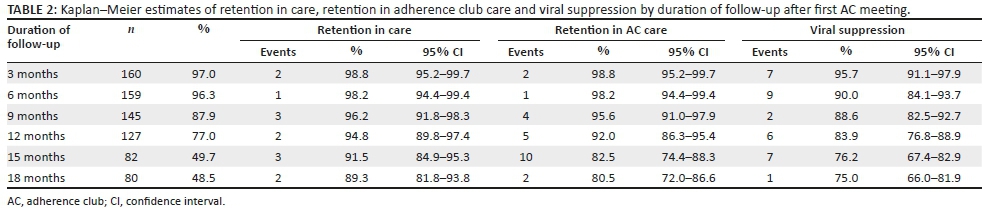
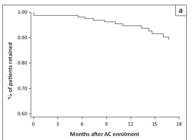
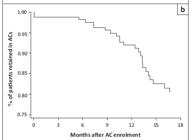
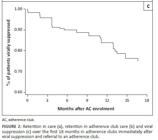
Retention in care was estimated to be 98.8% (95% CI, 94.4-99.4), 94.8% (95% CI, 89.8-97.4) and 89.3% (95% CI, 81.8-93.8) at 6, 12 and 18 months after AC enrolment, respectively (Table 2, Figure 2a). Retention in AC care was estimated to be 98.2% (95% CI, 94.4-99.4), 92.0% (95% CI, 86.3-95.4) and 80.5% (95% CI, 72.0-86.6) over the same time periods (Table 2, Figure 2b). Eighteen months after enrolment in ACs, 90% of patients retained in clinic care were still in ACs. Viral suppression was estimated to be 90.0% (95% CI, 84.1-93.7), 83.9% (95% CI, 76.8-88.9) and 75.0% (95% CI, 66.0-81.9) at 6, 12 and 18 months after AC enrolment, respectively (Table 2, Figure 2c).
Discussion
Patients who had previously had elevated VLs had good treatment outcomes following supported viral suppression and direct referral to ACs, a differentiated ART delivery model. Despite having had recent elevated VL, 75% of patients who joined ACs after undergoing a ROTF intervention were estimated to maintain viral suppression 18 months after joining the AC. Eighteen months after AC enrolment, retention in care was estimated at 89%, and 90% of patients retained in care were still in ACs. Care was differentiated in the intensified management intervention to target patients failing treatment and in the ART delivery model provided immediately after suppression. To date there is limited evidence on the outcomes of high-risk patients in ART delivery models differentiated for stable patients.
We observed retention and viral suppression outcomes matching or exceeding those of retention benchmarks and meta-analyses from sub-Saharan Africa through 18 months of follow-up. Retention in sub-Saharan Africa was estimated to be 81% at 12 months,10153631373835
Ninety per cent of patients retained in care after 18 months were still receiving their care in ACs, suggesting a high level of satisfaction with the service delivery model. This result is important because patient satisfaction is a strong predictor of adherence to ART regimens.394,40,41,42,43
In addition to the differentiated nature of the ACs, the model was also differentiated from routine care, providing more intensified integrated adherence and clinical care through the ROTF intervention to meet the needs of patients as they attempted to achieve viral suppression after elevated VLs and remain in care. This model of VL-informed differentiated care has been shown to be effective and cost-efficient in supporting patients who experience elevated VLs in routine care.44
These results should be viewed in light of a number of limitations. Firstly, a control group was not obtained, making comparison of these results difficult. Because of the retrospective nature of the study and the ability of patients to self-select into AC care or routine clinic care after ROTF, any control group chosen would be biased. We chose to compare the outcomes to broader benchmark goals for all ART programmes. Importantly, our analysis begins at AC enrolment and not ART start. Because the largest drop in retention occurs immediately after ART start, care must be taken when comparing these results to those of newly enrolled patients. Secondly, tracing of patients lost to follow-up to identify undocumented transfers was not completed. However, any bias this limitation created would serve to reduce observed retention. Thirdly, patients were given the choice to join an AC or return to routine clinic care after completing the ROTF intervention. It is therefore possible that only the motivated patients joined ACs, and our results are not representative of all patients who have experienced an elevated VL. This scenario is unlikely because fewer than 10.0% of patients chose to return to routine care after achieving suppression. Regardless, by allowing patients to self-select into care models, the probability that they will find a model of care that suits their life, and thus maintain adherence, increases. Fourthly, it is possible that transmitted resistance to first-line regimens was responsible for the positive response in patients switched to second line. This would only account for a small proportion of patients given the relative infrequency of transmitted resistance in South Africa4532,464748
Conclusion
Further research is needed to fully understand how less intense, differentiated ART delivery models can collectively support the heterogeneous population of patients currently ineligible for these models. We recommend both small-scale implementation in diverse contexts to assess the generalisability of our findings and randomised control trials to directly compare the outcomes of patients experiencing elevated VLs recently suppressed or resuppressed immediately accessing a simplified ART delivery model versus routine care. Tests of association should be employed to determine the populations who could most benefit. Finally, retention in AC care had its sharpest decline between 12 and 18 months, and longer term follow-up is needed to determine if differentiated ART delivery models can support patient retention over the long run. In summary, criteria for differentiation must continue to be re-evaluated. Using the criteria of proven 'stability' may exclude those who have the most to gain from streamlining access to ART, including those who have recently suppressed.
In conclusion, our findings suggest that patients who struggled to achieve or maintain viral suppression in routine clinic care can have good retention and viral suppression outcomes in differentiated ART delivery models, such as ACs, immediately following suppression support. These models may remove health system barriers imposed by clinician-led facility-based models. Further studies are required to evaluate both retention and viral suppression benefits of expanding access to differentiated ART delivery models to patients who have struggled with adherence.
Competing interests
The authors declare that they have no financial or personal relationship(s) that may have inappropriately influenced them in writing this article.
Authors' contributions
J.S. was responsible for the writing of the article, with statistical analysis completed by J.S. and A.G. J.S. and L.W. collected the data for analysis. J.S., L.W., C.C., G.v.C. and A.G. contributed to the plan of the analysis and interpretation of the data. L.W. and V.C. developed the ROTF to AC protocol. All authors commented on drafts of the article and approved the final version to be published.
Acknowledgements
The authors thank all the staff at Ubuntu Clinic and Khayelitsha and Eastern sub-structure for their ongoing dedication to their patients demonstrated through their continued support for piloting models of care that better suit the needs of their patients. The authors would also like to thank the MSF ROTF and AC nurses and counsellors who mentor and support their colleagues at Ubuntu Clinic.
References
-
1.Johnson L, Mossong J, Dorrington E, et al. Life expectancies of South African adults starting antiretroviral treatment: Collaborative analysis of cohort studies. PLoS Med. 2013;10(4):e1001418. https://doi.org/10.1371/journal.pmed.1001418
» https://doi.org/10.1371/journal.pmed.1001418 -
2.Cohen MS, Chen YQ, McCauley M, et al. Prevention of HIV-1 infection with early antiretroviral therapy. N Engl J Med. 2011;365(6):493-505. https://doi.org/10.1056/NEJMoa1105243
» https://doi.org/10.1056/NEJMoa1105243 -
3.Mills EJ, Nachega JB, Buchan I, et al. Adherence to antiretroviral therapy in sub-Saharan Africa and North America: A meta-analysis. JAMA. 2006;296(6):679-690. https://doi.org/10.1001/jama.296.6.679
» https://doi.org/10.1001/jama.296.6.679 -
4.Nachega JB, Marconi VC, Van Zyl GU, et al. HIV treatment adherence, drug resistance, virologic failure: Evolving concepts. Infect Disord Drug Targets. 2011;11(2):167-174. https://doi.org/10.2174/187152611795589663
» https://doi.org/10.2174/187152611795589663 - 5.UNAIDS. 90-90-90: An ambitious treatment target to help end the AIDS epidemic. Geneva: UNAIDS; 2014.
-
6.Tse W, Yang W, Haung W. A narrative review of cost-effectiveness analysis of people living with HIV treated with HAART: From interventions to outcomes. Clinicoecon Outcomes Res. 2015;7:431-439. https://doi.org/10.2147/CEOR.S85535
» https://doi.org/10.2147/CEOR.S85535 -
7.Madi D, Gupta P. Achappa B, et al. HIV status disclosure among people living with HIV in the era of combination antiretroviral therapy (cART). J Clin Diagn Res. 2015;9(8):14-16. https://doi.org/10.7860/JCDR/2015/12511.6373
» https://doi.org/10.7860/JCDR/2015/12511.6373 -
8.Bemelmans M, Baert S, Goemaere E, et al. Community-supported models of care for people on HIV treatment in sub-Saharan Africa. Trop Med Int Health. 2014;19(8):968-977. https://doi.org/10.1111/tmi.12332
» https://doi.org/10.1111/tmi.12332 -
9.Okoboi S, Ding E, Persuad S, et al. Community-based ART distribution system can effectively facilitate long-term program retention and low-rates of death and virologic failure in rural Uganda. AIDS Red Ther. 2015;12(37)e1-e9. https://doi.org/10.1186/s12981-015-0077-4
» https://doi.org/10.1186/s12981-015-0077-4 -
10.Fox M, Sydney R. Retention of adult patients on antiretroviral therapy in low- and middle-income countries: Systematic review and meta-analysis 2008-2013. J Acquir Immune Defic Syndr. 2015;16(1):98-108. https://doi.org/10.1097/QAI.0000000000000553
» https://doi.org/10.1097/QAI.0000000000000553 - 11.UNAIDS. 2006 report on the global AIDS epidemic. Geneva: UNAIDS; 2006.
- 12.UNAIDS. Global HIV & AIDS statistics - 2018 fact sheet. Geneva: UNAIDS; 2018.
-
13.Kaplan SR, Oosthuizen C, Stinson K, et al. Contemporary disengagement from antiretroviral therapy in Khayelitsha, South Africa: A cohort study. PLoS Med. 2017;14(11):e1002407. https://doi.org/10.1371/journal.pmed.1002407
» https://doi.org/10.1371/journal.pmed.1002407 -
14.Decroo T, Rasschaert F, Telfer B, Remartinez D, Laga M, Ford N. Community-based antiretroviral therapy programs can overcome barriers to retention of patients and decongest health services in sub-Saharan Africa: A systematic review. Int Health. 2013;5(3):169-179. https://doi.org/10.1093/inthealth/iht016
» https://doi.org/10.1093/inthealth/iht016 -
15.Luque-Fernandez MA, Van Cutsem G, Goemaere E, et al. Effectiveness of patient adherence groups as a model of care for stable patients on antiretroviral therapy in Khayelitsha, Cape Town, South Africa. PLoS One. 2013;8(2):e56088. https://doi.org/10.1371/journal.pone.0056088
» https://doi.org/10.1371/journal.pone.0056088 -
16.Grimsrud A, Lesosky M, Kalombo C, Bekker LG, Myer L. Community-based adherence clubs for the management of stable antiretroviral therapy patients in Cape Town, South Africa: A cohort study. J Acquir Immune Defic Syndr. 2015;71(1):16-23. https://doi.org/10.1097/QAI.0000000000000863
» https://doi.org/10.1097/QAI.0000000000000863 -
17.Bango F, Ashmore J, Wilkinson L, Van Cutsem G, Cleary S. Adherence clubs for long-term provision of antiretroviral therapy: Cost-effectiveness and access analysis from Khayelitsha, South Africa. Trop Med Int Heal. 2016;21(9):1115-1123. https://doi.org/10.1111/tmi.12736
» https://doi.org/10.1111/tmi.12736 -
18.Wilkinson L. ART adherence clubs: A long-term retention strategy for clinically stable patients receiving antiretroviral therapy. South Afr J HIV Med. 2013;14(2):48-50. https://doi.org/10.4102/sajhivmed.v14i2.77
» https://doi.org/10.4102/sajhivmed.v14i2.77 -
19.Auld AF, Shiraishi RW, Couto A, et al. A decade of antiretroviral therapy scale-up in Mozambique: Evaluation of outcome trends and new models of service delivery among more than 300,000 patients enrolled during 2004-2013. J Acquir Immune Defic Syndr. 2016;73(2):e11-e22. https://doi.org/10.1097/QAI.0000000000001137
» https://doi.org/10.1097/QAI.0000000000001137 -
20.Decroo T, Koole O, Remartinez D, et al. Four-year retention and risk factors for attrition among members of community ART groups in Tete, Mozambique. Trop Med Int Health. 2014;19(5):514-521. https://doi.org/10.1111/tmi.12278
» https://doi.org/10.1111/tmi.12278 -
21.Wringe A, Cawley C, Szumilin E, et al. Retention in care among clinically stable antiretroviral therapy patients following a six-monthly clinical consultation schedule: findings from a cohort study in rural Malawi. J Int AIDS Soc. 2018;21(11):e25207. https://doi.org/10.1002/jia2.25207
» https://doi.org/10.1002/jia2.25207 -
22.Mody A, Roy M, Sikombe K, et al. Improved retention with six month clinic return intervals for stable HIV-infected patients in Zambia. Clin Infect Dis. 2017;66(2):237-243. https://doi.org/10.1093/cid/cix756
» https://doi.org/10.1093/cid/cix756 -
23.Vogt F, Kalenga L, Lukela J, et al. Decentralizing ART supply for stable HIV patients to community-based distribution centers: Program outcomes from an urban context in Kinshasa, DRC. J Acquir Immune Defic Syndr. 2017;74(3):326-331. https://doi.org/10.1097/QAI.0000000000001215
» https://doi.org/10.1097/QAI.0000000000001215 -
24.Grimsrud A, Bygrave H, Doherty M, et al. Reimagining HIV service delivery: The role of differentiated care from prevention to suppression. J Int AIDS Soc. 2016;19(1):21484. https://doi.org/10.7448/IAS.19.1.21484
» https://doi.org/10.7448/IAS.19.1.21484 - 25.World Health Organization. Consolidated guidelines on the use of antiretroviral drugs for treating and preventing HIV infection: Recommendations for a public health approach. 2nd ed. Geneva: WHO; 2016.
- 26.Provincial Health Department of the Western Cape. HIV antenatal survey. 2012. Cape Town: Provincial Health Department of the Western Cape; 2013.
-
27.Stinson K, Goemaere E, Coetzee D, et al. Cohort profile: The Khayelitsha antiretroviral programme, Cape Town, South Africa. Int J Epidemiol. 2017;46(2):e21. https://doi.org/10.1093/ije/dyw057
» https://doi.org/10.1093/ije/dyw057 -
28.Western Cape Government. City of Cape Town 2016. Socioeconomic profile [homepage on the Internet]. Cape Town: City of Cape Town; 2016. Available from: https://www.westerncape.gov.za/assets/departments/treasury/Documents/Socio-economic-profiles/2016/City-of-Cape-Town/city_of_cape_town_2016_socio-economic_profile_sep-lg.pdf.
» https://www.westerncape.gov.za/assets/departments/treasury/Documents/Socio-economic-profiles/2016/City-of-Cape-Town/city_of_cape_town_2016_socio-economic_profile_sep-lg.pdf -
29.Coetzeea D, Hildebranda K, Boullea A, et al. Outcomes after two years of providing antiretroviral treatment in Khayelitsha, South Africa. AIDS. 2004;18(6):887-895. https://doi.org/10.1097/00002030-200404090-00006
» https://doi.org/10.1097/00002030-200404090-00006 -
30.Wilkinson L, Harley B, Sharp J, et al. Expansion of the adherence club model for stable antiretroviral therapy patients in the Cape Metro, South Africa 2011-2015. Trop Med Int Health. 2016;21(6):743-749. https://doi.org/10.1111/tmi.12699
» https://doi.org/10.1111/tmi.12699 -
31.Tsondai P, Wilkinson L, Grimsrud A, Mdlalo P, Ullauri A, Boulle A. High rates of retention and viral suppression in the scale-up of antiretroviral therapy adherence clubs in Cape Town, South Africa. JIAS. 2017;20(S4):21649. https://doi.org/10.7448/IAS.20.5.21649
» https://doi.org/10.7448/IAS.20.5.21649 -
32.Garone D, Conradie K, Patten G, et al. High rate of virological re-suppression among patients failing second-line antiretroviral therapy following enhanced adherence support: A model of care in Khayelitsha, South Africa. South Afr J HIV Med. 2013;14(4):170-176. https://doi.org/10.4102/sajhivmed.v14i4.52
» https://doi.org/10.4102/sajhivmed.v14i4.52 -
33.Médecins Sans Frontières. Supporting adherence to antiretroviral therapy: A facility approach to reduce the risk of treatment failure [homepage on the Internet]. Report and Toolkit. Cape Town: MSF; 2012. Available from: https://www.msf.org.za/system/tdf/risk_of_treatment_failure_mentorship_ toolkit_v3.pdf?file=1&type=node&id=3080&force=. Accessed May 26, 2018.
» https://www.msf.org.za/system/tdf/risk_of_treatment_failure_mentorship_ toolkit_v3.pdf?file=1& type=node& id=3080& force= -
34.Reekiem J, Mocroft A, Ledergerber B, Beniowski M, Clotet B. History of viral suppression on combination antiretroviral therapy as a predictor of virological failure after a treatment change. HIV Med. 2010;10:469-478. https://doi.org/10.1111/j.1468-1293.2009.00816.x
» https://doi.org/10.1111/j.1468-1293.2009.00816.x -
35.Smith C, Phillips A, Dauer B, et al. Factors associated with viral rebound among highly treatment-experienced HIV-positive patients who have achieved viral suppression. HIV Med. 2009;10(1):19-27. https://doi.org/10.1111/j.1468-1293.2008.00650.x
» https://doi.org/10.1111/j.1468-1293.2008.00650.x -
36.Decroo T, Telfer B, Dores CD, et al. Effect of Community ART Groups on retention-in-care among patients on ART in Tete Province, Mozambique: a cohort study. BMJ Open. 2017;7(8):e016800. https://doi,org/10.1136/bmjopen-2017-016800
» https://doi,org/10.1136/bmjopen-2017-016800 -
37.Boender TS, Sigaloff KCE, McMahon JH, et al. Long-term virological outcomes of first-line antiretroviral therapy for HIV-1 in low- and middle-income countries: A systematic review and meta-analysis. Clin Infect Dis. 2015;61(9):1453-1461. https://doi.org/10.1093/cid/civ556
» https://doi.org/10.1093/cid/civ556 -
38.Murphy R, Sunpath H, Castilla C, et al. Second-line antiretroviral therapy: Long-term outcomes in South Africa. J Acquir Immune Defic Syndr. 2012;61(2):158-163. https://doi.org/10.1097/QAI.0b013e3182615ad1
» https://doi.org/10.1097/QAI.0b013e3182615ad1 -
39.Dang BN, Westbrook RA, Black WC, Rodriguez-Barradas MC, Giordano TP. Examining the link between patient satisfaction and adherence to HIV care: A structural equation model. PLoS One. 2013;8(1):e54729. https://doi.org/10.1371/journal.pone.0054729
» https://doi.org/10.1371/journal.pone.0054729 -
40.O'Connor JL, Gardner EM, Esser S, et al. A simple self-reported adherence tool as a predictor of viral rebound in people with viral suppression on antiretroviral therapy. HIV Med. 2016;17:124-132. https://doi.org/10.1111/hiv.12284
» https://doi.org/10.1111/hiv.12284 -
41.Arnsten J, Demas P, Farzadegan H, et al. Antiretroviral therapy adherence and viral suppression in HIV-infected drug users: Comparison of self-report and electronic monitoring. Clin Infect Dis. 2001;33(8):1417-1423. https://doi.org/10.1086/323201
» https://doi.org/10.1086/323201 -
42.Cambiano V, Lampe F, Rodger A, et al. Use of a prescription-based measure of antiretroviral therapy adherence to predict viral rebound in HIV-infected individuals with viral suppression. HIV Med. 2010;11(3):216-224. https://doi.org/10.1111/j.1468-1293.2009.00771.x
» https://doi.org/10.1111/j.1468-1293.2009.00771.x -
43.Liu H, Miller L, Hays R, et al. Repeated measures longitudinal analyses of HIV virologic response as a function of percent adherence, dose timing, genotypic sensitivity, and other factors. J Acquir Immune Defic Syndr. 2006;41(3):315-322. https://doi.org/10.1097/01.qai.0000197071.77482.6e
» https://doi.org/10.1097/01.qai.0000197071.77482.6e -
44.Phillips A, Shroufi A, Vojnov L, et al. Sustainable HIV treatment in Africa through viral-load-informed differentiated care. Nature. 2015;528(7580):S68-S76. https://doi.org/10.1038/nature16046
» https://doi.org/10.1038/nature16046 -
45.Manasa J, Katzenstein D, Cassol S, Newell M-L, De Oliveira T. Primary drug resistance in South Africa: Data from 10 years of surveys. AIDS Res Hum Retroviruses. 2012;28(6):558-565. https://doi.org/10.1089/aid.2011.0284
» https://doi.org/10.1089/aid.2011.0284 -
46.Nachega JB, Hislop M, Dowdy DW, Lo M, Regensberg L, Maartens G. Adherence to highly active antiretroviral therapy assessed by pharmacy claims predicts survival in HIV-infected South African adults. J Acquir Immune Defic Syndr. 2006;43(1):78-84. https://doi.org/10.1097/01.qai.0000225015.43266.46
» https://doi.org/10.1097/01.qai.0000225015.43266.46 -
47.Johnson V, Cohen K, Wiesner L, et al. Viral suppression following switch to second-line antiretroviral therapy: Associations with nucleoside reverse transcriptase inhibitor resistance and subtherapeutic drug concentrations prior to switch. J Infect Dis. 2014;209 (5):711-720. https://doi.org/10.1093/infdis/jit411
» https://doi.org/10.1093/infdis/jit411 -
48.Tsegaye A, Wubshet M, Awoke T, Alene K. Predictors of treatment failure on second-line antiretroviral therapy among adults in northwest Ethiopia: A multicentre retrospective follow-up study. BMJ Open. 2016;6(12):e0125. https://doi.org/10.1136/bmjopen-2016-012537
» https://doi.org/10.1136/bmjopen-2016-012537

Accepted: 17 Apr. 2019
Published: 11 June 2019