Identifying sexual behavioural choices when commencing pre-exposure prophylaxis: Findings from a public health facility in eThekwini, KwaZulu-Natal, South Africa
Abstract
BACKGROUND: HIV/AIDS continues to be of concern, particularly in South Africa, where the current prevalence is 12.7% OBJECTIVES: This study aimed to explore sexual practices that increased HIV vulnerability among clinic users who chose to initiate pre-exposure prophylaxis (PrEP) in KwaZulu-Natal, South Africa METHOD: A quantitative approach was utilised to collect data at an urban clinic in eThekwini (n = 376). Data were analysed using SPSS v29 RESULTS: Participants were predominantly female (n = 331; 88%), single (n = 343; 91.5%), and heterosexual (n = 368; 98.1%). Sexual debut occurred at 18.4 ± 2.58 years. More men reported having concurrent sexual partners (n = 24; 54.5%). Transactional sex was more often reported by single women aged 18 years to 24 years. Age-disparate relationships were more common among those aged 18 years to 24 years. A significant association between early sexual debut and the number of lifetime partners was identified (P < 0.001 CONCLUSION: Our findings indicate that the study population was aware of their increased HIV vulnerability and were willing to try preventive measures, such as PrEP, to protect against seroconversion. However, interventions are required to abate the cycle of transactional sex, age-disparate relationships, and early sexual debut, especially among young women aged 15 years to 24 years
sexual behavioural choices; pre-exposure prophylaxis initiation; self-perceived HIV risk; HIV risk profile; KwaZulu-Natal; South Africa
Introduction
Vulnerable populations, such as adolescent girls and young women, orphans, street children, serodiscordant couples, and migrant workers, are at high risk of contracting HIV, based on their sexual behavioural practices.1,23,4,5,6,73,895456
These age-disparate relationships are often transactional in nature, with the female partner viewing the receipt of material items as an expression of love.1010,11,121111,12
Other factors, such as education inequalities and informal housing, contribute to sexual behaviour resulting in high HIV transmission rates.13,14,15161715
A study conducted by Madiba and Ngwenya1818
Existing interventions, such as condom use, male circumcision, harm reduction programmes for drug users, and elimination of mother-to-child transmission,192021,22,23,2425
Research methods and design
This quantitative study was conducted at a primary healthcare clinic located in the central business district in eThekwini, KwaZulu-Natal, South Africa. Data were collected from January 2022 to April 2023, using purposive sampling. This type of sampling allows one to gain knowledge about a particular phenomenon. Greater preference is given to the knowledge aspect rather than the statistical outcome of the research. Purposive sampling is beneficial in explanatory studies, and allows the researcher to create theories or suggestions.26,27
In the current report, early sexual debut was defined as those who had sex for the first time at 15 years and younger. In an age-disparate relationship, the sexual partner was at least 5 years older than the participants. Transactional sex was defined as an exchange of material support for sex. Multiple concurrent partners referred to having two or more sexual partners at the same time.
The questionnaire took approximately 15 min to complete. The researcher or research assistant was present to answer any questions. The questionnaires were available in either English or isiZulu. The baseline questionnaire was completed in a closed clinic room to allow for privacy while completing the questionnaire due to the sensitive nature of some questions. Participants were allowed to withdraw at any point in the study. Verbal cues and body language were taken into consideration, as the study population was predominantly younger; this ensured the participants' welfare was protected, especially if they did not voice their discomfort. In the current study, none of the participants displayed any signs of discomfort or voiced any questions they may have had. A distress protocol was in place for the relevant referrals for counselling and support groups; however, this was not utilised in the current study.
Prior to the main study, the questionnaires were piloted among PrEP users to ensure reliability and validity. An expert focus group, comprising the researchers, current PrEP users, and nurses (n = 6), assessed the validity of the questionnaire, after which minor changes were implemented. Cronbach's alpha was calculated only for sections comprising grouped items that measured a single construct. These included the abuse sections (type of abuse, α = 0.618; frequency of abuse, α = 0.833), and the PrEP knowledge section (α = 0.612). Other sections of the questionnaire consisted largely of single-item or descriptive measures for which Cronbach's alpha is not applicable. For further validation, we also computed the Kuder-Richardson 20 coefficient for the dichotomous knowledge items. The Kuder-Richardson 20 value was 0.51, which, while slightly lower than Cronbach's alpha, is consistent with moderate internal consistency for exploratory research of this nature. A total of 376 questionnaires were completed and included in the analysis.
Data analysis
All data were analysed using SPSS version 29 (IBM Corp., Armonk, New York, United States). Categorical data were calculated using frequencies, percentages, and standard deviation. Data were correlated using Pearson Chi-Square and Fisher Exact tests to determine bivariate associations. Missing data were excluded from the analyses. Participants with incomplete responses were not excluded from the dataset unless all responses for a construct were missing. In line with SPSS defaults, pairwise deletion was applied for descriptive and reliability analyses, while listwise deletion was used for regression models to ensure only participants with complete data on included predictors were analysed. A P-value of < 0.05 was deemed statistically significant.
Ethical considerations
Ethics approval was obtained from the Durban University of Technology Institutional Ethics Review Committee (reference number: IREC 148/20). Permission from the research clinic site, clinic manager, and the Department of Health, South Africa, was obtained prior to commencing the research. All participation was voluntary, and written informed consent was obtained. The questionnaire was answered in the privacy of a clinic room. Verbal cues and body language were taken into consideration, as the study population was predominantly younger, ensuring the participants' welfare was protected, especially if they did not voice their discomfort. In the current study, none of the participants displayed any signs of discomfort or voiced any questions they might have.
Results
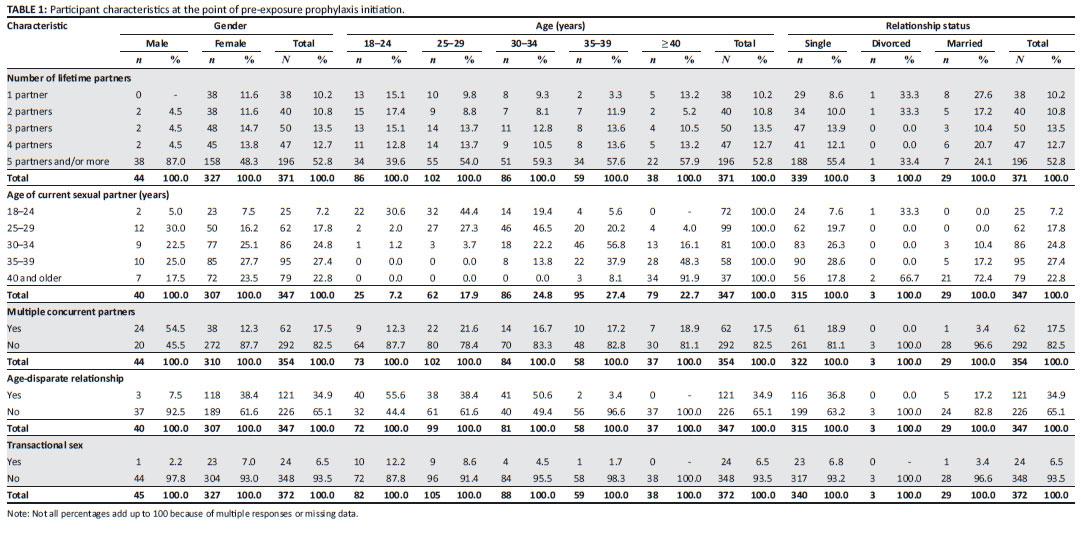
The demographic profile and sexual behavioural characteristics of the participants is reported in Table 1. Most participants were Black African (n = 376; 100%), single (n = 343; 91.5%), and heterosexual (n = 368; 98.1%). The mean age of the participants was 30.2 ± 6.99 years. Sexual debut occurred at 18.4 ± 2.58 years. Only 41.7% disclosed that they were in a serodiscordant relationship (n = 88). A small proportion (n = 76; 20.2%) was previously diagnosed with a sexually transmitted infection. Thirty-one participants (8.3%) reported having been subjected to some form of abuse, with some experiencing more than one type of abuse. Of those, physical abuse (n = 5; 16.1%), emotional abuse (n = 31; 8.2%), mental abuse (n = 1; 3.2%), and sexual abuse (n = 1; 3.2%) were identified among the participants. Those who were single and male reported having five or more lifetime partners. Concurrent sexual partners were more commonly reported among male participants than their female counterparts. Age-disparate relationships and transactional sex were reported by women.
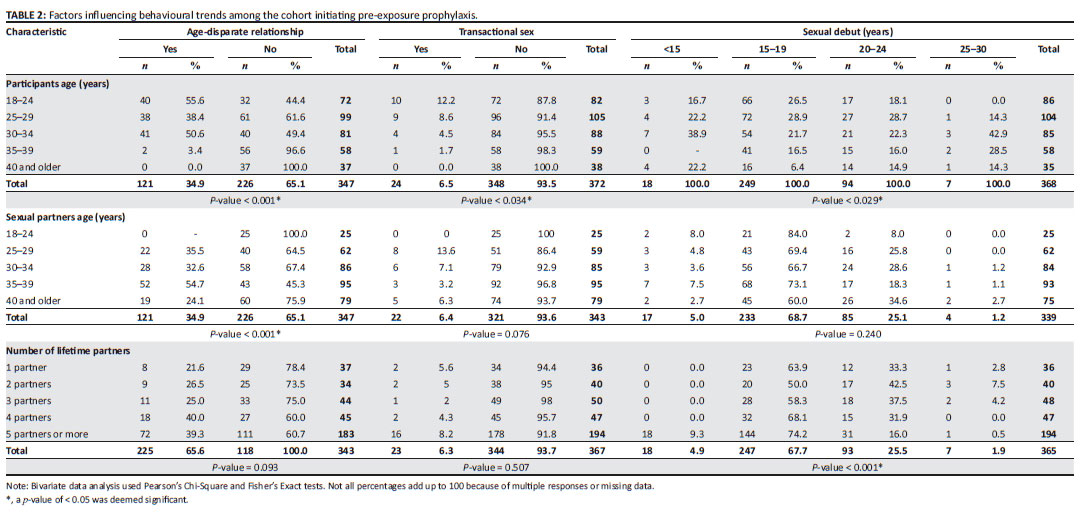
Factors associated with sexual behaviour trends are shown in Table 2. Bivariate analysis indicated that younger participants were more likely to have a sexual partner aged 5 years or older than themselves. Specifically, 55.6% (n = 40) of participants aged 18 years to 24 years reported having partners five or more years older. Notably, only 3.4% of participants aged 35 years to 39 years (n = 2), and none of those aged 40 years and older, reported having partners at least 5 years or older (Fisher's Exact test P < 0.001; Table 2). More participants aged 18 years to 24 years (n = 10; 12.2%) reported engaging in transactional sex compared to those aged 35 years to 39 years (n = 1; 1.7%; Fisher's Exact test P < 0.034). None of the participants aged 40 years and older reported transactional sex. Participants who reported sexual debut at the age of 19 years or younger were more likely to have five or more lifetime partners (Fisher's Exact P < 0.001). A linear trend was observed between age of sexual debut and number of lifetime sexual partners (Pearson Chi-Square test P < 0.001). Having five or more lifetime partners was reported for those who reported sexual debut at an age younger than 15 years (n = 18; 9.3%), or those between the ages of 15 years and 19 years (n = 144; 74.2%). However, when sexual debut occurred between the ages of 20 years and 24 years, 42.5% (n = 17) reported having only two lifetime partners. Early sexual debut was also positively correlated with age-disparate relationships (Fisher's Exact test P < 0.033).
Although the relationship between the number of lifetime partners and the likelihood of having a partner aged 5 years or older was not statistically significant (Pearson Chi-Square test P = 0.093), a linear-by-linear association indicated a trend between age disparity and number of lifetime partners (P = 0.009). Of those who had only one lifetime partner,few (n = 8; 21.6%) reported age-disparate relationships, in contrast to 39.3% (n = 72) participants with five or more lifetime partners being in age-disparate relationships (Table 2).
Discussion
The current study explored sexual practices that increased HIV vulnerability amongst primary healthcare clinic clients at the point of PrEP initiation. Early sexual debut, serodiscordant relationships, multiple concurrent sexual partnerships, age-disparate relationships, and transactional sex were identified, particularly amongst younger participants aged 18 years to 24 years. Transactional sex and age-disparate relationships were more common among women and among younger participants. Young people, aged approximately 18 years, are likely to have completed secondary education and are entering a tertiary institution, which may require a move away from home to a new city.2829,3031,32
Women in transactional relationships are unable to negotiate safe sex, including the use of condoms,33,3431353110,29,30,36
The current study population accessed public healthcare facilities, since private healthcare is expensive in South Africa. Only 16.2% of South Africans access private healthcare through private medical schemes.3839,404142,4344434535,46,474044
Early sexual debut has further consequences. We report a positive correlation between early sexual debut and age-disparate relationships, as well as a higher number of lifetime sexual partners. Young women with older partners are at a higher risk of engaging in unsafe sexual behaviours, such as unprotected sex and being in relationships with partners living with HIV.48494150
Recommendations
Early sexual health education should be implemented within schools and communities, in an attempt to delay sexual debut. Parents, guardians, and caregivers should be included in these programmes to facilitate open and honest conversations about sexual health. Mainstream and social media can portray accurate decisions in sexual relationships and their consequences. Economic support, such as scholarships or stipends, would be vital to young girls and women to mitigate early sexual debut and transactional sex.
Limitations
Our sample comprised those enrolling for PrEP, thus the reported sexual behaviours may be biased and not representative of the entire population. Furthermore, the responses were self-reported, which could have the potential of under-reporting certain behaviours, such as transactional sex or abuse, for social desirability. Similarly, the missing data could be a result of social desirability bias. The cross-sectional design limits causal inference. Multivariate analysis was not conducted due to missing data and purposive sampling, which would not be beneficial for regression models. Data on sensitive topics such as sexual behaviours can be underreported and affect the validity of multivariate models. Convenience sampling can cause potential bias.
Conclusion
Sexual practices that increase HIV vulnerability identified in this study allude to participants' self-awareness of their perceived risk for HIV acquisition. Hence, their exploration of PrEP as an HIV prevention strategy. The study alludes to economic constraints leading to sexual behaviours that may increase vulnerability to HIV. Thus, initiatives that promote financial independence and life skills among adolescent girls and young women can reduce economic dependence on men, decreasing these behaviours that lead to HIV vulnerability. Gender-transformative approaches would be vital in breaking the power disproportionateness, fostering healthier relationship dynamics, and contributing to long-term reductions in HIV incidence through enhanced agency and structural resilience.
Competing interests
Jyotika Basdav received funding from the Durban University of Technology PhD research funds. The terms of this arrangement have been reviewed and approved by Durban University of Technology in accordance with its policy on objectivity in research.
CRediT authorship contribution
Jyotika Basdav: Conceptualisation, Methodology, Investigation, Writing - Original Draft, Writing - Review & Editing. Poovendhree Reddy: Conceptualisation, Methodology, Supervision, Writing - Review & Editing. Firoza Haffejee: Conceptualisation, Methodology, Supervision, Writing - Review & Editing, Resources. All authors reviewed the article, contributed to the discussion of results, approved the final version for submission and publication, and take responsibility for the integrity of its findings.
Funding information
Jyotika Basdav received funding from the Durban University of Technology PhD research funds.
Data availability
The data that support the findings of this study are available on request from the corresponding author, Jyotika Basdav.
Disclaimer
The views and opinions expressed in this article are those of the authors and are the product of professional research. The article does not necessarily reflect the official policy or position of any affiliated institution, funder, agency, or that of the publisher. The authors are responsible for this article's results, findings, and content.
Acknowledgements
The authors thank the study participants for their time,Mr Deepak Singh for their time and valuable input, Xoliswa Mtolo for assisting with data collection. This article is based on data from a larger study. A related article focuses on motivators for oral PrEP uptake and has been published in AIDS Care (2023; https://doi.org/10.1080/09540121.2023.2208322). The present article addresses a distinct research question, exploring baseline sexual practices of a cohort commencing PrEP. This article is based on research originally conducted as part of Jyotika Basdav's doctoral thesis titled 'The evaluation of adherence and effects of PrEP on a cohort of PrEP users in KwaZulu-Natal', submitted to the Faculty of Health Sciences, Durban University of Technology in 2025. The thesis is currently unpublished and not publicly available. The thesis was supervised by Poovendhree Reddy and Firoza Haffejee. The manuscript has been revised and adapted for journal publication. The author confirms that the content has not been previously published or disseminated and complies with ethical standards for original publication.
References
- 1. Rebe K, editor. Sexually transmitted infections in vulnerable groups. Presentation given at the Southern African HIV Clinicians Society 3rd Biennial Conference; 2016 April 13-16; Johannesburg, South Africa.
- 2. National Department of Health. High transmission areas: Key populations. Pretoria: National Department of Health; 2015.
-
3. Pettifor A, O'Brien K, MacPhail C, Miller WC, Rees H. Early coital debut and associated HIV risk factors among young women and men in South Africa. Int Perspect Sex Reprod Health. 2009;35(2):82-90. https://doi.org/10.1363/ifpp.35.082.09
» https://doi.org/10.1363/ifpp.35.082.09 -
4. Wand H, Ramjee G. The relationship between age of coital debut and HIV seroprevalence among women in Durban, South Africa: A cohort study. BMJ Open. 2012;2(1):e000285. https://doi.org/10.1136/bmjopen-2011-000285
» https://doi.org/10.1136/bmjopen-2011-000285 -
5. Richter L, Mabaso M, Ramjith J, Norris SA. Early sexual debut: Voluntary or coerced? Evidence from longitudinal data in South Africa - The Birth to Twenty Plus study. S Afr Med J. 2015;105(4):304-307. https://doi.org/10.7196/SAMJ.8925
» https://doi.org/10.7196/SAMJ.8925 -
6. Zuma K, Shisana O, Rehle TM, et al. New insights into HIV epidemic in South Africa: Key findings from the National HIV prevalence, incidence and behaviour survey, 2012. Afr J AIDS Res. 2016;15(1):67-75. https://doi.org/10.2989/16085906.2016.1153491
» https://doi.org/10.2989/16085906.2016.1153491 -
7. Ranganathan M, Heise L, Pettifor A, et al. Transactional sex among young women in rural South Africa: Prevalence, mediators and association with HIV infection. J Int AIDS Soc. 2016;19(1):20749. https://doi.org/10.7448/IAS.19.1.20749
» https://doi.org/10.7448/IAS.19.1.20749 - 8. Zuma K, Setswe G, Ketye Y, Mzolo T, Rehle T, Mbelle N. Age at sexual debut: A determinant of multiple partnership among South African youth. Afr J Reprod Health. 2010;14(2):47-54.
-
9. Gibbs A, Reddy T, Dunkle K, Jewkes R. HIV-Prevalence in South Africa by settlement type: A repeat population-based cross-sectional analysis of men and women. PLoS One. 2020;15(3):e0230105. https://doi.org/10.1371/journal.pone.0230105
» https://doi.org/10.1371/journal.pone.0230105 - 10. UNAIDS and STRIVE. Transactional sex and HIV risk: From analysis to action. Geneva: Joint United Nations Programme on HIV/AIDS and STRIVE; 2018.
-
11. Mampane JN. Exploring the 'Blesser and Blessee' phenomenon: Young women, transactional sex, and HIV in rural South Africa. Sage Open. 2018;8(4):1-9. https://doi.org/10.1177/2158244018806343
» https://doi.org/10.1177/2158244018806343 -
12. Kilburn K, Ranganathan M, Stoner MC, et al. Transactional sex and incident HIV infection in a cohort of young women from rural South Africa. AIDS. 2018;32(12):1669-1677. https://doi.org/10.1097/QAD.0000000000001866
» https://doi.org/10.1097/QAD.0000000000001866 -
13. Allinder SM, Fleischman J. The world's largest HIV epidemic in crisis: HIV in South Africa 2019 [homepage on the Internet]. 2020 [cited 2020 Apr 21]. Available from: https://www.csis.org/analysis/worlds-largest-hiv-epidemic-crisis-hiv-south-africa
» https://www.csis.org/analysis/worlds-largest-hiv-epidemic-crisis-hiv-south-africa -
14. UNAIDS. UNAIDS data 2019 [homepage on the Internet]. 2019 [cited 2020 Apr 16]. Available from: https://www.unaids.org/sites/default/files/media_asset/2019-UNAIDS-data_en.pdf
» https://www.unaids.org/sites/default/files/media_asset/2019-UNAIDS-data_en.pdf -
15. Leung SC, Pant PN, Bartlett SJ, Esmail A, Dheda K, Bhatnagar S. Socioeconomic factors impact the risk of HIV acquisition in the township population of South Africa: A Bayesian analysis. PLoS Glob Public Health. 2023;3(1):e0001502. https://doi.org/10.1371/journal.pgph.0001502
» https://doi.org/10.1371/journal.pgph.0001502 - 16. Malone S, editor. Breaking the cycle of transmission: Increasing adoption of and adherence to HIV prevention among adolescent girls and young women (AVAC) and increasing uptake of HIV testing, prevention and treatment among young men (PSI). Presentation given at the International AIDS Conference; 2018 July 23-27; Amsterdam.
-
17. Govender K, Beckett S, Mukuku O, et al. Psychosocial and behavioral factors associated with HIV among adolescent girls and young women in DREAMS districts in South Africa: Cross-sectional survey. Front Public Health. 2025:13:1620084. https://doi.org/10.3389/fpubh.2025.1620084
» https://doi.org/10.3389/fpubh.2025.1620084 -
18. Madiba S, Ngwenya N. Cultural practices, gender inequality and inconsistent condom use increase vulnerability to HIV infection: Narratives from married and cohabiting women in rural communities in Mpumalanga province, South Africa. Glob Health Action. 2017;10(suppl 2):1341597. https://doi.org/10.1080/16549716.2017.1341597
» https://doi.org/10.1080/16549716.2017.1341597 -
19. WHO Africa. HIV/AIDS 2024 [homepage on the Internet]. 2024 [cited 2025 Jun 11].Available from: http://www.afro.who.int/health-topics/hivaids
» http://www.afro.who.int/health-topics/hivaids -
20. Bekker LG, Rebe K, Venter F, et al. Southern African guidelines on the safe use of pre-exposure prophylaxis in persons at risk of acquiring HIV-1 infection. South Afr J HIV Med. 2016;17(1):455. https://doi.org/10.4102/sajhivmed.v17i1.455
» https://doi.org/10.4102/sajhivmed.v17i1.455 -
21. Gombe MM, Cakouros BE, Ncube G, et al. Key barriers and enablers associated with uptake and continuation of oral pre-exposure prophylaxis (PrEP) in the public sector in Zimbabwe: Qualitative perspectives of general population clients at high risk for HIV. PLoS One. 2020;15(1):e0227632. https://doi.org/10.1371/journal.pone.0227632
» https://doi.org/10.1371/journal.pone.0227632 -
22. Irungu EM, Ngure K, Mugwanya KK, et al. 'Now that PrEP is reducing the risk of transmission of HIV, why then do you still insist that we use condoms?' The condom quandary among PrEP users and health care providers in Kenya. AIDS Care. 2021;33(1):92-100. https://doi.org/10.1080/09540121.2020.1744507
» https://doi.org/10.1080/09540121.2020.1744507 -
23. Chebet JJ, McMahon SA, Tarumbiswa T, et al. Motivations for pre-exposure prophylaxis uptake and decline in an HIV-hyperendemic setting: Findings from a qualitative implementation study in Lesotho. AIDS Res Ther. 2023;20(1):43. https://doi.org/10.1186/s12981-023-00535-x
» https://doi.org/10.1186/s12981-023-00535-x -
24. Kawuma S, Katwesigye R, Walusaga H, et al. Determinants of continuation on HIV pre-exposure prophylaxis among female sex workers at a referral hospital in Uganda: A mixed methods study using COM-B model. BMC Public Health. 2025;25:143. https://doi.org/10.1186/s12889-024-20975-y
» https://doi.org/10.1186/s12889-024-20975-y -
25. Haffejee F, Fasanmi-Kana O, Ally F, Thandar Y, Basdav J. Four years later: Do South Africans know what pre-exposure prophylaxis for HIV is? AIDS Care. 2023;35(4):466-473. https://doi.org/10.1080/09540121.2022.2032573
» https://doi.org/10.1080/09540121.2022.2032573 -
26. McCombes S. Understanding different sampling methods 2019 [homepage on the Internet]. 2020 [cited 2020 Apr 16]. Available from: https://www.scribbr.com/methodology/sampling-methods/
» https://www.scribbr.com/methodology/sampling-methods/ -
27. Health Knowledge. Methods of sampling from a population 2020 [homepage on the Internet]. 2020 [cited 2020 Apr 16]. Available from: https://www.healthknowledge.org.uk/public-health-textbook/research-methods/1a-epidemiology/methods-of-sampling-population
» https://www.healthknowledge.org.uk/public-health-textbook/research-methods/1a-epidemiology/methods-of-sampling-population - 28. Selepe K, Ngwenya BN, Albers AL, Jankey OM. Transactional sex relations among tertiary education students in the urban-village of Maun, Botswana. Botsw Not Rec. 2017;49:168-183.
-
29. Gabster A, Mayaud P, Jhangimal M, Pascale J, Francis S, Cislaghi B. Social norms that sustain transactional sex and associations with sexual health outcomes: A mixed-methods study in the Comarca Ngäbe-Buglé, a rural-Indigenous region of Panama. PLoS One. 2024;19(5):e0304805. https://doi.org/10.1371/journal.pone.0304805
» https://doi.org/10.1371/journal.pone.0304805 - 30. Oyeoku EK, Ibezim NE, Agwu PC, Okoye UO. Transactional sex in Nigerian universities among female students: Drivers and safety concerns. J Int Women's Stud. 2022;24(5):a11.
-
31. Zembe YZ, Townsend L, Thorson A, Ekström AM. 'Money talks, bullshit walks' interogating notions of consumption and survival sex among young women engaging in transactional sex in post-apartheid South Africa: A qualitative study. Glob Health. 2013;9:28. https://doi.org/10.1186/1744-8603-9-28
» https://doi.org/10.1186/1744-8603-9-28 -
32. Gichane MW, Joyce W, Kaitlyn A, et al. The influence of cash transfers on engagement in transactional sex and partner choice among adolescent girls and young women in Northwest Tanzania. Cult Health Sex. 2020:1-15. https://doi.org/10.1080/13691058.2020.1811890
» https://doi.org/10.1080/13691058.2020.1811890 -
33. Haffejee F, Koorbanally D, Corona R. Condom use among South African university students in the province of KwaZulu-Natal. Sex Cult. 2018;22(4):1279-1289. https://doi.org/10.1007/s12119-018-9523-5
» https://doi.org/10.1007/s12119-018-9523-5 -
34. Haffejee F, Ducray J, Basdav J, Kell C. Factors influencing the adoption of HIV prevention measures in low socio economic communities of inner-city Durban, South Africa. SAHARA J. 2023;20(1):2185806. https://doi.org/10.1080/17290376.2023.2185806
» https://doi.org/10.1080/17290376.2023.2185806 -
35. Khumalo S, Taylor M, Makusha T, Mabaso M. Intersectionality of cultural norms and sexual behaviours: A qualitative study of young Black male students at a university in KwaZulu-Natal, South Africa. Reprod Health. 2020;17(1):188. https://doi.org/10.1186/s12978-020-01041-3
» https://doi.org/10.1186/s12978-020-01041-3 -
36. Dunkle KL, Jewkes RK, Brown HC, Gray GE, McIntryre JA, Harlow SD. Transactional sex among women in Soweto, South Africa: Prevalence, risk factors and association with HIV infection. Soc Sci Med. 2004;59(8):1581-1592. https://doi.org/10.1016/j.socscimed.2004.02.003
» https://doi.org/10.1016/j.socscimed.2004.02.003 -
37. Munala L, Mohamed A, Okunna N, Yewhalawork B, Kibati P, Kihuha J. 'Instead of asking for fare, you ask her to pay with sex': Male perspectives on the factors influencing schoolgirls' participation in age-disparate transactional sex relationships. Adolescents. 2024;4:1-13. https://doi.org/10.3390/adolescents4010001
» https://doi.org/10.3390/adolescents4010001 - 38. National Department of Health. White Paper on National Health Insurance, towards Universal Health Coverage, South Africa. Pretoria: National Department of Health; 2015.
-
39. Alhassan AR, Abdulai K, Alhassan MA. Early sexual debut among Ghanaian women: Correlates and psychological effect. BioMed Res Int. 2021;2021:5838510. https://doi.org/10.1155/2021/5838510
» https://doi.org/10.1155/2021/5838510 -
40. Cribb Fabersunne C, Milliren C, Schuster MA, et al. Sexual debut in early adolescence and individual, school, and neighborhood social capital. J Adolesc Health. 2024;75(2):333-343. https://doi.org/10.1016/j.jadohealth.2024.04.007
» https://doi.org/10.1016/j.jadohealth.2024.04.007 -
41. McClinton Appollis T, Kim J, Roxanne B, et al. Early sexual debut and the effects on well-being among South African adolescent girls and young women aged 15 to 24 years. Int J Sex Health. 2021;34(2):242-253. https://doi.org/10.1080/19317611.2021.1979162
» https://doi.org/10.1080/19317611.2021.1979162 -
42. Omona K, Ssuka JK. Early sexual debut and associated factors among adolescents in Kasawo sub-county, Mukono district, Uganda. Cogent Public Health. 2023;10(1):2183561. https://doi.org/10.1080/27707571.2023.2183561
» https://doi.org/10.1080/27707571.2023.2183561 -
43. Sserwanja Q, Mwamba D, Poon P, Kim JH. Prevalence and factors associated with risky sexual behaviors among sexually active female adolescents in Zambia. Arch Sex Behav. 2023;52(1):205-215. https://doi.org/10.1007/s10508-022-02385-6
» https://doi.org/10.1007/s10508-022-02385-6 -
44. Fentie EA, Kidie AA, Fetene SM, Shewarega ES. Socioeconomic inequality in early sexual initiation among female youths in sub-Saharan African countries: A decomposition analysis. BMC Public Health. 2023;23(1): 1283. https://doi.org/10.1186/s12889-023-16124-6
» https://doi.org/10.1186/s12889-023-16124-6 -
45. Millanzi WC, Osaki KM, Kibusi SM. Attitude and prevalence of early sexual debut and assoicated risk sexual behvaiour among adolescents in Tanzania; Evidence from baseline data in a Randomized Controlled Trial. BMC Public Health. 2023;23(1): 1758. https://doi.org/10.1186/s12889-023-16623-6
» https://doi.org/10.1186/s12889-023-16623-6 -
46. Durowade KA, Babatunde OA, Omokanye LO, et al. Early sexual debut: Prevalence and risk factors among secondary school students in Ido-ekiti, Ekiti state, South-West Nigeria. Afr Health Sci. 2017;17(3):614-622. https://doi.org/10.4314/ahs.v17i3.3
» https://doi.org/10.4314/ahs.v17i3.3 -
47. Muhammad T, Srivastava S, Kumar P, Patel SK. What predicts the early sexual debut among unmarried adolescents (10-19 years)? Evidence from UDAYA survey, 2015-16. PLoS One. 2021;16(6):e0252940. https://doi.org/10.1371/journal.pone.0252940
» https://doi.org/10.1371/journal.pone.0252940 -
48. Reed DM, Radin E, Kim E, et al. Age-disparate and intergenerational sex partnerships and HIV: The role of gender norms among adolescent girls and young women in Malawi. BMC Public Health. 2024;24(1):575. https://doi.org/10.1186/s12889-024-17868-5
» https://doi.org/10.1186/s12889-024-17868-5 -
49. Kenyon CR, Tsoumanis A, Schwartz IS, Maughan-Brown B. Partner concurrency and HIV infection risk in South Africa. Int J Infect Dis. 2016;45:81-87. https://doi.org/10.1016/j.ijid.2016.03.001
» https://doi.org/10.1016/j.ijid.2016.03.001 -
50. Kyei-Arthur F, Agyekum MW, Kyei-Gyamfi S. 'You cannot stay with one person once you begin having sex at a young age': The prevalence, correlates and effects of early sexual debut among children in Ghana. Reprod Health. 2024;21(1):38. https://doi.org/10.1186/s12978-024-01775-4
» https://doi.org/10.1186/s12978-024-01775-4

Accepted: 06 Oct. 2025
Published: 04 Feb. 2026