The diagnostic utility of bone marrow examination in an infectious disease ward
Abstract
BACKGROUND: Patients with advanced human immunodeficiency virus often present with unexplained fevers or cytopenias. Bone marrow aspirate and trephine examinations are an invasive means to aid diagnoses in patients who present with diagnostic dilemmas. OBJECTIVES: A retrospective record review to assess the diagnostic utility of bone marrow examinations in a South African Infectious Diseases ward. METHODS: The records of patients who had undergone a bone marrow examination in the Infectious Disease ward at the Charlotte Maxeke Johannesburg Academic Hospital, Johannesburg, South Africa, between 01 January 2012 and 31 December 2014 were reviewed. A unique diagnosis was considered to be any diagnosis made on bone marrow examination alone, or a diagnosis made more timeously on bone marrow examination than with alternative investigations. RESULTS: Of 327 patients who underwent bone marrow examination, 80 unique diagnoses were obtained in 77 cases (23.5%). The unique diagnoses included the presence of granuloma (n = 49), Mycobacterium tuberculosis (n = 17), Mycobacterium avium complex (n = 3), haematological malignancy (n = 4) and pure red cell aplasia (n = 5). A white cell count ≤ 4 × 10⁹/L predicted a unique outcome (p < 0.01). A white cell count ≤ 4 × 10⁹/L and CD4 cell count ≤ 50 cells/mm3 predicted mycobacterial infection of the bone marrow. CONCLUSIONS: The findings of a unique diagnosis in 23.5% of bone marrow examinations performed suggests that this remains a useful investigative modality in patients in whom less invasive investigations have not yielded a diagnosis.
bone marrow examination; HIV; TB; infectious disease; internal medicine
Introduction
South Africa (SA) has an immense burden of infection with human immunodeficiency virus (HIV). The 2016 data released by Statistics South Africa (SSA) estimated that 12.7% of the population was infected with HIV.11323,4
A bone marrow aspirate and trephine examination is one of the modalities utilised when investigating such individuals. Since 1995 several local and international studies have evaluated the diagnostic utility of the bone marrow examination (BME), particularly in the setting of HIV. Diagnostic utility in this context refers to the number of diagnoses obtained from such a procedure. These studies have demonstrated a diagnostic utility in 25% - 47% of cases.3,4,5,6,7,8,9,105,6,7,9,11,12,13,1434
Previous SA studies of BME utility have confirmed MTB as the most frequent diagnosis. The last such study analysed data from 2004 to 2007. But since 2004, access to antiretroviral therapy (ART) has increased considerably.1516
Methods
Study design and setting
This was a retrospective record review of bone marrow aspirate and trephine examinations performed on adults admitted to the infectious disease (ID) ward of the Charlotte Maxeke Johannesburg Academic Hospital (CMJAH), in Johannesburg, SA, from 01 January 2012 to 31 December 2014.
Study population
Any patients, irrespective of their suspected diagnosis and HIV status, who had a BME in the ID ward during the study period were included in the study. There were no exclusion criteria. Patients admitted to the ID ward included any patient aged ≥ 16 years with a suspected ID that may or may not have potentially required isolation during their hospital stay, examples of which were patients with suspected tuberculosis, meningitis and opportunistic infections related to HIV infection.
Data collection and definitions
The results of the bone marrow aspirate and trephine studies were obtained from the National Health Laboratory Services' (NHLS) database. Data were extracted from these reports and transferred to a standardised data collection sheet. Each record was allocated a number and identifying features were removed. Only laboratory tests performed at the time of or within a month before or after the BME were used for this analysis.
The parameters documented were the patients' age, gender, HIV status, CD4 and viral load (VL) as well as pre-BME blood test results, namely the full blood count, reticulocyte production index, and vitamin B12, ferritin and folate levels. Cytopenias were recorded. The indications for the BME as well as the final clinical diagnoses were documented. The diagnosis of MTB on BME was made through a positive bone marrow culture and/or positive MTB polymerase chain reaction (PCR) test. At the time of the study direct PCR testing of bone marrow for MTB was not routine practice; where such data was available it has been included in the study. The diagnosis of MAC was made on a positive bone marrow culture. The presence of acid-fast bacilli on Ziehl-Neelsen (ZN) stain and/or that of granuloma on trephine examination suggested a likely mycobacterial infection. However, the microbiological diagnosis remained unconfirmed unless marrow culture or simultaneous tissue or fluid sampling elsewhere in the patient provided positive identification of the pathogen.
If relevant clinical information or data were not available on the NHLS database, the individual patient's hospital records were obtained and reviewed. Sputum for geneXpert MTB/RIF was routinely sent on all ID ward patients with a productive cough. Where indicated, the following tests were also performed: lumbar puncture, pleural tap or fine needle aspirate. A BME was performed if these investigations failed to provide a diagnosis. The results of all investigations were obtained from the NHLS database.
For the purposes of this study, the term 'unique diagnosis' refers to any diagnosis made on the BME that was not made with any other diagnostic tests or if the BME provided an answer more timeously than alternative tests. In particular, the latter refers to bone marrow cultures that flagged positive before other specimens. These 'unique' results were important for patient care and may have influenced subsequent outcomes.
Statistics
Statistica, version 13, and Stata were used to analyse the data. Descriptive statistics were used for patient demographics. Means and standard deviations were used for haematological parameters. The Student's t-test was used for comparison between continuous data with a normal distribution. The Mann-Whitney-U test was used in comparisons between data without a normal distribution, specifically in the comparison between possible predictive variables and unique diagnoses. A statistically significant result was defined as a p-value of < 0.05. Odds ratios (OR) were calculated for predictive determinants of a unique diagnosis on BME.
Ethical consideration
Ethics approval was obtained from the University of the Witwatersrand Human Research Ethics Committee (clearance number M150847).
Results
Baseline characteristics
A total of 327 bone marrow aspirate and trephine examinations were carried out in the adult ID ward during the study period. The study population consisted of 162 (49.5%) males and 165 (50.5%) females. The mean age of the study population was 36 years with a range of 17-65 years.
Overall, 314 patients (96%) were HIV-seropositive and 12 HIV-seronegative (3.7%). One patient's HIV status was unknown. Amongst those with HIV infection, the median CD4 cell count was 47 cells/mm3333
The major indication for performing a BME was for the investigation of a peripheral blood cytopenia (54% of cases). Thirty-two per cent of BMEs were performed due to a clinical suspicion of MTB and 9% were performed owing to a suspicion of a malignant lesion with bone marrow involvement. Other indications, accounting for 5% of BMEs performed, were for the investigation of a thrombocytosis, leucocytosis or suspected disseminated cryptococcal infection.
Unique diagnoses made on bone marrow examination
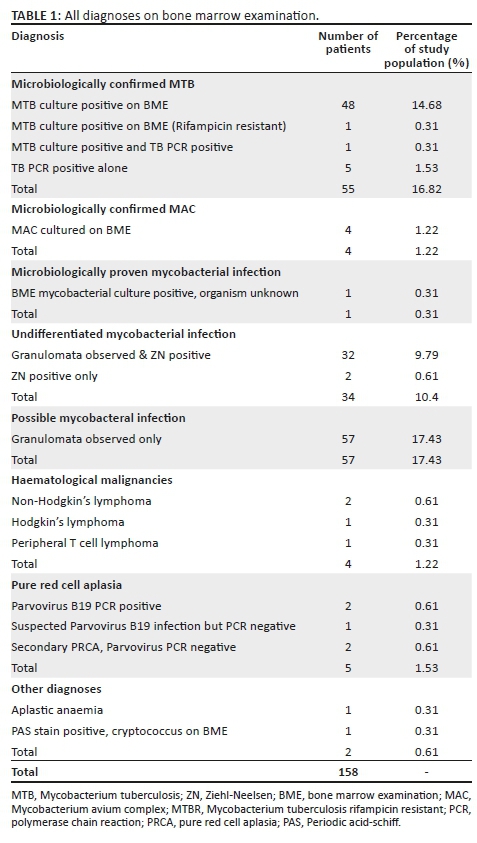
Of the 327 BMEs performed, 158 (48.3%) yielded positive results (Table 1). Three of these cases yielded two diagnoses each. The most common findings were the presence of granulomata on trephine examination (57 cases, 17.4%) and a positive bone marrow culture for MTB (50 cases, 15.3%). The presence of granulomata together with a positive ZN stain on BME was found in 32 cases (9.8%).
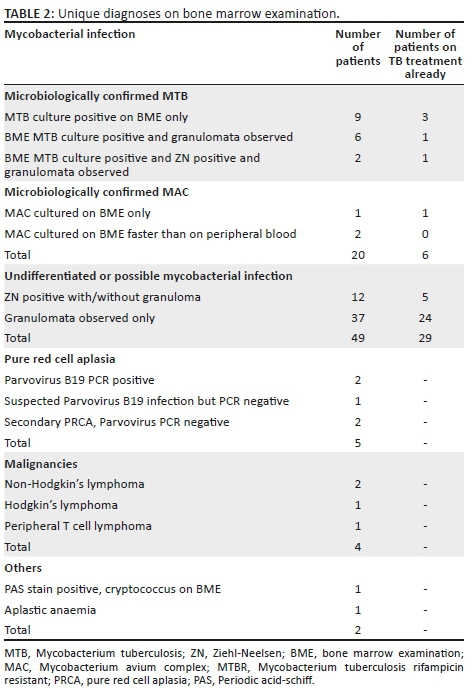
In 77 cases (23.5% of the study population), the diagnoses made were unique to the BME (Table 2). Confirmed MTB was the unique diagnosis obtained in 17 of the 77 cases (22.1%) with unique diagnoses and confirmed MAC comprising three of the unique diagnoses obtained (2.6%). In two of these cases, MAC was diagnosed considerably faster on BME than peripheral blood culture (4 vs. 38 days and 8 vs. 26 days, respectively). Five patients had the diagnosis of a pure red cell aplasia made on BME. Four cases of haematological malignancies were identified. These comprised two cases of non-Hodgkin's lymphoma (NHL), one case of Hodgkin's lymphoma and one case of peripheral T cell lymphoma. Aplastic anaemia and disseminated cryptococcal disease were two additional unique diagnoses made on BME.
Three patients had two unique diagnoses obtained on bone marrow investigation. The patient with Hodgkin's lymphoma also had the finding of granulomata on BME and was on empiric TB treatment. One patient with a positive Parvovirus B19 PCR slide also had a positive TB bone marrow culture. This patient was also on empiric TB treatment at the time of the BME. The third patient, who was not on TB treatment at the time of the BME, had both the diagnosis of NHL as well as a positive ZN stain together with granulomata observed on BME.
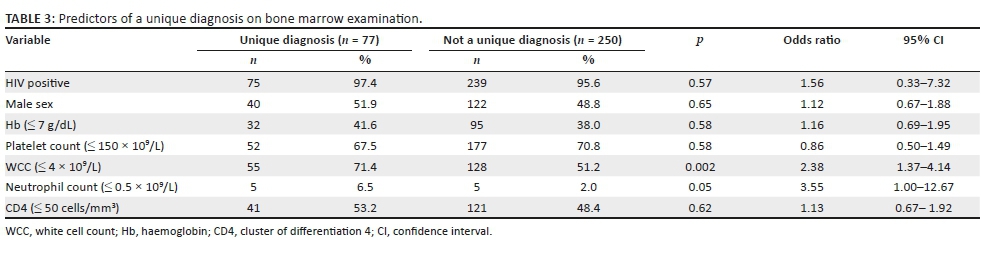
Of the laboratory parameters measured, a white cell count (WCC) ≤ 4 × 10⁹p = 0.002) (Table 3). A neutrophil count ≤ 0.5 × 10⁹p = 0.05); however, the numbers in this group were too small to interpret correctly.
Diagnosis of mycobacterial infection on bone marrow examination
Of the 327 bone marrow investigations performed, microbiological confirmation of MTB and MAC were made in 54 and 4 cases, respectively. Of the 226 bone marrow mycobacterial cultures performed 55 yielded positive results (24.3%). Of the 182 ZN stains performed 51 yielded positive results (28.0%). Six MTB PCRs were commented on as positive; however, it was not noted how many MTB PCR tests were performed that yielded negative results, and thus comparisons could not be performed. A WCC ≤ 4 × 1093Table 4).
There were seven patients with the diagnosis of MAC in the study population. In three of these patients, the BME was not diagnostic and MAC was found on a positive peripheral blood culture alone. Of the remaining four patients with MAC in the study population, one cultured MAC on bone marrow culture alone, namely a diagnosis unique to the BME. Amongst the other three patients, both the bone marrow and peripheral blood cultures were positive for MAC. In two of these cases, MAC was cultured faster on bone marrow than peripheral blood culture (unique diagnoses) and in one case MAC was cultured faster on peripheral blood hence not a unique diagnosis. This resulted in three of the four cases of MAC diagnosed on bone marrow culture that were unique to the BME. In all the cases of MAC, the CD4 cell counts were ≤ 35 cells/mm3
Discussion
In the current study, the cohort comprised patients from an ID ward at a tertiary level referral hospital covering a population of over 4 million individuals from central and northern Johannesburg.175,6,1118
The mean age of the study population was 36 years (17-65 years), with 96% of these individuals being HIV-seropositive. This reflects the high burden of HIV infection in the South African public sector.153333,19420n = 12 (4%) of the cohort was HIV-uninfected. This small number did not permit meaningful comparisons between the HIV-seronegative and HIV-seropositive groups.
Unique diagnosis on bone marrow examination
Positive results on BME were found in 48.3% of cases, which highlights the important persistent utility of BME in the investigation of patients with advanced immunosuppression and unexplained cytopenias, fever or the suspicion of disseminated mycobacterial infection. The finding of positive results in 48.3% of cases was marginally higher than previous studies in which diagnoses made on BME accounted for 25% - 47% of cases.3,4,5,8,9,10,12,13,14,2133,134
The predominant unique diagnosis made on BME in the current study was that of MTB, which encompassed 22.1% (17/77) of BMEs with a unique diagnosis. This finding is in agreement with the findings by both Van Schalkwyk et al.435
Other unique diagnoses found in the current study, which were similarly found in other studies, were disseminated MAC, haematological malignancies and disseminated cryptococcosis.11,14,2122
Predictors of a positive bone marrow examination result
This study found that a WCC ≤ 4 × 10⁹p = 0.002). A neutrophil count of ≤ 0.5 × 10939493,13136
Mycobacterial infection on bone marrow examination
Just over one-fifth of the unique diagnosis observed on BME resulted from confirmed MTB infection (22.1%). This finding highlights the persistent utility of the BMEs in diagnosing MTB despite the introduction of the Xpert MTB/RIF testing in early 2011.1623162425
Granulomata on bone marrow examination
In 57 cases granulomata were the only positive finding on the BME. Although there are potentially multiple causes of granuloma on BME, in the setting of advanced HIV and with a clinical suspicion of MTB in 32% of cases, the presence of granuloma in the clinical setting would add value in assisting with the decision to possibly initiate a patient on empiric MTB treatment. Lin et al.,12p = 0.03). This finding together with the high prevalence of HIV positive patients with lower CD4 cell counts possibly accounts for the higher prevalence of granulomata observed on BME in South African studies. Riley et al.11
Ziehl-Neelsen stain on bone marrow examination
Ziehl-Neelsen testing yielded positive results in 28% of cases. Van Schalkwyk et al.426
Predictors of Mycobacterium tuberculosis on bone marrow examination
This study found a WCC ≤ 4 × 10932733
Mycobacterium avium complex on bone marrow examination
Four individuals in this study had MAC cultured on BME, as compared to 49 who had MTB cultured. This finding is in contrast to studies conducted in the developed world, which reflect a higher prevalence of MAC infection as compared to MTB.5,6,9,10,11,12,1311
Potential limitations of the study
There were a few potential limitations of this study. This was a single centre study undertaken in a single unit and so the results may not be generalisable to other units or to other hospitals in SA. Study patients were already in an ID ward with clinically advanced HIV at the time of the study, this at the outset would favour the presence of opportunistic infections, particularly MTB. Bone marrow findings were obtained from the retrospective review of published reports and individual bone marrow aspirate and trephine specimens were not reanalysed; we were, therefore, unable to control for any unidentified variables that may have influenced patient presentation. The subjectivity associated with the interpretation of the BMEs by the different assessors has to be noted. In addition, the fact that the study cohort was obtained specifically from an ID ward in which the yield of tuberculosis and the HIV sero-prevalence is anticipated to be higher than that of a general medical ward having patients with both communicable and non-communicable diseases may influence how the study findings may be applied to primary or district hospital settings in SA.
Conclusion
The findings in this study conclude that bone marrow aspirate and trephine examinations still provide utility as a diagnostic tool even in the current South African setting of more comprehensive rollout of ART as well as increased availability of novel diagnostic tests for MTB. This finding applies particularly to patients in an ID ward in whom non-invasive standard investigations for the presence of cytopenias on peripheral blood have been negative and the concern of disseminated mycobacterial infection remains high. Performance of a bone marrow aspirate and trephine in these circumstances, through aiding with diagnosis, allows initiation and/or changes in patient treatment plans and by inference would most likely improve patient outcomes. The ongoing advancements occurring in the field of molecular diagnostics may in the future further revolutionise the efficacy and means of diagnostic tests utilised in such patients. Although the current study shows persistent diagnostic utility of BMEs, these ongoing advancements such as introduction of geneXpert Ultra testing may reduce the need for BME in the future. Furthermore, similar studies should be carried out and the current study would be a good marker to compare future studies against.
Our final recommendation would be to conduct the least invasive investigations first. If no success is obtained in making a diagnosis, a BME is then recommended. Mycobacterial cultures on blood and bone marrow specimens should be performed together to allow for optimal yield. Bone marrow trephine results should ideally be made available to the clinician within 2 weeks of the performance of the test. Unfortunately, this is often difficult in the resource-limited public sector in SA. It is imperative in those patients who have been started on empiric TB therapy to follow up the results of these invasive investigations in order to confirm the diagnosis and to exclude other unexpected diagnoses.
Competing interests
The authors have no conflict of interests.
Authors' contributions
N.B. assisted in conceptualising the study and writing the protocol, performed the data collection and data analysis and wrote the initial draft of the manuscript. C.F. assisted in conceptualising the study and writing the protocol, supervised the study, assisted in the data interpretation, and assisted in writing and finalising the manuscript.
Funding
This research received no specific grant from any funding agency in the public, commercial or not-for-profit sectors.
Data availability statement
Data sharing is not applicable to this article as no new data were created or analysed in this study.
Disclaimer
The views expressed in the article are those of the authors and not an official position of the institution or funder.
Acknowledgements
References
-
1.Statistics South Africa. Mid-year population estimates 2016: Statistical release P0302 [homepage on the Internet]. 2016 [cited 2017 Jun 18]. Available from: http://www.statssa.gov.za/publications/P0302/P03022015.pdf.
» http://www.statssa.gov.za/publications/P0302/P03022015.pdf -
2.Drain PK, Losina E, Parker G, et al. Risk factors for late-stage HIV disease presentation at initial HIV diagnosis in Durban, South Africa. PLoS One. 2013;8(1):e55305. https://doi.org/10.1371/journal.pone.0055305
» https://doi.org/10.1371/journal.pone.0055305 -
3.Karstaedt AS, Pantanowitz L, Omar T, Sonnendecker HEM, Patel M. The utility of bone-marrow examination in HIV-infected adults in South Africa. QJM. 2001;94(2):101-105. https://doi.org/10.1093/qjmed/94.2.101
» https://doi.org/10.1093/qjmed/94.2.101 -
4.Van Schalkwyk WA, Opie J, Novitzky N. The diagnostic utility of bone marrow biopsies performed for the investigation of fever and/or cytopenias in HIV-infected adults at Groote Schuur Hospital, Western Cape, South Africa. Int J Lab Hematol. 2011;33(3):258-266. https://doi.org/10.1111/j.1751-553X.2010.01280.x
» https://doi.org/10.1111/j.1751-553X.2010.01280.x -
5.Brook M, Ayles H, Harrison C, Rowntree C, Miller R. Diagnostic utility of bone marrow sampling in HIV positive patients. Genitourin Med. 1997;73(2):117-121. https://doi.org/10.1136/sti.73.2.117
» https://doi.org/10.1136/sti.73.2.117 -
6.Luther JM, Lakey DL, Larson RS, et al. Utility of bone marrow biopsy for rapid diagnosis of febrile illnesses in patients with human immunodeficiency virus infection. South Med J. 2000;93(7):692-697. https://doi.org/10.1097/00007611-200007000-00011
» https://doi.org/10.1097/00007611-200007000-00011 -
7.Tanaka PY, Hadad DJ, Barletti SC, De Souza SA, Calore EE. Bone marrow biopsy in the diagnoses of infectious and non-infectious causes in patients with advanced HIV infection. J Infect. 2007;54(4):362-366. https://doi.org/10.1016/j.jinf.2006.06.007
» https://doi.org/10.1016/j.jinf.2006.06.007 -
8.Engels E, Marks PW, Kazanjian P. Usefulness of bone marrow examination in the evaluation of unexplained fevers in patients infected with human immunodeficiency virus. Clin Infect Dis. 1995;21(2):427-428. https://doi.org/10.1093/clinids/21.2.427
» https://doi.org/10.1093/clinids/21.2.427 - 9.Bishburg E, Eng RH, Smith SM, Kapila R. Yield of bone marrow culture in the diagnosis of infectious diseases in patients with acquired immunodeficiency syndrome. J Clin Microbiol. 1986;24(2):312-314.
-
10.Quesada AE, Tholpady A, Wanger A, Nguyen AN, Chen L. Utility of bone marrow examination for workup of fever of unknown origin in HIV patients. J Clin Pathol. 2015;68(3):241-245. https://doi.org/10.1136/jclinpath-2014-202715
» https://doi.org/10.1136/jclinpath-2014-202715 -
11.Riley UB, Crawford S, Barrett SP, Abdalla SH. Detection of mycobacteria in bone marrow biopsy specimens taken to investigate pyrexia of unknown origin. J Clin Pathol. 1995;48(8):706-709. https://doi.org/10.1136/jcp.48.8.706
» https://doi.org/10.1136/jcp.48.8.706 -
12.Lin SH, Lai CC, Huang SH, Hung CC. Hsueh PR. Mycobacterial bone marrow infections at a medical centre in Taiwan, 2001-2009. Epidemiol Infect. 2014;142(7):1524-1532. https://doi.org/10.1017/S0950268813002707
» https://doi.org/10.1017/S0950268813002707 -
13.Keiser P, Rademacher S, Smith JW. Utility of bone marrow culture and biopsy in the diagnosis of disseminated infections in AIDS. Am J Hematol. 1997;56(1):1-4. https://doi.org/10.1002/(SICI)1096-8652(199709)56:1<1::AID-AJH1>3.0.CO;2-U.
» https://doi.org/10.1002/(SICI)1096-8652(199709)56:1<1::AID-AJH1>3.0.CO;2-U - 14.Northfelt DW, Mayer A, Kaplan LD, et al. The usefulness of diagnostic bone marrow examination in patients with human immunodeficiency virus (HIV) infection. J Acquir Immune Defic Syndr. 1991;4(7):659-666.
- 15.Shisana O, Rehle T, Simbayi LC, et al. South African national HIV prevalence, incidence and behaviour survey, 2012. Cape Town: HSRC Press; 2014.
-
16.National Health Laboratory Service. GeneXpert MTB/RIF progress report [homepage on the Internet]. 2015 [cited 2019 Feb 10]. Available from: https://www.nhls.ac.za/assets/files/GeneXpert%20Progress%20Report%20February%202015%20Final.pdf.
» https://www.nhls.ac.za/assets/files/GeneXpert%20Progress%20Report%20February%202015%20Final.pdf -
17.Gauteng Province Department of Health. Charlotte Maxeke Academic Hospital. [cited 2017 Jun 18]. Available from: https://www.health.gpg.gov.za/hospitals/pages/Charlotte-Maxeke-Academic.aspx.
» https://www.health.gpg.gov.za/hospitals/pages/Charlotte-Maxeke-Academic.aspx -
18.UNAIDS. Global AIDS Update 2016. Joint United Nations Programme on HIV/AIDS. 2016 [cited 2017 Jun 18]. Available from: https://www.unaids.org/sites/default/files/media_asset/global-AIDS-update-2016_en.pdf.
» https://www.unaids.org/sites/default/files/media_asset/global-AIDS-update-2016_en.pdf -
19.Holmes CB, Wood R, Badri M, et al. CD4 decline and incidence of opportunistic infections in Cape Town, South Africa: Implications for prophylaxis and treatment. J Acquir Immune Defic Syndr. 2006;42(4):464-469. https://doi.org/10.1097/01.qai.0000225729.79610.b7
» https://doi.org/10.1097/01.qai.0000225729.79610.b7 -
20.Simelela NP, Venter WDF. History of HIV in SA: A brief history of South Africa's response to AIDS. S Afr Med J. 2014;104(3):249-251. https://doi.org/10.7196/SAMJ.7700
» https://doi.org/10.7196/SAMJ.7700 -
21.Pande A, Bhattacharyya M, Pain S, Ghosh A, Samanta A. Diagnostic yield of bone marrow examination in HIV associated FUO in ART naive patients. J Infect Public Health. 2010;3(3):124-129. https://doi.org/10.1016/j.jiph.2010.07.006
» https://doi.org/10.1016/j.jiph.2010.07.006 - 22.World Health Organization. Global tuberculosis report 2014 (WHO/HTM/TB/2014.08). Geneva: WHO; 2014.
-
23.Steingart KR, Schiller I, Horne DJ et al. Xpert1 MTB/RIF assay for pulmonary tuberculosis and rifampicin resistance in adults. Cochrane Database Syst Rev. 2014;2014 Jan(1):CD009593. https://doi.org/10.1002/14651858.CD009593.pub3
» https://doi.org/10.1002/14651858.CD009593.pub3 -
24.Lawn SD, Kerkhoff AD, Pahlana P, Vogt M, Wood R. Diagnostic yield of tuberculosis using sputum induction in HIV-positive patients before antiretroviral therapy. Int J Tuberc Lung Dis. 2012;16(10):1354-1357. https://doi.org/10.5588/ijtld.12.0174
» https://doi.org/10.5588/ijtld.12.0174 -
25.Lawn SD, Gupta-Wright A. Detection of lipoarabinomannan (LAM) in urine is indicative of disseminated TB with renal involvement in patients living with HIV and advanced immunodeficiency: Evidence and implications. Trans R Soc Trop Med Hyg. 2015;110(3):180-185. https://doi.org/10.1093/trstmh/trw008
» https://doi.org/10.1093/trstmh/trw008 - 26.Chosmata BI. Comparison of multiple methods of diagnosis of mycobacterial infection from bone marrow samples of HIV positive patients [doctoral dissertation]. Johannesburg: Faculty of Health Sciences, University of the Witwatersrand; 2011.
-
27.Sedick Q, Vaughan J, Pheeha T, Alli NA. Bone marrow aspirate microscopy versus bone marrow trephine biopsy for detection of Mycobacterial tuberculosis infection. S Afr Med J. 2015;105(9):773-775. https://doi.org/10.7196/SAMJnew.8171
» https://doi.org/10.7196/SAMJnew.8171

Accepted: 05 June 2019
Published: 30 Sept. 2019