Guidelines for the vaccination of HIV-infected adolescents and adults in South Africa
Introduction
The introduction of vaccines has been one of the most cost-effective strategies to prevent infectious diseases in humans.12
Effective antiretroviral therapy (ART) has resulted in HIV infection becoming a chronic manageable illness. Despite ART, systemic inflammation and immune activation persist in HIV-infected individuals and are associated with adverse health outcomes.34
The impact of VPDs in HIV-infected individuals not only relates to the acute phase mortality but also derives from the high prevalence of these diseases in the HIV population, with effects on long-term morbidity and mortality.5
Vaccines enhance immunity against infections that may have been compromised following HIV infection. The benefits of vaccination in HIV-infected individuals must be weighed against its risks. However, in the absence of severe immunosuppression, the majority of routine vaccines, including live attenuated vaccines, have been found to be safe for use in HIV-infected individuals.24,678
There are no national guidelines for the use of vaccines for HIV-infected people in South Africa. Establishment of guidelines could contribute to improving vaccine uptake in this population. The national guidelines will also help healthcare workers in decision-making towards vaccinating HIV-infected individuals. The use of vaccines in the HIV-infected is generally safe and causes no harm among patients with CD4+ counts above 200 cells/µL and with very low viral load (< 50 copies/mL).9,10
As part of a comprehensive approach to the management of HIV-infected individuals, the Southern African HIV Clinicians Society aims to promote the use of vaccines in this group. Currently, there are no guidelines on the use of vaccines among the HIV-infected in South Africa. Furthermore, suboptimal knowledge among HIV-infected individuals and healthcare providers undermines the use of vaccines in a population that could otherwise benefit most from vaccination.
Challenges of vaccination
Challenges faced by the healthcare providers wanting to vaccinate HIV-infected individuals include, firstly, a lack of national guidelines and policies. Secondly, vaccines are not generally available at settings where HIV-infected adults seek care. Furthermore, cost of the vaccines may be a limiting factor in the health system which is already burdened by various other costs. These barriers impact negatively on the uptake of vaccines among HIV-infected adolescents and adults.
Rationale for the development of national guidelines
The epidemiology of HIV disease has changed significantly in the last 10 years in South Africa. More people with HIV are living longer as access to ART increases. Associated with this increase in life expectancy is an increased risk of VPDs despite suppressive ART.
Scope of guideline
These national guidelines for vaccines available for HIV-infected adolescents and adults in South Africa have been developed to address challenges of adolescent and adult immunisation in the setting of HIV. The guidelines specifically focus on the most common VPDs in sub-Saharan Africa among HIV-infected adolescents and adults. The best available evidence has been used to make recommendations on the appropriate use of active and passive immunisation in HIV-infected adolescents and adults.
Influenza vaccines
Influenza is a seasonal viral disease that often leads to a high morbidity and mortality both nationally and globally. The mortality from influenza in South Africa is between 6000 and 11 000 deaths every year.1112,1314101516
The influenza season in South Africa is variable. It can start as early as April or as late as July and lasts between 12 and 25 weeks.17
The panel recommends that the trivalent- or quadrivalent-inactivated influenza vaccine be administered between March and May each year to all HIV-infected persons, irrespective of CD4+ cell count, HIV viral load or pregnancy status.
Pneumococcal vaccines
Invasive pneumococcal disease (IPD) in HIV-infected individuals is a significant cause of morbidity and mortality.1819,20,2119,2022
However, with such a high burden of disease in the HIV-infected population, there is a need to consider additional or complementary strategies to prevent pneumococcal disease in HIV-infected adults. An example would be a combination vaccine strategy of the 13-valent pneumococcal conjugate vaccine (PCV13) and 23-valent pneumococcal polysaccharide vaccine (PPV23). This directly increases protection to serotypes that are in PPV23 but not in PCV13.
Broadly, there are two types of vaccine available for use to prevent pneumococcal disease: the pneumococcal polysaccharide vaccines (PPV) and the PCV. The PPV23 is protective against all-cause pneumonia and pneumococcal disease in HIV-infected adults, although data vary as to whether the protective benefit is irrespective of CD4+ count above a particular threshold, or dependent on HIV viral load at time of vaccination.232419
A randomised double-blind placebo-controlled trial of PCV7 in HIV-infected adults in Malawi showed that the vaccine was protective against recurrent IPD.192025
The use of either PCVs or PPVs will be a balance between the resources available to pay for the vaccine and the evidence to support the use of either of the vaccines or even a combination. The evidence suggests that the burden of pneumococcal disease is high in HIV-infected individuals, and vaccination against pneumococcal disease is an important strategy to reduce this.262725288,29
Vaccination against pneumococcal disease should be recommended for all HIV-infected individuals regardless of CD4+ count, but ideally when HIV viral load is < 1000 copies/mL.29
Meningococcal vaccines
Neisseria meningitidis is endemic in South Africa, presenting as meningococcal bacteraemia or meningitis. HIV infection is an important risk factor for acquiring invasive meningococcal disease (IMD), with a relative risk 5-13 times greater than the general population.30,31,32,3333
Currently in South Africa, meningococcal disease is a minor contributor to mortality among the HIV-infected, when compared to other infections such as tuberculosis (TB) and pneumococcal disease.3430,35
Our recommendation is that, where possible, vaccination should be considered in HIV-infected adults with a CD4+ count above 200 cells/µL. Where resources are limited, routine meningococcal vaccination of HIV-infected adults should follow the indications for meningococcal vaccination for the general population.
The general indications for vaccine are:
• functional or anatomic asplenia
• complement deficiency
• individuals at risk of exposure through travel or work settings (routine microbiology laboratories)
• individuals living in hostels, or university or college residences
• individuals at risk through an outbreak, including men who have sex with men (MSM) who may be exposed to outbreak strains because of social interactions within the global MSM community.
Two quadrivalent meningococcal vaccines covering serogroups A, C, W135 and Y are currently available in South Africa. One is a polysaccharide vaccine and the other is a protein-conjugated polysaccharide vaccine. Because of the hypo-immunity associated with repeated doses of the plain polysaccharide vaccine, it is recommended that HIV-infected individuals receive the conjugate vaccine.3637
Pertussis vaccines
There are currently two categories of pertussis vaccines, namely, acellular and whole-cell vaccines.38Bordetella pertussis organisms. Although infants below three months of age are at the highest risk of death from Bordetella pertussis, current epidemiological evidence shows that it is an important cause of respiratory disease in both adolescents and adults.38,39,404139
Evidence shows that asymptomatic pertussis infection is more common than symptomatic infection in healthy adolescents and adults.424143
Diphtheria and tetanus vaccines
Recommendations for the use of tetanus and diphtheria vaccines in HIV-infected adults mirror that for the general population. Both vaccines are inactivated toxoid and are therefore safe for use in HIV-infected individuals. Vaccine-induced immune responses following tetanus vaccination appear to be similar in both HIV-infected and HIV-uninfected individuals.44745
However, as the evidence is lacking on the optimal booster schedule for HIV-infected adults, the recommendation is administration of tetanus and diphtheria vaccines at least every 10 years until more data are available.
Hepatitis A vaccines
Hepatitis A virus (HAV) is the most common cause of acute viral hepatitis, with approximately 1.4 million clinical cases annually.46474747
Men who have sex with men are at a higher risk of acquiring HAV infection with reported outbreaks in some parts of the world.7,4849
About 13 studies have reported data on HAV vaccination of HIV-infected adults.464646
There is no consensus on the benefits of routine vaccination of HIV-infected adults with HAV vaccines. Advisory groups such as ACIP and the WHO Strategic Advisory Group of Experts on Immunisation (SAGE) recommend vaccination in the presence of other risk factors (medical, behavioural, epidemiological or occupational risk factors). High risk groups for HAV infection typically include MSM, injection drug users, people travelling to or working in countries with a high or intermediate endemicity of HAV, people with chronic liver disease (including hepatitis B or C), bleeding diathesis, immunosuppressed individuals who have undergone transplantation and contacts of children arriving from countries with high or intermediate HAV endemicity.46
We recommend that HAV vaccination should be given if there are other medical, behavioural, epidemiological or occupational conditions in addition to HIV infection. The accepted schedule is two doses separated by 6-12 months.46
Hepatitis B vaccines
Hepatitis B virus (HBV) vaccination is highly recommended for individuals with HIV infection. Globally, the introduction of routine HBV vaccination has resulted in a significant decrease of HBV infection and the overall disease burden.46,505146,52
In South Africa, HBV vaccination has been part of the childhood immunisation programme since April 1995. Although vaccination coverage against HBV in childhood is high,5354
The administration of vaccines against HBV among HIV-infected individuals has been shown to be safe in many studies.554656
The international recommendation for administration of vaccines against HBV is a four-double-dose regimen of a recombinant HBV vaccine (40 µg) at 0, 1, 2 and 6 months.57558,58,59,6046
The panel supports the four-double-dose regimen HBV vaccine schedule. If this is not possible, then the standard regimen should be administered. The panel does not recommend serologic antibody testing and is only advised for healthcare workers or others at high risk.
Human papilloma virus vaccines
Human papilloma virus (HPV) infection is a common infection in HIV-infected adults. The virus is more prevalent and persistent in HIV-infected adults. The persistence of certain serotypes of HPV infection is associated with squamous dysplasia and cancer.6161,6261,63
HPV vaccines are safe and immunogenic in HIV-infected adults.6461
In South Africa, HPV vaccination is routinely recommended for preteen girls aged 9-13 years, regardless of HIV status. HPV vaccination is recommended for all HIV-infected adult men and women, and MSM aged up to 40 years, regardless of CD4+ count, ART use or viral load. In the public sector in South Africa, the bivalent vaccine is currently in use. In the private sector, the quadrivalent HPV vaccine (4vHPV) is also available. The 4vHPV was originally tested and approved as a three-dose regimen, with a dosing schedule of 0, 2 and 6 months. More recently, a two-dose schedule (6 or 12 months apart) has been recommended by the World Health Organization for younger age groups (e.g. 9-14 years at first dose). This is because immunogenicity with two doses in preadolescent and early adolescent girls was noninferior to antibody responses in women aged 16-26 years receiving three doses.65,6628
Poliovirus vaccines
There are very little data on wild-type poliomyelitis in HIV-infected individuals. Poliomyelitis is exceedingly rare in South Africa but continues to occur in a few countries in the world. The live attenuated oral polio vaccine should be avoided in immunocompromised HIV-infected individuals because of the potential risk of paralytic polio.67
As with many other vaccines, HIV-infected adults have reduced vaccine-induced immune response to inactivated polio vaccine,44,68
We recommend that all unvaccinated HIV-infected adults be vaccinated with the inactivated polio vaccine, regardless of CD4+ count, especially if the individuals are travelling to high-risk regions (such as Nigeria, Pakistan and Afghanistan). Three doses should be administered at 0, 1-2 and 6-12 months with a further dose after 10 years if at high risk.69
Live vaccines
The use of live vaccines is contraindicated in HIV-infected adults, especially if the CD4+ count is below 200 cells/µL, and/or there is clinical evidence of acquired immune deficiency syndrome (AIDS). There is evidence that for some live vaccines, there is a potential for the proliferation of vaccine-related viruses in the host, varicella as an example.70,71
Measles, mumps and rubella vaccine
Measles, mumps and rubella (MMR) vaccines are live and therefore contraindicated in individuals with CD4+ counts below 200 cells/µL.
The ACIP has since 2013 made recommendation about the use of MMR vaccine in HIV-infected adults, provided the CD4+ counts are above 200 cells/µL, without laboratory evidence of immunity or past disease.7272
Most international guidelines recommend MMR vaccination in non-immune adults infected with HIV with a CD4+ cell count above 200 cells/µL.28,72
Varicella vaccines
It is estimated that 4.2 million cases of severe varicella infection globally result in hospitalisation or death. Varicella zoster virus (VZV) infections and related deaths are common in HIV-infected individuals. Most HIV-infected adults will have evidence of prior infection or immunity. There is an effective vaccine for varicella which is in use in high-income countries. There are limited data on varicella vaccination in HIV-infected adolescents or adults, although one study has reported on the safety and modest immunogenicity of two doses of varicella vaccine in HIV-infected adults with a CD4+ count above 400 cells/µL with a suppressed viral load.7374
Zoster vaccine
Reactivation of latent varicella-zoster virus infection leads to a debilitating condition: Herpes zoster (HZ; known as shingles). Despite the increased uptake and use of ART, the incidence of Herpes zoster remains increased in HIV-infected adults. The increased uptake of ART has also resulted in a greater proportion of HIV-infected people living beyond the age of 50 years.7,75,76
The use of varicella vaccine is recommended in varicella-susceptible adults, as long as they have a CD4+ count above 200 cells/µL; the same CD4+ threshold is used for MMR and yellow fever vaccines. No transmission of vaccine strain VZV has been documented in people with HIV infection with a CD4+ count above this threshold. The administration of live attenuated Herpes zoster vaccine (LAHZV) to 295 HIV-infected adults with a CD4+ count above 200 cells/µL was found to be safe and immunogenic, with no cases of vaccine strain infection.75,77
At present, there are no epidemiological data to support the use of this vaccine in Africa. There is a systematic review underway to assess the morbidity and mortality of VZV infection.74
Conclusion
The role out and increased uptake of ART has led to improvements in mortality of HIV-infected individuals. A great proportion of individuals are still at risk of vaccine preventable infections. Vaccines are an important tool in protecting individuals at risk of vaccine preventable infections. A suppressed viral load and a CD4+ count above 200 cells/µL improve immunogenicity to vaccines.
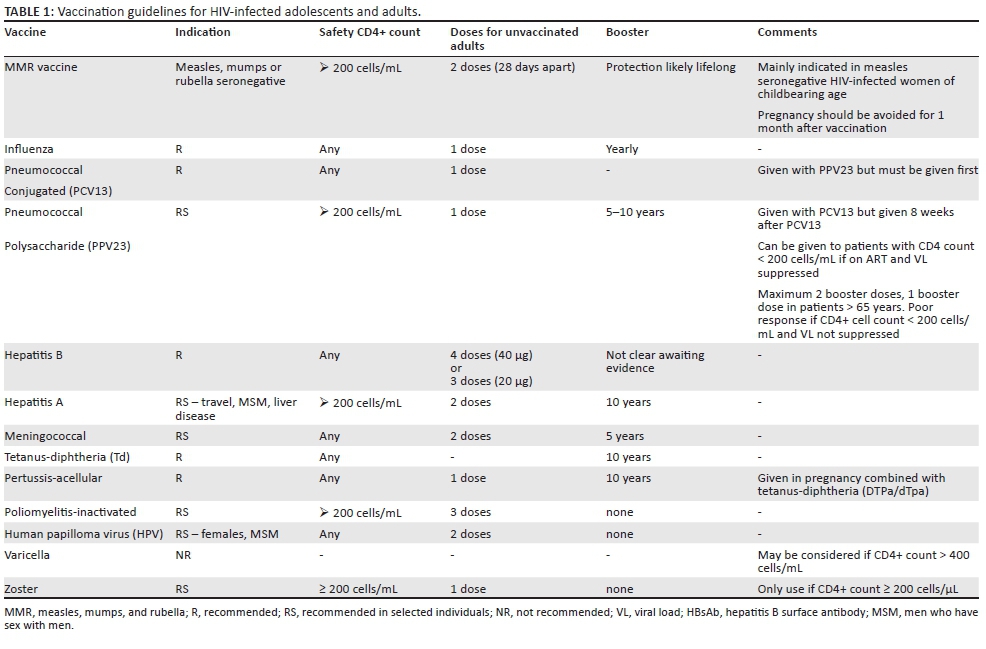
These guidelines are primarily aimed to help clinicians who look after people living with HIV infection. For some vaccines, there may not be enough local evidence to give guidance. It is believed that by producing this guideline, the gaps in our local data will generate research to provide the necessary evidence. This guideline attempts to take into account our local epidemiological situation in formulating our guidance where possible (see Table 1).
Competing interests
The authors declare no potential conflict of interest.
Authors' contributions
S.K.D. chaired the meeting for the development of guidelines for the use of vaccines for HIV-infected individuals, is the corresponding author and prepared the first draft of the manuscript. All other authors were involved in the discussions that guided the development of the manuscript, contributed to the first draft and reviewed the first draft. All authors developed the recommendations.
Acknowledgements
This work was supported and funded by the Southern African HIV Clinicians Society and MSD through an educational grant. The funders had no role in the development and preparation of the manuscript. Dr John Black, Dr Prashini Moodley and Dr Karl le Roux were involved in the discussions at the guideline meeting that guided the development of these guidelines.
References
-
1. Eaton EF, Kulczycki A, Saag M, Mugavero M, Raper JL. Immunization costs and programmatic barriers at an urban HIV clinic. Clin Infect Dis. 2015;61(11):1726-1731. https://doi.org/10.1093/cid/civ637
» https://doi.org/10.1093/cid/civ637 -
2. Geretti AM, Doyle T. Immunization for HIV-positive individuals. Curr Opin Infect Dis. 2010;23(1):32-38. https://doi.org/10.1097/QCO.0b013e328334fec4
» https://doi.org/10.1097/QCO.0b013e328334fec4 -
3. Slim J, Saling CF. A review of management of inflammation in the HIV population. BioMed Res Int. 2016;2016:3420638. https://doi.org/10.1155/2016/3420638
» https://doi.org/10.1155/2016/3420638 -
4. Tan DH, Szadkowski L, Raboud J, et al. Effect of intercurrent infections and vaccinations on immune and inflammatory biomarkers among human immunodeficiency virus-infected adults on suppressive antiretroviral therapy. Open Forum Infect Dis. 2015;2(2):ofv036. https://doi.org/10.1093/ofid/ofv036
» https://doi.org/10.1093/ofid/ofv036 - 5. Nicolini LA, Giacobbe DR, Di Biagio A, Viscoli C. Insights on common vaccinations in HIV-infection: Efficacy and safety. J Prev Med Hyg. 2015;56(1):E28-E32.
-
6. Kuller LH, Tracy R, Belloso W, et al. Inflammatory and coagulation biomarkers and mortality in patients with HIV infection. PLoS Med. 2008;5(10):e203. https://doi.org/10.1371/journal.pmed.0050203
» https://doi.org/10.1371/journal.pmed.0050203 -
7. Crum-Cianflone NF, Wallace MR. Vaccination in HIV-infected adults. AIDS Patient Care STDs. 2014;28(8):397-410. https://doi.org/10.1089/apc.2014.0121
» https://doi.org/10.1089/apc.2014.0121 -
8. Kerneis S, Launay O, Turbelin C, Batteux F, Hanslik T, Boelle PY. Long-term immune responses to vaccination in HIV-infected patients: A systematic review and meta-analysis. Clin Infect Dis. 2014;58(8):1130-1139. https://doi.org/10.1093/cid/cit937
» https://doi.org/10.1093/cid/cit937 - 9. Ceravolo A, Orsi A, Parodi V, Ansaldi F. Influenza vaccination in HIV-positive subjects: Latest evidence and future perspective. J Prev Med Hyg. 2013;54(1):1-10.
-
10. Remschmidt C, Wichmann O, Harder T. Influenza vaccination in HIV-infected individuals: Systematic review and assessment of quality of evidence related to vaccine efficacy, effectiveness and safety. Vaccine. 2014;32(43):5585-5592. https://doi.org/10.1016/j.vaccine.2014.07.101
» https://doi.org/10.1016/j.vaccine.2014.07.101 - 11. Cohen C, Moyes J, Tempia S, et al. Mortality amongst patients with influenza-associated severe acute respiratory illness, South Africa, 2009-2013. PLoS One. 2015;10(3):e0118884.
-
12. Cohen C, Walaza S, Moyes J, et al. Epidemiology of severe acute respiratory illness (SARI) among Adults and children aged >/=5 years in a high HIV-prevalence setting, 2009-2012. PLoS One. 2015;10(2):e0117716. https://doi.org/10.1371/journal.pone.0118884
» https://doi.org/10.1371/journal.pone.0118884 -
13. Cohen C, Moyes J, Tempia S, et al. Severe influenza-associated respiratory infection in high HIV prevalence setting, South Africa, 2009-2011. Emerg Infect Dis. 2013;19(11):1766-1774. https://doi.org/10.3201/eid1911.130546
» https://doi.org/10.3201/eid1911.130546 -
14. Kroon FP, van Dissel JT, de Jong JC, Zwinderman K, van Furth R. Antibody response after influenza vaccination in HIV-infected individuals: A consecutive 3-year study. Vaccine. 2000;18(26):3040-3049. https://doi.org/10.1016/S0264-410X(00)00079-7
» https://doi.org/10.1016/S0264-410X(00)00079-7 -
15. Madhi SA, Maskew M, Koen A, et al. Trivalent inactivated influenza vaccine in African adults infected with human immunodeficient virus: Double blind, randomized clinical trial of efficacy, immunogenicity, and safety. Clin Infect Dis. 2011;52(1):128-137. https://doi.org/10.1093/cid/ciq004
» https://doi.org/10.1093/cid/ciq004 -
16. Madhi SA, Nunes MC, Cutland CL. Influenza vaccination of pregnant women and protection of their infants. N Engl J Med. 2014;371(24):2340. https://doi.org/10.1056/NEJMc1412050
» https://doi.org/10.1056/NEJMc1412050 -
17. McAnerney JM, Cohen C, Moyes J, et al. Twenty-five years of outpatient influenza surveillance in South Africa, 1984-2008. J Infect Dis. 2012;206(Suppl 1):S153-S158. https://doi.org/10.1093/infdis/jis575
» https://doi.org/10.1093/infdis/jis575 -
18. Cohen C, Naidoo N, Meiring S, et al. Streptococcus pneumoniae serotypes and mortality in adults and adolescents in South Africa: Analysis of national surveillance data, 2003-2008. PLoS One. 2015;10(10):e0140185. https://doi.org/10.1371/journal.pone.0140185
» https://doi.org/10.1371/journal.pone.0140185 -
19. French N, Gordon SB, Mwalukomo T, et al. A trial of a 7-valent pneumococcal conjugate vaccine in HIV-infected adults. N Engl J Med. 2010;362(9):812-822. https://doi.org/10.1056/NEJMoa0903029
» https://doi.org/10.1056/NEJMoa0903029 -
20. Lombardi F, Belmonti S, Fabbiani M, et al. Immunogenicity and safety of the 13-valent pneumococcal conjugate vaccine versus the 23-valent polysaccharide vaccine in unvaccinated HIV-infected adults: A pilot, prospective controlled study. PLoS One. 2016;11(6):e0156523. https://doi.org/10.1371/journal.pone.0156523
» https://doi.org/10.1371/journal.pone.0156523 -
21. Meiring S, Cohen C, Quan V, et al. HIV Infection and the epidemiology of invasive pneumococcal disease (IPD) in South African adults and older children prior to the introduction of a pneumococcal conjugate vaccine (PCV). PLoS One. 2016;11(2):e0149104. https://doi.org/10.1371/journal.pone.0149104
» https://doi.org/10.1371/journal.pone.0149104 -
22. von Gottberg A, de Gouveia L, Tempia S, et al. Effects of vaccination on invasive pneumococcal disease in South Africa. N Engl J Med. 2014;371(20):1889-1899. https://doi.org/10.1056/NEJMoa1401914
» https://doi.org/10.1056/NEJMoa1401914 -
23. MacLennan CA, Richter A, Hodson J, et al. Brief report: Immunization of HIV-infected adults in the UK with Haemophilus influenzae b/meningococcal C glycoconjugate and pneumococcal polysaccharide vaccines. J Acquir Immune Defic Syndr. 2016;73(3):287-293. https://doi.org/10.1097/QAI.0000000000001054
» https://doi.org/10.1097/QAI.0000000000001054 -
24. French N, Nakiyingi J, Carpenter LM, et al. 23-valent pneumococcal polysaccharide vaccine in HIV-1-infected Ugandan adults: Double-blind, randomised and placebo controlled trial. Lancet. 2000;355(9221):2106-2111. https://doi.org/10.1016/S0140-6736(00)02377-1
» https://doi.org/10.1016/S0140-6736(00)02377-1 -
25. Sadlier C, O'Dea S, Bennett K, Dunne J, Conlon N, Bergin C. Immunological efficacy of pneumococcal vaccine strategies in HIV-infected adults: A randomized clinical trial. Sci Rep. 2016;6:32076. https://doi.org/10.1038/srep32076
» https://doi.org/10.1038/srep32076 -
26. Jones N, Huebner R, Khoosal M, Crewe-Brown H, Klugman K. The impact of HIV on Streptococcus pneumoniae bacteraemia in a South African population. AIDS. 1998;12(16):2177-2184. https://doi.org/10.1097/00002030-199816000-00013
» https://doi.org/10.1097/00002030-199816000-00013 -
27. Lee KY, Tsai MS, Kuo KC, et al. Pneumococcal vaccination among HIV-infected adult patients in the era of combination antiretroviral therapy. Hum Vaccin Immunother. 2014;10(12):3700-3710. https://doi.org/10.4161/hv.32247
» https://doi.org/10.4161/hv.32247 -
28. Geretti AM, Brook G, Cameron C, et al. British HIV association guidelines on the use of vaccines in HIV-positive adults 2015. HIV Med. 2016;17(Suppl 3):S2-S81. https://doi.org/10.1111/hiv.12424
» https://doi.org/10.1111/hiv.12424 - 29. Iyer AS, Leggat DJ, Ohtola JA, et al. Response to pneumococcal polysaccharide vaccination in HIV-positive individuals on long term highly active antiretroviral therapy. J AIDS Clin Res. 2015;6(2):pii: 421.
-
30. MacNeil JR, Rubin LG, Patton M, Ortega-Sanchez IR, Martin SW. Recommendations for use of meningococcal conjugate vaccines in HIV-infected persons - Advisory Committee on Immunization Practices, 2016. MMWR Morb Mortal Wkly Rep. 2016;65(43):1189-1194. https://doi.org/10.15585/mmwr.mm6543a3
» https://doi.org/10.15585/mmwr.mm6543a3 -
31. Miller L, Arakaki L, Ramautar A, et al. Elevated risk for invasive meningococcal disease among persons with HIV. Ann Intern Med. 2014;160(1):30-37. https://doi.org/10.7326/0003-4819-160-1-201401070-00731
» https://doi.org/10.7326/0003-4819-160-1-201401070-00731 -
32. Harris CM, Wu HM, Li J, et al. Meningococcal disease in patients with human immunodeficiency virus infection: A review of cases reported through active surveillance in the United States, 2000-2008. Open Forum Infect Dis. 2016;3(4):ofw226. https://doi.org/10.1093/ofid/ofw226
» https://doi.org/10.1093/ofid/ofw226 -
33. Cohen C, Singh E, Wu HM, et al. Increased incidence of meningococcal disease in HIV-infected individuals associated with higher case-fatality ratios in South Africa. AIDS. 2010;24(9):1351-1360. https://doi.org/10.1097/QAD.0b013e32833a2520
» https://doi.org/10.1097/QAD.0b013e32833a2520 -
34. Jafri RZ, Ali A, Messonnier NE, et al. Global epidemiology of invasive meningococcal disease. Popul Health Metr. 2013;11(1):17. https://doi.org/10.1186/1478-7954-11-17
» https://doi.org/10.1186/1478-7954-11-17 - 35. Campos-Outcalt D. Practice alert: ACIP vaccine update, 2017. J Fam Pract. 2017;66(3):166-169.
-
36. Khatami A, Pollard AJ. The epidemiology of meningococcal disease and the impact of vaccines. Exp Rev Vaccines. 2010;9(3):285-298. https://doi.org/10.1586/erv.10.3
» https://doi.org/10.1586/erv.10.3 -
37. Meiring S, Hussey G, Jeena P, Parker S, von Gottberg A. Recommendations for the use of meningococcal vaccines in South Africa. South Afr J Infect Dis. 2017;32(3):82-86. https://doi.org/10.1080/23120053.2017.1359939
» https://doi.org/10.1080/23120053.2017.1359939 - 38. Pertussis vaccines: WHO position paper - September 2015. Wkly Epidemiol Rec. 2015;90(35):433-458.
-
39. Nunes MC, Downs S, Jones S, van Niekerk N, Cutland CL, Madhi SA. Bordetella pertussis infection in South African HIV-infected and HIV-uninfected mother-infant dyads: A longitudinal cohort study. Clin Infect Dis. 2016;63(Suppl 4):S174-S180. https://doi.org/10.1093/cid/ciw527
» https://doi.org/10.1093/cid/ciw527 -
40. Celentano LP, Massari M, Paramatti D, Salmaso S, Tozzi AE, Group E-N. Resurgence of pertussis in Europe. Pediatr Infect Dis J. 2005;24(9):761-765. https://doi.org/10.1097/01.inf.0000177282.53500.77
» https://doi.org/10.1097/01.inf.0000177282.53500.77 -
41. Troy SB, Rossheim AE, Hilliard DD, Cunningham TD. Brief report: Seroprevalence of pertussis infection in HIV-infected adults in the United States. J Acquir Immune Defic Syndr. 2016;73(3):282-286. https://doi.org/10.1097/QAI.0000000000001037
» https://doi.org/10.1097/QAI.0000000000001037 -
42. Ward JI, Cherry JD, Chang SJ, et al. Bordetella pertussis infections in vaccinated and unvaccinated adolescents and adults, as assessed in a national prospective randomized Acellular Pertussis Vaccine Trial (APERT). Clin Infect Dis. 2006;43(2):151-157. https://doi.org/10.1086/504803
» https://doi.org/10.1086/504803 -
43. Dangor Z, Nunes MC, Kwatra G, Lala SG, Madhi SA. Vaccination of HIV-infected pregnant women: Implications for protection of their young infants. Trop Dis Travel Med Vaccines. 2017;3:1. https://doi.org/10.1186/s40794-016-0044-7
» https://doi.org/10.1186/s40794-016-0044-7 -
44. Kroon FP, van Dissel JT, Labadie J, van Loon AM, van Furth R. Antibody response to diphtheria, tetanus, and poliomyelitis vaccines in relation to the number of CD4+ T lymphocytes in adults infected with human immunodeficiency virus. Clin Infect Dis. 1995;21(5):1197-1203. https://doi.org/10.1093/clinids/21.5.1197
» https://doi.org/10.1093/clinids/21.5.1197 -
45. Rosenblatt HM, Song LY, Nachman SA, et al. Tetanus immunity after diphtheria, tetanus toxoids, and acellular pertussis vaccination in children with clinically stable HIV infection. J Allergy Clin Immunol. 2005;116(3):698-703. https://doi.org/10.1016/j.jaci.2005.05.016
» https://doi.org/10.1016/j.jaci.2005.05.016 -
46. Mena G, Garcia-Basteiro AL, Bayas JM. Hepatitis B and A vaccination in HIV-infected adults: A review. Hum Vaccines Immunother. 2015;11(11):2582-2598. https://doi.org/10.1080/21645515.2015.1055424
» https://doi.org/10.1080/21645515.2015.1055424 -
47. Franco E, Meleleo C, Serino L, Sorbara D, Zaratti L. Hepatitis A: Epidemiology and prevention in developing countries. World J Hepatol. 2012;4(3):68-73. https://doi.org/10.4254/wjh.v4.i3.68
» https://doi.org/10.4254/wjh.v4.i3.68 -
48. Beebeejaun K, Degala S, Balogun K, et al. Outbreak of hepatitis A associated with men who have sex with men (MSM), England, July 2016 to January 2017. Euro Surveill. 2017;22(5):698-703. https://doi.org/10.2807/1560-7917.ES.2017.22.5.30454
» https://doi.org/10.2807/1560-7917.ES.2017.22.5.30454 - 49. Cheng A, Chang SY, Sun HY, et al. Long-term durability of responses to 2 or 3 doses of hepatitis A vaccination in HIV-positive adults on antiretroviral therapy. J Infect Dis. 2017;215(4):606-613.
-
50. Catherine FX, Piroth L. Hepatitis B virus vaccination in HIV-infected people: A review. Hum Vaccines Immunother. 2017;13(6):1-10. https://doi.org/10.1080/21645515.2016.1277844
» https://doi.org/10.1080/21645515.2016.1277844 -
51. Amponsah-Dacosta E, Rakgole JN, Gededzha MP, et al. Evidence of susceptibility to lamivudine-based HAART and genetic stability of hepatitis B virus (HBV) in HIV co-infected patients: A South African longitudinal HBV whole genome study. Infect Genet Evol. 2016;43:232-238. https://doi.org/10.1016/j.meegid.2016.05.035
» https://doi.org/10.1016/j.meegid.2016.05.035 -
52. Stabinski L, O'Connor S, Barnhart M, Kahn RJ, Hamm TE. Prevalence of HIV and hepatitis B virus co-infection in sub-Saharan Africa and the potential impact and program feasibility of hepatitis B surface antigen screening in resource-limited settings. J Acquir Immune Defic Syndr. 2015;68(Suppl 3):S274-S285. https://doi.org/10.1097/QAI.0000000000000496
» https://doi.org/10.1097/QAI.0000000000000496 -
53. Burnett RJ, Kramvis A, Dochez C, Meheus A. An update after 16 years of hepatitis B vaccination in South Africa. Vaccine. 2012;30(Suppl 3):C45-C51. https://doi.org/10.1016/j.vaccine.2012.02.021
» https://doi.org/10.1016/j.vaccine.2012.02.021 -
54. Amponsah-Dacosta E, Lebelo RL, Rakgole JN, Burnett RJ, Selabe SG, Mphahlele MJ. Evidence for a change in the epidemiology of hepatitis B virus infection after nearly two decades of universal hepatitis B vaccination in South Africa. J Med Virol. 2014;86(6):918-924. https://doi.org/10.1002/jmv.23910
» https://doi.org/10.1002/jmv.23910 -
55. WHO. Hepatitis B vaccines: WHO position paper - Recommendations. Vaccine. 2010;28(3):589-590. https://doi.org/10.1016/j.vaccine.2009.10.110
» https://doi.org/10.1016/j.vaccine.2009.10.110 -
56. Landrum ML, Huppler Hullsiek K, Ganesan A, et al. Hepatitis B vaccine responses in a large U.S. military cohort of HIV-infected individuals: Another benefit of HAART in those with preserved CD4 count. Vaccine. 2009;27(34):4731-4738. https://doi.org/10.1016/j.vaccine.2009.04.016
» https://doi.org/10.1016/j.vaccine.2009.04.016 -
57. Crum-Cianflone NF, Sullivan E. Vaccinations for the HIV-infected adult: A review of the current recommendations, Part I. Infect Dis Ther. 2017;6(3):303-331. https://doi.org/10.1007/s40121-017-0166-x
» https://doi.org/10.1007/s40121-017-0166-x - 58. Hepatitis B vaccines: WHO position paper - July 2017. Wkly Epidemiol Rec. 2017;92(27):369-392.
-
59. Ni JD, Xiong YZ, Wang XJ, Xiu LC. Does increased hepatitis B vaccination dose lead to a better immune response in HIV-infected patients than standard dose vaccination: A meta-analysis? Int J STD AIDS. 2013;24(2):117-122. https://doi.org/10.1177/0956462412472309
» https://doi.org/10.1177/0956462412472309 -
60. Potsch DV, Oliveira ML, Ginuino C, et al. High rates of serological response to a modified hepatitis B vaccination schedule in HIV-infected adults subjects. Vaccine. 2010;28(6):1447-1450. https://doi.org/10.1016/j.vaccine.2009.11.066
» https://doi.org/10.1016/j.vaccine.2009.11.066 -
61. Kojic EM, Rana AI, Cu-Uvin S. Human papillomavirus vaccination in HIV-infected women: Need for increased coverage. Exp Rev Vaccines. 2016;15(1):105-117. https://doi.org/10.1586/14760584.2016.1110025
» https://doi.org/10.1586/14760584.2016.1110025 -
62. Bosch FX, Broker TR, Forman D, et al. Comprehensive control of human papillomavirus infections and related diseases. Vaccine. 2013;31(Suppl 7):H1-H31. https://doi.org/10.1016/j.vaccine.2013.10.003
» https://doi.org/10.1016/j.vaccine.2013.10.003 -
63. Heard I. Human papillomavirus, cancer and vaccination. Curr Opin HIV AIDS. 2011;6(4):297-302. https://doi.org/10.1097/COH.0b013e328347335d
» https://doi.org/10.1097/COH.0b013e328347335d -
64. Denny L, Hendricks B, Gordon C, et al. Safety and immunogenicity of the HPV-16/18 AS04-adjuvanted vaccine in HIV-positive women in South Africa: A partially-blind randomised placebo-controlled study. Vaccine. 2013;31(48):5745-5753. https://doi.org/10.1016/j.vaccine.2013.09.032
» https://doi.org/10.1016/j.vaccine.2013.09.032 -
65. Romanowski B, Schwarz TF, Ferguson LM, et al. Immunogenicity and safety of the HPV-16/18 AS04-adjuvanted vaccine administered as a 2-dose schedule compared with the licensed 3-dose schedule: Results from a randomized study. Hum Vaccines. 2011;7(12):1374-1386. https://doi.org/10.4161/hv.7.12.18322
» https://doi.org/10.4161/hv.7.12.18322 -
66. Garland SM, Kjaer SK, Munoz N, et al. Impact and effectiveness of the quadrivalent human papillomavirus vaccine: A systematic review of 10 years of real-world experience. Clin Infect Dis. 2016;63(4):519-527. https://doi.org/10.1093/cid/ciw354
» https://doi.org/10.1093/cid/ciw354 -
67. Chitsike I, van Furth R. Paralytic poliomyelitis associated with live oral poliomyelitis vaccine in child with HIV infection in Zimbabwe: Case report. BMJ. 1999;318(7187):841-843. https://doi.org/10.1136/bmj.318.7187.841
» https://doi.org/10.1136/bmj.318.7187.841 -
68. Vardinon N, Handsher R, Burke M, Zacut V, Yust I. Poliovirus vaccination responses in HIV-infected patients: Correlation with T4 cell counts. J Infect Dis. 1990;162(1):238-241. https://doi.org/10.1093/infdis/162.1.238
» https://doi.org/10.1093/infdis/162.1.238 - 69. Rivas P, Herrero MD, Puente S, Ramirez-Olivencia G, Soriano V. Immunizations in HIV-infected adults. AIDS Rev. 2007;9(3):173-187.
-
70. Kramer JM, LaRussa P, Tsai WC, et al. Disseminated vaccine strain varicella as the acquired immunodeficiency syndrome-defining illness in a previously undiagnosed child. Pediatrics. 2001;108(2):E39. https://doi.org/10.1542/peds.108.2.e39
» https://doi.org/10.1542/peds.108.2.e39 -
71. Maves RC, Tripp MS, Dell TG, et al. Disseminated vaccine-strain varicella as initial presentation of the acquired immunodeficiency syndrome: A case report and review of the literature. J Clin Virol. 2014;59(1):63-66. https://doi.org/10.1016/j.jcv.2013.10.027
» https://doi.org/10.1016/j.jcv.2013.10.027 -
72. Singh HK, Chiu YL, Wilkin T. Measles, mumps, and rubella serostatus and response to MMR vaccination among HIV-infected adults. AIDS Patient Care STDs. 2015;29(9):461-464. https://doi.org/10.1089/apc.2015.0050
» https://doi.org/10.1089/apc.2015.0050 -
73. Weinberg A, Levin MJ, Macgregor RR. Safety and immunogenicity of a live attenuated varicella vaccine in VZV-seropositive HIV-infected adults. Hum Vaccines. 2010;6(4):318-321. https://doi.org/10.4161/hv.6.4.10654
» https://doi.org/10.4161/hv.6.4.10654 -
74. Hussey HS, Abdullahi LH, Collins JE, Muloiwa R, Hussey GD, Kagina BM. Varicella zoster virus-associated morbidity and mortality in Africa: A systematic review protocol. BMJ Open. 2016;6(4):e010213. https://doi.org/10.1136/bmjopen-2015-010213
» https://doi.org/10.1136/bmjopen-2015-010213 -
75. Shafran SD. Live attenuated herpes zoster vaccine for HIV-infected adults. HIV Med. 2016;17(4):305-310. https://doi.org/10.1111/hiv.12311
» https://doi.org/10.1111/hiv.12311 - 76. Berkowitz EM, Moyle G, Stellbrink HJ, et al. Safety and immunogenicity of an adjuvanted herpes zoster subunit candidate vaccine in HIV-infected adults: A phase 1/2a randomized, placebo-controlled study. J Infect Dis. 2015;211(8):1279-1287.
- 77. Benson CA, Hua L, Anderson JW, et al. Zostavax® is generally safe and immunogenic in HIV-infected adults with CD4 counts ≥200 cells/μL virologically suppressed on ART: Results of a phase 2, randomized, placebo-controlled trial. The 19th Conference on Retroviruses and Opportunistic Infections (CROI); 2012 Mar 05-08; Seattle, WA; 2012.

Accepted: 09 Mar. 2018
Published: 23 May 2018