HIV status and mortality of surgical inpatients in rural Zimbabwe: A retrospective chart review
Abstract
BACKGROUND: People living with HIV treated with antiretroviral therapy (ART) are now living longer and thus many are requiring surgical procedures. For healthcare resource planning, it would be helpful to better understand the prevalence of HIV in surgical patients, the types of surgery HIV-positive patients are undergoing and whether HIV status impacts mortality. OBJECTIVE: The goal of this study was to determine the prevalence of HIV in surgical inpatients and the extent of ART coverage, as well as to assess any differences between HIV-positive and HIV-negative patients in type of surgery undergone and in-hospital mortality at Karanda Mission Hospital, Mount Darwin, Zimbabwe. METHOD: A 1-year retrospective chart review was undertaken to collect clinical and demographic data for adult (excluding maternity cases) and paediatric surgical inpatients including age, sex, type of surgery, HIV status, CD4+ counts and, if patient was HIV-positive, whether he or she was taking ART. RESULTS AND CONCLUSION: Charts for 1510 surgical inpatient stays were reviewed. HIV prevalence among the adults was higher than that in the general population in Zimbabwe in 2016 (23.2% vs. 14.7%). There was no significant difference in inpatient mortality between the HIV-negative group and the HIV-positive group. Within the group of patients with malignancies, people living with HIV were significantly younger than uninfected patients (mean age 50.5 vs. 64.4 years; p < 0.01). There were correlations between HIV and certain malignancies. Thus, in addition to AIDS-defining illnesses, clinicians must be alert to squamous cell carcinoma and oesophageal, anal and penile cancers in HIV-positive patients.
Introduction
With antiretroviral therapy (ART) extending the life expectancy of patients with human immunodeficiency virus (HIV), more HIV-positive patients are undergoing surgical procedures. One review in sub-Saharan Africa (SSA) from 2016 reported that HIV prevalence in surgical patients was higher than in the general population.12
In comparison to HIV-negative patients, HIV-infected patients are more likely to have to undergo surgery to treat infectious complications, such as abscesses or Fournier's gangrene.334
In 2016, the prevalence of HIV in adults (aged 15-49 years) in Zimbabwe was 14.7%, which was among the five highest rates in SSA.56
In this study, we aimed to determine the prevalence of HIV in surgical inpatients and the extent of ART coverage, as well as assess any differences between HIV-positive and HIV-negative patients in type of surgery undergone and in-hospital mortality at Karanda Mission Hospital, Mount Darwin, Zimbabwe.
Methods
Karanda Mission Hospital is a 150-bed rural community hospital in northern Zimbabwe where over 4000 surgeries are performed annually.
A retrospective chart review of surgical inpatient records from 01 January 2016 to 31 December 2016 was conducted to collect clinical and demographic data including age, sex, type of surgery performed, HIV status, CD4+ counts and, if patient was HIV-positive, whether he or she was taking ART. In addition, histological information was collected from a separate record that contains pathology results provided by Lancet Laboratories Harare, Zimbabwe. Missing CD4+ counts were extracted from the locally available IT system at Karanda Mission Hospital. All inpatient surgeries performed on children (defined as those below 15 years of age) and adults, excluding maternity cases, were included. Each visit corresponded to a separate entry in the study.
Before analysing the data, all cases were anonymised. General descriptive statistical analysis and further testing for statistical significance with cross tables, chi-square, phi and Cramer's V was performed. Additionally, we used Monte Carlo simulation and univariate analysis. All statistical analysis was performed with IBM SPSS Statistics 22.
Ethical consideration
There is no local institutional ethics committee; thus, ethics approval for this retrospective chart review was granted by the administrators at the hospital.
Results
Patient characteristics
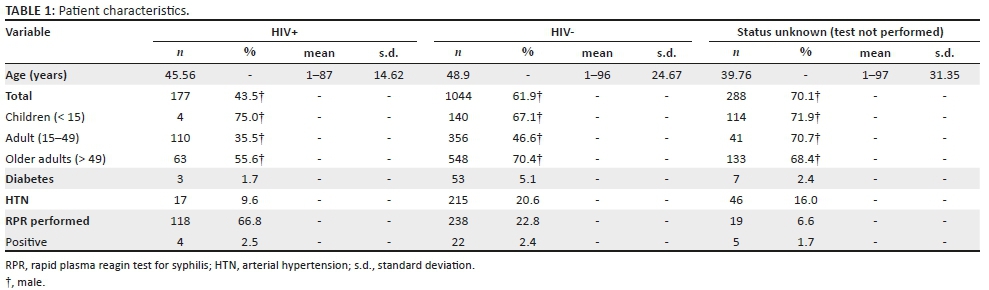
A total of 1510 surgical inpatient cases were identified (Table 1). Fifty-one patients (3.4%) presented more than once to the hospital: one patient underwent surgery three times and the remaining 50 patients were admitted twice. Eight hundred and ninety patients (61.0%) were male. The average age was 46.2 years (range 1-97, median 49). Forty-seven patients (3.1%) died in hospital.
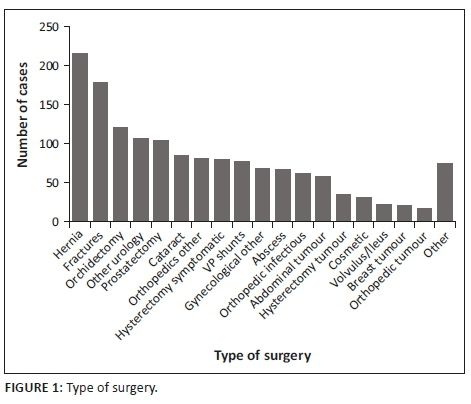
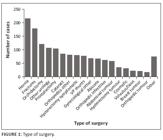
We established 32 different categories of surgery (Figure 1). Hernia repair was the most common procedure (216 cases; 14.3%), followed by fracture repairs (179; 11.9%), orchidectomies as palliative therapy in metastasised prostate cancer (129; 8.0%) and other urology cases and prostatectomies (107, 7.1%, and 104, 6.9%, respectively).
Histology
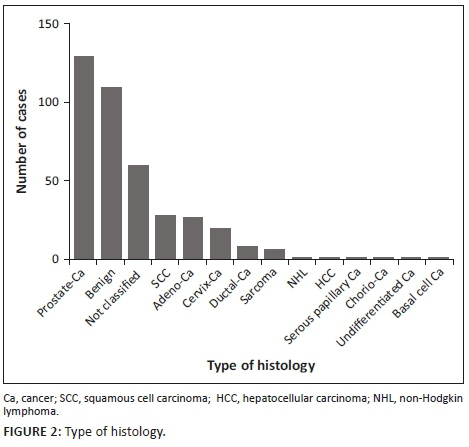
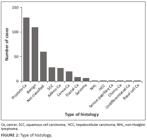
Histology was usually not performed for the bilateral orchidectomy (BLO) cases. The diagnosis of metastasised prostate cancer was therefore either based on clinical presentation and PSA levels and/or on histology provided by the patient. Two hundred and sixty-eight cases for histology were sent to Lancet Laboratories Harare. The most common findings were benign (N = 109) or not classifiable (N = 59). Including the BLO cases, prostate cancer was by far the most common malignancy, accounting for 129 cases (58.4%), followed by squamous cell carcinomas (all sites 27; 12.2%), adenocarcinoma (all sites 26; 11.8%) and cervical cancer (19; 8.6%) (Figure 2).
HIV and other comorbidities
Of the patients, 1045 (69.0%) had tested negative for HIV at the time of hospitalisation or during the preceding three months, while 288 (19.1%) of the patients did not have a documented valid test at the time of hospitalisation, that is, no test had been performed or the last test was performed over three months prior. Further, 11.9% of the patients had a positive HIV test or were known to be HIV-positive.
For further statistical analysis we excluded all patients without a valid test. In the group of patients between 15 and 49 years of age, 110 (23.3%) were HIV-positive. This group, usually defined as the adult reproductive-aged group by UNAIDS and WHO, accounted for 62.0% of all HIV patients in this cohort. Four children (2.8% of all children) were HIV-positive. In the group of adults over 49 years, 63 (10.3%) were HIV-infected.
In the paediatric group, 43.4% did not have a valid HIV test, compared to 9.3% and 17.9% in the adult group and the group over 49 years of age, respectively.
Twenty-one patients were newly diagnosed with HIV because of provider-initiated testing and counselling (PITC), although this approach was not fully initiated at Karanda Mission Hospital until the beginning of 2017. Seven (33.0%) of these patients were started on ART before discharge and 18 (90.0%) were started on cotrimoxazole prophylaxis.
Of the HIV-positive patients, 156/177 (88.1%) were receiving ART; in two cases it was impossible to establish whether ART was part of the patient's treatment. Five (2.8%) of the patients were on second-line treatment. Moreover, 88.1% of the patients were taking cotrimoxazole prophylaxis. A recent CD4+ count was available for 117 of the 177 patients (66.0%). The mean value was 413 cells/µL (range 0 cells/µL-1510 cells/µL, median 371 cells/µL, SD 287 cells/µL). Thirty-one (26.5%) had a CD4+ count below 200 cells/µL.
Of the 47 patients who died during hospitalisation, nine (19.0%) were HIV-positive.
There was no significant difference in mortality between the HIV-negative group and the HIV-positive group (p = 0.39).
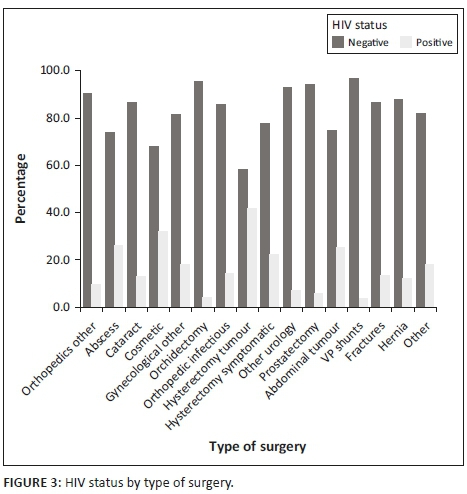
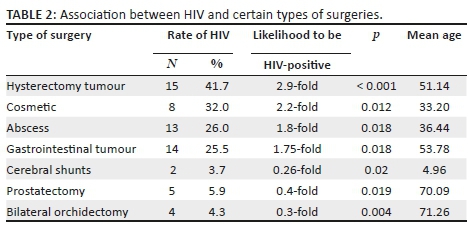
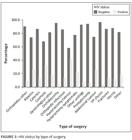
There was a significant correlation between the type of surgery and HIV status. HIV-positive patients were more likely to undergo surgery for hysterectomy because of suspected cancer, laparotomy because of suspected gastrointestinal malignancy or procedures for abscesses and plastic surgery. In contrast, this group was less likely to undergo surgery for cerebral shunts, prostatectomy or BLO (Figure 3; Table 2).
HIV and malignancies
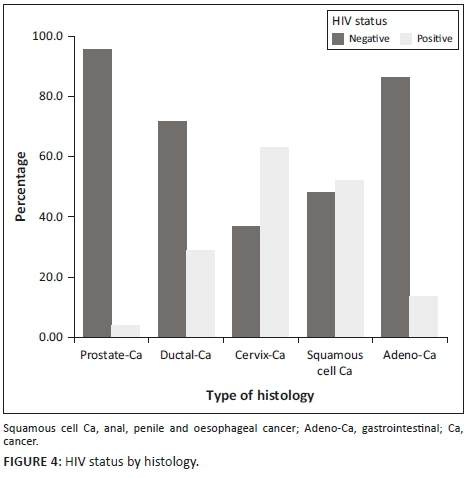
Thirty-seven (20.2%) of the patients with histologically proven malignancies were HIV-positive. When only patients in the group aged 15-49 years were analysed, 19 (46.3%) of those with malignancies were HIV-positive. Twelve (63.2%) of the patients with cervical cancer were HIV-positive, 14 (51.9%) of the patients with squamous cell carcinoma were HIV-positive and three (13.6%) of the patients with adenocarcinoma were HIV-positive. In contrast 9 (4.1%) of all patients with prostate cancer were HIV-positive.
Chi-square test showed a highly significant correlation between HIV status and certain types of histology with a p-value of p < 0.001 and a strong association with a Cramer's V value of 0.6 (Figure 4). Being HIV-positive was associated with a higher likelihood of having cervical cancer or squamous cell carcinoma (3.16- and 2.54-fold greater, respectively; p < 0.001).
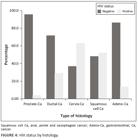
In contrast, patients with prostate cancer were 4.9 times less likely to be HIV-positive (p < 0.003). There was a significant difference between the mean age of the prostate cancer group and the remainder of the patients (71.2 vs. 45.7 years of age, respectively; p < 0.05).
Regarding the other diagnoses, trends but no statistically significant correlations were found.
Within the group of patients with malignancies, people living with HIV were significantly younger than uninfected patients (mean age 50.5 vs. 64.4 years; p < 0.01). Excluding all patients with prostate cancer (N = 86), HIV-positive patients were still younger (48.8 vs. 52.1), but the difference was not statistically significant (p = 0.126).
Discussion
Epidemiology
HIV prevalence among the adult surgical patients reviewed was higher than that in the general population in Zimbabwe in 2016 (23.2% vs. 14.7%).63,7 Women were over-represented in the HIV-positive adult group (64.5%). This may be because Karanda Mission Hospital is well known as a centre for gynaecologic and obstetric surgery. Distribution of the different age groups was similar to that reported in the UNAIDS Gap report from 2016.
Testing and therapy
The Zimbabwe Demographic and Health Survey of 2010-2011 showed that only 57.0% of women and 36.0% of men aged 15-49 years had ever been tested for HIV.89
Previous studies have reported very low testing rates among surgical patients, ranging from 10.0% to 50.0%.3,10 In our cohort, 80.9% had a valid and documented HIV test. In 2007, the WHO recommended a PITC approach for all patients encountering the health system.1112,13,14 The Zimbabwe Ministry of Health introduced PITC in 2007, which stated that anyone presenting to any level of healthcare institution should be offered HIV testing regardless of the purpose of their visit.15
Of the HIV patients in our cohort, 88.1% were on ART; only 2.8% of these were on second-line treatment. While this is heartening, to reach the 90-90-90 goal, PITC will have to be scaled up further.16
Interestingly, all the patients on ART were also on cotrimoxazole prophylaxis independent of the CD4+ count (mean CD4+ count 413 cells/µL and 73.5% > 200 cells/µL). According to the Zimbabwean guidelines, this is recommended. It appears to be acceptable in an area that has a high prevalence of malaria and bacterial infections.
HIV, type of surgery and outcome
HIV-positive patients in our cohort were significantly more likely to undergo hysterectomy because of suspected cancer, plastic surgery and abscess drainage or debridement. These findings are not surprising as cervical cancer is an AIDS-defining condition17188,11,19
There was no difference in in-hospital mortality between HIV-positive and HIV-negative surgical inpatients. This contrasts with a study in Malawi, which, in a small cohort, found a higher mortality rate in HIV-positive patients.17
In several studies from SSA, most of them in the pre-ART era, a significant difference in surgical outcomes and complications was not found.2021
HIV and malignancies
In addition to the known AIDS-defining malignancies, HIV-infected patients are also more likely to suffer from certain cancers.52223
Within our cohort, few men undergoing surgery for prostate cancer were HIV-positive and the average age of the group with prostate cancer was 71.2 years. Thus, the average age of HIV-positive patients with malignancies was significantly younger than that of HIV-negative patients with malignancies.
Our study had several limitations. Outpatients, and therefore most cases of surgery and maternity cases, were excluded. Older men were overrepresented. Likewise, not all histology results were available. Also, because of the lack of access to routine laboratory investigations, no biochemical profile was available for the patients. Furthermore, information about hepatitis, TB or HPV coinfections was not available in most of the cases. Because this was a retrospective chart review, only inpatient mortality could be captured. In this setting of rural Zimbabwe, it would be very difficult to follow-up patients to determine 30-day mortality.
In conclusion, this study shows a higher HIV prevalence among adult surgical inpatients than in the general population. We demonstrated that testing and treatment is well established in this specific rural Zimbabwean hospital. Interestingly, in-hospital mortality was not higher in HIV-positive patients compared to HIV-negative patients. There were correlations between HIV and certain malignancies. Thus, in addition to AIDS-defining illnesses, clinicians must have a high index of suspicion for squamous cell carcinoma and oesophageal, anal, penile cancers in HIV-positive patients. In countries experiencing a high prevalence of HIV, surgical training programmes and surgical units in hospitals must anticipate the types of surgeries that HIV-positive patients are likely to require, such as excision of malignancies, and provide adequate training, staffing and facilities to meet the needs for the future.
Competing interests
The authors declare that there were no conflicts of interest during the writing of this article.
Authors' contributions
P.M. performed data collection, data analysis and interpretation, wrote the article and acted as the corresponding author. M.S. supervised development of the article and helped in data interpretation and manuscript evaluation. P.T. conceived of the presented idea and helped in manuscript evaluation. P.M. and P.T. designed the study and developed the methodology.
Acknowledgements
References
-
1, Bowa K, Kawimbe B, Mugala D, et al. A review of HIV and surgery in Africa. Open AIDS J. 2016;10:16-23. https://doi.org/10.2174/1874613601610010016
» https://doi.org/10.2174/1874613601610010016 -
2. Haac BE, Charles AG, Matoga M, et al. HIV testing and epidemiology in a hospital-based surgical cohort in Malawi. World J Surg. 2013;37:2122-2128. https://doi.org/10.1007/s00268-013-2096-4
» https://doi.org/10.1007/s00268-013-2096-4 -
3. Wang CJ, Silverberg MJ, Abrams DI. Non-AIDS-defining malignancies in the HIV-infected population. Curr Infect Dis Rep. 2014;16:406. https://doi.org/10.1007/s11908-014-0406-0
» https://doi.org/10.1007/s11908-014-0406-0 - 4. Mitsuyasu RT. Non-AIDS-defining cancers. Top Antivir Med. 2014;22:660-665.
- 5. UNAIDS. 2015. HIV and AIDS estimates. Geneva: UNAIDS.
- 6. Zimbabwe Ministry of Health. GARPR Zimbabwe country progress report 2016. Harare: Ministry of Health Zimbabwe; 2016.
-
7. Cacala SR, Mafana E, Thomson SR, Smith A. Prevalence of HIV status and CD4 counts in a surgical cohort: Their relationship to clinical outcome. Ann R Coll Surg Engl. 2006;88:46-51. https://doi.org/10.1308/003588406X83050
» https://doi.org/10.1308/003588406X83050 - 8. Zimbabwe National Statistics Agency (ZIMSTAT), ICF International. Zimbabwe demographic and health survey 2010-2011. Harare: ZIMSTAT and ICF International Inc.; 2012.
- 9. Zimbabwe National Statistics Agency (ZIMSTAT), ICF International. Zimbabwe demographic and health survey 2015. MD, USA: ZIMSTAT and ICF International Inc.; 2016.
-
10. Martinson NA, Omar T, Gray GE, et al. High rates of HIV in surgical patients in Soweto, South Africa: Impact on resource utilisation and recommendations for HIV testing. Trans R Soc Trop Med Hyg. 2007;101:176-182. https://doi.org/10.1016/j.trstmh.2006.04.002
» https://doi.org/10.1016/j.trstmh.2006.04.002 - 11. World Health Organization. Guidance on provider-initiated HIV testing and counselling in health facilities. Switzerland: World Health Organization; 2007.
-
12. Pope DS, Deluca AN, Kali P, et al. A cluster-randomized trial of provider-initiated (opt-out) HIV counseling and testing of tuberculosis patients in South Africa. J Acquir Immune Defic Syndr. 1999;48:190-195. https://doi.org/10.1097/QAI.v0b013e3181775926
» https://doi.org/10.1097/QAI.v0b013e3181775926 -
13. Weigel R, Kamthunzi P, Mwansambo C, Phiri S, Kazembe PN. Effect of provider-initiated testing and counselling and integration of ART services on access to HIV diagnosis and treatment for children in Lilongwe, Malawi: A pre- post comparison. BMC Pediatr. 2009;9:80. https://doi.org/10.1097/QAI.0b013e3181775926
» https://doi.org/10.1097/QAI.0b013e3181775926 -
14. Kiene SM, Bateganya M, Wanyenze R, Lule H, Nantaba H, Stein MD. Initial outcomes of provider-initiated routine HIV testing and counseling during outpatient care at a rural Ugandan hospital: Risky sexual behavior, partner HIV testing, disclosure, and HIV care seeking. AIDS Patient Care STDS. 2010;24:117-126. https://doi.org/10.1089/apc.2009.0269
» https://doi.org/10.1089/apc.2009.0269 - 15. Zimbabwe Ministry of Health and Child Welfare. Guidelines for implementation of provider-initiated HIV testing and counselling. Harare: Zimbabwe Ministry of Health; 2014.
- 16. Joint United Nations Programme for HIV/AIDS (UNAIDS). 90-90-90: An ambitious treatment target to help end the AIDS epidemic. Geneva, Switzerland: UNAIDS; 2014.
-
17. Maiman M, Fruchter RG, Clark M, Arrastia CD, Matthews R, Gates EJ. Cervical cancer as an AIDS-defining illness. Obstet Gynecol. 1997;89:76-80. https://doi.org/10.1016/S0029-7844(96)00378-X
» https://doi.org/10.1016/S0029-7844(96)00378-X -
18. Wieland U, Kreuter A, Hautarzt D. 2017;68(3):192-198. https://doi.org/10.1007/s00105-017-3938-z
» https://doi.org/10.1007/s00105-017-3938-z -
19. Lewis DK, Callaghan M, Phiri K, et al. Prevalence and indicators of HIV and AIDS among adults admitted to medical and surgical wards in Blantyre, Malawi. Trans R Soc Trop Med Hyg. 2003;97:91-96. https://doi.org/10.1016/S0035-9203(03)90035-6
» https://doi.org/10.1016/S0035-9203(03)90035-6 -
20. Diettrich NA, Cacioppo JC, Kaplan G, Cohen SM. A growing spectrum of surgical disease in patients with human immunodeficiency virus/acquired immunodeficiency syndrome: Experience with 120 major cases. Arch Surg. 1991;12:860-866. https://doi.org/10.1001/archsurg.1991.01410310070010
» https://doi.org/10.1001/archsurg.1991.01410310070010 -
21. Giiti GC, Mazigo HD, Heukelbach J, et al. HIV, appendectomy and postoperative complications at a reference hospital in Northwest Tanzania: Cross-sectional study. AIDS Res Ther. 2010;7:47. https://doi.org/10.1186/1742-6405-7-47
» https://doi.org/10.1186/1742-6405-7-47 - 22. Reusser NM, et al. HPV carcinomas in immunocompromised patients. Ed. Jane Grant-Kels. J Clin Med. 2015;4(2):260-281. PMC. Web. 14 June 2017.
-
23. Goncalves PH, Montezuma-Rusca JM, Yarchoan R, Uldrick TS. Cancer prevention in HIV-infected populations. Sem Oncol. 2016;43:173-188. https://doi.org/10.1053/j.seminoncol.2015.09.011
» https://doi.org/10.1053/j.seminoncol.2015.09.011

Accepted: 13 Sept. 2018
Published: 24 Jan. 2019