A cross-sectional study of viral load suppression among youth living with HIV in Namibia
Abstract
BACKGROUND: Meeting the Joint United Nations Programme on HIV/AIDS targets and ending AIDS by 2030 requires global efforts, with a particular focus on older adolescents living with HIV (OALHIV) and younger adults living with HIV (YALHIV). These population groups are often associated with unsuppressed viral load compared to adults OBJECTIVES: This article assessed the extent of viral load suppression (VLS) and associated factors among this group in seven high-burden districts of Namibia METHOD: A cross-sectional survey was conducted to analyse data for 600 OALHIV and YALHIV, aged 15-24 years, who were already on antiretroviral treatment prior to 2020. The study employed a stratified cluster sampling across seven districts. Data were extracted from an electronic database and analysed using Statistical Package for Social Sciences (SPSS) software. However, limitations within the database restricted the availability of certain variables RESULTS: Overall, the VLS (< 1000 copies/mL) was 84.8%, with female patients showing a significantly higher VLS 88.3% compared to male patients, with 78.5% (P < 0.01; odds ratio [OR] = 2.08). Although OALHIV had higher suppression (84.9%) than YALHIV (74.6%), age was not significantly associated with VLS (P = 0.9). Dolutegravir-based regimens had a suppression of 93.3% (P < 0.01; OR = 9.1), and those with a fixed home address had an 88.2% suppression (P = 0.014; OR = 1.76 CONCLUSION: The VLS of 84.8% remains below the Joint United Nations Programme on HIV/AIDS target of 95%. There is a need for improvements in antiretroviral treatment programmes, particularly in scaling up dolutegravir-based regimens, enhancing adherence and peer support to end AIDS by 2030
adherence; older adolescents; antiretroviral therapy; HIV; viral load suppression; younger adults
Introduction
Viral load suppression (VLS) is essential for effective HIV management and reducing transmission.11,23
There are various definitions of VLS in the context of HIV care and treatment. Some literature defines VLS as the reduction of viral load (VL) to undetectable levels, typically below 40 copies/mL,145,678
Approximately 37.7 million individuals worldwide are living with HIV, with around 1.75 million being adolescents aged 10 to 19 years.79102
As of 2023, Namibia had an estimated 230 000 PLWH, the majority of whom were adults aged 15 years and older. Among them, 7700 were children under 15, and 19 970 were youth aged 15-24. The national HIV prevalence among individuals aged 15-49 was 9.0%, with a notable gender disparity.1111
Despite the introduction of ART access since 2002, achieving optimal VLS among OALHIV and YALHIV remains challenging. Understanding VLS in this group is key to guiding targeted interventions and improving outcomes.12,1314,15
This study assesses VLS among OALHIV and YALHIV in Namibia to inform targeted, evidence-based interventions that enhance treatment outcomes and reduce HIV transmission.
Research methods and design
Research design
A quantitative descriptive cross-sectional study was employed to assess the extent of VLS among OALHIV and YALHIV. These studies are frequently compared to a 'snapshot' of a population at a particular moment, as they involve the simultaneous determination of both exposure and outcome for each subject.16
Research setting
The research took place in six Namibian regions: Khomas, Ohangwena, Oshana, Omusati, Zambezi, and Oshikoto, with particular attention to seven districts with high burdens of HIV. These districts constituted 70% of the target population and housed the majority of PLWH with a concentration in the northern and peri-urban areas characterised by lower socio-economic status (Engela, Outapi, Oshikuku, Oshakati, Onandjokwe & Katima districts), as opposed to the fully urban area in the central part of the country (Windhoek).17
Population and sampling
In this study, routine records of OALHIV and YALHIV who were active on ART and enrolled into care before January 2020 were included. This criterion ensured sufficient treatment duration prior to data collection in May 2022 and allowed for adequate documentation of VL monitoring and follow-up interventions. Only records with at least one valid VL result recorded in the electronic patient monitoring system (ePMS) were considered. Data were drawn from 90 randomly selected health facilities out of 113 across seven high-burden districts, exceeding the minimum required sample size of 88 facilities. The ePMS remains the primary database for all PLWH on treatment in the public sector in Namibia. To ensure data validity, records extracted at the central level were cross-checked against data from some selected health facilities for the same reporting period.
A probability-based stratified cluster sampling method combining cluster, stratified, and random sampling techniques was used to select records of OALHIV and YALHIV for this study. Six regions were grouped to include seven high-burden districts, within which health facilities were stratified and randomly selected. From a total population of 19 670 OALHIV and YALHIV records across 90 facilities, a random sample of 600 records was drawn using the Raosoft sample size calculator (Raosoft, Inc., Seattle, Washington, United States), based on a 5% margin of error and a 95% confidence level.18
Data collection method
To collect the necessary information for the study, a checklist was utilised, which was developed in collaboration with statisticians who had expertise in working with the ePMS. Additionally, the team lead of the research monitoring and evaluation division, responsible for hosting the ePMS, guided the checklist development process.
Data analysis
Descriptive and inferential analyses were conducted using Statistical Package for Social Sciences (SPSS) version 28 (IBM Corp., Armonk, New York, United States), to determine the prevalence of VLS among OALHIV and YALHIV based on their most recent VL results documented in the ePMS. This statistical analysis served as the initial stage of analysis, aiding researchers in summarising data and identifying patterns. It explained the attributes of a population, encompassing measures like mean, mode, median, percentage, frequency, and range for a given variable.1920
Crude and adjusted regression analyses were used to identify various factors associated with VLS. Because of regimen documentation issues, the analysis was not done based on the regimen lines (first, second, and third), to avoid misclassification biases. Independent variables such as age and VL were still analysed using descriptive and inferential statistics. To align with international standards, the authors employed the VLS cut-off of < 1000 copies/mL per, as per the WHO's definition.1,4
Ethical considerations
The University of South Africa Research Ethics committee provided the approval for this study protocol (NHREC registration number: Rec-240816-052; CREC reference number: 12786918_CREC_CHS_2021). Permission to conduct the study at the seven high-burden districts was granted by the Ministry of Health and Social Service research committee (reference number 17/3/3/JK). Informed consent was not part of the requirement from OALHIV and YALHIV, as there was no direct contact with them. Confidentiality was maintained during the data collection and analysis and only the researchers had accessed the databases. The anonymity was ensured by using the ART unique number rather than their names and coding was used during data analysis.
Results
Records were gathered from the ePMS for 600 active OALHIV and YALHIV who were receiving ART care in seven high-burden districts. Among this group, 281 individuals (46.8%) initiated their ART treatment before 2010, while 231 individuals (38.5%) commenced treatment between 2010 and 2018. Only 88 individuals (14.7%) who initiated treatment in 2019 or later were started on dolutegravir, the recommended optimal regimen for adolescents living with HIV experiencing adherence challenges.
Participants' characteristics
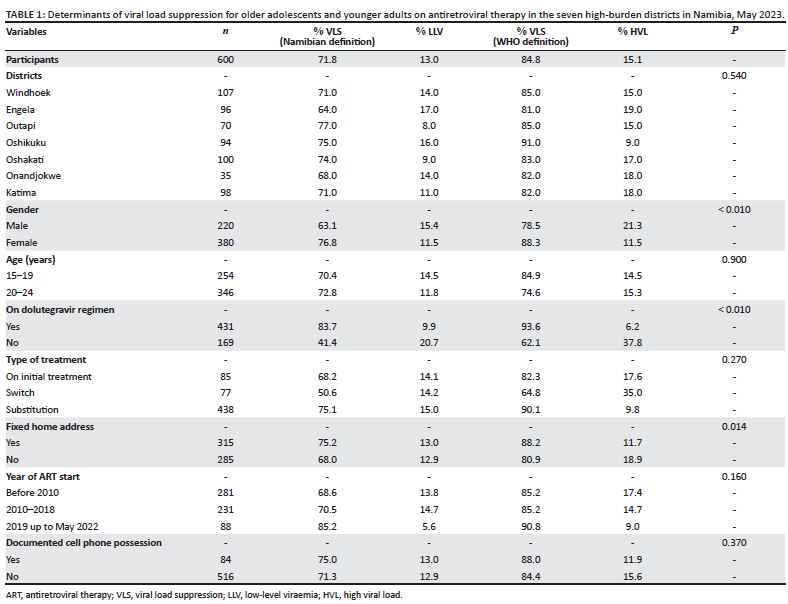
There was a significant gender disparity, with 63.3% (n = 380/600) female patients (P < 0.01), reflecting the broader gender distribution among PLWH in Namibia. The median age was 20.0 years, with no significant difference by gender (P = 0.9). The majority of patients (86%, n = 516/600) did not own cell phones. Additionally, 52.5% (n = 315/600) had a fixed home address (P = 0.014). Most patients (71.8%, n = 431/600) were on a dolutegravir regimen which was introduced in December 2019 in Namibia, as shown in Table 1.
Viral load outcome and associated factors
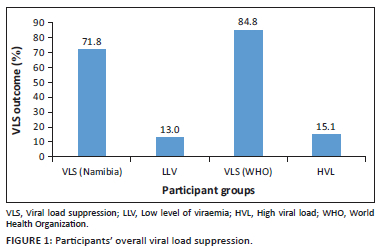
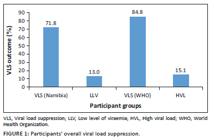
The VL results were categorised into four groups: virologic suppression with VL levels below 40 copies/mL per Namibian definition, LLV with VL between 40 copies/mL and 1000 copies/mL, virologic suppression with VL levels below 1000 copies/mL per WHO definition and high VL (HVL) with VL from 1000 copies/mL and above. The outcome demonstrated that 431 records (71.8%) of OALHIV and YALHIV were virally suppressed, while 78 records (13%) fell into the category of LLV, and 91 records (15.2%) exhibited HVL. When combining VLS with LLV (VL < 1000 copies/mL), the total number of OALHIV and YALHIV records meeting the WHO definition of virologic suppression was 509 (84.8%).
VLS was 84.8% (95% confidence interval: 81.2% - 87.3%) with no statistical difference across the seven high-burden districts, with a P-value of 0.54 (Figure 1).
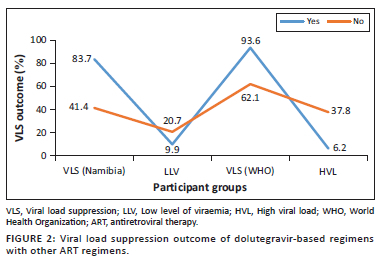
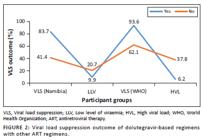
The initiation of the dolutegravir-based regimen began in mid-2019, with transitioning or regimen changes guided by patients' VL values. While the transitioning was largely completed early in January 2020, with an ongoing regimen change in cases of failure to treatment, records showed that OALHIV and YALHIV on dolutegravir-based regimens achieved significantly better VLS compared to those on non-dolutegravir-based regimens (P = 0.01; odds ratio [OR] = 9.1), as seen in Figure 2 and Table 1.
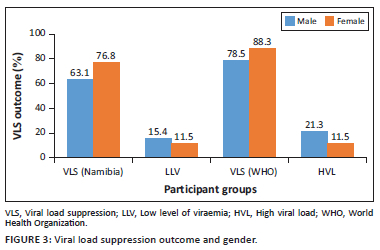
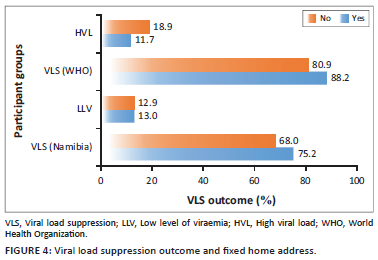
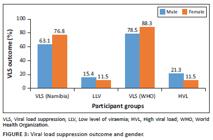
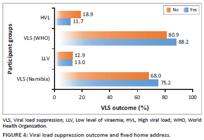
In addition to the dolutegravir-based regimen, other variables that exhibited statistically significant associations with VLS included female gender (P < 0.01; OR = 2.08), and having a fixed home address (P = 0.014; OR = 1.76), defined as no change in physical residence within the 12 months prior to data collection. These two variables exhibited good suppression across all levels of VLS, except in the categories of fixed home addresses with an LLV of 13% compared to 12.9% among those with non-fixed home addresses, as demonstrated in Figure 3 and Figure 4.
On the other hand, factors such as district of residence (P = 0.54), type of treatment (P = 0.27), age (P = 0.9), year of initiating ART medication (P = 0.12), and having an updated and documented cell phone number in the ePMS (P = 0.37), showed no significant associations with VLS in Table 1.
Discussion
This study sought to determine the prevalence of VLS and factors associated with the suppression among OALHIV and YALHIV aged 15 to 24 years old on ART in the seven high-burden districts in Namibia. The overall VLS, according to the WHO definition,1212223
The study revealed a higher percentage of female OALHIV and YALHIV (63.3%) compared to male patients, highlighting the elevated prevalence of HIV among adolescent girls and young women in both Namibia and worldwide.24252627,2828
Based on the sampling methodology, a higher proportion of YALHIV records were on ART compared to OALHIV records. This is because of the aging of perinatally infected infants who were put on treatment during their childhood,26292630
During the data collection period, a higher number of OALHIV and YALHIV were already on a regimen based on dolutegravir. This particular treatment approach was introduced in mid-2019, following the WHO's endorsement of dolutegravir as the most effective ART for adolescents experiencing adherence challenges.313233
Dolutegravir-based regimens are more effective than non-dolutegravir-based regimens, as demonstrated in this study, and supported by the findings from the ODYSSEY trial.34,3536
In Namibia, the ART regimens are classified into three categories: the initial treatment, representing the first-line regimen; the switch, which is the change from the first line to the second line or the third line, which is considered as a salvage therapy; and the substitution between regimen lines.373832
A greater proportion of OALHIV and YALHIV were identified as having a fixed home address. In conjunction with this discovery, OALHIV and YALHIV with a stable or fixed home address exhibited a higher rate of VLS compared to those without a fixed home address or residence. This finding demonstrated an association between a fixed address and VLS. No research has specifically addressed these observations; nevertheless, it is plausible that the lack of studies on this matter may be because of the potential correlation between OALHIV and YALHIV with a fixed home address, and the ongoing and strong support derived from the same household.39
However, some studies have demonstrated that treatment supporters' responsibilities go beyond supporting adherence to ART, to include supporting daily needs of individuals living with HIV, including clinic visits.4041
A greater number of OALHIV and YALHIV commenced their treatment before 2010, with the second-largest group initiating treatment between 2010 and 2018, and the smallest cohort beginning their treatment from mid-2019 onwards, which was mostly based on dolutegravir. The 2019 cohort exhibited a higher rate of VLS (90.1%) compared to the first and second cohorts, where both of the later groups had an equal level of suppression (85.4%). While there is no association between the year of initiating ART and VLS (P = 0.16), lower suppression observed in the first and second cohorts may be linked to factors like pill fatigue,424344
OALHIV and YALHIV who owned a cellphone exhibited higher VLS compared to those without a cellphone, but this was not statistically significant. The higher suppression in those with a cellphone may be attributed to the social support received from family or guardians,404546
Strengths and limitations of the study
This cross-sectional study utilised records of OALHIV and YALHIV who are representative of the broader population. The records were not selected based on VLS status or exposure to specific risk factors. This study design is appropriate for identifying initial associations and estimating the prevalence of either exposures or outcomes, such as VLS, within a population group. The study design used in this research did not allow for the establishment of causal relationships. Additionally, limitations within the database restricted access to a broader range of variables, thereby constraining the ability to explore associations with VLS.
Variables such as adherence, socio-economic status, psychosocial factors, environmental influences, and healthcare-related factors were not assessed, as they were not captured in the ePMS. Additionally, treatment regimen lines intended to demonstrate their association with VLS were misclassified in the database, preventing their use in the analysis. Despite these limitations, the researchers were satisfied with the findings, having successfully identified associations between a limited set of available variables and VLS.
Recommendations
The national HIV/AIDS response should prioritise expanding peer support and psychosocial adherence programmes across all health facilities, because these have proven effective in improving VLS among OALHIV and YALHIV. Additionally, treatment optimisation, especially transitioning to dolutegravir-based regimens, is essential to close the VLS gap and achieve UNAIDS targets. To further improve outcomes, targeted interventions must address lower VLS among male patients by overcoming healthcare barriers and implementing gender-specific strategies. Moreover, HIV programmes should continue prioritising adolescent girls and young women while strengthening support for YALHIV during their transition to adulthood to enhance adherence.
Furthermore, household and community support systems require reinforcement, particularly for those without stable housing, since stable living conditions and consistent treatment supporters are vital for long-term adherence. Digital tools, such as cellphone reminders, can also support adherence alongside efforts to address psychosocial and economic barriers. Challenges such as pill fatigue and drug resistance must not be overlooked. Because VLS remain below UNAIDS targets, ongoing monitoring, evaluation, and research are critical to identify barriers and tailor programmes effectively. Engaging OALHIV, YALHIV, and healthcare providers in a positive, nonjudgemental manner will yield valuable insights. Finally, future research should focus on psychosocial factors especially among male patients and unstably housed individuals, and assess the long-term impact of dolutegravir-based regimens in resource-limited settings.
Conclusion
In this study, the VLS among OALHIV and YALHIV was relatively low, at 82.4%, as compared to the set target by UNAIDS. A higher rate of VLS was associated with female gender, being on a dolutegravir-based regimen, and having a fixed home address. The WHO and UNAIDS recommend that countries working towards ending HIV/AIDS should achieve a VLS of 90% by 2020 and 95% by 2030. These findings align with numerous other studies indicating VLS falling below the target set by UNAIDS. To address the gaps, special attention should be directed towards OALHIV and YALHIV facing challenges in suppressing their VL, as well as individuals with a history of high VL, sub-optimal adherence, and those on second- or third-line regimens. Policymakers should prioritise the implementation of treatment optimisation based on dolutegravir and strategies to enhance VLS among these age groups in Namibia to align with the 95-95-95 UNAIDS targets.
Competing interests
The authors declare that they have no financial or personal relationships that may have inappropriately influenced them in writing this article.
CRediT authorship contribution
Jacques W.N. Kamangu: Conceptualisation, Software, Methodology, Formal Analysis, Data Curation, Investigation, Resources, Writing - Original Draft, Writing - Review & Editing, Visualisation, Project Administration. Sheillah H. Mboweni: Conceptualisation, Methodology, Formal Analysis, Data Curation, Investigation, Resources, Writing - Original Draft, Writing - Review & Editing, Visualisation, Supervision, Project Administration, Funding Acquisition. Both authors reviewed the article, contributed to the discussion of results, approved the final version for submission and publication, and take responsibility for the integrity of its findings.
Funding information
The authors received no financial support for the research, authorship, and/or publication of this article.
Data availability
The data that support the findings of this study are available on request from the corresponding author, Jacques W.N. Kamangu. The data are not publicly available due to restrictions, as they contain information that could compromise the privacy of research participants.
Disclaimer
The views and opinions expressed in this article are those of the authors and are the product of professional research. The article does not necessarily reflect the official policy or position of any affiliated institution, funder, agency, or that of the publisher. The authors are responsible for this article's results, findings, and content.
Acknowledgements
This article is based on research originally conducted as part of Jacques W.N. Kamangu's doctoral thesis titled 'HIV programme to improve the VLS among older adolescents and younger adults living with HIV in Namibia', submitted to the Department of Health Studies, College of Human Sciences, University of South Africa in 2023. The thesis was supervised by Sheillah H. Mboweni. The manuscript has since been revised and adapted for journal publication. The original thesis is currently unpublished and was not publicly available online at the time of publishing this article. The authors would like to thank the Ministry of Health and Social Services research ethics committee for providing permission to conduct of the research and the research monitoring and evaluation division for availing the database at the central level.
References
-
1. World Health Organization (WHO). The role of HIV viral suppression in improving individual health and reducing transmission [homepage on the internet]. 2023 [cited 2024 Apr 22]. Available from: https://www.who.int/publications/i/item/9789240055179
» https://www.who.int/publications/i/item/9789240055179 -
2. Gordon TP, Talbert M, Mugisha MK, Herbert AE. Factors associated with HIV viral suppression among adolescents in Kabale district, South Western Uganda. PLoS One. 2022;17(8):1-20. https://doi.org/10.1371/journal.pone.0270855
» https://doi.org/10.1371/journal.pone.0270855 -
3. Winpenny EM, Winkler MR, Stochl J, van Sluijs EMF, Larson N, Neumark-Sztainer D. Associations of early adulthood life transitions with changes in fast food intake: A latent trajectory analysis. Int J Behav Nutr Phys Act. 2020;17(1):130. https://doi.org/10.1186/s12966-020-01024-4
» https://doi.org/10.1186/s12966-020-01024-4 -
4. Jiamsakul A, Kariminia A, Althoff KN, et al. HIV viral load suppression in adults and children receiving antiretroviral therapy - Results from the IeDEA collaboration. Acquir Immune Defic Syndr. 2017;76(3):319-329. https://doi.org/10.1097/QAI.0000000000001499
» https://doi.org/10.1097/QAI.0000000000001499 -
5. Hanners EK, Benitez-Burke J, Badowski ME. HIV: How to manage low-level viraemia in people living with HIV. Drugs Context. 2022;11:2021-8-13. https://doi.org/10.7573/dic.2021-8-13
» https://doi.org/10.7573/dic.2021-8-13 -
6. Romo ML, Edwards JK, Semeere AS, et al. Viral load status before switching to dolutegravir-containing antiretroviral therapy and associations with human immunodeficiency virus treatment outcomes in sub-Saharan Africa. Clin Infect Dis. 2022;75:630-637. https://doi.org/10.1093/cid/ciab1006
» https://doi.org/10.1093/cid/ciab1006 -
7. Djiyou ABD, Penda CI, Madec Y, et al. Viral load suppression in HIV-infected adolescents in Cameroon: Towards achieving the UNAIDS 95% viral suppression target. BMC Pediatr. 2023;23(1):119. https://doi.org/10.1186/s12887-023-03943-0
» https://doi.org/10.1186/s12887-023-03943-0 -
8. Munyayi FK, Van Wyk B. Closing the HIV treatment gap for adolescents in Windhoek, Namibia: A retrospective analysis of predictors of viral non-suppression. Int J Environ Res Public Health. 2020;19(22):14710. https://doi.org/10.3390/ijerph192214710
» https://doi.org/10.3390/ijerph192214710 -
9. Joint United Nations Programme on HIV/AIDS UNAIDS. Global HIV & AIDS statistics - Fact sheet [homepage on the internet]. 2021 [cited 2024 Jan 22]. Available from: https://www.unaids.org/en/resources/fact-sheet
» https://www.unaids.org/en/resources/fact-sheet -
10. United Nations Children's Fund UNICEF. HIV statistics - Global and regional trends [homepage on the internet]. 2021 [cited 2024 Jan 19]. Available from: https://data.unicef.org/topic/hivaids/global-regional-trends.
» https://data.unicef.org/topic/hivaids/global-regional-trends -
11. Joint United Nations Programme on HIV/AIDS (UNAIDS). Namibia HIV sub-national estimates viewer. 2025 [cited 2025 Aug 17]. Available from: https://naomi-spectrum.unaids.org/
» https://naomi-spectrum.unaids.org/ -
12. President's Emergency Plan for AIDS Relief PEPFAR. Namibia Country Operational Plan 2022 strategic direction summary [homepage on the internet]. 2022 [cited 2024 Apr 22]. Available from: https://www.state.gov/wp-content/uploads/2022/09/Namibia-COP22-SDS.pdf
» https://www.state.gov/wp-content/uploads/2022/09/Namibia-COP22-SDS.pdf -
13. Ministry of Health and Social Services Directorate of Special Programmes. National strategic framework for HIV and AIDS response in Namibia 2017/18 to 2021/22 [homepage on the internet]. 2021 [cited 2024 Mar 25]. Available from https://www.unaids.org/sites/default/files/country/documents/NAM_2018_countryreport.pdf
» https://www.unaids.org/sites/default/files/country/documents/NAM_2018_countryreport.pdf -
14. United States President's Emergency Plan for AIDS Relief PEPFAR. Namibia country operational plan (COP) 2020 strategic direction summary [homepage on the Internet]. 2020 [cited 2024 Mar 13]. Available from: https://www.state.gov/wp-content/uploads/2020/07/COP-2020-Namibia-SDS-FINAL.pdf
» https://www.state.gov/wp-content/uploads/2020/07/COP-2020-Namibia-SDS-FINAL.pdf -
15. Center for Disease and Control CDC. CDC-Namibia [homepage on the Internet]. 2021 [cited 2024 Jan 22]. Available from: https://www.cdc.gov/globalhealth/countries/namibia
» https://www.cdc.gov/globalhealth/countries/namibia - 16. Ministry of Health and Social Services. 'Quarterly Bulletin April to June 2021 (Quarter 1)', Response monitoring and evaluation subdivision. Windhoek: Directorate of Special Programmes; 2021.
-
17. Zangirolami-Raimundo J, Echeimberg JO, Leone C. Research methodology topics: Cross-sectional studies. J Hum Growth Dev. 2018;28(3):356-360. https://doi.org/10.7322/jhgd.152198
» https://doi.org/10.7322/jhgd.152198 -
18. Majid U. Research fundamentals: Study design, population, and sample size. URNCST. 2018;2(1):1-12. https://doi.org/10.26685/urncst.16
» https://doi.org/10.26685/urncst.16 -
19. Amrhein V, Trafimow D, Greenland S. Inferential statistics as descriptive statistics: There is no replication crisis if we don't expect replication. Am Stat. 2019;73(1):262-270. https://doi.org/10.1080/00031305.2018.1543137
» https://doi.org/10.1080/00031305.2018.1543137 -
20. Ridzuan F, Wan Zainon WMN. A review of data cleansing methods for big data. Procedia Comput Sci. 2019; 161:731-738. https://doi.org/10.1016/j.procs.2019.11.177
» https://doi.org/10.1016/j.procs.2019.11.177 -
21. Joint United Nations Programme on HIV/AIDS UNAIDS. 2021. Fast-Track - Ending the AIDS epidemic by 2030 [homepage on the Internet]. 2021 [cited 2024 Jan 19]. Available from: https://www.unaids.org/en/resources/documents/2014/JC2686_WAD2014report
» https://www.unaids.org/en/resources/documents/2014/JC2686_WAD2014report -
22. Brown K, Williams DB, Kinchen S, et al. Status of HIV epidemic control among adolescent girls and young women aged 15-24 years - Seven African countries, 2015-2017. MMWR Morb Mortal Wkly Rep. 2018;67(1):29-32. https://doi.org/10.15585/mmwr.mm6701a6
» https://doi.org/10.15585/mmwr.mm6701a6 -
23. Nyirabatsinda E, Nsanzabera C, Mochama M, Kubahoniyesu T. Viral load suppression and associated factors among young adults living with HIV at Muhima District Hospital. Cognizance J Multidiscip Stud. 2023;3(9):9-25. https://doi.org/10.47760/cognizance.2023.v03i09.002
» https://doi.org/10.47760/cognizance.2023.v03i09.002 -
24. Joint United Nations Programme on HIV/AIDS (UNAIDS). HIV prevention among adolescent girls and young women: Fast-tracking HIV prevention among adolescent girls and young women and including boys & men [homepage on the Internet]. 2016 [cited 2024 Mar 23]. Available from: https://www.unaids.org/sites/default/files/media_asset/UNAIDS_HIV_prevention_among_adolescent_girls_and_young_women.pdf
» https://www.unaids.org/sites/default/files/media_asset/UNAIDS_HIV_prevention_among_adolescent_girls_and_young_women.pdf -
25. Palmer A, Gabler K, Rachlis B, et al. Viral suppression and viral rebound among young adults living with HIV in Canada. Medicine. 2018;97(22):1-10. https://doi.org/10.1097/md.0000000000010562
» https://doi.org/10.1097/md.0000000000010562 -
26. Mabizela S, Van Wyk B. Viral suppression among adolescents on HIV treatment in the Sedibeng District, Gauteng province. Curationis. 2022;45(1):1-8. https://doi.org/10.4102/curationis.v45i1.2312
» https://doi.org/10.4102/curationis.v45i1.2312 -
27. Brown WE, Malagala H, Bajunirwe F. Social support, gender and pill burden influence viral load suppression among HIV-infected adolescents and young adults in rural south-western Uganda. Vulnerable Child Youth Stud. 2020;6:86. https://doi.org/10.1080/17450128.2020.1842954
» https://doi.org/10.1080/17450128.2020.1842954 -
28. Desta AA, Woldearegay TW, Futwi N, et al. HIV virological non-suppression and factors associated with non-suppression among adolescents and adults on antiretroviral therapy in northern Ethiopia: A retrospective study. BMC Infect Dis. 2020;20:4. https://doi.org/10.1186/s12879-019-4732-6
» https://doi.org/10.1186/s12879-019-4732-6 -
29. Maskew M, Bor J, MacLeod W, Carmona S, Sherman GG. The adolescent HIV treatment bulge in South Africa's National HIV Program: A retrospective cohort. Lancet HIV. 2019;6(11):760-768. https://doi.org/10.1016/S2352-3018(19)30234-6
» https://doi.org/10.1016/S2352-3018(19)30234-6 -
30. Ashaba S, Zanoni BC, Baguma C, et al. Challenges and fears of adolescents and young adults living with HIV facing transition to adult HIV care. AIDS Behav. 2023;27:1189-1198. https://doi.org/10.1007/s10461-022-03856-6
» https://doi.org/10.1007/s10461-022-03856-6 -
31. Bacha JM, Dlamini S, Anabwani F, et al. Realizing the promise of dolutegravir in effectively treating children and adolescents living with HIV in real-world settings in 6 countries in Eastern and Southern Africa. Pediatr Infect Dis. 2023;42(7):576-581. https://doi.org/10.1097/INF.0000000000003878
» https://doi.org/10.1097/INF.0000000000003878 -
32. Ezenwosu IL, Onu JU, Chukwuma UV, et al. Effect of dolutegravir-based drug combinations on the level of medication adherence and viral load among adolescents living with HIV in a resource-limited setting: A pre-post design. Int J Adolesc Med Health. 2023;35(6):457-465. https://doi.org/10.1515/ijamh-2023-0082
» https://doi.org/10.1515/ijamh-2023-0082 -
33. Cottrell ML, Hadzic T, Kashuba AD. Clinical pharmacokinetic, pharmacodynamic and drug-interaction profile of the integrase inhibitor dolutegravir. Clin Pharmacokinet. 2013;52(11):981-994. https://doi.org/10.1007/s40262-013-0093-2
» https://doi.org/10.1007/s40262-013-0093-2 -
34. Moore CL, Turkova A, Mujuru H, et al. ODYSSEY clinical trial design: A randomised global study to evaluate the efficacy and safety of dolutegravir-based antiretroviral therapy in HIV-positive children, with nested pharmacokinetic sub-studies to evaluate pragmatic WHO-weight-band based dolutegravir dosing. BMC Infect Dis. 2021;21:5. https://doi.org/10.1186/s12879-020-05672-6
» https://doi.org/10.1186/s12879-020-05672-6 -
35. Yan L, Henegar CE, Marconi VC, et al. Effectiveness of dolutegravir-based regimens compared to raltegravir-, elvitegravir-, bictegravir-, and darunavir-based regimens among older adults with HIV in the Veterans Aging Cohort Study (VACS). AIDS Res Ther. 2024;21:96. https://doi.org/10.1186/s12981-024-00681-w
» https://doi.org/10.1186/s12981-024-00681-w -
36. Mutagonda RF, Mlyuka HJ, Maganda BA, Kamuhabwa AAR. Adherence, effectiveness and safety of dolutegravir based antiretroviral regimens among HIV infected children and adolescents in Tanzania. J Int Assoc Provid AIDS Care. 2022;21:23259582221109613. https://doi.org/10.1177/23259582221109613
» https://doi.org/10.1177/23259582221109613 -
37. Wood BR, Spach DH. Switching or simplifying antiretroviral therapy. National HIV Curriculum [homepage on the Internet]. 2023 [cited 2024 Apr 12]. Available from: https://www.hiv.uw.edu/go/antiretroviral-therapy/switching-antiretroviral-therapy/core-concept/all
» https://www.hiv.uw.edu/go/antiretroviral-therapy/switching-antiretroviral-therapy/core-concept/all -
38. Fekadu G, Bati L, Gebeyehu H. Reasons for antiretroviral treatment change among adult HIV/AIDS patients at Nedjo General Hospital, Western Ethiopia. Open AIDS J. 2019;13:65-73. https://doi.org/10.2174/1874613601913010065
» https://doi.org/10.2174/1874613601913010065 -
39. Onyango B, Mokaya R, Wasianga J, et al. Factors associated with viral load suppression among orphans and vulnerable children and adolescents living with HIV in Kenya. PLOS Glob Public Health. 2023;3(3):1-13. https://doi.org/10.1371/journal.pgph.0000794
» https://doi.org/10.1371/journal.pgph.0000794 -
40. Bezabhe WM, Chalmers L, Bereznicki LR, Peterson GM, Bimirew MA., Kassie DM. Barriers and facilitators of adherence to antiretroviral drug therapy and retention in care among adult HIV-positive patients: A qualitative study from Ethiopia. PLoS One. 2014;9(5):97353. https://doi.org/10.1371/journal.pone.0097353
» https://doi.org/10.1371/journal.pone.0097353 -
41. Knowlton AR, Yang C, Bohnert A, Wissow L, Chander G., Arnsten JA. Informal care and reciprocity of support are associated with HAART adherence among men in Baltimore, MD, USA. AIDS Behav. 2011;15(7):1429-1436. https://doi.org/10.1007/s10461-010-9749-1
» https://doi.org/10.1007/s10461-010-9749-1 -
42. Kawuma R, Bernays S, Siu G, Rhodes T, Seeley J. 'Children will always be children': Exploring perceptions and experiences of HIV-positive children who may not take their treatment and why they may not tell. Afr J AIDS Res. 2014;13(2):189-195. https://doi.org/10.2989/16085906.2014.927778
» https://doi.org/10.2989/16085906.2014.927778 -
43. Miti S, Handema R, Mulenga L, et al. Prevalence and characteristics of HIV drug resistance among antiretroviral treatment (ART) experienced adolescents and young adults living with HIV in Ndola, Zambia. PLoS One. 2020;15(8):2. https://doi.org/10.1371/journal.pone.0236156
» https://doi.org/10.1371/journal.pone.0236156 -
44. Mwangi A, Van Wyk B. Factors associated with viral suppression among adolescents on antiretroviral therapy in Homa Bay County, Kenya: A retrospective cross-sectional study. HIV/AIDS - Res Palliat Care. 2021;13:1111-1118. https://doi.org/10.2147/hiv.s345731
» https://doi.org/10.2147/hiv.s345731 - 45. Kamangu, J. HIV programme to improve adherence among older adolescents and younger adults living with HIV in Namibia [unpublished dissertation]. College of Human Science, Pretoria: University of South Africa; 2024.
-
46. Adraro W, Abeshu G, Abamecha F. Physical and psychological impact of HIV/AIDS toward youths in Southwest Ethiopia: A phenomenological study. BMC Public Health. 2024;24:2963. https://doi.org/10.1186/s12889-024-20478-w
» https://doi.org/10.1186/s12889-024-20478-w

Accepted: 20 Aug. 2025
Published: 30 Jan. 2026