The profile and frequency of known risk factors or comorbidities for deep vein thrombosis in an urban district hospital in KwaZulu-Natal
Abstract
BACKGROUND: Although deep vein thrombosis (DVT) is a preventable disease, it increases the morbidity and mortality in hospitalised, patients, resulting in considerable economic health impact. The identification and primary prevention of risk factors using risk assessment and stratification with subsequent anti-thrombotic prophylaxis in moderate- to severe-risk categories is the most rational means of reducing morbidity and mortality. AIM AND SETTING: The aim of the study was to describe the profile and frequency of known risk factors or comorbidities of hospitalised medical patients with ultrasound-diagnosed DVT in an urban district hospital in KwaZulu-Natal. METHODS: A retrospective review of clinical notes of all medical patients (age > 13 years) admitted to the hospital with ultrasound-diagnosed DVT between July and December 2013. RESULTS: The median age was 40 years (interquartile range 32-60 years) and female preponderance was 72.84%. HIV and tuberculosis emerged as the prevalent risk factors, accounting for 51.85% and 35.80%, respectively. Other risk factors observed were recent hospitalisation (34.57%), smoking (25.93%), previous DVT (19.75%) and congestive cardiac failure (18.52%). CONCLUSION: DVT in our study occurred predominantly in young female patients unlike previous studies where patients were generally older. Furthermore, HIV and tuberculosis were the two most common known risk factors or comorbidities observed. Clinicians should have a heightened awareness of venous thromboembolism in patients with either condition or where both conditions occur together and appropriate thromboprophylaxis should be administered.
Introduction
Deep vein thrombosis (DVT), with an average annual incidence of 48 per 100 000 persons, accounts for more than half of venous thromboembolic events in the United States and 52 per 100 000 persons in Australia.1,2 In India, an overall incidence of confirmed DVT has been shown to be 17.46 per 100 000 patients with 64% occurring in non-surgical non-trauma patients.3456
Although DVT is a preventable disease in hospitalised patients, morbidity and mortality associated with DVT is still high in these patients.78910111112
Recent reports suggesting increased risk of DVT amongst patients with HIV and tuberculosis (TB) point to the increasing role of these infections in the development of DVT. Given the high burden of HIV in South Africa, it is not surprising that many of the medical patients admitted with DVT are infected with HIV. Many researchers have documented the positive correlation between thrombosis and HIV infection because HIV predisposes to a hypercoagulable state, particularly those with severe immunosuppression (CD4 < 200 cells/mL).13,14 A study conducted in 2009 at Nelson Mandela Hospital, Mthatha, showed that the prevalence of DVT was 12.5% amongst HIV-positive patients admitted to the medical wards.15
Identification of suspected DVT cases is difficult and sometimes these are missed.1617
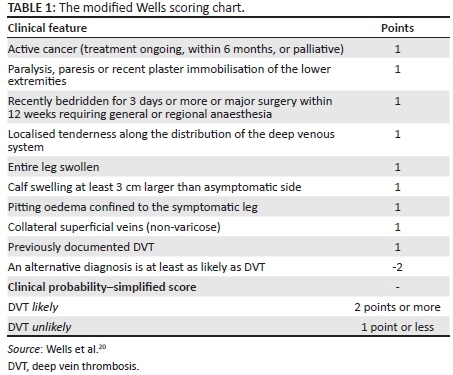
The Padau prediction score, which assesses the risk of VTE and identifies potential high-risk hospitalised medical patients for appropriate thromboprophylaxis, makes use of clinical components to arrive at this scores.18> 4 is regarded as high risk.1819> 3 points), intermediate risk (1-2 points) and low risk (< 1 point). It was later modified in 2003 with the addition of a further component (previously documented DVT) which was observed to increase the risk of DVT, giving a possible score range of -2-9.20> 2 points) and unlikely (< 2 points), based on the symptoms, signs and risk factors. With the emergence of HIV and its well-documented predisposition for coagulopathy, HIV is yet to be considered as an additional risk factor in any tool aimed at assessing the risk category for thromboprophylaxis administration. Tables 1 and 2 show the modified Wells and Padau prediction scoring systems, respectively, with the assigned points for each clinical feature or component. A definitive diagnosis is made by Doppler ultrasound scan for patients stratified as likely, and the most reliable indicator of the presence of a thrombus within a vein is direct visualisation of intraluminal thrombus or non-compressibility of the vein during ultrasound.21221616

Given the burden of HIV and TB amongst the patients seen in our study setting, we were interested in exploring the possible impact of these infections on the profile of patients presenting with DVT in our hospital. Therefore, the aim of the study was to describe the profile and frequency of risk factors of medical patients admitted with non-invasive ultrasound-diagnosed DVT.
Research method and design
This was a retrospective descriptive study done by reviewing clinical notes at an urban district hospital in KwaZulu-Natal. The study topic was selected based on the researcher's observation of an increased number of medical patients being admitted with DVT. The clinical records of all medical patients aged > 13 years who were admitted to the medical wards with ultrasound-diagnosed DVT between 1 July and 31 December 2013 were retrospectively reviewed and relevant data were extracted using a pre-defined data extraction tool.1515
Ethical consideration
Ethical approval was obtained from University of KwaZulu-Natal biomedical research ethics committee (Ref.BE214/14) as well as KwaZulu-Natal Department of Health and the management of the hospital where the study was conducted.
Results
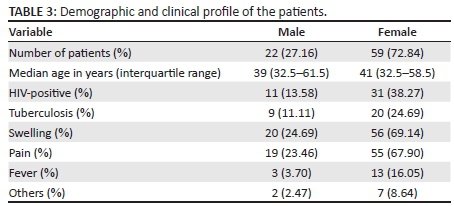
From the hospital records, a total of 118 patients with suspected DVT based on their clinical history, signs and symptoms were sent for ultrasound scans during the study period. Eighty one (68.64%) of these patients had confirmed DVT, whilst 37 (31.36%) had negative ultrasound scan results. Of the 81 who had ultrasound-confirmed DVT, 52 (64.2%) presented at the emergency unit with signs and symptoms, whilst 29 (35.8%) developed DVT in the ward during admission for other medical conditions. The age distribution of those with confirmed DVT ranged from 19 to 80 years, with median age of 40 years (interquartile range [IQR] 32-60 years). Amongst those with confirmed DVT, 22 were male patients (27.16%), whilst 59 were female patients (72.84%).
The study showed that 78 patients (96.30%) had DVT of the lower extremity. The remaining three patients (3.7%) had upper extremity DVT: two were in the neck (internal jugular vein) and one in the right subclavian vein.
The most common clinical presentation found in the study sample was swelling and pain, accounting for 76/81 (93.83%) and 74/81 (91.36%), respectively. Fever was seen in 16 patients (16/81, 19.75%), whilst other presentations like shortness of breath, cold limb and skin changes were recorded in only 9 patients (9/81, 11.11%). Table 3 shows the demographic and clinical profile of the patients.
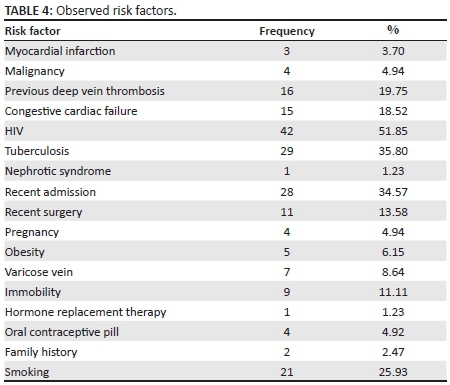
The most common risk factors identified in this study were HIV (n = 42) and TB (n = 29), whilst recent admission (n = 28), smoking (n = 21), previous DVT (n = 16) and congestive cardiac failure (n = 15) were other risk factors seen. Risk factors like myocardial infarction, pregnancy, recent surgery, immobility (unable to perform activities of daily living for > 3 days), oral contraceptive pills (OCP) and hormone replacement therapy (HRT) accounted for a negligible proportion. Table 4 depicts the observed risk factors.
Analysis of haematological profile of the patients showed mean haemoglobin level of 9.76 g/dL (standard deviation 1.92) for female patients and median haemoglobin level of 13.1 g/dL (IQR 9.02 g/dL - 13.80 g/dL) for male patients.
The median albumin level was 28.0 g/dL (IQR 23 g/dL -36 g/dL). D-dimer was done in 31 (38.37%) patients, 30 of whom had elevated levels. Baseline International Normalised Ratio (INR) was done in 78/81 (93.71%) patients, of whom 51 (65.38%) had a range of 0-1.0, whilst INR on discharge was done in 69/81 (85.16%) patients. The discharge INR was in the therapeutic range (INR 2-3) for 23 patients (23/81, 28.4%), it was sub-therapeutic (INR < 2) for 39 patients (39/81, 48.1%), and for 7 (7/81, 8.61%) patients INR was > 3.
There was a 97.5% compliance with the South African Standard Treatment Guidelines (2012) for adults for whom Warfarin and Low Molecular Weight Heparin (LMWH) or low-dose unfractionated heparin (as an alternative where cost precludes the use of LMWH) were started simultaneously.23
Discussion
The most common associated factors in the case series were HIV and TB. Although these findings differ from the risk factors identified in studies done in HIC, it is similar to the findings of a study conducted in GF Jooste Hospital in Cape Town, where HIV and TB were also identified as the most common risk factors accounting for 64.0% and 55.0%, respectively.9,10,24 That study showed that 97% of the DVT occurred in the lower limb, which is consistent with our finding of 96.3% of the DVT occurring in the lower extremity. A retrospective study conducted by Saber252627,28,29 In addition, many of these patients with HIV and TB coinfections may have had prolonged illnesses at home that may have contributed to their immobility, further predisposing them to DVT.
It is important to note that both Padau predictive rule and Wells criteria may need to be further modified for validation within South Africa to reflect the additional risk for DVT associated with these infections because they exclude HIV and TB, which were the two most common observed known risk factors in this study population. Further studies using appropriate designs and incorporating these scoring tools, which score HIV as risk factor, are recommended to test the validity of these tools for the local South African setting.
Despite existing evidence that age has a direct correlation with the formation of DVT resulting in an exponential increase in the incidence rate with increasing age, analysis of our study showed median age of 40 years (IOR 32-60 years).30,31 This finding is in keeping with studies done in similar setting with median age of 37 years (IQR 15-88 years).241532
Recent hospitalisation, smoking, previous DVT and congestive cardiac failure were the other risk factors observed in the study. However, risk factors such as malignancy, use of OCP, HRT and obesity were not common in the study and accounted for only 1.23% - 6.15%, which is consistent with the study of Levine et al.33,34,35 Recent hospital admissions occurred within the preceding 1 month in 28 patients (34.57%) of which the majority were because of HIV/AIDS and opportunistic coinfections. The results of studies investigating the relationship of smoking with VTE remain inconsistent and controversial. Whilst a prospective epidemiological study by Meyer-Michel Samama (the Sirius study)363737
The preponderance of female gender in our study population is in keeping with findings from earlier studies but inconsistent with the finding of Levine et al.3533,38 The result showed that 29 patients (35.8%) developed DVT during admission for other medical conditions of which HIV accounted for the majority. This may have been prevented with appropriate pharmacologic thromboprophylaxis. The lack of recommendation for clear thrombosis treatment guideline for this growing sub-population (HIV-infected population) leaves the decision to the attending clinicians to either administer thromboprophylaxis or not, although guidelines advocate that any sick patient who is non-ambulant receive thromboprophylaxis, unless contraindicated (South African guideline).39
Baseline INR was done in 78/81 (93.71%) patients, of whom 51 (65.38%) had a range of 0-1.0, whilst INR on discharge was done in 69/81 (85.16%) patients. The discharge INR was in the therapeutic range (INR 2-3) for 23 patients (23/81, 28.4%); sub-therapeutic (INR < 2) for 39 patients (39/81, 48.1%) and INR was >3for7 patients (7/81, 8.61%). The practical implications of optimising the INR in a busy district hospital in which staff are constantly pressured to make beds available because of the large burden of disease in South Africa sometimes contributes to the suboptimal care in that many patients are discharged before optimisation of the INR. Patients should ideally have INRs in the range of 2-3 before discharge but only a minority of patients were discharged with INRs in the therapeutic range. Outpatient management to obtain optimal INRs are done in first-world countries, but this is not feasible in the public sector in South Africa because of limited resources.40,41 The gap identified in the study will thus lend itself to a quality improvement project to improve the management of patients with DVT.
Limitations of the study
Information bias existed in the study as it was not possible to standardise the quality of the patients' clinical notes because of the retrospective nature of the study, therefore missed or improper documentation could not be completely ruled out. Furthermore, the study was done in an urban district hospital in a high prevalence of HIV and TB area, it is not possible to generalise the findings of the study.
Recommendations
• Further review of the modified Wells criteria to include HIV with a possible score of 1 and validated for use in a population with high burden of HIV infection, for example, Sub-Saharan Africa.
• The authors propose that all sick, hospitalised HIV-infected patients should be considered for thromboprophylaxis, particularly if non-ambulant, and until such time as they are fully weight-bearing ambulant.
• It is important that practicing clinicians ensure that all hospitalised patients with VTE should be adequately anticoagulated prior to discharge and ideally followed up at an anticoagulation clinic.
Conclusion
The review of the profile and risk factors of patients with DVT in our study setting shows predominantly young patients with female preponderance. TB and HIV are well-recognised risk factors, either alone or in conjunction. Clinicians should have a heightened awareness of VTE in patients with either condition or where both conditions occur together and appropriate thromboprophylaxis should be administered.
Competing interests
The authors declare that they have no financial or personal relationships which may have inappropriately influenced them in writing the article.
Authors' contributions
D.A. was the principal researcher with the conceptualisation of research topic and methodology whilst M.N. supervised the research and provided useful critique and editing of the final manuscript. M.H.C. provided academic and moral support in the development of the protocol.
Acknowledgements
References
- 1. Anderson FA, Wheeler HB, Goldberg RJ, et al. A population-based perspective of the hospital incidence and case-fatality rates of deep vein thrombosis and pulmonary embolism. The Worcester DVT study. Arch Intern Med. 1991;151: 933-938.
- 2. Ho WK, Hankey GJ, Eikelboom JW. The incidence of venous thromboembolism: A prospective, community-based study in Perth, Western Australia. Med J Aust. 2008;189:144-147.
- 3. Lee AD, Stephen E, Agarwal S, Premkumar P. Venous thromboembolism in India. Eur J Vasc Endovasc Surg. 2009;37(4):482-485.
- 4. Luciani A, Clement O, Halimi P, et al. Catheter-related upper extremity deep venous thrombosis in cancer patients: A prospective study based on Doppler US. Radiology. 2001;220:655.
- 5. Statistics South Africa. Mortality and causes of death in South Africa, 2009: Findings from death notification. 2011.
- [cited 2015 Sep 20]. Available from http://www.statssa.gov.za/Publications/P03093/P030932009.pdf
- 6. Ruppert A, Steinle T, Lees M. Economic burden of venous thromboembolism: A systematic review. J Med Econ. 2011;14(1):65-74.
- 7. Geerts WH, Pineo GF, Heit JA, et al. Prevention of venous thromboembolism: The Seventh ACCP Conference on Antithrombotic and Thrombolytic Therapy. Chest. 2004;126(3 Suppl):S338-S400.
- 8. Bonthier J. The venous thrombotic risk in non-surgical patients. Drugs. 1996;52(Suppl 7):16-29.
- 9. Anderson FA, Spencer FA. Risk factors for venous thromboembolism. Circulation. 2003;107:19-16.
- 11. Clayton TC, Gaskin M, Meade TW. Recent respiratory infection and risk of venous thromboembolism: Case-control study through a general practice database. Int J Epidemiol. 2011;40(3):819-827.
- 12. Rosendaal FR, Reitsma PH. Genetics of venous thrombosis. J Thromb Haemost. 2009;7(Suppl 1):301-304.
- 13. Shen YM, Frenkel EP. Thrombosis and hypercoagulable state in HIV infected patients. Clin Appl Throm Hemost. 2004;10(3):277-280.
- 14. Klein SK, Slim EJ, de Kruif MD, et al. Is chronic HIV infection associated with venous thrombotic disease? A systematic review. Neth J Med. 2005;63(4):129-136.
- 15. Olubanwo O. The profile of HIV/AIDS patients admitted with deep vein thrombosis.
- [cited 2015 Sep 20] Available from: http://www.phcfm.org/index.php/phcfm/thesis/view/32
-
16. Anand SS, Wells PS, Hunt D, Brill-Edwards P, Cook D, Ginsberg JS. Does this patient have deep vein thrombosis? JAMA. 1998;279(14):1094-1099. http://dx.doi.org/10.1001/jama.279.14.1094
» http://dx.doi.org/10.1001/jama.279.14.1094 - 17. Nuijten MJ, Berto P, Kosa J, Nadipelli V, Cimminielo C, Spreafico A. Cost-effectiveness of enoxaparin as thromboprophylaxis in acutely ill medical patients from the Italian NHS perspective. Recenti Prog Med. 2002;93(2):80-91.
-
18. Barbar S, Noventa F, Rossetto V, et al. A risk assessment model for the identification of hospitalized medical patients at risk for venous thromboembolism: The Padua Prediction Score. J Thromb Haemost. 2010 Nov;8(11):2450-2457. http://dx.doi.org/10.1111/j.1538-7836.2010.04044.x.
» http://dx.doi.org/10.1111/j.1538-7836.2010.04044.x - 19. Wells PS, Anderson DR, Bormanis J, et al. Value of assessment of pretest probability of 6 deep-vein thrombosis in clinical management. Lancet. 1997;350:1795-1798.
- 20. Wells PS, Anderson DR, Rodger M, et al. Evaluation of D-dimer in the diagnosis of suspected deep-vein thrombosis. N Engl J Med. 2003;349:1227-1235.
- 21. Talbot S. Use of real-time imaging in identifying deep venous obstruction: A preliminary report. Bruit. 1982;7:41-42.
- 22. Kearon C, Julian JA, Newman TE, Ginsberg JS. Noninvasive diagnosis of deep vein thrombosis. McMaster Diagnostic Imaging Practice Guidelines Initiative. Ann Intern Med. 1998;128:663-677.
-
23. Standard Treatment Guidelines and Essential Medicines List [homepage on the Internet]. (cited 2015 Sep 20) Available from: http://www.kznhealth.gov.za/pharmacy/edladult_2012.pdf
» http://www.kznhealth.gov.za/pharmacy/edladult_2012.pdf - 24. Aishehri MF. Risk factors for deep vein thrombosis in a South African public hospital [cited 2015 Sep 20]. Available from http://hdl.handle.net/11427/2879
- 25. Saber AA, Aboolian A, LaRaja RD, Baron H, Hanna K. HIV/AIDS and the risk of deep vein thrombosis: A study of 45 patients with lower extremity involvement. Am Surg. 2001;67(7):645-647.
- 26. Matta F, Yaekoub AY, Stein PD. Human immunodeficiency virus infection and risk of venous thromboembolism. Am J Med Sci. 2008;336(5):402-K06.
- 27. Naithani R, Neerja A. Deep vein thrombosis associated with tuberculosis. Blood Coagul Fibrinolysis. 2007;18(4):377-380.
- 28. Robson S, White N, Aronson I, Woollgar R, Goodman H, Jacobs P. Acute phase response and the hypercoagulable state in pulmonary tuberculosis. Br Haematol. 1996;93(4):943-949.
- 29. Setswe, G. (2009) TB and HIV/AIDS epidemics in South Africa: an overview. (Paper presented at the PDM2009 Summer School, Stellenbosch University, 13 January). [ cited 2015 Nov 18] Available from: http://www.hsrc.ac.za/en/research-outputs/view/4176
- 31. Hansson PO, Welin L, Tibblin G, Eriksson H. Deep vein thrombosis and pulmonary embolism in the general population. 'The study of the men born in 1913'. Arch Intern Med. 1997;157(15):1665-1670.
- 32. Shisana O, Rehle T, Simbayi L, et al. South African national HIV prevalence, incidence and behavior survey, 2012. Cape Town: HSRC Press; 2014.
- 33. Miah T, Hoque AA, Rashid HU, Mahmood T, Khan RR, Sarkar S. Clinical profile and risk association of DVT. J Med. 2007;8:7-9.
- 34. van Hylckama Vlieg A, Helmerhorst FM, Vandenbroucke JP, Doggen CJM, Rosendaal FR. The venous thrombotic risk of oral contraceptives, effects of oestrogen dose and progestogen type: Results of the MEGA case-control study. BMJ. 2009;339:1-8.
- 35. Levine M, Gent M, Hirsh J, et al. A comparison of low-molecular-weight heparin administered primarily at home with unfractionated heparin administered in the hospital for proximal deep-vein thrombosis. N Engl J Med. 1996;334(11):677-681.
-
36. Samama M, for the Sirius Study Group. An epidemiologic study of risk factors for deep vein thrombosis in medical outpatients: The Sirius Study. Arch Intern Med. 2000;160(22):3415-3420. http://dx.doi.org/10.1001/archinte.160.22.3415
» http://dx.doi.org/10.1001/archinte.160.22.3415 -
37. Cheng Y-J, Liu Z-H, Yao F-J, et al. Current and former smoking and risk for venous thromboembolism: A systematic review and meta-analysis. PLoS Med. 2013;10(9):e1001515. http://dx.doi.org/10.1371/journal.pmed.1001515s
» http://dx.doi.org/10.1371/journal.pmed.1001515s - 38. Naess IA, Christianse SC, Romundstad P, Cannegieter SC, Rosendaal FR, Hammerstrom J. Incidence and mortality of venous thrombosis: A population-based study. J Thromb Haemost. 2007;5(4):692-699.
- 39. Jacobson, BF, Louw S, Buller H, et al. Venous thromboembolism: Prophylactic and therapeutic practice guideline. S Afr Med J. 2013 [cited 2015 Dec 21];
- 103(4):260-267. Available from: http://www.samj.org.za/index.php/samj/article/view/6706/5002. http://dx.doi.org/10.7196/SAMJ.6706
- 40. Spyropoulos AC. Outpatient-based treatment protocols in the management of venous thromboembolic disease. Am J Manag Care. 2000;6(20 Suppl):1034-1044.
- 41. Dunn AS, Coller B. Outpatient treatment of deep vein thrombosis: Translating clinical trials into practice. Am J Med. 1999;106:660-669.
Accepted: 28 Jan. 2016
Published: 13 May 2016