When will sub-Saharan Africa adopt HIV treatment for all?
Abstract
BACKGROUND: The World Health Organization (WHO) HIV treatment guidelines have been used by various countries to revise their national guidelines. Our study discusses the national policy response to the HIV epidemic in sub-Saharan Africa and quantifies delays in adopting the WHO guidelines published in 2009, 2013 and 2015. METHODS: From the Internet, health authorities and experts, and community members, we collected 59 published HIV guidelines from 33 countries in the sub-Saharan African region, and abstracted dates of publication and antiretroviral therapy (ART) eligibility criteria. For these 33 countries, representing 97% regional HIV burden in 2015, the number of months taken to adopt the WHO 2009, 2013 and/or 2015 guidelines were calculated to determine the average delay in months needed to publish revised national guidelines. FINDINGS: Of the 33 countries, 3 (6% regional burden) are recommending ART according to the WHO 2015 guidelines (irrespective of CD4 count); 19 (65% regional burden) are recommending ART according to the WHO 2013 guidelines (CD4 count ≤ 500 cells/mm3); and 11 (26% regional burden) according to the WHO 2009 guidelines (CD4 count ≤ 350 cells/mm3). The average time lag to WHO 2009 guidelines adoption in 33 countries was 24 (range 3-56) months. The 22 that have adopted the WHO 2013 guidelines took an average of 10 (range 0-36) months, whilst the three countries that adopted the WHO 2015 guidelines took an average of 8 (range 7-9) months. CONCLUSION: There is an urgent need to shorten the time lag in adopting and implementing the new WHO guidelines recommending 'treatment for all' to achieve the 90-90-90 targets.
Introduction
The rapid expansion of antiretroviral therapy (ART) has been a cornerstone in transforming the acquired immunodeficiency syndrome (AIDS) response globally. In March 2015, the '15 by 15' target set out in the 2011 United Nations Political Declaration on HIV and AIDS was achieved ahead of the deadline.12223345,6,7,8,9,10,11,12,13,14
Translating scientific discovery into policy and then service delivery generally takes years. However, delays translate into missed public health opportunities to prevent illness, death and transmission and deny millions of people timely access to life-saving treatment. Since 2003, the World Health Organization (WHO) has updated its treatment guidelines to reflect expert consensus on when to initiate HIV treatment. Whilst the WHO 2003 guidelines recommended ART at CD4 count ≤ 200 cells/mm3153163317,1856719
Most of the countries in sub-Saharan Africa use the internationally accepted WHO guidelines as a reference to revise their national guidelines. Our study looks at the national ART policy response to the HIV epidemic in sub-Saharan African countries, and quantifies delays in national level adoption of the WHO ART guidelines published in 2009, 2013 and 2015.
Methods
From the International Association of Providers of AIDS Care's (IAPAC) National Policy Database,20www.hivpolicywatch.org) is current as of July 2016 and has been constructed over a 5-year period using quarterly Internet searches and direct submissions from Ministries of Health, WHO, UNAIDS, Centers for Disease Control and Prevention, United States Agency for International Development, PEPFAR, non-governmental organisations, HIV experts and members of the community. In addition to the IAPAC database, an Internet search was also done for previously published guidelines using the keywords 'country name' and 'HIV treatment or antiretroviral' and 'guidelines'. As PDF versions of national guidelines before 2005 were often not available or links to these guidelines had expired, we restricted the analysis to calculating the time lag in adoption of the WHO 2009, 2013 and 2015 guidelines.
Of the 48 countries in the sub-Saharan African region, we found 92 published national guidelines from 37 countries, representing 98% of regional HIV burden in 2015 (referred to as regional burden henceforth).2333
The date of adoption of a WHO guideline was defined as the date of publication of the first national guideline that was consistent with the WHO guideline recommendation. Using the WHO guidelines publication date (i.e. October 2009, June 2013 and September 2015), the time lag was calculated as the number of months taken by a country to adopt the WHO guidelines. The average time lag in WHO guidelines adoption was defined as the total number of months taken to adopt WHO guidelines divided by the number of countries. Delay was calculated separately for the WHO 2009, WHO 2013 and WHO 2015 guidelines according to the available published national guidelines for that period. We also estimated the delay in moving to the WHO 2013 guidelines for all 33 countries by assuming that the countries that are yet to move to CD4 count ≤ 500 cells/mm3
Results
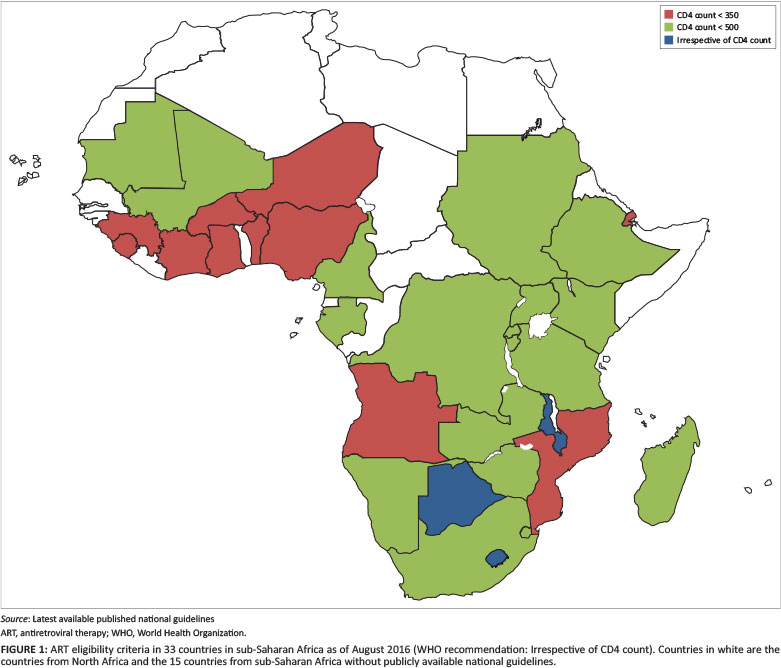
According to the latest available published national guidelines from 33 countries, 3 countries (6% regional burden) are recommending ART according to the WHO 2015 guidelines (treatment for all). A total of 19 countries (65% regional burden) are recommending ART according to the WHO 2013 guidelines (CD4 count ≤ 500 cells/mm33Figure 1).
Time lag in adopting the WHO 2009 guidelines
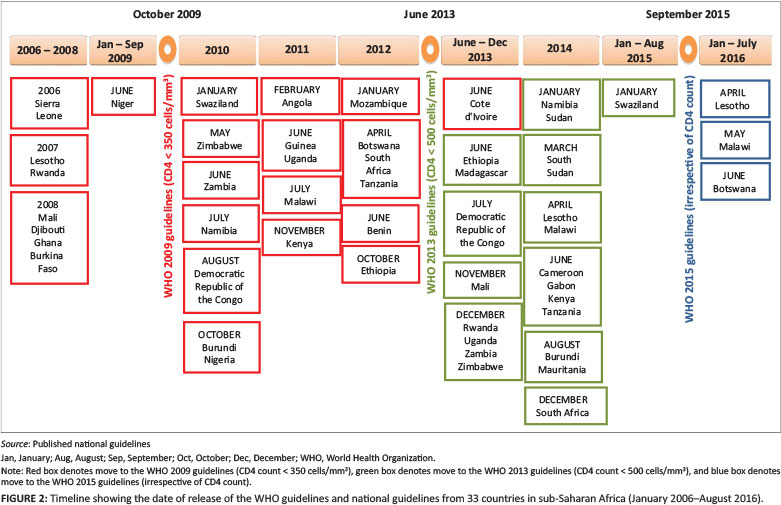
The WHO 2006 guidelines recommended ART at CD4 count ≤ 200 cells/mm3considered treatment at CD4 counts between 200 and 350 cells/mm33Figure 2).
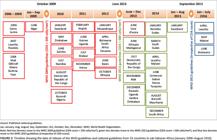
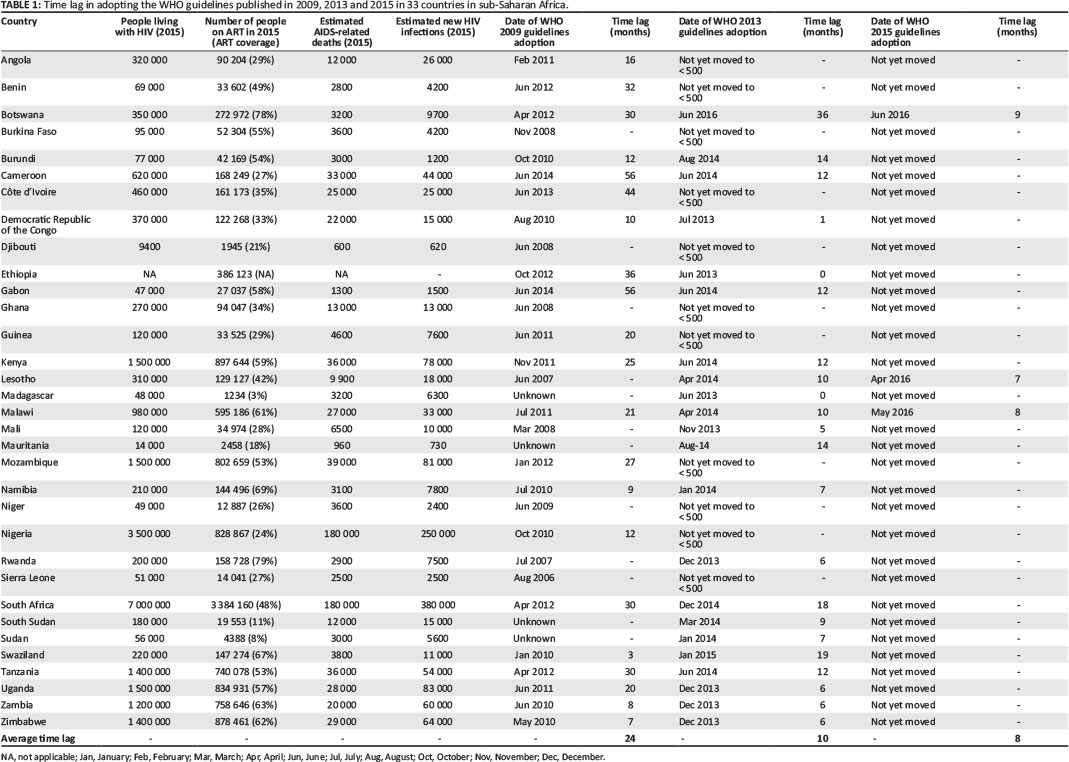
Of the 33 countries, 21 (91% regional burden) are known to have moved to CD4 count ≤ 350 cells/mm3Figure 2). On average, these countries took 24 (range 3-56) months to revise their national guidelines in line with the WHO 2009 guidelines (Table 1). For the remaining 4 countries (1% regional burden), national guidelines that adopted the WHO 2009 guidelines were not available.
Time lag in adopting the WHO 2013 guidelines
None of the countries in sub-Saharan Africa moved to the CD4 ≤ 500 cells/mm3Figure 2). Of the 33 countries, 22 (92% regional burden) moved to CD4 count ≤ 500 cells/mm3Figure 2). These countries took an average of 10 (range 0-36) months to revise their national guidelines in line with the WHO 2013 recommendations (Table 1). Eleven countries (26% regional burden) have not yet adopted the WHO 2013 guidelines. Assuming these 11 countries adopt the WHO 2013 guidelines by August 2016, average time lag would be 19 (range 0-38) months.
Time lag in adopting the WHO 2015 guidelines
None of the countries in sub-Saharan Africa moved to ART irrespective of CD4 count before the release of the WHO 2015 guidelines (Figure 2). Of the 33 countries, 3 (6% regional burden) moved to ART irrespective of CD4 count after publication of the WHO 2015 guidelines (Figure 2). These countries took an average of 8 (range 7-9) months to revise their national guidelines in line with the WHO 2015 recommendations.
Discussion
The national treatment guidelines are vital tools for programme design and management of people living with HIV. Timely adoption of international best practices and normative guidelines as national policies, and successful dissemination and implementation of these policies, are critical for accelerated access to ART. Guideline revisions can be complex and often involve consensus building around technical and operational issues and negotiations with internal and external stakeholders regarding budget prioritisation. Our study suggests that adoption of national treatment guidelines from sub-Saharan African countries has been very slow, with countries taking an average of 2 years to move to CD4 ≤ 350 cells/mm3
As of August 2016, after 11 months, only three countries in the region had adopted and published national guidelines reflecting the WHO 2015 recommendations, which were published in September 2015. Recent public announcements about plans to adopt 'test and treat' suggest that adoption of the WHO 2015 guidelines may be more rapid than for the WHO 2009 and 2013 guidelines.21
Countries with low HIV prevalence and higher HIV spending are more likely to adopt the WHO guidelines.2220202323
Adoption and implementation of the WHO 2015 guidelines will pay off with improvement in ART coverage and reductions in illness, AIDS-related deaths and HIV transmission, and save health and other costs.5,6,7221
Limitations of the study
Our study has several limitations. We concentrated solely on published national guidelines to determine the date of adoption of the WHO recommendations. Written policies might not reflect practice in countries or might have been published after a recommendation was implemented, suggesting that we might have overestimated the time lag in some cases. Even though we did a comprehensive search for all national guidelines, we might have missed some guidelines; and some guidelines may be outdated or in the process of being updated.
Conclusion
Since 2000, HIV treatment has dramatically changed the natural history of the HIV epidemic. The new science showing the benefits of treatment for all5,6,724,252
Competing interests
The authors declare that they have no financial or personal relationships, which may have inappropriately influenced them in writing this article.
Authors' contributions
R.G. was the project leader; R.G. and S.G. were responsible for project design; S.G. collected the data and performed the calculations; R.G. made conceptual contributions; and S.G. and R.G. prepared the manuscript.
Acknowledgements
References
-
1. How AIDS changed everything MDG 6: 15 years, 15 lessons of hope from AIDS response [homepage on the Internet]. Geneva, Switzerland: Joint UN Programme on HIV/AIDS (UNAIDS); 2015. Available from: http://www.unaids.org/sites/default/files/media_asset/MDG6Report_en.pdf
» http://www.unaids.org/sites/default/files/media_asset/MDG6Report_en.pdf -
2. AIDSinfo database [database online]. Geneva, Switzerland: Joint UN Programme on HIV/AIDS (UNAIDS); 2016. Available from: http://aidsinfo.unaids.org/
» http://aidsinfo.unaids.org/ -
3. 90-90-90: An ambitious treatment target to help end the AIDS epidemic. Geneva, Switzerland: Joint UN Programme on HIV/AIDS (UNAIDS); 2014. Available from: http://www.unaids.org/sites/default/files/media_asset/90-90-90_en_0.pdf
» http://www.unaids.org/sites/default/files/media_asset/90-90-90_en_0.pdf -
4. PEPFAR 3.0 controlling the epidemic: Delivering on the promise of an AIDS-free generation. The U.S. President's emergency plan for AIDS relief, United States, 2014 [homepage on the Internet]. Available from: http://www.pepfar.gov/documents/organization/234744.pdf
» http://www.pepfar.gov/documents/organization/234744.pdf - 5. Cohen MS, Chen YQ, McCauley M, et al. Prevention of HIV-1 infection with early antiretroviral therapy. N Engl J Med. 2011;365(6):493-505.
- 6. Group ISS, Lundgren JD, Babiker AG, et al. Initiation of antiretroviral therapy in early asymptomatic HIV infection. N Engl J Med. 2015;373(9):795-807.
- 7. Group TAS, Danel C, Moh R, et al. A trial of early antiretrovirals and isoniazid preventive therapy in Africa. N Engl J Med. 2015;373(9):808-822.
- 8. Attia S, Egger M, Muller M, Zwahlen M, Low N. Sexual transmission of HIV according to viral load and antiretroviral therapy: Systematic review and meta-analysis. AIDS. 2009;23(11):1397-1404.
- 9. Granich RM, Gilks CF, Dye C, De Cock KM, Williams BG. Universal voluntary HIV testing with immediate antiretroviral therapy as a strategy for elimination of HIV transmission: A mathematical model. Lancet. 2009;373(9657):48-57.
- 10. Montaner JS, Hogg R, Wood E, et al. The case for expanding access to highly active antiretroviral therapy to curb the growth of the HIV epidemic. Lancet. 2006;368(9534):531-536.
- 11. Montaner JS, Lima VD, Harrigan PR, et al. Expansion of HAART coverage is associated with sustained decreases in HIV/AIDS morbidity, mortality and HIV transmission: The 'HIV Treatment as Prevention' experience in a Canadian setting. PLoS One. 2014;9(2):e87872.
- 12. Quinn TC, Wawer MJ, Sewankambo N, et al. Viral load and heterosexual transmission of human immunodeficiency virus type 1. Rakai Project Study Group. N Engl J Med. 2000;342(13):921-929.
- 13. Suthar AB, Lawn SD, Del Amo J, et al. Antiretroviral therapy for prevention of tuberculosis in adults with HIV: A systematic review and meta-analysis. PLoS Med. 2012;9(7):e1001270.
- 14. Tanser F, Barnighausen T, Grapsa E, Zaidi J, Newell ML. High coverage of ART associated with decline in risk of HIV acquisition in rural KwaZulu-Natal, South Africa. Science. 2013;339(6122):966-971.
-
15. Scaling up antiretroviral therapy in resource-limited settings: Treatment guidelines for a public health approach [homepage on the Internet]. Geneva, Switzerland: World Health Organization (WHO); 2003. Available from: http://www.who.int/hiv/pub/prev_care/en/arvrevision2003en.pdf?ua=1
» http://www.who.int/hiv/pub/prev_care/en/arvrevision2003en.pdf?ua=1 -
16. Antiretroviral therapy for HIV infection in adults and adolescents: Recommendations for a public health approach [homepage on the Internet]. Geneva, Switzerland: World Health Organization (WHO); 2006. Available from: http://www.who.int/hiv/pub/guidelines/artadultguidelines.pdf
» http://www.who.int/hiv/pub/guidelines/artadultguidelines.pdf -
17. Antiretroviral therapy for HIV infection in adults and adolescents [homepage on the Internet]. Geneva, Switzerland: World Health Organization (WHO); 2010. Available from: http://whqlibdoc.who.int/publications/2010/9789241599764_eng.pdf
» http://whqlibdoc.who.int/publications/2010/9789241599764_eng.pdf -
18. Consolidated guidelines on the use of antiretroviral drugs for treating and preventing HIV infection. Geneva, Switzerland: World Health Organization (WHO); 2013. Available from: http://apps.who.int/iris/bitstream/10665/85321/1/?9789241505727_eng.pdf
» http://apps.who.int/iris/bitstream/10665/85321/1/?9789241505727_eng.pdf -
19. Guideline on when to start antiretroviral therapy and on pre-exposure prophylaxis for HIV. Geneva, Switzerland: World Health Organization (WHO); 2015. Available from: http://www.who.int/hiv/pub/guidelines/earlyrelease-arv/en/
» http://www.who.int/hiv/pub/guidelines/earlyrelease-arv/en/ -
20. Global HIV Policy Watch [database online]. International association of providers of AIDS care; 2015 [Updated 2016 June]. Available from: http://www.hivpolicywatch.org/
» http://www.hivpolicywatch.org/ -
21. South Africa moves to 'test and treat' [Newpaper article]. Health E-News: The South African Health New Service, May 2016. Available from: https://http://www.health-e.org.za/2016/05/10/south-africa-moves-test-treat/
» https://http://www.health-e.org.za/2016/05/10/south-africa-moves-test-treat/ - 22. Gupta S, Granich R, Suthar AB, et al. Global policy review of antiretroviral therapy eligibility criteria for treatment and prevention of HIV and tuberculosis in adults, pregnant women, and serodiscordant couples. J Acquir Immune Defic Syndr. 2013;62(3):e87-e97.
- 23. Granich R, Gupta S, Montaner J, Williams B, Zuniga JM. Pattern, determinants, and impact of HIV spending on care and treatment in 38 high-burden low- and middle-income countries. J Int Assoc Provid AIDS Care. 2016;15(2):91-100.
- 24. Kavanagh M, Cohn J, Mabote L, et al. Evolving human rights and the science of antiretroviral medicine. Health Hum Rights. 2015;17(1):E76-E90.
- 25. Montaner JS, Socias ME. Restricting access to HIV-related services: A bad public health and economic policy. Enferm Infecc Microbiol Clin. 2015;33(7):435-436.

Accepted: 28 July 2016
Published: 31 Aug. 2016