The prevalence of cervical abnormalities: Comparison of youth with perinatally acquired HIV and older women in Botswana
Abstract
BACKGROUND: Cervical cancer burden and prevalence of precursor lesions is unknown among young women living with HIV in high prevalence settings. Current cervical cancer screening guidelines in resource-limited settings with high HIV prevalence typically exclude adolescents and young women. After observing two cases of advanced cervical cancer among young women with perinatally acquired HIV, a pilot screening programme was established in Botswana. OBJECTIVES: To compare the prevalence of cervical abnormalities in young women with perinatally acquired HIV with women aged 30-49 years, regardless of HIV status. METHOD: We conducted a cross-sectional study of 30-49-year-old women who had visual inspection with acetic acid screening through the Botswana public sector programme, and youth (aged 15-24 years) with perinatally acquired HIV, at a single referral site between 2016 and 2018. We describe the prevalence of cervical abnormalities in each group as well as the crude prevalence ratio. RESULTS: The prevalence of cervical abnormalities in women 30-49 years of age was 10.9% (95% confidence interval [CI]: 10.4, 11.4), and 10.1% (95% CI: 4.7, 18.3) for youth. The crude prevalence ratio was 1.07 (95% CI: 0.58, 2.01). CONCLUSION: Inclusion of youth living with HIV in cervical cancer screening services should be considered in settings with a high prevalence of HIV and cervical cancer.
perinatal HIV; young women; visual inspection with acetic acid; cervical cancer screening; Africa
Background
Cervical cancer burden and prevalence of precursor lesions is unknown among young women with perinatally acquired HIV, living in high HIV prevalence settings. Young women are generally excluded from cervical cancer screening programmes in current guidelines in high HIV prevalence settings, which prioritise women aged 30-49 years. This approach is contrary to recommendations from other settings for increased frequency of cervical cancer screening and follow-up amongst people living with HIV due to faster progression of disease.123,4,5
Several biological processes have been suggested to explain this phenomenon. HIV increases HPV transmission. CD4+ T-lymphocytes play a central role in the control of established HPV infections. Therefore, HIV-related immune suppression facilitates viral persistence,1678
To test our hypothesis that young women with perinatally acquired HIV have similar prevalence of cervical abnormalities to women of 30-49 years, we compare the prevalence of cervical abnormalities between the women evaluated through the national screening programme in Botswana and a pilot project for screening adolescents and young women living with HIV at the Botswana-Baylor Children's Clinical Centre of Excellence (BBCCCOE), a centre focused on the care and treatment of children and youth living with HIV. Both programmes implemented visual inspection with acetic acid (VIA) screening, using the same equipment, supplies, trainings and Ministry of Health (MoH)-supported mentorship.
Methods
Setting
Based on stakeholder consensus and international evidence-based recommendations as provided by the World Health Organization, Botswana began implementation of a multipronged cervical cancer prevention and control programme in 2012. The prevention aspect focused on HPV vaccines for girls 9-13 years, while secondary prevention in the form of screening and early treatment targeted women 30-49 years of age. Women outside this age range typically are only screened if symptomatic.5,6
Participants and definitions
Data were included for: (1) women 30-49 years of age, regardless of HIV status, who were screened with VIA for the first time between 2016 and 2018 through the national screening programme; and (2) adolescents and young adults < 24 years of age ('youth') with perinatally acquired HIV screened with VIA at the BBCCCOE cervical cancer screening clinic for the first time in 2017 and 2018. We defined perinatal HIV infection as HIV infection that was thought to have resulted from the transmission of HIV from the mother to her child during pregnancy, labour and delivery, or breastfeeding.6
Our primary outcome of cervical abnormality was defined as a positive VIA or positive VIA-suspected cervical cancer The national guidelines define a positive VIA as a change in the cervix upon application of the acetic acid, resulting in well-defined, opaque-acetowhite lesions in the transformation zone close to the squamocolumnar junction or to the external orifice, or the entire cervix turning acetowhite.910
Data source
We used the National Cervical Cancer Screening Database to extract data for women screening for cervical cancer receiving VIA for the first time. This database is housed in the Botswana MoH and is disaggregated by age groups, HIV status (positive, negative, unknown), VIA test results (VIA positive; VIA positive - suspected cervical cancer; VIA negative), and procedures or referrals done in the event of a positive VIA test (cryotherapy, Loop Electrosurgical Excision Procedure, colposcopy). The MoH data are reported at the facility-level. Individual-level data are not available for the national cohort. The BBCCCOE registers and patient electronic data were used to extract and abstract variables for individual youth living with HIV who were included in the screening programme.
Inclusion/exclusion criteria
Because the national screening guidelines do not differ based on HIV status, we included data from all women between the ages of 30-49 who were having their first VIA, regardless of HIV status.
For the BBCCCOE sample, all data were from HIV-positive youth aged 16-24 years who were having their first VIA. Screening at the BBCCCOE was offered to sexually active females patients ≥ 16 years of age.
Sample size and power
We used exhaustive sampling for both groups. We estimated that there would be 120 youth screened at BBCCCOE and approximately 6000 30-49-year-old women in the public programme during the sampling period.
Considering the reported prevalence of positive VIA among women of mixed HIV status in the region (30.5% among farm workers and sex workers in South Africa's Limpopo province,1112
Data collection
All data were de-identified and either electronically or manually imported into Excel files by trained and authorised staff of the respective organisations. All MoH data were downloaded from the national database which is populated at the individual clinic level prior to being compiled centrally. Data were manually extracted from the BBCCCOE medical records, both electronic and paper-based, by clinic research nurses.
We evaluated for missing and out of range data for the two data sets. Data from the MoH were double-checked by the study Principal Investigator and an MoH data officer against the submitted reports from the respective facilities. All data from the BBCCCOE were double-checked for accuracy against the primary source by the study Principal Investigator, the study nurse, and the nurse in charge of the cervical cancer screening programme.
To protect study participants from the youth sample, medical record numbers were replaced with unique study numbers. Dates of birth were converted into the age at the time of the VIA evaluation.
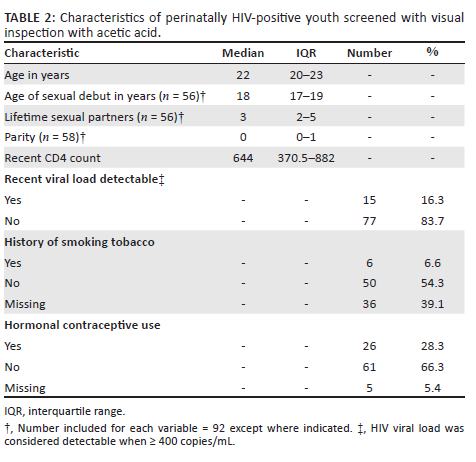
Data on HIV status (positive/negative/unknown) were reported in the national database. For the perinatally infected cohort, data were collected regarding whether they had ever used hormonal contraception, age of sexual debut, parity, CD4+ T-lymphocyte count (CD4 count) nadir and most recent CD4 count, most recent HIV viral load, and smoking history. HIV viral load was considered to be undetectable for values less than 400 copies/mL, as per Botswana guidelines. The most recent viral loads for all youth were within 6 months of index VIA.
Statistical analysis
Data were imported into the Stata IC/14.2® (Stata Corporation, College Station, Texas, United States) statistical software package for analysis. For our primary analysis, we used the composite endpoint of cervical abnormalities versus no cervical abnormalities. The proportion of cervical abnormalities versus no cervical abnormalities was compared between women 30-49 years of age in the national testing group and BBCCCOE youth, using chi-squared test with the criterion for significance set as a P-value < 0.05. Mean and standard deviation are reported for parametric data and median (interquartile range [IQR]) for non-parametric data. We calculated the crude cervical abnormalities prevalence ratio and 95% confidence interval (CI) by dividing the cervical abnormalities prevalence of women 30-49 years by that of BBCCCOE youth.
Results
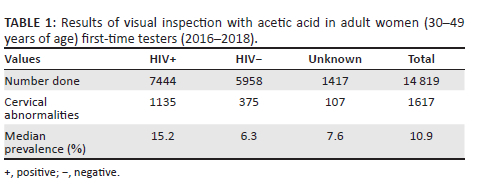
A total of 14 819 women aged 30-49 years attended VIA screening clinics across the country for the first time between January 2016 and December 2018, in 23 of the total 27 health districts. Of the 92 youth who attended the BBCCCOE cervical cancer screening clinic, 85 of 92 (92.4%) were screened with VIA alone, three (3.3%) with Pap alone and four (4.4%) with both Pap and VIA.
For the BBCCCOE group, the median age in years for screening was 22 years (range: 17 to 24), and 18 years (range: 8 to 23) for sexual debut. The lowest age of sexual debut was reported in a case of sexual abuse. The median total number was 3 (range: 1 to 16; IQR: 2-5) for sexual partners and 0 (range: 0 to 3; IQR: 0-1) for parity. The median CD4 count was 644 cells/µL (IQR: 370.5-882). The HIV viral load was undetectable in 77 (83.7%) of participants. Twenty-six (29.9%) participants reported ever using hormonal contraception and six (6.6%) reported ever smoking. Characteristics of screened adults are further described in Table 1, and youth in the perinatally infected cohort in Table 2.
A total of 1617 women and nine youth had cervical abnormalities, giving a prevalence of cervical abnormalities of 10.9% (95% CI: 10.4, 11.4) for women 30-49 years of age and 10.1% (95% CI: 4.7, 18.3) for youth living with HIV. The crude prevalence ratio was 1.07 (95% CI: 0.58, 2.01). Of the seven Pap smears done amongst the youth, three were atypical squamous cells of undetermined significance, two low-grade squamous intraepithelial lesions, one negative and one not reported.
Cases of suspected cancer constituted 8.7% (95% CI: 7.3, 10.1) of cervical abnormalities amongst the older women, while no cases of suspected cancer were reported for youth. Amongst youth with cervical abnormalities, three (33.3%) had detectable viral loads while viral loads were detectable in 11 (13%) of those without cervical abnormalities. The median CD4 count amongst youth with cervical abnormalities was 342 cells/µL (IQR: 188.5-455.5), and 656 cells/µL (IQR: 450-905) for those without cervical abnormalities.
Discussion
Our finding in this cross-sectional study of a group of 30-49-year-old women who received VIA screening in the public sector and perinatally HIV-positive youth at a single referral site suggests that the risk of cervical abnormalities of these two groups is similar. The overall prevalence of cervical abnormalities was lower in our cohorts (10.1%) compared with previously published samples from the region (15% - 30%).13,14151617
Spontaneous improvement of cervical abnormalities is possible,1819
This study was limited by the lack of individual-level data for the approximately 15 000 women screened through the national programme. The size of the individual-level data sample for the youth was relatively small since cervical cancer screening for younger women is not currently part of the public treatment programmes. Additionally, screening was done with VIA while the World Health Organization recommendation is that of using a DNA-based HPV assay.19
Our data suggest that cervical cancer screening and prevention services should be expanded to include youth living with HIV as a target population in high cervical cancer and HIV prevalence settings, such as Botswana. Future studies should evaluate the progression/regression of cervical abnormalities among youth living with HIV, including both those who were perinatally and behaviorally infected.
Competing interests
The authors declare that they have no financial or personal relationships that may have inappropriately influenced them in writing this article.
Authors' contributions
T.P., E.L., M.M. and B.M. conceptualised and developed the protocol. T.P. and E.L. analysed and prepared the draft manuscript. T.P., K.M. and O.T. contributed to the acquisition, cleaning and interpretation of Botswana-Baylor Children's Clinical Centre of Excellence patient data, these being important aspects of the study. All authors read and approved the final manuscript.
Ethical considerations
Ethical approval was sought and received from Research Ethics Committees of the following organisations: Botswana Health Research Development Committee, University of Botswana (reference: HPDME: 13/18/1), University of Pennsylvania, Botswana-Baylor Children's Clinical Centre of Excellence.
Funding information
This work was supported by a National Institutes of Health D43 HIV Research Training Program for Botswana (D43TW009781) grant. This work was made possible, in part, through core services and support from the Penn Center for AIDS Research (CFAR), an NIH-funded programme (P30 AI 045008). Support was also received from the Children's Hospital of Philadelphia Carole Marcus Mid-Career Award to Promote Career Development and Mentoring in Pediatric Research.
Data availability
The data sets used and/or analysed during the current study are available from the corresponding author, T.P., on reasonable request.
Disclaimer
The opinions expressed in this article are those of the authors. They do not purport to reflect the opinions or views of the funder nor that of the institutions to which the authors are affiliated.
Acknowledgements
We would like to acknowledge Mr Kadimo Khutsafalo for his librarian editorial support.
References
-
1.Stanley MA, Sterling JC. Host responses to infection with human papillomavirus. Curr Probl Dermatol. 2014;45:58-74. https://doi.org/10.1159/000355964
» https://doi.org/10.1159/000355964 -
2.Kamolratanakul S, Pitisuttithum P. Human papillomavirus vaccine efficacy and effectiveness against cancer. Vaccines (Basel). 2021;9(12):1413. https://doi.org/10.3390/vaccines9121413
» https://doi.org/10.3390/vaccines9121413 -
3.Gaym A, Mashego M, Kharsany ABM, Walldorf J, Frohlich J, Abdool Karim Q. High prevalence of abnormal Pap smears among young women co-infected with HIV in rural South Africa - Implications for cervical cancer screening policies in high HIV prevalence populations. S Afr Med. J. 2007;97(2):120-123. https://doi.org/10.7196/SAMJ.462
» https://doi.org/10.7196/SAMJ.462 - 4.Bohlius J, Foster C, Naidu G, Sengayi M, Turkova A. Cancer in adolescents and young adults living with HIV. Curr Opin HIV AIDS. 2018;13(3):196-203. https://doi.org/10.1097/COH.0000000000000460
-
5.Rohner E, Sengayi M, Goeieman B, et al. Cervical cancer risk and impact of Pap-based screening in HIV-positive women on antiretroviral therapy in Johannesburg, South Africa. Int J Cancer. 2017;141(3):488-496. https://doi.org/10.1002/ijc.30749
» https://doi.org/10.1002/ijc.30749 -
6.Doorbar J, Quint W, Banks L, et al. The biology and life-cycle of human papillomaviruses. Vaccine. 2012;30 Suppl 5:F55-F70. https://doi.org/10.1016/j.vaccine.2012.06.083
» https://doi.org/10.1016/j.vaccine.2012.06.083 -
7.Harris TG, Burk RD, Yu H, et al. Insulin-like growth factor axis and oncogenic human papillomavirus natural history. Cancer Epidemiol Biomarkers Prev. 2008;17(1):245-248. https://doi.org/10.1158/1055-9965.EPI-07-0686
» https://doi.org/10.1158/1055-9965.EPI-07-0686 -
8.Mthembu N, Dorward J, Naicker N, et al. Low CD4 count and educational status predict abnormal cervical smears amongst HIV-positive women initiating antiretroviral therapy in South Africa. S Afr J HIV Med. 2020;21(1):1045. https://doi.org/10.4102/sajhivmed.v21i1.1045
» https://doi.org/10.4102/sajhivmed.v21i1.1045 - 9.Ministry of Health and Wellness. Botswana National Cervical Cancer Prevention Programme strategic plan 2012-2016. Gaborone: Government of Botswana, Ministry of Health; 2012.
-
10.World Health Organization. WHO guidance note: Comprehensive cervical cancer prevention and control: A healthier future for girls and women [homepage on the Internet]. n.d. [cited 2018 May 25]. Available from: https://apps.who.int/iris/handle/10665/78128
» https://apps.who.int/iris/handle/10665/78128 -
11.Sankaranarayanan R, Nessa A, Esmy PO, Dangou JM. Visual inspection methods for cervical cancer prevention. Best Pract Res Clin Obstet Gynaecol. 2012;26(2):221-232. https://doi.org/10.1016/j.bpobgyn.2011.08.003
» https://doi.org/10.1016/j.bpobgyn.2011.08.003 -
12.Afzal O, Lieber M, Dottino P, Beddoe AM. Cervical cancer screening in rural South Africa among HIV-infected migrant farm workers and sex workers. Gynecol Oncol Rep. 2017;20:18-21. https://doi.org/10.1016/j.gore.2016.12.011
» https://doi.org/10.1016/j.gore.2016.12.011 -
13.World Health Organization, International Agency for Research on Cancer, African Population and Health Research Center. Prevention of cervical cancer through screening using visual inspection with acetic acid (VIA) and treatment with cryotherapy. A demonstration project in six African countries: Malawi, Madagascar, Nigeria, Uganda, the United Republic of Tanzania, and Zambia [homepage on the Internet]. 2012 [cited 2018 May 25]. Available from: https://apps.who.int/iris/handle/10665/75250
» https://apps.who.int/iris/handle/10665/75250 -
14.Anakwenze C, Bhatia R, Rate W, et al. Factors related to advanced stage of cancer presentation in Botswana. J Glob Oncol. 2018;4:1-9. https://doi.org/10.1200/jgo.18.00129
» https://doi.org/10.1200/jgo.18.00129 -
15.Nassali MN, Tadele M, Nkuba RM, Modimowame J, Enyeribe I, Katse E. Predictors of locally advanced disease at presentation and clinical outcomes among cervical cancer patients admitted at a tertiary hospital in Botswana. Int J Gynecol Cancer. 2018;28(6):1218-1225. https://doi.org/10.1097/IGC.0000000000001284
» https://doi.org/10.1097/IGC.0000000000001284 -
16.Dryden-Peterson S, Bvochora-Nsingo M, Suneja G, et al. HIV infection and survival among women with cervical cancer. J Clin Oncol. 2016;34(31):3749-3757. https://doi.org/10.1200/JCO.2016.67.9613
» https://doi.org/10.1200/JCO.2016.67.9613 -
17.Tainio K, Athanasiou A, Tikkinen KAO, et al. Clinical course of untreated cervical intraepithelial neoplasia grade 2 under active surveillance: Systematic review and meta-analysis. BMJ. 2018;360:k499. https://doi.org/10.1136/bmj.k499
» https://doi.org/10.1136/bmj.k499 -
18.Firnhaber C, Westreich D, Schulze D, et al. Highly active antiretroviral therapy and cervical dysplasia in HIV-positive women in South Africa. J Int AIDS Soc. 2012;15(2):17382. https://doi.org/10.7448/IAS.15.2.17382
» https://doi.org/10.7448/IAS.15.2.17382 - 19.World Health Organization. WHO guideline for screening and treatment of cervical pre-cancer lesions for cervical cancer prevention. 2nd ed. Geneva: World Health Organization; 2021. Licence: CC BY-NC-SA 3.0 IGO.

Accepted: 06 Feb. 2023
Published: 28 Mar. 2023