Making ward-based outreach teams an effective component of human immunodeficiency virus programmes in South Africa
Abstract
The implementation of ward-based outreach teams (WBOTs), comprised of community health workers (CHWs), is one of the three interventions of the South African National Department of Health's (NDoH) Primary Health Care (PHC) Re-engineering strategy for improving health outcomes. CHWs provide a necessary structure to contribute to successful implementation of the human immunodeficiency virus (HIV) programme in four ways: (1) prevention of HIV infection by health education, (2) linkage to care by health education and referrals, (3) adherence support and (4) identification of individuals who are failing treatment. However, CHW programme and HIV programme-specific barriers exist that need to be resolved in order to achieve maximum impact. These include a lack of stakeholder and community support for WBOTs, challenging work and operational environments, a lack of in-depth knowledge and skills, and socio-cultural barriers such as HIV-related stigma. Considering its promising structure, documentation of the WBOT contribution to healthcare overall, and the HIV programme in particular, is urgently warranted to successfully and sustainably incorporate it into the South African healthcare system.
Introduction
Ward-based outreach teams (WBOTs) are becoming an increasingly important part of primary healthcare (PHC) in resource-constrained rural settings across the globe.123
Several approaches have been initiated to improve outcomes of the HIV programme in South Africa, including human immunodeficiency virus (HIV) counselling and testing and adherence clubs.41
Key opportunities for ward-based outreach teams in South Africa's human immunodeficiency virus programme
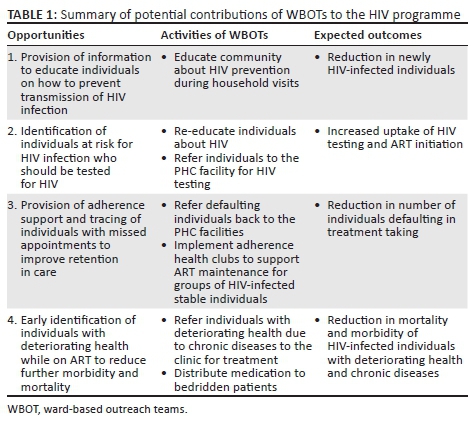
The WBOTs are well positioned at the interface of the community and facility to contribute to the HIV programme in the following ways (Table 1):
• provision of information to educate individuals on how to prevent transmission of HIV infection
• identification of individuals at risk for HIV infection who should be tested for HIV
• provision of adherence support and tracing of individuals with missed appointments to improve retention in care
• early identification of individuals with deteriorating health while on ART to reduce further morbidity and mortality.
Prevention of human immunodeficiency virus infection and its complications
There is evidence showing the effectiveness of using CHWs in large-scale health promotion and disease prevention programmes in low-income countries such as Haiti, Ethiopia, Uganda and Malawi.5,67,8,9,1011,12
Identification of human immunodeficiency virus-infected individuals
CHW's link between communities and facilities makes them well placed to support and appropriately refer vulnerable individuals to health facilities. Amongst those classified as vulnerable by the National Department of Health (NDoH) are individuals at risk for HIV infection and those already infected.3131415
CHWs could also make an important contribution to the HIV response by supporting home-based HIV testing. This approach to HIV testing and counselling was used in a cluster randomised controlled trial in KwaZulu-Natal Province, South Africa, which found significantly higher rates of HIV testing amongst participants in the home-based testing arm than those testing at facilities (69% vs. 47%; 95% CI 1.32-1.81). Other results included a higher uptake of couple counselling and testing as well as a reduction in multiple partners.161718
Tracing non-adherent individuals and provision of adherence support to improve retention in care
A high level of patient retention on antiretroviral treatment is imperative for good HIV programme outcomes. CHWs can improve retention in care directly by tracing individuals who missed their appointments or defaulted treatment and linking them back into care at the healthcare facility. Although tracing is an important part of the CHW's activities, the effectiveness of this approach remains undocumented. Defaulter tracing should not become so time consuming that it prevents CHWs from effectively undertaking their other duties. In the South African WBOT programme, we suggest that defaulter tracing should combine an initial attempt to contact non-adherent individuals telephonically, followed by physical tracing at their homes by CHWs if they are not reachable via telephone. This was shown to be successful in other studies19
Another way in which CHWs could contribute to improving retention in care is through adherence support. Grimwood et al.,20201212
The positive value of adherence support in retaining individuals on ART in South Africa was also documented in the study by Igumbor et al.,121221,22,23444
Early identification of individuals failing treatment
Finally, CHWs have a critical role to play in maintaining HIV viral suppression and hence reducing HIV-related morbidity and mortality through ongoing monitoring of individuals on ART. In this role, CHWs essentially provide a means for the early detection of individuals at risk of defaulting or treatment failure through symptom screening. By enhancing treatment literacy, early identification of ART side effects, awareness of psychosocial and poverty-related factors that may impact the likelihood of patient's virological failure, CHWs can be an essential link in the HIV treatment cascade. Grimwood et al.2020
Barriers and challenges to successful ward-based outreach team support
Despite the promise of the WBOTs in improving programme outcomes, there are several key barriers and challenges to their successful implementation in South Africa's healthcare system. These include general operational challenges and HIV programme-specific challenges as discussed below.
General challenges
Varying perceptions of community health worker roles
The health system identifies CHWs as volunteers who manage patients within the community in which they reside and usually receive a stipend for their services.24252627
Lack of stakeholder and community support
A fundamental challenge that limits the effectiveness of WBOTs in South Africa is their poor integration into local health systems, which in turn undermines the role of CHWs in community healthcare.728291,30
In addition, support from community leaders and social workers as well as community acceptance plays an important role in the success of the CHW programme. Evaluating the interaction of CHWs and the community from a cultural and gender perspective is therefore imperative; for example, male community members may resist interaction with female CHWs.3132333434
Challenging work environments and operational barriers
Minimal, inconsistent or irregular payment of stipends remains a critical challenge in maintaining CHWs interest and involvement in community-based programmes.7,2823,35286636,37
Human immunodeficiency virus programme challenges
Lack of knowledge and skills
In South Africa, the NDoH developed a curriculum for CHWs, with the ultimate goal of national certification.382838
Socio-cultural barriers
In a context where HIV is stigmatised, CHWs may be seen as a marker of HIV or AIDS as they are known to support individuals who are HIV-positive. This, in turn, can arouse a feeling of stigmatisation in community members which may result in individuals refusing to talk to CHWs, providing incorrect contact information, pretending to be someone else when visited by CHWs and asking to change the location of CHW visits. For example, there has been a report of CHWs specifically providing ART adherence support, trying to conceal their identities when visiting households by refraining from wearing uniforms given to them by their NGOs and pretending to be selling various commodities.313138
Perspective
There is great potential for CHWs to have a substantial impact on HIV programmes as evidenced above. We have presented several examples of successful CHW initiatives. CHW efforts can lead to improved health outcomes by improving community access to PHC in terms of health education, patient linkage to and retention in care. Expanding the CHW programme will further increase the potential to address large healthcare gaps. However, health system barriers such as human resource capacity, inconsistent remuneration, lack of nationally recognised training and a failure to mainstream WBOTs are important factors that limit the effectiveness of the WBOT programme. These need to be addressed for WBOTs to have maximum impact on the HIV and other health programmes.2323
Conclusion
There is evidence that WBOTs have a positive impact on healthcare. However, despite the strong potential, there are limited data on the impact of WBOTs on the South African HIV programme. Therefore, evaluations to determine operational barriers and opportunities for improvement are urgently warranted. This will provide much needed information to stakeholders regarding areas that need improvement and strengthening in order for WBOTs to become a sustainable structure in the South African healthcare system.
Anova Health Institute is supported by the US President's Emergency Plan for AIDS Relief (PEPFAR) programme via the US Agency for International Development (USAID) under Cooperative Agreement No. AID-674-A-12-00028. The views expressed in this manuscript do not necessarily reflect those of PEPFAR or USAID.
Competing interests
The authors declare that they have no financial or personal relationships which may have inappropriately influenced them in writing this article.
Authors' contributions
N.N. conceptualised the study and undertook the writing of the manuscript. J.R., G.J., N.M., G.M., J.A.M. and H.E.S. contributed to the manuscript review. R.P.H.P. conceptualised the study and contributed to the in-depth review of the manuscript.
Acknowledgements
Division of Epidemiology and Biostatistics, School of Public Health, Faculty of Health Sciences, University of the Witwatersrand, Johannesburg, South Africa. This research project was supported by a postgraduate training scholarship from the Fogarty and NIAID, The UNC-Wits AIDS Implementation Science and Cohort Analyses Training Grant (Grant number: 5D43TW009774-02). The content is solely the responsibility of the authors and does not necessarily represent the official views of the Fogarty and NIAID.
References
-
1. Lui A, Sullivan S, Khan M, Sachs S, Singh P. Community health workers in global health: Scale and scalability. Mt Sinai J Med. 2011;78:419-435. https://doi.org/10.1002/msj.20260
» https://doi.org/10.1002/msj.20260 -
2. Pillay Y, Barron P. The implementation of PHC re-engineering in South Africa [homepage on the Internet]. Public Health Association of South Africa; 2012 [cited 2017 Mar 10]. Available from: http://www.phasa.org.za/articles
» http://www.phasa.org.za/articles - 3.Naledi T Baron P, Schneider H. Primary Health Care in SA since 1994 and implications of the new vision for PHC re-engineering. SAHR. Durban: Health Systems Trust; 2011; p. 17-28.
-
4. Grimsrud A, Sharp J, Kalombo C, Bekker L, Myer L. Implementation of community-based adherence clubs for stable antiretroviral therapy patients in Cape Town, South Africa. JIAS. 2015;18:19984. https://doi.org/10.7448/IAS.18.1.19984
» https://doi.org/10.7448/IAS.18.1.19984 - 5. Mukherjee JS, Eustache FRE. Community health workers as a cornerstone for integrating HIV and primary healthcare. AIDS Care. 2007;19(1):73-82.
-
6.Hermann K, van Damme W, Pariyo GW, Schouten E, Assefa Y, Cirera AWM. Community health workers for ART in sub-Saharan Africa: Learning from experience - Capitalizing on new opportunities. Hum Resour Health 2009;7:31. https://doi.org/10.1186/1478-4491-7-31
» https://doi.org/10.1186/1478-4491-7-31 -
7. Schneider H, Hlope H, van Rensburg D. Community health workers and response to HIV/AIDS in South Africa: Tensions and prospects. Health Pol Plan. 2008;23(3):179-187. https://doi.org/10.1093/heapol/czn006
» https://doi.org/10.1093/heapol/czn006 -
8. Baral S, Beyrer C, Muessig K, et al. Burden of HIV among female sex workers in low-income and middle-income countries: A systematic review and meta-analysis. Lancet Infect Dis. 2012;12(7):538-549. https://doi.org/10.1016/S1473-3099(12)70066-X
» https://doi.org/10.1016/S1473-3099(12)70066-X -
9. Beyrer C, Baral SD, van Griensven F, et al. Global epidemiology of HIV infection in men who have sex with men. Lancet. 2012;380(9839):367-377. https://doi.org/10.1016/S0140-6736(12)60821-6
» https://doi.org/10.1016/S0140-6736(12)60821-6 - 10. Bekker L-G, Rebe K, Venter F, et al. Southern African guidelines on the safe use of pre-exposure prophylaxis in persons at risk of acquiring HIV-1 infection. S Afr J HIV Med 2016;17:a455.
-
11. Chang LW, Kagaayi J, Nakigozi G, et al. Effect of peer health workers on AIDS care in Rakai, Uganda: A cluster-randomized trial. PLoS One. 2010;5(6):e10923. https://doi.org/10.1371/journal.pone.0010923
» https://doi.org/10.1371/journal.pone.0010923 -
12. Igumbor JO, Scheepers E, Ebrahim R, Jason A, Grimwood A. An evaluation of the impact of a community-based adherence support programme on ART outcomes in selected government HIV treatment sites in South Africa. AIDS Care. 2011;23(2):231-236. https://doi.org/10.1080/09540121.2010.498909
» https://doi.org/10.1080/09540121.2010.498909 -
13. NDoH. Implementation of the universal test and treat strategy for HIV positive patients and differentiated care for stable patients [homepage on the Internet]. National Department of Health; 2016 [cited 2017 Mar 29]. Available from: http://www.sahivsoc.org/Files/22%208%2016%20Circular%20UTT%20%20%20Deconge stion%20CCMT%20Directorate%20(2).pdf
» http://www.sahivsoc.org/Files/22%208%2016%20Circular%20UTT%20%20%20Deconge stion%20CCMT%20Directorate%20(2).pdf -
14. Uys LR. The practice of community caregivers in a home-based HIV/AIDS project in South Africa. J Clin Nurs. 2002;11(1):99-108. https://doi.org/10.1046/j.1365-2702.2002.00566.x
» https://doi.org/10.1046/j.1365-2702.2002.00566.x -
15. Sips I, Haeri Mazanderani A, Schneider H, Greeff M, Barten F, Moshabela M. Community care workers, poor referral networks and consumption of personal resources in rural South Africa. PLoS One. 2014;9(4):e95324. https://doi.org/10.1371/journal.pone.0095324
» https://doi.org/10.1371/journal.pone.0095324 -
16. Doherty T, Tabana H, Jackson D, et al. Effect of home based HIV counselling and testing intervention in rural South Africa: Cluster randomised trial. BMJ. 2013;346:f3481. https://doi.org/10.1136/bmj.f3481
» https://doi.org/10.1136/bmj.f3481 -
17. Reif LK, Rivera V, Louis B, et al. Community-based HIV and health testing for high-risk adolescents and youth. AIDS Patient Care STDs. 2016;30(8):371-378. https://doi.org/10.1089/apc.2016.0102
» https://doi.org/10.1089/apc.2016.0102 -
18. WHO. WHO recommends HIV self-testing [homepage on the Internet]. World Health Organization; 2016 [cited 2017 Mar 29]. Available from: http://www.who.int/hiv/pub/vct/alternate_Policy-brief_HIVST-Asia.pdf?ua=1
» http://www.who.int/hiv/pub/vct/alternate_Policy-brief_HIVST-Asia.pdf?ua=1 -
19. Allen CG, Escoffery C, Satsangi A, Brownstein JN. Strategies to improve the integration of community health workers into health care teams: 'A little fish in a big pond'. Prev Chronic Dis. 2015;12:E154. https://doi.org/10.5888/pcd12.150199
» https://doi.org/10.5888/pcd12.150199 -
20. Grimwood A, Fatti G, Mothibi E, Malahela M, Shea J, Eley B. Community adherence support improves programme retention in children on antiretroviral treatment: A multicentre cohort study in South Africa. J Int AIDS Soc. 2012;15:17381. https://doi.org/10.7448/IAS.15.2.17381
» https://doi.org/10.7448/IAS.15.2.17381 -
21. le Roux K, le Roux I, Mbewu N, Davis E. The role of community health workers in the re-engineering of primary health care in Rural Eastern Cape. S Afr Fam Pract. 2015;57(2):116-120. https://doi.org/10.1080/20786190.2014.977063
» https://doi.org/10.1080/20786190.2014.977063 -
22. Cohen R, Lynch S, Bygrave H, et al. Antiretroviral treatment outcomes from a nurse-driven community supported HIV/AIDS treatment programme in rural Lesotho: Observational cohort assessment at two years. J Int AIDS Soc. 2009;12:23. https://doi.org/10.1186/1758-2652-12-23
» https://doi.org/10.1186/1758-2652-12-23 -
23. Mwai GW, Mburu G, Torpey K, Frost P, Ford N, Seeley J. Role and outcomes of community health workers in HIV care in sub-Saharan Africa: A systematic review. J Int AIDS Soc. 2013;16:18586. https://doi.org/10.7448/IAS.16.1.18586
» https://doi.org/10.7448/IAS.16.1.18586 - 24. Tsolekile LP, Puoane T, Schneider H, Levitt NS, Steyn K. The roles of community health workers in management of non-communicable diseases in an urban township. Afr J Prim Health Care Fam Med. 2014;6(1):E1-E8.
-
25. Rachlis B, Naanyu V, Wachira J, et al. Community Perceptions of Community Health Workers (CHWs) and their roles in management for HIV, tuberculosis and hypertension in western Kenya. PLoS One. 2016;11(2):e0149412. https://doi.org/10.1371/journal.pone.0149412
» https://doi.org/10.1371/journal.pone.0149412 -
26. Mlotshwa L, Harris B, Schneider H, Moshabela M. Exploring the perceptions and experiences of community health workers using role identity theory. Glob Health Action. 2015;8:28045. https://doi.org/10.3402/gha.v8.28045
» https://doi.org/10.3402/gha.v8.28045 -
27. Naimoli JF, Frymus DE, Wuliji T, Franco LM, Newsome MH. A community health worker 'logic model': Towards a theory of enhanced performance in low- and middle-income countries. Hum Res Health. 2014;12:56. https://doi.org/10.1186/1478-4491-12-56
» https://doi.org/10.1186/1478-4491-12-56 -
28. Horwood CM, Youngleson EM, Stern AF, Barker PM. Using adapted quality-improvement approaches to strengthen community-based health systems and improve care in high HIV-burden sub-Saharan African countries. AIDS. 2015;29 (Suppl 2):S155-S164. https://doi.org/10.1097/QAD.0000000000000716
» https://doi.org/10.1097/QAD.0000000000000716 -
29. Wools-Kaloustian KK, Sidle JE, Selke HM, et al. A model for extending antiretroviral care beyond the rural health centre. J Int AIDS Soc. 2009;12:22. https://doi.org/10.1186/1758-2652-12-22
» https://doi.org/10.1186/1758-2652-12-22 - 30. Bajpai N, Dholakai R. Improving the performance of Accredited Social Health Activists (ASHAs) in India. New Delhi: International Advisory Panel of the National Rural Health Mission, Ministry of Health and Family Welfare, Government of India; 2011.
-
31. Masquillier C, Wouters E, Mortelmans D, van Wyk B, Hausler H, Van Damme W. HIV/AIDS competent households: Interaction between a health-enabling environment and community-based treatment adherence support for people living with HIV/AIDS in South Africa. PLoS One. 2016;11(3):e0151379. https://doi.org/10.1371/journal.pone.0151379
» https://doi.org/10.1371/journal.pone.0151379 -
32. Treffry-Goatley A, Lessells R, Sykes P, et al. Understanding specific contexts of antiretroviral therapy adherence in rural South Africa: A thematic analysis of digital stories from a community with high HIV prevalence. PLoS One. 2016;11(2):e0148801. https://doi.org/10.1371/journal.pone.0148801
» https://doi.org/10.1371/journal.pone.0148801 -
33. Martinez Perez G, Cox V, Ellman T, et al. 'I know that I do have HIV but nobody saw me': Oral HIV self-testing in an informal settlement in South Africa. PLoS One. 2016;11(4):e0152653. https://doi.org/10.1371/journal.pone.0152653
» https://doi.org/10.1371/journal.pone.0152653 -
34. Gittings L. 'When you visit a man you should prepare yourself': Male community care worker approaches to working with men living with HIV in Cape Town, South Africa. Cult Health Sex. 2016;18(8):936-950. https://doi.org/10.1080/13691058.2016.1150513
» https://doi.org/10.1080/13691058.2016.1150513 -
35. UNICEF. What works for children in South Asia, community health workers [homepage on the Internet]. Regional Office for South Asia: The United Nations Children's Fund; 2004 [cited 2016 May 18]. Available from: http://www.unicef.org/rosa/community.pdf
» http://www.unicef.org/rosa/community.pdf -
36. Braun R, Catalani C, Wimbush J, Israelski D. Community health workers and mobile technology: A systematic review of the literature. PLoS One. 2013;8(6):e65772. https://doi.org/10.1371/journal.pone.0065772
» https://doi.org/10.1371/journal.pone.0065772 -
37. Schuttner L, Sindano N, Theis M, et al. A mobile phone-based, community health worker program for referral, follow-up, and service outreach in rural Zambia: Outcomes and overview. Telemed J E Health. 2014;20(8):721-728. https://doi.org/10.1089/tmj.2013.0240
» https://doi.org/10.1089/tmj.2013.0240 - 38. National Department of Health. National health insurance for South Africa (White paper). Pretoria: NDOH; 2015.

Accepted: 12 Feb. 2018
Published: 12 Apr. 2018