Incentivising student learning: Does it work?
Abstract
Motivation is one of the primary factors that influence students' learning behaviour. This study investigates the impact of extrinsic motivation, through the introduction of an intangible incentive scheme, on undergraduate STEM students' engagement and performance in an online reading comprehension activity. Since 2021, the activity has been conducted on the ReadTheory platform and although initial results seemed promising, a gap remained between students' performance and the activity's outcomes. In 2023 an incentive scheme combining two incentives namely, work avoidance and a marks incentive, was implemented to address students' perceived underinvestment in the activity. The study examined participation and performance data from 2021 to 2023 across three STEM modules. In 2023 the intervention was implemented in two of these modules, with the third module continuing with the original programme structure. The data revealed significant improvements in the performance of students who participated in the intervention, while performance of students in the original programme remained unchanged. The results suggest that the combination of work-avoidance and marks-based incentives effectively encouraged students to focus their efforts on reaching higher Lexile levels, thereby improving their overall reading comprehension. Moreover, the incentive scheme enabled effective identification of students in need of targeted support. This study demonstrates that carefully designed incentives, can enhance student engagement and performance in selected academic activities.
Incentive; undergraduate; reading comprehension; STEM
INTRODUCTION
Motivation lies at the very core of student learning, and it is one of the most studied constructs in educational psychology (Koenka 2020). Research on academic motivation focuses on explaining why students behave the way they do and how this affects learning and performance (Schunk Meece and Pintrich. 2014). Motivation can be either intrinsic or extrinsic. Intrinsic motivation is inherent and drives students to engage in certain behaviours because it is rewarding (Lee et al. 2012). Contrary to intrinsic motivation is extrinsic motivation, where one is motivated to behave in a certain way or engage in a particular activity because of either receiving a reward or avoiding punishment (Tranquillo and Stecker 2016).
Skinner, a strong advocate for behaviourism (1938), argued that people are not pushed into action by intrinsic forces, but rather "pulled into action by external forces". This idea steered us to investigate the use of an external force, such as an incentive scheme, in an attempt to address the under-investment and under-performance in a reading comprehension intervention of undergraduate STEM students at a South African University.
It has been a longstanding problem that South African university students find it difficult to critically and successfully engage with texts to comprehend and create meaning (Berndt, Petzer and Wayland 2014; Pretorius 2002; Van Dyk, Van de Poel and Van der Slik 2013; Van Schalkwyk 2008). An extensive body of research (Koenig, Du Plessis and Viljoen 2015; Nel, Dreyer and Klopper 2004; Nel and Nel 2010; Pretorius 2000; Van Dyk 2005; Van Schalkwyk, Bitzer and Van der Walt 2009; Andrianatos 2019; Molotja 2020) focuses on the myriad of reasons why students entering Higher Education (HE) in South Africa are under-prepared. One factor that repeatedly surfaces is the barrier they experience when reading. The 2016 and 2021, the Progress in International Reading Literacy Study (PIRLS) results identified one of the major factors contributing to this situation is students' inability to read for comprehension (Mullis et al. 2023). In both these years South Africa ranked last (49 participating countries in 2016, and 57 participating countries in 2021) out of all the participating countries (Department of Basic Education 2023). There seems to be a dearth of studies referring to under-preparedness related to reading and comprehension in the HE context, in the broader African context.
In 2017 the university in question implemented an online reading solution to help address this issue. In 2021 we changed to a different platform, namely ReadTheory. After three years, the implementation of the online reading programme was revised, as students' performance did not align with the intended learning outcomes. When reflecting on the 2021-2023 results, we deduced that students generally under-invested in both their engagement with, and performance in the programme. This led us to an investigation of student motivation and ways to influence learning behaviour, which ultimately resulted in the implementation of an intangible incentive scheme.
This scheme consisted of two motivational factors namely work avoidance and higher marks. Furthermore, the decision to implement this scheme was two-fold: 1) It allowed students to exit the programme on reaching the set target, and 2) it enabled lecturers to identify students who truly struggled to engage with university-level texts and provide them with targeted support.
The aim of this study was thus to explore whether intangible non-monetary incentives could encourage undergraduate STEM students to invest more time and effort into improving their reading comprehension.
Achievement goal theory
One of the most studied constructs in educational psychology is motivation and there are numerous established theories that aim to understand learning behaviours from this perspective (Urhahne and Wijnia 2023). Achievement Goal Theory (AGT) is one of the most popular theoretical frameworks in motivation research (Meece, Anderman and Anderman 2006; Urdan 2010; Senko, Hulleman and Harackiewicz 2011; Bardach et al. 2020; Chazan, Pelletier and Daniels 2022), and it is particularly favoured in research concerning academic achievement. Chazan et al. (2022) state that seminal papers focussing on AGT have been cited between 5000 and 12 000 times (e.g., Ames 1992; Dweck and Leggett 1988; Elliot and McGregor 2001).
AGT is able to provide academics with valuable insight into how students respond to academic activities (Van Yperen, Elliot and Anseel 2009). This understanding enables academics to create an environment that encourages positive student behaviour and contributes to desired outcomes. It is a comprehensive theory that recognises that motivation is not a one-dimensional construct. In an educational context, achievement goals can range from short term goals, such as passing a test, to longer term goals such as aiming for a specific career. It is imperative to recognise that students' goals have an impact on their attitude towards, and performance in their studies, including how they experience failure and how they define effort and competence (Pintrich 2000).
AGT maintains that achievement goals are those in which "competence" is the main aim for an individual (Elliot and Dweck 2005). In addition, achievement goals can be described as cognitive representations that are oriented toward the future, directing behaviour towards competence-related outcomes where a student is either motivated to pursue success or to avoid failure in a given task (Hulleman et al. 2010; Alrakaf et al. 2014).
AGT identifies two categories of goals namely mastery and performance. Students with a mastery goal mindset display a desire for self-improvement and place strong emphasis on learning (Murayama, Elliot and Friedman 2012). These characteristics are also associated with intrinsic motivation. On the other hand, students with a performance goal mindset are extrinsically motivated, typically comparing themselves to the performance of others, as well as to pre-defined goals (Elliot and Thrash 2001). Proponents of AGT argue that students who want to master their goals have a very different view about their ability compared to students who adopt performance goals (Senko et al. 2011). Moreover, they define their own successes and failures very differently. Hulleman and Senko (2020) endorse this reasoning in their explanation that students who aim to master their goals, see their academic abilities as flexible, and that they can improve these abilities through continuous development, hard work, and perseverance. In contrast, students who adopt performance goals tend to view their academic ability as a fixed trait that cannot be improved or enhanced (Dweck 1986). In essence, students who think and believe they are academically stronger, will outperform those who have less belief in their abilities.
Over the past few decades AGT-theorists have refined mastery and performance goals and have separated them into four distinct categories (Alrakaf et al. 2014). Students following a mastery-approach aim to learn and understand a task thoroughly, whereas students engaging in mastery-avoidance aim to avoid losing skills that they had previously acquired or to avoid not understanding a task. On the other hand, students following a performance-approach aim only to outperform others or demonstrate their ability to others. Finaly, performance-avoidance is where students simply avoid being less successful than others (Elliot 1999; Elliott and McGregor 2001; Elliot 2005; Eison 1981; Eison, Pollio and Milton 1986).
AGT has further evolved over the past forty years to include a third strategy, namely work-avoidance performance. This category represents students who are motivated by doing the minimum work required, while balancing this with maximum performance, in terms of grades (Canfield and Zastavker 2010; Elliot 2005; Elliot and Hulleman 2017; Urdan and Kaplan 2020). A study published by Roebken (2007) reported that students who employed a mixture of performance as well as achieving their mastery goals, achieved the best grades.
Despite AGT's efforts to provide academics with insight into students' attitude towards academic tasks, it cannot explain all behaviour. However, Fryer (2011:1756) has discovered that students often "lack sufficient motivation, dramatically discount the future, or lack accurate information on the returns to schooling to exert optimal effort," and in such cases the "provi[sion] of incentives for achievement will yield increases in student performance". That being said, EVT warns that, regardless of the incentive, if the expectancy or goal of the activity seems unattainable, students may disengage from the activity, especially if the perceived value is unclear (Wigfield and Eccles 2000). This highlights the aspect of student agency and how self-perception, prior experience and task relevance impact students learning behaviour.
Learning incentives
Since the turn of the century, there has been a growing body of research on the role of incentives in student learning across the primary, secondary and post-secondary sector (Angrist et al. 2002; Angrist and Victor, 2009; Angrist, Bettinger and Kremer 2006; Angrist, Lang and Oreopoulos 2009; Behrman, Sengupta and Todd, 2005; Jackson 2010; Kremer, Miguel and Thornton 2009; Allan and Fryer 2011). These studies predominantly focus on monetary incentives and raise both ethical and practical concerns for educational purposes. Park, Park and Barry (2022) did extensive research which involved a thorough analysis of 361 conceptual and empirical studies across multiple disciplines, including management, psychology, economics, health care and education, on the effects of incentives on ethical behaviour.
Apart from studies that focus on monetary incentives for academic achievement, there are several researchers who have opted to investigate the alternative route of implementing non-monetary incentives (Riener and Wagner 2022; Berry 2015; Chevalier, Dolton and Lührmann 2018; Levitt et al. 2016). Results from these studies support Fryer's (2011) above-mentioned argument showing how both tangible and intangible non-monetary rewards or incentives can serve to increase motivation by providing a form of instant gratification. Schildberg-Hörisch and Wagner (2018) reviewed the literature on monetary and non-monetary incentives, offering the following explanation: tangible non-monetary incentives include items such as trophies or certificates, whereas intangible incentives may consist of bonus marks or the granting of certain privileges to students, such as exemption from specific tasks (work avoidance).
Non-monetary incentives
The use of monetary incentives is central to economics (Gneezy, Meier and Rey-Biel 2011), however, in a HE context it would not be financially viable, and it could raise significant ethical concerns. Yet, when looking at the alternative of non-monetary incentives, it is still important to keep the context of the student population in mind. It is also key to consider students perceived valuation of an incentive when designing incentive schemes (Riener and Wagner 2022). Numerous studies, focused on older students (14-21), report that students place a high value on incentives such as bonus marks due to the impact on their grades, as well as other intangible incentives such as "work avoidance", which can be described as a way of compensating students for their past educational investment (Baumert and Demmrich 2001; Bigoni et al. 2015; Chevalier et al. 2018; De Paola, Gioia and Scoppa 2015; Grove and Wasserman 2006).
In light of these reports, the current study looked at how the implementation of two non-monetary intangible incentives, namely marks and work avoidance, impacted students' engagement with and performance in the Reading with Comprehension-activity.
READTHEORY AND THE LEXILE® FRAMEWORK FOR READING
The Reading with Comprehension-activity was conducted via the ReadTheory platform. This platform is an online reading comprehension assessment tool designed to evaluate and enhance students' reading skills. It uses the Lexile® Framework for Reading, as a scientific way of categorising texts according to difficulty levels (Smith et al. 2016; Stenner 2023). The two criteria used in this framework are text readability and vocabulary.
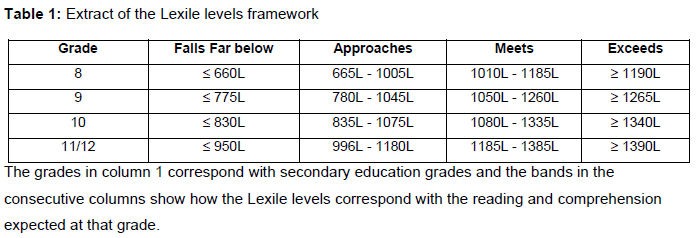
Table 1 below is an extract of the Lexile levels within the framework, showing how they correspond to grades at secondary education level. For example, in Grade 12 a learner should be able to manage a text that falls within the meets category, while grade 12 learners entering, HE should ideally fall within the exceeds category. Texts at university fall anywhere between 1355 - 1740L (Dagget and Pedinotti 2003).
ReadTheory matches each individual student with texts that align with their level of reading comprehension, through a placement test. The students then go on to complete online reading quizzes of increasing difficulty. The texts cover various themes and topics.
The platform uses an adaptive algorithm that adjusts to students' performance, presenting either more challenging or easier passages depending on the results of previous quizzes.
• Text complexity increases when a student scores 90 per cent or higher.
• Text complexity remains unchanged for scores between 70 per cent and 89 per cent.
• Text complexity decreases when a student scores below 70 per cent.
Furthermore, ReadTheory integrates gamification features as non-monetary incentives intended to promote sustained student engagement while completing quizzes. Points are awarded for quiz completion, with higher accuracy resulting in greater point accumulation. This system is designed to encourage a sense of incremental progress and achievement. Additional mechanisms include digital badges awarded for reaching specific milestones (e.g., completing a set number of quizzes, maintaining a consecutive practice streak, or achieving high accuracy scores). Students also progress through a tiered ranking system, beginning with Orienteer status at 45 knowledge points and culminating in Theorist status at 150 000 knowledge points.
Although badges are often perceived as engaging tools in educational contexts, research shows that their motivational impact is limited when students prioritise academic achievement over symbolic rewards (Balci, Secaur and Morris, 2022; Jaramillo-Mediavilla et al., 2024). For example, while students may view badges positively, they consistently rank course content mastery and final grades as more important (Jaramillo-Mediavilla et al., 2024). In response to this misalignment between incentive and student value, we replaced gamified rewards with outcomes students explicitly valued-namely, academic marks and the opportunity to avoid additional tasks (e.g., further quiz completion). This strategic shift aligned the motivational framework with students' preferences, thereby enhancing engagement and goal-directed behaviour.
RESEARCH APPROACHThis case study made use of participation and performance data to investigate the impact of an intervention on students' performance in the Reading with Comprehension-activity. Data from three different modules was collected over three years (2021 - 2023). The activity was credit-bearing, so participation in the activity contributed to the students' final grade in these modules. The modules, all from the STEM environment, are Science in Context (SiC), Scientific Communication Skills (SCS) and Intercultural Communication (IC). The incentives were implemented in SiC and SCS during 2023.
Participants
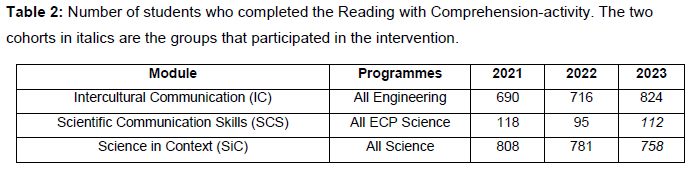
SiC is a compulsory first-year module for all mainstream Science students at this institution. SCS is a compulsory module for the Extended Curriculum Programme (ECP) students from Science, Agriscience and Engineering, in their first year of study. These students follow an extended curriculum since they did not meet the admission criteria of their preferred mainstream programme, likely due to socio-economic factors outside of their control. IC is a compulsory module for all Engineering students at this institution. Table 2 provides a summary of the number of students who completed the Reading with Comprehension-activity, per year, for the respective modules.
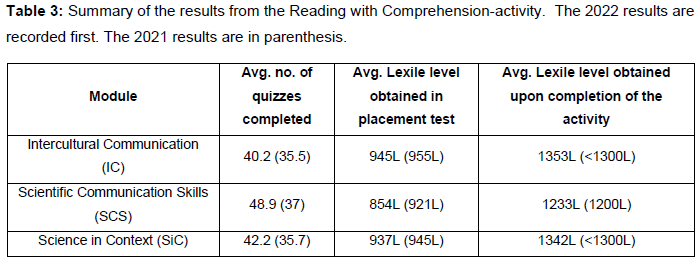
In the first two years of implementing the Reading with Comprehension-activity via the ReadTheory platform, the goal was to determine to what extent it improved students' reading abilities. Furthermore, it gave an indication of the time investment required by students to get optimal value from the programme. The pass requirements for 2021 and 2022 in all three modules, stipulated that students had to complete 40 quizzes, of which they had to pass at least 24 with a pass mark of 70 per cent. Considering the results of the placement tests (Table 3) and the fact that the university entry requirements for ECP students are lower than for the students in the other programmes, the students in IC and SIC were required to reach a Lexile level of 1250, while the students in SCS were required to reach a Lexile level of 1185L. Students were also rewarded with a 5 per cent bonus mark if they completed and passed more than the required number of quizzes. The results indicated that students were able to outperform the required Lexile levels within the allotted 40 quizzes.
2023 - THE INTERVENTION
Motivated by the results of 2021 and 2022, we decided to raise the required exit Lexile level to at least 1390L, matching the entry level for HE texts. To help students reach this target within 40 quizzes, we needed to encourage a more focused and intentional approach, fostering student agency by giving them control over their progress and effort. Expectancy Value Theory suggests that students are more likely to engage in a task when they believe their effort will lead to valued outcomes; higher incentives can therefore increase effort and persistence (Gneezy et al. 2011). This aligns with Skinner's (1938) view that extrinsic forces often pull individuals into action, highlighting the role of structured incentives in guiding purposeful learning.
In 2023, the Reading with Comprehension-activity was thus implemented with an incentivised scheme in both SiC and SCS while IC still followed the same passing criteria as in the previous two years. The completion criteria for the incentivised scheme were as follows:
In terms of the work avoidance incentive, students had to obtain a Lexile level of at least 1390L with a minimum passing score of 70 per cent for one quiz, and as soon as they achieved this, they could exit the programme. If a student did not achieve the 1390L after completing 40 quizzes, they were required to attend an in-person remedial workshop.
Encouraged by the 73.7 per cent of SiC students who claimed the 5 per cent bonus marks in 2022, we decided to use a sliding scale to allocate a final mark for the activity, thereby implementing a marks incentive. Students who managed to achieve a Lexile level of 1390L or higher within the first ten quizzes, received 100 per cent for the activity. Students who managed to achieve a Lexile level of 1390L or higher within 20 quizzes, received 90 per cent for the activity. Students who managed to achieve a Lexile level of 1390L or higher within 30 quizzes, received 80 per cent for the activity. Lastly, students who managed to achieve a Lexile level of 1390L or higher within 40 quizzes, received 75 per cent for the activity.
Students who did not meet the pass requirements after 40 quizzes were then flagged and at the beginning of the second semester, they were encouraged to complete additional quizzes to help them reach 1390L. Students who were able to reach 1390L before the scheduled remedial workshop were also awarded a final grade of 75 per cent. We created this opportunity as an added external motivator and incentive hoping it would pull more students into action and ensure that it was only those students who most needed the in-person help that were included in the remedial workshop. Students who successfully completed the remedial workshop were also awarded a final grade of 75 per cent.
In addition, the passing criteria for IC was also adjusted in 2023. Students were required to complete quizzes until they passed 30 quizzes with a grade of 70 per cent. There was no defined exit Lexile level, but a work avoidance incentive was hidden in the criteria: if students put in extra effort, they could pass the 30 quizzes more quickly and in so doing complete the Reading with Comprehension-activity in less time. This was, however, not made explicit as in the case of SiC and SCS.
RESULTS
Graph 1 below summarises the placement test results of the three modules over the three years of implementation of the Reading for Comprehension-activity. In 2023 in the SiC cohort, 43.7 per cent of students fell into the falls far below category. A further 43.2 per cent of students fell into the approaches category. Only 10.5 per cent of students fell into the meets category, and a mere 2.3 per cent of students were placed in the exceeds category.
Comparing this to the 2021 and 2022 results we found a 5.7 per cent difference between the 2022 cohort and a 4.9 per cent difference between the 2021 cohort in the results of the falls far below category. The results of the approaches and meets categories varied by less than 1 per cent with a slight increase in the exceeds category, compared to the 0.9 per cent in 2022 and the 0.5 per cent in 2021.
The SCS placement test results show more fluctuations. In 2023, 58.9 per cent of students fell into the falls far below category, compared to 68.4 per cent in 2022 and 49 per cent in 2021. In 2023, 33.9 per cent of students fell into the approaches category compared to 29.4 per cent in 2022 and 41.4 per cent in 2021. Of the 2023 cohort, 6 per cent of students fell within the meets category compared to 2 per cent in 2022 and 8.5 per cent in 2021. For the exceeds category, the 2023 and 2021 cohorts were 0.8 per cent with no students achieving this category in 2022.
The placement test results of IC are more consistent. In 2023 50.7 per cent of students fell into the falls far below category compared to 49.7 per cent in 2022 and 47 per cent in 2021. In 2023 39.4 per cent of students fell within the approaches category compared to 37.7 per cent in 2022 and 44.5 per cent in 2021. A total of 7.2 per cent of students were placed in the meets category in 2021, 11.3 per cent in 2022 and 8 per cent in 2023. The exceeds category delivered 0.8 per cent of students in 2021, 1.2 per cent in 2022 and 1.8 per cent in 2023.
In 2023, the incentive scheme was implemented in the SiC and SCS cohorts while the IC cohort followed the same scheme as in previous years. The results shown in Graph 2 demonstrate significant overall improvement in the text complexity for both SiC and SCS. It is clear that these students could manage more difficult texts while the results of IC are more comparable with previous years.
In 2023, 1.5 per cent of SiC students remained in the falls far below category compared to the 1 per cent in 2022 and the 3 per cent in 2021, however, the student distribution across the other three categories was noticeably different. In 2021, 28.4 per cent of students fell into the approaches category and this percentage decreased to 17.5 per cent in 2022 and only 8 per cent in 2023. Similarly, in 2021, 42.8 per cent of students fell within the meets category showing a decrease to 38.7 per cent in 2022. This number then dropped even more significantly to 14 per cent in 2023, which resulted in an overwhelming 76 per cent of the 2023 cohort scoring in the exceeds category, compared to the 42.8 per cent of the 2022 cohort and the 25.7 per cent of the 2021 cohort.
The study showed that the 2023 cohort of SCS exhibited a remarkable overall improvement in the students' ability to understand complex texts, even outperforming the SiC students. Only 1.7 per cent of students still placed in the falls far below compared to 7.3 per cent in 2022 and 5 per cent in 2021. The number of students who were placed in the approaches category decreased from 35.6 per cent in 2021, to 29.4 per cent in 2022 and 4.4 per cent in 2023. This pattern continued into the meets category where the number decreased from 45.8 per cent in 2021, to 40 per cent in 2022, and 6.2 per cent in 2023. This resulted in an overwhelming 87 per cent of the 2023 cohort scoring in the exceeds category compared to the 23 per cent of the 2022 cohort and the 13.6 per cent of the 2021 cohort. Thus, there was an overall increase of 64 per cent from 2022 and 73.4 per cent from 2021.
This is in stark comparison with the 2023 cohort of IC, who did not participate in the incentive scheme. The performance of this cohort was more comparable to the results of cohorts in the previous two years. The study indicated that 2.1 per cent of students still placed in the falls far below category compared to 1.2 per cent in 2022 and 3.2 per cent in 2021. The number of students who were in the approaches category increased from 14.1 per cent in 2022 to 24.6 per cent in 2023, which is very similar to the 22.6 per cent of 2021. In the meets category the results remained almost unchanged since 45.6 per cent were placed in this band in 2021, 40.7 per cent in 2022 and 42.2 per cent in 2023. Once again, in the exceeds category the 2022 cohort differs from 2021 and 2023. In 2022, 43.8 per cent of students reached the exceeds category, whereas only 30.9 per cent of the 2023 cohort and 28.4 per cent of the 2021 cohort managed to do so.
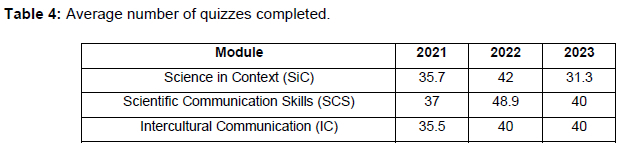
However, before we can attribute the increased performance of the 2023 SiC and SCS cohorts to the implementation of the incentive scheme, we need to consider the number of quizzes the students completed to reach the reported Lexile levels. The table below (Table 4) summarises the average number of quizzes completed by each cohort in the three years covered by the study.
In 2023, the SiC students completed an average of 31.3 quizzes which is less than the 42 of 2022 and the 35.7 of 2021. The SCS cohort completed an average of 40 quizzes in comparison to 48.9 in 2022 and 37 in 2021. Finally, the IC cohort completed an average of 40 quizzes, equal to the average of 2022 and slightly more than the average 35.5 quizzes of 2021.
It is interesting to note that in 2023, it took the SiC students an average of only 23 quizzes to reach the required Lexile level of 1390L, demonstrating their willingness to complete more than the necessary number of quizzes. Similarly, although it took the SCS students 35.8 quizzes to reach the required Lexile level, they still completed an average of 40 quizzes. Finally, the IC cohort of 2023 could exit the programme after passing 30 quizzes but required an average of 40 quizzes to obtain this goal.
DISCUSSION
This discussion aims to answer the questions we posed earlier: First, what is the impact of this incentive scheme on how students engaged with ReadTheory? Second, how did the performance of students who participated in the incentive scheme compared to those who did not participate in the incentive scheme?
Answering the first question we can look at the number of quizzes the different cohorts completed. Although the exit Lexile level increased markedly for both SiC and SCS in 2023, both cohorts completed fewer quizzes than in previous years. In comparison, the IC-cohort completed the same average number of quizzes as in 2022. This shows a positive change in the SiC and SCS students' learning behaviour, which is not observed with the IC cohort of 2023.
In response to the second question, there was a significant improvement in student performance in the SiC and SCS cohorts of 2023. In contrast, the performance of the IC cohort of 2023 was similar to previous years. From these results it is evident that students were motivated by the non-monetary incentive scheme of work avoidance and higher marks.
Furthermore, by using the scaffolded grading system, we could easily identify students who truly struggled. A reading-strategies workshop was then offered to students who achieved a Lexile level below 1180L. Attendance of the workshop was optional for those placed in the meets category. We were a bit apprehensive about the workshop, since we were cognisant of students feeling inadequate for not having achieved the desired Lexile level. However, the response was overwhelmingly positive. Not only did students express their gratitude, but some also contacted the Reading Lab to make individual appointments for further support. This confirmed that the incentivised approach was not experienced as a deficit model approach but proved effective at enabling the lecturers to provide targeted support where necessary.
Apart from comparing cohorts where the incentive scheme was implemented with those where it was not implemented, we were interested in whether there would be a significant difference between mainstream (SiC and IC) and ECP (SCS) students' performance. A total of 87 per cent of SCS students fell into the exceeds category compared to 76 per cent of the SiC students. On analysing these results in more depth, we discovered that although the SCS students outperformed the SiC students, there was one distinct, yet significant difference. On average, it took the SiC students 23 quizzes to reach the required Lexile level whereas it took the SCS students 35.8 quizzes to do so. Surprisingly, even though students could exit the program once they achieved the required Lexile level of 1390L or higher, they chose to complete more quizzes. So, even though the SCS students achieved the desired outcome within 35.8 quizzes, they still completed an average of 40 quizzes, with the SiC students completing an average of 31.3 quizzes.
The IC cohort of 2023 had to complete and pass 30 quizzes with a minimum score of 70 per cent, regardless of Lexile level. Consequently, students focused on achieving the required pass mark rather than improving their Lexile scores, possibly keeping their levels low to complete the quizzes more easily. According to EVT, learners are more likely to invest effort in tasks they perceive as directly leading to valued outcomes. In this case, passing the quizzes was clearly valued, while increasing Lexile levels was not, which helps explain why this cohort outperformed previous cohorts in quiz completion but demonstrated the poorest overall Lexile performance.
When considering the overall effect of incentivised learning in this case study it is thus clear that non-monetary incentives can improve students' effort and overall performance in academic activities. However, it is extremely important to carefully consider the type of incentive, as well as how it is implemented. In the case of SCS and SiC, the work avoidance incentive along with the explicitly defined high, but achievable exit Lexile level, positively impacted students' learning behaviour as well as their overall performance. Yet, in the case of IC, implicitly including a work avoidance incentive without the defined Lexile level had a negative impact on the students' performance.
Finally, one of the limitations of a comparative study, such as the one reported on in this article, is that there are numerous intrinsic and uncontrollable factors that could also influence the students' performance. One such factor is the nature of self-paced online activities, which allows for dishonesty in the students' engagement with the ReadTheory platform. It should, however, be taken into consideration that due to the extensive data set, gathered over 3 years and which included three different modules with high enrolment numbers, the impact of such factors is unlikely to refute the overall findings.
CONCLUSION AND RECOMMENDATIONS
This study explored the value of non-monetary, intangible incentives in positively influencing students learning behaviour and academic performance. The results show that incentivised learning has value, but there are important factors to consider before it is implemented. The motivation needs to be well-structured and stated explicitly to prevent adverse, or unintended outcomes. It is also important that the context in which such incentives are implemented is carefully considered. Incentivised learning, such as is discussed in this study, is more likely to suit activities where students require external motivation, because the value of the activity they are engaging in is not explicit or immediately experienced. This type of motivation would thus typically be more suitable for activities aimed at the development of generic or soft skills that are embedded in discipline-specific contexts, as was the case in this research. For practitioners, these findings highlight the importance of designing incentive structures that are simple to implement, adaptable across learning environments, and complementary to students' intrinsic motivation. Institutions seeking to replicate such approaches may benefit from exploring non-monetary incentives such as bonus marks, exemption from certain academic tasks and extended deadlines allowing more time to work on tasks.
REFERENCES
LITERATURE REVIEW
-
Allan, Bradley M., and Roland G. Fryer. 2011. "Appendix to The Power and Pitfalls of Education Incentives." The Hamilton Project. https://www.hamiltonproject.org/assets/legacy/files/downloads_and_links/092011_incentives_fryer_allen_appendix.pdf.
» https://www.hamiltonproject.org/assets/legacy/files/downloads_and_links/092011_incentives_fryer_allen_appendix.pdf -
Alrakaf, Saleh, Erica Sainsbury, Grenville Rose, and Lorraine Smith. 2014. "Identifying achievement goals and their relationship to academic achievement in undergraduate pharmacy students." American Journal of Pharmaceutical Education 78 (7): Article 133. https://doi.org/10.5688/ajpe787133.
» https://doi.org/10.5688/ajpe787133 -
Ames, Carole. 1992. "Classrooms: Goals, structures, and student motivation." Journal of Educational Psychology 84 (3): 261-271. https://doi.org/10.1037/0022-0663.84.3.261.
» https://doi.org/10.1037/0022-0663.84.3.261 -
Andrianatos, Kristien. 2019. "Barriers to reading in higher education: Rethinking reading support." Reading & Writing 10 (1): 1-9. https://doi.org/10.4102/rw.v10i1.241.
» https://doi.org/10.4102/rw.v10i1.241 -
Angrist, Joshua D., Eric Bettinger, Erik Bloom, Elizabeth King, and Michael Kremer. 2002. "Vouchers for private schooling in Colombia: Evidence from a randomized natural experiment." American Economic Review 92 (5): 1535-1558. https://doi.org/10.1257/000282802762024629.
» https://doi.org/10.1257/000282802762024629 -
Angrist, Joshua D., Eric Bettinger, and Michael Kremer. 2006. "Long-term educational consequences of secondary school vouchers: Evidence from administrative records in Colombia." American Economic Review 96 (3): 847-862. https://www.jstor.org/stable/30034075.
» https://www.jstor.org/stable/30034075 -
Angrist, Joshua D., Daniel Lang, and Philip Oreopoulos. 2009. "Incentives and services for college achievement: Evidence from a randomized trial." American Economic Journal: Applied Economics 1 (1): 136-163. https://doi.org/10.1257/app.1.1.136.
» https://doi.org/10.1257/app.1.1.136 -
Angrist, Joshua D., and Victor Lavy. 2009. "The effect of high-stakes high school achievement awards: Evidence from a group-randomized trial." American Economic Review 99 (4): 1384-1414. https://doi.org/10.1257/aer.99.4.1384.
» https://doi.org/10.1257/aer.99.4.1384 -
Balci, Sebiha, Jonathan M. Secaur, and Bradley J. Morris. 2022. "Comparing the effectiveness of badges and leaderboards on academic performance and motivation of students in fully versus partially gamified online physics classes." Education and Information Technologies 27 (6): 8669-8704. https://doi.org/10.1007/s10639-022-10983-z.
» https://doi.org/10.1007/s10639-022-10983-z -
Bardach, Lisa, Sophie Oczlon, Jakob Pietschnig, and Marko Lüftenegger. 2020. "Has achievement goal theory been right? A meta-analysis of the relation between goal structures and personal achievement goals." Journal of Educational Psychology 112 (6): 1197-1220. https://doi.org/10.1037/edu0000419.
» https://doi.org/10.1037/edu0000419 -
Baumert, Jürgen, and Anke Demmrich. 2001. "Test motivation in the assessment of student skills: The effects of incentives on motivation and performance." European Journal of Psychology of Education 16 (3): 441-462. https://doi.org/10.1007/BF03173192.
» https://doi.org/10.1007/BF03173192 -
Behrman, Jere R., Piyali Sengupta, and Petra Todd. 2005. "Progressing through PROGRESA: An impact assessment of a school subsidy experiment in rural Mexico." Economic Development and Cultural Change 54 (1): 237-275. https://doi.org/10.1086/431263.
» https://doi.org/10.1086/431263 -
Berndt, Adele, Daniel J. Petzer, and Jane P. Wayland. 2014. "Comprehension of marketing research textbooks among South African students: An investigation." South African Journal of Higher Education 28 (1): 28-44. https://doi.org/10.20853/28-1-321.
» https://doi.org/10.20853/28-1-321 -
Berry, James. 2015. "Child control in education decisions: An evaluation of targeted incentives to learn in India." Journal of Human Resources 50 (4): 1051-1080. https://doi.org/10.3368/jhr.50.4.1051.
» https://doi.org/10.3368/jhr.50.4.1051 -
Bigoni, Maria, Margherita Fort, Mattia Nardotto, and Tommaso Reggiani. 2015. "Cooperation or competition? A field experiment on non-monetary learning incentives." The B.E. Journal of Economic Analysis & Policy 15 (4): 1753-1792. https://doi.org/10.1515/bejeap-2014-0109.
» https://doi.org/10.1515/bejeap-2014-0109 -
Canfield, Casey, and Yevgeniya V. Zastavker. 2010. "Achievement goal theory: A framework for implementing group work and open-ended problem solving." In 2010 IEEE Frontiers in Education Conference (FIE). Washington, DC. https://doi.org/10.1109/FIE.2010.5673359.
» https://doi.org/10.1109/FIE.2010.5673359 -
Chazan, Devon J., Gabrielle N. Pelletier, and Lia M. Daniels. 2022. "Achievement goal theory review: An application to school psychology." Canadian Journal of School Psychology 37 (1): 40-56. https://doi.org/10.1177/08295735211058319.
» https://doi.org/10.1177/08295735211058319 -
Chevalier, Arnaud, Peter Dolton, and Melanie Lührmann. 2018. "'Making it count': Incentives, student effort and performance." Journal of the Royal Statistical Society: Series A (Statistics in Society) 181 (2): 323-349. https://doi.org/10.1111/rssa.12278.
» https://doi.org/10.1111/rssa.12278 -
Department of Basic Education. 2023. PIRLS 2021: South African Preliminary Highlights Report. Pretoria: Department of Basic Education. https://www.jet.org.za/resources/pirls-sa-2021_highlights-report_15-may-2023_final_print.pdf/view.
» https://www.jet.org.za/resources/pirls-sa-2021_highlights-report_15-may-2023_final_print.pdf/view -
De Paola, Maria, Francesca Gioia, and Vincenzo Scoppa. 2015. "Are females scared of competing with males? Results from a field experiment." Economics of Education Review 48: 117-128. https://doi.org/10.1016/j.econedurev.2015.06.002.
» https://doi.org/10.1016/j.econedurev.2015.06.002 -
Dweck, Carol S. 1986. "Motivational processes affecting learning." American Psychologist 41 (10): 1040-1048. https://doi.org/10.1037/0003-066X.41.10.1040.
» https://doi.org/10.1037/0003-066X.41.10.1040 -
Dweck, Carol S., and Ellen L. Leggett. 1988. "A social-cognitive approach to motivation and personality." Psychological Review 95 (2): 256-273. https://doi.org/10.1037/0033-295X.95.2.256.
» https://doi.org/10.1037/0033-295X.95.2.256 -
Eison, James A. 1981. "A new instrument for assessing students' orientations toward grades and learning." Psychological Reports 48 (3): 919-924. https://doi.org/10.2466/pr0.1981.48.3.919.
» https://doi.org/10.2466/pr0.1981.48.3.919 -
Eison, James A., Howard R. Pollio, and Ohmer Milton. 1986. "Educational and personal characteristics of four different types of learning- and grade-oriented students." Contemporary Educational Psychology 11 (1): 54-67. https://doi.org/10.1016/0361-476X(86)90012-3.
» https://doi.org/10.1016/0361-476X(86)90012-3 -
Elliot, Andrew J. 1999. "Approach and avoidance motivation and achievement goals." Educational Psychologist 34 (3): 169-189. https://doi.org/10.1207/S15326985EP3403_3.
» https://doi.org/10.1207/S15326985EP3403_3 - Elliot, Andrew J. 2005. "A conceptual history of the achievement goal construct." In Handbook of Competence and Motivation, edited by Andrew J. Elliot and Carol S. Dweck, 52-72. New York: Guilford Press.
- Elliot, Andrew J., and Carol S. Dweck. 2005. "Competence and motivation: Competence as the core of achievement motivation." In Handbook of Competence and Motivation, edited by Andrew J. Elliot and Carol S. Dweck, 3-12. New York: Guilford Press.
- Elliot, Andrew J., and Candice S. Hulleman. 2017. "Achievement goals." In Handbook of Competence and Motivation: Theory and Application, 2nd ed., edited by Andrew J. Elliot, Carol S. Dweck, and David S. Yeager, 43-60. New York: Guilford Press.
-
Elliot, Andrew J., and Holly A. McGregor. 2001. "A 2 × 2 achievement goal framework." Journal of Personality and Social Psychology 80 (3): 501-519. https://doi.org/10.1037/0022-3514.80.3.501.
» https://doi.org/10.1037/0022-3514.80.3.501 -
Elliot, Andrew J., and Todd M. Thrash. 2001. "Achievement goals and the hierarchical model of achievement motivation." Educational Psychology Review 13 (2): 139-156. https://doi.org/10.1023/A:1009057102306.
» https://doi.org/10.1023/A:1009057102306 -
Fryer, Roland G. 2011. "Financial incentives and student achievement: Evidence from randomized trials." Quarterly Journal of Economics 126 (4): 1755-1798. https://doi.org/10.1093/qje/qjr045.
» https://doi.org/10.1093/qje/qjr045 -
Gneezy, Uri, Stephan Meier, and Pedro Rey-Biel. 2011. "When and why incentives (don't) work to modify behavior." Journal of Economic Perspectives 25 (4): 191-210. https://doi.org/10.1257/jep.25.4.191.
» https://doi.org/10.1257/jep.25.4.191 -
Grove, Wayne A., and Tim Wasserman. 2006. "Incentives and student learning: A natural experiment with economics problem sets." American Economic Review 96 (2): 447-452. https://www.jstor.org/stable/30034689.
» https://www.jstor.org/stable/30034689 -
Hulleman, Chris S., Sheree M. Schrager, Shawn M. Bodmann, and Judith M. Harackiewicz. 2010. "A meta-analytic review of achievement goal measures: Different labels for the same constructs or different constructs with similar labels?" Psychological Bulletin 136 (3): 422-449. https://doi.org/10.1037/a0018947.
» https://doi.org/10.1037/a0018947 -
Hulleman, Chris S., and Corwin Senko. 2010. "Up around the bend: Forecasts for achievement goal theory and research in 2020." In The Decade Ahead: Theoretical Perspectives on Motivation and Achievement, vol. 16A, edited by Tim C. Urdan and Stuart A. Karabenick, 71-104. Bingley, UK: Emerald Group Publishing. https://doi.org/10.1108/S0749-7423(2010)000016A006.
» https://doi.org/10.1108/S0749-7423(2010)000016A006 - Jackson, C. Kirabo. 2010. The Effects of an Incentive-Based High-School Intervention on College Outcomes. NBER Working Paper No. 15722. Cambridge, MA: National Bureau of Economic Research.
-
Jaramillo-Mediavilla, Lorena, Andrea Basantes-Andrade, Marcos Cabezas-González, and Sonia Casillas-Martín. 2024. "Impact of gamification on motivation and academic performance: A systematic review." Education Sciences 14 (6): Article 639. https://doi.org/10.3390/educsci14060639.
» https://doi.org/10.3390/educsci14060639 - Koenig, Lea, Annelize du Plessis, and Marianne Viljoen. 2015. "The effect of a reading program on the reading performance of first-year students at a higher education institution." International Journal of Educational Sciences 10 (2): 297-305.
-
Koenka, Alison C. 2020. "Academic motivation theories revisited: An interactive dialogue between motivation scholars on recent contributions, underexplored issues, and future directions." Contemporary Educational Psychology 61: Article 101831. https://doi.org/10.1016/j.cedpsych.2019.101831.
» https://doi.org/10.1016/j.cedpsych.2019.101831 -
Kremer, Michael, Edward Miguel, and Rebecca Thornton. 2009. "Incentives to learn." Review of Economics and Statistics 91 (3): 437-456. https://doi.org/10.1162/rest.91.3.437.
» https://doi.org/10.1162/rest.91.3.437 -
Lee, Woogul, Johnmarshall Reeve, Yiqun Xue, and Jinhu Xiong. 2012. "Neural differences between intrinsic reasons for doing versus extrinsic reasons for doing." Neuroscience Research 73 (1): 68-72. https://doi.org/10.1016/j.neures.2012.02.010.
» https://doi.org/10.1016/j.neures.2012.02.010 -
Levitt, Steven D., John A. List, Susanne Neckermann, and Sally Sadoff. 2016. "The behavioralist goes to school: Leveraging behavioral economics to improve educational performance." American Economic Journal: Economic Policy 8 (4): 183-219. https://doi.org/10.1257/pol.20130358.
» https://doi.org/10.1257/pol.20130358 -
Meece, Judith L., Eric M. Anderman, and Lynley H. Anderman. 2006. "Classroom goal structure, student motivation, and academic achievement." Annual Review of Psychology 57: 487-503. https://doi.org/10.1146/annurev.psych.56.091103.070258.
» https://doi.org/10.1146/annurev.psych.56.091103.070258 -
Molotja, Tsebe W. 2020. "An exploration of the academic reading strategies of first-year English education students at a South African university." Journal of African Education 1 (2): 103-124. https://doi.org/10.31920/2633-2930/2020/1n2a5.
» https://doi.org/10.31920/2633-2930/2020/1n2a5 -
Mullis, Ina V. S., Matthias von Davier, Pierre Foy, Bethany Fishbein, Katherine A. Reynolds, and Erin Wry. 2023. PIRLS 2021 International Results in Reading. Chestnut Hill, MA: TIMSS & PIRLS International Study Center, Boston College. https://doi.org/10.6017/lse.tpisc.tr2103.kb5342.
» https://doi.org/10.6017/lse.tpisc.tr2103.kb5342 -
Murayama, Kou, Andrew J. Elliot, and Ronald Friedman. 2012. "Achievement goals." In The Oxford Handbook of Human Motivation, edited by Richard M. Ryan, 191-207. New York: Oxford University Press. https://doi.org/10.1093/oxfordhb/9780195399820.013.0012.
» https://doi.org/10.1093/oxfordhb/9780195399820.013.0012 - Nel, Charl, and Carisma Nel. 2010. "A 3-tier model for supporting reading literacy among first-year students." Paper presented at the 13th Pacific Rim First-Year in Higher Education Conference, Adelaide, Australia, June 27-30.
- Nel, Charl, Carisma Dreyer, and Mariaan Klopper. 2004. "An analysis of the reading profiles of first-year students at Potchefstroom University: A cross-sectional study and a case study." South African Journal of Education 24 (1): 95-103.
-
Park, Tae-Youn, Sanghee Park, and Bruce Barry. 2022. "Incentive effects on ethics." Academy of Management Annals 16 (1): 297-333. https://doi.org/10.5465/annals.2020.0251.
» https://doi.org/10.5465/annals.2020.0251 -
Pintrich, Paul R. 2000. "An achievement goal theory perspective on issues in motivation terminology, theory, and research." Contemporary Educational Psychology 25 (1): 92-104. https://doi.org/10.1006/ceps.1999.1017.
» https://doi.org/10.1006/ceps.1999.1017 -
Pretorius, Elizabeth J. 2000. "Reading and the Unisa student: Is academic performance related to reading ability?" Progressio 22 (2): 35-48. http://hdl.handle.net/10500/5472.
» http://hdl.handle.net/10500/5472 -
Pretorius, Elizabeth J. 2002. "Reading ability and academic performance in South Africa: Are we fiddling while Rome is burning?" Language Matters 33 (1): 169-196. https://doi.org/10.1080/10228190208566183.
» https://doi.org/10.1080/10228190208566183 -
Riener, Gerhard, and Valentin Wagner. 2022. "Non-monetary rewards in education." Educational Psychology 42 (2): 222-239. https://doi.org/10.1080/01443410.2021.1971159.
» https://doi.org/10.1080/01443410.2021.1971159 - Roebken, Heinke. 2007. "The influence of goal orientation on student satisfaction, academic engagement, and achievement." Electronic Journal of Research in Educational Psychology 5 (3): 679-704.
-
Schildberg-Hörisch, Hannah, and Valentin Wagner. 2020. "Monetary and non-monetary incentives for educational attainment: Design and effectiveness." In The Economics of Education, 2nd ed., edited by Steve Bradley and Colin Green, 249-268. London: Academic Press. https://doi.org/10.1016/B978-0-12-815391-8.00019-7.
» https://doi.org/10.1016/B978-0-12-815391-8.00019-7 - Schunk, Dale H., Judith L. Meece, and Paul R. Pintrich. 2014. Motivation in Education: Theory, Research, and Applications. 4th ed. Boston: Pearson.
-
Senko, Corwin, Chris S. Hulleman, and Judith M. Harackiewicz. 2011. "Achievement goal theory at the crossroads: Old controversies, current challenges, and new directions." Educational Psychologist 46 (1): 26-47. https://doi.org/10.1080/00461520.2011.538646.
» https://doi.org/10.1080/00461520.2011.538646 - Skinner, B. F. 1938. The Behavior of Organisms: An Experimental Analysis. New York: Appleton-Century.
-
Smith, Malbert, Jason Turner, Ellie Sanford-Moore, and Heather Koons. 2016. "The Lexile Framework for Reading: An introduction to what it is and how to use it." In Pacific Rim Objective Measurement Symposium (PROMS) 2015 Conference Proceedings, edited by Qiong Zhang, 411-424. Singapore: Springer. https://doi.org/10.1007/978-981-10-1687-5_27.
» https://doi.org/10.1007/978-981-10-1687-5_27 -
Stenner, A. Jackson. 2023. "Measuring reading comprehension with the Lexile Framework." In Explanatory Models, Unit Standards, and Personalized Learning in Educational Measurement, edited by William P. Fisher Jr. and Paul J. Massengill, 63-88. Singapore: Springer. https://doi.org/10.1007/978-981-19-3747-7_6.
» https://doi.org/10.1007/978-981-19-3747-7_6 -
Tranquillo, Joseph, and Mona Stecker. 2016. "Using intrinsic and extrinsic motivation in continuing professional education." Surgical Neurology International 7 (Suppl. 8): S197-S201. https://doi.org/10.4103/2152-7806.179231.
» https://doi.org/10.4103/2152-7806.179231 - Urdan, Tim. 2010. "The challenges and promise of research on classroom goal structures." In Handbook of Research on Classroom Motivation, edited by Judith L. Meece and Jacquelynne S. Eccles, 92-108. New York: Routledge.
-
Urdan, Tim, and Avi Kaplan. 2020. "The origins, evolution, and future directions of achievement goal theory." Contemporary Educational Psychology 61: Article 101862. https://doi.org/10.1016/j.cedpsych.2020.101862.
» https://doi.org/10.1016/j.cedpsych.2020.101862 -
Urhahne, Detlef, and Lisette Wijnia. 2023. "Theories of motivation in education: An integrative framework." Educational Psychology Review 35 (2): Article 45. https://doi.org/10.1007/s10648-023-09767-9.
» https://doi.org/10.1007/s10648-023-09767-9 -
Van Dyk, Tobie J. 2005. "Towards providing effective academic literacy interventions." Per Linguam 21 (2): 38-51. https://doi.org/10.5785/21-2-75.
» https://doi.org/10.5785/21-2-75 -
Van Dyk, Tobie J., Kris van de Poel, and Frans van der Slik. 2013. "Reading ability and academic acculturation: The case of South African students entering higher education." Stellenbosch Papers in Linguistics Plus 42: 353-369. https://doi.org/10.5842/42-0-146.
» https://doi.org/10.5842/42-0-146 -
Van Schalkwyk, Susan C. 2008. Acquiring Academic Literacy: A Case of First-Year Extended Degree Programme Students at Stellenbosch University. PhD diss., Stellenbosch University. http://hdl.handle.net/10019.1/1418.
» http://hdl.handle.net/10019.1/1418 -
Van Schalkwyk, Susan C., Eli Bitzer, and Christa van der Walt. 2009. "Acquiring academic literacy: A case of first-year extended degree programme students at Stellenbosch University." Southern African Linguistics and Applied Language Studies 27 (2): 189-201. https://doi.org/10.2989/SALALS.2009.27.2.6.869.
» https://doi.org/10.2989/SALALS.2009.27.2.6.869 -
Van Yperen, Nico W., Andrew J. Elliot, and Frederik Anseel. 2009. "The influence of mastery-avoidance goals on performance improvement." European Journal of Social Psychology 39 (6): 932-943. https://doi.org/10.1002/ejsp.590.
» https://doi.org/10.1002/ejsp.590 -
Wigfield, Allan, and Jacquelynne S. Eccles. 2000. "Expectancy-value theory of achievement motivation." Contemporary Educational Psychology 25 (1): 68-81. https://doi.org/10.1006/ceps.1999.1015.
» https://doi.org/10.1006/ceps.1999.1015