Anchor universities and communities: the power of community engagement
Abstract
Engaging with communities and the public is a powerful role that universities can play in anchoring themselves in society. In this paper, we argue that to fulfil this role effectively, universities must be conceptualised differently, moving beyond the notion of their three missions, with community engagement no longer treated as an afterthought. We propose the helix conception, a combination of Cooper's (2017) "quadruple helix" and Carayannis, Barth and Campbell's (2012) "quintuple helix", as a theoretical and practical approach to restructuring how universities anchor society, especially during the challenging time of the "polycrisis".
Helix Conception; Quadruple Helix; Quintuple Helix; Community Engagement; Anchor University
INTRODUCTION
The 2nd Universities South Africa (USAf) Higher Education Conference, which centred on engaged universities, took place in October 2021 (USAf 2021). The subsequent publication of articles on community engagement (CE) and engaged universities by the South African Journal of Higher Education (SAJHE) had a positive impact, reigniting the debate about the role of universities in communities and society in general. In various ways, the special edition of the SAJHE calls for the redefinition and reconfiguration of CE. The aim is to transform universities into potential anchors for communities and the country at large, thereby challenging the prevalent assumption that universities are mere "ivory towers" focused on inconsequential research and academic projects, with little impact on communities and South Africa's overall development (Saidi 2023; Vally 2023; Fongwa 2023; Saidi and Boti 2023).
To substantiate the aforementioned point, Vally (2023) points out that some centres and academics within universities have actively shifted their focus towards working-class communities. They have undertaken collaborative efforts with these communities to provide support in areas such as literacy, numeracy, and political education. Fongwa's (2023) discussion on the role of universities as anchor institutions in towns and small cities is an issue that is directly related to CE because it pertains to universities playing a developmental role, especially in small cities and towns. Using the Millennium Development Goals (MDGs), which seek to advance social and human welfare and create a socially just world, Saidi and Boti (2023) argue that the universities' institutional planning units and committees must include CEs as part of their third mission, a powerful point which will enable institutionalising CE into the strategic planning review and learning within universities.
Saidi (2023), Vally (2023), Fongwa (2023), and Saidi and Boti (2023) take the debate on CE in higher education forward by making concrete suggestions, such as building sustainable links between universities and communities, incorporating CE in university institutional planning, and conceptualising universities as anchor institutions, especially in towns and small cities.
While supporting the arguments made by the aforementioned scholars, we believe that CE has to be conceptualised and theorised in a manner that ensures that it becomes central to the functioning of a university, not just as a third mission, something that, we believe, has contributed to its marginalisation. We do so by drawing on our own reflections, anchoring our approach in a helix conception, an amalgamation derived from the works of Cooper (2017), who offers the "quadruple helix' (as an extension of the triple helix), and Carayannis, Barth and Campbell (2012), who offer the "quintuple helix" (as an extension on the fourth helix) as an organising frame for the possibilities of how universities can anchor society.
The confluence of tributaries of crises into one polycrisis (Tooze 2020; Bellini et al. 2022; Henig and Knight 2023; Hoyer et al. 2023) means that it cannot be business as usual for universities as South Africans find themselves on the deck of the sinking Titanic. To address the challenges posed by the polycrisis and promote CE, we propose the adoption of a helix theoretical framework within the South African system. This framework would encompass various stakeholders, including communities or civil society, the state, business, universities, and nature. By fostering collaboration and collective action among these entities, the helix framework aims to effectively respond to the demands and complexities arising from the polycrisis. Our critics may contend that it is not the business of business to play a role in resolving a crisis, as their primary focus is profit-making. Our response is that concrete struggles waged by communities, workers, and civil society have compelled business and the state to deliver tangible social and economic concessions in the form of public services and wage increases to working-class communities in Europe and South Africa (cf. Hlatshwayo 2013).
Our case for the need for universities to redefine CE so that it is part of the quadruple helix is based on the pioneering research conducted by Cooper in 2000, which was later published in 2011 and 2012. Cooper's (2012) work on technological revolutions comes before the hotly discussed Fourth Industrial Revolution (4IR). Regrettably, state authorities, State Presidents of the Republic, South African research organisations, South African university leadership, business leaders, trade unions, social movements, non-governmental organisations (NGOs), academics, and researchers have all ignored Cooper's (2011) seminal work on the role of universities in development.
THE CENTRALITY OF THE UNIVERSITIES IN TECHNOLOGICAL ADVANCEMENTS AND DEVELOPMENTTo sum it up here, Cooper (2012) effectively argues that all previous technology revolutions were led by innovators and national firms striving to overcome practical production constraints. The first industrial technological revolution, fuelled by the advent of coal and steam engines, textile industries, and iron, spanned from approximately 1769 to 1870. This epoch-making period was primarily led by family firms. Later, in 1776, James Watt invented a steam engine that was widely employed by British enterprises.
The second technological revolution emerged after the 1870s. It was largely spearheaded by national firms of the Global North, such as Germany's Siemens and Bayer, and the United States of America's (USA) Edison Electric Illuminating Company of New York, which was established by the visionary inventor Thomas Edison. In essence, this revolution was characterised by a convergence of pivotal advancements, including electricity, chemicals, petrol, diesel, electric trains, and diesel trains. It also witnessed a rise in the production and utilisation of gasoline and diesel automobiles.
Most research and innovation activities in the second industrial revolution took place in business laboratories rather than universities (Cooper 2011).
The economic crisis of the late 1960s, sometimes referred to as neoliberalism, encouraged universities to become more involved in innovation by establishing strong links with the state and business. The fact of the matter is that the third and fourth technological revolutions are unthinkable without the knowledge that universities can only provide. The two technological revolutions are based on highly complex scientific knowledge obtained only at universities in quantum physics, electrical engineering, computer science, physics, nanotechnology, and mathematics (Cooper 2021).
For example, the global positioning system (GPS) used to guide Uber cars employs complicated Albert Einstein theories and cell phones to ensure that goods are delivered to clients (Hlatshwayo 2023). It is also important to note that university-trained computer science students, such as Apple's Steve Jobs, Microsoft's Bill Gates, Facebook's Mark Zuckerberg, Google's Larry Page and Sergey Brin, and Uber's Travis Kalanick, founded small businesses that grew to become global players in the platform economies (Metz 2022).
The fundamental point, which is always overlooked by South African leaders and the South African university leadership, is that countries with the world's top four economies in 2022, such as the USA, China, Japan, and Germany, have developed a very strong triple helix that is based on strong technological and innovative partnerships between universities, the state, and business (Novikova 2023). For example, without the military technical research undertaken by the Massachusetts Institute of Technology (MIT), the USA's military strength would be unfathomable (Nelkin 2019). Stanford University's top neuroscientists apply their knowledge to help highly ranked USA soldiers' function at peak performance levels (Moreno 2012). Without a doubt, we are not advocating for war; rather, we want to demonstrate how heavily industrialised economies rely on university-based expertise to safeguard and promote their national interests. Strengthening these linkages and feedback learning loops is what is required in South Africa. We do recognise that there is some South African literature on public-private partnerships and community engagement which contributes to ways in which the triple helix can be strengthened (Sibhensana and Maistry 2023).
Cooper (2012) correctly claims that the quadruple helix plays a critical role in fostering strong partnerships for use-inspired fundamental research, which aims to have a long-term positive influence on socioeconomic challenges, thus enhancing the role of universities in driving societal development. In other words, addressing social, economic, and environmental calamities requires a departure from the traditional triple helix model, which primarily benefits big businesses. CE is currently recognised as the university's third mission (Johnson 2020; Cooper 2012).
In the context of South African universities, the first two missions - teaching and research - take precedence in terms of scholarly activities and promotions for academics and researchers, leading to a reduced emphasis on CE. This article asserts that to address this issue and effectively tackle the polycrisis in South Africa, a method is required that incorporates the quadruple helix and places CE at its centre. By adopting the quadruple helix approach, South African universities can be restructured as anchor institutions, drawing inspiration from Fongwa (2023), to collaboratively work with the state, business, and communities in addressing the pressing polycrisis humanity faces today.
We must state right away that our definition of CE does not seek to undermine small projects of CE, social welfare projects, and literacy and numeracy work carried out by university employees to assist urban and rural communities in social, economic, and environmental distress. However, we argue that, in addition to these social welfare projects, and in order to address the polycrisis, we advocate for a radical reform of the concept of CE, so that universities can reclaim their rightful position as anchors, working closely with the state, business, and civil society.
Below, we initiate the discussion by examining the nature and form of universities as a microcosm of the polycrisis in South African society. Subsequently, we put forward our argument advocating for universities to be anchor institutions, playing a central role in the quadruple helix model. We then argue for the need for a comprehensive rethinking of the university's mission in the context of the organic crisis. Our position here is that university leaders, the state, the government, business, and civil society must embrace the quadruple helix with a focus on CE to begin to address South Africa's polycrisis.
THE UNIVERSITY AS A MICROCOSM OF THE POLYCRISIS IN SOCIETYAntonio Gramsci, an influential Italian Marxist whose political writings emerged in the early 1900s, introduced the notion of 'organic crises'. According to Gramsci (2011), an organic crisis arises from the interweaving of diverse crises that become structural because they cannot be resolved by implementing cosmetic reforms. Instead, resolving them requires a fundamental transformation of the economic and political system to restore hegemony or economic rule over the working class (Gramsci 2011).
According to Saidi (2023), South Africa is grappling with a complex web of crises, encompassing a wide array of challenges. These include the COVID-19 pandemic, an ongoing transport crisis, the pressing issue of climate change, deteriorating infrastructure, an energy crisis, widespread poverty and hunger, the problem of potholes in roads, recurring crime, mental health concerns, the phenomenon of "brain drain" (emigration of skilled individuals), and the pervasive issue of gender-based violence. While we agree with Saidi's (2023) description of the crisis, we believe that the organic crisis is Gramsci's concept crafted in the early 1900s that does not capture the Anthropocene crisis, which is characterised by the negative effects of human activities on the environment, resulting in radical climate changes as well as social, economic, and political disasters (cf. Crutzen and Stoermer 2021).
"Polycrisis" refers to a collection of interconnected, interdependent, and mutually reinforcing crises that comprise a constellation of ecological, social, and economic issues. The 2008 financial crisis, the ecological crisis, the COVID-19 pandemic, rising global inequality, populism's resurgence, particularly in the Global North and some Global South states, and armed conflicts and wars in some parts of the world have all highlighted the fact that the crises are occurring concurrently as catastrophic events (Tooze 2020; Bellini et al. 2022; Henig and Knight 2023; Hoyer et al. 2023).
The polycrisis has also affected South Africa. In a study on the history of ecological disasters in KwaZulu-Natal (KZN), Grab and Nash (2022, 1) found, "Our research confirms that the April 2022 floods were likely the most catastrophic natural disaster yet recorded in KZN, in collective terms of lives lost and overall economic impact". Floods in KZN's eastern province killed 489 people, wrecked 4,000 homes, and displaced over 40,000 people. Climate change is likely to have exacerbated the calamity. Proper city planning, water drainage infrastructure, and the state's refusal to remove informal settlements, on the other hand, could have saved countless lives (Engelbrecht et al. 2022).
According to Statistics South Africa (StatsSA), the unemployment rate increased from 32.7 per cent in the fourth quarter of 2022 to 32.9 per cent in the first quarter of 2023 (StatsSA 2023). Youth unemployment is 46.5 per cent for those aged 15 to 34. Youth account for more than half of South Africa's employable population of 40.6 million people between the ages of 15 and 64. When the unemployment rate is expanded to include people who have given up looking for work, the percentage rises to 42.4 per cent. This alarming statistic places South Africa among the countries with the highest unemployment rates globally.
Eskom, South Africa's state-owned power utility, has aggravated the unemployment problem by leaving the country without power for an average of 10 hours per day. Critical sectors of the economy, such as manufacturing and mining, have lost jobs because of loadshedding and power outages. According to StatsSA, more research is needed to fully understand the precise impact of load-shedding on various sectors, including industry, mining, and overall employment (Gumbi 2023; StatsSA 2023). Meyer and Neethling (2023) found that economic growth and employment in South Africa require a consistent supply of energy to industry and enterprises.
Load-shedding has had devastating consequences for South Africans, with particularly dire implications for the health sector. Tragically, in Johannesburg's Bromhof neighbourhood, a three-year-old child died in a hospital when a life-sustaining inverter failed due to an extended period of load-shedding (Motloung 2023). The lack of consistent electricity supply has also exposed vulnerabilities in the health infrastructure. For instance, in 2023, nurses at the Mahikeng Hospital in the North-West Province were forced to resort to using cardboard boxes as makeshift incubators due to the government's failure to provide proper equipment (Ngcobo 2023a).
Tap water was viewed as safe and drinkable in South Africa (Wright et al. 2012), which meant that the general public, particularly poor households, did not need to acquire bottled water for human consumption. But at the end of May 2023, the Jubilee Memorial Hospital in Hammanskraal, a Tshwane neighbourhood, reported 44 cases of cholera (Mahlati 2023a). The Rooiwal water treatment plant, which provides most of the city's tap water, was identified as the source of the cholera outbreak. Investigators revealed that the plant, constructed in the 1970s, has never been properly updated or maintained (Mahlati 2023b). This lack of proper upkeep contributed to the conditions that allowed the cholera outbreak to occur.
Furthermore, over 100 water outages have occurred in the Makana municipality, where Rhodes University is located, since the beginning of 2023.
To make matters worse, the water quality in Makana was reported to be extremely poor and much below the normal threshold in May 2023 (Ellis 2023). Additionally, in response to a prolonged water outage, several University of Johannesburg (UJ) students were compelled to stage protests in early March 2023 (SABC News 2023), to draw attention to the critical issue of water scarcity and poor water infrastructure/management.
THE POLYCRISIS AND SOUTH AFRICAN UNIVERSITIESAs we were concluding the writing of this article on the 19th of July 2023, a terrifying explosion occurred on Lilian Ngoyi Street (previously known as Bree Street), one of Johannesburg's busiest streets. Notably, this street is located 1.6 kilometres away from Wits University, a prestigious institution known for its engineering and town planning skills within Africa. Five days after the explosion, the cause of the disaster still remained unknown. The impact of the blast was so severe that the road itself cracked, and numerous vehicles, including automobiles and minibus taxis, were overturned. Shockingly, 48 people suffered injuries, and one lost their life. The destruction to the area's buildings and road infrastructure was extensive, resulting in a massive humanitarian tragedy in the city. The presence of a gas odour was confirmed following the explosion, leading to suspicions that the incident might have been triggered by the underground gas and sewage pipelines. The impact of the explosion eerily coincided with the path of these subsurface pipelines, raising concerns about their potential involvement in the disaster. This unfortunate event has brought to light the deteriorating state of Johannesburg's infrastructure. It is evident that a lack of maintenance, coupled with a leadership crisis, poor management, and overall dysfunctionality, has led to the collapse of crucial systems (Ngcobo 2023b; du Toit 2023).
The University of KwaZulu-Natal (UKZN) expressed deep concern about the ecological disaster and devastating flooding that occurred in KZN. In response to the severe flooding in 2022, which caused significant damage, UKZN's academic and support staff displayed remarkable solidarity with the affected communities. They extended a helping hand to those impacted by collecting food, clothing, and other gifts through the College of Humanities' Community Engagement Department (Ngubelanga 2022).
For many years, Rhodes University, which anchors the town of Makana, has been dealing with a water crisis, prompting university employees and students to collaborate with local community organisations to seek accountability from the local government to address the water problem. On the 8th and 9th of May 2023, Rhodes University students and employees joined community organisations such as the Unemployed People's Movement (UPM) and Makana Citizen's Front (MCF), as well as religious leaders from the College of Transfiguration, in a large protest (Matlala 2023).
Vilia Dube, one of the protesting students, stated some of the protestors' demands by declaring,
"I stand here in unity with my fellow students, to show the university that we are serious about our frustrations. We don't have water on campus; we're battling with hygiene; and while loadshedding is a national disaster, the university has generators that are slow to start. Some of us don't have power in some areas of the labs, and test season is approaching "(cited in Matlala 2023, 1).
The University of the Western Cape (UWC) paid an average of R1.5 million (US $87,000) each month to keep university laboratories and other key services running during load-shedding. That is a sizable sum, especially given the decline in public subsidies and growing demand for higher education since the 1990s. Larger institutions with medical schools and health sciences, we believe, must spend substantially more than UWC to maintain its laboratories and other teaching and learning services, such as libraries and student housing (Nordling 2023).
The Institute for Microbial Biotechnology and Metagenomics at UWC stores exceedingly uncommon and precious samples that must be kept cold, which can only be done with a consistent supply of power. Because diesel is expensive and depletes the institute's laboratory budget, the institute is anxious about the power outage. In other words, instead of distributing funds for scientific research, institute leaders must devote their time to dealing with energy insecurity, which the government should have tackled in the early 1990s (Nordling 2023).
Some universities are attempting to address energy, hunger, and climate change challenges. For example, on November 4, 2021, the Wits University Senate established a new position called 'Pro-Vice-Chancellor (Pro-VC) for Climate Sustainability and Inequality' to lead the response to what we call the 'polycrisis', which manifests itself as the climate change crisis, energy unsustainability, socio-political crisis, economic crisis, and inequality. In 2011, the University of Cape Town (UCT) established a similar statement, but Wits contends that their perspective goes beyond a mere response to climate change. Instead, Wits takes into account what they refer to as the polycrisis (Heywood 2021).
Universities' efforts to respond to the polycrisis seem to be hindered by the concerning trend of South Africa losing its most talented academics and scientists. Regrettably, this appears to be an unintended consequence of the polycrisis. The sudden departure of top scientists, intellectuals, and university leaders is one of the unsaid signals that South Africa is in a polycrisis. It raises doubts about whether this phenomenon is merely a result of brain circulation, as some might argue, or if it is, in fact, a brain drain, leading to the loss of our most talented human capacity. Despite the fact that South Africa can contribute to global knowledge creation and university leadership by exporting its skills, the polycrisis makes research, academics, and university leadership highly challenging and onerous.
Academics, researchers, and university officials in many countries are unconcerned with electricity supply; instead, they concentrate on their academic and research responsibilities. What is more disturbing is that some of the leading academics who have been propagating decolonisation as an emancipatory discourse have left South Africa to work in Europe and the USA - countries that caused colonisation and continue to subjugate the Global South epistemically, socially, and politically (Naidu 2022, Opara 2021, Wits 2020).
THE HELIX CONCEPTION: THE QUADRUPLE AND QUINTUPLE HELIX IS THE ROBUST RESPONSE TO THE POLYCRISIS
The polycrisis in South Africa and the world over has compelled educationists, social scientists, and sociologists to devise strategies on how academics and researchers should respond to the unfolding crisis. Whether referred to as socially engaged scholarship, social impact, community engagement, community service, social responsibility, public sociology, or public engagement, all of these phrases refer to how scientists, academics, sociologists, and other university-based professionals engage with communities or societies in their own nations and around the world.
For instance, since the twenty-first century, the phrase "public sociology" has been closely associated with Michael Burawoy, a sociologist from the University of California, Berkeley, who in his 2004 American Sociological Association (ASA) presidency address made an impassioned demand for the acceptance of public sociology as a discipline. Burawoy (2005) compares public sociology with "professional sociology", a type of sociology concerned largely with addressing other academic sociologists, in his talk. Burawoy (2005) and other public sociology advocates push the discipline to engage with matters of substantial public and political significance. These include discussions about public policy, political activism, the goals of social movements, and civil society structures. If public sociology is considered a "movement" within sociology, it is one that aims to revitalise the discipline by leveraging its empirical methods and theoretical insights to contribute to debates not only about what is or has been in society but also about what society might yet be.
We acknowledge the importance of social scientists and other scientists actively engaging in society to contribute to its development and collaborate with different communities to solve social, economic, and ecological problems. However, we firmly believe that for public sociology or CE to have a significant impact, it must not be divorced from the imperative of radically restructuring the university system in South Africa. This restructuring is necessary to advance the quadruple and quintuple helix approach, ensuring that public sociology or CE becomes more than a "sideshow" within the South African university space.
Attempts to critically engage with the concept of public sociology from the Global South perspective (Bezuidenhout, Mnwana and Von Holdt 2022) have been valuable, offering scholars and strategic lessons that advance what we essentially consider as CE. However, their perspective seems to lack a strong drive to redefine public sociology and CE in a manner that places South African universities as anchor institutions actively responding to the polycrisis. This is vital for rescuing both the universities and South Africa from being engulfed in the economic and social crises. We argue that not putting CE, public sociology, or university-based science at the centre of the response to the polycrisis is most likely to reduce public sociology or CE to a soft liberal plea that has no call for the radical reconfiguration of the university system. Any crisis, including the polycrisis, demands both innovative thinking and proactive action to effectively mitigate and potentially overcome or resolve the crisis.
CE is represented by a multitude of diverse words and concepts, which Sandmann (2008) refers to as definitional anarchy. Instead of a negative interpretation, the array of conceptual associations, including "volunteerism", "socially engaged scholarship", "social responsibility", "responsiveness", "social innovation", "decolonisation," and "social impact", can be seen as a beautiful array of approaches through which scholars aim to foster meaningful connections with communities to enhance both their scholarship and the communities themselves. However, Cooper (2012, 3) states that the use of concepts such as "community service", university-community partnerships, "academic responsiveness", "service learning", "community-based research", and "participatory-action research", could cause EC to be ambiguous and all-encompassing. Johnson and Cooper (2014) elaborate on this point by asserting that the plethora of definitions and terminologies used to describe CE contributes to the confusion. We also add that the myriad of definitions further deepens the undermining of CE, relegating it to an "orphan", a "stepchild", or a "poor cousin".
The Universities South African Forum (USAf) Conference of 2021 on The Engaged University in partnership with the Council of Higher Education (CHE) and the Department of Higher Education (DHET) (Saidi 2023) was a significant turning point for South African universities as universities and the sector considered ways in which they could re-establish their connection to communities. However, we assert that the conference and the subsequent publications on CE have fallen short in terms of placing CE at the centre of university research and teaching in South Africa. Unwittingly, these endeavours have not been able to develop a radical framework for CE that addresses the challenges posed by the polycrisis or even what Saidi (2023) identifies as the organic crisis.
In critiquing the current model of CE, Motala and Baatjes (2015, 1) have argued that "the structure of rewards and incentives based on the funding formula for the national system of higher education makes it unproductive to be involved in engaged research and scholarship". They further state that "the criteria for upward mobility and promotion in higher education institutions are less favourably disposed towards this area of work relative to research and postgraduate supervision".
In concurring indirectly with the arguments advanced by Cooper (2012) and Johnson (2020), who contend that the current university system treats CE as a stepchild or an orphan, Motala and Baatjes (2015, 1) have this to say: "Engaged scholarship is often regarded as no more than "development work" characterized by its applicative nature, justifying the assumption that it is devoid of 'genuine' scholarship". The funding of university education and research by public funds compels scientists to be accountable to the public, and this applies even to "blue sky" research that is inquisitorial and may not have immediate social and economic consequences (Motala and Baatjes 2015).
Principles governing the autonomy of the universities and freedom of thought will have to be crafted to ensure that the universities do not become appendages of politicians and state bureaucrats. In other words, academics and researchers who do not want to participate in projects seeking to respond to the polycrisis will have the right to opt out. These radical changes will necessitate the restructuring of the state subsidy formula and the promotion criteria to financially and institutionally support researchers and academics involved in resolving the problems of the polycrisis. The current state subsidy formula, which, in part, supports outputs that have no relationship with the polycrisis, will have to be radically restructured if we are to rescue the sinking Titanic. For example, university-based scientists working in multidisciplinary groups, supported by the government, should be prioritised for state funding, particularly when addressing urgent issues like the energy crisis. This type of research holds the greatest potential for bringing power back to communities and universities alike.
It is of utmost importance to underscore the profound significance of knowledge that can only be attained at university in advancing development, science, and the general improvement of the conditions of human beings on earth. Of course, some of the scientific discoveries, such as the use of fossil fuels, military equipment, and bombs, have been harmful to the environment. One of the fundamental problems with the South African university system is its apparent disconnection from the realities of the country. This disengagement has led to significant consequences, impacting both the universities and the nation as a whole. As is commonly known, there are repercussions for not taking action to address crises affecting any system.
It was what Cooper (2011) terms "use-inspired basic research" that made the discovery of smartphones and the Global Positioning System (GPS) possible - in other words, long-term investment in research concerned with finding sustainable solutions to social problems. Without knowledge obtained from the universities and partnerships between business and the state, it would not have been possible for the USA to make all these technological advances. However, Cooper (2012) argued that there was a need for a quadruple helix that involves partnerships and cooperation between universities, businesses, the state, civil society, and communities. We extend Cooper's work to include the quintuple helix as discussed by Carayannis, Barth and Campbell (2012), which was developed in 2010 by Carayannis and Campbell (p. 5). They regard "The Quintuple Helix innovation model is even broader and more comprehensive by contextualizing the Quadruple Helix and by additionally adding the helix (and perspective) of the "natural environments of society" (p. 1).
The quintuple helix takes into account the period of crisis of the Anthropocene by casting a socioecological lens or an understanding of the relation between knowledge and innovation for long lasting sustainable development. This helix conception of the natural environment is extended over the various relations of the quadruple helix. It brings in an acute sensitivity of humanity, not only in its interrelations of the various dimensions of the political and social/knowledge democracy and economic/industry or knowledge economy spheres within society, but also the specific and equal value of the fifth helix in its co-evolution, distribution, and circulation of knowledges. In 2009, the European Commission identified ecological changes and, in particular, global warming, as a significant concern and challenge in which the quintuple helix supports the interrelation of "ecology, knowledge and innovation creating synergies between economy, society and democracy" (Carayannis, Barth and Campbell 2012, 1). This means that various aspects of social, political, and economic development must retain their gaze on the ecological dimension of life and draw knowledge from it, just as they do from other helices. For example, the future of energy production and consumption in generating knowledge innovations and knowledge democracies at points of intersection within the quadruple helix that contribute to the survival, sustainability, and revitalisation of life in its synergy and harmonious co-existence of humans and nature.
Carayannis, Barth and Campbell (2012) discuss the evolution of the quadruple helix, tracing its progression through different modes of knowledge as a foundation for lasting societal development. From Mode 1, which represents the traditional unilinear role of university research in society, to Mode 2, where knowledge is developed in the context of application, and then to Mode 3, which involves deriving use-value for industry from knowledge, forming the triple helix of the relation between universities (education), industry (economy), and government/state (society). The 4th helix includes civil society or media-based culture-based public space, providing a platform for knowledge creation and engagement (pp. 3-4).
Drawing on the work of Stokes (1997) and Etzkowitz (2003), Johnson and Cooper (2014) argue that in South Africa, for example, universities of technology (UoTs) have been oriented towards pure applied research (PAR) due to their historical connections. Conversely, research-intensive universities tend to be more focused on use-inspired-basic research (UIBR). Both, however, are evident in the third academic revolution, where links with industry were established to apply knowledge to the benefit of society. This revolution goes beyond the first academic revolution and second academic revolution, or mode 1, with universities focusing on teaching, and the second academic revolution, where universities included research in their activities. The argument they make is that by extending the quadruple helix to incorporate entities like NGOs, trade unions, and women's organisations as civil society, the value of knowledge for the benefit of society is consciously extended. By embracing the incorporation of the quintuple helix into the helix conception of knowledge production, circulation, and distribution, it is likely that within a differentiated higher education South African system, UoTs will more likely lean towards PAR compared to research-intensive universities. This, however, does not exclude the existence of pockets of both within each type of institution, as knowledge innovation intersections and partnerships continue to evolve and find stronger expressions in universities, especially as a consequence of the state funding crisis and drive to search for new sources of income within the knowledge economy and knowledge democracies.
The university as an education sub-system becomes a knowledge partner with the other sub-systems or partners within the quintuple helix that produces, distributes, and circulates knowledge for societal long-term sustainable development (Carayannis, Barth and Campbell 2012). What follows is a diagrammatic representation of the helix conception:
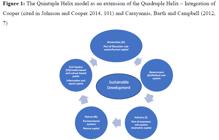
From this diagrammatic representation we can imagine different intersections of knowledge innovation between, for example, Government (G) and Industry (I), and or between knowledge systems from Nature (N) and the University (U), or complete intersections of U-G-I-N-CS within this helix configuration. Depending on the configurations, different kinds of knowledges will be in circulation and feeding back into cycles of research for knowledge and innovation. We appreciate the dominant role of universities in knowledge creation and human capacity development as their primary contribution to society.
Carayannis, Barth and Campbell (2012) proceed to make the model practical through a step process. Step 1 involves investing in education, research, and human capacity development. This leads to Step 2, where knowledge (university - theoretical knowledge and applicable knowledge) is produced, and new jobs are created (industry/economy) that are sensitive to the environment. Step 3 focuses on making sure that nature is protected and will be sustained in regenerative and long-lasting ways (nature). In Step 4, the focus is on communicating and generating new lifestyles that are reproductively green and sustainable (media-based and culture-based public), which inform government (political system) about the society valued. Step 5 is the final step in which the collection of knowledge creation finds its expression in the system in legislative and political systems feedback into ongoing learning, innovation, development, and knowledge creation (pp. 7-9). We recognise that this model may be more fitting in European contexts and might not adequately consider knowledge innovation systems in countries like South Africa, which are faced with state corruption and may need to explore alternative funding sources for universities. Additionally, the points/sites where knowledge production is sparked may, in fact, originate from civil society or what Carayannis, Barth and Campbell (2012) refer to as media-based and culture-based public sources.
We are in tune with the argument that in advancing the quadruple helix, the quintuple helix is an extension that necessitates some universities, the state, business, and civil society to collectively examine the long-term resolution of, for example, the energy crisis and the climate crisis facing South Africa as part of their use-inspired basic research (Cooper 2011). The fact of the matter is that energy is central to any form of industrialisation and development. All technological revolutions were powered by various sources of energy, without which they would have been impossible. Such a delicate process will have to help South Africa artfully balance the immediate energy needs to develop and rebuild the manufacturing sector and other sectors, which create jobs and respond to other energy needs of the universities and the education systems as a whole, as well as the long-term energy needs and the climate crisis. If universities only do this for themselves by building onsite sustainable energy sources and systems, it is likely to become a beacon of envy instead of a beacon of hope for humanity.
Drawing from Johnson and Cooper (2014), use-orientated research, whether of PAR or UIBR or basic in nature, will have to be led by engineers, natural scientists, social scientists, and climate change experts who are not driven by agendas from the Global North - countries that seek to impose an imperial agenda on South Africa - or even business lobbies seeking to ensure that the process leads to an outcome advancing their narrow economic interests in ways that mobilise intersecting socio-ecological or human-nature interrelations.
However, it seems as if what is urgently needed to respond to the polycrisis crisis in South Africa is research driven by the urgent need and desire to resolve the specific power, transport, potholes, and water crises. As argued earlier, the crisis has a direct impact on the functioning and future of the universities. The predicted national blackouts will collapse the entire university system and the country as a whole. The water crisis in the Hammanskraal area mentioned earlier may require a partnership between the University of Pretoria, the Tshwane municipality, the provincial government, community structures in the area, the municipal workers' union, and businesses to use applied research to resolve the water and cholera crises. Postgraduate and multi-disciplinary graduate networks can be drawn up to contribute towards a reinforcing relation of anchoring universities and society.
Another example is that the Vaal University of Technology (VUT) will have to work closely with the local municipality of Emfuleni, local companies such as ArcelorMittal, community structures, and trade unions to resolve the water and pothole crisis in the area. Conceptually and practically, applied research seeking to find the solution to very specific social problems is urgently needed and can only be driven by a quadruple helix (cf. Johnson and Cooper 2014)
OBSTACLES THAT STAND IN THE WAY OF THE QUADRUPLE HELIXThe South African public university system appears to be resilient; however, governance challenges have a negative impact on the public standing, credibility, and integrity of the university system. Sixteen independent assessors have been appointed by the Department of Higher Education and Training (DHET)
to investigate poor governance in universities. In some instances, administrators have been appointed to manage universities to address governance and administrative challenges (DHET 2023). In addition to the alleged sale of academic qualifications and fraud and corruption at the University of Fort Hare (UFH), along with bogus qualifications at the University of South Africa (UNISA), the ongoing investigation on governance issues at UCT is also a concern that seeks to diminish the potential role to be played by the universities in the quadruple helix (Jansen 2023; Staff Reporter 2013). We must fix what is broken.
The Corruption Perception Index (CPI) has been published annually by the NGO Transparency International since 1995. The 2022 CPI ranked 180 countries "on a scale from 100 (very clean) to 0 (highly corrupt)" based on the developments observed between May 1, 2021, and April 30, 2022. South Africa was ranked 70 in 2021, but in 2022, despite the recommendations of the state capture commission and the public announcements to rid the country of corruption by the state, the country was ranked 72 out of 180 countries (Sibanda 2023).
According to the Auditor-General Tsakani Maluleke's report in 2022, only 38 out of 257 municipalities had "clean" financial audits (Ditabo 2023). This reveals that corruption, maladministration, and mismanagement are prevalent in municipalities responsible for delivering essential services such as water, electricity, transport, and road infrastructure to the South African public and the universities.
The Steinhoff corruption scandal meant that R21 billion in public funds were squandered in what can be regarded as the biggest corruption scandal in South Africa (Ngoepe 2021). The Zondo Commission investigating "state capture" revealed corrupt practices engineered by global audit firms, such as KPMG, and the state companies and departments (Johnston 2018; van Vuuren and Marchant 2023). Business will also have to clean up its act in a manner that seeks to advance the development of the country, but that can be made possible by strengthening a progressive civil society that can hold business, the state, and the universities accountable to address the polycrisis as a matter of urgency.
Progressive civil society or social justice organisations in the form of trade unions, community-based organisations, and NGOs played a central role in the defeat of formal apartheid and the ushering in of formal democracy in 1994. Despite being weakened and fragmented in post-apartheid South Africa, social justice organisations have been able to challenge the state and business to address access to social services and socio-economic rights. Currently, social justice organisations like the Congress of South African Trade Unions (COSATU) and the Treatment Action Campaign (TAC) have been severely weakened by internal battles, lack of funding, and a lack of strategic direction. Nevertheless, some NGOs have taken it upon themselves to organise precarious workers and other marginalised segments of the population, resorting to court actions and mobilisation efforts for social and economic rights (Hlatshwayo 2022).
It would be an analytical error to disregard the problems that universities face, and these must be addressed to guarantee that universities actively play the role of anchor institutions, assisting their communities in furthering development. Universities retain their autonomy, academic freedom, and independence from direct state and government intervention and procurement. This is not to say that all South African universities are free of corruption (USAf, October 29, 2020). The declining state subsidy and chronic underfunding of the higher education system (cf. Habib 2019) will definitely undermine the role of the universities in the resolution of the polycrisis, and that is why funding remains an issue to be addressed so that the universities can play a development role. We have also witnessed universities under administration, Vice Chancellors needing the protection of bodyguards, assassinations in the university contxt (Jansen 2023), the selling of qualifications, and a rise in the lack of academic integrity (Cowan 2016; Govender 2021), not only in South Africa but globally (Denisova-Schmidt 2016).
As Jansen (2023) correctly suggests, corruption thrives in a dysfunctional university. A university lacking proper management and accountability systems for councils, the rectorate, finance leadership committees, support employees, and academics is most susceptible to corruption, ranging from issues in student housing to the awarding of academic qualifications and other forms of generalised corruption. To save the academic project, the councils of these universities, the rectorate, and their entire leadership of the academic project have to be cleansed of narrow-party political interference, dysfunctionality, corruption, bullying, and physical violence.
We support Jansen's call for the university system to be led by leaders who exhibit integrity, honesty, competence, and a commitment to academic excellence. However, we also emphasise that the quadruple helix requires not only university leaders but also academics, researchers, university support staff, and students who are committed to reorienting the university education system. This reorientation should aim to contribute effectively to addressing the polycrisis engulfing the entire country and the South African system. Hindsight and foresight would generally tell us that there are always consequences for doing nothing. It is easy to blame politicians for the existence of the current polycrisis. While this is correct, it is not enough. How did we find ourselves in this crisis when the country has one of the best university systems in Africa and the world? What did top university-trained electrical engineers and professors of Electrical Engineering say when Eskom was being looted and destroyed? Is the university not culpable in the creation and regeneration of the polycrisis? Are we not, as universities, paying the price for our cowardice, indifference, and our preoccupation with ourselves? Are these not the consequences of our indifference? We argue that higher education leaders and scholars must take some responsibility, as we are paid by taxpayers, for where we find ourselves today regarding the consequences of the absence of the systemic strategic positioning of CE and the quadruple helix. Moreover, we acknowledge our failure to provide leadership to society, but we have an opportunity now, with strong universities and leadership in place, to demonstrate the possibilities of the future African university.
CONCLUSION
The polycrisis presents a potentially devastating combination of concentrated and intersecting crises. Universities globally, and especially in countries like South Africa, have a tremendous opportunity to contribute to society by containing and revitalising it through their knowledge and innovation systems. In anchoring society, universities cannot do so on their own. They need all societal capitals in combination with nature to address human degradation, not only for the present but also for future generations. The quintuple helix, in combination with the quadruple helix, can be applied in practical ways to guide the work of universities in anchoring not only society but humanity in harmony with nature. Through good and ethical leadership, universities have a marvellous opportunity not only to lead their institutions but also to be beacons of hope, exemplifying what leadership in society can truly be.
REFERENCES
- Bellini, Oscar E., M.T. Gullace, and Martino Mocchi. 2022. "Re-Start: Student Housing Polycrisis Post-Coronavirus." Techne - Journal of Technology for Architecture and Environment 23: 94103.
- Bezuidenhout, Andries, Sonwabile Mnwana, and Karl Von Holdt, eds. 2022. Critical Engagement with Public Sociology: A Perspective from the Global South. Policy Press, Bristol.
- Burawoy, Michael. 2005. "For public sociology." American Sociological Review 70.1 : 4-28.
- Carayannis, Elias G., Thorsten D. Barth, and David F.J. Campbell. 2012. "The Quintuple Helix Innovation Model: Global Warming as a Challenge and Driver for Innovation." Journal of Innovation and Entrepreneurship 1 (2012): 1-12.
- Cooper, David. 2011. The University in Development: Case Studies of Use-Oriented Research. HSRC Press.
- Cooper, David. 2017. "Concepts of "applied and public sociology": Arguments for a bigger theoretical picture around the idea of a "university third mission"." Journal of Applied Social Science 11.2 141-158.
- Cooper, David. 2021. "Why Does the Davos World Economic Forum (WEF) Proclaim the 2nd Phase of a Post-1970s Third Capitalist Industrial Revolution as 'The 4IR'?" In The Fourth Industrial Revolution: A Sociological Critique, edited by Trevor Ngwane and Malehoko Tshoadi, 33-58. Jacana Media (Pty) Limited, Johannesburg.
-
Cowan, Kyle. 2016. "Second Degrees-For-Sale Scandal Rocks Unizulu." Zululand Observer, accessed June 27, 2016. https://zululandobserver.co.za/115828/second-degrees-for-sale-scandal-rocks-unizulu/
» https://zululandobserver.co.za/115828/second-degrees-for-sale-scandal-rocks-unizulu/ - Crutzen, Paul J., and Eugene F. Stoermer. 2021. "The 'Anthropocene' (2000)." In Paul J. Crutzen and the Anthropocene: A New Epoch in Earth's History, edited by Susanne Benner, Gregor Lax, Paul. J. Crutzen, Ulrich Pöschl, Jos Lelieveld, and Hans G. Brauch, 19-21. Springer, New York.
-
Denisova-Schmidt, Elena. 2016. "The Global Challenge of Academic integrity." International Higher Education 87 (2016): 4-6. DOI: 10.6017/ihe.2016.87.9494
» https://doi.org/10.6017/ihe.2016.87.9494 - Department of Higher Education and Training (DHET). 2023. "Briefing on the State of Governance of Higher Education Institutions with a Focus on UCT, UNISA, UFH and UKZN". 14 June 2023.
-
Department of Statistics South Africa (StatsSA). 2023. "Beyond Unemployment - Time-Related Underemployment in the SA Labour Market." https://www.statssa.gov.za/?p=16312#:~:text=South-20Africa's%20unemployment%20rate%20in,the%20fourth%20quarter%20of%202022.
» https://www.statssa.gov.za/?p=16312#:~:text=South-20Africa's%20unemployment%20rate%20in,the%20fourth%20quarter%20of%202022 -
Ditabo, Malaika. 2023. "AG Finds 38 Municipalities Have Clean Audits, EFF calls for Official to be Held Accountable." News24, Accessed June 1, 2023. https://www.news24.com/news24/politics/political-parties/ag-finds-38-municipalities-have-clean-audits-eff-calls-for-official-to-be-held-accountable-20230601
» https://www.news24.com/news24/politics/political-parties/ag-finds-38-municipalities-have-clean-audits-eff-calls-for-official-to-be-held-accountable-20230601 -
du Toit, Pieter. 2023. "The Bree Street Blast and the End of Johannesburg Accreditation." News24, Accessed July 22, 2023. https://www.news24.com/news24/opinions/columnists/pieter_du_toit/pieter-du-toit-the-bree-street-blast-and-the-end-of-johannesburg-20230722
» https://www.news24.com/news24/opinions/columnists/pieter_du_toit/pieter-du-toit-the-bree-street-blast-and-the-end-of-johannesburg-20230722 -
Ellis, Estelle. 2023. "Makhanda in the Eastern Cape." Daily Maverick, June 15, 2023. https://www.dailymaverick.co.za/article/2023-06-15-r400m-later-makhanda-is-still-facing-a-catastrophic-water-crisis/
» https://www.dailymaverick.co.za/article/2023-06-15-r400m-later-makhanda-is-still-facing-a-catastrophic-water-crisis/ -
Engelbrecht, F., A. Le Roux, C. Vogel, and A. Mbiyozo. 2022. "Is Climate Change to Blame for KwaZulu-Natal's Flood Damage." Institute for Security Studies, May 12, 2022. https://issafrica.org/iss-today/is-climate-change-to-blame-for-kwazulu-natals-flood-damage
» https://issafrica.org/iss-today/is-climate-change-to-blame-for-kwazulu-natals-flood-damage - Etzkowitz, H. (2003) Research groups as 'quasi-firms': The invention of the entrepreneurial university. Research Policy, 32(1): 109-121.
- Fongwa, S. 2023. "Universities as Anchor Institutions in Place-Based Development: Implications for South African Universities Engagement." South African Journal of Higher Education 37, no. 1 (2023): 92-112.
- Grab, S.W., and David J. Nash. 2023. "A New Flood Chronology for KwaZulu-Natal (1836-2022): The April 2022 Durban Floods in Historical Context." South African Geographical Journal (2023): 122.
- Gramsci, Antonio. 2011. Prison Notebooks Volume 2. Columbia University Press, New York.
-
Gumbi, Kopano. 2023. "South Africa's Unemployment Rate Rises Amid Power Crisis." Reuters, Accessed May 16, 2023. https://www.reuters.com/world/africa/south-africas-unemployment-rate-rises-329-q1-2023-05-16/#:~:text=Africa's%20most%20industrialised%20economy%20has,last%20three%20months%20of%202022.
» https://www.reuters.com/world/africa/south-africas-unemployment-rate-rises-329-q1-2023-05-16/#:~:text=Africa's%20most%20industrialised%20economy%20has,last%20three%20months%20of%202022 - Habib, Adam. 2019. Rebels and Rage: Reflecting on# FeesMustFall. Jonathan Ball Publishers, Cape Town.
- Henig, David, and Daniel M. Knight. 2023. "Polycrisis: Prompts for an Emerging Worldview." Anthropology Today 39, no. 2 (2023): 3-6.
-
Heywood, Mark. 2021. "Wits Council Resolves to Appoint Pro-Vice-Chancellor for Climate Sustainability and Inequality." Accessed November 25, 2021. https://www.dailymaverick.co.za/article/2021-11-25-wits-council-resolves-to-appoint-pro-vice-chancellor-for-climate-sustainability-and-inequality/
» https://www.dailymaverick.co.za/article/2021-11-25-wits-council-resolves-to-appoint-pro-vice-chancellor-for-climate-sustainability-and-inequality/ - Hlatshwayo, Mondli. 2013. "Sociological Analysis of Trade Union Responses to Technological Changes at the ArcelorMittal Vanderbijlpark Plant, 1989-2011." Doctoral thesis. University of Johannesburg.
- Hlatshwayo, Mondli. 2022. "The Public Transport Crisis in South Africa: Through the Eyes of the Four Revolutions." The Thinker 92, no. 3 (2022): 49-60.
- Hlatshwayo, Mondli. 2023. "South Africa Enters the Second Wave of Xenophobic Violence: The Rise of Anti-Immigrant Organisations in South Africa." Politikon 50, no. 1 (2023): 1-17.
-
Hoyer, Daniel, James S. Bennett, Jenny Reddish, Samantha Holder, Robert Howard, Majid Benam, Jill Levine, Francis Ludlow, Gary Feinman, and Peter Turchin. 2023 "Navigating Polycrisis: Long-Run Socio-Cultural Factors Shape Response to Changing Climate." SocArXiv. https://doi.org/10.31235/osf.io/h6kma.
» https://doi.org/10.31235/osf.io/h6kma - Jansen, Jonathan D. 2023. Corrupted: A Study of Chronic Dysfunction in South African Universities. NYU Press.
- Johnson, Bernadette. 2020. "Community Engagement: Barriers and Drivers in South African Higher Education." South African Journal of Higher Education 34, no. 6 (2020): 87-105.
- Johnson, Bernadette, and David Cooper. 2014. "Some Theoretical Considerations of 'Engaged Scholarship' and 'Use-Oriented Research' at a New University in South Africa: The Vaal University of Technology." Southern African Review of Education with Education with Production 20, no. 2 (2014): 97-120.
- Johnston, Andrew. 2018. "Company Secretaries: Gatekeepers or Doormen?." Without Prejudice 18, no. 1 (2018): 14-17.
-
Mahlati, Zintle. 2023a. "Confirmed Cholera Cases at Jubilee Hospital Climb to 44: Department." Times Live, Accessed May 26, 2023. https://www.timeslive.co.za/news/south-africa/2023-05-26-confirmed-cholera-cases-climb-to-44-gauteng-health-department/
» https://www.timeslive.co.za/news/south-africa/2023-05-26-confirmed-cholera-cases-climb-to-44-gauteng-health-department/ -
Mahlati, Zintle. 2023b. "Hammanskraal Cholera Outbreak: Ramaphosa Shocked by Dilapidated Rooiwal Waste Treatment Plant." Times Live, June 8, 2023. https://www.news24.com/news24/politics/government/hammanskraal-cholera-outbreak-ramaphosa-shocked-by-dilapidated-rooiwal-waste-treatment-plant-20230608
» https://www.news24.com/news24/politics/government/hammanskraal-cholera-outbreak-ramaphosa-shocked-by-dilapidated-rooiwal-waste-treatment-plant-20230608 -
Matlala, Thapelo. 2023. "Rhodes University's Heated Shutdown Over Water Crisis! Students, Religious Leaders, Unemployed People and Community Members Have Had Enough!." Grocott's Mail, May 11, 2023. https://grocotts.ru.ac.za/2023/05/11/rhodes-universitys-heated-shutdown-over-water-crisis/
» https://grocotts.ru.ac.za/2023/05/11/rhodes-universitys-heated-shutdown-over-water-crisis/ - Metz, Cade. 2022. Genius Makers: The Mavericks Who Brought AI to Google, Facebook, and the World. Penguin, London.
- Meyer, Daniel and Neethling Roan. 2023. "Electricity Production and Economic Growth: The South African Case." African Journal ofBusiness and Economic Research, 18, no. 1: 143
- Moreno, Jonathan D. 2012. Mind Wars: Brain Science and the Military in the 21st Century. Bellevue Literary Press.
-
Motala, Enver and Baatjes Ivor. 2015. "A Discussion Document. Thoughts on SociallyEngaged Research and Scholarship: Differentiating the Characteristics of Engaged Scholarship From 'Community Engagement'." Cipset, February 2015. https://cipset.mandela.ac.za/Occasional-Papers-and-Articles
» https://cipset.mandela.ac.za/Occasional-Papers-and-Articles -
Motloung, Tshepiso. 2023. "Joburg Girl, 3, Dies After Breathing Machine Reportedly Could Not Function Due to Load Shedding." New24, May 26, 2023. https://www.news24.com/news24/southafrica/news/joburg-girl-3-dies-after-breathing-machine-reportedly-could-not-function-due-to-load-shedding-20230526
» https://www.news24.com/news24/southafrica/news/joburg-girl-3-dies-after-breathing-machine-reportedly-could-not-function-due-to-load-shedding-20230526 -
Naidu, Edwin. 2022. "Outgoing UJ Vice-Chancellor Dreams Big About Africa." Sunday Independent, September 20, 2022. https://www.iol.co.za/sundayindependent/education/outgoing-uj-vice-chancellor-dreams-big-about-africa-92b9ac71-0334-4ca9-9e3d-21822249b360
» https://www.iol.co.za/sundayindependent/education/outgoing-uj-vice-chancellor-dreams-big-about-africa-92b9ac71-0334-4ca9-9e3d-21822249b360 - Nelkin, Dorothy. 2019. University and Military Research: Moral Politics at MIT. Cornell University Press, New York.
-
Ngcobo, Khanyisile. 2023a. "Union Defends Nurses' Cardboard Box Improvisation, Says Government Long Knew of Incubator Shortage." TimesLive, Accessed May 29, 2023. https://www.timeslive.co.za/news/south-africa/2023-05-29-union-defends-nurses-cardboard-box-improvisation-says-government-long-knew-of-incubator-shortage/
» https://www.timeslive.co.za/news/south-africa/2023-05-29-union-defends-nurses-cardboard-box-improvisation-says-government-long-knew-of-incubator-shortage/ -
Ngcobo, Khanyisile. 2023b. "'Taxis Flew into the Air': Driver Describes Moment When Blast Ripped up Bree Street." Times Live, Accessed July 20, 2023. https://www.timeslive.co.za/news/south-africa/2023-07-20-taxis-just-flew-into-the-air-driver-describes-moments-when-blast-ripped-up-bree-street/
» https://www.timeslive.co.za/news/south-africa/2023-07-20-taxis-just-flew-into-the-air-driver-describes-moments-when-blast-ripped-up-bree-street/ -
Ngoepe, Karabo. 2021. "Steinhoff Was SA's Biggest Corporate Fraud, Yet No Arrests Have Been Made." IOL, Accessed February 14, 2021. https://www.iol.co.za/sundayindependent/news/steinhoff-was-sas-biggest-corporate-fraud-yet-no-arrests-have-been-made-b6590fb7-9420-4c53-b306-6bfac80a731b
» https://www.iol.co.za/sundayindependent/news/steinhoff-was-sas-biggest-corporate-fraud-yet-no-arrests-have-been-made-b6590fb7-9420-4c53-b306-6bfac80a731b -
Ngubelanga, Lungile. 2022. "College of Humanities Lends Helping Hand to KZN Flood Victims." Accessed June 10, 2022. https://coh.ukzn.ac.za/news/2022/06/college-of-humanities-lends-helping-hand-to-kzn-flood-victims/
» https://coh.ukzn.ac.za/news/2022/06/college-of-humanities-lends-helping-hand-to-kzn-flood-victims/ -
Nordling, Linda. 2023. "Power Crisis Eats into South Africa's University Budgets." Research Professional News, Accessed February 2, 2023. https://www.researchprofessionalnews.com/rr-news-africa-south-2023-2-south-africa-s-power-crisis-eats-into-university-budgets/
» https://www.researchprofessionalnews.com/rr-news-africa-south-2023-2-south-africa-s-power-crisis-eats-into-university-budgets/ -
Novikova, E.S. 2023. "The Influence of Sanctions on the Transformation of Trade Cooperation of Countries Within the World Economy." International Trade and Trade Policy 8, no. 4. https://ideas.repec.org/a/acl/journl/y2023id567.html
» https://ideas.repec.org/a/acl/journl/y2023id567.html -
Opara, Ijeoma Nnodim. 2021. "It's Time to Decolonize the Decolonization Movement." PLOS Blogs, Speaking of Medicine and Health. https://speakingofmedicine.plos.org/2021/07/29/its-time-to-decolonize-the-decolonization-movement/
» https://speakingofmedicine.plos.org/2021/07/29/its-time-to-decolonize-the-decolonization-movement/ - Saidi, A. 2023. "Reflections on the Conceptualisation and Practices of Community Engagement as a Core Function of Universities." South African Journal of Higher Education 37, no. 1 (2023): 119.
- Saidi, A., and Z. Boti. 2023. "Revisiting Community Engagement in Higher Education in South Africa from a Vantage Point of the Notion of Third Mission." South African Journal of Higher Education 37, no. 1 (2023): 72-91.
- Sandmann, Lorilee R. 2008 "Conceptualization of the Scholarship of Engagement in Higher Education: A Strategic Review, 1996-2006." Journal of Higher Education Outreach and Engagement 12, no. 1 (2008): 91-104.
-
Sibanda, Omphemetse. 2023. "South Africa Stagnates on the Global Corruption Perception Index, But There Are Glimmers of Hope on the Horizon." Daily Maverick, Accessed January 31, 2023. https://www.dailymaverick.co.za/opinionista/2023-01-31-south-africa-stagnates-on-the-global-corruption-perception-index-but-there-are-glimmers-of-hope-on-the-horizon/
» https://www.dailymaverick.co.za/opinionista/2023-01-31-south-africa-stagnates-on-the-global-corruption-perception-index-but-there-are-glimmers-of-hope-on-the-horizon/ - Sibhensana, B., and S. Maistry. "Conceptualising Public-Private Partnerships for Social Innovation Through Community Engagement in Higher Education Institutions." South African Journal of Higher Education 37, no. 1 (2023): 185-205.
-
South African Broadcasting Corporation (SABC). 2023. "UJ, Wits Protests Intensify." @SABCNews, March 3, 2023. https://www.sabcnews.com/sabcnews/uj-and-wits-students-vow-to-continue-protests/
» https://www.sabcnews.com/sabcnews/uj-and-wits-students-vow-to-continue-protests/ -
Staff Reporter. 2013. "Unisa Swoops on Fraudulent Certificates." IOL, Accessed June 27, 2013. https://www.iol.co.za/news/unisa-swoops-on-fraudulent-certificates-1538445
» https://www.iol.co.za/news/unisa-swoops-on-fraudulent-certificates-1538445 - Stokes, DE. (1997) Pasteur's Quadrant. Basic Science and Technological Innovation. Washington: Brookings Institution Press.
-
Tooze, Adam. 2020. "Is the Coronavirus Crash Worse than the 2008 Financial Crisis?" Foreign Policy, March 18, 2020. https://foreignpolicy.com/2020/03/18/coronavirus-economic-crash-2008-financial-crisis-worse/
» https://foreignpolicy.com/2020/03/18/coronavirus-economic-crash-2008-financial-crisis-worse/ -
Universities South Africa (USAf). 2020. "The USAf Board Takes a Stand on Corruption." Accessed October 29, 2020. https://www.usaf.ac.za/the-usaf-board-takes-a-stand-on-corruption/
» https://www.usaf.ac.za/the-usaf-board-takes-a-stand-on-corruption/ -
Universities South Africa (USAf). 2021. "2nd Universities South Africa (USAf) Higher Education Conference, Engaged University." https://www.usaf.ac.za/2nd-national-higher-education-conference-2021/
» https://www.usaf.ac.za/2nd-national-higher-education-conference-2021/ -
University of the Witwatersrand (Wits). 2020. "Professor Adam Habib to Step Down From Wits at the End of the Year." February 18, 2020. Wits University. https://www.wits.ac.za/news/latest-news/general-news/2020/2020-02/professor-adam-habib-to-step-down-from-wits-at-the-end-of-the-year.html
» https://www.wits.ac.za/news/latest-news/general-news/2020/2020-02/professor-adam-habib-to-step-down-from-wits-at-the-end-of-the-year.html - Vally, S. 2023. "Reimagining University-Community Engagement." South African Journal of Higher Education 37, no. 1 (2023): 53-71.
- Van Vuuren, Hennie, and Michael Marchant. 2023. "Cycles of State Capture: Bringing Profiteers and Enablers to Account." In State Capture in South Africa: How and Why it Happened, edited by Mbongiseni Buthelezi and Peter Vale, 197-2016. Wits University Press, Johannesburg.
-
Wright, Jim A., Hong Yang, Ulrike Rivett, and Stephen W. Gundry. 2012. "Public Perception of Drinking Water Safety in South Africa 2002-2009: A Repeated Cross-Sectional Study." BMC Public Health 12 (2012): 1-9. https://link.springer.com/article/10.1186/1471-2458-12-556
» https://link.springer.com/article/10.1186/1471-2458-12-556