Evaluating the impact of curriculum model choices on academic success for extended commerce degree programmes
Abstract
Understanding how curriculum design choices impact the academic success in terms of grades of students provides valuable insights into the effective delivery of the teaching of introductory financial accounting and economics for students in extended degree programmes (ECP). The main research question asks which delivery model, either foundational modules or augmented main-stream modules, provides an effective pathway to achieving academic success in terms of grades in ECP. Performing a qualitative analysis of a large dataset incorporating 11 410 observations of data of a ten-year period. Analysis of variance was used to identify which delivery model is the most effective in terms of students' performance. The study provides evidence that introductory modules may provide increased support compared to augmented modules for financial accounting. The study also shows that the use of an introductory module has a significant beneficial effect on extended programme students in their second year in order to achieve academic success in mainstream modules but only in certain cases only if a certain threshold is achieved in the introductory module. This threshold appears to be higher in foundational level economics than financial accounting. The study provides evidence that the choice of delivery model has an impact on financial accounting and economics students' performance in terms of grades achieved. Foundation modules may benefit from higher required pass grade thresholds so that students in ECP are able to ultimately obtain their degrees.
accounting education; curriculum design; extended programme; student success
INTRODUCTION
Approximately 190 000 South African students make the transition from high school to university each year (News24 2019). They are immediately immersed in a learning and teaching environment that is notably different from school, and rapid adaption to this change is expected (McKay, O'Bryan and Kahu 2021; Ontong, Bruwer, and Schonken 2022). A substantial increase in the number of students who have access to higher education could be attributed to the additional access programmes developed by the Council on Higher Education (2013). The Council on Higher Education, in partnership with the Department of Higher Education and Training, created a platform for prospective students to apply and potentially register for an extended curriculum programme (ECP). This programme was designed for students who are not considered academically prepared for university as they do not meet mainstream admission requirements due to an academically disadvantaged background (Rollnick 2010). In order to aid these students to gain access, lower requirements are set for the extended curriculum foundation courses to grant them the opportunity to progress in line with their level of preparation (Lubbe 2016). Furthermore, ECPs are often introduced by higher education institutions (HEIs) as a way of addressing the South African legacy of unequal educational opportunities, as well as to assist students in academically bridging the transition between school and university with an additional year of study (Chukwuere 2020; Grayson 2010; Ogude et al. 2019). This bridging of inequity is often not possible due to economic and fiscal challenges (De Jager and Baard 2019).
The demand to enrol in ECPs in higher education is high and places a significant cost on the stakeholders of higher education (Potgieter et al. 2016). Due to the cost and pressure from stakeholders, the availability of ECP enrolment places is limited at HEIs. This, together with the financial pressure placed on students to enrol in a degree with no ECP funding, places students in higher education in South African in an unfortunate position that even if access to higher education and an ECP degree is achieved, the HEI does not have the resources to grant the student access to enrol in the degree. This cost and limited opportunities, together with the challenge of these programmes to deliver successful candidates, add to the pressure on HEIs to ensure that ECPs are designed to reach their full potential (Boughey 2007).
The ECPs are designed in a manner so that the students are developed academically to perform on par with the mainstream students, as well as being developed certain skills such as dealing with complex situations and adapting to studying at a HEI, on a wide range of aspects from psychologically to socially make the transition from school to university. Academic support is an important tool to assist with student success. In this context, academic planning and appropriate curriculum design are key aspects of consideration (Matabane and Matabane 2021). Although the course has lower entrance requirements, the same exit-level outcomes and recognition are required for the degree (Ogude et al. 2021). With the same exit-level outcomes in mind, the delivery of the course to obtain these outcomes can follow different models (Department of Higher Education 2012). The Department of Higher education allows ECP to follow various delivery modules for courses, for the purposes of this study two of these delivery models will be evaluated (Department of Higher Education 2012). The delivery can firstly take the form of incorporating a fully foundational course model, where a pre-course is implemented as a form of preparation and is additional to the regular curriculum. This foundation model often covers certain topics from the traditional mainstream first year module, however on a limited basis. Only after passing the foundation course a student progress to the mainstream module that is normally taken by other commerce students in their first year (Department of Higher Education 2012). In the second instance, the model available to the higher education curriculum is the augmented version of the traditional mainstream first year module. This augmented model covers all the material as per the regular course in the same duration as the mainstream first year module, however it provides additional resources to teach foundational material during formally timetabled interventions such as additional lectures and tutorial sessions. This model was followed during the last year of the period under study for the financial accounting module and was evaluated in comparison to the extended course model (Department of Higher Education 2012).
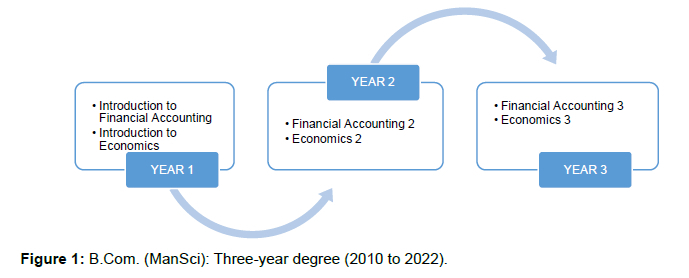
This study evaluated the curriculum design of an ECP at a residential South African university for the Bachelor of Commerce (Management Sciences [ManSci]) programme (B.Com. ECP). This degree extends over a four-year period versus the mainstream, standard B.Com. (ManSci) programme that extends over a three-year period, as illustrated in Figure 1.
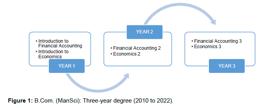
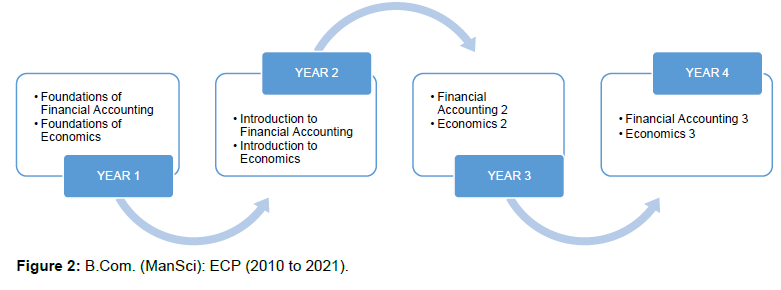
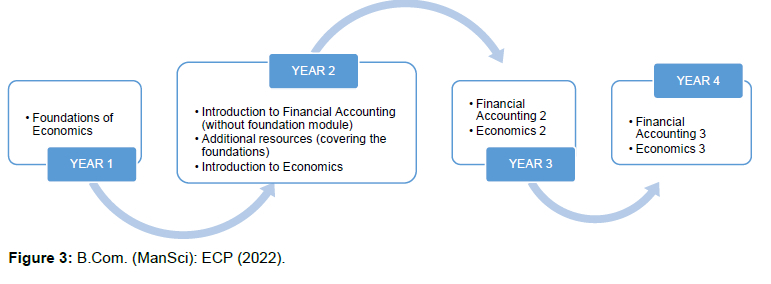
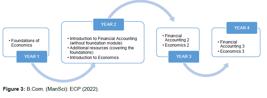
The study evaluated the effectiveness of two different ECP models, namely the extended course model for the years 2010 to 2021 (Figure 2) and the augmented course model for 2022 specifically in the Introduction to Financial Accounting course (Figure 3). The study focused on the financial accounting and economics modules as these are the only modules presented for the full duration of the degree, for either three or four years. Furthermore, the model design for these two modules was similar for a substantial period; thus, granting the researchers the opportunity to compare the same population in different modules under the same curriculum design. These subjects further lend themselves to the constructivist curriculum design with strong scaffolding of knowledge orientation (Green, Bean and Peterson 2013; Hesketh 2011). This aided the researchers to evaluate whether the extended curriculum models have different effects for different economic and management sciences modules.
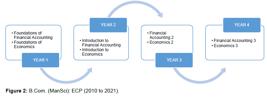
The development of the ECP introduced a foundation module in order to create a foundation for students in a constructivist manner and thus allowed the opportunity to reach a basis on par with the mainstream model. The study expected the ECP students to perform on average similarly to the mainstream students when enrolled in the introductory modules for economics and financial accounting, as the foundation module aims to bridge the gap between high school and higher education. The design of the ECP degree is presented in Figure 2.
The implementation of the foundation modules and their success related to the introductory modules were evaluated for the years 2010 to 2022 on a year-to-year basis. The extended curriculum design of the foundation module of financial accounting was, however, altered in the study during 2022, when the foundation module was removed and an augmented model was introduced through the implementation of alternative resources (Figure 3). The alternative resources comprised an additional lecture and an additional tutorial per week during which foundation principles were explained, as well as how these foundation theories integrate with the introductory topics lectured in the mainstream module. These additional resources added to the total credit-bearing modules for the B.Com. degree. The study evaluated the transition both qualitatively in the literature review and quantitatively in the results section of this research article.
The main contribution of this research is analysing the impact of the different ECP delivery models for modules on student performance in terms of grades. The findings of this study will allow module and faculty planners to better facilitate decisions surrounding extended degree programmes where students are expected to pass a mainstream module included in a standard B.Com. course during their extended degree programme.
The remainder of this article is set out as follows: a review of literature on ECPs, a discussion of foundation modules and their expected impact on the academic performance of students, and a discussion of curriculum design that highlights the advocacy for specific curriculum designs and the pedagogy they are grounded in. This sets the platform for the methodology to apply to the data. The study concludes with the interpretation of the results and a discussion of the study's limitations and future research opportunities.
The literature review commences with understanding of the nature of ECP and the results of the implementation of ECPs at different HEIs and concludes with an evaluation of the importance of foundation modules as implemented in the extended model of ECPs.
Understanding the nature of ECP
The implementation of ECPs at different universities to grant access to higher education has been widely researched, which shows the advantages and challenges that the implementation of an ECP could hold (Lisciandro and Gibbs 2016; Alexander and Hlalele 2012; Leshoro and Jacobs 2019; Ogude et al. 2019; Downs 2005). Lisciandro and Gibbs (2016) found that while the success of ECPs to grant access to students is undoubted, the success and retention of these students are, however, problematic. It is noted that both pre-course assistance and timetabled assistance could enhance retention rates (Lisciandro and Gibbs 2016). This study evaluated both these suggested interventions in the consideration of curriculum design and success. Leshoro and Jacobs (2019) identified the enhanced access that ECPs could provide to a broader spectrum of students; however, admission and registration constraints were identified that could be addressed. While access has been considered and addressed, literature on the success of ECPs is limited, and this study sought to expand on it. Tewari and Ilesanmi (2020) identified the success of granting access to higher education programmes but commented that the rate of student success is not as promising. The underlying source of the limited success was not disclosed. This study considered the effect of foundational knowledge on the success of students and evaluated the effect of curriculum design on student success. Although the aim of the Council on Higher Education is that the ECP should create a space where underprepared students can achieve sound foundations for success, this study evaluated whether the said foundation is successful, as well as how these foundations can be solidified. These foundation courses are developed to incorporate substantial foundational material that relates to the mainstream academic programmes that are to follow. This allows students to make connections to prior knowledge when progressing to the mainstream modules in academic programmes (Ogude et al. 2019).
The use of foundation modules highlights the constructivist learning framework where students create a foundation of previous experiences during the first year of the ECP to apply during the second year (Pange, Lekka, and Toki 2010). This allows the students to gather the required knowledge and understanding as explained in Bloom's taxonomy during the first year of the ECP and apply it during the second year, and being able to analyse and synthesise it during the third year, while all the divisions of Bloom's taxonomy, including the evaluation of information, are required by the end of the fourth year. This opposes the mainstream programme where the knowledge, understanding, and application of information are required in the first year; thus, replacing the first and second years of the ECP.
Understanding the use of foundation courses
The groundwork that these foundation courses lay for students has often been identified as creating declarative knowledge that students require for functional knowledge (Lubbe 2016). Building on a cognitive learning experience, students are allowed an opportunity to learn from the prior knowledge gained during the foundation phase of the ECP. These foundation courses are considered to bridge the gap between high school and university. As opposed to traditional bridging courses or enabling programmes, the foundation course as part of the ECP form a credit-bearing part of a university qualification. The foundation courses are set as the integrated foundation phase into a fully accredited course (Department of Education 2004). The outcome of the course, however, remains consistent with other enabling courses, namely to ease the transition and give students the best possible chance of success (Joynt 2022). A positive and significant benefit was identified by previous research related to the attendance of bridging courses by students at a South African university (Joynt 2022). Previous studies indicated the benefit of bridging courses but a later decrease in the benefits in the use of bridging courses as a foundation, while further building on the benefits could counter the erosion, as suggested by Xiang and Gruber (2012). The courses are built on the concept of creating the knowledge and skills needed for lifelong learning in commerce careers (Jones and Fields 2001).
This benefit confirms the positive experience and academic gain that ECPs offer students, as suggested by Potgieter et al. (2016). While the benefit is evident on an academic level, an isolation problem still exists on a social level. Students enrolled in an ECP tend to be isolated from the mainstream qualification group and experience stigma surrounding them as a group (Alexander and Hlalele 2012). While the initial composition of foundation courses had a strong academic focus on student success, the consideration of the social development of students has in recent years been a more prominent factor in curriculum development, and a holistic ECP was considered. The curriculum design of Introduction to Financial Accounting in this study was adapted during 2022 to incorporate students into the mainstream classes with an additional source of assistance; thus, following an augmented approach to ECPs; however, the economics module in the ECP continued the extended model of ECPs. This curriculum adjustment allowed students in the ECP to form part of the mainstream group; thus, removing the feeling of isolation and creating a community with weekly supplemental assistance. The weekly supplemental assistance was aimed at building the foundation of accounting during formal lectures for reflection, as well as allowing students to develop a sense of peer learning with students in the same situation during facilitated learning sessions. During these learning sessions, students are assisted to adapt to the learning styles of higher education, as well as "learning how to learn" economic and management science modules, as suggested by Jones and Fields (2001). This adapted curriculum applies the concept of supplemental instruction as an educational intervention, as opposed to the foundation course. Supplemental instruction models have previously indicated a positive association with academic performance (Jones and Fields 2001). This study evaluated whether this positive association would still occur if the supplemental instruction was applied in an ECP as an alternative to an additional year of study during a foundation course.
RESEARCH OBJECTIVE, RESEARCH QUESTIONS, AND RATIONALE
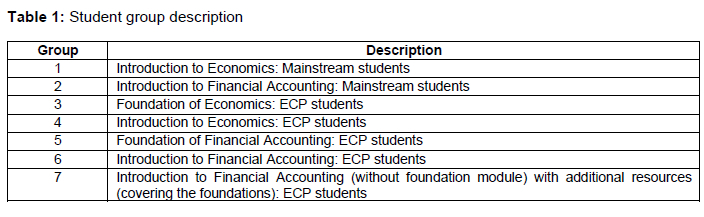
The objectives of this research were, firstly, to analyse the performance of the B.Com. ECP students in the introductory modules (both economics and financial accounting) versus their peers in the standard B.Com. The analysis involved the evaluation of seven different groups as set out in Table 1.
The analysis evaluated the performance of the groups as the aim of the ECP foundation module is to successfully integrate the students into the mainstream group and equip them with the skills and competencies required to succeed in higher education (Scott 2018) in order to answer Research Question 1:
• Research Question 1a: Do the students in the ECP group (Group 4) perform similarly to the students in the mainstream group (Group 1) in an introductory economics module following on the ECP foundation module?
• Research Question 1b: Do the students in the ECP group (Group 6) perform similarly to the students in the mainstream group (Group 2) in an introductory financial accounting module?
• Research Question 1c: Do the students in the ECP group (Group 7) perform similarly to the students in the mainstream group (Group 2) in an introductory financial accounting module without an ECP foundation module?
Secondly, Research Objective 2 aimed to evaluate the success rate of the B.Com. ECP students in the introductory modules while taking into account their performance in the foundation modules. This would aid the researchers in determining whether a standard pass rate in foundation modules is appropriate or whether progress requirements should be implemented in the ECP; hence Research Question 2:
• Research Question 2a: Does success in a financial accounting foundation module (ECP students - Group 5) lead to success in a follow-up introductory financial accounting module (Group 6)?
• Research Question 2b: Does success in an economics foundation module (ECP students -Group 3) lead to success in a follow-up introductory economics module (Group 4)?
Finally, Research Objective 3 sought to evaluate the impact of the ECP design on the year-to-year results of the introductory financial accounting module since the design of the module changed from a stand-alone foundation module as per the extended course model to the implementation of an augmented course model. This objective was addressed through the use of the financial accounting module changes and controlled for the performance of the group in the economics module. This evaluated which model, extended or augmented, if either, is the most effective for students to achieve academic success in a mainstream introductory financial accounting module; thus, answering the last research question:
• Research Question 3: Based on the extended model used for ECP during 2010 to 2021 (Group 6) and the augmented model used during 2022 (Group 7), is there a difference in the financial accounting performance in terms of the grades of ECP students under different ECP models in comparison to the mainstream group (Group 2)?
RESEARCH DESIGNResearch methodology
The study followed a qualitative and longitudinal approach over several years. The study used quantitative data, namely student grades, as obtained from the class lists. The population included all students enrolled in a B.Com. ManSci degree. Both student groups enrolled in the three-year programme, and students enrolled in the four-year ECP were included in the study.
Data collection
The performance of the students in two of the core subjects, economics and financial accounting, was included for the period 2010 to 2022. The period of the population is based on the available data since the restructuring of the B.Com. ManSci degree. Student performance was measured using the final grades obtained in the respective modules. Performance in the foundation module, both for economics and financial accounting, was measured from 2010 until 2021, while performance in the introductory modules was measured for the period 2011 to 2022. This was to ensure that a prior year performance grade was available to measure the relationship between the foundation module completed and the introductory module completed the following year.
Data analysis
The research team applied a univariate test to answer Research Question 1 regarding whether a significant difference exists between groups. The test included a one-way analysis of variance (ANOVA) to evaluate the difference between the ECP groups and the mainstream groups for the introductory modules in both economics and financial accounting based on their least squares means. The analysis was performed on a year-on-year basis, as well as in aggregate for each of the research questions. The team applied a 95 per cent confidence level indicating all items with p-values of <0.05 as statistically significant and indicated as such (*).
In order to answer Research Question 2 and measure the effect of success on the introductory module based on success in the foundation modules for the ECP groups, multiple regression was applied. The regression equation indicating the relationship between the performance of a student during the foundation module and the introductory module was further used to determine the required performance of a student during the foundation module to ensure a passing performance in the introductory module. The performance regression was stated as follows:

The variable of interest was the dependent variable FMn, which represented student performance in the introductory module in year n, while FM(n-1) represented the performance of the student in the previous year while completing the foundation module.
Research Question 3 was addressed through the application of an ANOVA to evaluate the difference between the groups. As the question related to three different groups and the groups varied in size, the results of the ANOVA were further evaluated through the use of a post hoc test to identify specifically which group differed from which. The post hoc test applied in the study was the Games-Howell test as it does not assume equal sample sizes. Since the data for Group 7 only comprised one year of data, the use of the post hoc test addresses the risk by including the Welch's degrees of freedom correction.
RESULTS
Descriptive statistics
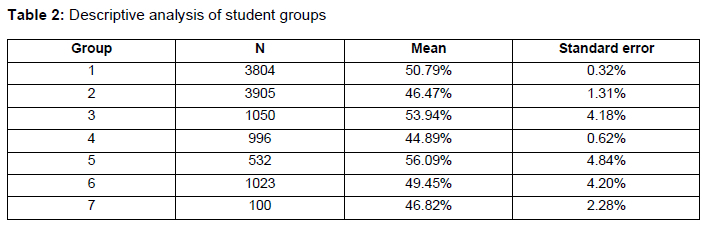
The data present the performance of students enrolled in the B.Com. ManSci degree programme. The student groups and their performance for the period 2010 to 2022 are presented in Table 2.
Table 2 shows that the mainstream group had the majority of students, while the ECP students present between 10 per cent and 20 per cent of the total population of students. In the introductory economics modules, for Groups 1 and 4, it was noted that the ECP students achieved an average grade of 44.89 per cent, while the mainstream students achieved an average grade of 50.79 per cent. This was further evaluated in the data analysis to answer Research Question 1. In addition, the variance between the performance of the mainstream accounting module students in the introductory course, as shown in the mean of 46.47 per cent for Group 2, was compared to both the six ECP performance groups under the extended module and to Group 7 under the augmented module. The groups that had a notable average above 50 per cent were Groups 3 and 5, which are the foundation modules. In the analysis to answer Research Question 2, only the students who passed the foundation module by achieving more than 50 per cent were included as the relationship between the foundation module and the follow-up introductory module was analysed. In order to address the variance and association between the performance of the groups above, the analysis below was performed.
• Research Question 1a: Do the students in the ECP group (Group 4) perform similarly to the students in the mainstream group (Group 1) in an introductory economics module following on the ECP foundation module?
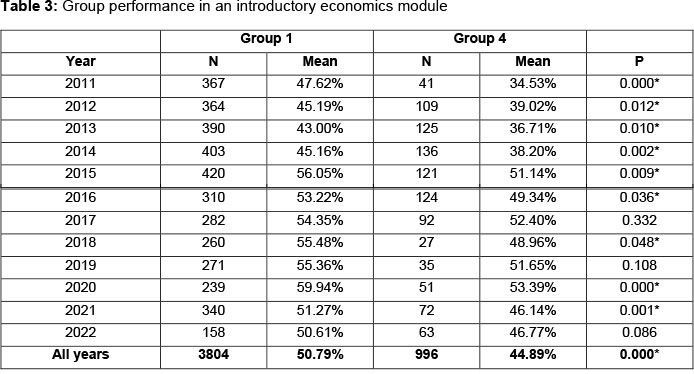
The ECP group's (Group 4) and the mainstream group's (Group 1) performance for the introductory economics module was compared on a year-to-year basis as reflected in Table 3.
The results of the ANOVA performed on the variance between the two groups reflect that most of the years, as well as the population in total over the period of the study, performed statistically significantly differently, p<0.05, with the p-value over the period being 0.000. This suggests that students who enter the introductory module of economics after passing the foundation module might not quite be on par with the mainstream students. It is noted that the performance of the ECP group of students increased in general from a mean of 34.53 per cent in 2011 to a mean of46.77 per cent in 2022, with a few years indicating a mean of above 50 per cent, namely 2015, 2017, 2019, and 2020. It does, however, lead to the consideration of whether a 50 per cent pass in a foundation module could be considered sufficient to place an ECP student on the same academic level as a mainstream student. This concept was further evaluated in Research Question 2a. The results reflect the expected later decrease in benefits as suggested by Xiang and Gruber (2012). It is, however, limited to the economics modules and suggest that the finding by Tewari and Ilesanmi (2020) holds true, namely that while success in granting access to ECPs has been achieved, the rate of success in the programme itself is not as promising.
• Research Question 1b: Do the students in the ECP group (Group 6) perform similarly to the students in the mainstream group (Group 2) in an introductory financial accounting module?
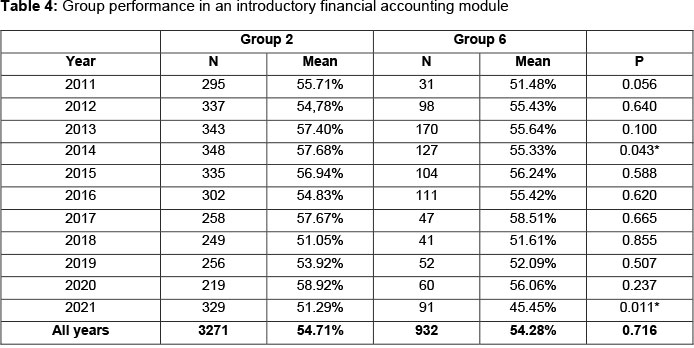
The ECP group's (Group 6) and mainstream group's (Group 2) performance for the introductory financial accounting module under the extended ECP model was compared on a year-to-year basis, as reflected in Table 4.
Evident from the results of the ANOVA above, the students in the ECP group, after completing a foundation module, performed similarly to the mainstream students in an introductory financial accounting course on a year-on-year basis. Only 2014 and 2021 showed significant differences between the two groups. In addition, when considered as a whole, the populations were deemed to not be statistically significantly different. This could indicate that after passing the foundation module, the students are on par with the mainstream group. Furthermore, it is noted that both groups have a mean of above the passing percentage of 50 per cent and it could be considered that after the foundation course, the ECP students per year performed in line with their mainstream counterparts. This finding builds on the findings of Lubbe (2016) and Joynt (2022); thus, reiterating the importance of sound foundations in the course of a constructivist learning approach in a scaffolding curriculum design.
• Research Question 1c: Do the students in the ECP group (Group 7) perform similarly to the students in the mainstream group (Group 2) in an introductory financial accounting module without an ECP foundation module?
The ECP group's (Group 7) and mainstream group's (Group 2) performance for the introductory financial accounting module under the augmented ECP model was compared on a year-to-year basis, as reflected in Table 5.
The results from the ANOVA suggest no statistically significant difference between the performance of the mainstream students and that of the ECP students. It is, however, important to note the low performance in the specific year when compared to the introductory model performance in Table 4. When considering Tables 4 and 5, it is evident that while the ECP students performed in line with the mainstream students under the augmented ECP model, there was a difference between the performance of the students when considered between the extended model students and the mainstream students. This difference was further considered in answering Research Question 3. The results reflect the conclusion to Research Question 1b and further enhance the findings of Jones and Fields (2001), which highlight the importance of supplemental instruction.
• Research Question 2a: Does success in a financial accounting foundation module (ECP students - Group 5) lead to success in a follow-up introductory financial accounting module (Group 6)?
The analysis of subsequent success in the follow-up financial accounting module is reflected in the following regression:

This suggests that a student who achieves 50 per cent in the foundation module would achieve a final grade of 44.4 per cent in the introductory module. This suggests that a 50 per cent pass requirement in a foundation module should perhaps be re-evaluated or the content of the foundation module should be reviewed in order to structure it in a manner that better prepares the students. When the regression is analysed from the perspective of achieving a 50 per cent performance grade in year n, it is calculated that students with a performance of 58 per cent and higher in the foundation module have a better chance of succeeding in the follow-up introductory module.
• Research Question 2b: Does success in an economics foundation module (ECP students -Group 3) lead to success in a follow-up introductory economics module (Group 4)?
The analysis of subsequent success in the follow-up economics module is reflected in the following regression:

The final grade of the student passing the introductory module at 50 per cent would thus suggest an expected performance in the foundation module of 55 per cent or higher. It can thus be evaluated whether the passing of the foundation module at 50 per cent would be deemed sufficient to prepare the student for the introductory course to be on par with the mainstream economics students. The regression, however, has a coefficient of determination of below 0.5; thus suggesting that the performance during the foundation course cannot be considered a reliable predictor of future performance. However, when compared to the results of the groups in Research Question 1b, it is evident that the performance in the foundation economics module does not affect the performance of the ECP students in the introductory modules and they are not able to perform on par with the mainstream group.
The results of Research Questions 2a and 2b confirm the findings by Leshoro and Jacobs (2019), as well as Xiang and Gruber (2012), regarding the risk of a decrease in foundation course benefits in later stages of the curriculum. In addition, the findings suggest the reconsideration of the tension between coverage and depth of understanding (Lubbe 2016). This could suggest that the depth of knowledge should be paid more attention in the curriculum design and module development of foundation modules.
• Research Question 3: Based on the extended model used for ECP during 2010 to 2021 (Group 6) and the augmented model used during 2022 (Group 7), is there a difference in financial accounting performance in terms of the grades of ECP students under different ECP models in comparison to the mainstream group (Group 2)?
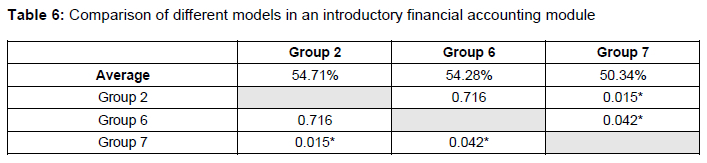
To evaluate the difference between the different ECP models applied, the comparison results of the Games-Howell post hoc test are presented in Table 6.
The results indicate that a statistically significant difference occurred between the performance of Group 7, the group that followed the augmented ECP model, and the performance of the mainstream group, Group 2, resulting in a p-value of 0.015, and the performance of the group that followed the extended model, Group 6, resulting in a p-value of 0.042. The results of the post hoc test indicate that no statistically significant difference occurred between the performance of Groups 2 and 6, as was discussed under Research Question 1b. Building on Research Question 1c, the post hoc test indicated that if the performance of Group 2 is considered as a whole and not only for the 2022 year, a significant difference (p=0.042) is found.
The results reflect the findings by Ogude et al. (2019), which highlighted the importance of foundational knowledge, as well as the findings by Lubbe (2016), which highlighted the benefit of knowledge scaffolding in curriculum design in order to create a constructivist alignment of curriculum design. While the inclusion of the augmented model in ECPs aims to bridge the isolation gap that students in an ECP experience, as identified by Potgieter et al. (2016), it could place their academic progress at risk.
CONCLUSION
The findings of the study suggest the importance of a foundation module to assist students in bridging the education gap for students who are not prepared for higher education. It was, however, noted that while the inclusion of the foundation module in the financial accounting module the threshold grade to prepare the ECP students to the same degree as the mainstream students was lower than for the economics module. The results therefore suggest that the use of a foundation module solely to increase future performance in mainstream education is not universally successful. It could be suggested that a student simply passing a foundation module may not be sufficient; instead, a higher grade may be required to increase the performance in subsequent modules. The study further found that students perform better, in terms of grades, in an extended curriculum model, which includes foundation modules, then in an augmented curriculum model in their subsequent financial accounting module. This indicates the potential that the inclusion of such modules could have on the future success of students enrolled in ECPs and suggests the value of extended models in comparison to augmented modules. Previous research has indicated the importance of foundation modules in curriculum development but have not evaluated the impact of these modules on the success rate, in terms of the number of students passing the module for ECP students. This study notes the importance of both the inclusion and the design model applied in extended curriculum development. The study expanded on previous research identifying singular modules in a curriculum, where this study included all foundation modules in an extended curriculum commerce degree to evaluate the effect of design on a degree and not only on a single module. The study is of interest to both lecturers evaluating content development for specific modules, as well as for HEIs in terms of their curriculum development for extended degrees.
The study is limited in that it relates to a single South African university course. Further studies could consider other courses in the commerce faculty or include ECP courses in other faculties, which are interesting areas for future research. The study also further notes that the nature of the foundation module may have an impact on students' subsequent grades.
Foundational modules such as the introduction to financial accounting which purely focuses on a limited selection of content followed in the mainstream financial accounting module, appear to put students in a position where they adapt better to the mainstream module, however it is acknowledged that a limitation of this study is that a foundation module may be used to teach ECP students additional skills such as problem solving, critical thinking and thinking about alternative perspectives to problems instead of purely covering content covered in later modules. This study having a focus purely on academic success in terms of grades therefore presents areas for future research focusing on the additional skills ECP students learn during foundational modules that may be of benefit in their future studies.
Ethical considerations
Ethical clearance to conduct this study was obtained from the Research Ethics Committee: Social, Behavioural and Education Research.
Competing interests
The authors declare that they have no financial or personal relationship(s) that may have inappropriately influenced them in writing this article.
Funding information
The research received no specific grant from any funding agency in the public, commercial, or not-for-profit sectors.
Data availability
Data are available from the corresponding author on request.
Disclaimer
The views and opinions expressed in this article are those of the authors and do not necessarily reflect the official policy or position of any affiliated agency of the authors.
REFERENCES
LITERATURE REVIEW
- Alexander, G. and D. Hlalele. 2012, "University access, inclusion and social justice." South African Journal of Higher Education 26(3): 487-502.
- Boughey, C. 2007, "Marrying equity and efficiency: The need for third generation academic development." Perspectives in Education 25(3): 1-11.
- Chukwuere, J. E. 2020, "Student voice in an extended curriculum programme in the era of social media: A systematic review of academic literature." International Journal of Higher Education 10(1): 147.
- Council on Higher Education. 2013. A proposal for undergraduate curriculum reform in South Africa: The case for a flexible curriculum structure. CHE, Pretoria.
- De Jager, E. and R. Baard. 2019. "Does 'free' higher education in South Africa make economic sense? Views of commerce students." South African Journal of Higher Education 33(6): 70-91.
- Department of Education. 2004. Foundation programme grants. DoE, Pretoria.
- Department of Higher Education. 2012. Foundation provision in departmentally approvedprogrammes. DHE, Pretoria.
- Downs, C. T. 2005. "Is a year-long access course into university helping previously disadvantaged black students in biology?" South African Journal of Higher Education 19(4): 666-683.
- Grayson, D. 2010. "Engage: An extended degree program at the University of Pretoria in South Africa." Paper presented at the 2010 Annual American Society for Engineering Education Conference & Exposition, Louisville, Kentucky.
- Green, G. P., J. C. Bean, and D. J. Peterson. 2013, "Deep learning in intermediate microeconomics: Using scaffolding assignments to teach theory and promote transfer." The Journal of Economic Education 44(2): 142-157.
- Hesketh, J. H. 2011. "Accounting educators' multiple challenges: Issues-driven learning offers a way forward." South African Journal of Accounting Research 25(1): 1-34.
- Jones, J. P. and K. T. Fields. 2001, "The role of supplemental instruction in the first accounting course." Issues in Accounting Education 16(4): 531-547.
- Joynt, C. 2022, "How to assess the effectiveness of accounting education interventions: Evidence from the assessment of a bridging course before Introductory Accounting." Meditari Accountancy Research 30(7): 237-255.
- Leshoro, T. M. and A. Jacobs. 2019, "Challenges to admissions in the extended curriculum programme in the Faculty of Business and Management Sciences." South African Journal of Higher Education 33(1): 173-183.
- Lisciandro, J. G. and G. Gibbs. 2016. "'On track' to university: Understanding mechanisms of student retention in an Australian pre-university enabling program." Australian Journal of Adult Learning 56(2): 198-224.
- Lubbe, I. 2016. "Challenges for curriculum design: Considerations for a four-year business and accounting degree in South Africa." South African Journal of Accounting Research 31(1): 1-23.
- Matabane, B. R. and M. E. Matabane. 2021, "Black students' experiences of academic support programs during first year at university: Case of extended studies." Research in Social Sciences and Technology 6(3): 93-108.
- McKay, L., S. O'Bryan, and E. R. Kahu. 2021, "'My uni experience wasn't completely ruined': The impacts of COVID-19 on the first-year experience." Student Success 12(3): 1-13.
-
News24. 2019. Extended courses and lecturers who care can help ensure no student gets left behind. https://www.news24.com/life/archive/extended-courses-and-lecturers-who-care-can-help-ensure-no-student-gets-left-behind-20190123. (Accessed 20 May 2023).
» https://www.news24.com/life/archive/extended-courses-and-lecturers-who-care-can-help-ensure-no-student-gets-left-behind-20190123 - Ogude, N. A., P. C. Majozi, K. C. Mathabathe, and N. Mthethwa. 2021, "The management of student success in extended curriculum programmes: A case study of the University of Pretoria's Mamelodi campus, South Africa." South African Journal of Higher Education 35(4): 237-252.
- Ogude, N. A., I. J. Meyer, J. Mwambakana, and N. E. Mthethwa. 2019, "Can extended curriculum programmes be improved through engagement with students using appreciative inquiry?" South African Journal of Higher Education 33(4): 219-236.
- Ontong, J. M., A. Bruwer, and C. Schonken. 2022, "The effectiveness of a first-year module presented as an accelerated learning programme to repeating students for subsequent learning." Perspectives in Education 40(4): 55-69.
- Pange, J., A. Lekka, and E. Toki. 2010, "Different learning theories applied to diverse learning subjects: A pilot study." Procedia - Social and Behavioral Sciences 9: 800-804.
- Potgieter, M., A. Harding, Q. Kritzinger, C. Somo, and J. Engelbrecht. 2016. "Reflections of science students on their experience of an academic development programme in South Africa." South African Journal of Higher Education 29(1): 108-131.
- Rollnick, M. 2010. Identifying potential for equitable access to tertiary level science: Digging for gold. Springer Science & Business Media, Heidelberg.
- Scott, I. 2018. "Designing the South African higher education system for student success." Journal of Student Affairs in Africa 6(1): 1-17.
- Tewari, D. D. and K. D. Ilesanmi. 2020, "Teaching and learning interaction in South Africa's higher education: Some weak links." Cogent Social Sciences 6(1): 1-16.
- Xiang, M. and R. Gruber. 2012, "Student performance in their first postsecondary accounting course: Does high school accounting matter?" In Advances in Accounting Education: Teaching and Curriculum Innovations, edited by D. Feldmann and T. J. Rupert, Volume 13: 297-311.