Self-directed learning approach as a social justice transformative pedagogy for work-integrated learning in higher education
Abstract
In this study, social justice was used as a lens to understand the role of self-directed learning (SDL) in influencing constructive engagement and challenging policymaking positions. The current education trajectory highlights a lack of clarity on how social justice contributes to social transformation in the education system. This study explored the role of SDL in shaping a social justice transformative agenda in higher education while maintaining autonomy. The researcher suggests that this approach holds considerable potential for SDL to assist student teachers in cultivating impactful educational settings within the school and higher education environments, which may support work-integrated learning. This article reports the qualitative findings from an educational policy study involving policy document analysis to analyse textual data, with a focus on interpretation for understanding and scrutiny. The findings indicate that through the implementation of self-directed social justice transformative strategies, students develop valuable skills that help them to work independently without the assistance of lecturers. In addition, such exposure allows students to connect with workplace settings and apply theory to practice, thereby broadening their opportunities for employability and networking.
Education White Paper 3; higher education institutions; pedagogy; self-directed learning; strategy; social justice; transformative leadership; work-integrated learning
INTRODUCTION
Globally, employers have significant expectations of higher educational institutions (HEIs): to equip graduates with a robust knowledge foundation and a strong focus on the application of that knowledge in practical work settings. This concern arises from the realisation that post-graduation employment is not guaranteed. At the institutional level, one strategy that holds promise for enhancing students' preparedness for the workforce and their ability to translate theoretical concepts into real-world scenarios is work-integrated learning (WIL) (Freudenberg, Brett and Brimble, 2010). However, the researcher emphasises the importance of combining WIL with self-directed learning (SDL) as an instructional approach. This combination serves as a crucible for students to develop essential skills such as self-directedness, autonomy and independent learning. The acquisition of these competencies empowers graduates to become proactive in making substantial contributions to economic advancement.
Voskamp, Annemieke and Kuiper (2020, p. 3) highlight a critical issue, namely, that "teachers frequently assume a significant role in the learning process, impeding students' development of self-guided learning skills". The need for comprehensive investigations into SDL within 21st-century African education institutions cannot be overstated. The contemporary landscape requires individuals to possess SDL abilities, as these are deemed indispensable in higher education (Bellanca, James and Paul, 2014). This need is particularly relevant in South African educational settings, which strive to foster culturally responsive learning environments.
The objective of this paper is to illustrate how a pedagogical framework that integrates self-directed social justice principles can synergistically enhance WIL in the realm of higher education. This approach heightened transformation, access, equity and inclusion in the quest to enhance the role and impact WIL have on the teaching and learning (Howard et al., 2024). In an attempt to improve access, equity and curriculum transformation, the MRTEQ (DHET, RSA, 2015: s. 2.4) proposed that all BEd programme in South Africa must address structural barriers created by the legacy of apartheid in the education system. This policy demands that all students irrespective of their gender, race, class and religion orientation embraces SDL skills in their learning traits before being exposed to WIL. The adoption of these transformative curriculum principles places social justice at the centre of BEd curriculum framework. In the context of teaching and learning, it is important to consider the changing demographics of South African classrooms. HEIs have a significant responsibility to prepare student teachers to successfully navigate these diverse environments.
In considering social dividers such as language, sexual orientation, gender and race, among others, Cochran-Smith and Zeichner (2005, p. 57) noted that one of the biggest challenges facing teacher education today is
"... preparing student teachers with the knowledge, skills, and dispositions to work successfully with an increasingly diverse pupil population, particularly those whose cultural, racial, language, and ethnic backgrounds are different from the teachers' backgrounds."
The authors assert that both university lecture halls and school classrooms grapple with similar challenges in fostering the development of future leaders who can improve inclusive learning environments.
SELF-DIRECTED LEARNING IN CONTEXT
As a student, gaining confidence in your learning abilities is crucial. It allows you to excel in your studies and find true worth in the knowledge you acquire. Taking responsibility for your educational growth is equally important (Boyer and Usinger, 2015). Framed within the context of a 21st-century skillset, SDL remains a cornerstone, fostering and elevating inquiry skills that empower students to consistently take ownership of their learning endeavours throughout their entire lifetimes (Gresham, 2018). This underscores the essential notion that students should be allowed to uncover new insights autonomously and be exposed to instructional methods that support SDL, thereby facilitating learner-centred participation in the educational process (Du Toit-Brits, 2020).
The infusion of transformative pedagogy within the curriculum as argued by Smith (1999) and Nxumalo and Mncube (2019) call for a strong leadership whose mandate is to implement deconstruction and reconstruction, self-determination and social justice, ethics, language, internationalisation of Indigenous experiences, history and critique. These critical elements underscore the need for curriculum training to promote indigenous knowledge systems aligned with the Ubuntu philosophy that can enhance problem-solving skills, excellence, and compassion among teacher trainees when engaged in WIL (Akinola and Uzodike, 2018). Students that exhibit Ubuntu qualities in their learning are likely demonstrate competence during WIL experiences in their quest to promote local values, culture and excellence (Mbigi, 1997; Nxumalo and Mncube, 2019)
SDL can be succinctly defined as a multifaceted process in which the learner takes a proactive role by establishing individualised learning objectives, discerning relevant learning resources, selecting appropriate methodologies and subsequently engaging in a critical evaluation of the learning journey through reflective introspection (Cazan and Schiopca, 2014; Knowles, 1975). In the view of Guglielmino (1977, pp. 57-69), students who adopt an SDL approach are "open to learning opportunities" and maintain a positive "self-concept like an effective learner". Most of these students believe in taking initiative, acting responsibly and functioning independently. In their quest for knowledge, they tend to discover a "love of learning", show "creativity" in their learning and are "future-oriented" with the "ability to use basic study skills and problem-solving skills". Guglielmino concludes that any student who exhibits the above SDL features is likely to adopt self-directedness in their learning. As stated above, renowned SDL scholars have adopted the common definition proposed by Knowles (1975, p. 18):
"[Self-directed learning is] a process in which individuals take the initiative, with or without the help of others, in diagnosing their learning needs, formulating learning goals, identifying human and material resources for learning, choosing and implementing appropriate learning strategies, and evaluating learning outcomes."
OBJECTIVES OF THE STUDYThis study sought to promote the pillars underpinning SDL as a social justice transformative pedagogy for WIL in HEIs. Specifically, it seeks to answer the following sub-research questions:
How does policy support SDL as a social justice transformative pedagogy for WIL in HEIs?
How can social interaction afford WIL students the opportunity of value change to teach and lead for social justice in schools?
What transformative intervention strategies can be formulated to enhance SDL?
Transformative learning theory as a pedagogy
Transformative learning fundamentally involves bringing about change. Learning and pedagogy are well-established concepts in the literature, and many research articles agree that the purpose of learning is to alter learners' conceptions of reality (Dewey, 1933; Mezirow, 2000). As Dewey (1933) avers, any learning that foregrounds a transformative approach to learning tends to promote new perspectives on the world - when new meaning is realised, it must be valued. Mezirow (2000, p. 214) defines transformative learning as a process whereby "we transform our taken-for-granted frames of reference to make them more inclusive, discriminating, open [changeable], and reflective so that they may generate beliefs and opinions that will prove truer or justified to guide action".
The theory of transformative learning underscores the importance of reflection in educational settings, prompting students to find alternative ways of integrating newly acquired knowledge that can lead to change in their experiences. As a result, to promote transformative learning and effect change in students' conceptions, educators must teach students to embrace change from thought to action and provide them with opportunities to apply new knowledge (Taylor, 1998). Promoting transformative learning among teachers is crucial, especially since many teachers underestimate their ability to engage in successful cross-cultural and culturally responsive teaching due to a lack of cultural awareness or being confined to a single cultural perspective.
The significance of transformative learning
The true significance of transformative learning lies in its ability to enable learners to perceive the world, a facet of their reality or even a solitary idea from a new vantage point as a result of a deliberately crafted transformative learning encounter. This shift in perspective can subsequently influence the way they experience events in the future. In the context of adult education, this change in perspective is examined and elucidated, highlighting the potential of transformative learning to reshape our understanding of adult learning and the approach to teaching adults, as described by Knowles (1998) in his concept of andragogy.
Transformative learning experiences inherently challenge the existing norms and conventions, whether on a broad or a more specific scale. These experiences empower learners whose perspectives have transformed to become catalysts for change, either as active agents driving change or as advocates. Many students entering the classroom, particularly freshmen and sophomores in undergraduate education, do not initially exhibit transformative learning tendencies. The primary objective of HEIs is to equip these students with meta-literacy skills and the ability to become independent learners, given that many students arrive at these institutions heavily reliant on guidance. For organisations seeking substantial changes or rapid shifts from one business model to another, as well as for HEIs striving to redefine themselves in response to threats to their survival, the effective application of transformative learning could serve as a crucial linchpin for success.
The essence of Work Integrated Learning (WIL)
In the economic and business realm, there is a significant demand for graduates from HEIs to possess a strong knowledge foundation. This demand arises from the concern that these graduates often lack the skills necessary to effectively apply their knowledge in professional settings. However, a promising approach to bridging this gap and facilitating the seamless translation of theoretical knowledge into practical application is WIL (Freudenberg et al., 2010). Accordingly, classroom-based instruction alone is insufficient to produce graduates who are capable of managing the challenges of the future. The primary purpose of infusing WIL into the curriculum is to promote an action-oriented approach to learning, emphasising practical, performance-based learning.
WIL is a specific type of experiential education embedded in the curriculum, where a student's academic studies are intentionally combined with valuable experiences gained in a professional workplace or practical setting. WIL engagements involve a dynamic collaboration among at least three parties: an academic institution, a host organisation, and a student. This form of learning can take place within individual courses or across entire programmes. It includes the formulation of learning objectives and outcomes aimed at enhancing students' employability, agency, and transferable knowledge and skills, while also fostering a lifelong learning attitude. Jackson (2015) alludes to WIL as "the practice of combining traditional academic study, or formal learning, with student exposure to the world-of-work in their chosen profession [and] has a core aim of better-preparing undergraduates for entry into the workforce". The South African Higher Education Quality Council (HEQC, 2004, p. 24) defines WIL as follows:
"The component of a learning program that focuses on the application of learning in an authentic learning workplace context under the supervision and/or mentorship of a person/s representing the workplace. It addresses specific competencies identified for the acquisition of a qualification that makes the learner employable and assists in the development of related personal attributes. Workplace employees and professional bodies are involved in the assessment of the learning experience, together with university academic employees."
The role of WIL in higher education
Higher education has dedicated attention to enhancing students' vocational competencies to increase their prospects of securing employment when they graduate (Peach and Matthews, 2011). Funding models influenced by government policies require universities, especially those that are publicly funded, to ensure that their graduates possess a diverse set of skills aligned with prevailing societal demands (Yorke, 2006). In response to these concerns, many HEIs, including universities, have taken steps such as introducing more programmes concentrated on specific professions and integrated genuine professional practice experiences like WIL (Billett, 2011). Accordingly, it would appear that HEIs are increasingly trying to bridge the gap between job market demands and students' coursework knowledge, as well as their ability to perform in an academic setting (Orrell, 2004).
Employability as a focus of work integrated learning as a higher education initiative
Higher education has increasingly focused on developing critical skill sets to align graduates with the job market (Peach and Matthews, 2011) to improve their chances of employability. HEIs carry a constitutional mandate to skill and reskill graduates, ensuring that they are equipped with the requisite skills to meet current societal demands (Yorke, 2006). Reinforcing this argument, employability is defined as "a set of achievements, skills, understandings, and personal attributes; that makes graduates more likely to gain employment and be successful in their chosen occupations, which benefits themselves, the workforce, the community, and the economy" (Yorke, 2006, p. 6). Tomlinson and Jackson (2021) expand on this definition, noting that employability encompasses the specific attributes aligned with the needs of the job market, which increases graduates' likelihood of securing employment in their chosen occupation or workplace.
It is unfortunate that African society continue to bear the brunt of poor-quality education engineered to promote Western worldviews over African epistemologies (Iwuanyianwu, 2022). In this regard, graduates from sub-Saharan institutions struggled to adopt SDL approaches due to their heavy reliance on the Eurocentric approach and it is even more complex to implement WIL that address curriculum needs (Mawere, 2015). In the words of Busia (1964), such education continues to reproduce men and women with limited problem-solving skills to champion innovations and who can also represent think tanks in society (Mawere, 2014; Nxumalo and Mncube, 2019). The lesson one can draw from this assertion is that universities have a responsibility to produce graduates who are fit for purpose through their transformed curriculum. However, such students must be allowed to explore and utilise their prior knowledge to promote their confidence. In Nigeria's Jigawa State, evidence exists of young students who invented a unique refrigeration system that operates for the entire month without gas, paraffin or electricity (Mawere, 2014).
Curricula must focus not only on developing the knowledge required for employment but also on the holistic development of students as human beings. However, transformative curricula go beyond the notion of knowledge provision by demanding students to be critical thinkers and problem solvers. Jackson (2011) supports this assertion, arguing that university education must adapt to societal changes by paying closer attention to equipping students with relevant skills. In this regard, the university curriculum must promote soft skills, also known as "people skills" or "interpersonal skills" which can be nurtured during WIL. Conversely, Barnett (2007) advocates for fostering learners' will and spirit to be and become. As the concept of "lifelong" learning has become ingrained in our understanding, Jackson (2011) also introduces the term "life-wide" learning. This concept is intended to support the transition towards more complex learning experiences that take place across diverse environments and scenarios.
Considering the insights presented earlier, WIL placements, given their workplace context and objectives, emerge as an educational strategy that not only encourages lifelong learning but also has the potential to enhance students' self-awareness and identity. Their exposure to real-life work environments tends to increase their confidence and self-belief that no one ever imagined (Lawrence and Maphalala, 2021). The opportunity to stand in front of learners for an extended period, not only increases their self-concept but builds resilience and adaptation as they confront real life challenges and overcome them.
The link between self-directed learning, work-integrated learning and transformative learning within a social justice learning environment
Internationally, literature on academic success and student attrition that applies Tinto's model of student retention (Tinto, 1975, 1998) plays a very important role. Tinto's model focuses on the nature of the academic programmes offered by higher education to achieve quality outcomes, while also trying to establish the difference between academic and social interaction. Tinto's theory focuses on clarifying the relationship between academic performance and students' intellectual development during their early years of study at HEIs. Successful integration of students into academic life is regarded as an academic achievement encompassing both formal academic integration (smooth adaptation to academic life) and informal academic integration (involvement within the broader faculty). In contrast, social integration emphasises the importance of extracurricular activities (formal social integration) and contact with peers (informal social integration). Severiens and Wolff (2009) summarise these two concepts - academic and social integration - as the most critical for helping the researcher to understand how diversity manifests in higher education. With these forms of integration supporting this study, the question can then be asked as to how the concepts of SDL, WIL and transformative learning are interrelated.
The impact of infusing social justice through SDL carries more generative power for many diverse African Higher Education Institutions working towards accelerating the empowerment of marginalised groups (Morris et al. 2024). In essence, the amount of pressure directed at universities to transform their curricula demands the adoption of practical social justice principles. Therefore, SDL, WIL and transformative learning share a common educational objective centred around change, transformation, personal enhancement, growth and development (Dirkx, 1997; Freire, 1984; Mezirow, 1997). The core value of SDL, functioning as a socially transformative pedagogy is to emphasise the importance of student input and their (work) experiences as fundamental aspects of the learning journey (Osman and Peterson, 2010). This underscores the opinion of many researchers who strongly believe universities as social justice agents can promote access, equity and transformation for people across society (Lawrence and Maphalala, 2021).
Furthermore, the authenticity of students' contributions to the construction of knowledge is a significant component of this approach (Petersen and Petker, 2017). SDL is recognised as a personal characteristic influenced by an individual's inclination to adopt a particular learning style and their ease with having autonomy in the learning process (Merriam and Bierema, 2014). In this framework, students take responsibility for their learning and achievements, while overseeing and regulating the entire learning process. In the context of WIL, students immerse themselves in a professional setting where they are required to demonstrate their knowledge and skills while learning to promote social justice. They also bear the responsibility of exemplifying professionalism by applying theoretical concepts to practical scenarios. As a pedagogical approach, SDL enables students to recognise how their experience contributes to their learning, extending beyond the university and the curriculum.
The study conducted by Laurence and Maphalala (2021) argued that there are a number of opportunities for South African universities to implement transformative curricula and pedagogical practices that enhance SDL skills. This confidence stems from the promise contained in the policy frameworks, the National Qualification Framework Act (67/2008) - Revised Policy on the Minimum Requirements for Teacher Education Qualifications (MRTEQ). All South African universities have a responsibility to promote soft skills such as SDL to ensure that students undergo WIL as part of their training and development (Groenewald and Mpisi, 2022). The study conducted at Sol Plaatjies University (SPU) explores how student teachers perceived and experienced social justice in three modules offered in the SPU BEd programme. The outcome reveals that despite unchallenged bias and stereotypical perceptions, students use SDL to challenge the status quo during WIL (Groenewald and Mpisi, 2022).
RESEARCH DESIGN AND METHODOLOGYResearch Approach
The study on which this paper is based employed a qualitative methodology to generate novel perspectives, utilising specific information sources (Jaakkola, 2020). In conceptual papers, arguments are not grounded in conventional data collection but rather involve amalgamating and adapting pre-existing concepts and theories (Hirschheim, 2008). Consequently, conceptual papers integrate empirical insights since they are built upon theories and concepts that have been originated and scrutinised through empirical research (Jaakkola, 2020).
Research design
In the field of policy studies, researchers often use a conceptual research design (CRD) to examine policy content and identify potential solutions to particular challenges (Farrell and Coburn, 2016). In the context of this study, CRD proved invaluable for investigating the way provisions within education policies can empower HEIs to equip future educators to implement transformative pedagogy focused on social justice. Additionally, conceptual research serves to bridge existing theories, transcend disciplinary boundaries, offer insights at various levels and broaden our cognitive horizons (Gilson and Goldberg, 2015, p. 128).
Data collection and analysis
Data collection in this research was guided by consulting South African education policy and the provisions of the Constitution which are instrumental in shaping higher education prescripts. The main document under review was The Education White Paper 3 (EWP3): A Program for the Transformation of Higher Education, published by the Department of Education (DoE) [DoE, RSA, 1997, p. 3]. An examination of this policy document was deemed necessary to explore the way in which it addresses student learning in higher education. As Coffey and Atkinsen (1994) note, there is no one correct way to analyse qualitative data. Therefore, researchers should consider various strategies for using data (Snyder, 2019). According to Lochmiller and Lester (2017), qualitative data analysis is often linked to a particular methodology, theoretical perspective, research tradition or field. Accordingly, the researcher focused on specific provisions of the policy (DoE, RSA, 1997) that had the closest connection to SDL, analysing them using thematic analysis (Lester, Jessica, Yoon Cho, Chad and Lochmiller, 2020).
The researcher applied several systematic stages during the data analysis process. Firstly, they organised and structured the data extracted from the policy stipulations, preparing it for thematic analysis. This initial step facilitated their immersion in the data and the accurate recording of initial reactions, while also enabling the identification of any limitations or gaps in the data, thus earmarking areas meriting further exploration. Secondly, the researcher delved into the data, crafting reflective memos to generate interpretations and insights.
Thirdly, they assigned codes to segments of the data, highlighting noteworthy statements, experiences and reflections related to SDL. The fourth stage involved the allocation of supplementary codes, a move that elevated coding to a more abstract level of inference. This facilitated the researcher's contemplation of concepts linked to the focal point of their study.
Subsequently, the fifth step involved creating categories and establishing relationships and disparities among the codes. This process facilitated the recognition of parallels, divergences and connections across categories, ultimately leading to the extraction of overarching themes for comprehensive analysis. The process culminated in interpreting the policy stipulations, drawing meaningful connections and deriving the research findings. Three themes were identified: responsive curriculum, autonomy, and social responsibility.
The purpose of the policy is to drive transformation and rectify historical disparities. It aimed to cater for a fresh societal framework, address national imperatives and adapt to evolving circumstances and prospects. The overarching objective of these policies is to facilitate the development of teachers - particularly in-service educators and student teachers (pre-service teachers) - into self-sufficient and self-aware professionals who can proficiently exhibit SDL abilities. As per Brown et al.'s (2018) research, policy is a complex process where issues of resources, values and interests interact through organisations and are facilitated by the government. However, policy discourse is subject to myriad interpretations as it seeks to achieve diverse interests (Peters, 2015). De Klerk (2014) argues that any discussion on policy requires some form of analysis, while Olssen, Mark and John et al. (2004) suggest that analysing education policy goes beyond understanding it as the mere declarations of policymakers, thus requiring a deeper interpretation.
FINDINGS AND DISCUSSION
The study aimed to extend the debates on SDL as a social justice transformative pedagogy in higher education, taking into consideration how the interpretation of policy texts can raise critical awareness of education (Freire, 1970; O'Connor, 2005). In reporting the findings, an interpretivist perspective was employed, which underpins an understanding of worldviews and appreciates the social context of own experiences (O'Connor, 2005, pp. 4-5).
Developing a responsive curriculum
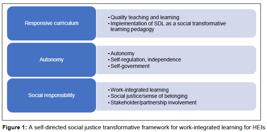
The first stipulations of the Education White Paper 3: A Programme for the Transformation of Higher Education, are "to improve the quality of teaching and learning throughout the system and, in particular, to ensure that curricula are responsive to the national and regional context" (DoE, RSA, 1997, p. 10, Section 1.27:5). Annotation made in Figure 1 aligns well with the responsive curriculum which seeks to strive to promote quality teaching and learning, implementation of SDL as a social transformative learning pedagogy.
The new curriculum framework advocates for a curriculum that responds directly to the changing needs of students while striving to minimise the gap between theoretical knowledge and practical, experiential knowledge applicable to the world of work. In other words, a responsive curriculum is sensitive to the changing realities that are taken for granted and the work-based environment.
In response to the urgent need for curriculum reform, many universities are struggling to find practical curriculum orientations that can directly address the changing needs of industry. Curriculum developers face ongoing challenges in adapting to curriculum systems that benefit a broader segment of society, while also catering to political interests that do not address professional processes and demands. The rapid pace of technological innovation in education and its implications for skill development and economic growth continue to put more pressure on the already stressed resources of the state to deliver quality education for all.
Nieuwenhuis, Loek and Henny et al. (2021) state that the mutability of professions increases the need for changing outcomes, and therefore this field requires a significant degree of flexibility and ongoing monitoring of developments. As such, most curriculum developers and experts are overwhelmed in attempting to adapt to the complexity of curriculum demands, highlighting the urgent need for curriculum responsiveness. The call for urgent curriculum responsiveness in shaping Ubuntu philosophy is gaining traction across all facets of life in South Africa, informed by the need to recognise the views held by Indigenous people from various backgrounds within the African context (Pitsoe and Letseka, 2016).
The process of designing such a curriculum system should first prioritise the knowledge acquisition, skills and values that underpin the desired learning outcomes. Consequently, quality education requires well-educated and trained teachers. One imperative of the Department of Basic Education (DBE), the National Strategy for Learner Attainment (NSLA) (DBE, 2015), aligns with Education White Paper 3 and aims to improve the quality of education by promoting lifelong learning among teachers. This approach encourages educators to continuously upgrade and enhance their competencies, knowledge and skills to better prepare learners for success. Du Plessis and Mestry (2019) assert that a quality teaching and learning system can be achieved if it is supported by a core of good teachers.
To ensure quality teaching and learning, pre-service teachers should reassess their teaching strategies. To become self-directed learners in their teaching practices, they have a responsibility to develop various skills and personal attributes (Van Wyk, 2017). The researcher recommends that HEIs offer student-centric programmes that prioritise the application of learnt information, as well as high levels of competency and reflection, as part of academic training aligned with modern economic demands and aspirations.
Institutional autonomy, self-regulation and self-government
Institutional autonomy means having a high level of self-regulation and administrative independence. Nica (2015) and Kori (2016, p. 47) assert that universities are typically centres of political and intellectual dissent, which leads governments to be hesitant in granting them the freedom and independence that could lead to instability.
When considering the concept of SDL, the importance of autonomy (see Figure 1) for pre-service teachers cannot be overstated. Essentially, this means that they must possess the capacity for self-rule, self-determination and self-ownership in their decision-making process. Additionally, autonomy requires the ability to self-govern, which entails acting independently, responsibly and with conviction. It is important to note that this applies not only from an institutional perspective but also at an individual level. The South African higher education policy states that:
"The principle of institutional autonomy refers to a high degree of self-regulation and administrative independence concerning student admissions, curriculum, methods of teaching and assessment, research, the establishment of academic regulations, and the internal management of resources generated from private and public sources. Such autonomy is a condition of effective self-government" (RSA, 1997, p. 8).
The terms "autonomy", "self-regulation", "independence" and "effective self-government" indicate that pre-service teachers possess the ability to act on their own with responsibility and conviction. According to Govender and Wait (2018) and Motloba (2018), SDL is a crucial aspect of autonomy (see Figure 1) that involves the freedom to interpret information. However, external factors may influence their liberty and freedom, which may have an impact on their decision-making processes. The idea is that with proper institutional support for independent teaching practices, pre-service teachers can enhance their teaching skills and improve their students' learning experiences. Therefore, autonomous pre-service teachers can participate in decision-making, change teaching practices, reflect on their teaching and handle the demands of the education system (Nxumalo and Mncube, 2019). Pre-service teachers must receive proper institutional support for their independent teaching practices, thus enhancing their teaching skills and improving their students' learning experiences.
Self-directed learners possess the ability to make independent decisions, allowing them to be open-minded in their choices. Additionally, self-regulation and self-government are essential skills for self-determination, enabling learners to interpret information and make informed decisions. When teachers exhibit self-reliance, they can develop strong and resilient students who can study independently from their teachers, as well as develop their autonomy to rebuild their professional values (Nica, 2015) and practise comprehensive self-care (Foucault, 1997). De Klerk and Barnett (2020) argue that 21st-century teachers should be innovative in their quest for knowledge development, as these kinds of teachers are likely to explore their full potential and later appreciate their profession. These attributes enhance student teachers' abilities to manage themselves skilfully and effectively when exposed to WIL environments.
SOCIAL RESPONSIBILITYThe phrase "social responsibility" refers to a personal investment in the well-being of others. This concept plays a crucial role in helping individuals work to uplift society, reflecting their contribution to the lives of others. Pancer and Pratt (1999, p. 38) define social responsibility (see Figure 1) as a sense of connection to those outside your "circle of family and friends [and] ... an obligation to help those in the community, nation, or society at large who are in need". Social responsibility extends beyond mere involvement to encompass community engagement and service learning (WIL), fostering a commitment to social justice in action.
Service-learning programmes, including WIL, have a responsibility to expose students to the world of work through internships that provide meaningful and reciprocal service while consolidating their classroom learning experiences. HEIs are mandated to integrate WIL into curricula and qualifications to promote student career development. This offers both academics and students a valuable opportunity not only to integrate theory and practice but also to familiarise future graduates with the world of work and assess their experiential learning. As previously mentioned, classroom-based instruction alone does not prepare graduates for the demands of the future (Govender and Wait, 2018).
The emphasis placed on WIL as an approach remains on integrating practical components into student performance and providing students an in-situ experiences related to their chosen career. The goal of infusing WIL is to help students articulate theoretical knowledge and give it practical meaning, enabling them to gain the workplace knowledge, skills and experience needed in business (industry). Exposure to these learning environments offers numerous benefits related to academic, personal, career and work ethic dimensions. In addition, WIL fosters strong partnerships with businesses, industry and government, contributing to improved economic growth for the country (Matoti, Junqueira and Odora, 2011).
CONCLUSION
The purpose of this paper was to analyse the stipulations in the Education White Paper 3: A Program for the Transformation of Higher Education, aimed at empowering student teachers to enhance their teaching skills and improve their students' learning experiences with effective institutional support for independent teaching practices. The analysis in this chapter indicates that Higher Education should promote a responsive curriculum that is both suitable and flexible for the 21st century. Such a curriculum should respond to the demands of society and keep track of the current trends and developments that affect South African citizens.
SDL is an effective teaching strategy that aligns well with a responsive curriculum. As self-directed learners, students are taking ownership of their learning and in the process establishing a cross-disciplinary perspective in the curriculum that fosters a collaborative approach to academic achievement.
This study highlighted the implications of SDL as a social justice transformative pedagogy, as outlined in White Paper 3, particularly in schools. Significantly, establishing WIL environments in schools necessitates continuous monitoring and support for in-service student teachers, which has significant policy implications for HEIs. These institutions and the academics who work in them must subscribe to high levels of academic integrity by promoting national and international values that integrate theory and practice into the revised curriculum programmes. This approach fosters growth, promotes employability and encourages partnerships that create fresh perspectives in knowledge building.
Student teachers are being prepared to teach effectively in multicultural classrooms. To achieve this goal, HEI programmes should be designed to capacitate them to work with diverse learners' cultures in the learning content, allowing learners to engage freely with social justice issues. An important avenue for further research could be an empirical study investigating the experiences of student teachers regarding their readiness to implement an SDL social justice transformative pedagogy within WIL contexts.
REFERENCES
- Akinola, Adeoye O., and U. F. Uzodike. 2018. "Ubuntu and the Quest for Conflict Resolution in Africa." Journal of Black Studies 49: 91-113.
- Barnett, Ronald. 2007. A Will to Learn: Being a Student in the Age of Uncertainty. Maidenhead: Open University Press/McGraw-Hill Education.
- Bellanca, James A., Andrea Paul, and Mark Paul. 2014. Becoming Self-Directed Learners: Student and Faculty Memoirs of an Experimenting High School 40 Years Later. Chicago: Windy City Publishers.
- Billett, Stephen. 2011. Curriculum and Pedagogical Bases for Effectively Integrating Practice-Based Experiences. Sydney: Australian Learning and Teaching Council.
- Boyer, Neal R., and Paul Usinger. 2015. "Tracking Pathways to Success: Triangulating Learning Success Factors." International Journal of Self-Directed Learning 12 (2): 22-48.
- Browne, Jessica, Belinda Coffey, Katrina Cook, Sarah Meiklejohn, and Claire Palermo. 2018. "A Guide to Policy Analysis as a Research Method." Health Promotion International 34 (5): 1-13.
- Busia, Abrefa. 1964. Purposeful Education for Africa, London: Mouton.
-
Cazan, Ana-Maria, and Bianca Schiopca. 2014. "Self-Directed Learning, Personality Traits, and Academic Achievement." Procedia: Social and Behavioral Sciences 127: 640-44. https://doi.org/10.1016/j.sbspro.2014.03.327.
» https://doi.org/10.1016/j.sbspro.2014.03.327 - Coffey, Amanda, and Paul Atkinson. 1996. Making Sense of Qualitative Data: Complementary Research Strategies. London: SAGE.
- Cochran-Smith, Marilyn, and Kenneth Zeichner. 2005. Studying Teacher Education: The Report of the AERA Panel on Research and Teacher Education. Mahwah, NJ: Lawrence Erlbaum.
- De Klerk, Elize D. 2014. "Teacher Autonomy and Professionalism: A Policy Archaeology Perspective." PhD diss., Stellenbosch University.
-
De Klerk, Elize D., and Elizabeth P. Barnett. 2020. "Continuing the Debate on Teacher Autonomy: A Capabilities Perspective." Journal of Education 81: 99-117. http://dx.doi.org/10.17159/2520-9868.i81a06.
» http://dx.doi.org/10.17159/2520-9868.i81a06 -
Department of Basic Education (DBE). 2015. National Strategy for Learner Attainment (NSLA 2015). Pretoria: DBE. https://www.purpletod.co.za/docs/NSLA%202015.pdf.
» https://www.purpletod.co.za/docs/NSLA%202015.pdf - Department of Education (DoE), Republic of South Africa. 2007. "National Education Policy Act (27/1996): National Policy Framework for Teacher Education and Development in South Africa." Government Gazette 502 (29832): 1-40.
- Department of Higher Education and Training, Republic of South Africa. 2015. "National Qualifications Framework Act (67/2008): Revised Policy on Minimum Requirements for Teacher Education Qualifications." Government Gazette 596 (38487).
- Dewey, John. 1933. Experience and Education. New York: Macmillan.
- Dirkx, John M. 1997. "Nurturing Soul in Adult Learning." In Transformative Learning in Action, edited by Patricia Cranton. San Francisco: Jossey-Bass.
- Du Plessis, Pierre, and Raj Mestry. 2019. "Teachers for Rural Schools: A Challenge for South Africa." South African Journal of Education 39 (1): 81-89.
-
Du Toit-Brits, Chantel. 2020. "Unleashing the Power of Self-Directed Learning." Africa Education Review 17 (2): 20-32. https://doi.org/10.1080/18146627.2018.1494507.
» https://doi.org/10.1080/18146627.2018.1494507 -
Farrell, Catherine, and Cynthia Coburn. 2016. "What Is the Conceptual Use of Research, and Why Is It Important?" Accessed November 7, 2025. https://wtgrantfoundation.org/conceptual-use-research-important.
» https://wtgrantfoundation.org/conceptual-use-research-important - Freire, Paulo. 1970. Pedagogy of the Oppressed. London: Penguin.
- Freire, Paulo. 1984. Education in Progress Path. Translated by Ahmad Birshak. Tehran: Kharazmi Publications.
- Foucault, Michel. 1997. "The Ethics of the Concern for Self as a Practice of Freedom." In Ethics: Subjectivity and Truth, edited by Paul Rabinow, 281-301. New York: New Press.
- Freudenberg, Brett, Mark Brimble, and Veronica Vyvyan. 2010. "The Penny Drops." E-Journal of Business Education & Scholarship of Teaching 4 (1): 42-61.
- Gilson, Lucy L., and Caren B. Goldberg. 2015. "Editor's Comment: So, What Is a Conceptual Paper?" Group & Organization Management 40 (2): 127-30.
- Gresham, John D. 2018. "Creative Inquiry: Self-Directed Learning for High School Students." Paper presented at ISSDL Symposium, Cocoa Beach, FL.
-
Groenewald, Elmarie, and Andile Mpisi. 2022. "Student Teachers' Perceptions." South African Journal of Education 42 (3). https://doi.org/10.15700/saje.v42n3a2104.
» https://doi.org/10.15700/saje.v42n3a2104 -
Govender, Chika M., and Michelle Wait. 2018. "Work-Integrated Learning Benefits." South African Journal of Higher Education 31 (5): 49-64. http://doi.org/10.20853/31-5-609.
» http://doi.org/10.20853/31-5-609 - Guglielmino, Lucy M. 1977. "Development of the Self-Directed Learning Readiness Scale." Dissertation Abstracts International 38 (11-A): 6467.
- bro. Criteria for Institutional Audits. Pretoria: Council on Higher Education.
- Hirschheim, Rudy. 2008. "Guidelines for Reviewing Conceptual Papers." Journal of the Association for Information Systems 9 (8): 432-41.
-
Howard, Morris Thomas, Ulrik Brandi, Steven Hodge, Tania Hoggan-Kloubert, and Marcella Milana. 2024. "Social Justice through Lifelong Education." International Journal of Lifelong Education 43 (6): 573-78. https://doi.org/10.1080/02601370.2024.2418661.
» https://doi.org/10.1080/02601370.2024.2418661 - Jaakkola, Elina. 2020. "Designing Conceptual Theories." AMS Review 10: 18-26.
- Jackson, Robert. 2011. "The Interpretive Approach as a Research Tool." British Journal of Religious Education 33 (2): 189-208.
-
Jackson, Denise. 2015. "Employability Skill Development." Studies in Higher Education 40 (2): 350-67. https://doi.org/10.1080/03075079.2013.842221.
» https://doi.org/10.1080/03075079.2013.842221 - Knowles, Malcolm S. 1975. Self-Directed Learning: A Guide for Learners and Teachers. New York: Prentice Hall.
- Knowles, Malcolm S. 1998. The Adult Learner. Houston: Gulf Publishing.
- Kori, Eric. 2016. "Challenges to Academic Freedom." International Journal of Teaching and Education 4 (1): 45-53.
- Lawrence, Kezia C., and M. C. Maphalala. 2021. "Opportunities for Social Justice." Curriculum Perspectives 41: 143-51.
-
Lester, Jessica N., Yoon Cho, and Chad R. Lochmiller. 2020. "Learning to Do Qualitative Data Analysis." Human Resource Development Review. https://doi.org/10.1177/1534484320903890.
» https://doi.org/10.1177/1534484320903890 - Lochmiller, Chad R., and Jessica N. Lester. 2017. An Introduction to Educational Research. Thousand Oaks, CA: Sage.
- Iwuanyanwu, P.N. (2022). Affordances of African indigenous Knowledge and Practices. Indilinga: African Journal of Indigenous Knowledge Systems, 21(2): 223-235
- Matoti, S., E. K. Junqueira, and R. J. Odora. 2011. "Pre-Service Teachers' Self-Efficacy." South African Journal of Higher Education 25 (6): 1140-77.
- Merriam, Sharan B., and Laura L. Bierema. 2014. Adult Learning: Linking Theory and Practice. San Francisco: Jossey-Bass.
- Mezirow, Jack. 1997. "Transformative Learning." In Transformative Learning in Action, edited by Patricia Cranton, 5-12. San Francisco: Jossey-Bass.
- Mezirow, Jack. 2000. Learning as Transformation. San Francisco: Jossey-Bass.
- Mbigi, Lovemore. 1997. "Images of Ubuntu." Flying Springbok 4: 31-35.
-
Nxumalo, S. A., and Dumsani W. Mncube. 2019. "Using Indigenous Games." Perspectives in Education 36 (2): 103-18. https://doi.org/10.38140/pie.v36i2.3802.
» https://doi.org/10.38140/pie.v36i2.3802 -
Motloba, P.D. 2018. "Understanding the Principle of Autonomy." South African Dental Journal. https://doi.org/10.17159/2519-0105/2018/v73no5a7.
» https://doi.org/10.17159/2519-0105/2018/v73no5a7 - Nica, Diana. 2015. "Nietzsche and Foucault on Self-Creation." Philosophy Series 64 (1): 21-41.
- Nieuwenhuis, Loek, Henny Smulders, and Ron Sessink. 2021. "Responsiveness as a Mission." In Handboek Beroepsgerichte Didactiek, 73-92. Huizen: Pica.
- O'Connor, Maureen K. 2005. "Policy Archaeology." Paper presented at International Congress of Qualitative Inquiry.
- Olssen, Mark, John Codd, and Anne O'Neill. 2004. Education Policy. London: Sage.
- Orrell, Jan. 2004. "Work-Integrated Learning Programmes." Proceedings, Australian Universities Quality Forum.
-
Osman, Rahmat, and Nadine Petersen. 2010. "Students' Engagement." British Journal of Educational Studies 58 (4): 407-19. https://doi.org/10.1080/03071005.2010.527665.
» https://doi.org/10.1080/03071005.2010.527665 - Pancer, S. Mark, and Michael W. Pratt. 1999. "Social and Family Determinants." In Roots of Civic Involvement, 32-55. Cambridge: Cambridge University Press.
- Peach, Debra, and Judy Matthews. 2011. "Work-Integrated Learning for Life." In Research and Development in Higher Education, 227-37.
- Peters, B. Guy. 2015. Advanced Introduction to Public Policy. Cheltenham: Edward Elgar.
- Petersen, N & Petker, G 2017, 'Teacher education students' struggles with group work in service learning', South African Journal of Childhood Education, vol. 7, no. 1, pp. 1-8.
- Pitsoe, Victor, and Moeketsi Letseka. 2016. "Ubuntu-Driven ODL Assessment." In Open Distance Learning through Ubuntu, 93-105. New York: Nova.
- Severiens, Sabine, and R. P. Wolff. 2009. "Study Success of Ethnic Minority Students." In International Handbook of Higher Education, 61-72. Routledge.
- Smith, Linda T. 1999. Decolonizing Methodologies. London: Zed Books.
- Snyder, Hannah. 2019. "Literature Review as a Research Methodology." Journal of Business Research 104: 333-39.
- Taylor, Edward W. 1998. "Transformative Learning." ERIC Information Series No. 374.
- Tinto, Vincent. 1975. "Dropout from Higher Education." Review of Educational Research 45 (1): 89-125.
- Tinto, Vincent. 1998. "Colleges as Communities." Review of Higher Education 21: 167-77.
- Tomlinson, Michael, and Denise Jackson. 2021. "Professional Identity Formation." Studies in Higher Education 46 (4): 885-900.
- Van Wyk, Micheal M. 2017. "Student Teachers' Views on Portfolios." Australian Journal of Teacher Education 42 (6): 1-15.
-
Voskamp, Annemieke, Els Kuiper, and Monique Volman. 2020. "Teaching Practices for Self-Directed Learning." Educational Studies. https://doi.org/10.1080/03055698.2020.1814699.
» https://doi.org/10.1080/03055698.2020.1814699 - Yorke, Mantz. 2006. Employability in Higher Education. York: Higher Education Academy.