Academic staff experiences of a continuously disrupted rural South African university campus
Abstract
Multi-campus universities are not unusual in South Africa, and many researchers have indicated the challenges such university campuses experience. Yet, how university leaders manage these institutions to support academic staff seems to be approached differently by each institution. One such multi-campus institution is the University of the Free State, with two campuses in Bloemfontein and one in rural Qwaqwa (Eastern Free State). When rurality and continuous disruptions are added to the multi-campus model, such as in the case of the Qwaqwa campus, managing an already intricate model becomes even more complex. These disruptions constitute multiple natural and human-created disruptions, including student protests and various events and occurrences which disrupt the academic programme and are possibly linked to the rural nature of the campus. With this context in mind, this research aimed to answer the question, "How do academic staff experience working on a continuously disrupted rural campus of the UFS?" Through this exploratory, mixed-methods study, based on two years' worth of data (collected through surveys), it became apparent that academics experience campus disruptions, workload, personal well-being, and research as primary challenges in such an environment. Various levels of support are thus proposed, including effective campus management communication, creating a flexible work environment across campuses, and ensuring the environment is conducive to meeting required deliverables. Supporting these key university role players based on their concerns while considering their unique environment is crucial to a successful multi-campus institution. This support needs to be embedded into institutional policies and strategic planning documentation.
multi-campus management; rural campus management; contextual academic staff support
BACKGROUND AND INTRODUCTION
International and national multi-campus models
Multi-campus systems are regular features of the higher education sector in countries such as the United States (US), Australia, and South Africa (Pinheiro and Berg 2017, 6). Some reasons for creating multi-campus universities include the need to expand student numbers, expand the geographic reach, and provide communities with additional academic programmes that address these communities' niche needs, enhance specialisation or foster diversity (Pinheiro and Berg 2017, 6; McKeever 2018, 41, 43; Jacquemin, Junker and Doll 2019, 1). In Northern Europe, multi-campus universities are also a result of overcapacity, fragmentation, and rising competition (Pinheiro and Berg 2017, 5). Multi-campus universities are structured in multiple ways: as one larger flagship university with additional campuses (McKeever 2018), as higher education institutions with two or more campuses (Pinheiro and Berg 2017, 5), or as campuses that are geographically separated from each other and combined as one university system.
"Additional locations" are called branches, satellites or campuses (McKeever 2018, 42). The branch campus, specifically, is defined as "a location that is geographically apart from the main campus, offers a wide range of educational programs leading to academic degrees or certificates, and has its own budget, resident faculty, onsite administration, and a broad range of student support services". A branch is furthermore defined as an institution that is geographically apart, independent of the main campus, and offers at least half of a program's offerings (Jacquemin et al. 2019, 1). There are also different management approaches to the multi-campus model. The first is decentralised management (where the additional location has autonomy). The second is centralised management (the additional campus relies on the operational structure of the main campus). The third is the leadership management model (the additional campus relies on strategic management from the main campus) (McKeever 2018, 43-44). A generally accepted assumption is that the more centralised the systems are, the better alignment between campuses will be, while the more decentralised the systems are, the more autonomy a branch will experience. The organisational structure alone will not result in well implemented practices and policies, but is dependent on close collaborations and high-level communication, where all stakeholders feel included in decision-making, instead of competing towards decision-making. Instead of creating a structure, the aim is thus to rather create a system (Baar 2020, 3, 70-71).
Many researchers have predominantly indicated the challenges that multi-campuses experience. For example, one study related to an Australian university mentions challenges such as inconsistent technology, hesitation to innovate, and the geographical separation of staff and students (Christensen and Nilsen 2021, 203). Other challenges raised include issues of power, autonomy, communication, culture (Groenwald 2018, 136), identity, role confusion (McKeever 2018, 44), a larger or more diverse workload for the branch campus staff (such as administration and other operational tasks), less access to teaching tools, poorer support services, problematic relationships, and misalignment of interests (McKeever 2018, 45; Pinheiro and Berg 2017, 7). Finally, socio-economic, student demographic and academic differences between campuses are also challenges that can decrease the probability of graduation (Jacquemin et al. 2019, 7).
The South African education landscape has evolved since the 1980's, especially while transitioning from apartheid to post-apartheid. During apartheid, higher education institutions were categorised by race (namely African, coloured, Indian and white institutions). They were further characterised as two types of institutions: a university, which revolved around science and where knowledge was studied for the sake of knowledge; and Technikons, essentially focused on technology and the application of knowledge (Bunting 2006, 36-37). In the South African context, the turn of the new democratic republic led to a decision to introduce the multi-campus model as a way to ensure that universities were more efficient, more substantial and focused, promoting equity and democratisation. Jansen (2003, 29) theorises that mergers are a result of politics, defined as contingency theory: "the origins, forms and outcomes of mergers are conditioned by, and are contingent on, the specific forms of interaction between institutional micro-politics, on the one hand, and governmental macro-politics, on the other, especially in turbulent and transitional contexts". Higher education bodies in South Africa also proposed qualifications that integrated theoretical depth and occupational breadth (Gultig 2000, 20). Therefore, by 2020, the 36 existing tertiary institutions had been merged and reduced to a total of 26, including 11 traditional universities, nine universities of technology and six comprehensive universities. Some of these mergers resulted in multi-campus universities (Delport, Hay-Swemmer and Wilkinson 2008, 22; Uleanya and Rugbeer 2020, 30).
Rurality and higher education reform in Africa and South Africa
Rurality presents a distinct set of challenges and opportunities in the context of higher education reform across Africa, particularly in South Africa. Students from rural areas often face limited access to quality secondary education, digital infrastructure, and financial resources, which undermines their preparedness for and participation in higher education. Additionally, universities (and especially their "main" campuses) tend to be concentrated in urban areas, further marginalising rural youth and reinforcing educational inequalities. Reform efforts must therefore be tailored to address these systemic barriers by expanding access, improving rural secondary and tertiary education, and investing in technologies and practices that bridge geographic divides. Contextual adaptations for these branch campuses are thus key. Some reform initiatives and discussions are continuously taking place and various studies propose possible actions towards reform. These include: education for sustainable development (ESD) and sustainable development goals (SDGs), considering an integrated model to encourage debate on education quality for higher education in the Global South (Anapey 2024, 2), a process of cultural restitution and indigenisation (thus, at epistemological level) (Nyamnjoh 2004, 161), and understanding what moderates academic staff and student experiences across campuses (Christensen and Nilsen 2021, 199).
In South Africa, the legacy of apartheid has compounded the rural-urban educational divide, making rurality a critical lens for understanding and addressing systemic inequities in higher education: "Quality higher education is crucial for capacity building necessary for development, progress and socio-economic and environmental sustainability anywhere in the world" (Heleta and Bagus 2021, 166). Reform strategies increasingly call for inclusive policies that expand physical access to institutions and adapt curricula to reflect rural contexts and knowledge systems. Community-based learning initiatives, rural satellite (or branch) campuses, and digital learning platforms have shown promise in mitigating the effects of spatial inequality. However, these reforms require sustained commitment and investment to ensure that rural students and staff members are not only included in higher education systems but are empowered to thrive within them.
The multi-campus model and the rural Qwaqwa campus
The rurality of the Qwaqwa (QQ) campus of the University of the Free State (UFS) adds a unique dimension to the typical challenges of a multi-campus model, as mentioned in the previous sections. A campus is deemed rural based on its location and setting (Uleanya and Rugbeer 2020, 31). Thus, due to the location of rural campuses, some additional issues that they experience in the multi-campus model include limited broadband and networks, more diversity in terms of students and their socio-economic backgrounds, and the need for adaptability based on the area's job market (Kerwin 2020, 4; Charles 2016, 2). In South Africa, further challenges include untarred roads, more illiteracy, and higher unemployment (Uleanya and Rugbeer 2020, 31).
Rurality also impacts learning and teaching (L&T) at university level, especially where it is juxtaposed against urban counterparts and how they function differently. Students experience an environment deficient of information, with socio-economic barriers, poverty and limited infrastructure (Rautenbach, Shozi, and Nicolaides 2023). Most impactful to students is lack of access to low-cost internet and relevant technology needed for today's digitally enhanced L&T.
Such challenges are emphasised on the QQ campus, considering the vast differences in location between the Bloemfontein-based campuses (Bfn) and the QQ campus, as well as the fact that communities in the surrounding areas of the QQ campus experience poor community service delivery, diverse language preferences, a centralised decision-making authority, fewer support services, more digital access difficulties (i.e., insufficient computers on campus), and an unbalanced staff and student composition (for example, level of staff appointments, staff-student ratio, and race). Yet, according to the UFS' Integrated Transformation Plan (ITP) (University of the Free State 2018), the one (albeit outdated) institutional document that does refer to the multi-campus component of the UFS, the QQ campus does have its own profile and challenges. As such, one of the main principles underpinning the UFS multi-campus model is the equal provision of support services and academic offerings. Thus, each campus is expected to create niche research and teaching areas, staff and students are to be treated equitably across campuses, the campuses are to be held to the same L&T standards, and equitable resources are to be provided. In other words, no campus should be made to feel inferior to another. Whether this is practically implementable is still a point of discussion. And it does seem that different units and departments on the different campuses follow different multi-campus models or combinations of these models on micro levels (e.g., some departments seem to function more centrally, while others act more decentralised). However, final decisions are mainly made in Bloemfontein, aligning with the "leadership model". The UFS thus seems to follow a combination of all three approaches to manage its multi-campus model.
The multi-campus model and adapting initiatives to speak to the rural QQ context
One study of a South African university identified some of the challenges of being part of a multi-campus set-up. These challenges included a less personal relationship between staff and students, more physical distance between academic staff and management, more activities being bureaucratised, and a decrease in the quality of support service provisioning (such as libraries, dining halls, and computer labs) (Nel 2007, 1 and 5). Risk factors related to these challenges are poor maintenance of the physical campus, students not experiencing a student life, poor or little communication from stakeholders, students not being aware of support services, and a lack of helpfulness from administrative staff.
The findings of an Australian university study (Christensen and Nilsen 2021, 203-205) propose key implementation considerations for enhancing staff and student satisfaction at multi-campus universities. These considerations are the need for an electronic backbone (i.e., having the technological infrastructure and skills to respond to changes with support from a centre for teaching and learning), incentives (or rewards) for staff for adapting practices, nuanced communication to reduce isolation, flexibility and collegiality, inclusivity and autonomy for the remote campus, and the inclusion of the student voice.
When drawing from these pieces of literature, one must, however, use them in a manner suitable for the rural South African environment, in this study, the QQ environment. Thus, contextualisation is another key consideration. Deep contextualisation, and how to address it, is similar in other countries. Kerwin (2020, 4), for example, notes that "Rural-college leaders say they must be nimble, flexible, creative, and always ready to adapt". Ultimately, the primary value or consideration is to ensure impact despite rurality and afford the campus flexibility and adaptability when considering its practices.
Using different data points, the uniqueness of the QQ campus can be illustrated. Firstly, 92 per cent of the QQ students are first-generation students (Centre for Teaching and Learning 2023), which means that only eight percent of QQ students have a parent or sibling who has attended university before them (based on the definition used for this data set). The first-generation status of several QQ students indicates the additional level of challenge they will experience when acculturating into the university environment. Simple challenges, such as how to register, which modules to enrol for, which programme to choose, or what devices might be needed, must be addressed by engaging with strangers and university members. Also, 90 per cent of the QQ students are reliant on the National Student Financial Aid Scheme (NSFAS) bursary to pay for their studies, which indicates that the majority of students who register on the QQ campus have a low household income, and experience multiple challenges based on NSFAS allocations (Centre for Teaching and Learning 2021). Challenges with NSFAS allocations include absolute desperation when meal funds have still not been paid out as late as April, for example.
Most of the QQ students are isiZulu first-language speakers, followed by Sesotho as the second-largest language group, and then other Indigenous African Languages. However, students mainly use English since it is the medium of instruction and academic lingua franca of the campus, although many students struggle to communicate orally and in writing in English at an academic level. An additional challenge includes the possible digital divide, which needs to be considered regarding the kind of support these students might need. The impact of the digital divide is illustrated through students' experiences, such as having to immediately present a computer-generated paper of 2000 words without having worked on a computer before (Loots 2020, 45). In recent years, the QQ campus has also experienced an accelerated increase in student numbers, with 2907 registered students in 2012, increasing to 6852 by 2018. From 2018 to 2022, these numbers started stabilising, with only a slight increase from 6852 to 7461 (University of the Free State 2024).
Further to note, only 13 staff members have Doctoral degrees, and 85 have Masters degrees. The majority of staff (273) are between the ages of 21 and 30, followed by 187 who are between the ages of 31 and 40 (University of the Free State, 2024). The large cohort of young staff means that for many lecturing staff, this is their first lecturing job, and their development needs to take place intentionally. This does not go unnoticed by the students, as indicated by student responses in a journey mapping study (Loots 2020, 42).
A glance at disruptions at South African universities
South Africa has a history of student protests, emanating as far back as the 1970s (Steinhart 1972, 53). Many of these protests aim to bring people together (especially the vulnerable) and to make their voices heard. De Vos (2018, 65), for example, argues that "many citizens feel that they have no political voice, and that the government will not take their complaints seriously unless they take part in collective protest action to draw attention to their complaints". Other reasons for protest action include a lack of transformation, exclusions (related to socio-economic challenges, such as fees and services), poor communication between university management and students, and poor relationships between students and student leaders (who need to elevate the student voice) (Morwe, Garcia-Espana and Leuscher 2018, 919-921). Disruptions are also a movement towards Africanisation and decolonisation (Nyamnjoh 2023, 350). Unfortunately, some of these protests disrupt academic activities and cause the closure of university campuses. The most recent and prominent examples of national disruptions to higher education were the #FeesMustFall movement and the COVID-19 pandemic (Luescher, Loader and Mugume 2016; Langa 2017; Greeff, Mostert and Jonker 2021). As explained by Naidu (2022 n.p.) "#FeesMustFall was a national student-led protest movement that began on 12 October 2015 to stop increases in student fees and push for an increase in government funding of universities". The COVID-19 pandemic also disrupted normal L&T, with the first case of the illness in South Africa reported in March 2020; most teaching continued remotely (and thus online). In response to the pandemic, the South African government enforced a national lockdown, which was lifted on 5 April 2022.
Various researchers have found possible solutions to address the challenges due to campus disruptions. One study by Coetzee et al. (2021) has created a list of interventions regarding the management of South African universities that can be put into place to mitigate the impact of continued disruptions. These include: 1) having an online presence for revenue and continuity reasons; 2) integrating science, technology, engineering, and mathematics skills through curriculum design; 3) merely adapting curricula (instead of overhauling); 4) providing formal and reputable qualifications; 5) requiring all students to take a course in ethics (focused on the fourth industrial revolution); 6) creating competitive graduates by including the graduate skills in curriculum design (Coetzee et al. 2021, 8-10). Other interventions include pedagogies such as the "No Student Left Behind" campaign, which emphasised equitable access for all students (Samuel 2022, 117), embracing the possibilities of a Learning Management System, and a redesign of learning in terms of online teaching and educational technology (Louw and Thukane 2019, 31).
A brief exploration of QQ disruptions (2022 to 2023)
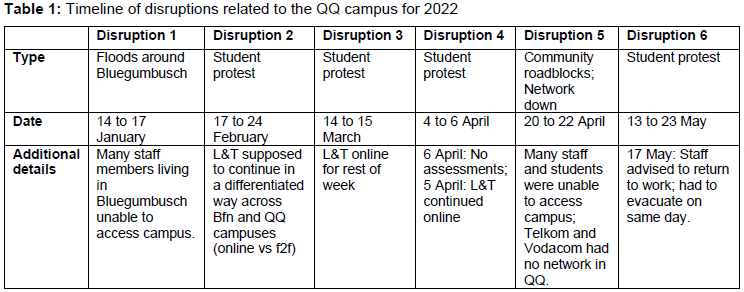
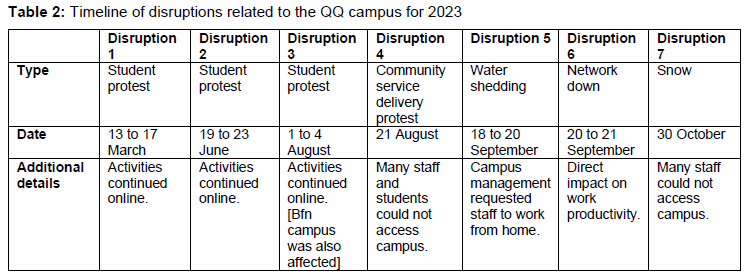
Since the #FeesMustFall movement, protests have become a regular occurrence at higher education institutions in South Africa. This is also true for the QQ campus. During 2022 and 2023, the QQ campus experienced multiple disruptions, which are not limited to student protests but include various events and occurrences which disrupt the academic programme and are possibly linked to the rural nature of the campus. The QQ campus and its surroundings have been continuously experiencing disruptions in different shapes and sizes since January 2022. These include natural environmental events (floods, fires), municipal-related issues (such as water shedding, electricity cut-offs, and network and internet being down), community protests (involving roadblocks), and campus protests. All these disruptions impact staff and students' ability to access campus and how learning and teaching can continue, especially if staff and students cannot access campus.
The following tables provide summaries of the disruptions on the QQ campus for 2022 and 2023, showing the variance in kind of disruption, the number of disruptions, and the effects thereof on the campus.
PROBLEM STATEMENT
The QQ campus of the UFS regularly experiences a variety of disruptions due to its rural surroundings and its status as an institution of higher learning where students raise their challenges through protests. The reasons behind the protests impact the duration, level of violence, and L&T during these protests.
The nature, approach to, and characteristics of these disruptions directly impact L&T activities. The question then is, how do these (continuous) disruptions affect academic staff members, who must continue teaching students, meet learning outcomes, and ensure student success while meeting other deliverables, such as research, engaged scholarship, administration, and academic leadership?
RESEARCH QUESTIONSIn light of the above problem, the main research question for this research was:
"How do academic staff experience working on a continuously disrupted rural campus of the UFS?".
The secondary research questions, which would serve to address the main question, are:
• What are the academic staff's perceptions of the challenges experienced on the QQ campus?
• What are the academic staff's perceptions of the support provided during periods of disruption on the Qwaqwa campus?
• How can key stakeholders support academic staff in mitigating these challenges?
All data collected and analysed aimed to address these research questions.
RESEARCH DESIGNThis study followed an exploratory longitudinal mixed methods approach, embedding qualitative and quantitative data from two years (2022 and 2023) to gauge academic staff's experiences of disruptions at the QQ campus of the UFS. Through a random purposive sampling strategy, surveys were distributed to all QQ academics through a shared group email to allow every academic the opportunity to respond (irrespective of faculty or level of appointment); participation was voluntary and anonymous. Using data for two years would enrich the feedback received, as there would be fluctuations in each year's experience due to variability in contextual challenges experienced. (In essence, no year looks the same as the next, and only including one year's results would be generalisable to that year only.) Furthermore, using multiple means of data collection (quantitatively using closed-ended Likert-scale and limitless multiple-answer options, qualitatively adding open-ended options to most closed-ended questions, as well as individual open-ended questions) would allow one to view the same perception from different angles, provide the "how and why" reasons to the "what" answers, and avoid questionnaire design bias. Ethics was obtained as part of the umbrella ethical clearance of the Scholarship of Teaching and Learning project on the QQ campus for 2022 and 2023.
The survey was created based on three themes: experience of work and the work environment of 2022, work challenges experienced in 2022, and support needed in 2023 and consisted of six sections. Section one comprised nine 5-point Likert-type questions (scaled from "strongly disagree" to "strongly agree") and one open-ended question, focused on staff's overall work experience in terms of online teaching, transitioning back to face-to-face classes and support in terms of well-being, online teaching, and disruptions. Section two was a tick-box exercise with an open-ended question to gauge different work-related challenges on a range. Section three reflected only on workload, and Sections four and five were open-ended reflections on the challenges and successes of 2022. The last question related to support needs for 2023. This survey was shared online with all 300 academic staff members, and 48 (16%) responded to the survey.
The survey for 2023 was slightly adjusted and shortened to four sections. Section one consisted of five 5-point Likert-type questions related to support in terms of duties; the Likert-scale questions were followed by one open-ended question. Section two consisted of 13 5-point Likert-type questions regarding work challenges, with an added open-ended question. Section three was related to workload, and Section four related to their support needs for 2024. A sample of 13 per cent completed the survey.
Although for both cycles these were not an ideal sample size as one would aim for in quantitative research, it was still representative of the academic staff composition of the QQ campus (and not representative of for example all rural campuses in South Africa). The sample would be deemed more than adequate for the qualitative responses, and these open-ended qualitative question responses provided rich data for those in decision-making positions who support the academic community.
The Likert-type questions were analysed through descriptive statistics, primarily generated automatically by the online Questback software used, where the mean was calculated for some datasets, a range presented for others, and ultimately summarising the data through graphics such as charts. This type of statistical analysis focuses on describing and analysing a dataset's main features and characteristics without making generalisations or inferences to a larger population. The open-ended qualitative responses were coded and thematically analysed for each year. Results and findings from both years were integrated, aligning (and thus either triangulating or embedding) both qualitative and quantitative results for both cycles based on the research questions and themes identified, creating a conclusion and possible way forward to addressing the challenges stated previously.
RESULTS AND FINDINGS
The results and findings will be presented separately for 2022 and 2023. However, these findings will be merged and embedded to create an integrated conclusion.
Results for 2022
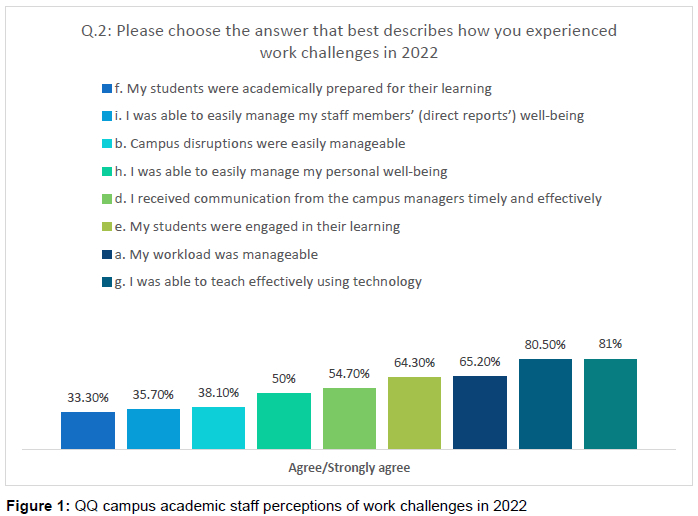
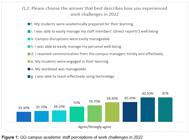
The top three work challenges identified (based on average response rates) were 1) workload, 2) disruptions, and 3) staff well-being. Respondents indicated these same three challenges in the Likert-type and open-ended responses. Responses furthermore indicate that academics felt more confident and motivated to teach with technology, and experienced effective and timely feedback from their direct line managers. Figure 1 below summarises the staff responses in terms of their experiences related to work challenges (indicated from lowest to highest, bottom to top and left to right).
Theme 1: Workload
In their Likert-type responses, 65.2 per cent academics indicated that they had a manageable workload.
In some of their open-ended responses about the workload, staff especially reflected on cross-campus sharing of duties, high student numbers, and the fact that teaching carries the bulk of the workload, leaving little time for research:
"I had a much worse workload (4 courses) than similar colleagues in Bloemfontein (2 courses) even though we are all trying to complete doctorates this year".
"Further, with the high number of undergraduate students in some modules, like mine, make for a situation where very little time is left for research".
"A handful of academics are extremely overloaded in terms of teaching, with little to no teaching and administrative support. Very often, the most competent academics are buried in duties of less motivated colleagues, because "someone has to do the work". As a result, they are unable to engage in any research activities whatsoever. This is detrimental to students, and to the personal and professional development of academic staff".
These responses indicate that teaching seems to carry the most extensive workload and might be perceived as unbalanced across the different campuses, leaving little time for administrative and research duties.
Theme 2: Disruptions
In their Likert-scale responses, 48.8 per cent indicated that there was not adequate support available to continue working during disruptions, and 61.9 per cent indicated that campus disruptions were not easily manageable.
Academic staff reflecting on disruptions expressly indicated challenges in terms of campus communication:
"Campus closure and messages to students of lecture-free days, without informing lecturers of notice to students".
"Top management continues to be very quiet during disruptions and it leads to insecurity and discontent, especially when endless catch-up plans are requested with no real consequence if staff are non-compliant with fulfilling these requests or there is little feedback on their use. We just have to carry on...".
These responses indicate that little to no communication from management reaches the academics when classes are suspended or disruptions occur, while they still need to ensure the academic programme progresses.
Theme 3: Well-being
50 per cent of respondents indicated that they could not manage their own well-being, while 64.3 per cent indicated that they could not manage their direct reports' well-being.
Their reflections on well-being included emotional and physical experiences, such as feeling pressured, exhausted, and burnt out:
"Immense work pressure this year".
"Regarding personal well-being, I am just really really tired, there are not enough hours in the day to attend to everything and everyone".
"I felt like this year was busier than the past two years, and it took a toll on me. I had to go on leave more often as I felt exhausted".
"Regarding wellness, I burnt out this year, attended group sessions with a life coach and individual sessions with a psychologist, organised by a non-UFS entity. I can't say I tried any wellness programme at UFS. I would however like to join a wellness programme through Bestmed but there is no clinic that supports the programme in Harrismith sadly".
"As line managers, we are seriously unprepared (in terms of training and guidance) for dealing with the burnout that our staff are experiencing, and there are not many tools available to give them the rest they often need, due to disruptions and inadequate staff/student ratios".
What is especially evident through these responses is the emotive language used to explain the well-being challenges, such as "really really tired", "immense work pressure", "exhausted", "burnt out", and "seriously underprepared". The urgency in these responses is quite notable.
Additional challenges staff indicated included their proximity to the campus, daily travel, administration, and timetable management.
Another mentionable is students' under-preparedness, featuring also strongly in the quantitative feedback with 66.7 per cent of respondents indicating that their students are not prepared for university.
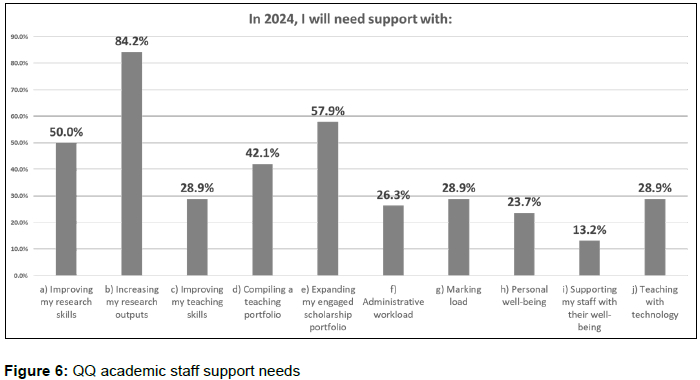
Lastly, respondents indicated their support needs, which were primarily related to research. The following themes emerged from the data: increasing my research outputs (76%), compiling a teaching portfolio (57%), improving my research skills (50%), and expanding my engaged scholarship (48%).
RESULTS FOR 2023
Quantitative results
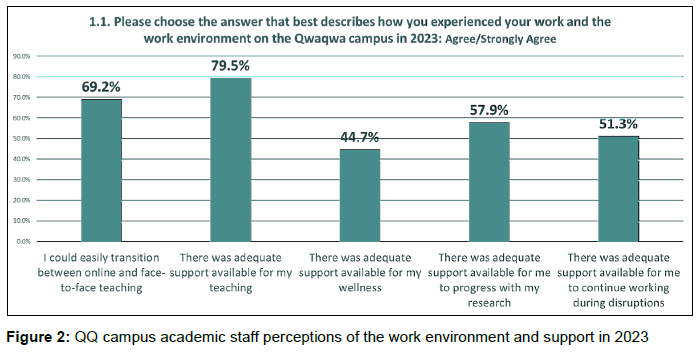
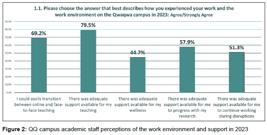
The first question of the 2023 survey focused on the support available on campus. These results revealed the perceived lack of support for wellness and research, yet a certain satisfaction with the levels of L&T received and the ability to move between different modes of blended delivery. Figure 2 below summarises staff perceptions of the workload and institutional support in 2023, with a key shortcoming in terms of support for wellness (44.7%).
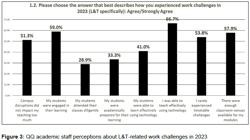
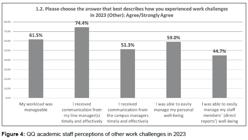
The second question in the 2023 survey related to the challenges that staff experienced. Participants were also asked to rate their top three work challenges in 2023, of which, in order of prevalence, campus disruptions, poor class attendance by students, workload, students' lack of engagement, and timetable issues were the five most mentioned.
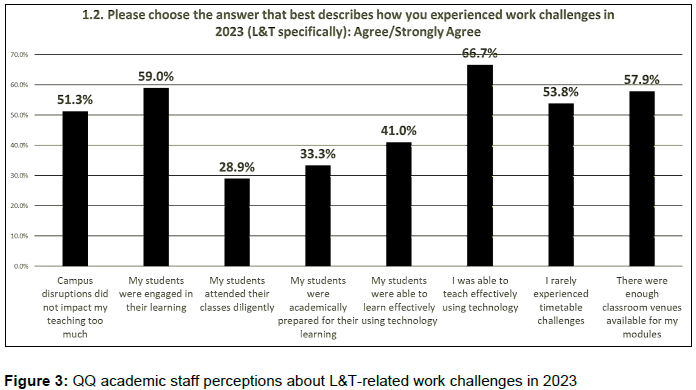
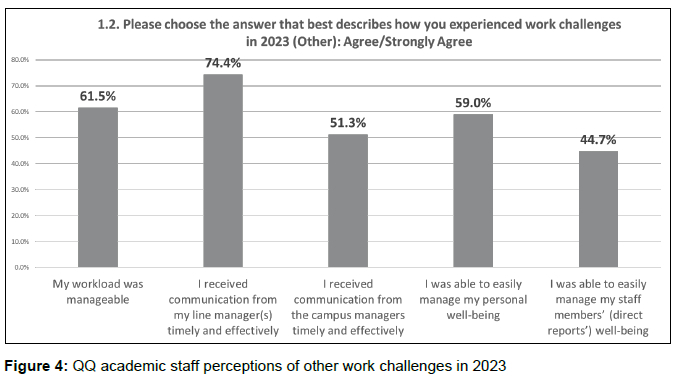
The data is presented as two smaller themes: challenges associated with L&T (Figure 3) and overall challenges (Figure 4).
Distinct quantitative responses
Some challenges indicated in the quantitative results were not necessarily reflected in the qualitative results of 2023. However, these do align with 2022 results.
Almost 40 per cent felt their workload was unmanageable. The survey question that focused on workload indicated that 61.5 per cent of academics felt their workload was fair, and 74.4 per cent could spend adequate time on their teaching. However, only 28.2 per cent felt they could spend enough time on engaged scholarship, and 35.9 per cent on their research.
Qualitative results integrated with quantitative results
Four different open-ended questions were posed in the survey, from which four main challenges were identified employing a thematic analysis:
Theme 1: An unconducive environment: water; internet/network/wi-fi; electricity;
Theme 2: Timetable/venue challenges;
Theme 3: Student class attendance /student engagement; and
Theme 4: Issues related to student protests.
To follow, is an integration of these results with the quantitative feedback.
Theme 1: Unconducive working environment
This theme was not posed in any closed-ended questions, but came out immensely strongly in the qualitative responses.
Contextual elements (water, internet/network/wi-fi, and electricity) were grouped as issues creating an "unconducive" working environment. These elements also, at times, impact one another. For example, when the power supply is disrupted, it has implications for internet provision, hardware functioning, as well as classes:
"The lack of running water and a stable supply of electricity and internet on campus has been particularly problematic this year".
"Network and Electricity issues make it impossible to work on campus!!".
"The unavailability and constant disruptions of water, electricity, and internet made the working space unconducive".
"The internet was a challenge on a number of occasions and had a negative impact on classes". / "Office Desktop slows down after the loadshedding".
Theme 2: Timetable challenges
46.2 per cent of academics experienced timetable issues, which is closely linked to a perceived lack of venues on campus (42.1%).
More specific timetable challenges were raised, including timetable clashes, a shortage of venues, scheduled venues that are not used, infrastructure, and venues that are not big enough for larger student groups:
"Due to shortages of venues, we had to make use of online sessions. Very little teaching and learning took place in the online sessions due to connectivity issues for both students and facilitators".
"The computers reboot and shut off so often in the 2 hours that you would give up on using them due to "high temperature". How doesn't those classes have effective ventilation?".
"Timetable is disaster" / "The lecture timetable clashes is another serious issue" / "Large class, no venue that can accommodate all my students".
Theme 3: Students attendance or engagement
More than 70 per cent respondents indicated that their students did not attend classes diligently, and 40 per cent felt that their students were not engaged in their learning. These concerns were also raised in the open-ended responses:
"Some students nonchalant attitude towards class attendance".
"Student attendance for classes was highly disappointing. At all material times, I had less than 10 per cent of students in class. The result of this manifested in the poor performances by students during assessments. The levels of students' commitment to their studies are worrisome".
Theme 4: Campus disruptions
Almost 50 per cent of academics were impacted by campus disruptions. Most academics seemed satisfied with the communication from their line managers but not necessarily from campus management.
Respondents also raised a variety of issues because of disruptions, including management communication, communication between the QQ and Bfn campuses, the added cost for staff to work off-campus, and overall support needed:
"There is ltd [SIC] support during disruptions. I get the feeling the academic program is very easily suspended and we are expected to cope because we have, in the past, and we will, because we have no choice. But there isn't even data support as there used to be, or support for loadshedding unless it's at own cost...these additional costs are vital for Qwaqwa staff who are forced to work from home much more frequently than Bloemfontein staff".
"During student protests, online classes do not become a 100 per cent solution because of connectivity issues".
"I fell behind because of protests and did not manage to finish all my themes/chapters for the semester".
"There was a day when no communication was received from campus managers about students' disruptions".
"Line managers seem to also be the last to know of anything that is happening, or just too afraid to give their own instruction during these events, and rather wait for Bloemfontein to respond and make decisions (that almost never happen, they generally have no care when there are strikes on campus or within the community on our side)".
These challenges are explained in terms of how the disruptions led to additional difficulties: personal costs while working from home, falling behind with academic content, and the perception that the Bfn counterparts do not care for QQ and their challenges.
Figure 6 below indicates the support that academic staff felt they would need in 2024.
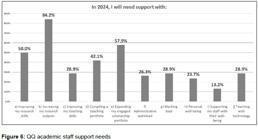
Most evident is the support needed for research skills capacitation and research outputs (50% and 84.2%), which implies that staff development and mentorship support mechanisms are needed in terms of research (such as workshops, retreats, and one-on-one mentoring). More than half (57.9%) also indicate the need to expand their engaged scholarship portfolio.
CONCLUSION
When reflecting on the main research question, "How do academic staff experience working on a continuously disrupted rural campus of the UFS?", it becomes evident that staff experience various challenges and require different kinds of support. A flexible approach to cross-campus deliverables needs to be adapted to suit all branches, not just the main campus. Creating flexibility between different campuses would mean understanding the challenges those individuals face. Thus, supporting academics must be based on their voiced concerns and their unique environment.
The findings from the 2022 results indicate that the main challenges (as well as support needs) experienced by the QQ campus academic staff were related to workload, campus disruptions, personal well-being, and performing research. For 2023, their top challenges were an unconducive working environment, the creation of the timetable and venues, student class attendance and engagement, and continued disruptions. The disruptions experienced on the QQ campus relate not only to student protests but also to more nuanced contextual issues of the rural environment, such as electricity cuts, water shortages, and network connectivity.
Workload seems to drive many other challenges. The primary needs indicated by academic staff were research support and finding time to do research. The expectation to perform in terms of research also appears to be seen as a priority. The continuously disrupted environment and perceived challenging workload led to uncertainty and anxiety, ultimately impacting well-being.
PRACTICAL RECOMMENDATIONS BASED ON RESULTS AND FINDINGSSome actions from key stakeholders and decision-makers could address these challenges and needs:
Communicating across different channels in a timely manner
Timely communication from the campus and middle management during disruptions is essential to support the academic staff in this environment. Even if a solution to the initial disruption has not been reached, while management is still trying to understand the nature and extent of the disruption, immediate emails and instant messages could be shared to acknowledge that management is aware of the situation and is working on a solution. Departmental emails and WhatsApp messages could also be used to update academics about the progress of the situation regularly.
Being flexible and adaptable while considering the multi-campus context
Considering the unique challenges across the institution, there is a clear need to create flexibility in the work environment across campuses. Complete copying of elements such as the academic programme and timelines, the classroom timetable, and the number of staff appointed, might need to be reconsidered. Alignment could rather be addressed and planned in terms of outcomes, which in fact means that to meet the same learning outcomes in two different environments, perhaps the approaches need to be nuanced.
Creating a conducive working environment in terms of infrastructure
An optimal work environment needs to be created in terms of electricity, water, network, and internet provisioning (an aspect that might, unfortunately, remain challenging due to the remoteness of the campus).
Support, and perhaps relief, is needed in terms of workload. The main reasons for an unmanageable workload seem to be the staff-student ratio and teaching load. This could possibly be solved through equipping the campus with teaching relief.
Research capacitation of academics, and allocating time to this
Academics clearly desire to develop their research skills while spending more time completing research activities. Skills development and time to do research are main concerns and seem to emanate from an unmanageable teaching load. A balance would need to be created for academics to manage their workload, providing them with teaching-free time to focus on research (such as sabbaticals and writing retreats).
Sixth, additional well-being support measures must be implemented, especially concerning burnout and workload. The perception exists that campus leaders do not care for QQ academics, and that they must work under "extreme pressure". Workload again seems to be the culprit, this time leading to well-being challenges, and a multi-pronged approach would be needed to address this, in terms of practical solutions (such as administrative support), communication from management, and more nuanced psychosocial support such as counselling.
Creating a viable, workable timetable
Creating a workable timetable with minimum venue clashes, providing enough venues for the number of modules, having large venues that can accommodate large classes, and optimally capacitating venues with technology is important to support academics during challenging teaching times.
Assisting with student engagement
Intentional strategies might need to be devised at a modular level to assist lecturers in exploring their students' class attendance issues.
LIMITATIONS AND FUTURE RESEARCHThe main limitation of this study is that the specific recommendations are not transferable to all rural- or multi-campus institutions. These issues raised are specific to the Qwaqwa campus of the UFS, and also to the specific time it was voiced, and should thus be interpreted within that context. Gauging academics' challenges in future, it would make sense to have a targeted approach to differentiate between new academics and longer-appointed academics, as well as to increase the response rate, which would create stronger feasibility and representation of the QQ academic staff population. Most interesting would be focus-group interviews with these academics.
For future research, it could be interesting to have interviews with the different UFS campus management stakeholders to understand their challenges (thus, the other side of the coin). Circulating these surveys to the main campus academics could create opportunities to compare challenges across different campuses of the same institution. At a larger scale, it would be especially interesting to obtain feedback from various smaller (or rural) campuses of multi-campus institutions, to consider which challenges and needs surface across South African institutions.
STRATEGIC POSSIBILITIES AND RECOMMENDATIONS FOR HIGHER EDUCATION MULTI-CAMPUS MANAGEMENT BEYOND THE QWAQWA CAMPUS: A CASE FOR CONTEXTUALISATION ACROSS CAMPUSES
Perhaps the most important realisation from this study is that multi-campus management should aim to provide students with equitable opportunities for quality education and success, through equitable support to its staff members (who need to teach these students). Thus, alignment between campuses and the management thereof should not eventuate in mirroring what the main campus branch offers and delivers. Instead, a strong focus should be on alignment with institutional, national and even global higher education strategic goals. Practically, this means that learning and teaching activities, academic staff capacitation and support, and the overall business management of different campuses should be contextualised. In some spheres, this would be called a decolonised approach to campus management, which implies including the student and staff voices to guide decision-making. Institutions can only achieve this equitable approach through intentional collaboration and communication while understanding contextual differences by exploring data and evidence (such as academic staff and student feedback surveys). And this kind of intentionality needs to be driven by or embedded into policies, institutional strategies and resource allocation. This intentionality will, on a deeper level, illustrate a component of care from management to the different campus communities: care for their students based on who they are and what they want to achieve, care for their academic staff based on their voiced challenges, and care for colleagues.
REFERENCES
-
Anapey, G. 2024. "Achieving Education for Sustainable Education Learning Outcomes: An Integrated Model for Higher Education in the Global South." International Journal of Educational Reform, 1-20. https://doi.org/10.1177/10567879241270503.
» https://doi.org/10.1177/10567879241270503 - Baar, J. 2020. The Impact of Organizational Structure at Multi-Campus Community Colleges on Student Access, Equity, and Completion. Maryland: University of Maryland University College.
-
Bunting, I. 2006. "The Higher Education Landscape under Apartheid." In Transformation in Higher Education, edited by N. Cloete et al. https://link.springer.com/chapter/10.1007/1-4020-4006-7_3.
» https://link.springer.com/chapter/10.1007/1-4020-4006-7_3 - Centre for Teaching and Learning. 2021. Beginning University Survey of Student Engagement. Bloemfontein: University of the Free State.
- Centre for Teaching and Learning. 2023. Beginning University Survey of Student Engagement. Bloemfontein: University of the Free State.
- Charles, D. 2016. "The Rural University Campus and Support for Rural Innovation." Science and Public Policy 43 (6): 763-773.
- Christensen, L., and N. Nilsen. 2021. "Deconstructing Quality at Multi-Campus Universities: What Moderates Staff and Student Satisfaction?" Quality Assurance in Education 29 (2-3): 198-208.
-
Coetzee, J., B. Neneh, K. Stemmet, J. Lamprecht, C. Motsitsi, and W. Sereeco. 2021. "South African Universities in a Time of Increasing Disruption." South African Journal of Economic and Management Sciences 24 (1): a3739. https://doi.org/10.4102/sajems.v24i1.3739.
» https://doi.org/10.4102/sajems.v24i1.3739 - De Vos, P. 2018. "The Constitutional Limits of Disruptive Protest: The Case of Student Protest in South Africa." Zeitschrift für Menschenrechte 12 (1): 64-86.
- Delport, M., D. Hay-Swemmer, and A. Wilkinson. 2014. "An Internal Communication Model for Multi-Campus Higher Education Institutions in South Africa." Journal for New Generation Sciences 12 (1): 21-46.
-
Greeff, M., K. Mostert, and C. Jonker. 2021. "The #FeesMustFall Protests in South Africa: Exploring First-Year Students' Experiences at a Peri-Urban University Campus." South African Journal of Higher Education 35 (4): 78-103. https://doi.org/10.20853/35-4-4219.
» https://doi.org/10.20853/35-4-4219 - Groenwald, S. 2018. "The Challenges and Opportunities in Leading a Multi-Campus University." Journal of Professional Nursing 34: 134-141.
- Gultig, J. 2000. "The University in Post-Apartheid South Africa: New Ethos and New Divisions." South African Journal of Higher Education 14 (1): 37-52.
- University of the Free State. 2018. Integrated Transformation Plan. Bloemfontein: University of the Free State.
-
University of the Free State. 2024. "PowerHEDA Dashboard." https://www.heda.co.za/powerheda/dashboard.aspx.
» https://www.heda.co.za/powerheda/dashboard.aspx -
Heleta, S., and T. Bagus. 2021. "Sustainable Development Goals and Higher Education: Leaving Many Behind." Higher Education 81 (1): 163-177. https://doi.org/10.1007/s10734-020-00573-8.
» https://doi.org/10.1007/s10734-020-00573-8 -
Jacquemin, S., C. Junker, and J. Doll. 2019. "The Branch Effect: Understanding Multi-Campus Enrollment and Student Success." Journal of Continuing Higher Education 67 (1): 1-12. https://doi.org/10.1080/07377363.2019.1642690.
» https://doi.org/10.1080/07377363.2019.1642690 -
Jansen, J. 2003. "Mergers in South African Higher Education: Theorising Change in Transitional Contexts." Politikon 30 (1): 27-50. https://doi.org/10.1080/0258934032000073897.
» https://doi.org/10.1080/0258934032000073897 -
Kerwin, A. 2020. "The Road Ahead for Rural Colleges: How They Are Adapting to Meet Financial, Cultural, and Geographic Challenges." The Chronicle of Higher Education. https://www.chronicle.com/featured/student-success/rural-colleges-the-road-ahead.
» https://www.chronicle.com/featured/student-success/rural-colleges-the-road-ahead - Loots, S. 2020. Mapping UFS Students' Journeys: What Works for Student Success? Bloemfontein: University of the Free State.
- Louw, I., and M. Thukane. 2019. "Teaching and Learning Sciences in Times of Disruptions: Blended Learning Action." Journal for New Generation Sciences 17 (2): 30-43.
-
Luescher, T., L. Loader, and T. Mugume. 2016. "#FeesMustFall: An Internet-Age Student Movement in South Africa and the Case of the University of the Free State." Politikon 44 (2): 231-245. https://doi.org/10.1080/02589346.2016.1238644.
» https://doi.org/10.1080/02589346.2016.1238644 - McKeever, M. 2018. Employee Commitment to the Organisation: A Comparative Quantitative Exploration of Employees Based on Role and Primary Workplace Location at Multi-Campus Colleges. Doctoral thesis, Colorado State University.
- Morwe, K., E. Garcia-Espana, and T. Luescher. 2018. "Factors That Contribute to Student Protests at a South African University." The Social Sciences 13 (4): 916-926.
-
Naidu, E. 2022. "#FeesMustFall Book Captures Key Moment in Student Politics." University World News Africa Edition. https://www.universityworldnews.com/post.php?story=20221129202714626.
» https://www.universityworldnews.com/post.php?story=20221129202714626 - Nel, H. 2007. "Enhancing the Student Experience in a Merged Multi-Campus University in South Africa." Paper presented at the Annual Conference of the Society for Research into Higher Education, Brighton, United Kingdom, December 2007.
-
Nyamnjoh, A. 2004. "A Relevant Education for African Development-Some Epistemological Considerations." Africa Development 29 (1): 161-184. https://doi.org/10.4314/ad.v29i1.22190.
» https://doi.org/10.4314/ad.v29i1.22190 -
Nyamnjoh, A. 2023. "Is Decolonisation Africanisation? The Politics of Belonging in the Truly African University." Social Dynamics 49 (2): 349-368. https://doi.org/10.1080/02533952.2023.2226500.
» https://doi.org/10.1080/02533952.2023.2226500 - Pinheiro, R., and L. Berg. 2017. "Categorising and Assessing Multi-Campus Universities in Contemporary Higher Education." Tertiary Education and Management 23: 5-22.
- Rautenbach, J., N. Shozi, and A. Nicolaides. 2023. "The Implication of 'Rurality' in Terms of Higher Education in Rural South African Context." Athens Journal of Education 10 (4): 717-738.
- Samuel, M. A. 2022. "No Student Left Behind: 'Pedagogies of Comfort' or 'Pedagogies of Disruption'?" Scholarship of Teaching and Learning in the South 6 (2): 117-139.
- Steinhart, E. I. 1972. "White Student Protests in South Africa: The Privileged Fight for Their Rights." Africa Today 19 (3): 39-54.
-
Uleanya, C., and Y. Rugbeer. 2020. "Investigation of First-Year Learning Experiences in a Rural University in South Africa." Journal of Student Affairs in Africa 8 (1): 29-46. https://doi.org/10.24085/jsaa.v8i1.3824.
» https://doi.org/10.24085/jsaa.v8i1.3824