Exploring the nature of communities of inquiry in undergraduate accounting education: a systematic literature review
Abstract
Online learning has become an integral part of higher education, and while its adoption was accelerated by the COVID-19 pandemic, it will continue to be an important mode of learning in higher education. However, research indicates that accounting students are experiencing the online learning component as a significantly bigger challenge than the face-to-face learning component. Providing a responsive online accounting learning environment requires an effective framework to assist with the design of the teaching and learning environment, facilitating optimal online learning. This article reports on a systematic literature review to determine the nature of the Community of Inquiry (CoI) framework within the context of online undergraduate accounting education. Utilising scholarly databases (Scopus, Web of Science, African Journals and EbscoHost), a literature search was conducted for the period 2012-2022, resulting in the identification of 35 articles for full-text review. The results of this review highlighted that all three presences of the CoI (social presence, cognitive presence, and teaching presence) were present. Most of the articles reported on group cohesion and affective/personal connections within social presence, and instructional design within teaching presence. Sub-themes such as triggering events within cognitive presence and direct instruction within teaching presence received the least coverage in the sampled articles. The insufficient inclusion of certain sub-themes in the presences indicated the need for further application to create a responsive online learning environment in accounting education.
Community of Inquiry; online learning; undergraduate accounting education; higher education
INTRODUCTION
Since the introduction of the Internet and World Wide Web in the 1990s, online learning and blended learning (a mix of face-to-face and online classes) have been implemented to reach a larger student population (Palvia et al. 2018, 233). As early as the year 2000, online learning became a standard mode of learning at many Higher Education Institutions (HEIs) (Love and Fry 2006, 152) and has gained further significance in higher education in recent years (D'Aquila, Wang, and Mattia 2019, 63). For example, Ebaid (2020, 238) argues that online learning makes education accessible to more students, overcoming social and equality challenges (Irshad Ali, Narayan, and Sharma 2020, 8). Palvia et al. (2018, 233) already predicted in 2018, before the COVID-19 outbreak in 2020, that online learning would globally become the mainstream mode of learning by 2025. For this study, "online learning" refers to the delivery of a learning experience by means of digital or computer technology with synchronous or asynchronous learning interaction between students, lecturers, and digital learning resources.
The COVID-19 pandemic wreaked havoc globally and challenged the stability of political, economic, and social environments. Consequently, HEIs worldwide had to swiftly transition from traditional face-to-face (physical) academic classes to remote online teaching and learning (virtual classes) to limit the spread of the virus (Lazim, Ismail, and Tazilah 2021, 13; W. Ali 2020, 16). The adoption of online learning also became an urgent technological measure to ensure the continuation of the academic year (Ebaid 2020, 245).
Both students and academics, unprepared for this sudden shift to a fully online setting, experienced it as a drastic adjustment, which generated uncertainty, negativity, and resistance to change among them (Ebaid 2020, 240). Furthermore, HEIs encountered time constraints in transitioning to quality teaching and learning within this online-only environment (Malan 2020, 321). Regardless of these challenges, it remained crucial for the online learning environment to deliver a constructive learning experience with positive results (Halabi et al. 2014, 165).
Providing a responsive online accounting learning environment requires an effective framework to assist with the design of the teaching and learning environment, facilitating optimal online learning. From the various models that aim to enhance the success of online and blended learning (Akyol, Garrison, and Ozden 2009, 65), the Community of Inquiry (CoI) framework developed by Garrison, Anderson, and Archer in 2000 stands out as the most prominent, garnering the highest level of interest. The CoI framework enables lecturers to design, assess, and facilitate effective online learning environments, while offering a structured and cooperative student community with the aim to analyse, generate, and validate valuable knowledge (Garrison and Vaughan 2008, 9).
The establishment and maintenance of a CoI are guided by three presences: social presence, cognitive presence, and teaching presence (D.R. Garrison and Arbaugh 2007, 158). Social presence pertains to the capacity to establish personal connections with fellow learners within a community. Cognitive presence involves collaboratively constructing meaning through the process of inquiry, while teaching presence constitutes the guiding force that organises and facilitates the educational process in a constructive, collaborative, and continuous manner. The convergence of these elements forms the essence of the CoI, enabling collaborative and constructivist educational experiences to be attained (D.R. Garrison 2006, 26). Research furthermore suggests that implementing CoI design principles enhances student satisfaction (Yandra et al. 2021, 2).
In the realm of high-demand qualifications, such as the chartered accountancy (CA) certification, it is imperative that the quality of online learning match that of traditional face-to-face education (Myring, Bott, and Edwards 2014, 67). Even in favourable conditions, the CA qualification is widely regarded as challenging (Wilmot and Jonker 2020). Olivier (2020, 7576) concurs, highlighting that the extensive content covered by the CA qualification necessitates innovative teaching methods. Moreover, the accounting profession now emphasises the need for graduates to possess not only technical expertise, but also effective communication and soft skills (Matt 2021, ix). Nevertheless, current accounting education often overlooks the development of these crucial soft skills (Matt 2021, ix). Irshad Ali, Narayan, and Sharma (2020, 2) observe that, in many online accounting courses, student engagement tools remain underutilised, which, in turn, hinders the cultivation of essential skills.
Given the challenges faced by accounting students in online learning environments, it is imperative to explore how the social, cognitive, and teaching elements of the CoI framework can inform the formulation of tailored guidelines that address the distinct needs of these students. This article delves into the nature of the CoI framework, offering practical insights into responsive online learning environments structured specifically for undergraduate accounting education. The contribution of the study lies in its aim to enhance the quality of teaching and learning within the field of accounting. In doing so, the research responds to the call for more focused investigations in teaching and learning within accounting education, thereby enriching the existing body of knowledge in this domain.
RESEARCH METHODOLOGYTo answer the research question and limit bias, a systematic literature review (SLR) was conducted. This entailed the collection, critical evaluation, and synthesis of existing literature (Leonidou et al. 2020, 246). With the assistance of a faculty information specialist, predefined search criteria were followed to source and select pertinent literature (Kitchenham 2004, 2).
The research question and objective of the review
To determine the nature of CoI within undergraduate online accounting education, (Booth 2006) SPICE framework (Setting, Perspective, phenomenon of Interest/Intervention, Comparison, Evaluation) was used in developing the research question that guided the SLR, namely: What is the nature of CoI within online learning in undergraduate accounting education?
The review process
The SLR was conducted in three phases: planning the review, conducting the review, and reporting the findings from the review (Kitchenham 2004, 3). To mitigate researcher bias, the researcher, in collaboration with an expert in the field of SLR, determined the necessity of the review and developed the review procedure (Kitchenham 2004, 10).
In Phase 1 a search strategy was formulated for the identification of primary studies. This strategy included pre-determined, research-specific keywords, search strings, databases, selection criteria, as well as methods for data extraction and synthesis (Kitchenham 2004, 7). To ensure rigour, the review procedure was scrutinised by three experienced researchers in the accounting and educational fields.
Phase 2 consisted of identifying and selecting applicable literature across several institutional databases using the review procedure outlined in Phase 1. An electronic search was conducted across institutional databases for the period 2012-2022 to cover research that has been conducted over the last 10 years. Institutional databases of the North-West University (NWU) such as Scopus, Web of Science, African Journals and EbscoHost were utilised and in EbscoHost the following suitable databases were selected: Academic Search Complete, Africa-Wide Information, Business Source Complete, EconLit with Full Text, E-Journals, ERIC, MasterFILE Premier, SocINDEX with Full Text, and Teacher Reference Center. Google Scholar was excluded as a database as all relevant records were expected to be included in the selected databases.
To retrieve specific, relevant results pertaining to the nature of CoI within online learning in undergraduate accounting education, the following keywords and search strings (derived from the research question) were used: "online learning" OR "web-based learning" OR "e-learning" OR "virtual learning" OR "digital learning" OR "distance learning" OR "remote learning" OR "online teaching" OR "web-based teaching" OR "e-teaching" OR "virtual teaching" OR "digital teaching" OR "distance teaching" OR "remote teaching" OR "online education" OR "web-based education" OR "e-education" OR "virtual education" OR "digital education" OR "distance education" OR "remote education" OR "web-based instruction" OR "online instruction" OR "virtual instruction" OR "digital instruction" OR "remote instruction" OR "distance instruction"; "accounting" OR "accountancy"; "community of inquiry" OR "CoI".
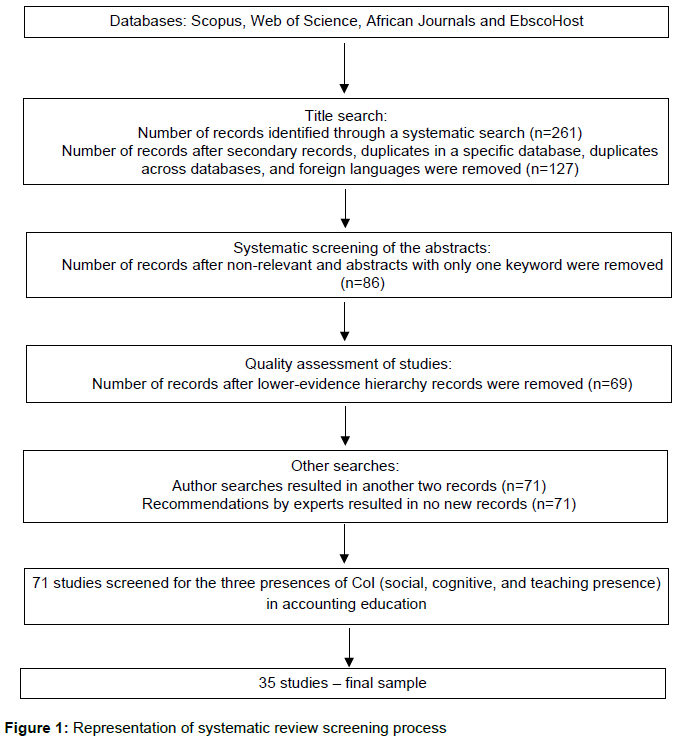
English, full-text, scholarly, and peer-reviewed articles from accredited journals and conference proceedings were selected using the above keywords. The initial search yielded 261 potentially relevant articles. After removing secondary documents, foreign language records, and duplications, 127 articles remained. The screening of abstracts followed, and after excluding those that did not contain at least two of the keywords, 86 articles remained for a subsequent round of scrutiny. Kitchenham (2004, 10) emphasises the importance of evaluating records and applying quality assessment to the study design of primary studies, as per the hierarchy of evidence. For instance, in evaluating individual primary records, systematic reviews are excluded due to their status as a secondary hierarchy of evidence (Kitchenham 2004, 13). Thus, after eliminating articles with a secondary hierarchy of evidence, 69 records remained.
As part of quality assurance, two experts, one in the field of Col (an acclaimed publisher in academic journals on Col in an educational context) and the other in the field of accounting education (a professor and researcher in accounting education) reviewed the list of articles, and no records were added. After a final search, the researcher added two articles, resulting in 71 articles for full-text screening. In the full-text screening, the researcher scrutinised the articles, removing articles that did not speak to the three presences of CoI in accounting education.
Ultimately, 35 articles remained for analysis. Figure 1 illustrates the SLR screening process.
Data extraction through qualitative content analysis
The 35 articles were thematically analysed using ATLAS.ti 9, a qualitative data analysis software. Applying the structured methodology suggested by Jones et al. (2020, 38), the researcher familiarised herself with the data by reading through it, seeking to gain an understanding of its content. Using both a deductive and inductive approach, the researcher linked the data to codes and the codes to themes (the three presences) and sub-themes (their components) relevant to the research question (Terry et al. 2017, 19). Co-coding was applied, and inter-rater reliability in the research was assured by means of Cohen's Kappa (Geisler and Swarts 2019, 162). The researcher shared the developed codes with two independent coders (the promotor and co-promoter of this study). The coding of eight articles was compared with a Kappa statistic of 0.94, indicating a high level of coding agreement.
Phase 3, the last phase of the review process, entails reporting the findings of the SLR (Kitchenham 2004, 3), which is the purpose of the following section.
FINDINGS
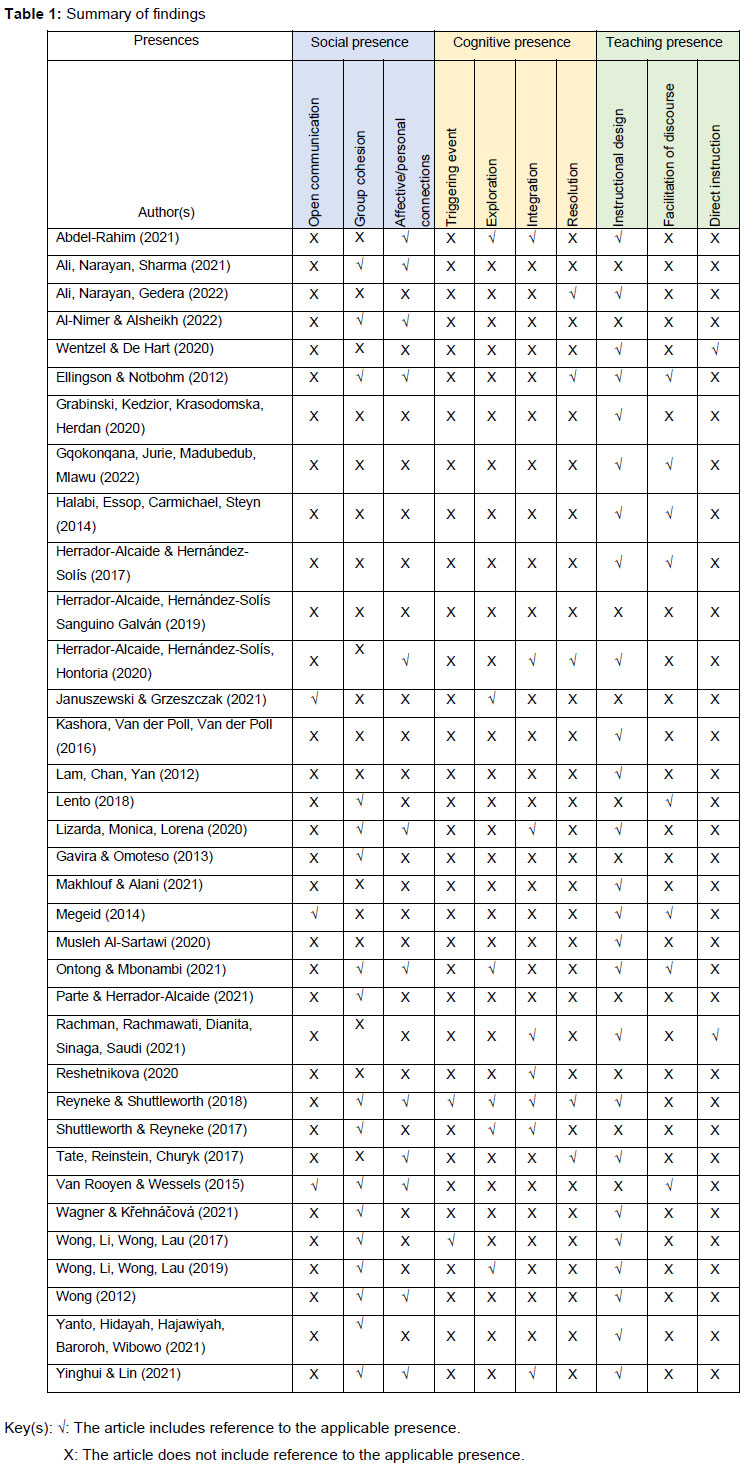
Table 1 provides an analysis of the 35 articles, outlining the presences and their components within the Col framework addressed in each article. All components are indicated with a "√", while an "X" indicates the absence of a specific component in the article. A detailed analysis of the findings is available on request.
DISCUSSION
The aim of the discussion below is to determine the nature of CoI within online learning in undergraduate accounting education. Specific attention will be paid to the three presences, proposed in the CoI framework as essential elements for the design and facilitation of successful online learning (Chiroma, Meda, and Waghid 2021).
Nature of CoI in online accounting education
The SLR showed that a substantial body of knowledge reports on the positive correlation between the CoI framework and student satisfaction within an online learning environment. This affirms that, if the presences are purposefully designed and successfully implemented in the online learning environment, it would lead to meaningful and rewarding online learning experiences (Choy and Quek 2016, 14; Sidiropoulou and Mavroidis 2019, 9; AlShamsi 2021, 3; Purwandari, Junus, and Santoso 2022; Pellas and Kazanidis 2014, 21; Chiroma, Meda, and Waghid 2021, 2, 12; Goh 2020, 4).
The SLR further revealed that, although studies on online learning in accounting seldom mention CoI explicitly, accounting lecturers are incorporating the three presences into their teaching methods without labelling them as CoI practices. Below, we explore the application of the three presences found in the literature.
Theme 1: Social presence
Social presence in online learning refers to students' ability to project their personal characteristics while collaborating and communicating in their online community (D.R. Garrison, Anderson, and Archer 2000). Multiple studies highlight the importance of social presence in enhancing student engagement, which is crucial for successful online teaching and learning (Lawrence-Benedict, Pfahlb, and Smith 2019, 6). The components of social presence include open communication, group cohesion, and affective expression (Garrison and Arbaugh 2007), which will be discussed below.
Sub-theme 1: Open communication
Open communication refers to the importance of safe communication, group work, emotional expression, social interactions, comfort in discussions, effective interactions, positive self-identity, and reciprocal feedback in online learning. These factors enhance participation, satisfaction, engagement, knowledge sharing, collaboration, and overall learning experience in online environments (Stenbom, Jansson, and Hulkko 2016; AlShamsi 2021; Chiroma, Meda, and Waghid 2021; Lee et al. 2021; Daspit, Mims, and Zavattaro 2015; Purwandari, Junus, and Santoso 2022; Su Kyoung and Sangmi 2017).
The SLR underscores the significance of fostering social presence and encouraging open communication. It indicates that integrating interactive technology into blended learning not only enhances effectiveness, but also strengthens communication skills and deepens accounting understanding (Megeid 2014, 35). Students value relaxed conversations and a stress-free learning environment - again emphasising the importance of open communication in establishing social presence (Van Rooyen and Wessels 2015; Januszewski and Grzeszczak 2021). Immediate two-way communication, such as SMS or mobile technologies, was found to be crucial in successful didactic conversations, improving throughput and retention rates, while effective social interactions and emotional expression were deemed important within open communication (Van Rooyen and Wessels 2015).
Sub-theme 2: Group cohesion (cohesive responses)
Group cohesion aims to foster a feeling of unity among students and lecturers and to promote a supportive environment (Stenbom, Jansson, and Hulkko 2016; Daspit, Mims, and Zavattaro 2015; Waddington and Porter 2021). To enhance group cohesion, lecturers should focus on inclusivity, value diverse perspectives, and set respectful classroom norms (AlShamsi 2021; Chiroma, Meda, and Waghid 2021). During discussions, group cohesion can be improved through thought-provoking questions and group work (Chiroma, Meda, and Waghid 2021).
Ellingson and Notbohm (2012, 5) investigated interactive opportunities with regard to both peers and the lecturer in online accounting education and found that collaboration holds significant value in education. Thus, active engagement and interaction should be prioritised over passive content consumption, as indicated by L. Wong (2012, 12). Lento (2018, 14) agrees that students excel when exposed to dynamic learning resources, surpassing the benefits offered by static materials. Furthermore, Lizarda, Monica, and Lorena (2020, 5) asserted that engaging in discussions enhances deep learning.
Limited exposure to group work case studies was identified as a hindrance to peer learning in accounting education (Shuttleworth and Reyneke 2017, 6). While acknowledging the challenges of conducting group case studies online (Reyneke and Shuttleworth 2018, 8-9), it is crucial to recognise that the depth and quality of student engagement are paramount for enhancing operational accounting competencies (Yanto et al. 2021, 15).
In preventing student isolation, the crux of the matter lies in the essential role of group cohesion (Irshad Ali, Narayan, and Sharma 2020, 7-8; Parte and Herrador-Alcaide 2021, 19). To foster this cohesion, various approaches have been suggested, including podcasts, SMS messages, educational blogs, and online discussion forums (Van Rooyen and Wessels 2015, 10; Reyneke and Shuttleworth 2018, 8-9). These methods contribute significantly towards creating a sense of community among students. Active participation, interactive techniques, and humour have also been identified as effective tools for enhancing engagement in online accounting education (Yinghui and Lin 2021, 4). Al-Nimer and Alsheikh (2021, 843) concur, stating that robust engagement strategies positively influence online learning and the development of essential accounting professional skills.
Sub-theme 3: Affective/personal connections
Affective or personal connections constitute the initial stage of the development of social presence in a learning community (Garrison and Arbaugh 2007, 160). According to Brown (2001, 24), close relationships and companionship will be established after strong associations have been formed with group members, creating true social presence in an educational establishment.
Hamid et al. (2015) demonstrated that promoting collaboration among students through online tools enhances peer interaction, which, in turn, improves learning experiences and leads to mastery of course content. Sidiropoulou and Mavroidis (2019) found that the establishment of a secure and supportive atmosphere is crucial, as it strengthens interpersonal connections and contributes to the general benefit of students. In a study by Junus et al. (2019), learners responded positively to online classroom interactions when they felt comfortable engaging with their peers and participating in discussions. Such an environment not only seems to enhance collaboration, but to also enrich the overall online learning experience.
The SLR revealed the vital role of personal connections in online accounting education. For example, Ellingson and Notbohm (2012, 5) investigated the value of live web-conferencing and group work for active student engagement, while Lizarda, Monica, and Lorena (2020, 5) reiterated the value of interactive online environments and feedback activities for enhanced learning. Active participation was found to be crucial for acquiring knowledge and reaching higher-level outcomes (Irshad Ali, Narayan, and Sharma 2020, 7-8) as well as for fostering community akin to the notion of group cohesion in the CoI framework. L. Wong (2012, 12) stressed the effectiveness of face-to-face sessions over recorded tutorials, emphasising the impact of interaction. Especially regular interaction with lecturers was shown to provide a sense of care (Van Rooyen and Wessels 2015, 10-11).
Other challenges, according to the literature, include online students often feeling isolated due to minimal interaction (Reyneke and Shuttleworth 2018, 8) and struggling to stay motivated in the absence of empathetic friends (Ontong and Mbonambi 2021, 266). Technological issues and the need for personal connections also hinder engagement (Irshad Ali, Narayan, and Sharma 2020, 7-8), whereas faculty interaction and asynchronous tasks limit building professional relationships (Tate, Reinstein, and Churyk 2017, 3).
With regard to fostering positive relationships, the SLR showed that lecturers must encourage active student roles (Yinghui and Lin 2021, 4) and establish transactional presence (Herrador-Alcaide, Hernández-Solís, and Hontoria 2020, 17). Van Rooyen and Wessels (2015, 10-11) found that consistent module-related information makes online students feel valued, whereas immediate feedback is crucial for student satisfaction (Abdel-Rahim 2021, 9). The literature unmistakably showed that engaging online learning significantly improves accounting competencies (Al-Nimer and Alsheikh 2021, 844). This reinforces the vital role that personal connections play in online accounting education.
Theme 2: Cognitive presence
Cognitive presence, as outlined by (Garrison and Arbaugh (2007), involves the construction and confirmation of meaning through reflection and discourse while engaging with learning materials. It forms the core of the Col framework and represents the actual learning process (Krzyszkowska and Mavrommati 2020, 463). Hence, a robust cognitive element is essential for students to find satisfaction and excel in online assignments and blended courses (Choy and Quek 2016, 14). Goh (2020, 3) also acknowledges the role of cognitive presence in knowledge building.
Garrison (2016, 26) proposed four stages of cognitive presence: triggering event, exploration, integration, and resolution. These stages constitute the process through which meaningful learning occurs.
Sub-theme 1: Triggering event
In online learning, a triggering event signifies the identification, conceptualisation, and formulation of a problem or issue (Pecka, Kotcherlakota, and Berger 2014; Stenbom, Jansson, and Hulkko 2016). Indicators like student engagement rates and video downloads are examples of triggering events that stimulate cognitive learning experiences (Chiroma, Meda, and Waghid (2021). This prompts the student to further explore the event based on the confusion or curiosity it generated (Pecka, Kotcherlakota, and Berger 2014). This leads to subsequent stage of exploration (AlShamsi 2021).
Despite its significance, the notion of triggering events is under-researched within online accounting learning environments. One study, by Reyneke and Shuttleworth (2018), suggested that case studies be integrated into accounting modules to ground theory in practice and provide concrete issues for discussion. B.T.-M. Wong et al. (2017) also recommended early posting of learning materials to encourage pre-review, emphasising their role in stimulating class discussions. However, further research is needed to explore the applicability of triggering events in accounting education.
Sub-theme 2: Exploration
Exploration involves students delving into a problem or issue (Anderson et al. 2001). In this phase, students review prior knowledge, brainstorm in discussions, and seek information collectively (Stenbom, Jansson, and Hulkko 2016; Pecka, Kotcherlakota, and Berger 2014). While students are adept at acquiring information, lecturers must guide them to move beyond the mere processing of information to the critical application of their knowledge - nurturing their critical thinking abilities in this way (Chiroma, Meda, and Waghid 2021).
The literature showed that, in advanced accounting courses, a strong foundation in accounting principles enables students to search for relevant information (Abdel-Rahim 2021). Practical exercises and homework assignments were also found to be preferred resources for information gathering (Abdel-Rahim 2021). Integrating real-life group case studies and multi-step projects was found to foster active learning, analytical skills, critical thinking, as well as peer learning (Januszewski and Grzeszczak 2021; Shuttleworth and Reyneke 2017; Reyneke and Shuttleworth 2018). Interestingly, B.T.-M. Wong et al. (2019) claimed that, to effectively engage the tech-savvy generation, online learning should emphasise in-depth exploration supported by technology, whereas Ontong and Mbonambi (2021, 267) argued for physical textbooks due to their note-taking convenience. To conclude, the literature seemed to show that exploration in online accounting education can be enhanced by employing different instructional methods based on student preferences.
Sub-theme 3: Integration
Integration involves the utilisation of ideas derived during the exploration stage to develop a comprehensive understanding of concepts. Students critically reflect on the ideas they have explored and assess their coherence with other information sources (Pecka, Kotcherlakota, and Berger 2014). In essence, ideas are amalgamated to make them practical, such as incorporating mathematical calculations within the inquiry process.
Findings from the SLR referred to students receiving assignments and projects in online learning environments. In these cases, they accessed, gathered, and assimilated information from various sources (AlShamsi 2021), highlighting the efficacy of employing suitable strategies to integrate different solutions when solving a problem. Connecting this information to task fulfilment, students were advised to undertake activities such as completing, reading, investigating, linking, and generating the final product (AlShamsi 2021). According to Sidiropoulou and Mavroidis (2019), achieving successful integration is often more challenging than the preceding phases.
In online accounting education, the emphasis on integration is highlighted through practical questions and active learning. As indicated by Herrador-Alcaide, Hernández-Solís, and Hontoria (2020, 16-17), positive accounting perception links to an understanding of both numerical and logical processes. Active teaching was also found to enhance students' skills, serving as a vital link for integrating, applying, and mastering theoretical knowledge and helping to avoid passivity (Reshetnikova 2020, 450). For instance, advanced accounting demands assignments and weekly quizzes to integrate core principles and evaluate student comprehension (Abdel-Rahim 2021, 65; Rachman et al. 2021, 480).
In effective online accounting education, the evaluation of practical competencies plays a crucial role in developing pervasive skills and fostering critical thinking. This process emphasises the necessity of integrating knowledge, particularly during the exploration phase when seeking solutions (Shuttleworth and Reyneke 2017, 7). The integration of theory and practice is further facilitated by online platforms, which offer opportunities for self-generated activities (Lizarda, Monica, and Lorena 2020, 6).
A key element in this educational approach is the use of case studies, which not only contribute to the enhancement of critical skills but also promote reflection and decision-making, ultimately preparing students for real-world challenges (Reyneke and Shuttleworth 2018, 8-9). As students progress in their academic journey, there is a deliberate shift in focus. Third-year students are tasked with the integration of knowledge, while postgraduates are encouraged to cultivate innovative thinking (Reyneke and Shuttleworth 2018, 8).
In essence, the narrative of effective online accounting education revolves around the intrinsic value of integration. Whether through assessing practical competencies, leveraging online platforms, or incorporating case studies, the consistent emphasis on seamlessly blending theoretical understanding with practical application remains a linchpin in preparing students for the dynamic demands of the accounting profession.
Sub-theme 4: Resolution
During the resolution stage, solutions generated in the integration stage are tested and supported (Pecka, Kotcherlakota, and Berger 2014; Stenbom, Jansson, and Hulkko 2016). Resolution refers to the initial problem being resolved by testing and implementing solutions (Swan, Garrison, and Richardson 2009, 47-48).
The literature revealed that questions should be designed based on group assignments, case studies or scenarios (Reyneke and Shuttleworth 2018, 9-10). This requires students to demonstrate the application of the skills they have learned in accounting education (Irshad Ali, Narayan, and Gedera 2022, 9-10). It is important that students apply their newly integrated knowledge to solve a problem, and in this regard the lecturer plays a pivotal role in cultivating self-directed learning in students (Herrador-Alcaide, Hernández-Solís, and Hontoria 2020, 18). Recruiters at public accounting companies have stated that online learning is well suited for grasping both writing skills and technical accounting standards (Tate, Reinstein, and Churyk 2017, 2) in order to solve an accounting problem by applying the accounting standards. Likewise, Ellingson and Notbohm (2012, 5) found that students quickly adapt to web-conferencing software, gaining valuable exposure to tools that are relevant to solve problems in their field of study.
Theme 3: Teaching presence
Anderson et al. (2001, 5) describe teaching presence as "the design, facilitation, and direction of cognitive and social presences for the purpose of realizing personally meaningful and educationally worthwhile learning outcomes." Teaching presence explains how the lecturer plans and organises the learning process for students (Sidiropoulou and Mavroidis 2019, 3). It has three sub-themes: instructional design and organisation, facilitation of discourse, and direct instruction (Garrison 2016, 28).
Sub-theme 1: Instructional design
Instructional design refers to the design and organisation of a course, enabling lecturers to develop and structure course materials to ease student navigation (Stenbom, Jansson, and Hulkko 2016). The SLR indicated that lecturers have the responsibility to not only create courses that promote cognitive and social presence (Garrison and Arbaugh 2007), but to also recognise pertinent knowledge and design course activities to support student learning (Pecka, Kotcherlakota, and Berger 2014). Instructional design can be adjusted for online learning, effectively utilising an online platform and incorporating group-based teaching methods (AlShamsi 2021). Thus, the lecturer should strive to foster the development of self-efficacy and instil hope within a Col by establishing clear goals and delivering effective instruction through well-designed tools (Daspit, Mims, and Zavattaro 2015).
According to the literature, best practices include clearly structured and engaging learning experiences, easy navigation, timely updates, progress tracking, and effective assessments (Lam, Chan, and Yan 2012; Lizarda, Monica, and Lorena 2020; B.T.-M. Wong et al. 2019; Irshad Ali, Narayan, and Gedera 2022; Grabinski et al. 2020; Makhlouf and Alani 2021). In aligning with the dynamics of the accounting profession, essential components include face-to-face interactions, practical applications, and proficiency in industry-specific software (Makhlouf and Alani 2021; B.T.-M. Wong et al. 2019). Efficient online learning environments leverage a diverse array of tools such as pre-recorded lectures, videos, case studies, and practice quizzes to replicate these crucial aspects (Reyneke and Shuttleworth 2018; Ellingson and Notbohm 2012; Abdel-Rahim 2021; Herrador-Alcaide and Hernández-Solís 2017; Kashora, Van der Poll, and Van der Poll 2016; Halabi et al. 2014; Rachman et al. 2021).
Recognising the preferences of students, asynchronous methods for collaborative learning are often favoured, underscoring the importance of content that is mobile-friendly and incorporates video resources (Yanto et al. 2021; Herrador-Alcaide, Hernández-Solís, and Hontoria 2020; Lam, Chan, and Yan 2012). Nevertheless, challenges arise for some students who find online learning time-consuming and yearn for more group work opportunities (Ontong and Mbonambi 2021; Tate, Reinstein, and Churyk 2017).
A solution to these challenges lies in blended approaches that amalgamate recorded tutorials with synchronous classes, leading to enhanced student performance and understanding (Wagner and Aneta 2021; B.T.-M. Wong et al. 2017; Megeid 2014). Notably, the impact of videos and computer applications on accounting education is substantial, exhibiting a positive correlation with student performance (Musleh Al-Sartawi 2020; Kashora, Van der Poll, and Van der Poll 2016). In this context, online learning emerges as a potent force in advancing the effectiveness of accounting education (Herrador-Alcaide and Hernández-Solís 2017).
Sub-theme 2: Facilitation of discourse
The second sub-theme of the teaching presence involves the lecturer directing and enabling students' learning (Garrison 2006), which includes monitoring performance and providing support to encourage cognitive progression (Stenbom, Jansson, and Hulkko (2016). To accomplish this, the lecturer should ensure understanding among the students through patient explanation and repetition, reiterating information as needed. Sustaining attention on the topic, fostering active involvement, and promoting the use of interactive tasks are also integral aspects of this approach (AlShamsi 2021). Responsibilities such as facilitation and formative feedback are linked to the study process, understood as "the process of actively searching for personal meaning and shared understanding" (Garrison 2016, 24).
For reviewing online learning in accounting education, Ellingson and Notbohm (2012, 6) proposed that the online course site facilitate individual or small group sessions, as this has proven to be beneficial for learning. Challenges in this context may arise when a lecturer adopts a pace that is too rapid during a class (Gqokonqana et al. 2022, 10). In addition, due to the limited visibility in online learning, lecturers might not be aware of students' lack of understanding (Ontong and Mbonambi 2021, 265).
According to Herrador-Alcaide and Hernández-Solís (2017, 10), the use of short videos, forums, and online self-evaluation and self-test tools is beneficial in the online learning environment, which, again, emphasises the importance of monitoring performance. Halabi et al. (2014, 13) found a direct link between logged online sessions and the achievement of grades; therefore, lecturers should encourage student engagement during discourse. Although Megeid (2014, 46) agrees that assessments are integral to the learning process, Lento (2018, 14) found that students crammed self-study resources before a test and will only be consistent in working through resources when it is linked to an assessment.
The SLR showed that students can be assisted in staying focused and positive by including mobile technologies in the learning process (Van Rooyen and Wessels 2015, 11). Regular and prompt interventions and feedback were also found to be highly useful in the quick resolution of learning problems and queries (Van Rooyen and Wessels 2015, 11; Megeid 2014, 50). Megeid (2014, 46) indicated that students were more satisfied with a blended learning environment due to perceived benefits such as in-time feedback and higher levels of motivation and self-direction in learning which stemmed from continuous access to lecturers and immediate support.
Sub-theme 3: Direct instruction
The last sub-theme of teaching presence refers to lecturers imparting specific subject knowledge to learners, often accompanied by step-by-step guidance towards problem-solving (Stenbom, Jansson, and Hulkko 2016). This approach offers students necessary guidelines and objectives for learning (Chiroma, Meda, and Waghid 2021) and can include teachers repeating instructions, giving prompt feedback, and providing numerous activities to ensure clarity (AlShamsi 2021). Lecturers provided direct instruction by providing explicit guidance on course requirements and objectives and ensured students remain on track (Stenbom, Jansson, and Hulkko 2016; Chiroma, Meda, and Waghid 2021).
Limited literature was found with regard to direct instruction in accounting. According to Wentzel and de Hart (2020, 284), clear objectives should accompany each video cast, for example, whether to watch them before or within specific study units. Lecturers can actively participate in discussion forums, serving as moderators and correctors. This was found to increase the effectiveness of these forums, again confirming the crucial function that direct instruction fulfils in online education (Rachman et al. 2021, 9).
CONCLUSION AND IMPLICATIONS OF THE STUDY
The SLR answered the research question by providing valuable insights into the nature of Col within online undergraduate accounting education. Online learning has become an integral part of higher education, and even though it was accelerated due to the COVID-19 pandemic, online learning will continue to remain an important mode of delivery in HE. To provide a responsive online accounting learning environment, an effective framework is necessary to assist with the design of the teaching and learning environment to facilitate optimal online learning.
The three presences - social presence, cognitive presence, and teaching presence - of Col were investigated in the context of accounting literature. This model was proposed as a framework that, when applied correctly, has the potential to establish a responsive and meaningful online learning environment in accounting education, achieving effectiveness comparable to in-class teaching. The review gave evidence that the CoI framework might indeed enable lecturers to design, assess, and facilitate effective online learning environments.
The SLR further showed that accounting education articles do speak to some principles associated with online learning design. The majority of the reviewed articles focused on group cohesion, affective/personal connections in social presence, and instructional design in teaching presence. However, sub-themes like triggering events in cognitive presence and direct instruction in teaching presence received minimal attention. The limited coverage of these sub-themes suggests a need for more application to enhance the responsiveness of online learning environments in accounting education.
The review made it clear that CoI is currently not used for the purpose of designing responsive and effective online learning environments in accounting education. This might be one of the reasons why the online teaching of accounting students is perceived as challenging and ineffective. The literature indicated that, when teaching accounting online, the design and facilitation of learning within the online learning environment must be underpinned by sound pedagogical principles. Thus, it is proposed that the CoI framework be purposefully embedded in accounting education to improve the quality of online learning in accounting education and ensure optimal learning. To achieve this, accounting lecturers are advised to address all three presences of CoI, namely, social, cognitive, and teaching presences, when designing an online learning environment for their students. Drawing on the strengths of the Col framework in this design process is expected to reduce several of the difficulties that students encounter in the online learning environment and have a positive impact on higher accounting education in South Africa. These outcomes warrant deeper investigation into the application of the Col model in accounting education, paving the way for future research.
LIMITATIONS OF THE REVIEWThis study was confined to an SLR, which inherently introduces subjectivity into the search process with regard to the selection of database keywords, search string, and inclusion and exclusion criteria. Subjectivity also came into play in coding the data into themes and sub-themes. The study was further limited to articles published only between 2012 and 2022. The researcher found no articles pertaining to research on online accounting education referring explicitly to the CoI framework. This suggests a considerable opportunity for further research in this domain of teaching and learning.
DISCLOSURE STATEMENTThe authors acknowledge that this article is based on a thesis that was submitted by the corresponding author for the degree Doctor of Philosophy in Economic and Management Sciences with Accountancy. No potential conflict of interest was reported by the authors.
REFERENCES
-
Abdel-Rahim, Heba. 2021. "The effectiveness of online teaching and learning tools - Students' perceptions of usefulness in an upper-level accounting course." Learning and Teaching 14 (3): 52-69. https://doi.org/10.3167/latiss.2021.140304.
» https://doi.org/10.3167/latiss.2021.140304 - Akyol, Zehra, Donn Randy Garrison, and M Yasar Ozden. 2009. "Online and blended communities of inquiry: Exploring the development and perceptional differences." International Review of Research in Open and Distance Learning 10 (6): 65-83.
-
Al-Nimer, Munther, and Ghaith Alsheikh. 2021. "Unleashing the role of e-learning in student engagement practices and accounting professional competencies." Journal of Applied Research in Higher Education 14 (2): 829-851. https://doi.org/10.1108/JARHE-10-2020-0377.
» https://doi.org/10.1108/JARHE-10-2020-0377 -
Ali, Irshad, Anil Kumar Narayan, and Umesh Sharma. 2020. "Adapting to COVID-19 disruptions: student engagement in online learning of accounting." Accounting Research Journal. https://doi.org/https://doi.org/10.1108/ARJ-09-2020-0293. https://www.emerald.com/insight/1030-9616.htm.
» https://doi.org/https://doi.org/10.1108/ARJ-09-2020-0293. https://www.emerald.com/insight/1030-9616.htm -
Ali, Irshad, Anil K Narayan, and Dilani Gedera. 2022. "Transforming assessment in accounting education to align with online learning." Pacific Accounting Review 34 (4). https://doi.org/10.1108/PAR-05-2021-0058.
» https://doi.org/10.1108/PAR-05-2021-0058 -
Ali, Wahab. 2020. "Online and Remote Learning in Higher Education Institutes: A Necessity in light of COVID-19 Pandemic." Higher Education Studies 10 (3): 16-25. https://doi.org/https://doi.org/10.5539/hes.v10n3p16. https://doi.org/10.5539/hes.v10n3p16.
» https://doi.org/https://doi.org/10.5539/hes.v10n3p16. https://doi.org/10.5539/hes.v10n3p16 -
AlShamsi, Aysha Saeed. 2021. "A bio-environmental perspective on Emirati female college students' experiences in virtual learning communities of inquiry." International Journal of Educational Technology in Higher Education 18 (47). https://doi.org/10.1186/s41239-021-00281-y.
» https://doi.org/10.1186/s41239-021-00281-y - Anderson, Terry, Rourke Liam, D Randy Garrison, and Walter Archer. 2001. "Assessing teaching presence in a computer conferencing context." Journal of the Asynchronous Learning Network 5 (2): 1-17.
-
Booth, Andrew. 2006. "Clear and present questions: formulating questions for evidence based practice." Emarald 24 (3): 355-368. https://doi.org/10.1108/07378830610692127.
» https://doi.org/10.1108/07378830610692127 - Brown, Ruth E. 2001. "The process of community building in disitance learning classes." Journal of Asynchronous Learning Networks 5 (2): 18-35.
-
Chiroma, Jane Adhiambo, Lawrence Meda, and Zayd Waghid. 2021. "Examining Emergency Remote Teaching Using the Community of Inquiry Framework: Lecturer Experiences in a Kenyan University." International Journal of Information and Communication Technology Education 17 (4): 1-16. https://doi.org/10.4018/IJICTE.20211001.oa17.
» https://doi.org/10.4018/IJICTE.20211001.oa17 - Choy, Jeanette Lyn Fung, and Choon Lang Quek. 2016. "Modelling relationships between students' academic achievement and community of inquiry in an online learning environment for a blended course." Australasian Journal of Educational Technology 32 (4): 106-124.
-
D'Aquila, Jill M, Daphne Wang, and Angela Mattia. 2019. "Are instructor generated YouTube videos effective in accounting classes? A study of student performance, engagement, motivation, and perception." Journal of Accounting Education 47: 63-74. https://doi.org/https://doi.org/10.1016/j.jaccedu.2019.02.002. https://doi.org/10.1016/j.jaccedu.2019.02.002.
» https://doi.org/https://doi.org/10.1016/j.jaccedu.2019.02.002. https://doi.org/10.1016/j.jaccedu.2019.02.002 - Daspit, Joshua J, T. C Mims, and Staci M Zavattaro. 2015. "The Role of Positive Psychological States in Online Learning: Integrating Psychological Capital Into the Community of Inquiry Framework." Journal of Management Education 39 (5): 626 -649.
-
Ebaid, Ibrahim El-Sayed. 2020. "Accounting students' perceptions on e-learning during the Covid-19 pandemic: Preliminary evidence from Saudi Arabia." Journal of Management and Business Education 3 (3): 236-249. https://doi.org/https://doi.org/10.35564/jmbe.2020.0015. https://doi.org/10.35564/jmbe.2020.0015.
» https://doi.org/https://doi.org/10.35564/jmbe.2020.0015. https://doi.org/10.35564/jmbe.2020.0015 - Ellingson, Dee Ann, and Matthew Notbohm. 2012. "Synchronous Distance Education: Using Web-Conferencing In An MBA Accounting Course." American Journal Of Business Education 5 (5): 555-562.
- Garrison, D. Randy. 2006. "Online collaboration principles." Journal of Asynchronous Learning Networks 10 (1): 25-34.
- Garrrison, D. Randy 2016. E-Learning in the 21st Century : A Community of Inquiry Framework for Research and Practice. New York: Taylor & Francis.
- Garrison, D. Randy, Terry Anderson, and Walter Archer. 2000. "Critical inquirty in a text-based environment: Computer referencing in higher education." Internet and Higher Education 1 (19): 2-3.
- Garrison, D. Randy, and J. B Arbaugh. 2007. "Research the community of inquiry framework: Review, issues, and future directions." Internet and Higher Education 10: 157-172.
- Garrison, D. Randy, and Norman Vaughan. 2008. Blended learning in higher education: Framework, principles, and guidelines. San Fransisco: John Wiley & Sons.
- Geisler, Cheryl, and Jason Swarts. 2019. Coding streams of language: Techniques for the systematic coding of text, talk, and other verbal data.: Colorado: WAC Clearinghouse.
-
Goh, Lay Huah. 2020. "The Gathering of the Community of Inquiry in Online Learning." International Journal of Information and Education Technology, 10 (7): 494-499. https://doi.org/10.18178/ijiet.2020.10.7.1413.
» https://doi.org/10.18178/ijiet.2020.10.7.1413 -
Gqokonqana, Onke, Felicia Jurie, Andisiwe Madubedub, and Lonwabo Mlawu. 2022. "The Influence of Emergency Remote Learning on Level 2 Accounting Students at a South African University." International Journal of Learning, Teaching and Educational Research 21 (4): 240-254. https://doi.org/10.26803/ijlter.21.4.14.
» https://doi.org/10.26803/ijlter.21.4.14 -
Grabinski, Konrad, Marcin Kedzior, Joanna Krasodomska, and Agnieszka Herdan. 2020. "Embedding E-Learning in Accounting Modules: The Educators' Perspective." Education sciences 10 (97). https://doi.org/10.3390/educsci10040097.
» https://doi.org/10.3390/educsci10040097 -
Halabi, Abdel K, Ahmed Essop, Teresa Carmichael, and Blanche Steyn. 2014. "Preliminary evidence of a relationship between the use of online learning and academic performance in a South African first-year university accounting course." Africa Education Review 11 (2): 164-182. https://doi.org/https://doi.org/10.1080/18146627.2014.934995. https://doi.org/10.1080/18146627.2014.927148.
» https://doi.org/https://doi.org/10.1080/18146627.2014.934995. https://doi.org/10.1080/18146627.2014.927148 -
Hamid, Suraya, Jenny Waycott, Sherah Kumia, and Shanton Chang. 2015. "Understanding students' perceptions of the benefits of online social networking use for teaching and learning." The Internet and Higher Education 26: 1-9. https://doi.org/10.1016/j.iheduc.2015.02.004.
» https://doi.org/10.1016/j.iheduc.2015.02.004 - Herrador-Alcaide, Teresa C, and Montserrat Hernández-Solís. 2017. "Numerical-Technological Skills and Work Experience in the Perceived Usefulness in an Accounting Virtual Learning Environment." The Turkish Online Journal of Educational Technology 16 (3).
-
Herrador-Alcaide, Teresa C, Montserrat Hernández-Solís, and J. Fortunato Hontoria. 2020. "Online Learning Tools in the Era of m-Learning: Utility and Attitudes in Accounting College Students." Sustainability 12 (5171): 1-23. https://doi.org/10.3390/su12125171.
» https://doi.org/10.3390/su12125171 -
Januszewski, Arkadiusz, and Maigorzata Grzeszczak. 2021. "Internship of Accounting Students in the Form of E-Learning: Insights from Poland." Education sciences 11 (447). https://doi.org/10.3390/educsci11080447.
» https://doi.org/10.3390/educsci11080447 -
Jones, David, Chris Snider, Aydin Nassehi, Jason Yon, and Ben Hicks. 2020. "Characterising the Digital Twin: A systematic literature review." Journal of Manufacturing Science and Technology 29: 36-52. https://doi.org/doi.org/10.1016/j.cirpj.2020.02.002.
» https://doi.org/doi.org/10.1016/j.cirpj.2020.02.002 - Junus, Kasiyah, Heru Suhartanto, Sri Hartati R-Suradijono, Harry Budi Santoso, and Lia Sadita. 2019. "The Community of Inquiry Model Training Using the Cognitive Apprenticeship Approach to Improve Students' Learning Strategy in the Asynchronous Discussion Forum." Journal of Educators Online 16 (1).
-
Kashora, Trust, Huibrecht M. Van der Poll, and John A Van der Poll. 2016. "E-learning and technologies for open distance learning in Management Accounting." Africa Education Review 13 (1). https://doi.org/10.1080/18146627.2016.1186863.
» https://doi.org/10.1080/18146627.2016.1186863 - Kitchenham, Barbara. 2004. "Procedures for performing systematic reviews." Keele, UK, Keele University 33 (2004): 1-26.
-
Krzyszkowska, Krystyna, and Maria Mavrommati. 2020. "Applying the Community of Inquiry e-Learning Model to Improve the Learning Design of an Online Course for In-service Teachers in Norway." The Electronic Journal of e-Learning 18 (6): 462-475. https://doi.org/10.34190/JEL.18.6.001.
» https://doi.org/10.34190/JEL.18.6.001 - Lam, Jeanne, Radar Chan, and KYK Yan. 2012. "A Report on the Online Learning Experience of Students in Accounting Course." International Journal of Services and Standards 10, no. 4 (2015): 192-210. 10 (4): 31-44.
- Lawrence-Benedict, Heather, Michael Pfahlb, and Scott J Smith. 2019. "Community of Inquiry in online education: Using student evaluative data for assessment and strategic development." Journal of Hospitality, Leisure, Sport & Tourism Education 25: 1 -8.
- Lazim, Che Siti Lazrina Md, Nur Diyana Binti Ismail, and Mohd Danial Afiq Khamar Tazilah. 2021. "Application of Tecnology Acceptance Model (TAM) towards Online Learning during COVID-19 Pandemic: Accounting students perspective." International Journal of Business, Economics and Law 24 (1): 13-20.
-
Lee, Richard, Kim Hoe Looi, Margaret Faulkner, and Larry Neale. 2021. "The moderating influence of environment factors in an extended community of inquiry model of e-learning." Asia Pacific Journal of Education 14 (1): 1-15. https://doi.org/10.1080/02188791.2020.1758032.
» https://doi.org/10.1080/02188791.2020.1758032 - Lento, Camillo 2018. "Student Usage of Assessment-Based and Self-Study Online Learning Resources in Introductory Accounting." Issues in accounting education 33 (4): 13-31.
- Leonidou, Erasmia, Michael Christofi, Demetris Vrontis, and Alkis Thrassou. 2020. "An integrative framework of stakeholder engagement for innovation management and entrepreneurship development." Journal of Business Research 119: 245-258.
-
Lizarda, Vargas Chagna, Gallegos Varela Monica, and Jaramillo Mediavilla Lorena. 2020. "Virtual Learning Objects in the teaching of Financial Accounting II of the Accounting and Auditing Career at Tecnica del Norte University." International conference of Digital Transformation and Innovation Technology. https://doi.org/10.1109/Incodtrin51881.2020.00032.
» https://doi.org/10.1109/Incodtrin51881.2020.00032 -
Love, Nia, and Nadine Fry. 2006. "Accounting Students' Perceptions of a Virtual Learning Environment: Springboard or Safety Net?" Accounting Education: an international journal 15 (2): 151-166. https://doi.org/https://doi.org/10.1080/06939280600609201.
» https://doi.org/https://doi.org/10.1080/06939280600609201 -
Makhlouf, Mohammed Hassan Salem , and Rawand Alani. 2021. "COVID-19 and education: insights into the impact of E-learning on accounting education: evidence from Jordan." VINE Journal of Information and Knowledge Management Systems. https://doi.org/10.1108/VJIKMS-09-2021-0223.
» https://doi.org/10.1108/VJIKMS-09-2021-0223 -
Malan, Marelize. 2020. "Engaging students in a fully online accounting degree: An action research study." Accounting Education 29 (4): 321-339. https://doi.org/https://doi.org/10.1080/09639284.2020.1787855.
» https://doi.org/https://doi.org/10.1080/09639284.2020.1787855 - Matt, Katie F. 2021. "Examining Student and Faculty Perception of Collaborative Learning in Online Accounting Courses." Doctor of Philosophy, State University of New York at Buffalo.
- Megeid, Nevine Sobhy Abdel. 2014. "E-Learning versus blended learning in accounting courses." The Quarterly Review of Distance Education 15 (2): 35-55.
- Musleh Al-Sartawi, Abdalmuttaleb M.A. 2020. "E-Learning Improves Accounting Education: Case of the Higher Education Sector of Bahrain." Information Systems: 17th European, Mediterranean, and Middle Eastern Conference, EMCIS 2020, Dubai, United Arab Emirates, November 2526, 2020, Proceedings 17.
- Myring, Mark, Jennifer P Bott, and Richard Edwards. 2014. "New approaches to online accounting education." The CPA Journal 84 (8): 66-71.
- Olivier, Gareth. 2020. "Tertiary education going online." Accounting South Africa, 38-40.
-
Ontong, Juan M, and S Mbonambi. 2021. "An explortory study of first-year accounting students' perceptions on the socio-economic challenges of the transition to emergency remote teaching at a residential university." South African Journal of Higher Education 35 (5): 256-276. https://doi.org/10.20853/35-5-4174.
» https://doi.org/10.20853/35-5-4174 -
Palvia, Shailendra, Prageet Aeron, Parul Gupta, Diptiranjan Mahapatra, Ratri Parida, Rebecca Rosner, and Sumita Sindhi. 2018. "Online Education: Worldwide Status, Challenges, Trends, and Implications." Journal of Global Information Technology Management 21 (4): 233-241. https://doi.org/https://doi.org/10.1080/1097198X.2018.1542262. https://doi.org/10.1080/1097198X.2018.1542262.
» https://doi.org/https://doi.org/10.1080/1097198X.2018.1542262. https://doi.org/10.1080/1097198X.2018.1542262 -
Parte, Laura, and Teresa Herrador-Alcaide. 2021. "Teaching Disruption by COVID-19: Burnout, Isolation, and Sense of Belonging in Accounting Tutors in E-Learning and B-Learning." International Journal of Environmental Research and Public Health 18 (19): 1 -22. https://doi.org/10.3390/ijerph181910339.
» https://doi.org/10.3390/ijerph181910339 - Pecka, Shannon L, Suhasini Kotcherlakota, and Ann M Berger. 2014. "Community of Inquiry Model: Advancing Distance Learning in Nurse Anesthesia Education." AANA Journal 82 (3).
-
Pellas, Nikolaos, and Ioannis Kazanidis. 2014. "The impact of computer self-efficacy, situational interest and academic self-concept in virtual communities of inquiry during the distance learning procedures through Second Life." World Wide Web 17: 695-722. https://doi.org/10.1007/s11280-013-0266-9.
» https://doi.org/10.1007/s11280-013-0266-9 -
Purwandari, Endina Putri, Kasiyah Junus, and Harry B Santoso. 2022. "Exploring E-Learning Community of Inquiry Framework for Engineering Education." International Journal of Instruction 15 (1): 619-632. https://doi.org/10.29333/iji.2022.15135a.
» https://doi.org/10.29333/iji.2022.15135a -
Rachman, Andry Arifian, Rima Rachmawati, Mirna Dianita, Obsatar Sinaga, and Mohd Haizam Saudi. 2021. "Effectiveness of E-Learning as a Learning Model for Accounting Students in the Covid-19 Pandemic at Widyatama University Bandung." Review of international geographical education 11 (6): 472-482. https://doi.org/10.48047/rigeo.11.06.59.
» https://doi.org/10.48047/rigeo.11.06.59 -
Reshetnikova, Olga. 2020. "E-Learning as an Efficient Technology in Accounting Education." Academic Conferences International Limited: 445-451. https://doi.org/10.34190/EEL.20.041.
» https://doi.org/10.34190/EEL.20.041 - Reyneke, Yolande, and Christina Shuttleworth. 2018. "Accounting education in an open distance learning environment: Case studies for pervasive skills enhancement." Turkish Online Journal of Distance Education 19 (3).
- Shuttleworth, Christina, and Yolande Reyneke. 2017. "Enhancing Accounting Students'Vocational Skills in Open Distance Learning (ODL).
- "
-
Sidiropoulou, Zoi , and Ilias Mavroidis. 2019. "The Relation Between the Three Dimensions of the Community of Inquiry and the Learning Styles of Students in a Distance Education Programme." iJET 14 (23). https://doi.org/10.3991/ijet.v14i23.11564.
» https://doi.org/10.3991/ijet.v14i23.11564 -
Stenbom, Stefan , Malin Jansson, and Annelie Hulkko. 2016. "Revising the Community of Inquiry Framework for the Analysis of One-To-One Online Learning Relationships." International Review of Research in Open and Distributed Learning 17 (3): 36-53. https://doi.org/10.19173/irrodl.v17i3.2068.
» https://doi.org/10.19173/irrodl.v17i3.2068 -
Su Kyoung, Mo, and Lee Sangmi. 2017. "The Relationships among the Presences of Community of Inquiry and the Perceptions of EFL College Students in Online Learning." Multimedia-Assisted Language Learning 20 (2): 11-35. https://doi.org/10.15702/mall.2017.20.2.11.
» https://doi.org/10.15702/mall.2017.20.2.11 - Swan, Karen , Don Randy Garrison, and Jennifer C Richardson. 2009. "Information Technology and Constructivism in Higher Education: Progressive learning Framework." In A contructivest approach to online learning: The community of inquiry framework, edited by In C. P. Payne (Ed.), 43-57. Hershey, PA.
- Tate, Stefanie, Alan Reinstein, and Natalie Tatiana Churyk. 2017. "The Impact of Online Education on Accounting Recruiting." The CPA Journal.
- Terry, Gareth, Nikki Hayfield, Victoria Clarke, and Virginia Braun. 2017. "Thematic analysis." In The SAGE handbook of qualitative research in psychology, edited by C. Willig and Stainton-Rogers W., 17-37. London: SAGE.
-
Van Rooyen, Annelien, and Jacobus Wessels. 2015. "Small Talk Versus Smart Talk: Providing Accounting Content and Emotional Support in a Distance Education Course." mLearn 2015, CCIS 560,. https://doi.org/10.1007/978-3-319-25684-9_14.
» https://doi.org/10.1007/978-3-319-25684-9_14 -
Waddington, Andrew, and Shannon Porter. 2021. "Developing social presence in online learning among nurses: Exploration of the community of inquiry models domain of social using a qualitative descriptive design." Nurse Education in Practice 52. https://doi.org/10.1016/j.nepr.2021.103000.
» https://doi.org/10.1016/j.nepr.2021.103000 - Wagner, Jaroslav , and Kfehnácová. Aneta. 2021. "Coerced application of e-learning in the management accounting course - critical reflection.
- "
-
Wentzel, Lenatha, and Kerry de Hart. 2020. "The use of podcasts and videocasts by tertiary accounting students in distance education." South African Journal of Higher Education 34 (1): 267-287. https://doi.org/10.20853/34-1-2827.
» https://doi.org/10.20853/34-1-2827 - Wilmot, Lanelle, and Carli Jonker. 2020. Covid-19's impact on student learning. Accessed 14 Apr. 2021.
-
Wong, Billy Tak-Ming, Kam Cheong Li, Beryl Yuen-Yee Wong, and Joseph Shiu-Wing Yau. 2017. "E-learning in Accounting Programmes in Hong Kong: Evolution and Effectiveness.".K.S. Cheung et al. (Eds.): ICBL 2017, LNCS10309: 97-105. https://doi.org/10.1007/978-3-319-59360-9_9.
» https://doi.org/10.1007/978-3-319-59360-9_9 - __________. 2019. "Evolution and effectiveness of e-learning in accounting education: the case of Hong Kong." International Journal Innovation and Learning 25 (2): 185-196.
- Wong, Lily. 2012. "Student Attitudes towards E-Learning: The First Year Accounting Experience." Issues in Informing Science and Information Technology 9.
-
Yandra, Fachmi Pachlevi, Badr Alsolami, Ivana Oktarina Sopacua, and Wisnu Prajogo. 2021. "The role of community of inquiry and self-efficacy on accounting students' satisfaction in online learning environment." Jurnul Siasat Bisnis 25 (1): 1-16. https://doi.Org/https://doi.org/10.20885/jsb.vol25.iss1.art1.
» https://doi.Org/https://doi.org/10.20885/jsb.vol25.iss1.art1 -
Yanto, Heri, Retnoningrum Hidayah, Ain Hajawiyah, Niswah Baroroh, and Agus Wibowo. 2021. "Developing operational accounting competencies during the pandemic using emergency online learning." Cogent Education 8 (1). https://doi.org/10.1080/2331186X.2021.1926405.
» https://doi.org/10.1080/2331186X.2021.1926405 -
Yinghui, Zhang, and Chen Lin. 2021. "Current Situation and Reform Countermeasures of Accounting Specialty Teaching in Private Colleges Under the Background of Online Education." International Conference on Internet, Education and Information Technology. https://doi.org/10.1109/IEIT53597.2021.00128.
» https://doi.org/10.1109/IEIT53597.2021.00128