"The law" and protests: a case study of public rhetoric in the #RUReferenceList rape culture protests at Rhodes University, South Africa
Abstract
Where legislation is not itself the central point of dispute in higher education protests, "the law" may be used as a rhetorical strategy to bolster arguments. We use the case study of the #RUReferenceList rape culture protests at Rhodes University in 2016 to highlight the implications of "the law" as a rhetorically persuasive device. We analysed 16 public posts from "official" communication channels and 34 "unofficial" posts on Facebook following the protests. On "official" platforms, it was argued that the University's actions aligned with the Constitution and subsequent national laws. On "unofficial" platforms, rhetors contested the University's "narrow law and order" responses, appealing to the Constitution. Our case study illustrates how the ethos or credibility accruing to higher education institutions means that rhetorical appeals to external legal authorities, such as the Constitution, may outweigh counter-arguments made by social movements about social justice. Rapprochement could be effected through highlighting distributive and recognition injustices in the context of progressive law.
rape culture; sexual violence; protests; rhetorical analysis; law; higher education
INTRODUCTION
That the law is not necessarily an objective and neutral arbiter of justice is a reasonably well-established argument within socio-legal feminist studies (Bano and Pierce 2013). Where the law is generally understood as fair, it is the disjuncture between the "ideal" and the "real" that social justice activists highlight. In this article, we focus on such a case: a country with a widely lauded Constitution and progressive legislation in which high levels of sexual violence (SV) continue unabated. In our study of a university campus-based anti-rape protest in South Africa, we present a rhetorical analysis of how "the law" was used as a discursive resource in justifying or contesting actions taken by both the campus-based anti-rape social movement (named #RUReferenceList) and authorities at the higher education institution. We used communication on official University channels about the protests as the counterpoint to the social movement Facebook data.
Protests have long shaped the institutional ideology of university life and are intimately interlinked with the social, economic, and political transformations in which they are embedded (Badat 2016; Teferra and Ntuli 2021). The protest in question took place at Rhodes University, South Africa. Rhodes University is a historically white university located in a small town. An Equity and Institutional Culture Office is tasked with facilitating and overseeing transformation along intersectional lines. Although the student racial profile has changed considerably (nearing the country's demographic profile), the racial profile of staff has lagged, particularly at the senior level.
South African higher education campuses have seen several significant student-led protests since 2015, such as the #FeesMustFall and #RhodesMustFall social movements. As such, South African universities have emerged as central sites for the decolonisation efforts in deconstructing various forms of oppression in higher education institutions and across South African society (Bashonga and Khuzwayo 2017). Alongside issues of race and class as central to the social movements, SV also became a critical issue of these projects (Bashonga and Khuzwayo 2017).
In April 2016i, a social movement protest, known as #RUReferenceList, led by students (and some staff) raised the issue of rape culture on the Rhodes campus. Though the immediate context (in rhetorical language, the exigence of the protests) was different for this movement compared to the previous #FeesMustFall and #RhodesMustFall protests, it can be viewed as a form of decolonisation because of how it addressed inequality, injustice, and oppression and sought to challenge dominant power structures, systemic violence, and cultural norms (that enable rape culture), as well as centring marginalised voices; all of which align and intersect with the goals of broader decolonisation efforts (see for example, Gopal 2021).
Protests can be seen, as outlined by della Porta (2020), as a process of "cracking": the production of a sudden rupture. The impetus for the 2016 anti-rape culture protest was a poster campaign highlighting alleged injustices in the University's response to rape reports (e.g., a prosecutor indicating that if the complainant continued, she would ruin the alleged perpetrator's life). It began on a Friday when there was some dispute about whether the public display of posters was allowed. Over the weekend, a list of 11 individuals' names followed by "et al." was circulated on a social media group created/used by students. The list soon went viral. Although no direct allegations were made, students commonly understood that the list of names referred to alleged rapists at the University. That Sunday evening, some students mobilised to protest the University's SV policies and procedures, entering residences to haul out and shame men on the list. The protest escalated quickly, including blockades, naked protests, lecture, and residence disruptions, resulting in a complete academic shutdown the following week. Social media sites played a pivotal role in the mobilisation of students during the protest action.
Legal context of the protest
Post-apartheid legislation is grounded in the 1996 South African Constitution, which outlines citizens' fundamental rights. These "include a robust and redistributive equality right, as well as positive social and economic rights requiring the state to engage in the realisation of healthcare, education, social assistance and so on" (Albertyn 2019, 752). Legislation passed in the post-apartheid era must be in line with the Constitution. Disputes on the constitutionality of laws and judgements are referred to the Constitutional Court.
After the release of the list with the 11 alleged perpetrators' names on social media, media outlets reported that the University management labelled this as "extremely damaging" and "unconstitutional" (Mail & Guardian 2018) and that "Rhodes University cannot condone the sharing of such information, which is a complete violation of another's rights" (Eye Witness News; Whittles 2016). Though legally sound, these statements, as well as efforts by the University to protect the named male students, formed part of the basis of students' perception that management favoured the rights of offenders over those of victims (Bashonga and Khuzwayo 2017). Soon after the protest began, the University took out an interim interdict against three named students, the Student Representative Council, and broad classes of "students and persons associating themselves with or engaging in unlawful activities" on campus (Rhodes University v Student Representative Council of Rhodes University and Others: 1937/2016).
The interdict prohibited several activities, including blocking access to campus, disrupting lectures/tutorials, damaging the University's reputation, and interfering with academic activities. The named students, as well as 37 staff members, applied to intervene and opposed the finalisation of the interdict. The court ultimately considerably reduced the scope of the interdict and restricted its application to the named students, who were interdicted from unlawful activities such as kidnapping, assault, and inciting violence. The judgement has been considered important in delimiting the interdicts that higher education institutions may put in place during protests (see for example, Karim and Kruger 2017).
As a result of the anti-rape culture protest, the University set up a "Sexual Violence Task Team" (SVTT) "through a participatory process to explore ways in which a counterculture to rape culture may be addressed at the University and more broadly" (SVTT 2016, 23). The SVTT produced a report with over 90 recommendations, in six broad areas, on addressing (counter) rape culture within the institution. The report was then inspected by a committee set up by the Vice-Chancellor, and some recommendations were put into place. This, for example, is referenced as protocol document in the Sexual Offences Policy for Students which is reviewed every five years (last reviewed in 2023). Despite the critique during the 2016 protest of a "narrow law and order" being ineffective in addressing SV and the SVTT report recommending other avenues of justice-based approaches (e.g., restorative, and reparative justice), the existing policy still largely follows a retributive approach: referral of SV cases to the criminal justice system is preferred (with no parallel internal disciplinary procedure allowed). A narrow rights-based approach is taken, where "procedures are designed to protect the rights, needs, and privacy of the student making a University complaint" (Rhodes University 2023, 2) as well as, those accused of misconduct: "The rights of the alleged perpetrator as enshrined in the Constitution of the Republic of South Africa will be upheld" (i.e., innocent until proven guilty) (Rhodes University 2023, 6). Alternative dispute resolution avenues, "including but not limited to mediation, in cases of sexual assault and rape will not be permitted" according to the policy (Rhodes University 2023, 9). Additionally, an "Anti-harassment and Discrimination" office with a dedicated harassment officer was set up to deal with complaints of sexual assault more effectively, as a result of the demands of the protest.
Sexual violence in South Africa and at HE institutions
The difficulties of accurately estimating the rate of rape in South Africa (and elsewhere) are well-known and include challenges in collecting data, problematic police reporting, unclear definitions of rape, and high levels of unreported rapes (Vetten 2014). The barriers that contribute to the under-reporting of rape include the fear of: perpetrator retaliation; not being believed; the stigma attached to rape; and secondary victimisation (Vetten 2014). Despite these difficulties, South Africa is considered to have a "rape crisis". As of 2020, The World Population Review reports a rape rate of 132.4 per 100 000 people on its website. The high prevalence of SV, coupled with inadequate systems of response, has created a "culture of fear" among women where the threat of SV maintains existing unequal power relations (Gordon and Collins 2013; Gqola 2015).
South Africa is overwhelmed with high levels of SV and higher education institutions in South Africa are not exempt from this. Research (de Klerk et al. 2007; Dosekun 2007; Gordon and Collins 2013; Sass 2005; Singh et al. 2015) suggests that SV is, in fact an abidingly serious problem in university contexts. Several studies (Banyard et al. 2005; Clowes et al. 2009; Macleod et al. 2018) have related this issue to various broader societal issues, and the intersection of these with the contextual particulars of higher education contexts.
Literature has shown that high levels of distrust and dissatisfaction exist amongst students/staff concerning many institutional responses to SV on campuses across various South African higher education institutions (Bashonga and Khuzwayo 2017; de Klerk et al. 2007; Gordon and Collins 2013). Additionally, campus grievance procedures are often adversarial as they place responsibility on the victim to file and pursue a complaint against the perpetrator, and to provide evidence or testimony in formal hearings (Brenner 2013). This, in turn, may lead to a culture of underreporting sexual assault instances, which may lead universities to "believe that sexual harassment is not a problem and that the policy and grievance procedure[s] are dealing with problems effectively" (Gouws et al. 2005, 107).
Higher education institutions' challenge is their ability to adequately set up policies/services, carry out procedures, and respond to SV and rape culture on their campuses. This is even though universities are uniquely situated in their potential to respond to and transform rape culture, as rape occurs within a "social and institutional framework that offers profound possibilities for the mobilization of social change" (Brenner 2013, 2). Perceived failure to transform rape culture on university campuses has created an environment where some students/staff resort to protest action as a means to call for transformation.
METHODS
The aim of the study on which this article is based was to explore how "official" and "unofficial" online communication sites, and the collective of rhetors thereon, addressed the topic of dealing with "rape culture" and the anti-rape protests at Rhodes University from the occurrence of the protest in April 2016 until August 2018. We concentrate here on arguments relating to the Constitution and the law.
After viewing the online sites available as public forums, the following sites were identified as best capturing the major discussion spaces of the two major groups: 1) public online official University communications and 2) public social media sites (Facebook groups). Two public online forums were used to collect "official" communications: the Rhodes News webpage and Toplist emails used for official University notices. An archive of the latter emails is available to the public online. Two Facebook groups were used to collect "unofficial" communications: UCKAR (University currently known as Rhodes) Student Body Page; UCKAR Concerned Staff page. The Student Body Page (with 14987 followers at the time) is a public group created for "students of the University who refused to be silenced". The Concerned Staff page (with 339 followers at the time) is described as being "set up by the "concerned staff group" and "interested in such things as academic freedom, disruptive pedagogy, agitation, managing conflict in higher education, transformation, decolonisation, changing power relations, but mostly we're interested in students".
We used varying methods to collect data from the online mediums. In the case of the University News webpage and Toplist communications, each news article and email communication was read through, and those broadly relevant to the research topic (within the outlined period) were included in the initial dataset. The Facebook groups were searched for posts, comments/replies within the stated period that contained the term "rape" + "culture". We collected entire threads where this term occurred (i.e., if it occurred in a post then all the comments were collected and vice versa). This dataset was cleaned (duplicates, pictures and emoticons removed) and exclusion criteria applied (e.g., personal stories of sexual assault excluded). All personal identifying information was redacted. In some cases, positions in the University (e.g., managerial/leadership titles) could not be redacted as it compromised understanding. The final dataset consisted of eight University News webpage pieces (RNM), eight Toplist messages (TM), thirty Student Body posts (USB), and four Concerned Staff (UCS) posts.
We analysed the data using a rhetorical analysis (Winton 2013). The first step was to identify discursive patterns or resources across the dataset through a thorough reading and rereading of the data. This article concentrates on the discursive resource of "the law". The next step was to situate these discourses within the context and look at aspects of the "rhetorical situation" (Leach 2000): exigence, rhetor, audience (Bitzer 1986). Rhetoric responds to an "exigence", which has been defined by Bitzer (1968 6) as "an imperfection marked by urgency". An exigence becomes rhetorical when a situation both calls for, and can only be resolved by, discourse (Fahnestock and Secor 2004). Overall, the data emerged in the exigence of the protests. Particular excerpts, however, responded to specific exigencies within the protest interactions like the court interdict. Rhetor refers to the author (implied or actual) of a text.
Audience can refer to the actual readers of a text, the anticipated reader in the rhetor's mind, and the "presence" of an audience (i.e., identity construction) within the text itself (Fahnestock 2011).
The next step was to identify the type of persuasive discourse. Persuasive texts can be categorised into three broad types of discourse (forensic, deliberative, and epideictic), which may overlap with each other (Fahnestock and Secor 2004; Leach 2000; Selzer 2003; Winton 2013). Forensic arguments, which concern past actions, seek to establish the nature, cause, truth/falsity of allegations of these past events, and the rightness of judgments about these. Deliberative arguments speculate on courses of conduct for future events and actions, and seek to convince others to do something and/or accept particular viewpoints. Epideictic arguments (concerning current affairs) seek to establish whether particular individuals or events deserve praise, honour, blame or censure and define acceptable/unacceptable social acts to strengthen an audience's commitment to these values. Arguments take persuasive form through their use of ethos, pathos, and/or logos (Leach 2000; Selzer 2003). Ethos relies on the establishment of trustworthiness or credibility of the rhetor or external appeals to those deemed credible or holding authority in the eyes of the audience (for example, the Constitution). Pathos is a form of persuasion that appeals to an audience's emotion. Logos most simply refers to persuading through logic or logical reasoning.
Ethics clearance was provided by the Rhodes University Ethical Standards Committee (PSY2017/56). Permission was sought from the Registrar of the University for the official platforms to be used. Two methods of obtaining permission/consent to use the Facebook data were used. The first consisted of contacting the group administrators through private messaging. The second consisted of a message posted on the groups that notified followers that the site was being used to collect data.
The authors are University members, and thus inevitably drawn in the politics of the protests. The first author was a student the year prior (and year following) the protest and was part of the Facebook groups that students/staff created. The second author facilitated the task team set up in response to the protests and was also one of the members of staff who opposed the interdict. The third author was a postdoctoral fellow at the University and took part in the task team. In light of this, a key ethics principle was to ensure that our analyses were not overly biased in one direction or the other. An external researcher was contracted to review the data and analysis.
FINDINGS
The University is governed by the law: "In our fight, everything that we, as the university can do, is determined by the constitution and the law"
Within the institutional rhetoric, the South African law, Constitution, and human rights were framed as inviolable, and were appealed to in order to support the University's stance on how issues around SV should (and should not) be addressed on campus:
Extract 1
In our fight, everything that we, as the university, can do, is determined by the constitution and the law. [...] Every intervention, adjustment and change to our approach must be informed by the constitution, law and our values as an institution. Any conduct which deviates from what the constitution and the law enjoin us to do is therefore at odds with what we are seeking to build. We must avoid any form of engagement which could fall foul of the law, violates the rights of others and undermines legitimate structures and established systems. This would imperil everything we are seeking to achieve in establishing a counterculture to rape culture. [RNM#3]
An appeal to an external higher authority, like the Constitution, automatically reminds the audience of shared criteria, evaluations, or values (Fahnestock and Secor 2004). This appeal relied on the use of forensic discourse, pointing to a "self-evident" standard of what is moral, ethical, or of consequence. It also encourages the audience to judge as the rhetor does, using ethos (expertise in the Constitution) and pathos ("violates", "imperil") to instil a vague sense of fear should "our fight" not be successful.
The epideictic discourse deployed implicitly named "us" - the rhetor and the addressee - as deserving praise for following the Constitution. It did not directly mention any person or people to blame. Instead, the generic "any conduct", and "we must avoid" left the identities of the perpetrators who may "fall foul of the law" vague. In rhetorical theory, the use of "we" implies a "they", who, thus, do not need mentioning. This normalises and prioritises the values of the author and suggests that there is a hierarchical relationship between the author and those who do not share the same viewpoint (Winton 2013).
In the below extract, a hierarchy was created between "peacefully", "unarmed" protesting action, and protests that are "unlawful" or "undermining of the rights and liberties of others". Furthermore, consequence, through causal association, was exemplified:
Extract 2
At Rhodes University, everyone has the right to freedom of expression, the right, peacefully and unarmed, to assemble, to demonstrate, to picket and to present petitions as afforded in sections 16 and 17 of the Constitution. [...] Our institution will protect these rights for everyone. What we cannot protect and what the law does not protect, however, is unlawful conduct and the undermining of the rights and liberties of others. It is extremely unfortunate when illegality is committed in the name of a necessary and important campaign against gender-based violence. [RNM#6]
The rhetors' underlying position on the matter is evident through their forensic definitions of consequence. In this case, the consequence of not abiding by the University's definition of protest (as supported by the Constitution, according to the rhetor) was that the institution's protection would be withheld. Citing particular sections of the Constitution bolstered the rhetor's ethos. Subtly, it was furthermore implied that should a student contravene the University's definition of protest, the University could (and should - in line with the Constitution) take legal action. Thus, deliberative discourse is used to predict future events (legal avenues against protesters), suggesting, epideictically, that those who continue to pursue "unlawful" protest have only themselves to blame. Pathos, through disappointment ("extremely unfortunate") is expressed at these certain individuals and their actions that interfere with "necessary and important" efforts to address rape culture.
Commensurate with Constitution-speak, official University rhetors referred repeatedly to rights: 1) right to protest (mentioned above); 2) the right to a fair trial; 3) the right to bodily integrity; and 4) the right to freedom of expression.
Extract 3
As we engage each other on the future of our University, it is important that we do so respectfully and within the prescripts of our Constitution. We must always defend the right to freedom of expression and the unfettered exchange of ideas. [TM#4]
Extract 4
Every person has a right to their bodily integrity. One rape, is one too many [...] The University must accord all students the right to a fair trial in line with Section 35 of our Constitution. [RNM#1]
In these extracts, forensic discourse was used in an abstract way as no reference is made to the contexts to which the rights apply and the power relations that may either enable, or hinder, one to exercise these rights. The generic "we" overtly assigned the institutional collective the power to choose where the lines between respect/disrespect, fairness/unfairness are drawn.
In TM#2, below, the University Council made a statement in support of upholding these particular rights:
Extract 5
It is the duty of Council to ensure that lawful protest action, however robust, is allowed and protected. Such robust engagement however should not propagate or result in violence, racial hatred or undermine individual dignity or the protections each of us have a right to in respect of, amongst others, freedom of expression, academic freedom, religion, culture, creed, and sexual orientation. [...] It just cannot, and will not, be allowed that the dignity of protest actions with legitimate demands for addressing sexual violence, transformation [...] to mention but a few, should be undermined by unlawful conduct. The University's leadership is expected to take lawful action against those who may believe they have license to break the law and violate the constitutionally protected rights of others, and is not at liberty to simply look away and allow a culture of impunity to take root. [TM#2]
The authority (ethos) of the rhetor was established at the outset, as they wrote on behalf of "Council". As the Council has statutory duties to the University, this authority enabled the use of strong action verbs, such as: "it just cannot, and will not, be allowed". Pathos is used to instil a sense of dread at the prospect of, inter alia, "violence, racial hatred". Here the authority ("Council") is explicitly named as opposed to a generic "we" apparent in other extracts. The audience was, thus, enjoined to trust the authority and reasonableness of Council, which is depicted as both trustworthy (ethos) and reasonable (logos).
Epideictically, "those" to blame were depicted as deluded ("believe they have license to break the law") and dangerous (instilling a "culture of impunity"). The use of the word "culture", entrenched social ways of being, persuaded the reader that action must be taken now, before it is too late. This is an "if-then" (slippery slope) causal statement, which appeals to the audience's understanding of causal relations by constructing a type of "chain reaction" (Fahnestock 2011). The rhetor also used the discursive rhetorical strategy of "presence" (Jasinski 2001), which makes the advocated for problem (exigence) at hand appear more vivid (present) to the reader by showing the "urgency" ("take root"), "magnitude" ("culture of"), and "severity" ("impunity") thereof. This persuaded the audience of the rhetor's proposed, or enacted, solution to the problem: taking a stand against those undertaking unlawful actions.
The hierarchy spoken to above rests on isolating and pointing to a small group of protesters. As noted, these people were often not referred to directly or were given vague descriptors ("those"). In the extract below, explicit mention was made:
Extract 6
Universities should not have to turn to the courts due to violations of others' rights by anarchists and agent provocateurs who hijack legitimate protest to instigate and participate in violence and damage to the University's and others' property. [TM#2]
In Extract 6, the nouns "anarchists and agent provocateurs" left no doubt about who is epideictically to blame: a few individuals engaging in criminality and violence within the broader protest. An opposition was created between these individuals and "legitimate" protesters. This line of argument uses a layered strategy of "identification". It identified for the audience a shared value/interest (i.e., legitimate protests), and used "identification through antithesis" which focused on uniting in the face of a shared enemy ("anarchists and agent provocateurs"), thereby creating a "transcendent" collective group identity (Jasinski 2001) -this time including the majority of protesters.
The above statement that "Universities should not have to turn to the courts" laid blame for the interdict at the feet of the protesters and framed the action as being forced upon the University. The extract below stated why the University sought an interdict:
Extract 7
The interdict followed involvement and participation by the students in protests against gender-based violence [...] which the court found had "made serious inroads into the rights and liberties of others." The protests led in some instances to unlawful conduct that included the kidnapping and assault of two male students who were suspected of rape or sexual assault, the disruption of classes at the University, damage to and destruction of University property, and the erection of barricades at the entrance to the University. [RNM#6]
Similar to other official communications, the authors used direct quotations from higher authorities, in this case (selectively) from the High Court judgement. This is a bureaucratic style of rhetoric, which conveys messages that are not primarily addressed to sway opinions, but rather to establish jurisdiction, and formulate rules (Hauser 2002).
While adherence to the Constitution was reiterated in official communication, there were a few instances in which official rhetors acknowledged that the "systems" meant to ensure survivors' rights were in fact flawed:
Extract 8
We acknowledge that there are flaws within the systems that are meant to ensure justice when one's rights have been violated. [...] Society fails survivors of rape daily as they are often not believed and securing a conviction is excruciatingly difficult and presents a significant barrier to reporting cases of rape. We need to debunk the "stranger danger" myth, as more often than not rape is not reported because these assaults take place within intimate relationships. Rhodes University has committed to address our policies and protocols to ensure that we rid our institution of the pernicious scourge of sexual violence and rape and provide a safe, secure and supportive space for survivors of rape and sexual violence. [RNM#1]
Although the rhetor did not specifically name what structures/systems are flawed (institutional versus broader social/legal ones), they indicated that the University is committed to fixing identified flawed systems/structures in the institution. Between these two premises, the author spoke to how "society" fails rape victims. As such, "blame" was purposively allocated to "society": the justice/legal system; and prominent rape myths that have negative effects/consequences for victims. While these are all true, the rhetor did not address the institution's "flaws" other than in vague terms (the need to address policies and protocols).
The contradiction to the overall rhetoric, which advocated strongly for following "due process" and abiding by the law, is evident when the institution acknowledged that the justice/legal system fails rape survivors.
Contesting legal frameworks: "A narrow 'law and order' approach is not appropriate"
The social movement rhetors deliberated on the legislative courses of action that the institution took in response to the protest. The rhetors in these extracts, with some contestations, determine that the legal approach of the university is too narrow and not useful in addressing rape culture. For example, in a communication posted across both the student body and staff-led social media group, the University management is criticised in its narrow use of the law, resulting in an escalation of violence on campus:
Extract 9
Over the last months police have been invited onto our campus and some students have been arrested for offenses that are not criminal but are prohibited by the interdict. Protest has been criminalised and dissent demonised and, we believe, the space for disruptive, peaceful protest, has been narrowed. In place of dialogue, we have seen the escalation of violence accompanied by increasing surveillance (including cameras in lecture venues), securitisation and the hardening of positions. Our safety does not appear to be of concern to the university's management: both staff and students have been shot with rubber bullets and complaints are being laid against the police for the use of excessive force. A narrow "law and order" approach is not appropriate for dealing with protest on campus and has escalated rather than quelled violence. [USB#15/UCS#1]
Here the rhetor juxtaposed positions: peaceful (albeit disruptive) protest and dialogue versus criminalisation, surveillance, securitisation, and excessive force. Like the official rhetors, these authors used the generic pronoun - "our campus" - to lay claim to the audience's allegiance. Through pathos, the audience is drawn into a picture of violence effected by the institution. Epideictically, the author laid blame directly on those who took out the interdict - they allowed arrests for non-criminal activities - and on the University's management, who were not concerned with "our" - "staff and students" - safety. Similar to official communication, this unofficial rhetoric pitted a majority ("both staff and students") against a small group of people in management positions.
The "narrow law and order" approach taken by the University was argued not only to victimise students, but also to interfere with the rights of protesters:
Extract 10
We oppose the interdict in the interests of the constitutional right to protest and academic freedom. We believe that alternative, internal, mechanisms for dealing with conflict were not exhausted before resorting to the option of an interdict. The interdict obtained by the university's management is so broad as to interfere with the Constitutional rights to protest. [USB#15/UCS#1]
In this extract, the rhetor established credibility (ethos) through appeal to the Constitution and knowledge of internal institutional mechanisms. Invoking academic freedom and the logic (logos) of using alternative resolution processes set the rhetor up as able to pronounce on the effects of the interdict. This argument created doubt in the audience's mind about whether the University's approach was indeed "determined" by the Constitution.
Indeed, the University's authority to enact particular courses of legal action were questioned, as indicated in the extract below:
Extract 11
The #RUReferenceList Protests highlighted a national crisis - a war against women - and pushed all of us on campus to reflect on just how flawed the systems of justice are [...] the university argues that they [those excluded on the basis of the interdict] led a vigilante [group] and held hostage students who had been accused of rape. The university claims these are common-law offences and appointed itself a court of law, declaring that the two women had broken the law and must be punished. It is questionable whether a university can act in such a manner. The Constitution of South Africa is very clear that the judiciary is the only competent body to declare conduct unlawful. Beyond the question of legality, the decision further exposes the backward, anti-humanist, racist and patriarchal nature of the people in charge at Rhodes. [USB#13]
Here, the legal and political authority of the University to enforce and impose punishments was (mistakenly) questioned1. This line of questioning expressed doubt and suspicion that ultimately undermined the authority of the institution; known as an "aporia" form of questioning (Fahnestock 2011). The rhetor attempted to establish their credibility (ethos) to highlight the questionable status of management's actions through their knowledge of the Constitution. This was quickly side-lined, though, with an appeal to indignation (pathos) - "the backward, anti-humanist, racist and patriarchal nature" - "beyond the question of illegality".
Similarly, in USB#14 below, a series of questions was rhetorically arranged to voice aloud doubts/suspicions about actions that the University took, and in doing so magnified the rhetor's appraisal (belief) of the situation:
Extract 12
SASCO2 Rhodes University has noted with shock and disappointment the mischievous victimisation of two female social activists who have been handed down the sentence of "exclusion for life" by the university. [...] We condemn this reactionary behaviour with the strongest possible terms at our disposal and wish to register that we are not yet aware of who pressed the charges?, on what basis? and what arguments were tabled before the "three" courts. We are convinced and believe that this sentence is a tool of precedence for victimisation of any student who wishes to choose the path of social activism and social justice. [USB#14]
In this extract, ethos was established through the statement being made by an official body that represents students (SASCO). The actions of management were depicted as "mischievous", "reactionary" and non-transparent (forensic discourse). "Shock and disappointment" were established as the correct emotions (pathos). Again, like official rhetors, this disappointment was aimed particularly at the actions of the "opposing" collective. Rather than the law being seen as providing stability, attention was drawn to its being used as a "tool of precedence for victimisation" of any student who engages in social activism.
In USB#2, the legality of a document that students were required to sign3 at registration (exigence) is spoken to:
Extract 13
Excluding anti rape activists for life says a lot about what the university is doing about the issue affecting young womxn on that campus. I understand that students are afraid to speak out because of what they were made to sign during registration, however students of Rhodes I want to assure you that the thing you were forced to sign is illegal. [USB#2]
In this extract, the rhetor implicitly accuses the University of not caring about rape; although what exactly "says a lot" means is unclear, this rhetorical move draws the audience into a sense of outrage ("excluding ... for life" is harsh). The rhetor introduces the notion that the institutional management is not only acting "illegally" despite its "lawful" rhetoric, but that their actions disempower anti-rape culture efforts.
In the following extract of USB#16, a rhetor used a sequence of rhetorical questions to make a number of indirect claims and assertions, a strategy that undermines the veracity of any answer other than the one implied (Jasinski 2001). The rhetor used these questions to imply "deeper underlying power imbalances":
Extract 14
Secondly, is the university negotiating the difficult balance between different stakeholders and between the freedoms of expression and protest on the one hand, and maintaining law and order on the other? Or, as its critics maintain, are the university's responses creating a silencing environment that exacerbates the deeper underlying power imbalances? Do academics and students at the university feel free to raise and discuss issues? Or is an environment being created where people are afraid to speak out against a disciplinary and corporatized university, given what seems to be an "undercover" witch-hunt for "dissenters"? [USB#16]
The rhetor's initial question (law and order versus freedoms of expression and protest) was followed by a series of further questions that essentially answered the first. Additionally, questioning, and proposing, the notion that the University was "undercover", "corporatized", and conducting "witch-hunts for dissenters", relied on a conspiracy appeal as a way of explaining the presence of setbacks of the social movement.
Conversations on the unofficial sites extended the approbation to the institution of the law itself and "society". In UCS#2, below, audience members conversed in relation to an article4 that considered the role of journalists in reporting on sexual assault in South Africa:
Extract 15
• It struck me how the "rules" of good journalism - like the law - are constructed with good intentions but are utterly inadequate to deal with sexual assault. And - like the law - end up favoring the powerful. [Comment 1: UCS#2]
• Also I find it sad that our own administration feel under attack when we try to change the culture. It is a universal problem, arising from how society is structured. Great that [redacted; Task Team member] is not giving up and still pushing for Senate to do something real with the Task Team report. That was such a huge lost opportunity - it would have put us in front of the #MeToo movement for a start. [Comment 2: UCS#2]
In the first comment, "the law" itself was called into question. Rather than being appealed to as a neutral arbiter in determining the status of actions, it was depicted as "utterly inadequate". Another rhetor, in reply to this argument, implicitly linked this inadequacy to the University administration ("also...our own administration"), but partially excused it based on such responses being a "universal problem". The solution posed was "not giving up", with positive associations being made with the international #MeToo movement. This epideictically assumed that the audience would agree that this is a movement to emulate, and the failure of the University to live up to this standard is blameworthy.
Opposition to the "narrow law and order" approach was not seamless, however. In USB#17, some protest tactics of some individuals in the social movement were argued against:
Extract 16
The fight for Free Higher Education for the Poor is entirely legitimate, as is the fight against Rape Culture, but if you engage in illegal activity you are violating the law. There are mechanisms in place such as; voting for a change in leadership and peaceful protest within the bounds of the law, to deal with these issues. I personally disagree with the tactics of management regarding the interdict and violent silencing of student voices that has occurred in regards to peaceful protests, but I also disagree wholeheartedly with "radical" approaches that only serve to inflame the situation and make it worse. [USB#17]
Whenever there is a disagreement in a movement, a tension exists between self/group maintenance and change (Hauser 2002). These types of tensions are generally found in struggles or disagreements within group identities where the factions of the movement attempt to define and influence the course of its actions or policies. Here tensions exist between how the "radical" approach ("violating the law") to fighting rape culture had been taken up and legality, which the rhetor favoured ("within the bounds of the law"). Importantly, in the context of this research, the possible tensions that arose within the ranks of the University management were not viewed publicly. Instead, a picture of seamless agreement about the University's position was presented.
DISCUSSION
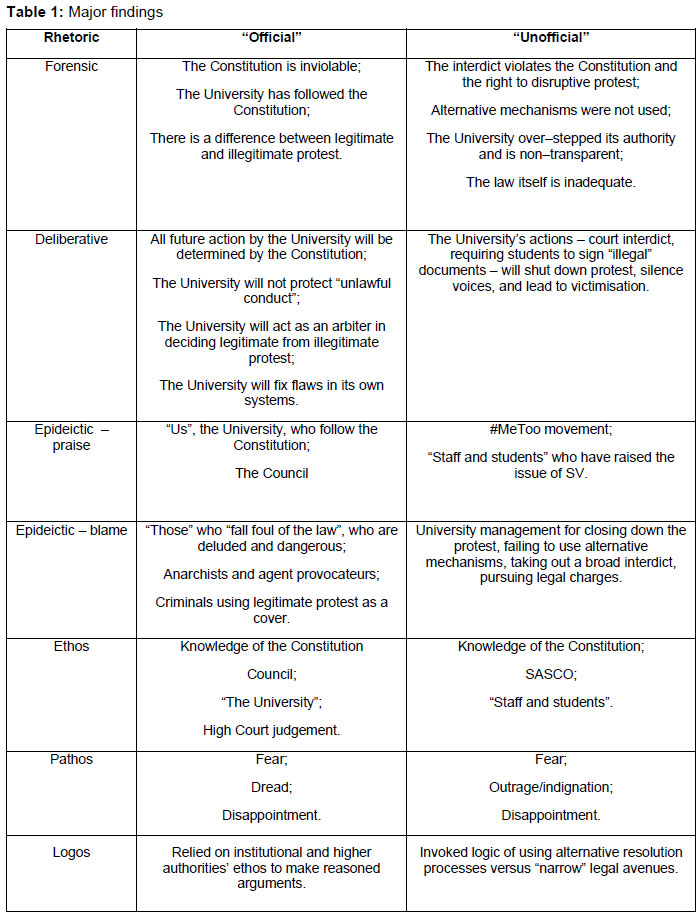
Table 1 summarises, and contrasts, the major findings of our analysis of the "the law" as a discursive resource in the case of the anti-rape protest at Rhodes University.
At no point did the University disavow the importance of addressing rape culture. Instead, they rhetorically separated out "agent provocateurs" and protesters engaging in "illegal" activities, arguing, through the use of generic pronoun, that everyone (other than the protesters engaged in illegal activities) would agree that their approach is firmly within the bounds of the Constitution. Protesters, on the other hand, argued that the University adopted a "narrow law and order" approach and failed to engage properly with the key issues at hand. They too used the generic pronoun - "we, staff and students", thereby isolating management as culpable for the narrow approach.
Each side of the dispute presented persuasive rhetoric based on forensic, deliberative, and epideictic arguments. Our analysis of these arguments shows some of the significant fault-lines between the two collectives. The ethos that the University could draw on (as a properly constituted, regulated body with a Council) meant that their appeals to the "higher authority" of the Constitution held significant weight. Within unofficial communication, authority was lent from the student organisation SASCO. Both sides used pathos - particularly fear of consequences - to bolster arguments. The social movement used the pathos appeal of indignation or outrage, possibly as a counterbalance to their weaker position on ethos (credibility). The use of expressed disappointment, aimed at particular members of each collective group, was also evident on both sides. This invoked the audience to channel disappointment at the opposing collective's actions (which may help gain solidarity by identifying with the in-group) while creating distancing (rhetorical division) from the opposition (and their use of the law).
CONCLUSION
In the contestations between higher education institutions and social movements, both may appeal to a "higher" system of authority - in this case, the Constitution. Where there is broad agreement between the two parties that the Constitution and "the law" is legitimate, arguments must then proceed along the lines of how these are understood and used by each collective. For official Rhodes rhetors, "the law" was viewed as self-evident, inviolable, and the higher authority that should and does determine the University's actions. Within rhetoric from #RUReferenceList social movement members, the University's actions were depicted as a "narrow law and order" approach, illegitimate or even illegal; at times, these actions were considered victimising and silencing.
Our study illustrates, we argue, some of the struggles that social movements face in the context of rights-based legislation, particularly in higher education institutions. And yet, the positions of each side were not seamless. In our analytical section, we presented extracts showing a rapprochement between the two sides. It is perhaps in these moments of fracture of neat rhetorical stances that ground can be gained in focussing away from "the law", per se, towards the kinds of issues social movements in such circumstances (progressive law) stress: distributive rights (equitable distribution of, and access to, resources - in this case, access to psychological, medical, legal resources to ameliorate and prevent sexual violence), recognition rights (avoidance of discrimination, being treated with respect and dignity - in this case, recognition of gendered-based rape myths, and dignity for survivors/victims), and reparative rights (recompense where injustices have been inflicted - in this case, the extraordinarily low rate of convictions or support for survivors). These issues enable a focus on justice concerning the implementation of the law rather than the law itself.
Declaration of interest
The authors are or were affiliated with the institution reported on in this article. This is declared in the article as well as the mechanisms put in place to ensure that the interpretations of the data are not biased in one way or the other.
REFERENCES
-
Albertyn, Cathi. 2019. "(In) equality and the South African Constitution." Development Southern Africa 36 (6): 751-766. https://doi.org/10.1080/0376835x.2019.1660860
» https://doi.org/10.1080/0376835x.2019.1660860 - Badat, Saleem. 2016. Deciphering the meanings, and explaining the South African higher education student protests of 2015-16. Pax Academica, 1(1): 71-106.
-
Bano, Samia, and Jennifer L. Pierce. 2013. "Personal narratives, social justice, and the law." Feminist Legal Studies 21 (3): 225-239. https://doi.org/10.1007/s10691-013-9251-z
» https://doi.org/10.1007/s10691-013-9251-z -
Banyard, Victoria, L., Elizabethe G. Plante, and Mary M. Moynihan. 2004. Bystander education: Bringing a broader community perspective to sexual violence prevention. Journal of Community Psychology 32 (1): 61-79. https://doi.org/10.1002/jcop.10078
» https://doi.org/10.1002/jcop.10078 -
Bashonga, Ragi, and Zuziwe Khuzwayo. 2017. ""This thing of the victim has to prove that the perp intended to assault is kak!": Social media responses to sexual violence on South African university campuses." Agenda 31 (3-4): 35-49. https://doi.org/10.1080/10130950.2017.1394636
» https://doi.org/10.1080/10130950.2017.1394636 - Bitzer, Llyod. F. 1968. "The rhetorical situation." Philosophy & rhetoric: 1-14.
-
Brenner, Alletta. 2013. "Transforming campus culture to prevent rape: the possibility and promise of restorative justice as a response to campus sexual violence." Harvard Journal of Law & Gender 10: 1-27. https://doi.org/10.1163/2210-7975_hrd-9963-3005
» https://doi.org/10.1163/2210-7975_hrd-9963-3005 - Clowes, Lindsay, Tamara Shefer, Elron Fouten, Tania Vergnani and Joachim Jacobs. 2009. Coercive sexual practices and gender-based violence on a university campus. Agenda 23 (80): 22-32.
-
de Klerk, Vivienne, Larissa Klazinga and Amy McNeill. 2007. "The habitus of the dominant: addressing rape and sexual assault at Rhodes University." Agenda 21 (74): 115-124. http://dx.doi.org/10.1080/10130950.2007.9674885
» http://dx.doi.org/10.1080/10130950.2007.9674885 -
della Porta, Donatella. 2020. "Protests as critical junctures: Some reflections towards a momentous approach to social movements." Social Movement Studies 19 (5-6): 556-575. https://doi.org/10.1080/14742837.2018.1555458
» https://doi.org/10.1080/14742837.2018.1555458 -
Dosekun, Simidele. 2007. "We live in fear, we feel very unsafe": Imagining and fearing rape in South Africa. Agenda 21 (74): 89-99. https://doi.org/10.1080/10130950.2007.9674881
» https://doi.org/10.1080/10130950.2007.9674881 -
Fahnestock, Jeanne. 2011. Rhetorical style: The uses of language in persuasion. New York: Oxford University Press. https://doi.org/10.1093/acprof:oso/9780199764129.001.0001
» https://doi.org/10.1093/acprof:oso/9780199764129.001.0001 - Fahnestock, Jeanne, and Marie Secor. 2004. A rhetoric of argument: A text and reader. 3rd ed. New York. McGraw-Hill.
-
Gopal, Priyamvada. 2021. On Decolonisation and the University, Textual Practice 35(6): 873-899, https://doi.org/10.1080/0950236X.2021.1929561
» https://doi.org/10.1080/0950236X.2021.1929561 - Gordon, Sarah Frances, and Anthony Collins. 2013. ""We face rape. We face all things": Understandings of gender-based violence amongst female students at a South African university. " African Safety Promotion: A Journal of Injury and Violence Prevention 11 (2): 93-106.
- Gouws, Amanda, Andrienetta Kritzinger and Marece Wenhold. 2005. "Report of an inquiry into the implementation of the sexual harassment policy and grievance procedure at the University of Stellenbosch." In Killing a virus with stones? Research on the implementation of policies against sexual harassment in Southern African higher education, edited by J Bennett, 53-116. University of Cape Town: African Gender Institute.
- Gqola, Pumla. 2015. Rape: A South African nightmare. Johannesburg: MF Books.
- Hauser, Gerard A. 2002. Introduction to rhetorical theory. 2nd ed. Illinois: Waveland Press.
-
Jasinski, James. 2001. Sourcebook on rhetoric: Key concepts in contemporary rhetorical studies. Thousand Oaks: Sage. https://doi.org/10.4135/9781452233222.n119
» https://doi.org/10.4135/9781452233222.n119 - Karim, Safura Abdool, and Catherine Kruyer. 2017. "Rhodes University v Student Representative Council of Rhodes University: The constitutionality of interdicting non-violent disruptive protest." South African Crime Quarterly 62: 93-102.
-
Leach, Joan. 2000. "Rhetorical analysis." In Qualitative researching with text, image and sound: A practical handbookfor social research, edited by Bauer, M.Q. and G. Gaskell, 207-226. Thousand Oaks. Sage. https://doi.org/10.4135/9781849209731.n12
» https://doi.org/10.4135/9781849209731.n12 -
Macleod, Catriona, I., Werner Böhmke, Jabulile Mavuso, Kim Barker, and Malvern Chiweshe. 2018. Contesting sexual violence policies in higher education: the case of Rhodes University, Journal of Aggression, Conflict and Peace Research 10 (2): 83-92. https://doi.org/10.1108/JACPR-05-2017-0295
» https://doi.org/10.1108/JACPR-05-2017-0295 -
Mail & Guardian. 2018. #RUReferenceList: The fear of repercussions still lingers. https://mg.co.za/article/2018-07-06-00-rureferencelist-the-fear-of-repercussions-still-lingers/
» https://mg.co.za/article/2018-07-06-00-rureferencelist-the-fear-of-repercussions-still-lingers/ - Rhodes University v Student Representative Council of Rhodes University and Others (1937/2016) [2016] ZAECGHC 141; [2017] 1 All SA 617 (ECG) (1 December 2016).
-
Rhodes University. 2023. Sexual Offences Policy for Students. https://www.ru.ac.za/media/rhodesuniversity/content/deanofstudents/documents/Sexual_Offences_Policy_for_students.pdf
» https://www.ru.ac.za/media/rhodesuniversity/content/deanofstudents/documents/Sexual_Offences_Policy_for_students.pdf - Sass, Bridgette. 2005. Coping with violence: institutional and student responses at the University of the Western Cape. MA dissertation. University of the Western Cape.
-
Selzer, Jack. 2003. "Rhetorical analysis: Understanding how texts persuade readers." In What writing does and how it does it. An introduction to analyzing texts and textual practices, edited by Bazerman, C. and P. Prior, 285-314. New Jersey: Lawrence Erlbaum. https://doi.org/10.4324/9781410609526
» https://doi.org/10.4324/9781410609526 -
Singh, Shakila, Ronicka Mudaly and Asheena Singh-Pillay. 2015. The what, who and where of female students' fear of sexual assault on a South African University campus. Agenda-Empowering Women for Gender Equity 29 (3): 97-105. https://doi.org/10.1080/10130950.2015.1045335
» https://doi.org/10.1080/10130950.2015.1045335 - Teferra, Damtew, and Mthokozisi Emmanuel Ntuli. 2021. Towards a new conceptual framework of student activism in South Africa. Journal of Higher Education in Africa/Revue de l'enseignement supérieur en Afrique, 19(2): 57-76.
- Vetten, Lisa. 2014. Rape and other forms of sexual violence in South Africa (Policy Brief 72). Pretoria: Institute for Security Studies.
-
Winton, Sue. 2013. Rhetorical analysis in critical policy research. International Journal of Qualitative Studies in Education 26(2): 158-177. https://doi.org/10.1080/09518398.2012.666288
» https://doi.org/10.1080/09518398.2012.666288 -
Whittles, Govan. 2016. Rhodes reference list a violation of human rights. Eye Witness News. https://ewn.co.za/2016/04/22/Rhodes-reference-list-a-violation-of-human-rights
» https://ewn.co.za/2016/04/22/Rhodes-reference-list-a-violation-of-human-rights
ENDNOTES
• To note, in 2017 a revival of the protest took place (#RUReferenceList 2.0), however it received less attention and action from both student and management.
• All universities create disciplinary codes that deal with breaches of university rules and apply administrative justice. While these processes are separate from the criminal justice system, the two work in tandem, and universities are required to report criminal activity where it does occur.
• South African Students Congress.
• Document quotes: "You have accepted and agreed that if you are accused of any activity that may interfere with the ordinary functioning of the University, you may be subject to immediate suspension from participation in University activities and excluded from the University campus pending the completion of disciplinary proceedings".
• Article can be accessed at: https://www.dailymaverick.co.za/article/2018-05-24-reporting-on-sexual-abuse-the-most-difficult-journalism-of-all/