A critical analysis of the adventure tourism higher education landscape in South Africa
Abstract
The adventure tourism sector continues to grow in both developed and developing countries. With this growth, there also exists an increased demand for qualified and highly trained employees that are ready for the real world of work. Further education and higher education institutions (HEIs) serve as platforms for the development of this much needed human resource. Specialised curricula, form the basis on which this human capacity is developed. However, not much is known about the landscape of adventure tourism higher education offerings in South Africa, in particular. This article seeks to address this shortcoming by critically analysing the adventure tourism higher education landscape in South Africa. Results are presented and recommendations are made to further the academic discourse in adventure tourism curriculum development.
Adventure Tourism; curriculum development; higher education; South Africa, tourism
INTRODUCTION
The global adventure tourism sector of the tourism industry was said to be worth an estimated US$496 million in 2019, just prior to the COVID-19 pandemic (Statista, 2021). In the post-COVID-19 landscape, the global adventure tourism market in 2022 was valued at US$366.7 billion and is forecasted to grow to US$4.6 trillion by 2032 (Allied Market Research, 2023). This is sector attracts high value tourism consumers with high spending power which directly has a multiplier effect on the supporting local economies. In South Africa, a total of ZAR4.6 billion (€272.7m) in revenue was generated through these activities, which equated to a direct contribution of 4 per cent to the total contribution of the tourism industry to the country's gross domestic product (Du Toit, 2022). This information paints a picture of continued growth in the adventure tourism sector globally, exceeding pre-COVID-19 pandemic levels.
From a South African perspective, the adventure tourism sector presents great potential due to the country's rich resources for the hosting of adventure products such as the variety of landscapes (cultural and natural) provided by the country's natural environment that are suitable for adventure tourism activities, many of which remain relatively pristine. In addition, the development of adventure tourism has significant potential for the upliftment of local communities, especially those in rural and lesser-developed areas, through local economic development strategies due to the relatively low capital needed to establish many activities considered adventure tourism. However, very little research exists on this important sector in the South African context (Giddy, 2016) which presents a challenge, especially related to understanding the development of the specialist human resources needed to successfully operate adventure services.
Higher education institutions (HEIs) play a major role in furthering education, in that they are to provide environments which nurture learning among students. From a national policy perspective, the South African Council for Higher Education (CHE, 2013a:v) document entitled The Aims of Higher Education; the purpose of higher education is alluded to as follows:
"To meet the learning needs and aspirations of individuals through the development of their intellectual abilities and aptitudes throughout their lives. To address the development needs of society and provide the labour market, in a knowledge-driven and knowledge-dependent society, with the ever-changing high-level competencies and expertise necessary for the growth and prosperity of a modern society. Contribute to the socialisation of enlightened, responsible and constructively critical citizens. To contribute to the creation, sharing and evaluation of knowledge."
The role of HEIs is evidently multifaceted; nevertheless, the core theme that pertains to the purpose of these institutions aligns with the development of students' cognitive knowledge and skills to meet the economic, social and environmental needs of the industry they serve as well as the need for global citizenship.
The aim of this article is to, through a critical analysis of curricula on offer, shape a discourse that may contribute towards the development and transformation of future adventure tourism curricula in South Africa.
This literature review will provide a theoretical overview of adventure tourism as a field of study in South Africa followed by a discussion of the nature of higher educational qualifications in South Africa.
Overview of adventure tourism
Adventure tourism is considered a form of tourism that that involves exploring remote or exotic locations and engaging in physically challenging activities (McKay, 2014). It often includes activities such as hiking, trekking, climbing, scuba diving, rafting and wildlife safaris, therefore this form of tourism may also play into the domains of other categories of tourism such as ecotourism, leisure and recreation (Rantala, Rokenes and Valkonen, 2016). This form of tourism emphasizes sustainability and environmental consciousness, often promoting respect for local cultures and ecosystems. An academic debate has however arisen regarding whether "adventure tourism" is a category of tourism as opposed to an analytical concept. In this article the view of Rantala, et al. (2016) is sustained wherein adventure tourism is seen as a niche category of tourism in which the actions of adventure tourists may also habitually overlaps into other tourism categories.
Adventure tourism focuses on experiences that provide excitement and adrenaline rushes, appealing to travellers seeking new and thrilling experiences predominantly, but not limited to, natural environments. These tourists therefore partake in so called "risky" activities (Mueller and Pell, 2016) that may require specialised skills and experience. However, with a growth of adventure tourism there has also been an aligned growth in commercialisation and best practice some have argued that the element of real risk has been mitigated so such a degree that it is minimal (Buckley, 2012). This element of risk, may be seen as a potential limiting factor for the pedagogical (and andragogical) potential of adventure in education (Brown and Beames, 2016) and thus may curb the continued development of curricula in this regard. The inclusion of adventure in education and experiences has also been seen as a beneficial tool in the development of skills related to the unpredictability and complexity in a world which is in constant change, this is beneficial to learners (and students) but also potentially for tourists themselves (Brown and Beames, 2016). In order to effectively manage risks and to cater for the specific needs of adventure tourists, service providers in the sector require human resources with specialised skills and competencies as adventure tourists may not always be masters of the adventure activity they partake in and in most cases seek "thrill and excitement" as opposed to real risk experiences (Cater, 2006).
Adventure tourism in South Africa offers a diverse range of activities which are predominantly set against the country's natural landscapes. South Africa is known for its rich biodiversity, dramatic scenery and varied climates, making it an ideal destination for adventure seekers (Giddy and Webb, 2018). Some of the most popular adventure activities that have been the topic of research discourse in the country being:
Safari Tours: Exploring national parks and protected areas such as the Kruger National Park to see the Big Five (lion, leopard, rhinoceros, elephant and cape buffalo) and adventure activities in natural landscapes (Geldenhuys, Van der Merwe and Saayman, 2016; Giddy and Webb, 2016) and adventure activity preferences in national parks (Kruger et al., 2018),
Scuba diver tracking (Giddy and Rogerson, 2018), behaviour (Allkins, Tshipala and Hermann, 2021) and experiences (Schoeman, Van der Merwe and Slabbert, 2016),
Socio-economic impacts on local communities of mountain biking and horse trail (Ndlovu and Rogerson, 2003; Steyn, Spencer, Gonzalez and Swart, 2016; Du Preez and Lee, 2016), mountain bike development (Bordelon and Ferreira, 2018) and participant motivations in these activities (Kruger, Hallmann and Saayman, 2016),
4X4 trail management (Saayman and Klaibor, 2016),
Profiling hikers (Saayman and Viljoen, 2018),
Bunge jumping development (McKay, 2014),
Rock climbing and abseiling (Graham, Tshipala and Lötter, 2017; Potgieter, Tshipala and Coetzee, 2019).
South Africa's adventure tourism sector is the largest in Africa and has shown significant growth potential (McKay, 2018b). The sector has the potential to revive the stagnant domestic tourism market and to generate valuable foreign revenue form international tourist arrivals (McKay, 2018b). This economic contribution has the added benefit in supporting small business growth and employment creation in a country with one of the highest unemployment rates, especially in rural communities (Spenceley and Seif, 2003; McKay, 2014). Research into the sector from a South African and African perspective is inadequate with unsystematic and segmented small-scale research which hamper effective planning and promotion of the sector in national policy and strategies (McKay, 2018b). To elaborate further on this challenge, the following section delves into analysing the adventure tourism higher education landscape in South Africa.
Tourism and adventure tourism as a field of higher education in South Africa
In comparison with many established academic disciplines and professional domains, tourism (particularly the adventure tourism sector) may be regarded as a comparatively recent area of scholarly focus. The earliest formalised qualification related to tourism appeared in 1922, when the Cornell School of Hotel Administration in the United States introduced a course in hotel management (Scotland, 2006). By 1969, the first four-year degree programme centred on travel and tourism had been launched, also within the United States (Scotland, 2006). The initial emphasis of these early programmes was largely on the administration and organisation of recreational tourism activities (Airey, 2014). It was only in the early 1990s that tourism education began to attain recognition as a legitimate field of academic specialisation, a period during which it also started to gain traction within the South African higher education sector. In the South African context, tourism was incorporated into the high school curriculum for the first time in 1996, coinciding with the introduction of formalised tourism qualifications within the higher education sector (Dube, 2014). According to Geldenhuys (2000), early tourism programmes offered by higher education institutions (HEIs) were often perceived as extensions of the school-level curriculum. Consequently, learners who had taken tourism as a subject at school were seen to possess a comparative advantage when pursuing further studies in the field (Airey, 2014). At present, tourism-related qualifications in South Africa are offered across a diverse range of post-school institutions, including:
TVET colleges (Technical and Vocational Education and Training), which provide vocationally oriented programmes.
Private higher education institutions, offering industry-focused or specialised tourism qualifications.
Universities of technology, which emphasise applied and vocational education.
Traditional universities, primarily oriented toward research-intensive academic programmes and
Comprehensive universities, which integrate both vocational and research-based approaches.
Tourism is a dynamic, multisectoral and ever-changing industry. As the industry undergoes constant change, employers' requirements also fluctuate, with new jobs emerging, while others seem to become obsolete. Unforeseen circumstances, such as the COVID-19 pandemic, its associated global lockdowns and travel restrictions, have had a significant impact on the industry, altering the way people perceive the need to travel in the future. Online information sources have gained increased importance over consulting friends and relatives, additionally the advancement of digitisation is expected to decrease tourist reliance on "brick and mortar" service providers, except for specialised and advisory services. Additionally, technologies such as virtual reality and artificial intelligence may play an increasingly important role (Toubes, Araújo-Vila and Fraiz-Brea, 2021). In the post COVID-19 landscape smart care, enhanced customer-centric pricing strategies, safety, comfort and social distancing have become the norm (Orden-Mejía et al., 2022). The tourism industry, as a whole, must therefore take cognisance of these new trends in the market on order to cater to the demands of the industry (Benjamin, Dillette and Alderman, 2020). Although adventure tourism, as a discipline, is a relatively new sector of tourism education, the field has been an area of learning, albeit in augmented but closely related fields. For example, the history of outdoor education and subsequent undergraduate provision in adventure and outdoor programmes dates back to the late 1960s (Stott, 2015) in Europe. Melhuish (2017) notes that since then, research in the field and curriculum development in HEIs has grown, boosted by the launch of dedicated journals, such as the Journal of Adventure Education and Outdoor Leadership in the 1990s, followed by the Journal of Adventure Education and Outdoor Learning in 2000. This led to increased discourse into the development of outdoor education qualifications and professional standards as well as curriculum development practices. Over the past 60 years there has been a marked increase in undergraduate qualifications in the United Kingdom that relate to outdoor recreation and adventure tourism specifically with Hickman and Collins (2014) recording around 50 undergraduate outdoor courses and a separate 70 postgraduate outdoor courses. This can only be attributed to the demand for such qualifications from the industry. Although there has been a marked increase in qualifications on offer, Melhuish (2017), as with Giddy (2020) argue for a more aligned and standardised curriculum development process for the development of qualifications and training in this regard. Adventure tourism has also become an emergent specialised field of higher education in South Africa with the first specialised qualification in the field being the National Diploma in Adventure Tourism Management implemented by the former Technikon Pretoria in 2001 (South African Department of Education, ND). The slow development of specialised adventure tourism qualifications, especially in South Africa may be influenced by several systematic factors that shape the sector, these factors include:
Fragmentation of the industry
The sector encompasses a wide array of activities, each with different skill requirements often overlapping with other tourism sectors (Rantala et al., 2016). This diversity makes may make it challenging to create a standardised qualification that applies across all activities. Different regions and countries may have varying areas of focus when it comes to research into the field of adventure tourism (Cheng, 2018) which may complicate the creation of universally recognised qualifications.
Lack of regulatory oversight
Unlike other tourism sectors in South Africa, such as aviation or hospitality, adventure tourism is often less regulated (McKay, 2018b). Governments may not enforce stringent qualifications for operators, making it less urgent for the sector to develop formal qualifications. Many adventure tourism operators rely on self-regulation through internal training or certifications provided by specific organisations, questioning the need for standardised, externally recognised qualifications (McKay, 2018b).
Education system constraints
Education systems, particularly HEIs in South Africa tend to take time to develop and approve new curricula due to bureaucratic processes (Matlakala and Maritz, 2019). Establishing a specialised qualification often requires collaboration between universities, industry professionals and regulatory bodies, which can be time-consuming. Often, there is also a gap between the rapidly evolving needs of the tourism industry and its associated sectors, and the ability of academic institutions to respond with relevant courses and qualifications (Burlacu, 2023).
Market demand and perceived value
Adventure tourism is still a niche within the broader tourism industry (Giddy, 2020). This may lead to lower perceived demand for specialised qualifications, especially in comparison to more general tourism management qualifications. Many adventure tourism operators place greater emphasis on practical experience and in-house training, rather than formal qualifications (Giddy, 2020), reducing the perceived need for specialised academic programmes.
Cost and resource barriers
Setting up adventure tourism operations require significant capital investment (McKay, 2018a) and this may also be the case with developing qualifications which will also require significant investment in resources, such as equipment, trained instructors and access to appropriate training environments. This can deter institutions from offering such programmes. The sector is inherently risky, and the need for insurance and liability management (Clinch and Filimonau, 2017) can further complicate the development of formal training programs that need to meet high safety standards.
Changing nature of the sector
Adventure tourism is constantly evolving with new trends and activities (Giddy, 2020) making it difficult to create qualifications that remain relevant over time. Qualifications need to adapt to new safety protocols, equipment and technologies, adding further complexity to the development process. The sector often relies on informal knowledge-sharing networks (Hansen et al., 2019), including mentorship and apprenticeship models, which may reduce the pressure to formalise qualifications.
Cultural and geographical differences
Adventure tourism activities are often location-dependent (Buckley, 2018) meaning the training required for one activity may not be applicable to others, making the creation of a standardised qualification system more challenging. These systematic factors highlight the complexity of developing specialised qualifications in adventure tourism, where industry dynamics, educational limitations and market forces all interact.
Considering the challenges listed above, Melhuish (2017) notes that considerable potential still exists in provision of undergraduate adventure and outdoor qualifications, especially in light of the increasing breadth of the sector. Additionally, the sector is a highly activity-based that requires specialist and well-trained guiding and instruction (Clinch and Filimonau, 2016; Giddy, 2020; Mees, Toering and Collins, 2021) that not only ensure visitor service quality but also safety and risk mitigation (Hild, Jóhannesson and Sydnes, 2023). For this reason, a need has been identified for the development and provision of specialist human resources that are able to effectively cater to the needs of the adventure sector. This specialist knowledge and competencies in turn require specialised curricula that promote the development of professional outdoor instructors which should embrace challenging formative learning experiences, building a community of practice and the explicit development of metacognition (Mees et al., 2021). Leadership is also considered a vital attribute of adventure graduates, more specifically, the affective attributes of inter and intra-personal skills that are required to be an effective outdoor leader (Baker and O'Brien, 2019).
The training and development of these specialist human resources for the sector has been achieved by means of adventure tourism operators providing their own in-house training and through courses offered at colleges, institutes and universities in the higher education arena (Giddy, 2020). Research into the field of adventure tourism higher education in a South African and African perspective is essentially absent with the few studies in the field focussing primarily on basic education such as adolescents' perceptions of an adventure-based learning programme in schools (Bosch and Oswald, 2010), adolescent psychosocial development through adventure education (Blaine and Akhurst, 2020) and experiential learning using adventure (Louw et al., 2012). A literature search found no studies on adventure tourism curriculum design in Africa nor any qualification in this field on the continent. Giddy (2020) therefore promotes the need for a more research in the field and the advancement of the standardised development and monitoring of training and qualifications on offer in the sector which is an evident current challenge in South Africa and the continent. Failure to address these challenges may result in poor service delivery by inadequately trained staff, a lack of effective risk mitigation and potential litigation and overall inefficiencies in operations which may have a detrimental effect on the reputation of the South African adventure sector. To address this challenge, more research and discourse is needed on the adventure tourism higher education curriculum landscape in South Africa.
NATURE OF HIGHER EDUCATION QUALIFICATIONS IN SOUTH AFRICAThe governance of the South African higher education system is entrusted to the Department of Higher Education and Training (DHET), which functions under the authority of the Minister of Higher Education, Science and Innovation. In addition to its regulatory mandate, DHET plays a key supportive role by allocating financial resources to public higher education institutions (DHET, 2022). The operational development, administration and assurance of quality within the sector are further facilitated by several associated statutory bodies and agencies.
All formally registered qualifications in South Africa are structured according to the Higher Education Qualifications Sub-Framework (HEQSF), which forms a component of the National Qualifications Framework (NQF) (South African Qualifications Authority [SAQA], 2024). The NQF establishes a coherent national system intended to standardise and articulate qualifications across educational sectors. It consists of ten levels, with Levels 1 to 4 classified as part of basic education, falling under the ambit of the Department of Basic Education, while Levels 5 to 10 constitute the domain of higher education and fall under DHET's oversight (South African Government [SA], 2014).
Tourist guiding qualifications, including those in cultural, adventure and ecotourism guiding, are situated at NQF Level 4 (SAQA, 2024). As such, they are categorised within further education and training rather than higher education, placing them outside the immediate scope of the HEQSF.
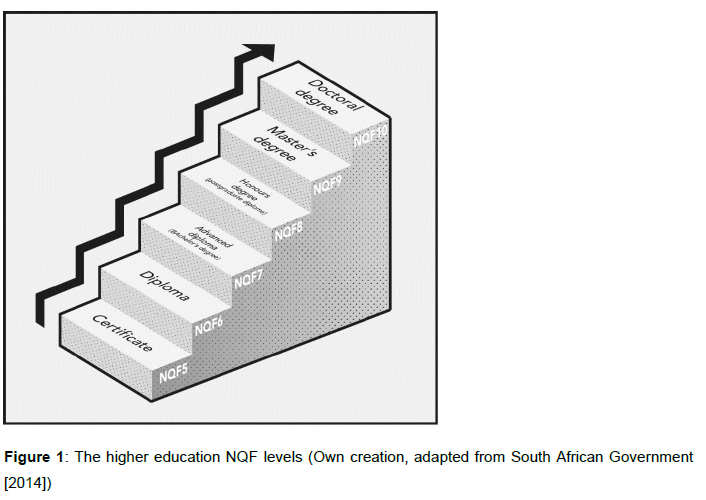
The implementation of the HEQSF, gazetted in 2008, required modifications to existing national diplomas and the creation of new qualifications, such as postgraduate diplomas, to ensure a vertical articulation trajectory leading to the Master's qualification and thereafter Doctoral qualifications. Figure 1 provides a visual representation of these NQF levels and how one may vertically articulate into another. As this study focusses on higher education, only NQF level 5 and higher are included.
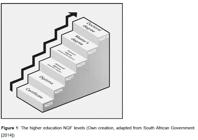
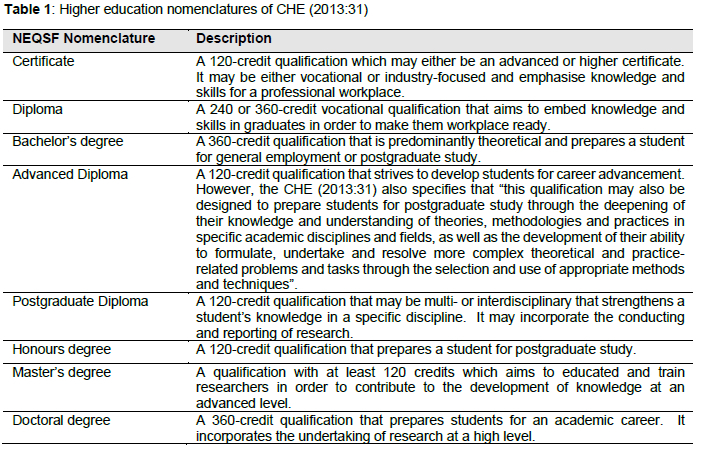
In order to further delineate the NQF levels in Figure 1, Table 2 provides an overview of the primary nomenclatures of qualifications on the HEQSF.
SAQA is mandated to develop the policies and criteria that guide the registration of standards and qualifications on the NQF, acting on the recommendations submitted by the Council on Higher Education (CHE) (SA, 2014). As an institution, SAQA primarily fulfils an oversight function in relation to the NQF, which includes responsibilities connected to the formulation and coordination of qualification standards. Within this role, SAQA provides guidance to the quality councils (such as the Quality Council for Trades and Occupations) and is responsible for the registration of both full qualifications (e.g., degrees) and part-qualifications (e.g., credit-bearing short programmes) on the NQF. This means that all qualifications offered by higher education institutions in South Africa are required to be formally registered with SAQA (SAQA, 2014).
The SAQA database of registered qualifications therefore offers a comprehensive and authoritative source from which to examine the structure and distribution of adventure-tourism-related higher education programmes in the country. For this reason, it served as the primary data source for the present study.
METHOD
The aim of this article is to, through a critical analysis of curricula on offer, shape a discourse that may contribute towards the development and transformation of future higher education adventure tourism curricula. The empirical evidence was sourced from the SAQA website, which publishes the details of all qualifications formally registered in South Africa. Keywords were used that also served as inclusion criteria such as adventure, adventure tourism, outdoor recreation, recreation and leisure during the searching of the database in order to identify and obtain the qualification descriptors of all qualifications on NQF levels 5 to 10. This set of documents therefore only included those qualifications formally registered with SAQA and it does not include short courses or part qualifications or other forms of training that is not formally registered. Thus, this excluded all curricula on basic education level. The exclusion criteria were also set to exclude all qualifications that focus only on sport management or generic tourism qualifications. A total of 55 qualification descriptors were downloaded and screened for appropriateness. This screening pertained to eliminating those qualifications that did not adhere to the aforementioned inclusion and exclusion criteria. After the screening a total of 15 qualification descriptors were retained for analysis. The research design made use of document analysis in which the purpose, NQF level, module outline and institution hosting the qualification were identified and analysed. Document analysis is the process of examining and evaluating documents to extract meaningful information, understand content and gather data for specific purposes (Quinlan et al., 2019). This process involved reviewing various forms of written, visual, or digital materials which in this case were the SAQA course descriptors. The approach allows researchers to analyse both the content and context of the documents. In this process content analysis was used in order to identify patterns, trends and insights from the textual data within the documents, making use of a qualitative approach. The content analysis process set out to analyse each of the course descriptors to identify common themes deductively, based on the primary exit level outcomes of these qualifications and their sector of focus, modules in each course were analysed by means of frequencies. Data collection and analysis took place during April 2024 the results therefore depict a snapshot of the landscape of adventure tourism higher education in South Africa as of this period.
RESULTS AND DISCUSSION
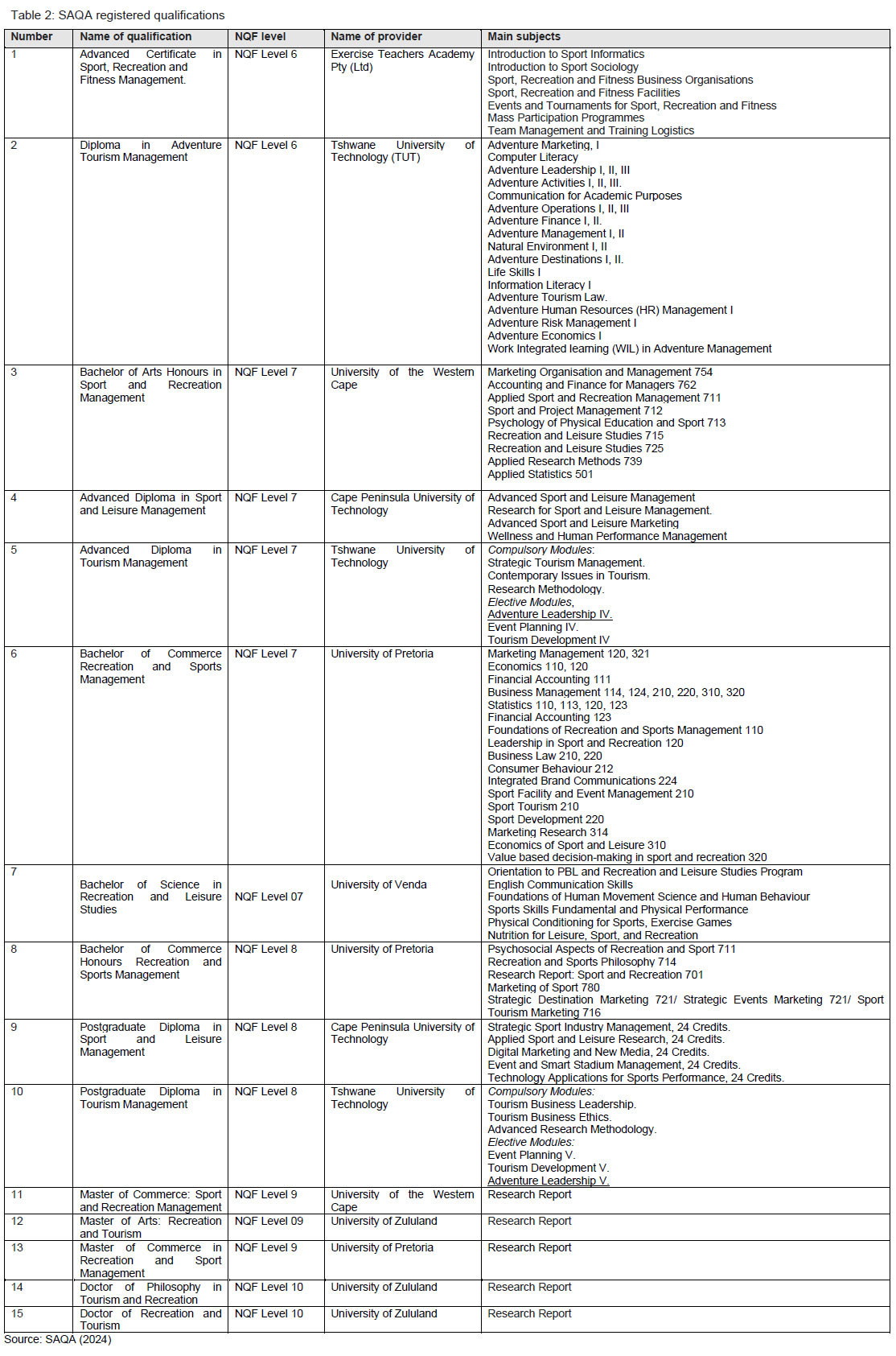
From the SAQA (2024) database a total of 15 qualifications were retained for analysis as indicated and presented in Table 2.
The search on the SAQA database revealed a number of qualifications related to the disciplines of tourism as well as those encompassing pure sport management, however these were excluded from the analysis as they primarily seek to develop graduates for the world of work in tourism which generally excludes adventure activities or for the sports sector, more specifically sport coaching and management, fitness and personal training. These fields were deemed too far removed from the core focus of this study, adventure tourism. For the purposes of this analysis only those qualifications were included whose purpose dealt with to the development of graduates for the world of work involving potential tourists serving as clients that receive services related to outdoor recreation, leisure or adventure. From Table 2 it is evident that the registered qualifications in the adventure and recreation landscape range predominantly on the NQF levels 6-10. The majority of these qualifications, apart from one, are offered by public HEIs in the form of universities of technology, traditional and comprehensive universities.
At undergraduate level, 7 qualifications revealed themselves, namely; the Advanced Certificate in Sport, Recreation and Fitness Management; the Diploma in Adventure Tourism Management; the Bachelor of Arts Honours in Sport and Recreation Management; the Advanced Diploma in Sport and Leisure Management; the Bachelor of Commerce Recreation and Sports Management and the Bachelor of Science in Recreation and Leisure Studies. All these qualifications, apart from the Diploma in Adventure Tourism Management focus on the development of graduates primarily for the management of activities related to outdoor facilitation, with a strong focus on sport and recreation management. As an example, the Bachelor of Commerce in Recreation and Sport Management from the University of Pretoria states its purpose as follows:
"The first purpose of the qualification is to provide qualifiers with graduate-level knowledge, specific skills and applied competence in the management sciences in order to apply these in the field of sport and recreation. This includes a study of both sport and recreation as a phenomenon, their management and social and personal value. This will provide opportunities for continued personal growth, gainful economic activity and rewarding contributions to society".
From the above it is evident that this qualification serves a role in the development of graduate competence in the management of sport and recreational activities, including a specific module on sport tourism. The specialised focus on adventure tourism is not prominent.
The Diploma in Adventure Tourism Management of the Tshwane University of Technology is the only pure adventure tourism qualification accredited in South Africa. This 360-credit, 3-year diploma is offered at the university's Mbombela (Nelspruit) campus and is an evolution of the original 2001 National Diploma curriculated by the former Technikon Pretoria. The purpose of this diploma is stated as follows:
"Students with the qualification will be able to operate as supervisors, managers, owners and/or operators of small adventure tourism businesses or in government departments at national, provincial and local level. They could also work for adventure tourism companies, resorts, parks or lodges. They can enter the industry as outdoor adventure guides on water (canoe guides, kayak guides, white-water rafting guides, river guides, lifeguards), on land (cycling guides, horseback guides, natural history guides, safari guides, tour leaders, trail staff), in mountains (climbing guides and mountaineering guides) or as outdoor adventure personnel in a variety of occupations (outfitting staff, outdoor educators, tour guides, trip leaders, wilderness specialists). The will also be able to operate as tour operators and as facilitators in leadership training."
This purpose statement reveals the clear role that this qualification seeks to achieve in the development of adventure guides, managers and entrepreneurs in the sector. To achieve this purpose the qualification entails numerous general modules aligned to the management of tourism services as well as specialist adventure modules such as Adventure Leadership, Adventure Activities, Adventure Operations, Natural Environment as well as a 6-month module entailing work integrated learning (WIL) where students are required to participate in vocation-based practical learning in an adventure tourism setting. Paradoxically, this qualification promotes the development of adventure guides, however guiding rests on NQF4 and thus a graduate with this diploma will need to have to complete an additional NQF4 guiding course to become a registered adventure guide.
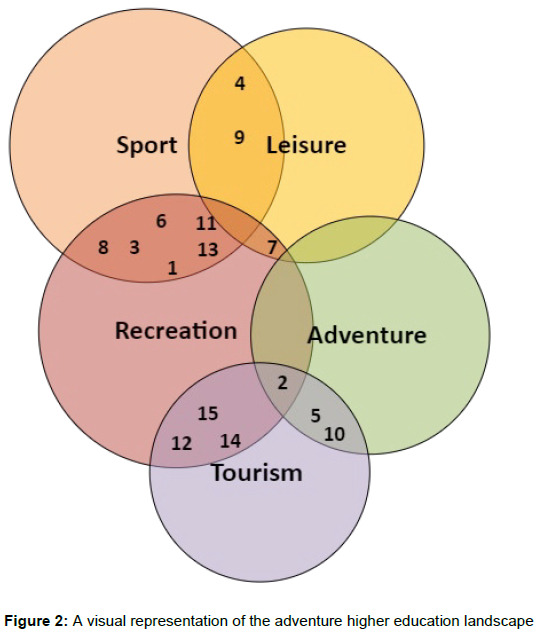
On a postgraduate, NQF 8 level, two qualifications were identified, namely the Bachelor of Commerce Honours Recreation and Sports Management and the Postgraduate Diploma in Sport and Leisure Management. As with the predominant trend in undergraduate qualifications, these two curricula focus on the further development of students in the field of sports and recreation management. From a vertical articulation perspective, three masters and two doctoral qualifications exist in the field of sport and recreation or recreation and tourism. No specialised adventure tourism qualifications exist on NQF7 or higher. Although the Advanced Diploma and Postgraduate Diploma in Tourism Management at TUT include an elective module focussing on Adventure Leadership (SAQA, 2024). Figure 2 provides a visual presentation of the adventure higher education landscape based on the purpose of each qualification. The numbers indicated in the figure correlate with the numbering of qualifications as indicated in Table 2.
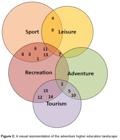
From Figure 2 it is evident that the accredited qualifications in South Africa are clustered around two core areas. On an undergraduate level these predominantly cater to the development of graduates in the field of sport and recreation. On postgraduate level there is a cluster of qualifications in tourism and recreation. Only one specialised adventure tourism qualification was identified which aims towards the development of student skills and competence in the adventure discipline, as well as one focussing on leisure and recreation that may indirectly develop graduates in the field of adventure tourism, although the latter is not a core outcome of the Bachelor of Science in Recreation and Leisure Studies at the University of Venda.
With the continued growth in the adventure tourism sector in South Africa, there is and will be a related need for specialist human resources. These human resources should provide for the unique requirements of the sector for competent and specialised adventure guides, facilitators and, tour and expedition planners. Brown and Beames (2016) caution that new forms of adventure as continuously in development based on a range of factors, such as increasing global mobility, rapid advances in media and communications and constantly evolving technology. In such a dynamic sector, curriculum developers must strive to remain current with the continually shifting worlds that students will inhabit and to adapt curricula in order to meet the vocational needs of the sector.
Currently, only one vocational qualification in South Africa caters directly to the needs of the sector with other qualifications providing limited modules for the development of the specialist needs of the sector. There therefore exists a seemingly evident gap in the vocational needs of the sector and the ability of HEIs to provide for these vital needs. The reason for this may be two-fold; firstly, although professional bodies exist in the adventure tourism sector in South Africa, there are no policies or regulations that make it obligatory for those practicing in the sector to register with such a professional body or operate under sectoral guidelines which may result in a lack of sector standardisation (as alluded to by Giddy, 2016) and a lack of a robust uniform voice from the sector. Due to the aforementioned there is no clear understanding of what the needs are of industry and as a result HEIs face a challenge in catering to the needs of the sector. Secondly, the qualifications that are on offer are either not well received by the adventure tourism sector due to a potential misalignment of the curriculum or perhaps there is a gap in the provision of an effective curriculum at an adequate NQF level that will cater to the needs of the sector. Although this study did not seek to identify the causes of these challenges, there is an evident need for further research in this regard, more specific recommendations are provided in the next section.
CONCLUSION
Understanding which qualifications are currently on offer is essential for effectively planning and developing future curricula. This knowledge may assist stakeholders such as HEIs identify gaps in the existing education landscape and respond to evolving industry needs, ensuring that future programs remain relevant and aligned with market demands. It also enables curriculum developers to avoid redundancy and create innovative qualifications that address emerging skills shortages. Moreover, having a clear understanding of the qualifications on offer allows institutions to build coherent educational pathways for students, promoting seamless progression from one level of study to the next and ultimately enhancing employability and career development.
Over the past few decades qualifications in the field of adventure tourism have emerged globally in markets where the sector is better established. This has occurred to a lesser degree in South Africa, albeit in a growing market. To meet the needs of human resources in the sector, operators have resorted in inhouse training of guides and formal training providers have also emerged as providers of accredited qualifications in this regard. Thus, curricula offered at HEIs may not be effectively catering to the needs of the sector and greater liaison is needed to bridge this gap.
For the higher education sector in adventure tourism to advance, it is essential to recognise and address the existential challenges it faces. A key issue is the fragmentation of the industry and the lack of meaningful collaboration between the sector and HEIs. This disconnect is exemplified by the absence of SAQA approved vocational qualifications at NQF levels 6 and 7 that adequately serve the requirements of adventure guiding. Graduates at these levels are still required to complete an additional NQF 4 guiding qualification in order to practice professionally and legally, which calls into question the practical relevance and achievement of the exit-level outcomes of these qualifications. This highlights a misalignment between the needs of the adventure sector and the role of HEIs in addressing those needs.
As Rantala et al (2016) allude to, there is a need for greater regulatory oversight as well as improved sectoral regulation (McKay, 2018b). Although bodies such as the South African Adventure Industry Association exist, membership is voluntary and as such there is currently no single "voice" for the sector. There is a need for greater transformation of such organisations in order to become a holistic voice of the adventure sector through the recognition of a professional body in this regard. This may create opportunities for more effective industry liaison by HEIs and the promotion of greater formalised knowledge-sharing networks as proposed by Hansen et al (2019),
The bureaucratic nature of curriculum development in South Africa does provide a constraint, especially for niche curricula such as those in the adventure sector. HEIs should actively and on an ongoing process strive to transform their curricula as opposed to reactive and periodic reviews. Industry-academia collaboration is vital in this regard as promoted by Burlacu (2023). Advisory committees that include industry and graduate representation should play a continuous and active role in curriculum transformation.
The high cost of specialised training in the adventure tourism sector, as highlighted by McKay (2018a), could be mitigated through strategic collaboration with industry stakeholders. By forming industry partnerships, HEIs can integrate practical learning opportunities and relevant training into their curricula, ensuring that students acquire the skills necessary for the demands of the sector. Collaboration with industry also enables HEIs to better identify essential training needs, allowing them to eliminate outdated or irrelevant activities that unnecessarily inflate the cost of education.
Moreover, industry partnerships can provide crucial input for determining the appropriate mix of higher education qualifications required by the sector, while also facilitating more effective channels for student WIL. Currently, there are very few NQF 6 qualifications registered with the SAQA, even though adventure operators often bear significant costs to train their employees in order to meet operational requirements. With adventure guiding qualifications typically registered at NQF 4, it is possible that HEIs are developing qualifications that are misaligned with industry needs.
This situation presents an opportunity for HEIs to collaborate with industry bodies, including Culture, Arts, Tourism, Hospitality, and Sport Sector Education and Training Authority (CATHSSETA) and the Quality Council for Trades and Occupations (QCTO), in the development of more practical qualifications, such as higher certificates, that meet the sector's demands in a shorter time frame. Such collaborations could involve HEIs offering NQF 6 qualifications where students receive accreditation or recognition of prior learning for NQF 4 qualifications from accredited partner providers. These more holistic qualifications would provide a cost advantage to service providers, as graduates from these programs would possess the practical skills required for the profession, thus reducing the training burden on employers.
Although there has been curricular development in this field, challenges still exist in skills development standardisation and there is no clear outline of formal qualifications on offer in South Africa. This study did not seek to address the challenge of standardisation, the results of this study will contribute to the rigour of discourse on understanding the landscape of qualifications that cater to the needs of the adventure sector. Gaps have been identified and opportunities for potential qualification transformation and for the development of curriculum discourse are provided. Should HEIs and the adventure sector in South Africa embrace collaborative partnerships in the development of curricula there may be material benefit to sector, through improved graduate readiness, improved customer service, effective risk management resulting in a potential framework that may be beneficial to other African countries in the region that experience similar dynamics.
This study acknowledges the limitation of analysing only formally registered qualifications and excluding all other forms of vocational training. This implies that the results may not be generalisable to the holistic landscape of adventure training in South Africa, but only to the registered qualification provided by HEIs. This however provides an opportunity for further research into the informal and vocational training that actively takes place in the sector.
REFERENCES
LITERATURE REVIEW
- Airey, David. 2014. "40 Years of Tourism Studies - A Remarkable Journey." Tourism Recreation Research 40 (1): 6-15.
- Allied Market Research. 2023. "Adventure Tourism Market." May 2023. Allied Market Research.
-
Allkins, M. E., N. N. Tshipala, and U. P. Hermann. 2021. "Scuba Divers' Attitudes towards Responsible Behaviour and Profile." African Journal for Physical Activity and Health Sciences 27 (1): 1-15. https://doi.org/10.37597/ajphes.2021.27.1.1.
» https://doi.org/10.37597/ajphes.2021.27.1.1 -
Baker, Matthew, and William O'Brien. 2019. "Rethinking Outdoor Leadership: An Investigation of Affective Abilities in Australian Higher Education Curriculum." Journal of Adventure Education and Outdoor Learning 20 (3): 202-216. https://doi.org/10.1080/14729679.2019.1634598.
» https://doi.org/10.1080/14729679.2019.1634598 - Benjamin, Simon, Alana Dillette, and Derek H. Alderman. 2020. "We Can't Return to Normal: Committing to Tourism Equity in the Post-Pandemic Age." Tourism Geographies 22 (3): 476-483.
-
Brown, Mike, and Simon Beames. 2016. "Adventure Education: Redux." Journal of Adventure Education and Outdoor Learning 17 (4): 294-306. https://doi.org/10.1080/14729679.2016.1246257.
» https://doi.org/10.1080/14729679.2016.1246257 -
Blaine, J., and J. Akhurst. 2020. "A South African Exploration into Outdoor Adventure Education and Adolescent Psychosocial Development." Journal of Psychology in Africa 30 (5): 440-450. https://doi.org/10.1080/14330237.2020.1821311.
» https://doi.org/10.1080/14330237.2020.1821311 - Bordelon, L. A., and S. L. A. Ferreira. 2018. "Going Off-Road: The Stellenbosch Winelands as a Mountain Biking Destination." African Journal for Physical Activity and Health Sciences 24 (4): 659-672.
- Bosch, R., and M. Oswald. 2010. "Adolescents' Perception of an Adventure-Based Programme." Perspectives in Education 28 (1): 64-76.
-
Buckley, R. 2012. "Rush as a Key Motivation in Skilled Adventure Tourism: Resolving the Risk Recreation Paradox." Tourism Management 33 (4): 961-970. https://doi.org/10.1016/j.tourman.2011.10.002.
» https://doi.org/10.1016/j.tourman.2011.10.002 - Buckley, R. 2018. "Adventure Tourism". In Special Interest Tourism: Concepts, Contexts and Cases, edited by S. Agrawal, G. Busby, and R. Huang. Wallingford: CABI.
- Burlacu, A. G. 2023. "Novelty and Perspectives on the Impact of the Tourism Industry in the Tourism Education Curriculum". International Journal of Communication Research 13 (1): 13-20.
-
Cater, Carl. 2006. "Playing with Risk? Participant Perceptions of Risk and Management Implications in Adventure Tourism." Tourism Management 27: 317-325. https://doi.org/10.1016/j.tourman.2004.10.005.
» https://doi.org/10.1016/j.tourman.2004.10.005 -
Cheng, Min. 2018. "A Cross-Cultural Comparison of East and Western Academic Literature on Adventure Tourism." Tourist Studies 18 (4): 357-374. https://doi.org/10.1177/1468797617723472.
» https://doi.org/10.1177/1468797617723472 -
Clinch, H., and V. Filimonau. 2017. "Instructors' Perspectives on Risk Management within Adventure Tourism." Tourism Planning and Development 14 (2): 220-239. https://doi.org/10.1080/21568316.2016.1204360.
» https://doi.org/10.1080/21568316.2016.1204360 - Council on Higher Education (CHE). 2013. "The Aims of Higher Education." Pretoria: CHE. Council on Higher Education.
- Department of Education. 2004. Formal Technikon Instructional Programmes in the RSA. Report 151 (01/04). Department of Higher Education and Training PDF.
- Department of Higher Education and Training. 2022. "About Us." Department of Higher Education and Training.
- Dube, Z. H. W. 2014. "Conceptions and Misconceptions of Tourism as a Subject in the South African School Curriculum." Alternation 21 (1): 153-170.
-
Du Preez, M., and D. E. Lee. 2016. "The Economic Value of the Trans Baviaans Mountain Biking Event in the Baviaanskloof Mega-Reserve, Eastern Cape, South Africa: A Travel Cost Analysis Using Count Data Models." Journal of Outdoor Recreation and Tourism 15 (1): 47-54. https://doi.org/10.1016/j.jort.2016.07.003.
» https://doi.org/10.1016/j.jort.2016.07.003 - Du Toit, A. 2022. "A Step towards Self-Regulating Adventure Tourism." Southern and East African Tourism Update. Tourism Update.
- Geldenhuys, S. 2000. "Career Profiles for the Travel Sector of the Tourism Industry." Master's diss., University of Potchefstroom.
-
Geldenhuys, L. L., P. van der Merwe, and M. Saayman. 2016. "Setting the Table for Mountain Tourism: The Case of a South African National Park." In Mountain Tourism: Experiences, Communities, Environments and Sustainable Futures, edited by H. Richins and J. S. Hull, 310-318. Oxon: CABI. https://doi.org/10.1079/9781780644608.0000.
» https://doi.org/10.1079/9781780644608.0000 - Giddy, J. K. 2016. "Adventure Tourism in South Africa: Challenges and Prospects." Turizam 64 (4): 451-455.
-
Giddy, J. K. 2020. "Insight into Adventure Tourism Employment in South Africa." In Sustainable Human Resource Management in Tourism, edited by T. Baum and A. Ndiuini. Cham: Springer. https://doi.org/10.1007/978-3-030-41735-2_14.
» https://doi.org/10.1007/978-3-030-41735-2_14 - Giddy, J. K., and C. M. Rogerson. 2018. "Tracking SCUBA Diving Adventure Tourism in South Africa." Euro Economica 37 (2): 47-62.
-
Giddy, J. K., and N. L. Webb. 2016. "The Influence of the Environment on Adventure Tourism: From Motivations to Experiences." Current Issues in Tourism 21 (18): 2124-2138. https://doi.org/10.1080/13683500.2016.1245715.
» https://doi.org/10.1080/13683500.2016.1245715 - Graham, W. H., N. N. Tshipala, and M. J. Lötter. 2017. "The Demographic Profile of Gauteng Rock Climbers." African Journal of Hospitality, Tourism and Leisure 6 (1): 1-19.
-
Hansen, M., D. Rogers, A. Fyall, T. Spyriadis, and J. Brander-Brown. 2019. "Collaborative Industry Risk Management in Adventure Tourism: A Case Study of the US Aerial Adventure Industry." Journal of Outdoor Recreation and Tourism 28: 1-10. https://doi.org/10.1016/j.jort.2019.03.008.
» https://doi.org/10.1016/j.jort.2019.03.008 -
Hickman, M., and D. Collins. 2014. "Terrain Traps: Barriers to Effective Reflective Practice in Undergraduate Vocational Outdoor Leadership Students." Pastoral Care in Education 32 (3): 218-232. https://doi.org/10.1080/02643944.2014.940550.
» https://doi.org/10.1080/02643944.2014.940550 -
Hild, B. O., G. T. Jóhannesson, and A. K. Sydnes. 2023. "Everyone Can Be a Guide until Something Goes Wrong: Adventure Guides' Competencies and Tourist Safety in the Arctic." Scandinavian Journal of Hospitality and Tourism 23 (4): 325-344. https://doi.org/10.1080/15022250.2023.2289.
» https://doi.org/10.1080/15022250.2023.2289 - Kruger, M., K. Hallmann, and M. Saayman. 2016. "Intention of Mountain Bikers to Return." South African Journal for Research in Sport, Physical Education and Recreation 38 (3): 95-111.
- Kruger, M., P. van der Merwe, Z. J. Bosch, and M. Saayman. 2018. "Adventure Activity Preferences in South African National Parks." South African Journal for Research in Sport, Physical Education and Recreation 40 (1): 1-23.
- Louw, P. J., C. du Plessis Meyer, G. L. Strydom, H. N. Kotze, and S. Ellis. 2012. "The Impact of an Adventure Based Experiential Learning Programme on the Life Effectiveness of Black High School Learners." South African Journal for Physical, Health Education, Recreation and Dance 18 (1): 55-64.
-
Matlakala, M. C., and J. E. Maritz. 2019. "Curriculum Development at Institutional Level: Reflections and Lessons Learnt." Africa Journal of Nursing and Midwifery 21 (7): 1-11. https://doi.org/10.25159/2520-5293/4781.
» https://doi.org/10.25159/2520-5293/4781 - McKay, T. M. 2014. "Adventure Tourism in South Africa: The Case of Bungee Jumping." African Journal for Physical, Health Education, Recreation and Dance 20 (4:1): 1473-1491.
- McKay, T. 2018a. "An Analysis of the South African Adventure Tourism Industry." Anatolia 29 (4): 529-539.
- McKay, T. 2018b. "The Regulations Governing South Africa's Adventure Tourism Industry: An Overview." Paper presented at the Biennial Conference of the Society of South African Geographers, University of the Free State, October 1-5, 2018.
-
Mees, A., T. Toering, and L. Collins. 2021. "Exploring the Development of Judgement and Decision Making in 'Competent' Outdoor Instructors." Journal of Adventure Education and Outdoor Learning 22 (1): 77-91. https://doi.org/10.1080/14729679.2021.1884105.
» https://doi.org/10.1080/14729679.2021.1884105 -
Melhuish, L. 2017. "Dangerous Liaisons: Exploring Employer Engagement Relationships in Vocational Undergraduate Adventure and Outdoor Management Degrees." Industry and Higher Education 31 (1): 3-10. https://doi.org/10.1177/0950422216686474.
» https://doi.org/10.1177/0950422216686474 -
Mueller, F., and S. J. Pell. 2016. "Technology Meets Adventure: Learnings from an Earthquake-Interrupted Mt. Everest Expedition." In Proceedings of the 2016 ACM International Joint Conference on Pervasive and Ubiquitous Computing, 817-828. New York: ACM. https://doi.org/10.1145/2971648.2971683.
» https://doi.org/10.1145/2971648.2971683 - Ndlovu, N., and C. M. Rogerson. 2003. "Rural Local Economic Development through Community-Based Tourism: The Mehloding Hiking and Horse Trail, Eastern Cape, South Africa." Africa Insight 33 (1/2): 124-129.
-
Orden-Mejía, M., M. Carvache-Franco, A. Huertas, W. Carvache-Franco, N. Landeta-Bejarano, and O. Carvache-Franco. 2022. "Post-COVID-19 Tourists' Preferences, Attitudes and Travel Expectations: A Study in Guayaquil, Ecuador." International Journal of Environmental Research and Public Health 19 (8). https://doi.org/10.3390/ijerph19084822.
» https://doi.org/10.3390/ijerph19084822 -
Potgieter, M., N. Tshipala, and W. J. Coetzee. 2019. "Sustainable Indicators for Adventure Tourism Destinations: A Case of Waterval Boven." African Journal of Science, Technology, Innovation and Development 11 (5): 589-595. https://doi.org/10.1080/20421338.2018.1552546.
» https://doi.org/10.1080/20421338.2018.1552546 - Quinlan, Christina, Barry Babin, Jon Carr, Mitch Griffin, and William Zikmund. 2019. Business Research Methods. 2nd ed. Andover: Cengage Learning.
-
Rantala, O., A. Rokenes, and J. Valkonen. 2016. "Is Adventure Tourism a Coherent Concept? A Review of Research Approaches on Adventure Tourism." Annals of Leisure Research 21 (5): 539-552. https://doi.org/10.1080/11745398.2016.1250647.
» https://doi.org/10.1080/11745398.2016.1250647 - Saayman, M., and C. A. Klaibor. 2016. "Critical Success Factors for the Management of 4x4 Ecotrails." South African Journal of Business Management 47 (3): 45-54.
-
Saayman, M., and A. Viljoen. 2016. "Who Are Wild Enough to Hike a Wilderness Trail?" Journal of Outdoor Recreation and Tourism 14 (1): 41-51. https://doi.org/10.1016/j.jort.2016.04.004.
» https://doi.org/10.1016/j.jort.2016.04.004 -
Schoeman, K., P. van der Merwe, and E. Slabbert. 2016. "The Perceived Value of a Scuba Diving Experience." Journal of Coastal Research 32 (5): 1071-1080. https://doi.org/10.2112/jcoastres-d-15-00140.1.
» https://doi.org/10.2112/jcoastres-d-15-00140.1 - Scotland, M. 2006. "Higher Education Program Curricula Models in Tourism and Hospitality Education: A Review of the Literature." AHRD Conference Proceedings. CiteSeerX PDF.
- South African Government. 2014. National Qualifications Framework Act: Higher Education Qualifications Sub-Framework. Government Gazette No. 38116, October 17. Pretoria. South African Government PDF.
- South African Qualifications Authority. 2024. "All Qualifications and Unit Standards." SAQA.
- Spenceley, A., and J. Seif. 2003. "Strategies, Impacts and Costs of Pro-Poor Tourism Approaches in South Africa." PPT Working Paper No. 11. Academia.edu.
- Statista. 2021. "Adventure Tourism Spending in the United States vs. Worldwide in 2019." Statista.
- Steyn, J. N., J. P. Spencer, R. Gonzalez, and K. Swart. 2016. "The ABSA Cape Epic Mountain Bike Challenge: Impacts and Legacies: Tourism." African Journal for Physical Activity and Health Sciences 22 (1-2): 318-334.
- Stott, T. 2015. "Pedagogic Practice in Higher Education in the UK." In Routledge International Handbook of Outdoor Studies, edited by B. Humberstone, H. Prince, and K. A. Henderson, 131-140. London: Routledge.
-
Toubes, D. R., N. Araújo Vila, and J. A. Fraiz Brea. 2021. "Changes in Consumption Patterns and Tourist Promotion after the COVID-19 Pandemic." Journal of Theoretical and Applied Electronic Commerce Research 16 (5): 1332-1352. https://doi.org/10.3390/jtaer16050075.
» https://doi.org/10.3390/jtaer16050075