Curriculum transformation in Southern African universities in the digital transformation era: A systematic review
Abstract
Southern Africa's higher education system has undergone significant changes, including efforts to transform the curriculum to reflect the countries' dynamic social, economic, and political realities. However, there are concerns about whether these efforts have successfully created a truly transformative curriculum that aligns with the goals of social justice, equity, and inclusion. This article examines the concept of higher education curriculum transformation in Southern Africa in the context of the digital transformation era. A systematic literature review identifies and maps articles over 5 years (2019-2023) using inclusion and exclusion criteria. The literature was collected using the Google Scholar database. Google Scholar was searched through Publish or Perish Application, and a total of 200 results were specified. A total of 10 articles were included for in-depth analysis to address the issue under investigation. The study's outcomes and conclusions were informed by the TPACK theoretical framework. According to the study's findings, curriculum transformation in Southern African universities faces a number of obstacles, including a lack of funding and resources, opposition to change from certain institutional stakeholders, decreased support for curriculum development and teacher preparation, and the need for more inclusive and diverse pedagogical approaches. The findings of the study also revealed some positive initiatives in curriculum transformation in Southern African universities. These interventions include embracing digital transformation in teaching and learning, infrastructure, positive attitudes by staff and students, and government funding. Overall, the article concludes that while higher education curriculum transformation is not a myth, it is still a work in progress that requires ongoing engagement and collaboration from all stakeholders. The study recommends that Southern African universities should include, innovation in their education curricula, upgrading education policies, and curriculum redesign and planning to adopt digital transformation in their curricula.
Curriculum transformation; Digital transformation; Southern Africa; Botswana; South Africa; TPACK; Universities; Zimbabwe
INTRODUCTION
Digital transformation has rapidly become a top priority for many organizations operating in different sectors and higher education is also influenced by digitalization. Artificial intelligence (AI), machine learning, mobile computing, and automated processes are examples of the fourth industrial revolution (4IR) technologies that are currently used in higher education (Eleyyan 2021). According to Sych, Khyykov, and Ptakhin (2021), digital transformation of education is the combination of digital technology into all areas of education, delivering value to learners and basically changing the way they operate. Digital transformation has transformed the traditional teacher-centred classroom into a learner-centred paradigm, offering an interactive and collaborative resource-rich environment that fosters participation and information sharing (Montrieux et al. 2015; Zhu and Li 2020). Southern Africa's higher education system has undergone significant changes, including efforts to transform the curriculum to reflect the countries' dynamic social, economic, and political realities (Agbaje 2022). Digital technologies made it possible for students and faculty to digitally connect and share information regardless of time zones and geographic locations, hence expanding access to education. The work of academic staff in teaching and learning should be complemented by the usage of these technologies in the classroom. (Masenya 2021:10). According to Kanyane (2023), both locally and internationally, the digital revolution of the educational scene presents both new opportunities and problems. Academic staff members' usage of digital tools at work is essential to promoting creative teaching and learning. Although the usage of these cutting-edge technologies in South African universities is gradually growing, more work remains before the entire educational environment is completely transformed. (Kanyane 2023). The COVID-19 epidemic has fundamentally altered how we teach and learn, resulting in the expansion of online and blended learning. This has underscored the significance of digital services like artificial intelligence, big data, and information systems for higher education administration (Hye-jin, 2021; Sych et al. 2021).
Efforts to digitally transform higher education can greatly reduce barriers students face in accessing learning opportunities. Scholars such as Ohei and Brink (2019:4) and Simbarashe (2021:285, 291) note that universities across Africa increasingly rely on digital platforms and educational technologies. This shift accelerated during the COVID-19 period and under the influence of the Fourth Industrial Revolution (4IR), both of which underscored the global need for blended and flexible learning models. Research by Östlund (2008), Meyer and Gent (2016), and Kayembe and Nel (2019) indicates that lecturers are now expected to develop skills that enable them to integrate technology meaningfully into their teaching. This includes supporting learners with diverse needs and maintaining strong engagement within online learning spaces. For this reason, it is important for academic staff to understand how ICT fits into curriculum design, assessment practices, and the broader administration and management of educational programmes.
Successful digital integration also depends on strong institutional collaboration. Mechanisms that allow lecturers to share knowledge, resources, and experiences can strengthen collective ownership and ensure technology is used more effectively. Moreover, continuous professional development and awareness programmes are essential so that the introduction of ICTs aligns with pedagogical best practices and occurs gradually and purposefully (Östlund, 2008; Meyer and Gent, 2016; Kayembe and Nel, 2019). The establishment of clear institutional guidelines can help both staff and students make informed use of technological tools to enhance learning (Kanyane, 2023). Kanyane (2023) mentions that higher education systems need a substantial pool of digitally capable academics, as such expertise is vital for sustaining improvements in teaching quality and ensuring that ICT-enabled education becomes meaningful and effective.
Hattangdi and Ghosh (2008) contend that to achieve such a transformation, the benefits of Information and Communication Technologies (ICT) should be integrated into the current system of higher education. Hattangdi and Ghosh claim that the adoption of ICT in higher institutions of learning would enable the flexibility of teaching and learning wherein, the students could conveniently access knowledge. Academic staff members' usage of digital tools at work is essential to promoting creative teaching and learning. Pandemics and natural catastrophes have demonstrated that education and technology are interconnected and that teaching and learning are not limited to four walls (Wargo et al. 2020). Although the usage of these cutting-edge technologies in South African colleges is gradually growing, much work needs to be done to completely change the educational landscape. The necessity for academic professionals to have 21st-century skills was one of the effects of digital technology, although they are still lacking (Masenya 2021:1). Marinoni, van't Land, & Jensen (2020) noted that many countries in the Global South relied on traditional face-to-face teaching. The sudden transition to the online environment was sudden, with most governments unprepared. Marinoni et al., reported that only 29 % of educational institutions in Africa were able to move into the online environment during the COVID-19 lockdown. This also meant that the curriculum was to be transformed to match the new norm.
Curriculum transformation, according to the United Nations Educational Scientific and Cultural Organization [UNESCO] (2023), is the process of rethinking and revamping educational curricula to conform to evolving teaching and learning trends, educational objectives, and societal demands. It entails a change from conventional, content-driven methods to more inclusive, learner-centred, and holistic educational paradigms. Curriculum transformation in Southern African higher institutions of learning should be reflected in all facets of the institution such as governance, management and leadership, student environment such as reasonable access and academic success, equity in staffing, institutional cultures, progressive and inclusive teaching and learning, research and knowledge systems, institutional equity, and the political economy of higher education funding (South African Human Rights Commission [SAHRC] 2016). Across many parts of the world, reforming education and its supporting systems has become a shared priority. Although countries-and even communities within the same country-experience wide disparities, which the COVID-19 pandemic has further deepened (World Bank 2021; World Bank 2023), there is a growing global recognition that transforming the aims, content, and methods of education is essential. Such transformation must be accompanied by major improvements in how resources are provided and utilised to ensure the creation of a more sustainable and equitable future for coming generations.
Previous research focused on promoting curriculum transformation in diverse populations. For instance, Eshiwani (1999) found that higher education systems in Africa are strongly influenced by global developments. Eshiwani study noted that rising social expectations and shifting labour market demands have compelled universities to review and redesign their academic programmes. Nyoni (2019) argues that curriculum reform in Africa should be grounded in indigenous culture, languages, and knowledge systems so that Africans can rebuild an educational framework centred on their own epistemological foundations. A study by Kugara, Tshamano, and Mawere (2022) revealed that curriculum transformation in Africa should be indigenised according to African cultures and not be too westernised. According to a study done by Mashilo and Govender (2023), Among other things, African university courses need to adapt to the 4IR, pandemics, and climate change. However, there are concerns about whether these efforts have successfully created a truly transformative curriculum that aligns with the goals of social justice, equity, and inclusion. Through this analysis, the researchers aimed to provide insights into how digital transformation can be used to improve curriculum transformation in Southern African universities. Therefore, it is important to carefully consider the context and the needs of the learners when designing and implementing digital interventions. The objectives of the study were to:
Identify challenges faced by Southern African universities in adopting digital transformation to improve curriculum transformation.
Examine positive interventions adopted by Southern African universities in adopting digital transformation to improve curriculum transformation.
To address these research objectives, this study undertook a systematic review. A total of 10 articles were included for in-depth analysis to address the issue under investigation. The remainder of this article is divided into six more sections. The above introduction precedes the methodology in Section 2. Data collection and analysis are set out in Section 3, followed by the results in Section 4. Section 5 discusses the key findings of the study including the theoretical framework. The study's conclusions and recommendations are presented in Section 6, and its implications and limitations are covered in Sections 7 and 8, respectively.
METHODOLOGY
This study adopted a systematic literature review (SLR) approach. Relevant publications were sourced through Google Scholar, accessed using the Publish or Perish software. The search was restricted to the top 200 retrieved items, in line with Haddaway, Collins and Coughlin (2015) who advise that systematic searches in Google Scholar should concentrate on the first 200-300 records for reliability. The review further applied filters such as publication year (2019-2023), document type (peer-reviewed journal articles), and language (English). To organise and synthesise the selected literature, the study utilised the five-step framework developed by Arksey and O'Malley (2005), which provides a structured method for mapping existing evidence on a specific research topic. The application is outlined as follows:
Stage 1: Identification of Research Objectives
The study provided insights on how digital transformation can be used to improve curriculum transformation in Southern African universities. The objectives of the study identified were to identify challenges faced by Southern African universities in adopting digital transformation to improve curriculum transformation and examine positive interventions adopted by Southern African universities in adopting digital transformation to improve curriculum transformation.
Stage 2: Identification of Relevant Studies in Literature
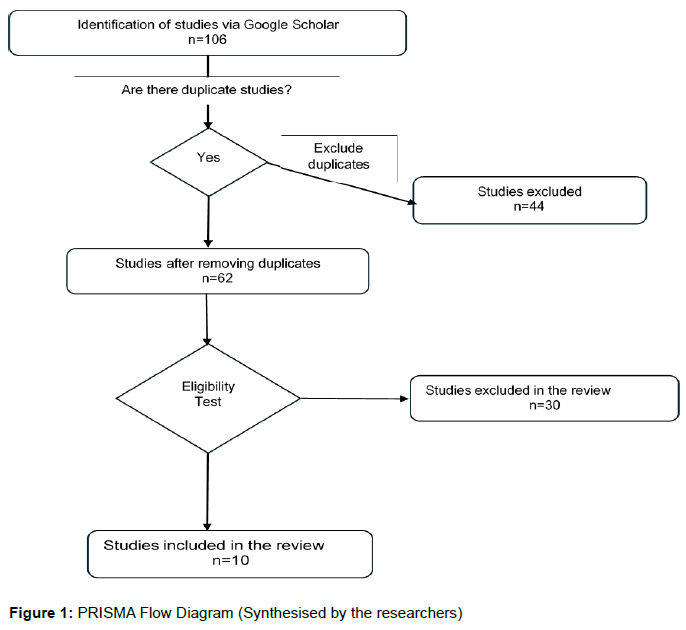
The researcher employed the Preferred Reporting Items for Systematic Reviews and Meta-Analyses (PRISMA) flow diagram in Figure 1, as a guideline to identify relevant studies in the literature that relate to the research objectives. The researchers established search criteria based on the keywords and timeframe (2019-2023).
Search Criteria and Identification of Sources
For this review, the researchers searched Google Scholar to locate peer-reviewed journal articles and other scholarly materials that discuss how digital transformation can support curriculum reform within Southern African universities. Several rounds of searching were carried out to ensure that all relevant studies published within the past five years (2019-2023) were captured.
Eligibility Criteria
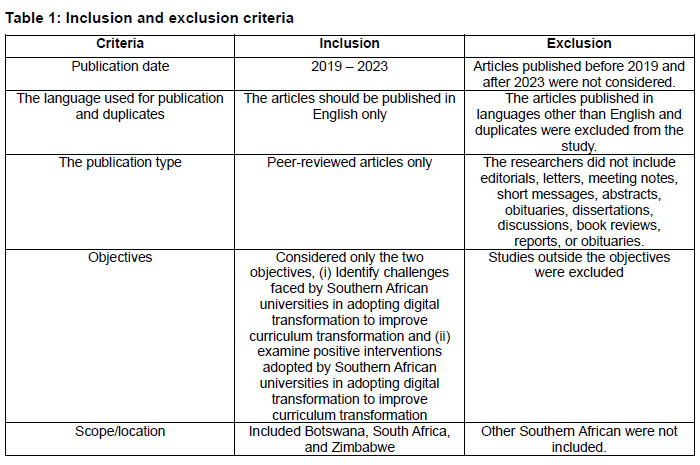
The researchers established inclusion and exclusion criteria to retain the relevant publications and articles from the published publications, Table 1 shows the inclusion and exclusion criteria. In addition, papers from 2019 to 2023 were included in the review. The studies included identified challenges faced by Southern African universities in adopting digital transformation to improve curriculum transformation and examined positive interventions adopted by Southern African universities in adopting digital transformation to improve curriculum transformation. Botswana, South Africa, and Zimbabwe were the only countries included in Southern Africa. The language of the included studies was restricted to English. For the exclusion criteria, publications that were written in other languages, and studies undertaken outside the digital transformation and curriculum transformation in Southern African universities context, were excluded from the study.
Stage 3: Selection of Relevant Publications
Each publication was evaluated against the predetermined inclusion and exclusion criteria before moving on to detailed screening. The researchers conducted this screening process using the Mendeley Reference Manager, which assisted in organising and reviewing the documents. Only the studies that successfully passed the full-text review were retained and used as the core data sources for this systematic review.
Stage 4: Data Extraction and Quality Assessment
At this stage, only the full-text studies that satisfied the inclusion requirements underwent further examination. This phase involved applying analytical criteria to interpret and synthesise the extracted information. The process required carefully sorting and organising the data in line with the key objectives guiding the review. To structure this analysis, a thematic analysis approach was used. The data extracted from each study included details such as the authors, year of publication, country or countries examined, the purpose of the study, the methodology employed, and the major findings, which were grouped according to the review's objectives.
Stage 5: Summarising, Revision, and Reporting Results
This phase consisted of three components: analysing the collected data, presenting the review findings, and interpreting those findings within a broader scholarly and contextual framework. To generate a coherent understanding of the subject under review, the synthesised data were first examined and organised in alignment with the study's research objectives.
DATA COLLECTION AND ANALYSISA total of 106 records were initially gathered from Google Scholar and imported into the Mendeley Reference Manager. The search strategy made use of several keyword combinations, including:
"Curriculum transformation" AND "Southern African universities" AND "digital transformation",
"Curriculum Transformation" AND "Botswana Universities" AND "Digital Transformation",
"Curriculum Transformation" AND "South Africa Universities" AND "Digital Transformation", and
"Curriculum Transformation" AND "Zimbabwe Universities" AND "Digital Transformation."
After removing 44 duplicate entries, 62 unique titles and abstracts remained for preliminary assessment. During this stage, 30 publications were excluded because they did not satisfy the inclusion criteria. The specific reasons for these exclusions are illustrated in the PRISMA flow diagram (Figure 1). Ultimately, 32 studies met all requirements and were selected for detailed review. Of these, only 10 studies directly addressed the determinants or influencing factors of digital transformation and curriculum reform within Southern African universities.
RESULTS OF THE STUDY
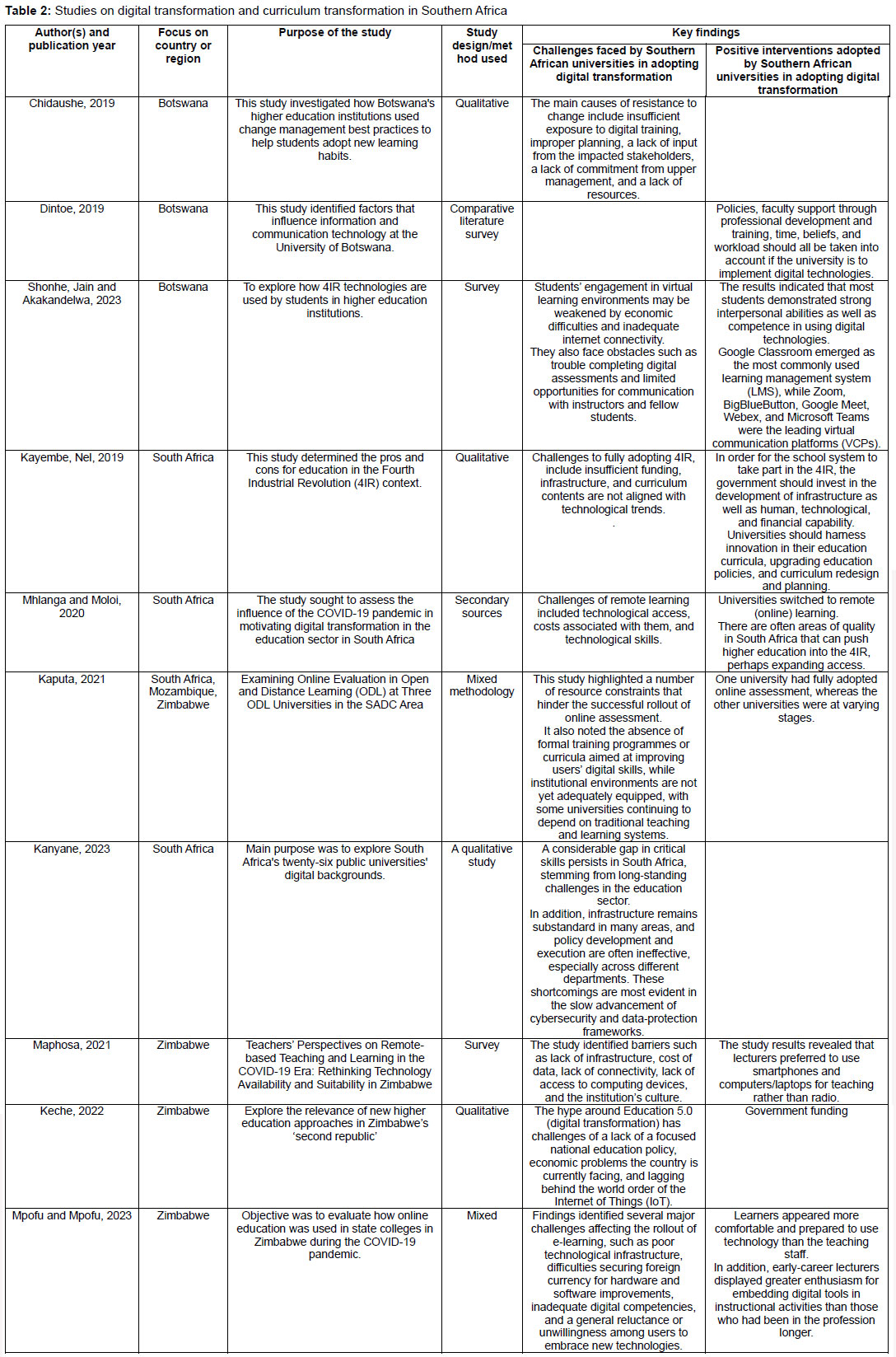
For this study, 10 publications that explored how digital transformation can support curriculum reform in Southern African universities were subjected to detailed analysis. The studies were grouped by country-beginning with Botswana, followed by South Africa, and lastly Zimbabwe-and were also organised in chronological order from 2019 to 2023, as outlined in Table 2. The distribution of publications across the years showed three studies published in 2019, one in 2020, two in 2021, one in 2022, and three in 2023.
Data extracted from each article included the authors, year of publication, geographical context, research aims, methodological approach, and the main findings aligned with the review objectives. As presented in Table 2, qualitative methods dominated the selected literature, accounting for four of the studies. Two studies used quantitative methods, two adopted a mixed-methods design, and another two employed a systematic literature review approach. Among the qualitative studies, case study designs were most common, whereas the quantitative research primarily relied on survey designs. The articles in Table 2 were from three different countries in Southern Africa: Botswana, South Africa, and Zimbabwe. Botswana had three articles, and South Africa and Zimbabwe with four articles respectively. One study was done in both South Africa and Zimbabwe.
Nine articles explained the challenges faced by Southern African universities in adopting digital transformation to improve curriculum transformation. These problems include not enough digital training, bad planning, a lack of participation from those who will be affected, lack of commitment from upper management, and lessons that don't match up with current technological trends. Seven articles discussed positive interventions adopted by Southern African universities in adopting digital transformation to improve curriculum transformation. These interventions include universities updating their policies, faculty support through professional development and training, and government funding.
DISCUSSION
This systematic review focused on insights about how digital transformation can be used to improve curriculum transformation in Southern African universities. According to Powel and Koelemay (2022) systematic reviews are becoming more popular as a way of doing research, although they are useful and well-liked, they are also difficult, time-consuming, and prone to human error. Based on the findings, the discussions are presented in line with two research objectives. To frame the discussion, the study drew on Koehler et al.'s (2014) TPACK model, which highlights how educators integrate technological, pedagogical, and content-related knowledge when designing and delivering instruction.
THEORYAccording to Koehler et al. (2014), the TPACK framework highlights that a thorough grasp of the subject matter and the pedagogical methodologies employed to teach it is a prerequisite for any meaningful use of technology in the classroom. According to this concept, technology should assist instructional strategies that promote student learning and improve the way knowledge is delivered rather than being added for its own purpose. TPACK emphasises the interdependence of pedagogical, technological, and content knowledge, acknowledging that successful instruction takes place at the intersection of these three domains. (Koehler and Mishra, 2008; Mishra and Koehler, 2006). At this intersection, teachers are able to select suitable technologies and pair them with appropriate teaching strategies to deliver subject content effectively. The framework is also used to guide the development and evaluation of teacher knowledge aimed at promoting strong learning outcomes across different subject areas (AACTE Committee on Innovation and Technology, 2008).
Koehler and Mishra (2009) further argue that successfully integrating technology into teaching requires a seamless combination of content expertise, pedagogical understanding, and technological proficiency. TPACK builds on Shulman's (1987) idea of pedagogical content knowledge, extending it to include technology as an essential component of modern instruction (Harris and Hofer, 2011). As a result, TPACK provides a useful perspective for thinking about the kinds of knowledge that educators need to successfully incorporate digital resources and how this knowledge can be developed over time. Applying TPACK as a framework for assessing teaching competence has important implications for the design of staff training and professional development programmes-particularly in efforts to advance curriculum transformation within universities in the digital age.
CHALLENGES FACED BY SOUTHERN AFRICAN UNIVERSITIES IN ADOPTING DIGITAL TRANSFORMATIONThe objective aims to address Southern African universities' challenges when adopting digital transformation to improve curriculum transformation. According to Johnson et al. (2016), there are some barriers which can hinder the integration of technology into teaching and learning practices.
According to the findings, the difficulties include inadequate finance for higher education, insufficient exposure to digital training, improper planning, involvement of the impacted stakeholders, top management's lack of commitment, and insufficient resources. In a study by Kaputa, (2021) who conducted mixed methodology research in Mozambique, South Africa, and Zimbabwe where he examined online evaluation in Open and Distance Learning (ODL) found that there were resource and funding challenges observed that need to be addressed for online evaluation to take off. The researcher further observed the absence of a dedicated training pathway or curriculum intended to advance staff knowledge of digital tools. In addition, workplace readiness is lacking, as certain universities continue to depend on legacy teaching-and-learning enablers. Echoing these concerns, Shonhe et al. (2023)-examining trends shaping Botswana's higher education-found that constrained funding hampers sectoral development. Their findings also point to economic barriers and poor internet access as factors that weaken students' ability to learn online, alongside challenges with online examinations and assignments and insufficient engagement with instructors and classmates (Shonhe et al. 2023).
The findings as presented in Table 2 reveal that policy formulation is a challenge faced by Southern African universities in adopting digital transformation. These findings align with those of Kanyane (2023), who conducted a qualitative study to explore South Africa's twenty-six public universities' digital backgrounds. His research highlighted persistent challenges linked to weak policy development and poor implementation across government departments, including significant delays in establishing adequate cybersecurity and data-protection measures. He also observed that rural and historically disadvantaged institutions are most severely affected, as they cater to large numbers of students from low-income backgrounds. This confirms the results of Keche (2022) who explored the relevance of new higher education approaches in Zimbabwe's 'second republic', in his findings he pointed out that the hype around Education 5.0 (digital transformation) has challenges attributed to a lack of a focused national educational policy, current economic problems that are being faced by the country, and lagging behind the world order of the Internet of Things (IoT).
The findings in Table 2 show that some challenges faced by Southern African universities include a lack of infrastructure, staff's negative attitude, and a curriculum that is not aligned with the digital transformation era. An evidenced-based strategy by Maphosa (2021) found that a lack of infrastructure hindered universities in Zimbabwe from adapting to the digital transformative environment. These findings were also collaborated by Kayembe and Nel (2019) who ascertained that in South Africa they encounter problems pertaining to poor quality infrastructure in universities for them to fully adopt digital transformation, and Kanyane (2023) noted that the full adoption of digital transformation is hindered by several obstacles, including limited financial resources, inadequate technological infrastructure, and curriculum designs that do not keep pace with emerging technological developments. Chidaushe, (2019) also agreed with similar aforementioned studies, where the findings of his qualitative study confirmed that in Botswana infrastructure hindered the transition to new learning habits at the universities.
In his findings, Maphosa (2021) summarised the barriers to adopting digital transformation for curriculum transformation as cost of data, lack of connectivity, lack of access to computing devices, and the institution's culture. Maphosa found out that major barriers to the implementation of e-learning included, a shortage of foreign currency to upgrade the hardware and software, digital skills gap and general attitude and resistance to change. Mhlanga and Moloi (2020) summarised their findings on the challenges of universities adopting digital transformation as technological access, costs associated with them, and technological skills. Kanyane (2023) echoed the conclusions reached by Mhlanga and Moloi, pointing out that South Africa still has a significant labour shortage, which is mostly caused by long-standing flaws in its educational system. Chidaushe (2019) summarised the findings as insufficient exposure to digital training, improper planning, a lack of input from the impacted stakeholders, a lack of commitment from upper management, and a lack of resources. Kayembe and Nel (2019) observe that previous industrial revolutions exposed and intensified long-standing inequalities. Even today, a substantial segment of the population still lacks basic services such as transportation, electricity, and internet connectivity. This persistent divide between those with access and those without continues to fuel feelings of exclusion, erode trust, and contribute to social instability.
POSITIVE INTERVENTIONS ADOPTED BY SOUTHERN AFRICAN UNIVERSITIES IN ADOPTING DIGITAL TRANSFORMATIONThe objective focuses on identifying and summarising the positive interventions Southern African universities utilise in adopting digital transformation. Mpofu and Mpofu (2023), for instance, examined how Zimbabwean state universities implemented online learning during the COVID-19 period. Their findings showed that both students and academic staff generally held positive attitudes toward digital learning and that various Southern African universities had adopted effective measures to support digital transformation. The study further revealed that students tended to be more technologically ready than their lecturers. It also showed that younger academics were keener to incorporate digital tools into teaching and learning processes than their older counterparts. Meanwhile Kaputa, (2021) claimed that some Southern African universities-South Africa, Mozambique, and Zimbabwe-were in varying levels of adopting online assessment, with South Africa being the most advanced. These findings are similar to Mhlanga and Moloi's (2020) study pointed that the adoption of remote (online) learning by South African universities. Mhlanga and Moloi go on to say that there are generally some areas of competence in South Africa that can push higher education into the 4IR, potentially expanding access. Another study that lends credence to digital transformation and university education in Southern Africa is that of Dintoe, (2019) who discovered that policies, faculty support through professional development and training, time, beliefs, and workload should all be taken into account in order for digital technologies to be embraced by university organisational characteristics.
A study conducted by Maphosa, (2021) in Zimbabwe found that lecturers had their preferences when it comes to digital technologies to be adopted. The results of the study revealed that some lecturers preferred to use smartphones and computers/laptops for teaching rather than radio. This aligns with the findings of Shonhe et al. (2023), whose study in Botswana examined the key drivers and emerging trends influencing higher education transformation in the country. Their results showed that the Botswana government is actively working to strengthen the sector through initiatives such as the ETSSP, along with investments in research and innovation. The study also found that many students demonstrated strong interpersonal and digital competencies. Google Classroom emerged as the most frequently used learning management system, while virtual communication platforms such as Zoom, BigBlueButton, Google Meet, Webex, and Microsoft Teams were the most commonly utilised. Another study that aligns with the current review is that of Keche, (2022) who posited that government funding is vital in the adoption of digital transformation by universities. As shown in Table 2 the findings indicate that the positive interventions adopted by Southern African universities in adopting digital transformation also include enhanced personalised learning experiences for students, thus improving academic performance. According to a study by Kayembe and Nel (2019), it will be simpler for South African universities to create an education system that incorporates digital transformation into its curricula if the government invests in the development of infrastructure and human, technical, and financial capacity. They also mentioned that universities should harness innovation in their education curricula, upgrading education policies, and curriculum redesign and planning. In the South African context, certain universities are able to adopt online learning with relatively few obstacles. For instance, the University of Johannesburg made the shift to digital and blended learning much easier because it had already started integrating Fourth Industrial Revolution (4IR) technologies into its teaching methods prior to the COVID-19 epidemic (Mhlanga and Moloi, 2020). In contrast, many rural universities face substantial difficulties in implementing online education due to limited resources and inadequate digital competencies. These institutions continue to fall behind more resourced universities, reflecting the broader inequalities that characterise the country's higher education system (Mhlanga and Moloi, 2020).
TPACK AND ITS APPLICATION IN CURRICULUM TRANSFORMATION OF UNIVERSITIES IN THE DIGITAL TRANSFORMATION ERATaken together, these studies indicate that TPACK is a valuable lens for interpreting how digital initiatives drive curriculum change in Southern African universities. As argued by Murtafiah, Svarif and Dhieni (2022), an innovative educator can adopt a Technology-Pedagogy-Content-Knowledge approach that purposefully combines knowledge (K), pedagogical methods (P), disciplinary content (C), and ICT tools (T) to strengthen teaching and learning.
TPACK's contribution to improving student outcomes has been the subject of a considerable body of research. (e.g., Lase, 2022; Hambali, Rozi, and Mardiya, 2023). According to Dwi Kristanto et al., (2020) Content Knowledge (CK) refers to command of the subject matter specified in the curriculum. Lecturers should hold this expertise because it shapes disciplinary thinking and guides curriculum transformation in the digital era. Pedagogical Knowledge (PK) encompasses deep understanding of teaching and learning-objectives, processes, assessment practices, strategies, and related instructional decisions (Candra, Soeprivanto and Praherdhiono 2020). Technological Knowledge (TK) is the knowledge of fundamental digital tools and systems that can be used to enhance classroom instruction (Candra et al., 2020).
As discussed in this article, several obstacles can impede lecturers' development of the technological competencies required to enact TPACK within curriculum reform-most notably inadequate infrastructure, which restricts access to effective digital tools and constrains classroom application. Conversely, when TPACK guides curriculum redesign, it can catalyse constructive initiatives, including the thoughtful infusion of digital technologies across the teaching-learning process. Importantly, the TPACK framework is flexible and adaptable, supporting multimodal instructional approaches that align technology with sound pedagogy and robust content.
CONCLUSION AND RECOMMENDATION
This study, a systematic review aimed to provide insights into how digital transformation can be used to improve curriculum transformation in Southern African universities. The article concludes that while higher education curriculum transformation is not a myth, it is still a work in progress that requires ongoing engagement and collaboration from all stakeholders. The TPACK theoretical framework guided the results and findings of the study. Challenges were identified in the study which are encountered by Southern African universities when adopting digital transformation to improve curriculum transformation. The challenges include a lack of finance for higher education, a lack of exposure to digital training, improper planning, a lack of involvement from the impacted stakeholders, a lack of dedication from upper management, and insufficient resources. The study concludes that to overcome the challenges positive interventions need to be adopted by Southern African universities. These interventions include embracing digital transformation in teaching and learning, infrastructure, positive attitudes by staff and students, and government funding. Based on the challenges encountered by Southern African universities when adopting digital transformation to improve curriculum transformation the study recommends that Southern African universities should include, innovation in their education curricula, upgrade education policies, and curriculum redesign and plan to adopt digital transformation in their curricula.
IMPLICATION TO PRACTICEThis systematic review provides a useful summary of the body of knowledge that South African universities can use to guide policy and decision-making when it comes to researching positive interventions that could preventatively close the skills gap that exists in the digital transformation era and university education. Such an approach may provide a guiding framework for universities across Africa that wish to evaluate their capacity to adapt to the digital era and modernise their curricula.
LIMITATIONS OF THE STUDYAlthough research published in English was included in the review, there might be studies published in different languages may exist. Additionally, the literature search was carried out across Google Scholar. Other databases may have pertinent studies that this evaluation did not include. Nevertheless, the consensus that was reached for the keywords and the participation of numerous researchers reduced prejudice that occurs from the subjectivity of a single researcher (Field and Derksen 2021). Although the study has certain constraints, it nonetheless enhances understanding of how digital technologies can be leveraged to advance curriculum transformation across Southern African higher education institutions.
REFERENCES
- AACTE (American Association of Colleges of Teacher Education). 2008. Handbook of Technological Pedagogical Content Knowledge (TPCK) for Educators. New York: Routledge/Taylor & Francis Group.
-
Agbaje, O. 2023. "Curriculum Reform in African Higher Education: Solving Society's Problems and Meeting Its Needs." Curriculum Perspectives 43 (1): 141-149. https://doi.org/10.1007/s41297-023-00206-x.
» https://doi.org/10.1007/s41297-023-00206-x -
Arksey, H., and L. O'Malley. 2005. "Scoping Studies: Towards a Methodological Framework." International Journal of Social Research Methodology 8 (1): 19-32. https://doi.org/10.1080/1364557032000119616.
» https://doi.org/10.1080/1364557032000119616 -
Candra, P., Y. Soepriyanto, and H. Praherdhiono. 2020. "Pedagogical Knowledge." Journal of Educational Technology Studies 3 (2): 166-177. https://doi.org/10.17977/um038v3i22020p166.
» https://doi.org/10.17977/um038v3i22020p166 - Chidaushe, W. K. 2019. "Exploring the Impediments to New Learning Habits in View of Change Management: A Comparative Study of Botswana Accountancy College (BAC) and Botho University (BU)." Journal of Business Strategy Finance and Management 1 (1-2): 41-64.
- Dintoe, S. S. 2019. "Technology Innovation Diffusion at the University of Botswana: A Comparative Literature Survey." International Journal of Education and Development Using Information and Communication Technology 15 (1): 8-28.
- Eleyyan, S. 2021. "The Future of Education According to the Fourth Industrial Revolution." Journal of Educational Technology and Online Learning 4 (1): 23-30.
- Eshiwani, G. S. 1999. "Higher Education in Africa: Challenges and Strategies for the 21st Century." In Higher Education in the 21st Century: Global Challenge and National Response. Boston: Boston Books.
-
Field, S., and M. Derksen. 2021. "Experimenter as an Automaton; Experimenter as Human: Exploring the Position of the Researcher in Scientific Research." European Journal for Philosophy of Science 11 (11). https://doi.org/10.1007/s13194-020-00324-7.
» https://doi.org/10.1007/s13194-020-00324-7 - Haddaway, N. R., A. M. Collins, and D. Coughlin. 2015. "The Role of Google Scholar in Evidence Reviews and Its Applicability to Grey Literature Searching." PLoS One 10 (9).
- Hambali, H., F. Rozi, and M. Mardiya. 2023. "Technology in Education: TPACK as an Approach to Becoming a Revolutionary Teacher in the Digital Age." Academy of Education Journal 14 (2): 171-185.
-
Hye-jin, K. 2021. "Digital Transformation of Education Brought by the COVID-19 Pandemic." Journal of the Korea Society of Computer and Information 26 (6): 183-193. https://doi.org/10.9708/jksci.2021.26.06.183.
» https://doi.org/10.9708/jksci.2021.26.06.183 - Harris, J. B., and M. J. Hofer. 2011. "Technological Pedagogical Content Knowledge (TPACK) in Action: A Descriptive Study of Secondary Teachers' Curriculum-Based, Technology-Related Instructional Planning." Journal of Research on Technology in Education 43 (3): 211-229.
- Hattangdi, A., and A. Ghosh. 2011. "Enhancing the Quality and Accessibility of Higher Education through the Use of Information and Communication Technologies." In Proceedings of the 11th Annual Convention of the Strategic Management Forum, 1-14.
- Johnson, A. M., M. E. Jacovina, D. E. Russell, and C. M. Soto. 2016. Challenges and Solutions When Using Technologies in the Classroom. New York: Taylor & Francis.
-
Kanyane, M. 2023. "Digital Work-Transforming the Higher Education Landscape in South Africa." In New Digital Work. Cham: Springer. https://doi.org/10.1007/978-3-031-26490-0_9.
» https://doi.org/10.1007/978-3-031-26490-0_9 - Kaputa, T. M. 2021. "Embracing Online Assessment in Open Distance Learning in Zimbabwe." Zambia Journal of Distance Education 1 (1): 9-17.
- Kayembe, C., and D. Nel. 2019. "Challenges and Opportunities for Education in the Fourth Industrial Revolution." African Journal of Public Affairs 11: 79-94.
-
Keche, K. 2020. "Relevance of New Higher Education Approaches in Zimbabwe's Second Republic." Accessed January 28, 2024. http://dx.doi.org/10.5772/intechopen.99934.
» http://dx.doi.org/10.5772/intechopen.99934 - Koehler, M. J., and P. Mishra. 2008. "Introducing TPCK." In Handbook of Technological Pedagogical Content Knowledge (TPCK) for Educators. Mahwah, NJ: Lawrence Erlbaum Associates.
- Koehler, M. J., and P. Mishra. 2009. "What Is Technological Pedagogical Content Knowledge?" Contemporary Issues in Technology and Teacher Education 9 (1): 60-70.
-
Koehler, M. J., P. Mishra, K. Kereluik, T. S. Shin, and C. R. Graham. 2014. "The Technological Pedagogical Content Knowledge Framework." In Handbook of Research on Educational Communications and Technology. New York: Springer. https://doi.org/10.1007/978-1-4614-3185-5_9.
» https://doi.org/10.1007/978-1-4614-3185-5_9 - Kugara, S., W. Tshamano, and J. Mawere. 2022. "Curriculum Transformation in South Africa: An Indigenous Knowledge Systems Perspective." Journal of African Education 3 (10).
- Lase, U. 2022. "Technology in Education: TPACK as an Approach to Becoming a Revolutionary Teacher in the Digital Age." Journal of Educational Technology Studies 3 (1): 28-39.
-
Maphosa, V. 2021. "Teachers' Perspectives on Remote-Based Teaching and Learning in the COVID-19 Era." European Journal of Interactive Multimedia and Education 2 (1). https://doi.org/10.30935/ejimed/9684.
» https://doi.org/10.30935/ejimed/9684 - Marinoni, G., H. van't Land, and T. Jensen. 2020. The Impact of COVID-19 on Higher Education around the World. Paris: International Association of Universities.
- Masenya, T. M. 2021. "Digital Literacy Skills Are a Prerequisite for Teaching and Learning in Higher Education Institutions." South African Journal of Information Studies 39 (2): 1-20.
- Mashilo, P. P., and L. Govender. 2023. "African Identity and Curriculum Transformation at Universities in South Africa." South African Journal of Teacher Education 12 (2): 119-143.
-
Meyer, I. A., and P. R. Gent. 2016. The Status of ICT in Education in South Africa and the Way Forward. Centurion: National Education Collaboration Trust. Accessed November 20, 2023. http://nect.org.za/publications/technical-reports/the-state-of-ict-in-education-in-south-africa/view.
» http://nect.org.za/publications/technical-reports/the-state-of-ict-in-education-in-south-africa/view - Mishra, P., and M. J. Koehler. 2006. "Technological Pedagogical Content Knowledge: A Framework for Integrating Technology in Teachers' Knowledge." Teachers College Record 108 (6): 1017-1054.
-
Mhlanga, D., and T. Moloi. 2020. "COVID-19 and the Digital Transformation of Education." Education Sciences 10 (7): 180. https://doi.org/10.3390/educsci1007018.
» https://doi.org/10.3390/educsci1007018 -
Montrieux, H., R. Vanderlinde, T. Schellens, and L. De Marez. 2015. "Teaching and Learning with Mobile Technology." PLoS One 10 (12): 1-17. https://doi.org/10.1371/journal.pone.0144008.
» https://doi.org/10.1371/journal.pone.0144008 -
Mpofu, F., and A. Mpofu. 2023. "The COVID-19 Pandemic and Digital Transformation in Zimbabwean State Universities." International Journal of Social Science Research and Review 6 (3). https://doi.org/10.47814/ijssrr.v6i3.957.
» https://doi.org/10.47814/ijssrr.v6i3.957 - Murtafiah, S., M. Syarif, and N. Dhieni. 2022. "Technology in Education: TPACK as an Approach." Journal of Educational Technology Studies 6 (2): 10113-10123.
-
Nyoni, J. 2019. "Decolonising the Higher Education Curriculum." Transformation in Higher Education 4. https://doi.org/10.4102/the.v4i0.69.
» https://doi.org/10.4102/the.v4i0.69 -
Ohei, K. N., and R. Brink. 2019. "A Framework for ICT Adoption in Higher Education." South African Journal of Information Management 21 (1): 1-12. https://doi.org/10.4102/sajim.v21i1.1030.
» https://doi.org/10.4102/sajim.v21i1.1030 - Östlund, B. 2008. "Prerequisites for Interactive Learning in Distance Education." Australasian Journal of Educational Technology 24 (1).
-
Simbarashe, K. 2021. "COVID-19 as a Catalyst for Digital Transformation in Higher Education." African Renaissance 18 (4): 285-304. https://doi.org/10.31920/2516-5305/2021/18n4a14.
» https://doi.org/10.31920/2516-5305/2021/18n4a14 - Shonhe, L., P. Jain, and A. Akakandelwa. 2023. "Students' Experiences with 4IR Technologies in Online Learning." Regional Journal of Information and Knowledge Management 8 (2): 81-100.
- Shulman, L. S. 1987. "Knowledge and Teaching: Foundations of the New Reform." Harvard Educational Review 57 (1): 1-22.
- South African Human Rights Commission (SAHRC). 2016. "Transformation at Public Universities in South Africa." Accessed November 10, 2024.
-
Sych, T. V., Y. M. Khrykov, and O. M. Ptakhina. 2021. "Digital Transformation as the Main Condition for the Development of Modern Higher Education." Educational Technology Quarterly (2): 293-309. https://doi.org/10.55056/etq.27.
» https://doi.org/10.55056/etq.27 -
UNESCO. 2023. "Curriculum in Transformation Mode." Accessed February 10, 2024. https://unesdoc.unesco.org/ark:/48223/pf0000387188.
» https://unesdoc.unesco.org/ark:/48223/pf0000387188 -
Wargo, E., C. Chellman, K. Budge, and C. Davis. 2020. "On the Digital Frontier." Journal of Research on Technology in Education. https://doi.org/10.1080/15391523.2020.1760753.
» https://doi.org/10.1080/15391523.2020.1760753 - World Bank. 2021. "COVID-19 Leaves a Legacy of Rising Poverty." Accessed March 5, 2024.
- World Bank. 2023. "Poverty Is Back to Pre-COVID Levels Globally." Accessed March 5, 2024.
-
Zhu, X., and J. Li. 2020. "Education in and After COVID-19." Postdigital Science and Education 2: 695-699. https://doi.org/10.1007/s42438-020-00126-3.
» https://doi.org/10.1007/s42438-020-00126-3