ICT as a mediation tool for inclusivity in higher education: critical reflections from Malawi
Abstract
Recently, there has been increased popularity in the use of Information and Communication Technology (ICT) at all levels of education globally and in southern Africa. This situation results from improved access to technologies and the transformative agency possible in the use of ICT in education. In Malawi, the use of ICT in education is more prominent in higher education settings than in the lower levels of education because of the issue of accessibility and proficiency. Even so, the larger discourse on ICT use in higher education pertains to the 'typical' student. There is less focus on how ICT can mediate inclusive learning for students with disabilities. Research that has attempted to study the use of ICT among higher education students with disabilities in Malawi focuses on the convenience the ICT brings to such students. Globally, studies agree that ICT presents practical opportunities for implementing inclusive education at all levels of education. These opportunities are largely missed in the current Malawian education setting. From our experiences, we attribute this situation to the lack of connection between ICT and inclusivity. Therefore, this article conceptualises the use of ICT in higher education for inclusivity from a learning instead of convenience perspective. Through our critical reflections as educators in Malawian higher education institutions, we employ Vygotsky's theoretical framework of mediation and mediating tools to argue that ICT (mediating tool) can facilitate inclusive learning for higher education students with disabilities if used in a manner that influences the subject (students with disabilities) to engage with the object (learning process).
ICT; inclusive education; mediation; higher education; Malawi
INTRODUCTION
Despite the increasing prevalence of Information and Communication Technology (ICT) in higher education systems in Malawi, a noticeable gap still exists in understanding how ICT can effectively mediate inclusive learning for higher education students with disabilities. The current discourse on ICT in higher education predominantly focuses on the 'typical' higher education students, neglecting the specific needs and challenges faced by students with disabilities. While existing research acknowledges the convenience of ICT to students with disabilities, it fails to explore its potential for enhancing learning perspectives. This research problem arises from a lack of connection between ICT and inclusivity in higher education systems, hindering the realisation of opportunities for implementing inclusive education. Previous studies (such as Chambers 2019; Viner, Singh, and Shaughnessy 2020) suggested that ICT can facilitate the education of students with disabilities by offering personalised learning through assistive technologies and adaptive curricula. This article conceptualises the use of ICT in higher education from learning enhancement perspective than convenience. As such, we broadly ask: can ICT mediate inclusive learning for higher education students with disabilities in Malawi? We specifically ask:
• How do higher education students with disabilities in Malawi currently engage with ICT in their learning processes?
• What specific challenges and barriers do higher education students with disabilities face in accessing and benefiting from ICT-mediated learning in Malawi?
• In what ways can the integration of ICT contribute to enhancing inclusive learning environments for higher education students with disabilities in Malawi?
Firstly, exploring the current state of ICT utilisation among students with disabilities provides a baseline understanding of their interaction with technology in the educational context. Secondly, identifying the obstacles that may impede the effective use of ICT for inclusive learning among students with disabilities offers insights into the practical issues that need to be addressed for successful implementation. Thirdly, investigating ICT's potential positive impacts and benefits in facilitating inclusive learning by exploring how technology can be utilised to create an accessible, supportive and inclusive higher educational environment may enable higher education stakeholders to select appropriate ICT resources that may help to break epistemological barriers that hinder access to educational content for students with disabilities.
Inclusive Education and Higher Education
Inclusive education is a philosophy that promotes equal opportunities and access to education for all students, regardless of their abilities, disabilities or differences, i.e. a philosophy of difference (Allan 2007). This entails that inclusive education extends beyond the hegemonic understanding of special education to creating learning environments that embrace diversity and accommodate the unique needs of every student. The evolution of inclusive education has witnessed a paradigm shift from exclusionary practices to a more inclusive approach. At the policy level, the Salamanca Statement of 1994 laid the foundation for inclusive education on a global scale. The Salamanca Statement emphasised the importance of adapting education systems to accommodate diverse students. This global commitment has since gained momentum (Pather 2019) including in higher education, as universities and colleges around the world recognise the benefits of enhancing diverse learning environments.
Studies (such as Collins, Azmat, and Rentschler 2019; Moriña 2019; Salmi and D'Addio 2021) highlighted benefits of inclusive higher education, such as improved academic performance, enhanced social skills and the development of a more inclusive society. For example, Moriña (2019, 12) argued that "not only students with disabilities benefit from the experience in higher education, but also the teaching and learning processes are enriched by having diverse students in the classrooms. In this sense, the presence of students with disabilities helps build a better university". This entails that the benefits of inclusive education go beyond the university and college students with disabilities to enhance the overall higher education system. However, challenges persist, including attitudinal barriers, lack of appropriate resources and the need for staff development in inclusive teaching practices (Moriña 2019). These challenges vary across countries and are influenced by cultural, economic and policy factors.
Before independence in 1964, Malawi had limited educational opportunities, with no higher education available. Basic education was the focus, and students eligible for higher education attended institutions abroad, such as in Southern Rhodesia (now Zimbabwe) (Kadzamira 2020). Post-independence, Malawi prioritised education for national development, expanding access at all levels. Despite this, higher education was limited, with only the University of Malawi established in 1965. Efforts to enhance higher education access for all students, including those with disabilities, have been noted (Gunda 2015). In the late 20th century, global awareness on inclusive education grew. Malawi began addressing educational disparities to improve access for marginalised groups, including students with disabilities (Malawi Ministry of Education, Science and Technology 2017). The Malawi government emphasised policies to make higher education more inclusive, integrating students with disabilities into mainstream higher education institutions and developing support services and accommodations, particularly at the University of Malawi in Zomba. Thus, inclusive education in Malawi has been a gradual process, influenced by social, political and economic factors (Kadzamira and Rose 2001; Kamchedzera 2010). Nevertheless, strides were made with the establishment of special education units, awareness campaigns and policies serving students with disabilities.
Malawi, like many other countries, has undergone significant educational reforms over the years. The Education for All (EFA) initiatives and the Sustainable Development Goals (SDGs) have enabled the country to emphasise the importance of inclusive education, paving the way for basic and higher education reforms. For example, Kamchedzera (2015) gave a historical account of inclusive education at Chancellor College (now the standalone University of Malawi at Chirunga in Zomba). She noted that the university enrolled its first students with disabilities in 1972, and gradually the numbers increased in the later years.
While Malawi has made strides in promoting inclusive education at the basic level, challenges persist in higher education. Kamchedzera's (2015) study found that limited resources, inadequate infrastructure and a shortage of trained personnel remain key challenges. Additionally, cultural beliefs and societal attitudes towards disability and diversity can negatively affect inclusivity of higher education institutions in Malawi (Chikaipa et al. 2021; Salmi 2021). Chikaipa and colleagues' study acknowledged national policy efforts to promote inclusive education in higher education. Such government policies include the National Education Sector Plan and the Special Needs Education Policy. These policy frameworks underscore the commitment to inclusive education at all levels of education in Malawi. However, as de Souza (2022) found, effective implementation and monitoring mechanisms are crucial to ensuring these educational policies translate into tangible improvements in practice.
ICT and Higher Education
Information and Community Technology (ICT) is becoming increasingly essential in various aspects of life, including education (UNESCO 2023; Unwin 2017). The integration of ICT in education varies between developed and developing countries. Developed countries began integrating ICT into higher education in the 1970s, with significant advancements in the 1990s (Kirkup and Kirkwood 2005; Tokareva, Smirnova, and Orchakova 2019). In contrast, most developing countries, including Malawi, started in the early 21st century (Nawaz, Awan, and Ahmad 2011). In Malawi, ICT integration in higher education began with basic computer literacy programmes for administrative and academic purposes in the early 2000s (Chaputula 2012). Universities and colleges established ICT departments and computer laboratories to improve access to ICT facilities (Kalembera and Majawa 2015). For instance, Mzuzu University established an ICT department in 2005 to train ICT technocrats. However, only students studying computer-related courses received foundational computer skills training.
To expand access to higher education, Malawian higher education institutions have introduced open distance and e-learning (ODeL) programmes, which use ICT to enhance teaching and learning (Alenezi 2020; Pavel, Fruth, and Neacsu 2015). Mzuzu University established its ODeL centre in 2006 that utilises various media for instruction delivery (Chawinga and Zozie 2016). Similarly, Lilongwe University of Agriculture and Natural Resources (LUANAR) launched its ODeL programme in 2016. Other public institutions offering ODeL programmes include Malawi University of Business and Applied Sciences, University of Malawi and Malawi University of Science and Technology. To promote ICT in education, Malawi developed its first ICT policy in 2006. The policy aims to facilitate collaboration between the government and private institutions for ICT infrastructure and skills development (Malawi Ministry of Information and Tourism 2006). The policy promotes e-learning and encourages Public-Private Partnerships to address ICT integration challenges in higher education through resource sharing, expertise and funding support (Gondwe 2020).
As highlighted in various studies and reports (such as Adam 2003; Chawinga and Zinn 2016; Heeks 2017), ICT plays a crucial role in higher education globally and in Malawi. Globally, the integration of ICT in higher education has become essential since the COVID-19 pandemic. The pandemic led to a rapid shift towards distance and online learning. For example, UNESCO (2023) confirmed the necessity of e-learning programmes to ensure continuity in education. UNESCO's emphasis on the importance of e-learning in higher education institutions recognises that these institutions play key roles in supporting the integration of ICT in teaching and learning processes. Furthermore, other studies (such as Akour and Alenezi 2022; Owens 2017) highlighted that higher education institutions should exemplify the use of ICT in teaching and learning activities in order to appreciate its potential for transformation.
The technologies that many higher education institutions globally have adopted to facilitate online teaching and learning include Learning Management Systems (LMS) such as Moodle, Blackboard and Canvas (Mpungose and Khoza 2022; Sharifov and Mustafa 2020). Implementation of these technologies offers a centralised hub for easy access to course materials and assignments. They also facilitate discussions between students and lecturers and students themselves. In addition, with the advancement of video conferencing technologies such as desktop video conferencing, Zoom, Google Meet and Microsoft Teams, virtual classrooms and lectures have become commonplace (Cavus and Sekyere-Asiedu 2021). With the availability of stable and reliable internet connectivity, professors, lecturers and tutors may conduct lectures, tutorials and seminars remotely, enabling access to education from anywhere. Many institutions have also adopted blended teaching and learning approaches, which combine traditional face-to-face instruction with online components (Brown 2016; Singh, Steele, and Singh 2021). For example, Cavus and Sekyere-Asiedu (2021) agreed that before COVID-19 pandemic, most lectures in higher education institutions were conducted in traditional face-to-face model. To decongest lecture rooms and continue teaching during COVID-19, institutions adopted blended and online models (Atwa et al. 2022; Singh, Steele, and Singh 2021).
One of the merits of the blended model is its flexibility. Students on-site and off-campus can still maintain interactions with lecturers, instructors and peers (Atwa et al. 2022). In addition, studies (including Cavus and Sekyere-Asiedu 2021; Kozlova and Pikhart 2021) asserted that due to COVID-19, e-learning, blended learning and hybrid learning have become more prevalent in university courses, requiring lecturers and students to spend most of their time in front of computers. Many scholars have also collaborated online in many aspects of their academic endeavours, such as research. Such collaborations enable sharing of research findings, collaboration on projects and networking opportunities. Different media platforms which provide Open Educational Resources (OER) have become more useful for sharing digital educational resources such as textbooks, notes and multimedia content (Mishra 2017).
Equally, the higher education institutions in Malawi have made some strides to upscale the use of ICT. For example, the development and enactment of the National ICT Policy, revised in 2013, facilitates ICT integration across many educational sectors. The policy also aims to contribute to socio-economic development through enhanced ICT literacy, improved educational management systems and access to quality education (Malawi Ministry of Information 2013). In addition, the Digital Broadcasting Policy has been developed to improve internet access and digital literacy nationwide (Malawi Ministry of Information 2013). Since internet connectivity has slightly improved in Malawi, some universities and colleges have scaled up implementing e-learning programmes to utilise ICT usage and reach marginalised students in remote areas, thus providing access to higher education opportunities (Gama, Chipeta, and Chawinga 2022; Kayange 2019).
Despite the strides Malawi is making towards ICT integration in higher education institutions, the implementation still needs to be improved compared to traditional face-to-face instruction. For example, Malawi faces significant challenges in the use of ICT at tertiary level due to underdeveloped infrastructure, including limited internet access, unreliable electricity supply and inadequate technology resources in the institutions (Kayange 2019). Thus, these factors hinder the widespread adoption of ICT in higher education and conditions could be more unfavourable for most students studying through ODeL mode as well as students with disabilities (Kayange 2019).
THEORETICAL FRAMEWORKStudents with disabilities face many barriers in accessing higher education. Integrating ICT into educational practices has been recognised as a promising avenue to address these challenges and enhance inclusive learning environments (Odunga 2024). In the Malawian context, despite the potential benefits of ICT, there is a lack of research on its effective integration as a learning mediating tool for higher education students with disabilities. This study employs Vygotsky's sociocultural learning theory to investigate the interplay of inclusive education, higher education and ICT in Malawi. Within the Vygotskian theory, the study draws on the concepts of mediation, mediating tools and the zone of proximal development (ZPD). Mediation refers to the role of external tools and social interactions in facilitating learning (Vygotsky 1981). Vygotsky (1981) posited that cognitive development is inherently social and mediated by cultural tools. This entails that meditation tools can be psychological (language, symbols, signs) and physical (tools, artefacts). The ZPD represents the distance between a student's current developmental level and the potential level achievable with assistance or collaboration (Vygotsky 1978).
ICT as a mediating tool provides alternative means of access, communication and interaction. The adaptability of ICT tools to cater to diverse learning needs resonates with the principles of inclusive education. Understanding ICT as a mediating tool allows us to explore its potential to bridge the educational gap for higher education students with disabilities in Malawi. In mediated learning, adaptive technologies, assistive software and online resources can enhance learning experiences while nurturing independence and inclusivity. The Vygotskian framework speaks to the unique sociocultural context of Malawi and the need for culturally responsive ICT solutions that resonate with local values and practices. The framework also provides insights into the design of inclusive pedagogical practices that employ ICT as a mediating tool, hence its use in this study.
RESEARCH APPROACHAs higher education educators involved in teacher education, with a focus on language education (lead author) and science education (the co-author), our journey into researching the role of ICT in mediating learning for higher education students with disabilities in Malawi is both enlightening and challenging. In our pursuit to address whether ICT can effectively facilitate learning for these students, we find critical reflection to be a valuable research methodology and a good starting point for further research. Our interest originates from our observations in the lecture theatres where we noticed the varying degrees of accessibility and inclusion experienced by students with disabilities in resource-constrained educational settings like Malawi. Therefore, as educators committed to equity and quality education for all, we feel compelled to look deeper into this issue.
Critical reflection can be used as a research methodology. For example, Morley (2008) reported that they used critical reflections in their doctoral research. When critical reflections are used in research, the researchers become research participants. In this study, we take a double role of research participants and researchers. This may, prima facie, sound odd, but Fook (1999) cited in Morley (2008, 286) reminded us that "research should arise from personal experience since the researcher will certainly have the motivation and openness to appreciate the experiences being studied". Accordingly, critical reflections gave us insights that extended beyond research methodologies such as surveys and interviews. Through introspection and dialogue, we unearthed complexities that might have otherwise remained overlooked.
Our background in teacher education enriched our critical reflections, offering multifaceted perspectives on the intersection of ICT and inclusive education. Our experiences working with students and colleagues in the local context allowed us to navigate cultural complexities and understand the unique challenges faced by higher education students with disabilities. We acknowledge that research methods such as surveys, workshops and interviews provide valuable insights, but we should also remember that "one of the goals of critical reflection, drawing on education techniques, is transformative learning" (Morley 2008, 265). This entails that surveys, workshops and interviews would fall short of capturing the lived experiences and subjective realities of individuals like us who used ICT in higher education and then wrote about it. Morley (2008, 286) also argued that "critical reflection therefore brings into question how we know what we know, and aims to transform our ways of knowing". We, therefore, find critical reflection resonant to our inquiry as it enriches the quality and depth of our study.
Despite its merits, critical reflection as a research methodology has limitations. Subjectivity and bias are inherent risks, and maintaining methodological rigour requires constant vigilance. Moreover, critical reflection may not be generalisable and caution must be exercised in extrapolating discussions beyond the study's specific context. Nevertheless, drawing on our personal experiences, perspectives and insights enriched our understanding of the complex interplay between technology, disability and education. We motivate for the integration of critical reflection alongside other research methods because of its potential to deepen engagement and generate a deepened understanding of social phenomena. We decided to use critical reflection as the stepping stone research methodology in this study. Later, we intend to conduct further research in the same foci using other research methodologies, but the critical reflection has laid the groundwork for us.
CRITICAL REFLECTIONSICT for Inclusivity in Language Education
I (the lead author) engaged higher education students, including those with disabilities, through ICT in language education. I now reflect on the challenges, successes and transformative potential of incorporating ICT to enhance inclusive learning environments for students with disabilities in higher education settings in Malawi. As an educator in language education, particularly training students preparing to become secondary school teachers in English, I have experienced a significant evolution in my approach due to integrating ICT into my practices.
One of the key benefits observed was the ability of ICT to cater to diverse learning styles among students with disabilities. By utilising various digital tools, it became possible to provide customised learning materials that accommodated different cognitive and sensory preferences. Integrating multimedia resources, such as audio and visual aids, allowed for a more holistic understanding of language concepts, ensuring that students with diverse abilities could access content in ways that suited their needs. For example, students with visual impairments benefited from English audio descriptions of visual content, while those with hearing impairments could access captioned videos and transcripts. Thus, through ICT, I could provide personalised learning materials tailored to individual preferences and needs.
Secondly, the flexibility afforded by ICT also allowed for differentiated instruction, enabling me to scaffold learning experiences and provide additional support where needed. For instance, students struggling with comprehension could access supplementary materials, such as explanatory videos or interactive simulations, to reinforce key concepts at their own pace. This suggests that incorporating ICT into my lecturing practices somehow transformed students' learning experiences, including those with disabilities. Beyond simply accommodating their needs, ICT has empowered these students to fully participate in the learning process, promoting a sense of agency and belonging within the lectures and tutorials.
Furthermore, ICT has proven invaluable in enhancing various aspects of teaching and learning, including listening skills. For example, I have utilised multimedia resources such as audio recordings to reinforce listening skills among students. Students were exposed to authentic language use in real-world contexts by providing diverse audio materials covering different speech patterns, enhancing their listening comprehension abilities. Similarly, ICT has been instrumental in facilitating reading activities through digital texts. Students could engage with textual materials flexibly, customising font sizes, colour contrasts and reading layouts to accommodate their preferences and needs. Additionally, integrating multimedia elements, such as audio narration, enriched the reading experience, promoting deeper understanding and engagement with the content. ICT has also facilitated interactive and communicative language learning experiences, allowing students to practise and refine their language skills in contexts.
Nonetheless, integrating ICT into my lecturing practices encountered some challenges. One of the primary challenges I encountered was ensuring that the ICT tools and resources I utilised were accessible to all students, including those with disabilities. This required careful consideration of factors such as alternative visual content formats and interactive tools' usability for students with diverse impairments. Additionally, the diverse nature of disabilities among my students presented challenges in tailoring ICT resources to meet individual needs effectively. While some students may benefit from audio-based materials, others may require visual aids. Striking a balance and ensuring that all students could engage meaningfully with the content was a continuous learning process. Furthermore, technological limitations and infrastructure issues sometimes hindered the integration of ICT. The learning curve associated with new technologies occasionally disrupted the learning process flow, requiring flexibility and adaptability on my part and the students. While challenges were encountered along the way, the successes achieved and the transformative potential of ICT in promoting inclusive learning environments for students with disabilities have been undeniable.
ICT for Inclusivity in Science Education
Information in this section is based on the co-author's critical reflections about using ICT in science education for inclusivity in Malawi. Inclusivity in this context focuses on the planning and delivery of lectures in order to accommodate a diverse group of students to develop conceptual understanding related to scientific knowledge. I have also highlighted the challenges leading to sparingly integration of ICT to assist students with disabilities.
At the beginning of my career as a teacher educator, I was enrolled into online courses (Science Methodology and Physics) with New Jersey Centre for Teaching and Learning. My interest as science teacher educator to integrate ICT into science education activities accelerated through this training. The training equipped me with knowledge and skills to use ICT infrastructure and help my students learn better through available ICT resources. This training unlocked various platforms where I had access to online materials. The implementation of knowledge and skills I acquired related to ICT has played a significant role in enhancing my students' learning experiences in science education. ICT has been helping me to prepare and present my lectures impactfully and make most of the discipline-based content easily accessible to all students. The use of computers such as laptops, smartphones, tablets and projectors enhanced the visibility of scientific concepts.
The use of ICT has also changed the way I used to interact with students in lecture rooms. For example, students with low vision used to sit in front of the lecture room to see clearly what is written on the board. Now, with availability and competencies in using ICT such as data projectors, slides for presentation are always enlarged and appropriate colour is used to enhance visibility. Thus, students with related disabilities can sit anywhere in the lecture room. In addition, projectors that are fixed in the lecture rooms are positioned not to make letters blurred and also to increase the font size of content on slides in order to accommodate diverse group of students in the room. Furthermore, the use of speakers enables students to listen to the sound coming from audio-visual resources such as video clips that simulate some scientific concepts. The selection and use of video clips with subtitles also play a significant role to support students with disabilities develop their conceptual understanding. The use of projectors, laptops and audio-visual resources enabled me to pause and emphasise on the concepts being discussed. Thus, speakers in large lecture theatres have made it possible for uniform voice projection to enhance learning processes.
In addition, using interactive computer simulations such as Physics Education Technology (PhET) in science education courses has been a valuable tool in mediating learning processes. My interaction with student teachers has been exceptional whenever the computer interactive simulations have been incorporated in the lectures to explore scientific concepts and discuss how to introduce or teach a particular scientific concept to secondary school learners. For example, student teachers have been able to interact with different simulation interfaces and manipulate variables to explore different scientific concepts with colleagues, promoting conceptual understanding among a diverse group of student teachers, including those with disabilities. PhET simulations, for example, are designed to meet the diverse needs of students with(out) disabilities by including inclusive features such as alternative inputs and auditory descriptions. Using such simulations in science fields makes students with disabilities fully participate in learning processes either with colleagues or individually.
However, there are limited ICT-related resources for the majority of students at my workplace in Malawi. Internet signal is also very poor and most classrooms and lecture theatres do not have Wi-Fi or cable connectivity, thus making it difficult to explore web-based resources while the class is in session. In addition, I have observed that most higher education institutions in Malawi do not have special pre-determined application software that students with disabilities can use to assist their learning processes in science education. There is also limited training for lecturers on the effective use of ICT in science education to assist a diverse group of students. There is a further lack of awareness to most educators and administrators on the identification of students with disabilities and determination on what kind of assistive technologies could be used, especially in science education. My experiences tell that management is not usually aware that students with disabilities are admitted in science education. This indicates that students with disabilities in this field are not effectively assisted to enhance their learning, and focus is on assisting those students with severe disabilities in non-science programmes like language education.
DISCUSSION AND RECOMMENDATIONS
Individuals learn and develop through social interactions and tools, which mediate their understanding of the world (Vygotsky 1978; 1981). These tools can include language, symbols and, in our study context, ICT. In this regard, Artiles et al. (2020, 161) argued that "learning technologies can provide new kinds of options that allow and encourage greater diversity in the ways that students, especially those who have been disabled in traditional schooling environments, can 're-mediate' and 'customize' their own participation". As this study sought to investigate whether ICT can mediate learning for higher education students with disabilities in Malawi, our critical reflections reported in the last section suggest that we need to designate students with disabilities as Subject, the learning process as Object, ICT as the Mediating Tool and inclusive higher education as Outcome, as shown in Figure 1 below.
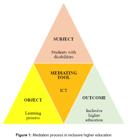
Considering students with disabilities as the Subject recognises their diverse needs and abilities. Each student's disability presents unique challenges that may affect their learning process. However, Vygotsky's theory suggests that these students can overcome barriers and actively engage in learning through appropriate mediation because "addressing learning difficulties should be framed as enabling students to 'mediate their participation' in activities (e.g., reading text) in new ways (i.e., alternative forms of cultural re-mediation)" (Artiles et al. 2020, 161). We frame the learning process as the Object of mediation. For students with disabilities, traditional teaching methods may not always be sufficient to accommodate their diverse learning needs. ICT serves as a mediating tool, offering various features and functionalities tailored to different disabilities. Thus, we agree with an observation that "a complementary tenet is that learning is 'mediated' by ideal (beliefs, values, theories) and material (print, charts, lists) [artifacts] that have cultural origins" (Artiles et al. 2020, 161). For us, the ideal is that higher education students with disabilities deserve inclusivity and we use ICT as 'material' towards inclusivity. For example, audio recordings assist visually impaired students. At the same time, subtitles aid those with hearing impairments when a lecturer uses a certain video to elaborate an abstract point, as we did in our language (lead author) and science (co-author) education practices.
In a Vygostkian sense, ICT is a mediating tool. We observe its potential to scaffold the learning experiences of higher education students with disabilities. ICT can enhance their participation in higher education by providing alternative means of access to information, communication and learning resources. As Perera-Rodríguez and Moriña-Díez (2019) observed, ICT facilitates collaboration and interaction, enabling higher education students with disabilities to engage with educators and peers despite physical or communication barriers. Ultimately, the Outcome of mediating learning via ICT is inclusive higher education. Using ICT as a mediating tool, higher education institutions in Malawi can promote a more inclusive learning environment where students with disabilities are empowered to achieve academic success. Through accessible digital resources, adaptive technologies and supportive instructional strategies, students can fully participate in educational opportunities that were previously inaccessible.
As reported in our critical reflections, by using various digital tools, we could provide customised learning materials and support that accommodated different cognitive and sensory preferences. This resonates with Vygotsky's notion of mediation, where external tools facilitate learning and scaffold cognitive processes (Wong, Hall, and Hernandez 2020). For example, our critical reflections revealed that integrating multimedia resources allowed for a more holistic understanding of language (the lead author) and science (the co-author) concepts, ensuring that students with diverse abilities could access content in ways that suited their individual needs. We mediated the learning process through audio descriptions and captioned videos, providing support and enhancing comprehension for students with disabilities.
We acknowledge and agree with Perera-Rodríguez and Moriña-Díez (2019) that ensuring ICT tools and resources are accessible to all students, including those with disabilities, poses significant challenges. In our case, we had to carefully consider alternative formats for visual content and interactive tools' usability to effectively meet diverse needs. This reflects Vygotsky's emphasis on the social and cultural context of learning, where the accessibility of mediation tools such as ICT influences their effectiveness, and not just for the convenience of the educator as it is largely the case in our context of practice in Malawi. We further acknowledge that technological limitations and infrastructure issues can hinder the integration of ICT into lectures, disrupting the teaching and learning processes and requiring extra efforts for flexibility and adaptability. To mitigate this, Vygotsky's theory emphasises the importance of dynamic interactions between individuals (in our case students with disabilities) and their environment (higher education), highlighting the need for ongoing adjustment and refinement in the use of ICT as a mediating tool for inclusivity in higher education (the outcome).
Despite these practical and conceptual challenges, our experiences have demonstrated the transformative potential of ICT in promoting inclusive learning environments at the tertiary level in Malawi. Beyond Malawi, other studies (including Bond et al. 2020) posited that ICT can empower higher education students with disabilities to fully participate in learning processes, cultivating a sense of agency and belonging within the lectures, seminars and tutorials across disciplines. As Vygotsky (1978) could put it, ICT is part of cultural (and educational) tools that influence and transform learning experiences of higher education students with disabilities. Thus, if you ask us the main question in this study (can ICT mediate inclusive learning for higher education students with disabilities in Malawi?), our onto-epistemic response is affirmative if educators use ICT not only for convenience (the current dominant practice) but also conscious of and utilise its potential to help students facing learning barriers to enhance their learning experiences and outcomes.
CONCLUSION
Our critical reflections on integrating ICT into language (for the lead author) and science (coauthor) education at the tertiary level revealed benefits for all engaged parties, including us as educators (mostly convenience) and the students with(out) disabilities (enhanced learning experiences and outcomes). Using ICT as a mediation tool, we created inclusive learning environments that accounted for diverse needs and promoted student inclusion. We believe inclusive practices facilitated by ICT can extend beyond the confines of lecture theatres to prepare students to embrace inclusivity and accessibility principles in future roles, such as student teachers who experience the benefits of inclusive teaching practices supported by ICT. These future teachers are better positioned to create inclusive learning environments in their practice context, thereby continuing a cycle of inclusivity. Through critical reflection as a research methodology, we have realised that we needed to be fully conscious of the many elements of ICT use that we employed in our practices as educators. Only now, through critical reflection, we can cognitively evaluate ourselves as far as ICT for inclusivity in higher education is concerned. Thus, despite the shortcomings of this research methodology (especially being a researcher participant and the inter-subjectivity that comes with it), critical reflection offers analytical opportunities to surface deeply seated and reflexively relevant ontological contradictions that are embedded in educators' practices, with the potential for transformation and open new avenues for alternative ways of knowing and researching.
REFERENCES
LITERATURE REVIEW
-
Adam, Lishan. 2003. "Information and Communication Technologies in Higher Education in Africa: Initiatives and Challenges." Journal of Higher Education in Africa 1, no. 1: 195-221. https://doi.org/10.57054/jhea.v1i1.1695.
» https://doi.org/10.57054/jhea.v1i1.1695 -
Akour, Mohammad, and Mamdouh Alenezi. 2022. "Higher Education Future in the Era of Digital Transformation." Education Sciences 12, no. 11: 784. http://dx.doi.org/10.3390/educsci12110784
» http://dx.doi.org/10.3390/educsci12110784 - Alenezi, Abdullah. 2020. "The Role of E-learning Materials in Enhancing Teaching and Learning Behaviours." International Journal of Information and Education Technology 10, no. 1: 48-56.
- Allan, Julie. 2007. Rethinking Inclusive Education: The Philosophers of Difference in Practice. Dordrecht: Springer.
-
Artiles, Alfredo J., David Rose, Taucia González, and Aydin Bal, A. 2020. "Culture and Biology in Learning Disabilities Research: Legacies and Possible Futures." In Handbook of the Cultural Foundations of Learning, edited by Na'ilah S. Nasir, Carol D. Lee, Roy Pea, and Maxine M. de Royston, 160-177. New York: Routledge/Taylor & Francis Group. https://doi.org/10.4324/9780203774977-11
» https://doi.org/10.4324/9780203774977-11 -
Atwa, Hani, Mohamed Hany Shehata, Ahmed Al-Ansari, Archana Kumar, Ahmed Jaradat, Jamil Ahmed, and Abdelhalim Deifalla. 2022. "Online, Face-to-Face, or Blended Learning? Faculty and Medical Students' Perceptions During the COVID-19 Pandemic: A Mixed-method Study." Frontiers in Medicine 9: 791352. http://dx.doi.org/10.21203/rs.3.rs-951471/v1
» http://dx.doi.org/10.21203/rs.3.rs-951471/v1 - Bond, Melissa, Svenja Bedenlier, Katja Buntins, Michael Kerres, and Olaf Zawacki-Richter. 2020. "Facilitating Student Engagement in Higher Education through Educational Technology: A Narrative Systematic Review in the Field of Education." Contemporary Issues in Technology and Teacher Education 20, no. 2: 315-368.
-
Brown, Michael Geoffrey. 2016. "Blended Instructional Practice: A Review of the Empirical Literature on Instructors' Adoption and Use of Online Tools in Face-to-Face Teaching." The Internet and Higher Education 31: 1-10. http://dx.doi.org/10.1016/j.iheduc.2016.05.001
» http://dx.doi.org/10.1016/j.iheduc.2016.05.001 -
Cavus, Nadire, and Daniel Sekyere-Asiedu. 2021. "A Comparison of Online Video Conference Platforms: Their Contributions to Education During COVID-19 Pandemic". World Journal on Educational Technology: Current Issues 13, no. 4:1163-1173. https://doi.org/10.18844/wjet.v13i4.6329.
» https://doi.org/10.18844/wjet.v13i4.6329 -
Chambers, Dianne. 2019. "Assistive Technology to Enhance Inclusive Education." In Oxford Research Encyclopedia of Education. http://dx.doi.org/10.1093/acrefore/9780190264093.013.155
» http://dx.doi.org/10.1093/acrefore/9780190264093.013.155 - Chaputula, Harvey Aubrey. 2012. "State, Adoption and Use of ICTs by Students and Academic Staff at Mzuzu University, Malawi." Program 46, no. 4: 364-382.
-
Chawinga, Winner D., and Sandy Zinn. 2016. "Use of Web 2.0 by Students in the Faculty of Information Science and Communications at Mzuzu University, Malawi." South African Journal of Information Management 18, no. 1: 1-12. http://dx.doi.org/10.4102/sajim.v18i1.694
» http://dx.doi.org/10.4102/sajim.v18i1.694 - Chawinga, Winner Dominic, and Paxton Andrew Zozie. 2016. "Increasing Access to Higher Education through Open and Distance Learning: Empirical Findings from Mzuzu University, Malawi." International Review of Research in Open and Distributed Learning 17, no. 4: 1-20.
- Chikaipa, Victor, John A. Chirwa, Chikumbutso H. Manthalu, and Anthony M. Gunde. 2021. "Re-imagining Discourses of Disability at Higher Education Institutions in Democratic Malawi." In Education, Communication and Democracy in Africa: A Democratic Pedagogy for the Future, edited by Chikumbutso Herbert Manthalu, Victor Chikaipa, and Anthony Mavuto Gunde, 187203. London: Routledge.
-
Collins, Ayse, Fara Azmat, and Ruth Rentschler. 2019. "'Bringing Everyone on the Same Journey': Revisiting Inclusion in Higher Education." Studies in Higher Education 44, no. 8: 1475-1487. http://dx.doi.org/10.1080/03075079.2018.1450852
» http://dx.doi.org/10.1080/03075079.2018.1450852 -
de Souza, Ben. 2022. "Reframing Policy Trajectory for Inclusive Education in Malawi." Journal of Education (University of KwaZulu-Natal) 88: 69-86. http://dx.doi.org/10.17159/2520-9868/i88a05
» http://dx.doi.org/10.17159/2520-9868/i88a05 - Gama, Limbani Chrispin, George Theodore Chipeta, and Winner Dominic Chawinga. 2022. "Electronic Learning Benefits and Challenges in Malawi's Higher Education: A Literature Review." Education and Information Technologies 27, no. 8: 11201-11218.
-
Gondwe, Foster. 2020. "ICT Integration into Teacher Education: Teacher Educators' Experiences of Policy at Two Teacher Education Institutions in Malawi." Journal of International Development Studies 29, no. 1: 117-128. https://doi.org/10.32204/jids.29.1_117
» https://doi.org/10.32204/jids.29.1_117 - Gunda, Marianne Nsanja. 2015. "An Investigation of Inclusion of Students with Disabilities in Tertiary Learning Institutions: A Case Study of Two Public Universities in Malawi." Masters diss., Mzuzu University.
-
Heeks, Richard. 2017. Information and Communication Technology for Development (ICT4D). London: Taylor and Francis. http://dx.doi.org/10.1177/00472395211047865
» http://dx.doi.org/10.1177/00472395211047865 - Kadzamira, Esme C., and Pauline Rose. 2001. Educational Policy Choice and Policy Practice in Malawi: Dilemmas andDisjunctures. No. 124. Brighton, UK: Institute of Development Studies.
-
Kadzamira, Zimani David. 2020. "Higher Education Systems and Institutions, Malawi.". In The International Encyclopedia of Higher Education Systems and Institutions, edited by Pedro Nuno Teixeira, and Jung Cheol Shin, 1-5. Dordrecht: Springer. https://doi.org/10.1007/978-94-017-8905-9_459
» https://doi.org/10.1007/978-94-017-8905-9_459 -
Kalembera, Lloyd, and Felix Majawa. 2015. "The Integration of ICTs into the Learning Activities of the College of Medicine Undergraduate Students." In 2015 IST-Africa Conference, 1-10. IEEE. http://dx.doi.org/10.1109/ISTAFRICA.2015.7190528
» http://dx.doi.org/10.1109/ISTAFRICA.2015.7190528 -
Kamchedzera, Elizabeth Tikondwe. 2010. "Education of Pupils with Disabilities in Malawi's Inclusive Secondary Schools: Policy, Practice and Experiences." PhD diss., University of Warwick. https://wrap.warwick.ac.uk/55933/
» https://wrap.warwick.ac.uk/55933/ - Kamchedzera, Elizabeth Tikondwe. 2015. "Access and Equity for Students with Disabilities at the University of Malawi: The Case of Chancellor College." In Knowledge, for a Sustainable World: A Southern African-Nordic Contribution, edited by Tor Halvorsen, Hilde Ibsen, and Vyvienne RP M'kumbuzi, 71-92. Cape Town: African Minds.
-
Kayange, Albert. K. 2019. "E-learning Encounters in Malawi Higher Education Institutions." International Journal for E-Learning Security (IJeLS) 8, no. 1: 592-603. http://dx.doi.org/10.20533/ijels.2046.4568.2019.0074
» http://dx.doi.org/10.20533/ijels.2046.4568.2019.0074 - Kirkup, Gill, and Adrian Kirkwood. 2005. "Information and Communications Technologies (ICT) in Higher Education Teaching-A Tale of Gradualism Rather Than Revolution." Learning, Media and Technology 30, no. 2: 185-199.
- Kozlova, Diana, and Marcel Pikhart. 2021. "The Use of ICT in Higher Education from the Perspective of the University Students." Procedia Computer Science 192 (2021): 2309-2317.
- Malawi Ministry of Education, Science and Technology. 2017. National Strategy on Inclusive Education 2017-2021: Towards an Inclusive Education System in Malawi. Lilongwe: Ministry of Education, Science and Technology.
- Malawi Ministry of Information and Tourism. 2006. Malawi National ICT for Development (ICT4D) Policy. Lilongwe: Ministry of Information.
- Malawi Ministry of Information. 2013. The Malawi Digital Broadcasting Policy. Lilongwe: Ministry of Information.
- Mishra, Sanjaya. 2017. "Open Educational Resources: Removing Barriers from Within." Distance Education 38, no. 3: 369-380.
-
Moriña, Anabel. 2019. "Inclusive Education in Higher Education: Challenges and Opportunities." European Journal of Special Needs Education 31, no 1: 3-17. http://dx.doi.org/10.1080/08856257.2016.1254964
» http://dx.doi.org/10.1080/08856257.2016.1254964 - Morley, Christine. 2008. "Critical Reflection as a Research Methodology." In Knowing Differently: Arts-based and Collaborative Research Methods, edited by Pranee Liamputtong, and Jean Rumbold, 265-280. New York: Nova Publishers.
-
Mpungose, Cedric Bheki, and Simon Bheki Khoza. 2022. "Postgraduate Students' Experiences on the Use of Moodle and Canvas Learning Management System." Technology, Knowledge and Learning 27, no. 1: 1-16. https://link.springer.com/article/10.1007/s10758-020-09475-1
» https://link.springer.com/article/10.1007/s10758-020-09475-1 - Nawaz, Allah, Zahid Awan, and Bashir Ahmad. 2011. "Integrating Educational Technologies in Higher Education of the Developing Countries." Journal of Education and Practice 2, no. 2: 1-13.
-
Odunga, Jack O. 2024. "Information and Communication Technology (ICT) Interventions for Enhancing Access to Education in Rural sub-Saharan Africa: A Systematic Review." Journal of the Kenya National Commission for UNESCO 4, no. 1. https://doi.org/10.62049/jkncu.v4i1.80 .
» https://doi.org/10.62049/jkncu.v4i1.80 -
Owens, Taya Louise. 2017. "Higher Education in the Sustainable Development Goals Framework." European Journal of Education 52, no. 4: 414-420. http://dx.doi.org/10.1111/ejed.12237
» http://dx.doi.org/10.1111/ejed.12237 -
Father, Sulochini. 2019. "Confronting Inclusive Education in Africa since Salamanca." International Journal of Inclusive Education 23, no. 7-8: 782-795. http://dx.doi.org/10.1080/13603116.2019.1623329
» http://dx.doi.org/10.1080/13603116.2019.1623329 - Pavel, Adina-Fetruta, Andreas Fruth, and Monica-Nicoleta Neacsu. 2015. "ICT and E-learning-Catalysts for Innovation and Quality in Higher Education." Procedia Economics and Finance 23: 704-711.
-
Ferera-Rodríguez, Víctor-Hugo, and Anabel Moriña-Díez. 2019. "Technological Challenges and Students with Disabilities in Higher Education." Exceptionality 27, no. 1: 65-76. http://dx.doi.org/10.1080/09362835.2017.1409117
» http://dx.doi.org/10.1080/09362835.2017.1409117 -
Salmi, Jamil, and Anna D'Addio. 2021. "Policies for Achieving Inclusion in Higher Education." Policy Reviews in Higher Education 5, no. 1: 47-72. http://dx.doi.org/10.1080/23322969.2020.1835529
» http://dx.doi.org/10.1080/23322969.2020.1835529 - Sharifov, Mahammad, and Abdulsalam S. Mustafa. 2020. "Review of Prevailing Trends, Barriers and Future Perspectives of Learning Management Systems (LMSs) in Higher Institutions." The Online Journal of New Horizons in Education 10, no. 3: 166-173.
- Singh, Jitendra, Keely Steele, and Lovely Singh. 2021. "Combining the Best of Online and Face-to-Face Learning: Hybrid and Blended Learning Approach for COVID-19, Post Vaccine, & Post-pandemic World." Journal of Educational Technology Systems 50, no. 2: 140-171.
- Tokareva, Elena A., Yulia V. Smirnova, and Larisa G. Orchakova. 2019. "Innovation and Communication Technologies: Analysis of the Effectiveness of Their Use and Implementation in Higher Education." Education and Information Technologies 24, no. 5: 3219-3234.
- United Nations Educational, Scientific and Cultural Organisation [UNESCO]. 2023. Global Education Monitoring Report: Technology in Education-A Tool on Whose Terms? Paris: UNESCO.
- Unwin, Tim. 2017. Reclaiming Information and Communication Technologies for Development. Oxford: Oxford University Press.
- Viner, Mark, Ajay Singh, and Michael F. Shaughnessy. 2020. "Assistive Technology to Help Students with Disabilities." In Special Education Design and Development Tools for School Rehabilitation Professionals, edited by Ajay Singh, Mark Viner, and Chia Jung Yeh, 240-267. Pennsylvania: IG Global.
- Vygotsky, Lev S. 1978. Mind in Society: The Development of Higher Psychological Processes. Cambridge, Massachusetts: Harvard University Press.
- Vygotsky, Lev S. 1981. "The Genesis of Higher Mental Functions." In The Concept of Activity in Soviet Psychology, translated and edited by James V. Wertsch, 144-188. New York: M.E. Sharpe.
- Wong, Daniel W., Kimberly R. Hall, and Lucy Wong Hernandez. 2020. Counselling Individuals Through the Lifespan (2nd ed.). London: Sage.