"I am uncertain about its worth...": Academics' lived experiences post-PhD
Abstract
This study explored the lived experiences of academics post-PhD, examining their perceptions of the degree's worth in relation to career stability, intellectual growth, and personal wellbeing. While the PhD is widely regarded as the pinnacle of academic achievement, its practical worth remains contested, particularly in an era of precarious employment and shifting career landscapes. Using a phenomenological approach, this study draws on insights from ten early- and mid-career academics across disciplines. Findings reveal a dual reality: while the PhD enhances intellectual development and research expertise, it often fails to secure stable employment, leading to career uncertainty, financial precarity, and psychological strain. Academics reported unmet career expectations and challenges in translating their doctoral training into non-academic roles, accentuating the misalignment between doctoral education and contemporary job markets. To address these issues, the study advocates for PhD programmes to integrate comprehensive career preparation, mental health support, and clearer job market guidance. A conceptual model is proposed to map academics diverse post-PhD lived experiences, offering insights into how academic and professional trajectories intersect. Through highlighting systemic challenges and areas for reform, this study contributes to ongoing discussions on the evolving role and value of the PhD in academia and beyond.
PhD worth; career stability; intellectual growth; post-PhD employment; doctoral education; lived experiences; mental health
INTRODUCTION
The PhD, or Doctor of Philosophy, has long been regarded as the pinnacle of academic achievement, signifying the transition from student to scholar. Traditionally, it has served as a gateway to stable academic careers in teaching and research (Spina, Smithers, Harris and Mewburn 2022) and is widely valued as a mark of expertise in both academic and non-academic contexts. However, the real-world worth of the PhD is increasingly contested, as structural shifts in higher education and labour market conditions have made stable academic employment less attainable. Today, an oversupply of PhD graduates, coupled with a decline in permanent academic positions, has led many to navigate precarious adjunct, postdoctoral, or contract-based roles that often fall short of their initial career expectations (Gallagher 2022).
Despite its intellectual and professional significance, the PhD does not guarantee job security. In fields such as the humanities and sciences, it remains crucial for securing research funding and contributing to knowledge (Headworth and Freese 2016), but competition for academic positions continues to intensify. Moreover, changes in funding structures and the expansion of doctoral education have created a surplus of highly qualified individuals competing for limited opportunities (Spina et al. 2022). This has prompted increasing scrutiny of the PhD's practical worth, given the extensive investment of time, resources, and personal sacrifices it demands (Siler 2024).
Beyond employment concerns, the PhD journey often exacts a significant psychological toll. Research indicates that doctoral candidates experience disproportionately high levels of stress, anxiety, and burnout, with many struggling with mental health challenges that persist well beyond graduation (Satinsky et al. 2021). Isolation, publication pressures, and the demand to establish an academic reputation also contribute to these difficulties (Bastalich and McCulloch 2024). For many graduates, the transition to an uncertain job market exacerbates these challenges, leading them to question whether the sacrifices associated with the PhD were ultimately worthwhile.
While extensive research has explored the PhD experience itself, there is relatively little scholarship examining how academics retrospectively assess the value of their degrees once they have entered the workforce (Solms, van den Heuvel, Nevicka and Homan 2024). This study addresses this gap by investigating these PhD holders perceive the long-term impact of their degrees, focusing on career stability, intellectual development, mental health, and personal relationships. Through capturing the lived experiences of early- and mid-career academics, this study offers insights into the evolving significance of the PhD and identifies areas where doctoral education could better support graduates in navigating post-PhD realities. Accordingly, this study is guided by the following research questions:
How do academics perceive the worth of their PhD post-completion, and what factors influence this perception?
What are the primary benefits and challenges experienced by academics post-PhD?
In what ways has completing a PhD influenced their career trajectories and personal lives?
Through centring the voices of academics across career stages and disciplines, this study contributes to critical discussions on the alignment between doctoral training and contemporary career pathways. The findings aim to inform policy recommendations for doctoral education and post-PhD support mechanisms, and to offer a more holistic understanding of the PhD's long-term value in an evolving academic and professional landscape.
REVIEW OF RELEVANT LITERATURE
This section reviews existing research on the evolving value of a PhD, the global perspective on post-PhD employment trends, its impact on career trajectories, the personal challenges faced by PhD graduates, and structural barriers in academic employment.
The changing role and value of the PhD
The PhD was traditionally designed to develop specialised research skills and contribute original knowledge to a field (Solms et al. 2024). It provides rigorous training in research methodologies, critical analysis, and academic writing, shaping graduates into experts who advance knowledge production (Gallagher 2022). Historically, it has served as a qualification for entry into academia, particularly in research and teaching (Hunt 2021). However, as higher education systems expand and job markets shift, the PhD's role has become more uncertain. In recent years, the number of PhD graduates has grown significantly, yet academic positions have not kept pace with this increase. As a result, many PhD holders struggle to secure permanent jobs in academia (Spina, Harris, Bailey and Goff 2020). While some successfully transition into industry, others find that their training is not always aligned with non-academic career demands. Despite growing discussions on the need to prepare PhD students for diverse career pathways, universities often remain focused on training for academic careers (Southworth 2022). This disconnect raises concerns about whether doctoral education adequately equips graduates for today's job market.
A global perspective on post-PhD employment trends
The post-PhD employment landscape varies significantly between the Global North and Global South, shaped by differences in funding availability, institutional support, and economic conditions. In many parts of the Global North, particularly in well-funded research-intensive universities, PhD graduates have better access to postdoctoral fellowships, research grants, and alternative career pathways (Hunt 2021; Bastalich and McCulloch 2024). However, even in these contexts, competition for permanent academic positions remains high, with an increasing number of PhD holders moving into non-academic roles due to limited full-time opportunities (Baker et al. 2023).
Conversely, in the Global South, including regions such as Africa and parts of South Asia, PhD graduates often face even greater career uncertainty. Limited research funding, fewer permanent academic positions, and institutional constraints result in prolonged job insecurity (Kınıkoğlu and Can 2024). In South Africa, for example, the expansion of doctoral education has not been matched by an increase in stable employment opportunities, leading to a growing pool of highly qualified individuals struggling to secure academic positions (Mouton and Cloete 2023). Many PhD holders are forced to take on multiple contract-based roles, with little job security and restricted access to research funding (Burton and Bowman 2022). These challenges highlight the need for structural reforms that align doctoral training with evolving labour market realities across different regions.
Employment outcomes and career challenges
PhD graduates face an increasingly competitive job market, particularly in academia, where permanent positions are scarce. Many early-career researchers take on temporary, part-time, or postdoctoral contracts, often without clear pathways to long-term employment (Lin et al. 2023). This issue is especially pronounced in the humanities and social sciences, where stable academic roles are more limited (Siler 2024). In contrast, STEM (Science, Technology, Engineering and Mathematics) graduates generally have better employment prospects, though they are not immune to job insecurity (Roach and Sauermann 2017).
Employment outcomes also vary by location and institutional prestige. PhD holders in well-funded universities or research-intensive countries often have better opportunities, whereas those in regions with limited research funding, such as parts of South Africa and Europe, face greater career instability (Vavasseur 2024). These differences suggest that universities should offer tailored career support based on discipline and regional employment trends.
Beyond academia, many PhD graduates explore careers in government, non-profits, and industry. However, those who pursue non-academic roles often feel underprepared due to gaps in transferable skills such as project management and communication (McAlpine and Inouye 2022). This highlights the need for doctoral programmes to integrate broader professional development to support career adaptability.
The personal and emotional toll of the PhD
The PhD journey is often emotionally demanding, with high rates of stress, anxiety, and burnout reported among candidates (Bastalich and McCulloch 2024). While some mental health challenges may lessen post-PhD, job insecurity and career instability continue to create stress for many graduates (Lin et al. 2023). The pressure to publish, secure funding, and establish an academic reputation further exacerbates these issues, particularly for those in precarious employment (Adler and Harzing 2009).
Imposter syndrome is another common struggle among PhD graduates, driven by the competitiveness of academia and the expectation to perform at exceptionally high levels (Ramos and Wright-Mair 2021). To add, Fisher and James (2022) state that feelings of self-doubt are particularly intense for those on short-term contracts with limited mentorship support. These pressures suggest that doctoral education should incorporate structured mentorship and wellbeing support to help graduates manage career uncertainty.
PhD studies can also strain personal relationships. Many candidates experience social isolation due to long research hours, missed family events, and a lack of work-life balance (Schmidt and Hansson 2018). Even after completing the degree, some struggle to reconnect with friends and family, particularly if they enter demanding academic careers (Fisher and James 2022). These findings indicate that universities should encourage a more holistic approach to PhD training, incorporating strategies for maintaining social connections and mental wellbeing.
Structural Barriers in Academic Employment
Several structural barriers affect PhD graduates' career stability, including hiring practices, limited funding, and resistance to career diversification. Many universities rely on short-term contracts due to financial constraints, reducing permanent academic positions and leaving PhD holders in uncertain, temporary roles (Spina et al. 2022; Burton and Bowman 2022).
Funding shortages, especially in the Global South, further limit opportunities. Scarce research grants and postdoctoral funding make it difficult for early-career academics to establish themselves, often forcing them to leave academia for industry or seek employment abroad (Fazio et al. 2021; Baral 2023).
Moreover, faculty attitudes remain a challenge, as traditional academic pathways are still prioritised over alternative careers (Kınıkoğlu and Can 2024). PhD graduates who transition beyond academia often face stigma, despite the increasing demand for interdisciplinary skills (Ahmed et al. 2022). Addressing these issues requires universities to improve career guidance, strengthen mentorship, and advocate for long-term academic employment policies.
To sum up this review, while research on the PhD journey is extensive, most studies focus on students' experiences rather than post-graduation reflections. Limited research examines how PhD graduates perceive the long-term value of their degrees in terms of career satisfaction, financial stability, and wellbeing (Solms et al. 2024). Few studies explore the psychological impact of job insecurity after a PhD. Therefore, this article addresses these gaps by examining academics' lived experiences post-PhD, assessing how they perceive their degree's worth in professional and personal contexts. With incorporating diverse perspectives across disciplines and career stages, it contributes to discussions on improving doctoral education and graduate support.
METHODOLOGY
This study employed a phenomenological methodology within qualitative approach to explore how academics perceive the value of their PhD degrees post-completion. Phenomenology was selected to capture the depth and complexity of individual experiences, acknowledging the unique ways in which participants interpret the impact of their doctoral education. The phenomenological design of this study prioritises participants' subjective perspectives, with semi-structured interviews conducted to allow for open-ended, in-depth exploration. This approach aligns with phenomenology's emphasis on understanding how individuals make sense of significant life events, in this case, the completion of a PhD and the transitions that follow. The study employed semi-structured interviews to maintain flexibility, enabling participants to express their thoughts in their own words while still allowing the researcher to explore specific topics related to career outcomes, intellectual development, and personal well-being.
Sampling and participant selection
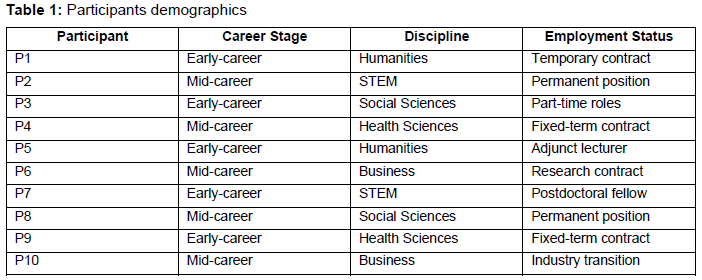
A purposive sampling strategy was employed to ensure representation from diverse academic backgrounds and career stages. The final sample consisted of ten participants who completed their PhDs within the past three to ten years. This timeframe allowed for insights from both recent graduates and those with more established careers. Participants were selected based on three criteria: career stage, discipline, and employment status. Table 1 below summarises participants demographics:
Although the sample size is limited to ten participants, this focus is consistent with qualitative research objectives, as smaller, purposive samples allow for more in-depth exploration of individual experiences (Nendauni, Sadiki and Baloyi 2021). The limitations in terms of generalisability are acknowledged; however, the richness of qualitative data gathered from this carefully selected sample offers valuable insights into the long-term impact of PhD completion.
Data collection
Data was collected through semi-structured interviews conducted via MS Teams. Each interview lasted for approximately 25 minutes, allowing participants the time to reflect meaningfully on their experiences. The interview guide was designed to explore themes related to career expectations, intellectual fulfilment, personal sacrifices, and mental wellbeing. Open-ended questions encouraged participants to share their insights freely, fostering a conversational flow that allowed for the emergence of new themes. Key interview questions included:
How do you perceive the value of your PhD in your academic career?
What challenges and benefits have you experienced post-PhD?
How has your PhD influenced your personal relationships and mental wellbeing?
Data analysis
Thematic analysis, following Braun and Clarke's (2023) six-phase process, was employed to interpret the interview data. However, to ensure alignment with phenomenological principles, this study incorporated Husserlian phenomenological reduction, focusing on the essence of participants' lived experiences by setting aside preconceived notion. The analysis began with familiarisation with the data, where interview recordings were transcribed verbatim, and an initial reading conducted to gain an overview of key themes. Next, the data was systematically coded to identify significant concepts, phrases, and experiences related to participants' reflections on their PhD journeys. The codes were then organised into potential themes, grouping related concepts into overarching categories that captured common experiences. Following this, the themes were reviewed for coherence and relevance, ensuring each accurately represented the data across participants. Each theme was labelled and defined, highlighting core aspects of participants' experiences, such as career insecurity, intellectual fulfilment, and mental health impacts. Finally, the themes were woven into a cohesive narrative that formed the basis of the study's findings, with participant quotes included to illustrate key points and enhance credibility. To ensure analytical rigour, member-checking was conducted, allowing participants to review the transcriptions and interpretations of their responses, which in turn provided an additional layer of validity to the findings.
Reflexivity and researcher influence
Given the interpretive nature of phenomenology, reflexivity was central to this study. The researcher maintained a reflexive journal to document potential biases, critically examining how personal experiences as an academic navigating similar career transitions may have shaped data interpretation. This process helped to identify moments where personal assumptions could influence the analysis and allowed for conscious efforts to prioritise participants' voices over the researcher's perspectives. Additionally, regular peer debriefings were conducted to enhance credibility and mitigate subjectivity. These discussions provided an external lens to challenge potential biases, ensuring that interpretations remained faithful to participants' lived experiences rather than being coloured by the researcher's own academic trajectory.
Ethical considerations
The present research adhered to strict ethical guidelines to protect participants' rights and wellbeing. All participants were informed about the study's purpose, their right to withdraw at any time, and the management of their data. Informed consent was obtained before each interview, and confidentiality was assured. Pseudonyms were employed to anonymise data, and any identifying information regarding participants' institutions, departments, or job titles was carefully handled to prevent disclosure. Data was securely stored and accessible only to the researcher. Participants were reminded of their right to decline to answer any questions or to terminate the interview at any point, to ensure voluntary participation that is free from coercion.
FINDINGS
The findings of this study reveal a complex picture of academics' lived experiences post-PhD, in terms of how they perceive the worth of their degree in terms of intellectual growth, career stability, and personal wellbeing. Key themes emerging from the data include professional outcomes, career challenges, and the personal impacts associated with completing a PhD. This section presents a cohesive analysis of these themes, with selected participant quotes illustrating key insights.
Theme 1: Professional outcomes
Most participants acknowledged that completing a PhD significantly enhanced their intellectual growth and skill development. Beyond acquiring discipline-specific knowledge, they highlighted improvements in critical thinking, research methodologies, and problem-solving abilities. For instance, P1 and P2 noted:
"I feel like I have become a critical thinker, not just in my field but in how I approach challenges, whether they are administrative or academic" [P1].
"The process has taught me to see connections between concepts I hadn't initially considered. I think differently, now more strategically and analytically" [P2].
These experiences align with research showing that academic growth moves from basic knowledge to advanced critical thinking and interdisciplinary understanding (Peng and Kievit, 2020). Also, Magolda and King (2023) add that this process develops self-authorship, helping academics integrate diverse perspectives. Participants also noted gaining key skills during their PhDs, including data analysis, academic writing, and student mentorship, which shaped their professional identities. P7 noted:
"I have learned how to structure and present my research findings effectively. Writing for publication has been a skill I continue to refine with each paper" [P7].
Research shows that academia plays a key role in skill development (Radović et al., 2023). Kolb (2007) highlights experiential learning in teaching, research, and feedback as essential for academics. Radović et al. (2023) add that these skills improve adaptability in different fields. In concurrence, Hunt (2021) emphasises the 'reflective practitioner', where continuous learning enhances professional growth, aligning with this study's participants' views on improved analysis and self-awareness. Similarly, Southworth (2022) describes a shift from knowledge consumers to producers, mirroring participants' experiences of intellectual growth. The PhD journey, he argues, blends curiosity and practical skills, driving personal and professional development. The next theme focuses on career challenges academic endures post PhD.
Theme 2: Career challenges
A prominent theme emerged regarding the gap between participants' expectations of career benefits from a PhD and the stark realities of the academic job market. Many entered doctoral studies believing that obtaining a PhD would lead to stable, lucrative academic positions. However, upon graduation, they encountered a fiercely competitive environment characterised by limited full-time opportunities and a rise in precarious roles such as part-time or temporary contracts. Hirschi and Koen (2021) emphasise the diminishing full-time roles and increasing reliance on contingent employment, which often leaves PhD graduates cobbling together short-term or part-time positions. P1 and P3 noted:
"I thought a PhD would be my gateway to a secure academic job, but here I am, years later, cobbling together part-time roles just to make ends meet. I am not sure about its worth" [P1].
"After investing so much time and money into my education, I honestly feel blindsided by the lack of full-time opportunities. It's like I was sold a dream that didn't align with the job market's reality" [P3].
As Jackson et al (2024) point out, PhD employment outcomes are influenced by various factors, including discipline and institutional reputation. Participants from the humanities and social sciences reported even fewer secure positions compared to their peers in STEM fields, highlighting a stark contrast in job market experiences. P8 remarked:
"I have seen peers in engineering and tech secure jobs quickly, but for us in the humanities, the struggle is real. We are competing for an ever-shrinking pool of academic positions" [P8].
Spina et al. (2022) examine precarious employment in academia, where institutions rely more on contract-based work instead of stable, long-term positions. Once seen as a pathway to permanent jobs, casual contracts now leave many academics in uncertainty for years (Fazio et al. 2021). This shift coincides with higher education expansion and increased teaching demands, creating an oversupply of degree holders. Burton and Bowman (2022) describe this as a state of 'limbo', reflecting PhD graduates' instability. Short-term contracts cause financial insecurity, limit career growth, and hinder research focus (Spina et al. 2022), pushing early-career academics to seek alternative paths.
For Giuffre and Webber (2023), structural issues worsen career insecurity, while Mula et al. (2022) link contract reliance to stress, anxiety, and lower research productivity due to limited resources and funding. Kınıkoğlu and Can (2024) highlight its disproportionate impact on early-career academics, restricting diversity as only privileged individuals can endure financial instability. Baral (2023) warns that losing talented academics to industry fuels a "brain drain", where academics leave academia for better opportunities, stability, or favourable conditions.
The emergence of "alternative academic" (alt-ac) careers was a prominent root among this study's participants. While some found fulfilment in non-academic roles, others reported feeling unprepared for such transitions, asserting that their PhD training primarily equipped them for academic roles. Hyland (2019) remarks that this trend reflects a broader shift in how PhD graduates perceive their career trajectories; however, many expressed a sense of unreadiness for non-academic sectors. P10 stated:
"It was like everything I learned in my PhD was geared toward academia, I mean, publishing, teaching, research, none of which directly translates to private sector work, I cannot go anywhere else" [P10].
Others expressed emotional challenges and willingness to do a career transition beyond academia. P6 stated:
"Eight years after completing my PhD, I remain a researcher on a three-year rotational contract, making me feel like giving up on my dream. I never anticipated seeking work outside the university, but I find myself with no choice". [P6].
Existing literature highlights an urgent need for PhD programmes to diversify career preparation strategies, equipping graduates with skills beyond academia (Sherman, Ortosky, Leong, Kello and Hegarty 2021). Further, Sherman et al. (2021) support a holistic doctoral education to equip graduates for diverse careers, reducing reliance on short-term academic contracts that can leave PhD holders discouraged, as seen with P6. Ahmed et al. (2022) add that career instability harms early-career academics' mental health, limits diversity, and affects talent retention. This trend is especially pronounced in fields requiring specialised expertise, where instability contributes to a "brain drain" as academics transition to sectors offering greater job security and growth potential.
In response to this trend, Sherman et al. (2021) propose career preparation models that incorporate industry internships, grant writing, and project management skills, thus equipping PhD graduates for roles both within and beyond the academic context. This broadened approach may help bridge the expectation gap experienced by many PhD holders, as seen in this case, by providing them with practical skills and professional networks that enhance career mobility in a competitive job market. Nonetheless, other participants voiced a desire for more strong preparation for the realities of the job market; for instance, P4 stated:
"I wish my PhD programme had prepared me for this reality. If they had been more open about the challenges and taught us skills beyond academic research, maybe I would feel more confident navigating this competitive job market" [P4].
The sentiments expressed by P4 reflect widespread frustration among PhD graduates regarding their inadequate preparation for a competitive and diverse job market. Many doctoral programmes focus primarily on academic research, neglecting the development of transferable skills and transparent information on non-academic career opportunities. Xu and Grant (2020) highlight the need for PhD students to acquire a broader skill set, including communication, project management, and career adaptability, to enhance their versatility in various employment contexts.
Kınıkoğlu and Can (2024) argue that focusing only on academic training leaves PhD graduates unprepared for both limited academic roles and non-academic jobs requiring broader skills. Burton and Bowman (2022) add that this lack of preparation causes stress, as PhD holders struggle with job market demands. To address this, some universities now include professional development in PhD programmes. Iris (2023) highlights that industry-relevant skills, mentorship, and career guidance help graduates adapt and gain confidence, bridging the gap between academia and employment.
Theme 3: Personal impact
The PhD journey and unstable academic jobs can affect wellbeing and social ties. The intense demands often lead to anxiety, depression, and burnout (Martínez-García et al. 2024; Levecque et al. 2017). Many participants reported that these mental health challenges persisted after completing their PhDs, with ongoing pressures to publish, secure funding, and remain competitive further straining their wellbeing. For instance, P1 reflected on the enduring pressure while P5 described the experience of imposter syndrome, which intensified after entering the job market:
"You would think that once the PhD was over, the pressure would ease, but it just transforms. Now it is all about publishing and proving yourself over and over again. It feels like there is no end to the pressure" [P1].
"I often feel like I don't belong, like any minute someone will realise I am not as capable as they think. It is exhausting, and I never felt like this before starting the PhD" [P5].
P1's account highlights the persistent pressures faced by PhD graduates, as academia demands relentless productivity and self-validation. Post-PhD academic life often intensifies stress, with an acute focus on publication, securing funding, and building reputation (Jones 2023). This "publish-or-perish" cycle, as described by Adler and Harzing (2009), compels early-career academics to meet escalating productivity standards, creating a high-stress environment that risks burnout, as career stability relies on continual self-justification (Bunjak et al. 2023). These findings accentuate the need for structural reforms to support mental wellbeing and sustainable careers within academia.
Conversely, P5's experience of imposter syndrome reflects a common challenge among early-career academics. Their feelings of inadequacy align with Ramos and Wright-Mair (2021), who note that imposter syndrome, often exacerbated by high expectations and competition, can lead to chronic mental health issues. Such feelings frequently intensify during the transition from doctoral studies to the job market, particularly when early-career roles lack security and clear progression paths, perpetuating the pressure to prove competence.
Imposter syndrome worsens due to structural challenges like short-term contracts, high expectations, and limited mentorship, making PhD graduates feel unsupported (Ramos and Wright-Mair 2021). The competitive academic environment, especially for early-career academics, increases self-doubt, anxiety, and burnout (Fisher and James 2022). Beyond mental health, the demands of doctoral studies and academia often strain personal relationships. Long hours and isolation disrupt work-life balance, weakening social connections and support systems (Schmidt and Hansson 2018). P2 and P4 remarked:
"I missed so many family events, birthdays, and just regular time with loved ones. It was like the world moved on without me, and now, it's hard to feel as connected as I once was" [P2].
"Friends stopped inviting me out after I declined so many times. I was completely absorbed in my work. But now that I have the time, I feel like I have lost those connections" [P4].
The sacrifices made by P2 and P4 often lead to regret, as participants struggle to restore strained relationships post-PhD. Focusing on academic milestones can create tunnel vision, making some feel distant from loved ones. Schmidt and Hansson (2018) note that PhD demands often shift priorities away from personal connections, making balance harder. Fisher and James (2022) add that this is especially true in doctoral studies, where research focus can harm relationships and work-life balance. The resulting loneliness and lack of supportive structures can exacerbate feelings of inadequacy and imposter syndrome, as new academics may lack the networks needed to counteract these internalised pressures. Participants also expressed lingering regret over the impact of their academic pursuits on personal relationships, P10 and P6 uttered:
"I thought that once I finished, I could go back to a 'normal' life, but academia has a way of pulling you in and never letting you go. It has been hard to make time for those I care about, even now" [P10].
"Being in a research contract academic role means I am always focused on the next deadline, the next project. I barely have time to see the friends I have, let alone make new ones" [P6].
The literature supports these narratives, indicating that the pressures of academic careers foster a culture of overwork and social withdrawal. For instance, Fang and White (2024) highlight that relentless demands and isolation jeopardise academics' mental health and social wellbeing. This aligns with Vavasseur (2024), who notes that academia's competitiveness increases stress and lowers job satisfaction, worsening isolation. Similarly, Brew et al. (2018) highlight that the pressure to publish and secure funding often weakens social connections and support. This highlights the urgent need for structural changes in academia to improve mental health and foster a supportive environment for scholars at all career stages.
Theme 4: Long-term value of PhD on academics
The long-term value of a PhD in academia is widely debated. Research shows it brings benefits but also challenges that differ by context (Ramos and Wright-Mair 2021; Fisher and James 2022). Participants' views on its career impact vary based on their academic background, career stage, and role. P1 and P4 expressed the following:
"I thought getting a PhD would open doors, but it feels more like a key that gets stuck in a lock. I am still struggling to find stable positions and prove my worth in a crowded field" [P1].
"The PhD was critical in advancing my career. However, I still feel the pressure of job security, especially with funding being so unpredictable" [P4].
The experiences of P1 and P4 show the mixed impact of a PhD, offering career growth but also ongoing job insecurity. P1 describes it as a "key that gets stuck in a lock", echoing research on unstable academic careers (Baker et al. 2023; Cassuto and Weisbuch 2021). While P4 sees a PhD as boosting professional identity and research skills (McIntosh and Nutt 2022), concerns over job security and funding remain. Their views highlight both the advantages and structural challenges of academic careers. Another participant added:
"The skills I acquired during my PhD have been invaluable, but the job market is so volatile. I have seen many colleagues who were once stable face layoffs or forced relocations due to shifting industry needs" [P10].
For P10, the lasting value of a PhD lies in the skills developed through doctoral training, despite the academic job market's uncertainties. PhD holders acquire expertise in research, critical thinking, and problem-solving, valuable in both academic and non-academic contexts (McIntosh and Nutt 2022). However, P10 highlights that job market instability now challenges the security once associated with academic careers. Budget cuts and evolving institutional priorities have led many universities to rely on part-time or contract positions, resulting in layoffs or requiring relocation (Baker et al. 2023). In the same vein, Bastalich and McCulloch (2024) note that while a PhD may lead to senior roles, job insecurity persists, making adaptability essential. Another participant uttered:
"I chose a career in education expecting a steady path, but I am still in contract roles. The long-term impact of my PhD feels uncertain; I am just hoping to land something more stable" [P3].
The long-term value of a PhD for individuals in academic contract roles, like P3, is uncertain. While a PhD strengthens expertise, research skills, and credibility, it does not guarantee job security, especially within institutions increasingly dependent on precarious contracts (Xu and Grant 2020). In this regard, Bunjak et al. (2023) argue that despite demand for highly qualified educators, structural constraints such as budget limitations and shifting priorities restrict permanent positions, complicating stable career paths for PhD holders. Contrary, P7 added:
"My PhD has definitely been worth it. It opened up opportunities for research grants and collaborations that have significantly advanced my career. However, I see my peers in the humanities struggling, which makes me grateful for my field" [P7].
For P7, the long-term value of a PhD is evident in enhanced career prospects, including access to research grants and collaborative projects that have boosted professional growth. This reflects research on the benefits of PhDs in well-funded fields like STEM, where funding and networks significantly aid career advancement (Baker et al. 2023). P7's field-specific advantages align with Bastalich and McCulloch's (2024) findings that, while PhDs in well-resourced fields yield higher returns, humanities graduates often face poor funding and job scarcity. P7's experience highlights how the PhD's value varies across disciplines, shaped by research funding availability.
REFLECTION ON THE FINDINGSThis study's findings engage with existing literature on the lived experiences of PhD graduates, offering insights into the changing meaning of doctoral education. The findings show how perceptions of a PhD's worth shift depending on career paths, job market conditions, and personal experiences. This section connects key themes from the findings with the literature, highlights unexpected insights, and presents a conceptual model mapping diverse academics' post-PhD experience.
Participants expressed mixed feelings about the worth of their PhD, reflecting broader trends in doctoral education research (Magolda and King 2023). Some saw it as a valuable tool for intellectual growth and professional credibility, while others questioned its practical benefits due to career instability and financial insecurity. This complexity aligns with Van Manen's (2025) view that lived experiences are shaped by personal and professional contexts.
An unexpected finding is that participants in non-academic careers reported greater satisfaction with their PhD than those in unstable academic roles, challenging the notion that PhD success depends on securing a permanent academic position (Cassuto and Weisbuch, 2021). The findings suggest that adaptability and the ability to apply research skills across different fields play a key role in post-PhD fulfilment. Many participants in industry cited financial stability, better work-life balance, and clearer career progression as advantages over precarious academic positions. However, some felt unprepared for the transition, as their PhD training focused primarily on research, publishing, and teaching.
While a PhD develops advanced research skills and critical thinking (Kolb 2007), its benefits are often limited by job market challenges. The rise in short-term academic contracts has led to widespread disillusionment. This study builds on Spina et al.'s (2022) critique of precarious employment structures reshaping academic careers.
Discipline-based differences also play a key role in post-PhD experiences. STEM academics reported more career stability and funding opportunities, whereas humanities and social sciences academics faced ongoing job insecurity. This finding supports research on discipline-related job market inequalities (Bastalich and McCulloch 2024) and highlights the need for career preparation tailored to different fields.
Mental health challenges emerged as a major theme, with stress, imposter syndrome, and burnout frequently cited. These findings align with Ramos and Wright-Mair's (2021) research on the psychological strain of doctoral education. However, this study extends the discussion by showing that these challenges persist long after graduation, especially for those in unstable academic roles.
It is important to note that some participants experienced delayed regret about pursuing a PhD. While initial enthusiasm masked concerns about employability, years of job insecurity led to disillusionment. This supports Hirschi and Koen's (2021) argument that career instability fosters long-term self-doubt among highly qualified professionals.
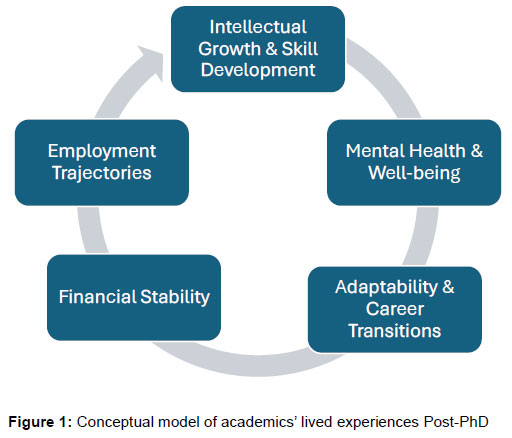
To synthesise this study's findings, the current researcher developed the following conceptual model to illustrates the interconnected factors shaping academics' lived experiences post-PhD.
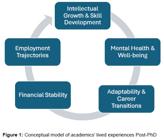
This conceptual model provides a structured way to understand the multiple factors that shape academics' lived experiences of their PhD degree's worth. It highlights the complex relationships between intellectual growth, career stability, mental health, financial security, and adaptability. The model suggests that a PhD's value is not fixed but evolves based on individual career pathways and external employment conditions. PhD graduates who transition into stable employment, whether in academia or industry, tend to view their PhD more positively. In contrast, those in temporary or contract roles often struggle with financial insecurity and psychological stress, leading to a more negative perception of their academic journey.
A key strength of this model is its holistic approach. It does not isolate academic training from broader career and life experiences but instead shows how intellectual gains should be balanced with practical employment realities. This aligns with previous research that highlights the disconnect between doctoral training and job market expectations (Cassuto and Weisbuch 2021). Additionally, by including adaptability as a key factor, the model acknowledges that career success is not solely determined by external opportunities but also by individual flexibility and willingness to explore alternative career paths.
However, the model also has limitations. While it captures major trends, it does not account for all variables that influence post-PhD experiences, such as geographic location, gender, race, or institutional prestige. These factors can significantly affect employment prospects and mental wellbeing, requiring further investigation. Another limitation is that the model assumes a relatively linear trajectory, whereas in reality, many PhD graduates experience career shifts, setbacks, and re-evaluations of their professional goals over time.
Future research can build on this model by incorporating longitudinal studies that track PhD graduates over a longer period. This would provide deeper insights into how career satisfaction evolves and how individuals navigate employment transitions. Researchers could also refine the model by integrating intersectional perspectives, considering how social and economic factors shape post-PhD experiences differently for various groups.
RECOMMENDATIONSTo improve academics post-PhD experience, key stakeholders including universities, academic supervisors, and policymakers should take targeted action. The following recommendations prioritise the most impactful interventions and draw on real-world examples of successful initiatives.
Expanding career preparation
PhD programmes should integrate structured training in transferable skills such as project management, communication, and networking. These skills are essential for both academic and non-academic careers. Strengthening career services and fostering partnerships with industry and government sectors can provide PhD graduates with job placement opportunities beyond academia.
Providing structured mentorship and wellbeing support
Universities should implement formal mentorship schemes, pairing recent PhD graduates experienced faculty members. This can provide guidance on job searches, research strategies, and work-life balance. Additionally, institutions should prioritise mental health by offering stress management workshops, peer support groups, and accessible counselling services to help students cope with academic pressures.
Improving work-life balance and family support
Policies promoting work-life balance, such as flexible working hours and remote work options, should be adopted. Family-friendly initiatives, including paid parental leave and on-campus childcare facilities, can support academics with caregiving responsibilities, making academia more inclusive.
Strengthening research and funding support
Financial instability is a major concern for many PhD graduates. Universities should offer grant-writing workshops, manuscript preparation services, and increased access to research funding. Providing early-career funding opportunities can help young academics secure stable research positions.
Encouraging alternative career pathways
Doctoral education should equip graduates for roles beyond academia. Skills-mapping exercises can help students identify how their research expertise applies to industry jobs. Universities should also introduce transition workshops and networking events to connect PhD graduates with non-academic employers.
CONCLUSION
This study critically explored academics' lived experiences post-PhD, focusing on how they view the value of their degrees, highlighting both intellectual benefits and challenges such as job insecurity, mental health struggles, and personal sacrifices. While academics recognise the PhD's role in expertise development, many question its worth due to unstable employment and unmet career expectations. The findings challenge the assumption that a PhD guarantees an academic career and call for urgent reforms in doctoral education. The study contributes to debates on PhD training by exposing gaps in career preparation and institutional support. It urges universities and policymakers to rethink doctoral education by incorporating structured career programmes, enhancing mental health support, and providing clearer job market guidance. Future research should track PhD graduates' careers over time to assess long-term satisfaction and adaptability. Studies should also examine how factors like gender, race, and institutional prestige shape post-PhD experiences, offering a deeper understanding of employment disparities. In conclusion, this study stresses the need for systemic changes to ensure a more supportive and sustainable academic environment. Without reform, the PhD will remain paradoxical, intellectually valuable but of uncertain practical benefit. Addressing these challenges will help make doctoral education more relevant, inclusive, and aligned with job market realities.
REFERENCES
-
Adler, N. J., and A. W. Harzing. 2009. "When Knowledge Wins: Transcending the Sense and Nonsense of Academic Rankings." Academy of Management Learning & Education 8 (1): 72-95. https://doi.org/10.5465/amle.2009.37012181
» https://doi.org/10.5465/amle.2009.37012181 -
Ahmed, N., A. G. Baker, A. Bhattacharya, S. Cawood, A. J. Cabrera Pacheco, and L. Westman. 2022. "Redefining the Role of Urban Studies Early Career Academics in the Post-COVID-19 University." City 26 (4): 562-586. https://doi.org/10.1080/13604813.2022.2091826.
» https://doi.org/10.1080/13604813.2022.2091826 - Baker, A. M., S. D. Livers, M. Acosta, C. Willey, M. Strozier Jr., and K. E. Harbour. 2023. "Beyond Conventional Boundaries: Advancing Equity and Inclusivity in Educational Supervision." Journal of Educational Supervision 6 (2): 1.
- Baral, A. K. 2023. "Addressing Brain Drain: Retaining Skilled Professionals in Nepal in Manufacturing Sector from the Perspective of Human Resource Management." Journal of Advanced Academic Research 10 (2): 22-32.
-
Bastalich, W., and A. McCulloch. 2024. "Doctoral Induction: Sociocultural Context and the Transition to the Research Degree." Innovations in Education and Teaching International: 1-13. https://doi.org/10.1080/14703297.2024.2357374
» https://doi.org/10.1080/14703297.2024.2357374 - Braun, V., V. Clarke, N. Hayfield, L. Davey, and E. Jenkinson. 2023. "Doing Reflexive Thematic Analysis." In Supporting Research in Counselling and Psychotherapy: Qualitative, Quantitative, and Mixed Methods Research, 19-38. Cham: Springer International Publishing.
-
Brew, A., D. Boud, K. Crawford, and L. Lucas. 2018. "Navigating the Demands of Academic Work to Shape an Academic Job." Studies in Higher Education 43 (12): 2294-2304. https://doi.org/10.1080/03075079.2017.1326023
» https://doi.org/10.1080/03075079.2017.1326023 -
Bunjak, A., M. Černe, N. Nagy, and H. Bruch. 2023. "Job Demands and Burnout: The Multilevel Boundary Conditions of Collective Trust and Competitive Pressure." Human Relations 76 (5): 657-688. https://doi.org/10.1177/00187267211059826.
» https://doi.org/10.1177/00187267211059826 -
Burton, S., and B. Bowman. 2022. "The Academic Precariat: Understanding Life and Labour in the Neoliberal Academy." British Journal of Sociology of Education 43 (4): 497-512. https://doi.org/10.1080/01425692.2022.2076387.
» https://doi.org/10.1080/01425692.2022.2076387 - Cassuto, L., and R. Weisbuch. 2021. The New PhD: How to Build a Better Graduate Education. Baltimore: Johns Hopkins University Press.
-
Fang, R., and R. White. 2024. "Distance Learning Students' Perspectives of Academic Procrastination: A Qualitative Investigation." The Journal of Continuing Higher Education: 1-17. https://doi.org/10.1080/07377363.2024.2317614.
» https://doi.org/10.1080/07377363.2024.2317614 - Fazio, M., C. Launius, T. Strangleman, M. Rank, L. Eppard, and H. Bullock. 2021. "The Transformations of Greek Working-Class Fiction from the Interwar Period to the Present." Journal of Working-Class Studies 6 (2).
-
Fisher, J. J., and J. L. James. 2022. "Know the Game: Insights to Help Early Career Researchers Successfully Navigate Academia." Placenta 125: 78-83. https://doi.org/10.1016/j.placenta.2021.10.013.
» https://doi.org/10.1016/j.placenta.2021.10.013 - Gallagher, S. R. 2022. The Future of University Credentials: New Developments at the Intersection of Higher Education and Hiring. Cambridge, MA: Harvard Education Press.
- Giuffre, P., and G. R. Webber. 2023. "Teaching Work and the Economy: Essential Topics." In Handbook of Teaching and Learning in Sociology, 171-189. Cheltenham: Edward Elgar Publishing.
-
Headworth, S., and J. Freese. 2016. "Credential Privilege or Cumulative Advantage? Prestige, Productivity, and Placement in the Academic Sociology Job Market." Social Forces 94 (3): 1257-1282. https://doi.org/10.1093/sf/sov102
» https://doi.org/10.1093/sf/sov102 -
Hirschi, A., and J. Koen. 2021. "Contemporary Career Orientations and Career Self-Management: A Review and Integration." Journal of Vocational Behavior 126: 103505. https://doi.org/10.1016/j.jvb.2020.103505
» https://doi.org/10.1016/j.jvb.2020.103505 -
Hunt, C. 2021. "Understanding Reflective Practice." In Critical Reflection, Spirituality and Professional Practice. Cham: Palgrave Macmillan. https://doi.org/10.1007/978-3-030-66591-32.
» https://doi.org/10.1007/978-3-030-66591-32 - Iris, M. W. 2023. Burnout of Career Development Professionals in Higher Education: An Action Research Study on Staff Retention. Doctoral diss., College of Saint Elizabeth.
- Jackson, D., C. Lambert, R. Sibson, R. Bridgstock, and M. Tofa. 2024. "Student Employability-Building Activities: Participation and Contribution to Graduate Outcomes." Higher Education Research & Development: 1-17.
- Jones, K. 2023. "Precarity of Post Doctorate Career Breaks: Does Gender Matter?" Studies in Higher Education 48 (10): 1576-1594.
-
Kınıkoğlu, C. N., and A. Can. 2024. "Between Luck and Stigma: Gendered Experiences of Precarity in Higher Education in the UK and the US." International Studies in Sociology of Education: 1-22. https://doi.org/10.1080/09620214.2024.2383217
» https://doi.org/10.1080/09620214.2024.2383217 - Kolb, D. A. 2007. The Kolb Learning Style Inventory. Boston, MA: Hay Resources Direct.
-
Li, H., and H. Horta. 2024. "Perceived Academic Working Conditions and Career Choices of Chinese PhD Students." Studies in Higher Education 49 (8): 1329-1345. https://doi.org/10.1080/03075079.2023.2264890
» https://doi.org/10.1080/03075079.2023.2264890 -
Lin, P. M., K. L. Peng, W. C. Wilson Au, and T. Baum. 2023. "Labor Market Transformation in the Hospitality Gig Economy in a Post Pandemic Era: Impacts of Institutional Governance." International Journal of Contemporary Hospitality Management 35 (4): 1490-1510. https://doi.org/10.1108/IJCHM-12-2021-1531
» https://doi.org/10.1108/IJCHM-12-2021-1531 - Magolda, M. B. B., and P. M. King, eds. 2023. Learning Partnerships: Theory and Models of Practice to Educate for Self-Authorship. New York: Taylor & Francis.
- Martínez-García, I., H. De Witte, J. García-Martínez, and F. J. Cano-García. 2024. "A Systematic Review and a Comprehensive Approach to PhD Students' Wellbeing." Applied Psychology: Health and Well-Being.
-
McAlpine, L., and K. Inouye, K. 2022. "PhD graduates in non-academic roles: harnessing communication knowledge to meet organizational goals". Studies in Graduate and Postdoctoral Education, 13(2), 151-170. https://doi.org/10.1108/SGPE-05-2021-0044
» https://doi.org/10.1108/SGPE-05-2021-0044 - McIntosh, E., and D. Nutt. 2022. The Impact of the Integrated Practitioner in Higher Education. Abingdon, VA: Routledge.
-
Mula, J., C. L. Rodríguez, J. Domingo Segovia, and C. Cruz-González. 2022. "Early Career Researchers' Identity: A Qualitative Review." Higher Education Quarterly 76 (4): 786-799. https://doi.org/10.1111/hequ.12348
» https://doi.org/10.1111/hequ.12348 - Mouton, J., and N. Cloete. 2023. Doctoral Education in South Africa. Cape Town: African Books Collective.
-
Nendauni, L., M. Sadiki, and M. Baloyi. 2021. "Name-Calling as a Communicative Tool in South African Political Discourse." Communicatio 47 (4): 21-47. https://doi.org/10.1080/02500167.2021.2009531
» https://doi.org/10.1080/02500167.2021.2009531 -
Peng, P., and R. A. Kievit. 2020. "The Development of Academic Achievement and Cognitive Abilities: A Bidirectional Perspective." Child Development Perspectives 14 (1): 15-20. https://doi.org/10.1111/cdep.12352
» https://doi.org/10.1111/cdep.12352 -
Radović, S., O. Firssova, H. G. Hummel, and M. Vermeulen. 2023. "Improving Academic Performance: Strengthening the Relation between Theory and Practice through Prompted Reflection." Active Learning in Higher Education 24 (2): 139-154. https://doi.org/10.1177/14697874211014411.
» https://doi.org/10.1177/14697874211014411 - Ramos, D., and R. Wright-Mair. 2021. "Imposter Syndrome: A Buzzword with Damaging Consequences." Diverse Issues in Higher Education 38 (5): 10-12.
-
Roach, M., and H. Sauermann. 2017. "The declining interest in an academic career". PLoS ONE, 12(9), e0184130. https://doi.org/10.1371/journal.pone.0184130
» https://doi.org/10.1371/journal.pone.0184130 -
Satinsky, E. N., T. Kimura, M. V. Kiang, R. Abebe, S. Cunningham, H. Lee, X. Lin, C. H. Liu, I. Rudan, S. Sen, M. Tomlinson, M. Yaver, and A. C. Tsai. 2021. "Systematic Review and Meta-Analysis of Depression, Anxiety, and Suicidal Ideation among PhD Students." Scientific Reports 11: 14370. https://doi.org/10.1038/s41598-021-93687-7.
» https://doi.org/10.1038/s41598-021-93687-7 -
Schmidt, M., and E. Hansson. 2018. "Doctoral Students' Well-Being: A Literature Review". International Journal of Qualitative Studies on Health and Well-Being 13 (1): 1508171. https://10.1080/17482631.2018.1508171
» https://10.1080/17482631.2018.1508171 -
Sherman, D. K., L. Ortosky, S. Leong, C. Kello, and M. Hegarty. 2021. "The changing landscape of doctoral education in science, technology, engineering, and mathematics: PhD students, faculty advisors, and preferences for varied career options". Frontiers in Psychology, 12, 711615. https://doi.org/10.3389/fpsyg.2021.711615
» https://doi.org/10.3389/fpsyg.2021.711615 -
Solms, L., M. van den Heuvel, B. Nevicka, and A. C. Homan. 2025. "Be a hero, be your own best friend: a self-compassion-based PsyCap intervention improves PhD students' well-being". Higher Education, 89(4), 969-999. https://doi.org/10.1007/s10734-024-01257-3
» https://doi.org/10.1007/s10734-024-01257-3 -
Southworth, J. 2022. "Bridging critical thinking and transformative learning: The role of perspective-taking". Theory and Research in Education, 20(1), 44-63. https://doi.org/10.1177/14778785221090853
» https://doi.org/10.1177/14778785221090853 - Spina, N., J. Harris, S. Bailey, and M. Gof. 2020. Making it' as a contract researcher: A pragmatic look at precarious work. Routledge.
-
Spina, N., K. Smithers, J. Harris, and I. Mewburn. 2022. "Back to zero? Precarious employment in academia amongst 'older'early career researchers, a life-course approach". British Journal of sociology of Education, 43(4), 534-549. https://doi.org/10.1080/01425692.2022.2057925
» https://doi.org/10.1080/01425692.2022.2057925 -
van Manen, M. 2025. "Humility, textuality, and method in phenomenological research". Qualitative Inquiry, 31(6), 555-561. https://doi.org/10.1177/10778004241265985
» https://doi.org/10.1177/10778004241265985 -
Vavasseur, B. 2024. A qualitative study of job satisfaction, work-life balance, and sense of belonging, on well-being and retention of faculty in Louisiana's public higher education institutions [Doctoral dissertation, University of Louisiana at Lafayette]. ProQuest Dissertations & Theses. https://www.proquest.com/openview/a8bd2a906ba3e99bd52c8a70a954c13c/1?pq-origsite=gscholar&rcbl=18750&diss=y
» https://www.proquest.com/openview/a8bd2a906ba3e99bd52c8a70a954c13c/1?pq-origsite=gscholar&rcbl=18750&diss=y -
Xu, L., and B. Grant. 2020. "Doctoral publishing and academic identity work: Two cases". Higher Education Research and Development, 39(7), 1502-1515. https://doi.org/10.1080/07294360.2020.1728522
» https://doi.org/10.1080/07294360.2020.1728522