Promoting scholarship of engagement using the appreciative inquiry model: the case of Mangosuthu University of Technology, South Africa
Abstract
This article aims to demonstrate how appreciative inquiry (Ai) model was used to promote the scholarship of engagement (SoE) at Mangosuthu University of Technology (MUT) in South Africa. Qualitative research was conducted through group consultative sessions following the Ai model. Data analysis involved interpreting words, phrases, and nonverbal cues from group discussions. Findings included staff recognition of the importance of integrating community engagement (CE) into teaching, learning, and research at MUT. A need was also identified to integrate indigenous knowledge systems (IKS) into CE for better feedback on curricular development. It was suggested that for successful integration of CE into teaching, learning, and research (TL), MUT's Executive Management could prioritize CE's importance. While it is early to measure Ai's impact on MUT's transition to SoE, its application facilitated smooth engagement in consultations. Recommendations include promoting understanding and prioritization of CE within the MUT community to align it with TL
Community Engagement; scholarship of engagement; appreciative inquiry model; teaching and learning and research; Mangosuthu University of Technology
INTRODUCTION
Background and Statement of the Problem
Although scholarship of engagement (SoE) is an historical commitment of universities to what Boyer calls the "common good" (Boyer 2016, 18), its objectives have been difficult to realize in many parts of the world, including Africa, and South Africa to be specific. SoE is said to be a situation where universities become a more vigorous partner in the search for answers to the most pressing problems of society, thus affirming its historical commitment or purpose (Boyer 2016, 18). In other words, universities are to be active partners with communities in their quest to find solutions to societal problems. By implication, universities are to integrate community engagement (CE) in its core business of teaching and learning and research (TL&R). The benefits of making engagement central by universities cannot be overemphasized. Efforts by universities to become engaged universities point to the fact that engagement enhances universities' ability to achieve their fundamental reason for existence (Fitzgerald et al. 2012, 19). Despite its potential benefits, the task of aligning engaged scholarship with what already exists in an institution is not an easy one; a task which for example, demands a deep look at funding models, systems of reward, and policies governing relationships with external stakeholders (Fitzgerald et al. 2012, 23).
The concept of SoE, which integrates CE into TL&R is relatively new in higher education institutions (HEIs), especially in South Africa. However, it is a requirement for South Africa's transformation agenda. Until recently, the three pillars of higher education (TL&R, and CE) were not connected, and this was true also for Mangosuthu University of Technology (MUT). Although CE at MUT is defined as a scholarly activity that encompasses all planned activities that the university community and the external communities engage together in, as reflected in the CE policy of the institution, this has not been effectively implemented across all faculties. The university is however beginning to recognize and embrace the importance of integrating CE into its core business.
MUT's road to scholarship of engagement
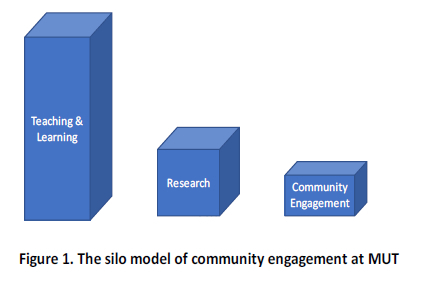
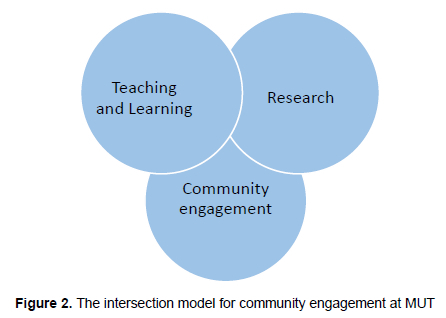
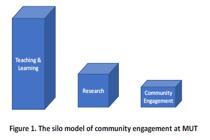
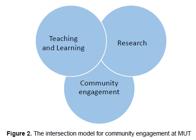
MUT's response to the need for SoE could be categorized into five main stages. The first stage is based on its earlier need to respond to the recommendations made by the Higher Education Qualification Committee (HEQC) institutional audit of 2012 to integrate CE into the strategic priorities and the core functions of teaching, learning and research (HEQC 2012). In line with this, MUT began a process of trying to integrate CE into teaching and learning by capacitating academic staff members to introduce CE in the form of service-learning into their business of teaching and learning. In this regard, a total of fifteen (15) academic staff members received training and started working on service-learning projects. Due to the level of support witnessed during the first stage, there was a realization to change the type of CE model that was in vogue at the time at MUT. This is what led to the second stage, which is the stage for a choice of CE model. This process led to the adoption of a new model for CE: the intersection model (Figure 2), as against the silo model (Figure 1) that was operational at the time.
The sHo model of CE at MUT
The silo model of CE at MUT could be defined in two folds. The first is the system where staff or faculty members saw themselves as exclusive owners of their knowledge and knowledge creation. As such, they did not see any reason to collaborate or partner with other staff members, not to talk less of external community. The second definition is like what Bender (2008) says, as a university, the three main functions of TL&R, and CE, are seen as separate entities, pursued differently, and CE is largely seen as voluntary (Bender 2008, 87). This type of model is the most traditional notion, which usually does not see the potential of CE as a scholarly activity, and how it contributes to TL&R (HEQC 2007a). Under this view at MUT, greater attention is given to teaching and learning, relatively little attention to research, and very little or no attention is given to CE, which in most cases, is done only as an outreach activity. The Figure 1 is a presentation of the silo model at MUT.
The intersection model of CE at MUT
The intersection model of CE sees CE as an irreducible and unavoidable element of TL&R; it assumes that all research and teaching (and learning), directly or indirectly, no matter the type of impact, ultimately involve engagement with community. The choice of the intersection model was based on four basic reasons. The first has to do with the mission of the institution. According to the mission statement, MUT seeks to do all its business by "engaging with government/business/industry and communities as end-users". The second reason relates to the vision statement of the institution to be anchored in its communities, and to grow together with them. The third reason was based on the National Plan for Higher Education, which states that "community service/engagement" is one of its priorities. The fourth and final reason was based on the recommendation by HEQC (2012) Institutional Audits, Criterion 18 which stated that service-learning should be part of CE. All the above go to show recognition for, as well as the realization that HEIs cannot be able to achieve their objectives without partnership or collaboration with its communities. Figure 2 is a presentation of the intersection model as used at MUT.
The third stage in the development of SoE at MUT began when a formal session within the university was organized to stimulate debate on the SoE. The debate illuminated discussions on the journey of MUT since the new South Africa as guided by the White paper on Post school education and training (2013) and to reflect on the stage where MUT was in terms of the evolution of CE. Academics were expected to engage on their understanding of the SoE and show some levels of scholarship in their CE. The engagements exhibited limited understanding regarding the SoE. That called for further engagements in the form of a colloquium which ultimately assisted in the build-up for the university strategy on CE.
The fourth stage came about in 2021, when MUT reviewed its criteria for academic staff promotions. Integration of CE into TL&R was at the top of priorities for senior staff members i.e., Senior Lecturers and Professors. The inclusion of the criterion as topping the list signaled that scholarship is being taken more seriously at MUT. This effort was also meant to strengthen CE at MUT and receive a recognizable status alongside other forms of scholarship namely research and teaching and learning. The fifth stage was a general initiative by the Community Engagement and Development (CEAD) Directorate, as the MUT support unit tasked with the mandate of ensuring MUT community does CE and achieves the institution's strategic goal three of "Excellence in CE". The main reason for this initiative was to encourage and solicit for buy-in by all MUT structures to the ideals of SoE. The result of the initiative is the focus of this article.
OBJECTIVE OF THIS ARTICLEThe main objective of this article is to present how appreciative inquiry (Ai) model can be a viable tool to encourage scholarship of engagement (SoE), using the case of MUT in its journey to be an engaged scholarship institution of higher learning in South Africa.
Why Scholarship of Engagement at MUT?
Scholarship of engagement is a form of public engagement aimed at addressing the relevance of MUT amidst the challenges faced by its surrounding communities. For MUT, SoE will ensure scholarly CE. MUT will showcase its impact by actively driving community-focused initiatives, utilizing new channels such as "community imbizos" and public talks to disseminate academic knowledge and enhance community transformation and curriculum enhancements. SoE will foster synergy among the three pillars of university education: TL&R, and CE, fostering ongoing reflection on MUT's community engagement and its integration with TL&R, producing graduates with necessary attributes. Through SoE, MUT will assess the impact of its TL&R on engaged communities and its collaborative knowledge creation with them. Engaged scholarship will also reveal MUT's contribution to community transformation.
Appreciative Inquiry as a Model for Organizational Change and Development
Appreciative inquiry (Ai) came to the scene towards the end of 1980s as a reiteration of the action research method for organization's growth (Cooperrider and Srivastva 1987, 129- 130). Highly motivated by Ai model's potential of being able to link theory and practice for social change, it is suggested that the model is a more suitable approach of inquiry in a post-industrial world (Cooperrider and Srivastva 1987, 129-165). As a change management approach for organization's growth, Ai has developed, and is mostly known as a process-based approach for the transformation of an organization (Cooperrider et al. 2008, 33-46). Ai has been used by leaders in organisations to effect smooth transition from existing practices by first appreciating their existing practises and then building on them, going forward. There are success stories of the use of the model in bringing about new knowledge to the already existing one. The model embraces the efforts that the participants bring to the organisation. Priest et al. (2013, 18-33) describe how Ai facilitated change at Virginia Tech in that it changed the behaviour of a department, and it became a practice that the participants followed up on the creation of targeted goals with weekly lunch-and-learn style work group as well as follow up meetings to encourage continuous collaboration (Priest et al. 2013, 18-33). Weekly meetings became a norm because of the Ai process.
By its very nature, Ai is a theory and practice of inquiry-to-change which moves the viewpoint of organization development (OD) methods through its proposition that the very act of asking generative questions has immense impact in the systems of the organization (Rothwell et al. 2015). Ai is a method that seeks what is right within an organization in order to improve on them going forward (Coghlan et al. 2003, 5-6). Ai is an approach to organisational change which focuses and builds on organizations' strengths, instead of their weaknesses (Cooperrider and Srivastva 1987, 129-130).
Examples of Ai as a model for organizational change
Ai has been proven to be successful when systemic action and macro management skills are the primary leverage points for game-changing innovation, scalable solutions, and leadership. The first case study is that of Fairmont Minerals in the US. This is an example where the Chief Financial Officer (CFO) wanted to introduce a sustainability as an embedded organisation wide passion. The CFO felt it critical to reach beyond silos and specialities and create a one firm alignment of strengths. Through a summit that brought different stakeholders, the CFO achieved a one firm alignment of strengths. As a result, the firm doubled its revenues within two years (2005-2007). Post summit research findings indicate an inspired workforce because it was engaged and empowered during the process.
A second case study is in the period of the late nineties where there were sporadic protests against businesses around the world. Targets were big companies such as Nike, Starbucks, Gap, Enron, WorldCom, and Arthur Anderson. It was within this context that the Secretary-General of the United Nations, Kofi Annan addressed Chief Executive Officers (CEOs) from around the world in the 1999 World Economic Forum, where he spoke about the importance of aligning strengths as a call to a new era of business and society leadership which resulted in the launch of the UN Global Compact. Subsequent to that, a summit for UN Global Compact Leaders was convened in 2004. This was meant to provide a forum for discussion and come up with strategies and action steps to improve the initiative. As such, in a space of three years, and by the next Geneva summit, the Global Compact initiative had increased from 1,500 (one thousand five hundred) firms to over 8,000 (eight thousand) of the world's biggest companies, implying a 433 per cent growth rate of an average of 144.4 per cent annually.
A third case study is the United Regions Initiative (URI), established through the efforts of His Holiness the Dalai Lama, who was troubled by tensions among religions, nations, and ethnic groups. Inspired by the success stories of the Ai, experts were invited to launch dialogues, leading to engagements among various leaders, including those from religious bodies. A charter was agreed upon and signed in 2000 at Carnegie Hall. Stemming from this effort, over 600 URI centres across every continent aim to "end religious violence and create cultures of peace and justice" in challenging conflict settings (Cooperider and McQuaid 2012). Due to its impact, commentators suggest the URI could potentially receive a Nobel Peace Prize.
A fourth case study is Sustainable Cleveland 2019, where the city faced job losses and population decline. The mayor, aiming to unite the community and foster innovation, adopted an Ai macro-strengths approach. This involved organizing a summit to address economic and ecological concerns, breaking down silos. Over 700 business leaders and civic entrepreneurs participated in designing Sustainable Cleveland, envisioning a green future for the city. The summit's success can be attributed to its embrace of diverse configurations, including "unlikely configurations," which harness systemic strengths effectively. The city established a narrative-rich storytelling culture and developed a 400-page strategy document to guide future annual summits over the next nine years.
Operationality of Ai as a Model in MUT
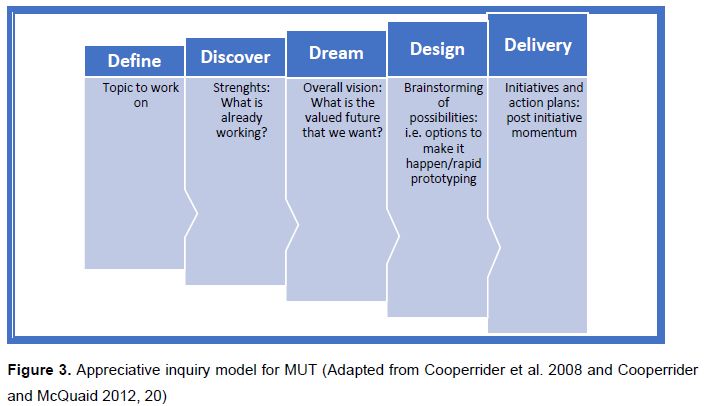
In order to adopt the SoE it is important for MUT to begin to appreciate its uniqueness and potentials. An Ai model is appropriative to move MUT from the state that it is currently, regarding CE, to a state where it builds on its strengths, potentials, aspirations to scholarly CE. The Ai model, also referred to as 5-D model, is described as a series of co-ordinated stages that guides an organization towards a vision and desired goals centred around a positive core (Cooperrider et al. 2008, 33-46). The Figure 3 is a presentation of the 5-D model of Ai as used for MUT.
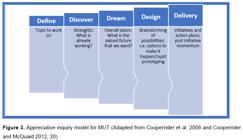
The first stage of the Ai model is when participants define the focus of inquiry. An example of a probing question here includes, "are we practising the SoE at MUT?" This stage is then followed by the discovery stage. This is where participants discover their potentials by sharing and appreciating success stories. An example of a probing question here also includes, "can we remember the good works we did with our communities: the time we spent with them and the fulfilment that we acquired by reaching out to them?". As participants discover their potentials, they will be automatically moved to a dream stage where they create together a clear results-oriented visualisation of where they want to see themselves. For example, "can we imagine now whether what we were doing for communities could also benefit our TL&R?" In the design stage, participants create bold statements of possibilities for an ideal situation, creating structures to enact the positive core (a strategy is designed). The final stage is the delivery stage (implementation of strategy). During this stage, the implementation of the dream happens. In this stage, new ways of thinking and new actions will not only increase productivity, efficiency, and performance, but will result in operating with an "appreciative eye" (Cooperrider et al. 2008). This process will be an ongoing one, resulting in new affirmative topics that guide further inquiry for CE at MUT.
Principles of Ai as it applies to MUT
Although five other principles of Ai have emerged over the years (The Centre for Appreciative Inquiry [CAI] 2023) from the original conception (Cooperrider and Strivastva 1987, 129-165), Ai model, as used by MUT, centres on the five original or core principles. These include: Constructionist principle ("words create worlds" [CAI 2023])
This principle states that knowledge about an organization and the destiny of that organization are interwoven. Rather than assuming one absolute truth, this standpoint suggests that truth is local, meaning that organizational members are continually coconstructing their own realities (Gergen 2012, 123). These constructionist dialogues predict the next moment.
Simultaneity principle ("inquiry creates change" [CAI])
This principle proposes that inquiry is intervention. This means that change begins simultaneously at the moment we first pose a question in a human system, not after we find an answer (Meier and Dirks 2017, 2). The questions we ask set the stage for what we "discover," and what we "dream" creates the narratives that lead to conversations about how the organization lives in the present moment and will construct its future, which is "design" and "deliver". Just as if we want to learn about how to create an engaged workforce, we must ask questions about when people have felt most engaged and what engagement looks like to them.
Poetic principle ("we can choose what we study" [CAI])
This principle acknowledges that human organizations are like open books to be interpreted (Rothwell et al. 2015). An organization's story is constantly co-authored by the people within the organization and those outside who interact with it. The organization's past, present, and future are endless sources of learning, inspiration, and interpretation, just as a good poem is open to endless interpretations.
Anticipatory principle ("image inspires action" [CAI 2023])
This principle suggests that human beings act based on their "anticipation" of future events, and this anticipation affects themselves, the people, and systems in the organization they belong (Rothwell et al. 2015). Leveraging the "simultaneity principle" with the power of questions, and the "constructionist principle" with the power of "co-construction", the anticipatory principle invites organization systems to ask questions that help them generate a collective understanding of the present and vision for a desired future. This image of a better tomorrow guides the current behaviour of any person or organization. If we act from our expectations and we move toward what we anticipate, an important task for change agents is to help organizations articulate a powerful image of their ideal state, which becomes a beacon for the realization of that vision.
Positive principle ("positive questions lead to positive change" [CAI])
This principle's premise is that the more positive and affirmative the images we carry, the more likely we are to move into these images. The positive principle supports the other four principles. Positive questions lead to positive images of the future, and positive images lead to positive, long-lasting actions (Cooperrider and Strivastva 1987, 129- 165). The positive emotions of hope, optimism, compassion, and awe generated by appreciative work literally strengthen a person or organization's ability to bring their images of the future into fruition.
RESEARCH METHODOLOGYThe qualitative research design was adopted for the study, wherein data was collected in various group consultative sessions, following the Ai model. Although Ai is a model which is gradually gaining recognition as an effective tool for engagement and scholarship, its robustness and potential of being able to unite theory and practice for the purpose of social change, is highly desirable. Ai is understood as a process-based approach which supports organizational transformation and used for change management (Cooperrider et al. 2008, XX1). It has been used by leaders in organizations to effect smooth transition from existing practices by appreciating their own practices and building on them, going forward. In this regard, Ai model was adopted to assist a smooth transition of MUT from a former disintegrated scholarship to the desired SoE.
Choice of participants and data collection
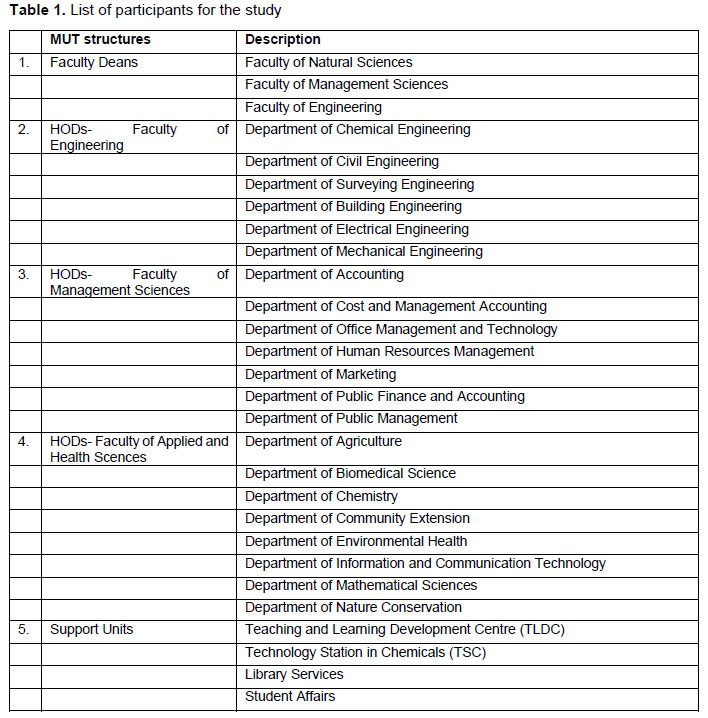
In consonant with the 5-D (Define, Discover, Dream, Design, and Delivery) approach upon which Ai revolves, and guided by its principles, consultative group sessions and/or workshop were held with MUT structures, which formed the basis of information. Two sessions were conducted with the internal stakeholders at MUT for consultation regarding the concept document for CE strategy. The first session was held virtually on the 9th of September 2021 with the Deans of faculties (three faculties), Heads of Departments (HODs) and support departments, represented by Teaching and Learning Development Centre (TLDC), Technology Station in Chemicals (TSC), Library Services, and Student Affairs. As a background, the Director of CEAD Directorate, indicated the motivation for the consultation which was due to the Higher Education Quality Committee (HEQC) institutional audit findings of 2011. Table 1 represents the different categories of MUT structures where data originated.
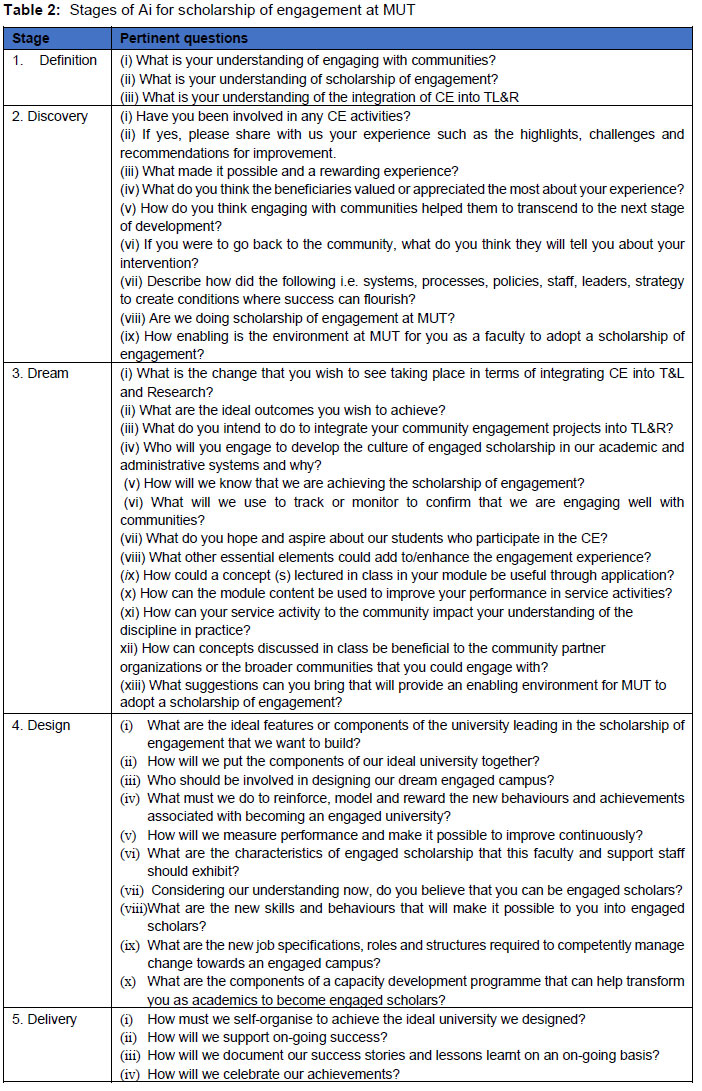
The second session was a workshop held with the academic staff members based on the Ai model, aligning with the five stages: Define, Discover, Dream, Design and Deliver. For the workshop, academic staff members were provided with an opportunity to share experiences on their CE projects so that they could discover their strengths and weaknesses as well as those of the university processes, systems, and leadership. For the two sessions, specific questions were designed in line with the 5-D approach of Ai. The Table 2 is a presentation of the various questions in alignment with the principles of Ai.
Data analysis process
Data analysis was with qualitative analysis process of group discussion, involving the interpretation of words, phrases, and nonverbal cues to understanding discussion. Due to the fact that data collection was from consultative sessions, data analysis was in many ways ongoing as participants statements were documented, sometimes, in the form of quotes. It is not always possible to differentiate data analysis from data collection in qualitative research, as the former sometimes goes on during the latter (Ngulube 2015, 2). Further classification of similar responses was done, in the form of themes, to enhance better understanding or interpretation (Chinyamurindi 2016; Braun and Clarke 2013, 223).
FINDINGS AND DISCUSSION OF FINDINGS
At the end of the different sessions, certain observations were made, either in the form of suggestions on steps to making SoE work at MUT, or on challenges hampering efforts to implement SoE, that needed attention. Significant among these are classified into themes, based on participants' views, and discussed accordingly in the sections that follows.
Firstly, the lack of funding for CE projects was a notable issue, particularly in the integration of CE into TL&R, not only for MUT but also for HEIs in South Africa. Unlike the other main functions of universities, CE remains unfunded by the Department of Higher Education and Training (DHET), posing a significant challenge. Despite being recognized as the third main function of universities, CE often receives minimal attention from faculty members due to this funding disparity. The White Paper for Post School Education and Training of 2013 lacks funding recommendations for CE at the university level (DHET 2013, 39-41); leaving it without a funding mandate (Bangani and Dube, 2023, 3). The literature highlights access to adequate funds as crucial for success or failure in any endeavour; stressing the relevance of funding, amongst other factors (Choi and Chandler 2020, 3). Supporting this, it is further emphasized that organizations with access to financial resources or alternative funding avenues were better equipped to weather the impact of the COVID-19 pandemic (Obrenovic et al. 2020, 1618).
A key observation is the necessity of ensuring adequate monitoring for Continuing Education (CE) activities. Monitoring, an essential management process, aids in the success of any activity by systematically collecting information to measure progress, achievement of objectives, and resource utilization (World Bank 2022). The literature suggests challenges in assessing/monitoring CE in South African universities, with one challenge stemming from perceiving CE as voluntary, resulting in perceived lower quality compared to other university functions (Dole and Hill 2012). Despite these challenges, Salamon (2016) asserts the non-negotiable necessity of assessing CE projects. To enhance CE monitoring at MUT, regular monthly meetings were proposed for staff to share progress and challenges, facilitating timely problem identification and resolution.
Another remarkable observation was the absent communication of a university policy framework that allocated time spent on the three pillars of the university (i.e. a workload model). There was an existence of one, it was however not communicated, as at the time of data collection for this study. As such, CE continued to receive little or no attention in relation to TL&R. This indeed is very remarkable in terms of the adoption of SoE, because as it currently stands, CE is viewed as an add-on: staff members perceive CE as infringing on their time for TL&R. Another implication of this problem is the situation where academic staff are not obliged to do CE. In other words, CE activities are seen as voluntary: when one has finished doing TL&R, whatever time remains (that is if any), can be considered for CE activities. This seems to be the case in many universities in South Africa, thus constituting a huge setback for the incorporation of CE into TL&R. Faculty members believe CE is voluntary (Bangani and Dube 2023, 3). CE is difficult to assess because it involves goodwill which cannot be measured or fully assessed (Dole and Hill 2012).
Similarly, there was the suggestion that for CE to be properly incorporated into TL&R, there must be a business component attached to it. The business component was viewed as the only element that could make CE projects sustainable, especially at the face of little or no government funding for CE vis-à-vis TL&R. Currently, the business component at MUT is housed only in the Faculty of Management Sciences. Under this view, the role of entrepreneurial development was emphasized. It was further indicated that the system of entrepreneurship at MUT was not coordinated. As way forward, it was suggested that there must be a proper coordination between CEAD Directorate and other university structures that house entrepreneurial development to strengthen the development unit of CEAD Directorate. This is because, providing necessary entrepreneurial skills is one of the goals of CE. By implication, when communities (including students) are properly empowered with skills, they are able to play more active part in finding solutions to societal ills, thus becoming active citizenry.
There was a view advocating for closer collaboration between the CEAD Directorate and the Research Directorate, aligning well with the intersection model for CE implementation at MUT (Figure 2). This suggestion, integral to our study's focus, echoes Boyer's notion of "engaged research" or "scholarship of discovery" (Boyer 1996, 18). Engaged research involves collaborative efforts with communities, as defined by the University of Free State (UFS 2021). It integrates CE principles into various aspects of knowledge discovery, teaching, integration, application, development, and mobilization for mutual benefit. The CEAD Directorate, responsible to support CE incorporation, collaborating with the Research Directorate, the research support office, is crucial for realizing the Scholarship of Engagement (SoE) at MUT. The collaboration could benefit students by enhancing research opportunities and improving overall research outputs for the university.
There was, as well, a view that stated a need to, "incorporate indigenous knowledge systems (IKS) into CE so that engagements with communities could feedback to the curriculum". This idea highlights one of the practical bases for CE. The cornerstone for the argument for CE is the realization that not all knowledge and expertise reside in the university, non-academic settings also have great learning opportunities (Fitzgerald et al. 2012, 10). Indigenous knowledge (IK) speaks of understandings and skills developed by various communities, which are transferred from one generation to another (Keane et al. 2016, 164). Human societies globally have developed valuable sets of experiences and details of the environments they live in (Nakashima et al. 2000). Hammersmith Jerome provides a long list of knowledge that could be included in the list of IKS (Hammersmith 2007, 3). Examples include practical common sense based on information and experiences transferred from generation to generation; knowledge of the environment, such as snow, ice, weather, resources, etc and their relationships; et-cetera. Semali and Maretzki (2004) thus advise that if we would be able to win in our strategies to overcome our day-to-day challenges, like poverty, famine, disease, and natural resource depletion, the academic community must therefore create ways to engage IK holders in meaningful ways that will ensure the knowledge systems of both parties are valued.
There was also a view that "MUT Executive Management must understand and elevate CE to be at equal parity with TL&R". This again is very crucial in the quest to achieve SoE goals at MUT. This is because, organizations' development and current operation potentials are dependent on whatever traits or characteristics of those who lead it (Arshad et al. 2023). Commenting further, Arshad et al. (2023) maintain that the impact of leaders of any organization on the performance of the organization cannot be overemphasized, as they are responsible for the success or failure of the organization. In the list of barriers to the implementation of CE in South African HEIs provided by Johnson, lack of executive leadership support in the understanding of CE, its mission, and potentials, was indicated as one of the main barriers (Johnson 2020, 91).
The silo mentality approach at MUT view was also emphasized by participants. It was stated, that "Some of the systems/structures in the university are not integrated. It is as if we are not working towards the same goal Let's work towards the same goal as an institution". The need for collaboration in knowledge creation, whether internal-internal, or internal-external, cannot be overemphasized. To emphasize this, Boyer challenged higher education institutions of his day to renew their commitments to society and embrace societal problems in shared collaboration with communities (Boyer 1990, 43). In their work on "the centrality of engagement in higher education", where Fitzgerald et al. argued that universities must become engaged institutions in all its businesses, among the institutional changes suggested was "the breakdown of firmly established and isolated silos" (Fitzgerald et al. 2012, 17). Instead of silo, interdisciplinary cooperation, and a rejection of disciplinary turfism were suggested.
There was, as well, a suggestion on benchmarking. It was said, "Let us encourage case studies to promote SoE". Collecting information of what others are doing (case studies or benchmarking) is one of the best ways for growth and improvement. Benchmarking could be defined as a systematic and progressive way of comparing products, processes, and outcomes of an organization with others of same similarity (Nugroho and Jaqin 2021, 82), in this case, HEIs. Benchmarking is gradually becoming a cardinal tool for improving performance of HEIs (Al-Khalifa 2015, 151-152). Many countries share similar worries regarding the performance of their higher education systems and would like to understand how, in comparison to others, their systems of operations are faring (Organization for Economic Cooperation and Development, OECD 2017, 55). It is argued that, if benchmarking is done properly well, it has the potential to assist HEIs position themselves competitively in their environments, and for the challenges of the current era (Al-Khalifa 2015, 151).
Students' participation in CE was highlighted as crucial. It was stated that, "Students should grasp CE concepts and apply them in communities." Engaging students in CE is vital for fostering SoE in HEIs, particularly at MUT. HEIs primarily aim to train and equip students with skills to tackle societal issues. Involving students in community activities during their university years provides a platform to nurture necessary attributes for addressing societal challenges. Student involvement may take the form of volunteerism or service-learning (SL). While volunteerism involves students providing services to communities without direct academic ties, SL stands out as the most effective CE involvement method. SL, also known as "CE pedagogies," integrates learning goals with community service to enhance both student learning and societal welfare (Bandy 2011). The National Service-learning Clearinghouse defines SL as a method that combines meaningful community service with instruction and reflection to enrich learning, instil civic responsibility, and empower communities (Bandy, 2011).
A final finding to consider emphasized that research in CE should be encouraged. Encouraging research in CE could be seen from two angles. Firstly, it could be doing more research to establish more how CE works and its dynamics, or it could be conducting more community engagement-based research, or the need to incorporate CE into research. Whichever is the case, involving communities in research has the potential to making research more relevant, translatable, and sustainable. It was further stated that community involvement in the research process can improve greatly the way research is planned, implemented, and utilized (Han et al. 2021, 2).
REFLECTIONS, CONCLUSION AND RECOMMENDATIONS
Although it is still early to judge the potency of Ai model in facilitating MUT transitioning into an engaged scholarship institution, it is however, noteworthy how the application of its principles assisted in no small measure, encourage smooth engagement at the different structures of consultations. It is indeed amazing to note how, following the 5-D (Define, Discover, Dream, Design, and Delivery) approach upon which Ai revolves, assisted participants' openness and readiness for necessary engagement. At the end of the day, through the various consultations, there was overarching understanding that adequate integration of CE into TL&R at MUT, which is what SoE is all about, was indeed worthwhile. The added benefit was the realization of overall societal impact, which SoE produces, and which is expected of universities. Based on findings, it is recommended that, for the drive towards CE integration to be successful at MUT, the MUT community, which must begin with the Executive Management, must first understand the need, and then elevate CE in all its dealings, to be at parity with the two other main functions (TL&R) of the institution.
REFERENCES
- Al-Khalifa, Lobna Ali. 2015. "Benchmarking as a means to gauge and improve academic standards in higher education within the Arab Region," The Business and Management Review, 6(5): 151160.
- Arshad, M., C.K. Yu and A. Qadir. (2023). Leadership and sustainable innovation: a systematic literature review. In J. Crawford (Ed.). leadership for sustainable and educational advancement. Advancing Great Leaders and Leadership. IntechOpen. doi: 10.5772/intechopen.110860.
-
Bandy, Joe. 2011. "What is service-learning or community engagement? Vanderbilt University Center for Teaching'" https://oft.vanderbilt.edu/guides-sub-pages/teaching-through-community-engagement/.
» https://oft.vanderbilt.edu/guides-sub-pages/teaching-through-community-engagement/ - Bangani, Siviwe and Luyanda Dube. 2023. "Institutional commitment to community engagement in South African academic libraries," The Journal of Academic Librarianship, 49(2023): 102679.
- Bender, Gerda. 2008. "Exploring conceptual models for community engagement at higher education institutions in South Africa." Perspectives in Education, 26(1): 81-95.
- Boyer, Ernest L. 1990. "Scholarship reconsidered: the priorities of the professoriatePrinceton, N.J.: Carnegie Foundation for the Advancement of Teaching.
- Boyer, Ernest L. 1996. "The scholarship of engagement." Bulletin of the American Academy of Arts and Sciences, 49(7); 18-33.
- Boyer, Ernest L. 2016. "The scholarship of engagement". Journal of Higher Education Outreach and Engagement, 20(1): 15-27.
- Clarke, Victoria and Virginia Braun. 2013. Successful qualitative research: a practical guide for beginners. Sage.
- Chinyamurindi, Willie T. 2006. "A narrative investigation into the meaning and experience of career success: Perspectives from women participants." SA Journal of Human Resource Management, 14(1): 11.
- Choi, Taehyon, and Susan Meyers Chandler. 2020. "Knowledge vacuum: an organizational dynamic of how e-government innovations fail." Government Information Quarterly, 37(2020): 101416.
- Coghlan, Anne T., Hallie Preskill, and Tessie Tzavaras Catsambas. 2003. "An overview of appreciative inquiry in evaluation, 2003 (100)". In Special Issue: using appreciative inquiry in evaluation. Winter: Wiley Publishers.
- Cooperrider, David Loy. 1986. "Appreciative inquiry: toward a methodology for understanding and enhancing organizational innovation." Unpublished Ph.D. thesis, Case Western Reserve University, Cleveland, OH.
- Cooperrider, David L., and Michelle McQuaid. 2012. "The positive arc of systemic strengths. How appreciative inquiry and sustainable designing can bring out the best in human systems." JCC 46 Summer 2012, Greenleaf Publishing 2013.
- Cooperrider, David L., and Suresh Srivastva. 1987. "Appreciative inquiry in organizational life." Research in Organizational Change and Development, 1: 129-169.
- Cooperrider, David L., Jacqueline M. Stavros, and Diana Whitney. 2008. "Appreciative inquiry handbook: for leaders of change " (2nd Ed). San Francisco: Berrett-Koehler Publishers.
- Department of Higher Education and Training 2013. "White paper for post-school education and training: building an expanded, effective, and integrated post-school system.'" Pretoria: Department of Higher Education and Training.
- Dole, Wanda V., and J. B. Hill. 2012. "Assessing the good will of community users in an academic library." New Library World, 113(5/6): 270-280.
- Fitzgerald, Hiram E., Karen Bruns, Steven T. Sonka, Andrew Furco, and Louis Swanson. 2012. "The centrality of engagement in higher education." Journal of Higher Education Outreach and Engagement, 16(3): 7-27.
-
Gergen, Kenneth J. 2001. "Social construction in context.", Psychol Stud (April- June 2012) 57(2): 121-125. DOI 10.1007/s12646-012-0151-0
» https://doi.org/10.1007/s12646-012-0151-0 - Hammersmith, Jerome Alvin. 2007. "Converging indigenous and western knowledge systems: implication for tertiary education.'" Unpublished PhD Thesis, University of South Africa.
- Han, Hae-Ra, Ashley Xu, Kyra JW Mendez, Safiyyah Okoye, Joycelyn Cudjoe, Mona Bahouth, Melanie Reese, Lee Bone, and Cheryl Dennison-Himmelfarb. 2021. "Exploring community engaged research experiences and preferences: a multi-level qualitative investigation." Research Involvement and Engagement, 7(19): 1-9.
- Johnson, Bernadette J. 2020. "Community engagement: barriers and drivers in South African higher education." South African Journal of Higher Education, 34(6): 87-105.
- Keane, Moyra, Constance Khupe and Blessings Muza. 2016. "It matters who you are: indigenous knowledge research and researchers." Education as Change, 20(2): 163-183.
-
Meier, Corinne, and Dirk J. Geldenhuys. 2017. "Co-constructing appreciative inquiry across disciplines: a duo ethnography." SA Journal of Industrial Psychology/SA Tydskrif vir Bedryfsielkunde, 43(0), a1400. https://doi.org/10.4102/sajip.v43i0.1400
» https://doi.org/10.4102/sajip.v43i0.1400 - Nakashima, Douglas, Lyndel V. Prott, and Peter Bridgewater. 2000. "Tapping into the world's wisdom." UNESCO Sources, 125.
- Ngulube, Patrick. 2015. "Qualitative data analysis and interpretation: systematic search for meaning." In: Mathipa, E.R. and Gumbo, M.T. (Eds). Addressing research challenges: making headway for developing researchers. Noordywk: Mosala-MASEDI Publishers & Booksellers cc, pp. 131-156.
- Nugroho, Bayu Hari, and Choesnul Jaqin. 2021. "Implementation of benchmarking method for higher education institution: a literature review." Indonesian Journal of Industrial Engineering & Management , 2(2): 81-93.
- Obrenovic, Bojan, Jianguo Du, Danijela Godinic, Diana Tsoy, Muhammad Aamir Shafique Khan, and Ilimdorjon Jakhongirov. 2020. "Sustaining enterprise operations and productivity during the COVID-19 pandemic: enterprise effectiveness and sustainability model." Sustainability, 12: 5981.
- Organization for Economic Cooperation and Development 2017. "Benchmarking higher education system performance: conceptual framework and data, enhancing higher education system performance." Paris: OECD.
- Priest, Kerry L., Eric K. Kaufman, Kelsey Brunton, and Megan Seibel. 2013. "Appreciative inquiry: a tool for organizational, programmatic, and project-focused change." Journal of Leadership Education, 12(1): 18-33.
- Salamon, Anaïs. 2016. "Benefits and challenges of outreach in academic libraries: a case study at the McGill Islamic Studies Library."MELA Notes, 89: 1-14.
- Semali, Ladislaus, and Audrey Maretzki. 2004. "Valuing indigenous knowledges: strategies for engaging communities and transforming the academy." Journal of Higher Education Outreach and Engagement, 10(1): 91-106.
-
University of the Free State. 2021. "Engaged scholarship strategy." https://www.ufs.ac.za/docs/librariesprovider20/engaged-scholarship-2021/strategy-of-engaged-scholarship-2021.pdf?sfvrsn=819f7720_2
» https://www.ufs.ac.za/docs/librariesprovider20/engaged-scholarship-2021/strategy-of-engaged-scholarship-2021.pdf?sfvrsn=819f7720_2