Investigating the impact of academic staff's resistance to change on technology readiness: The mediating role of technology self-efficacy
Abstract
This study examines the factors that affect technology adoption among academic staff at a South African university, focusing on resistance to change and technology self-efficacy. Its goal is to determine how educators' attitudes towards technology affect their willingness to use new tools to improve digital literacy and adoption in educational settings. A cross-sectional survey was carried out among faculty members from various disciplines using a quantitative methodology. The results showed a significant gap between technology self-efficacy and readiness to adopt new technologies, with resistance to change being a major obstacle. The study proposes practical strategies that institutions can use to promote a culture of innovation and openness to technological advancements. It emphasises the importance of supportive frameworks encouraging staff to engage with digital tools. The study's contributions include insights into overcoming resistance to change and enhancing technology readiness in higher education, providing valuable implications for policy-makers and educational leaders who aim to facilitate technological integration and innovation.
Academic staff; Digital literacy; Resistance to change; Technology adoption; Technology readiness; Technology self-efficacy
INTRODUCTION
The COVID-19 pandemic greatly affected the global education system, creating several challenges within the academic environment for schools and higher education institutes (Oyedotun 2020). Human resistance to change is inevitable, considering the challenges experienced by academic staff. The sudden changes caused by the pandemic created hindrances that influenced the academics' self-efficacy; it might be stated as the primary cause for resistance to fast change within the educational sector (Williams-Buffonge 2021, 18).
Previous research on technological changes within the academic environment is described as a "holistic and multidisciplinary collaboration" (Smuts, Lalitha and Khan 2017, 755). A study by Smuts et al. (2017, 757) found that academics significantly resist adopting educational technology. Changes and enhancements in the technological environment force higher education institutions (HEIs) to adjust their teaching and learning methodology to a technical platform (Matrosova 2021). Resistance to change affects people's cognition, emotions, and behaviour (Khalil 2013; Matrosova 2021). Managers of institutions need to be agile and ensure proactive commitment to support staff members through skills development and knowledge (Diedericks, Cilliers and Bezuidenhout 2019).
The COVID-19 pandemic directly affects academic staff's self-efficacy, significantly affecting a person's self-portrayal, thinking, behaviour, and interaction with others (Umit 2018; Williams-Buffonge 2021). Lack of experience, inadequate technology, and unstable internet connections are only some of the frustrations experienced by academic staff (Matrosova 2021). The main challenge for academic staff is insufficient support, negatively affecting their self efficacy (Williams-Buffonge 2021, 18). Although self-efficacy is integral to adapting to technology-based education, experts in their fields can become anxious and doubtful, lowering their self-esteem in achieving results (Rojas 2020).
Based on the literature, resistance to change can lead to low technology self-efficacy and a lack of readiness for using technology. Individuals resistant to change may need more confidence and skills to use technology. Resistance to change can result in a lack of interest in learning about new technology, leading to a lack of readiness to use it (Siegel, Acharya and Sivo 2017, 58). When people resist change, they may avoid learning about new technologies or be less motivated to try new things. This can result in a lack of knowledge and skills, further reducing their confidence and making them even less likely to adopt new technologies. The problem statement is: "Inadequate adoption of technology among academic staff persists due to the prevailing resistance to change within educational institutions. This resistance impedes the development of technology self-efficacy and readiness, posing a significant barrier to effective technology integration in teaching and learning environments". In addition, the mediator role of technology self-efficacy in the relationship between resistance to change (independent variable) and technological readiness (dependent variable) is also investigated. The study aims to investigate the levels of resistance to change, technology self-efficacy and technology readiness of academic staff. To achieve this, the researchers have formulated specific research objectives. The study's objectives were to explore the levels of resistance to change, technology self-efficacy and technology readiness of academic staff. The study aimed to investigate whether there is a relationship between resistance to change, technology self-efficacy and technology readiness. Additionally, the study sought to determine whether technology self-efficacy mediates the relationship between resistance to change and technology readiness.
The literature review focuses on resistance to change (independent variable), technology self-efficacy (mediator variable) and technology readiness (dependent variable). Change is defined as transitioning from one state to another, with Schein (2010) emphasising its multi-level nature, influenced by various factors and the necessity of discontinuity for change. Oreg (2003) identifies resistance to change as being driven by routine-seeking, emotional reactions, short-term focus, and cognitive rigidity. Research since the 1980s has explored the shift to digitalisation in higher education, driven by sustainability and competitiveness, despite resistance from academics favouring traditional, teacher-centred methods due to technological unreadiness and lack of digital skills (Watty et al. 2016). Khalil (2013) and Matrosova (2021) attribute resistance to comfort, insufficient information, uncooperativeness and poor technological skills, suggesting leadership can counter resistance by providing direction and prioritising academic purpose. Studies suggest reluctance rather than resistance to pedagogical change, with emotional reactions and habits being key factors (Dunican 2015; Oreg 2003). Trust and supportive management relations are crucial for adapting to change (Ramos 2017; Thakur and Srivastava 2018), with technology acceptance potentially mediated by constructive belief and self-enhancement (Mittal and Alavi 2020).
The theoretical framework of resistance to change is a set of concepts, assumptions, and principles that explain resistance to change in individuals and how to overcome resistance to change. Some of the concepts are described as the transformational leadership theory developed by James Macgregor in 1978, further developed by Burns in the 1980s (Seligman 1980), Self-determination theory (SDT) (Deci and Ryan 1980) and cognitive dissonance theory (Festinger 1957). Transformational theory highlights leaders' ability to inspire and motivate followers towards a shared vision, emphasising values and change implementation. It relies on understanding follower values, offering individual support, and promoting a common objective (Bakker et al. 2022). Four components define this leadership style: idealised influence, inspirational motivation, intellectual stimulation and individualised consideration. Idealised influence involves leaders acting as role models, inspirational motivation encouraging a shared vision, intellectual stimulation fostering creative thinking, and individualised consideration offering tailored support (Chebon, Aruasa and Chirchir 2019). SDT focuses on human motivation, stressing the need for autonomy, competence and relatedness. It suggests that satisfying these needs enhances motivation, performance and well-being, making it crucial for managing change (Deci, Olafsen and Ryan 2017; Vansteenkiste et al. 2012). Cognitive Dissonance Theory (CDT) describes the discomfort from conflicting beliefs, attitudes and values, leading individuals to seek consistency. It is relevant to understanding resistance to change, particularly in adapting to new technologies or methodologies (Chelliah 2022). CDT can inform strategies to manage resistance by addressing change-related psychological discomfort.
The Technology Readiness Framework (TRF) theory assesses individual willingness and capability to adopt new technology, which is crucial for integrating technology into education and understanding academic staff's readiness for new technologies and methods (Jafari-Sadeghi et al. 2021). TRF's four components are optimism, innovativeness, discomfort and insecurity. The COVID-19 pandemic highlighted the varied responses of higher institutions to pedagogical changes, with some adapting more smoothly than others due to prior familiarity with digital methods (Bartolic et al. 2022). Challenges such as the lack of digital teaching resources and the need for training were identified, emphasising the need for comprehensive training and institutional support to promote technological adaptation (Kebritchi, Lipschuetz and Santiague 2017; Mishra, Gupta and Shree 2020). Studies have shown diverse readiness profiles among educators, indicating a complex relationship between institutional support, self-efficacy, and technology readiness (Hofer, Nistor and Scheibenzuber 2021; Siegel et al. 2017).
Lai (2017) and other research underline the theoretical basis of technology readiness and its importance in facilitating successful adoption and implementation. The Technology Acceptance Model (TAM) by Davis (1985) aims to predict user acceptance and guide technology implementation in curriculum design, focusing on Perceived Usefulness (PU) and Perceived Ease of Use (PEU) as critical determinants (Caffaro et al. 2020). The Unified Theory of Acceptance and Use of Technology (UTAUT) expands this by incorporating social influence and facilitating conditions alongside individual differences, highlighting performance expectancy, effort expectancy, social impact, and facilitating conditions as predictors of technology use intention (Dwivedi et al. 2019; Venkatesh et al. 2003). The Diffusion of Innovations (DoI) theory outlines how innovation spreads within a society, emphasising the roles of communication, innovation and social systems in this process. It identifies critical factors like adoption, trialability, observability, complexity, and compatibility that affect technology adoption (Bennett and Bennett 2003; Minishi-Majanja and Kiplang'at 2005; Rogers 1995). DoI stresses the importance of training, trialability, observability, and the need for technology compatible with users' values and beliefs for successful adoption. These frameworks provide a comprehensive understanding of technology acceptance and diffusion, combining individual, contextual and social perspectives to inform effective technology implementation and adoption strategies.
Self-efficacy, defined as confidence in one's ability to perform tasks, is crucial in integrating technology into education and personal success (Akturk and Ozturk 2019; Eller et al. 2018; Kent and Giles 2017). High self-efficacy in academics positively influences student performance and technological adaptation. However, low self-efficacy can negatively impact educators and students, with studies highlighting its influence on academic outcomes and technology use (Pan 2020). Anxiety, particularly among digital natives versus digital immigrants, affects technology use, with age-related differences in self-confidence and anxiety levels (Maican et al. 2019; Nikou, Brännback and Widén 2019). Personality traits, however, may substantially impact technology adoption more than previously believed, influencing work engagement and online pedagogy success (Maican et al. 2019). Theoretical frameworks like SDT and Flow Theory provide insight into the development and impact of technology self-efficacy. SDT emphasises autonomy, competence and relatedness as foundational for motivation and well-being (Deci and Ryan 2000; Sørebø et al. 2009), while Flow Theory relates to maintaining engagement and optimal experience in tasks (Csikszentmihalyi 1990; Hendricks 2016). Together, these theories suggest a correlation between self-efficacy and the ability to achieve flow, indicating that higher self-efficacy can enhance the likelihood of engaging deeply in activities or tasks.
According to Oreg's study (2003), people tend to have varying levels of resistance to change. The study identified five factors that influence how people react to change. The first factor is Routine-Seeking, which measures a person's preference for stability and routine. The study found that the mean score for this factor was 2.87, indicating a moderate preference for stability but with a slight lean towards change. The second factor is Emotional Reaction, which measures how much emotional stress or discomfort a person experiences due to change. The mean score for this factor was 3.53, indicating that people generally experience stress when faced with change. The third factor is Short-term Focus, which measures how much people prioritise immediate challenges over potential long-term benefits. The mean score for this factor was 2.98, suggesting that people generally have a balanced perspective on short-term inconveniences versus long-term gains. The fourth factor is Cognitive Rigidity, which measures a person's resistance to altering their beliefs or perspectives. The mean score for this factor was 3.42, indicating that people tend to hold on to their existing beliefs but with some degree of flexibility. The fifth and final factor is Optimism towards Technology, which measures a person's confidence in technology's potential to enhance efficiency, accessibility and overall quality of life. The mean score for this factor was 3.75, suggesting that people generally have a positive outlook towards technological progress. It is important to note that individual responses to these factors are significantly variable, indicating that people have different levels of comfort with change, emotional resilience, prioritisation, cognitive flexibility and optimism toward technology.
Kent and Giles (2017) found that the overall score mean across the technology self-efficacy items for the participants (n=62) was 4.6 on a six-point scale, indicating a moderately high level of technological efficacy overall.
According to a study by Parasuraman and Colby (2015), innovativeness received a mean score of 3.02 and the highest standard deviation of 1.02 among the factors. This means there is a strong interest in adopting and exploring new technologies. However, the variability in this score suggests that some individuals are more enthusiastic about technological adoption than others. Discomfort, with a mean of 3.09 and a standard deviation of 0.84, indicates a moderate level of feeling overwhelmed by technology among participants. This implies that while there is a recognition of technology's benefits, there is also a concern about the pace of technological change and the challenges of keeping up with new tools and platforms. Insecurity, represented by a mean of 3.58 and a standard deviation of 0.83, reveals a notable concern or distrust towards technology. This dimension captures apprehensions regarding the reliability, safety and potential misuse of technological advancements, reflecting a significant level of scepticism about the implications of technology on privacy, security and personal well-being.
The relationship between resistance to change and technology readiness is complex and multifaceted, as noted by Thakur and Srivastava (2018), who suggest that trust, motivation and self-efficacy all play significant roles in how individuals adapt to technological changes. Trust in management and the organisation can mitigate resistance, encouraging a more positive approach to technological changes. However, emotional reactions and fear of the unknown often hinder acceptance and adaptation (Thakur and Srivastava 2018). Repovš, Drnovšek and Kaše (2019) challenge the conventional view that change readiness and resistance to change are opposite extremes of a single spectrum. Instead, they suggest that separate dimensions can coexist within an individual. This finding implies the need for a more nuanced approach to understanding and measuring attitudes towards organisational change. The COVID-19 pandemic highlighted the varying responses to forced technological adaptation, as noted by Hong (2022). The research underscores the importance of self-efficacy in technology use, indicating that confidence in one's ability to navigate technological challenges can lead to higher engagement and optimisation of online platforms. However, factors like age, gender, work capacity, and technical skills also influence the effectiveness of online learning implementations and academic commitment (Zaidi 2022).
Strategies to enhance technology readiness and reduce resistance include fostering an organisational culture that values learning, adaptability and innovation. Open communication, involving individuals in decision-making, comprehensive training, and ongoing support are crucial for encouraging technology adoption (Leso, Cortimiglia and Ghezzi 2023; Self and Schraeder 2009). Understanding the dynamics between resistance to change and technology readiness allows organisations to tailor interventions that address concerns, boost confidence and support technological adoption, facilitating smoother transitions and successful technology integration. Continuous assessment and adaptation of strategies are essential in the ever-evolving technological landscape to maintain an environment conducive to technology readiness and positive change reception.
Kim and Kim (2021) revealed that readiness for change mediates the relationship between self-esteem and technology readiness among South Korean teachers, and high self-esteem positively correlates with both technology readiness and readiness for change. The study by Pan and Chen (2021) highlights the mediating role of technology self-efficacy. It emphasises that the academic lecturer's self-efficacy in using and adapting to technology benefits students' emotional support and behaviour towards technology. The study found that engaging with technology and effectively implementing its adaptation can impact students' self-efficacy towards technology use. Similarly, Williams-Buffonge (2021), citing VanderNoor (2014), emphasises the importance of academic self-efficacy in deciding on technology integration while implementing online pedagogy. The study found that academics' self-efficacy directly impacts incorporating technology in educational and instructional practice, influencing students' collective beliefs about their experience and the advantages of technology implementation. In other words, self-efficacy shapes academics' beliefs and ideas about using technology, impacting the instructional delivery of pedagogy. The study by Yener, Arslan and Kilinç (2020) reveals that technological self-efficacy, as a moderator, mitigates the adverse effects of technostress on burnout, underscoring its importance in alleviating the negative impact of technostress on employees. An, Xi, Yu and Zhang (2022) indicate that technological self-efficacy significantly mediates the relationship, enhancing students' self-directed learning capabilities. Pan and Chen's (2021) study also showed that technology self-efficacy substantially mediates the relationship between teacher support and students' self-directed language learning. However, the mediator role of technological self-efficacy in the relationship between resistance to change and technology readiness has not been established. This study aims to fill this gap.
RESEARCH PHILOSOPHYThis study's research philosophy is positivism. Positivism in research separates the person and the reality to analyse the content statistically and objectively. The knowledge obtained is from empirical testing. Positivist studies identify explanatory relations through a quantitative approach; within positivism, the principles include experimentation, the replication of findings, and generalisation (Rahman 2020).
RESEARCH METHODOLOGYThis study was conducted within the quantitative paradigm. According to Rahman (2020), quantitative research perceives the quantification of data in the collection and analysis thereof. The quantitative method uses deductive logic by interpreting empirical components presented numerically as a rate or frequency and associating them with one another through statistical techniques and systematic measurement.
RESEARCH DESIGNThe study used a cross-sectional survey design, which, as stated, involves collecting data from a diverse population at a single point in time to analyse and compare the prevalence and influence of the variables. In this research design, the variables of interest were observed and measured naturally, without manipulation or researcher intervention. Researchers can analyse and compare the responses or characteristics of different individuals or groups within the sample population by collecting data simultaneously (Mohajan 2020).
TARGET POPULATIONThe target population for the study consisted of academic staff from the North-West University (NWU). The sample frame was all academic staff members from the Faculty of Education, Faculty of Economic and Management Science, Faculty of Engineering, Faculty of Health Sciences, Faculty of Humanities, Faculty of Law, Faculty of Natural and Agricultural Sciences, and Faculty of Theology across all three campuses of the North-West University (NWU). The approximate size of the population was 1 568 (NWU 2023).
SAMPLE METHOD AND SIZE
The questionnaire link was distributed by the university's corporate communication team, who acted as gatekeepers. Ninety-five academic staff members completed the questionnaire through convenience sampling.
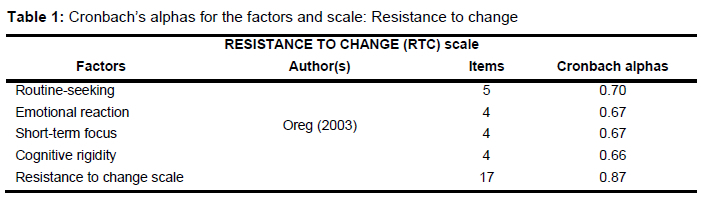
MEASURING INSTRUMENTSThis study used reliable and validated instruments to measure resistance to change (RTC), technology self-efficacy and technological readiness. Oreg's (2003) resistance to change (RTC) scale was used to measure academic staff's resistance to change (RTC). The scale consists of five factors, with a total of 17 items.
Routine-seeking - 5 items
Emotional reaction - 4 items
Short-Term thinking - 4 items
Cognitive rigidity - 4 items
Resistance to change scale - 17 items
A 6-point Likert scale, ranging from 1 (strongly disagree) to 6 (strongly agree), was used to evaluate the factors.
Kent and Giles's (2017) technology self-efficacy scale, which consists of six items and uses a six-point Likert scale ranging from 1 (not at all) to 6 (a great deal), was used to measure technology self-efficacy.
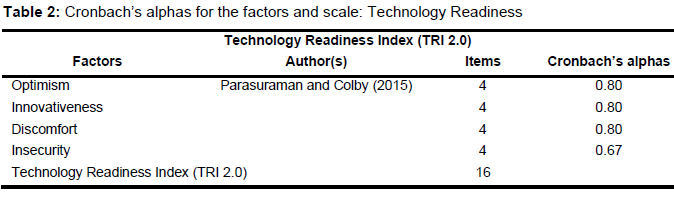
The technology readiness index from Parasuraman and Colby (2015) was used to measure technology readiness. The scale consists of four factors and 16 items to measure academic staff's propensity to accept and utilise technology.
Optimism - 4 times
Innovativeness - 4 items
Discomfort - 4 items
Insecurity - 4 items
TRI 2.0 - 16 items
A 6-point Likert scale ranged from 1 (strongly disagree) to 6 (strongly agree).
RELIABILITY OF THE MEASURING INSTRUMENTSAccording to Sürücü and Maslakçi (2020), the reliability of a measuring scale refers to the instrument's stability in measurement and consistency. The reliability of the scales has been tested; therefore, the researcher will need to complete an internal consistency test. Reliability allows measuring instruments to provide similar results if applied at different time intervals. Determining the reliability of scales in empirical research is done through various methods, such as test-retest reliability, alternative forms and internal consistency tests. Cronbach's alpha tests the Likert-scale surveys for reliability; the questions determine latent variables. The latent variables are either hidden or unobservable - Cronbach's alpha determines how closely related the set of items within the scale is in the specific group. The scale for Cronbach's alpha is determined between 0 and 1, with greater accuracy closer to 1. DeVilles (2003) states that Cronbach alpha coefficient should be above 0.7.
Kent and Giles (2017) did not validate their technology self-efficacy scale.
DATA COLLECTION
An electronic questionnaire was used to collect data from North-West University (NWU) academics. The questionnaire was uploaded to Microsoft Forms, and responses were collected online. Data was stored securely on Microsoft Forms and later exported to an Excel spreadsheet for analysis. SPSS was used to conduct a statistical analysis of the data. Electronic distribution, data storage, and software applications have made the research process more effective, streamlined, and amenable to data analysis.
DATA ANALYSISThe following statistical techniques were used to answer the research questions. Descriptive statistics were calculated for all items in the questionnaire. Categorical variables were reported as frequencies and percentages. Means and standard deviations were reported for question items measured on a Likert scale. Cronbach's alpha values were reported as a measure of reliability. Pearson's product-moment correlation was used to establish the relationship between RTC, technology self-efficacy and technology readiness. Mediation analysis was used to determine if technology self-efficacy mediated the influence of RTC and technology readiness. The Sobel test and bootstrapped confidence intervals were reported. Mean factor scores were calculated for each construct. These factor scores were summarised by reporting means and standard deviations.
RESULTS
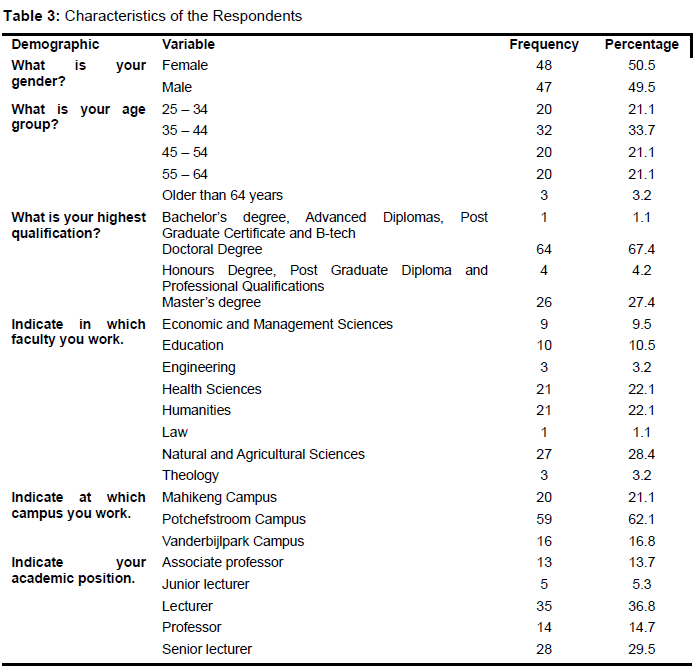
The research participants have a comprehensive representation across numerous categorical characteristics regarding their demographic profile. Concerning gender distribution, the results show an almost equal division, with 50.5 per cent identifying themselves as female and 49.5 per cent as male. The analysis of age distribution demonstrates a diverse population, wherein the most significant proportion is concentrated within the 35-44 age bracket (33.7%), closely followed by the 25-34 age category (21.1%). The study sample included individuals aged 55-64, accounting for 21.1 per cent of the total participants, while those aged 65 and above comprised 3.2 per cent of the sample.
The educational qualifications of the individuals surveyed revealed a significant majority (67.4%) holding doctoral degrees, while 27.4 per cent had master's degrees. The distribution of faculties demonstrates a comprehensive representation, with Natural and Agricultural Sciences accounting for 28.4 per cent and Health Sciences accounting for 22.1 per cent, both of which are significant numbers. Regarding campus affiliation, the majority of individuals were associated with Potchefstroom Campus (62.1%), followed by Mahikeng Campus (21.1%) and Vanderbijlpark Campus (16.8%). This observation highlights the significance of considering possible dynamics peculiar to the campus context in the ensuing research. The researcher's understanding of the academic hierarchy within the study population was facilitated by the various academic positions held by the respondents, which included lecturers (36.8%), senior lecturers (29.5%), and associate professors (13.7%).
The educational credentials of the participants demonstrate a significant predominance of individuals with PhD degrees (67.4%), suggesting a considerable level of scholarly proficiency and speciality within the surveyed population. The inclusion of individuals with master's degrees (27.4%) in the survey adds to its overall credibility since it incorporates insights from a diverse set of academic backgrounds. The distribution among faculties demonstrates a diverse representation, highlighting the interdisciplinary character of the study.
RELIABILITY OF THE MEASURING INSTRUMENTS
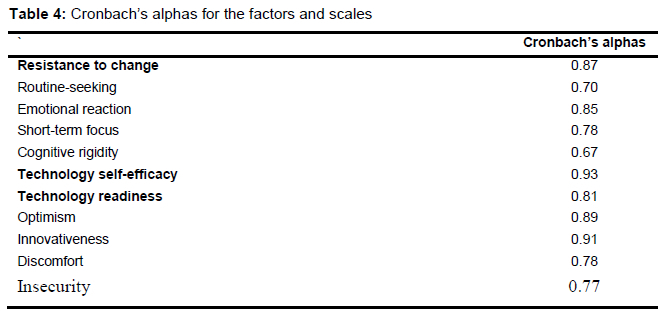
Cronbach's alpha was used to examine the relationship in terms of consistency and determine the reliability of the measuring instruments. According to Sürücü and Maslakçi (2020, 2713-2714), Cronbach's alpha is an acceptable coefficient in literature with a value of between 0 and 1, with greater accuracy closer to 1. The reliability of the factors and scales is illustrated in Table 5.
The RTC construct encompasses four sub-constructs: Routine-Seeking, Emotional Reaction, Short-term Focus and Cognitive Rigidity. Routine-Seeking had a Cronbach's alpha of 0.70. Emotional Reaction showed a Cronbach's alpha of 0.85. Short-term Focus had a Cronbach's alpha of 0.78. Cognitive Rigidity scored a Cronbach's alpha of 0.67. The overall Cronbach's alpha for the RTC construct is 0.87. Technology Self-efficacy was measured with a high Cronbach's alpha of 0.93, indicating excellent internal consistency. The Technology Readiness construct included Optimism, Innovativeness, Discomfort and Insecurity. Optimism had a Cronbach's alpha of 0.89, while Innovativeness scored an alpha of 0.91. Discomfort had a Cronbach's alpha of 0.78, and Insecurity records a Cronbach's alpha of 0.77. The overall technology readiness score had a Cronbach's alpha of 0.81.
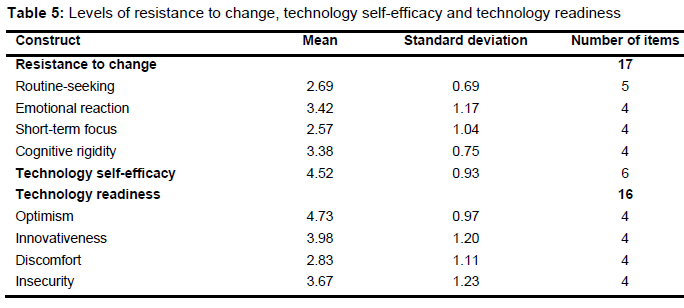
The study's first objective was to explore the levels of resistance to change, technology self-efficacy and technology readiness of academic staff. RTC and Emotional Reaction indicated a relatively low level of resistance and emotional discomfort towards change (M = 2.69, SD = 0.69; M = 2.57, SD = 1.04, respectively), suggesting that the participants might be somewhat open to change but not highly reactive emotionally. Routine-Seeking and Short-term Focus showed moderate scores (M = 3.42, SD = 1.17; M = 3.38, SD = 0.75, respectively), implying a preference for routine and a focus on immediate outcomes rather than long-term implications.
Technology Self-Efficacy showed a high mean score (M = 4.52, SD = 0.93), indicating strong confidence among participants in their ability to use technology effectively.
Technology Readiness components like Optimism and Innovativeness had low mean scores (M = 0.89, M = 0.91, respectively) with high standard deviations (SD = 4.73, SD = 3.98). At the same time, Discomfort and Insecurity also showed low mean scores (M = 0.78, M = 0.77, respectively) but with lower standard deviations (SD = 2.83, SD = 3.67). Despite high technology self-efficacy, these findings suggest a general hesitance and lack of readiness to adopt new technologies.
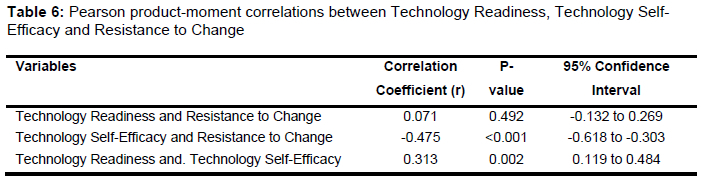
The second research objective was to establish the relationship between RTC, technology self-efficacy and technology readiness. Pearson's product-moment correlation analyses were conducted to investigate the relationships between technology readiness, technology self-efficacy and RTC. First, the relationship between technology readiness and RTC revealed a very weak positive correlation, r (93) = 0.071, p = .492, which was not statistically significant. This suggests a negligible association between technology readiness and RTC.
Subsequently, a significant moderate negative correlation was found between technology self-efficacy and RTC, r (93) = -0.475, p < .001. This indicated that individuals with higher levels of technology self-efficacy would likely exhibit lower RTC. The 95 per cent confidence interval for this correlation ranged from -0.618 to -0.303, further supporting the reliability of these findings.
Lastly, the relationship between technology readiness and technology self-efficacy was explored, revealing a weak to moderate positive correlation, r (93) = 0.313, p = .002. This result suggested a positive association, where increases in technology readiness corresponded with increases in technology self-efficacy. This correlation's 95 per cent confidence interval extended from 0.119 to 0.484, underscoring the consistency and significance of the positive relationship.
The third objective was to establish if technology self-efficacy mediated the relationship between RTC and technology readiness. Due to the weak and not statistically significant (r = 0.071, p = 0.492) correlation between technology readiness and RTC, technology self-efficacy does not mediate this relationship by default. Considering the substantial extent of the observed inverse influence of RTC and technology self-efficacy, it is plausible to propose that technology self-efficacy might mitigate the association between technical readiness and RTC. The decrease in technology self-efficacy that coincided with RTC could thus impact the preparedness of academic staff to embrace and implement new technology.
DISCUSSION
The results reveal a relatively low level of resistance and emotional discomfort towards change among academic staff, as indicated by mean scores for RTC and emotional reaction (M = 2.69, SD = 0.69; M = 2.57, SD = 1.04, respectively). This suggests that academic staff may be somewhat open to change but are not emotionally highly reactive. This finding contrasts with previous literature, which often portrays RTC as a significant barrier in academic settings due to comfort, insufficient information and poor technological skills (Khalil, 2013; Matrosova, 2021).
Technology self-efficacy among academic staff is reportedly high (M = 4.52, SD = 0.93), indicating strong confidence in using technology effectively. This aligns with literature that emphasises the critical role of self-efficacy in integrating technology into education and personal success (Akturk and Ozturk 2019; Eller et al. 2018; Kent and Giles 2017). High self-efficacy is associated with positive student performance and technological adaptation, whereas low self-efficacy can negatively impact educators and students.
The results indicate a general hesitance and lack of readiness to adopt new technologies among academic staff despite high technological self-efficacy. This is evidenced by low mean scores for optimism and innovativeness (M = 0.89, M = 0.91, respectively), along with discomfort and insecurity (M = 0.78, M = 0.77, respectively), albeit with lower standard deviations (SD = 2.83, SD = 3.67). This finding highlights a discrepancy between the confidence to use technology and the willingness to adopt new technologies. The literature suggests that technology readiness involves optimism, innovativeness, discomfort and insecurity, which are crucial for successful adoption and integration (Jafari-Sadeghi et al. 2021).
The findings from this analysis resonate with existing literature that identifies RTC, technology self-efficacy and technology readiness as significant factors influencing technology adoption in academic settings. However, the high level of technology self-efficacy among academic staff suggests that while individuals feel capable of using technology, there may still be hesitance due to discomfort and insecurity regarding new technologies. This underscores the importance of addressing the skills and confidence related to technology use and the attitudes towards technology adoption and change. Moreover, the relatively low RTC observed in this study suggests that academic staff may be more open to adopting new technologies than often assumed, pointing towards the potential for positive change if appropriate support and resources are provided. This aligns with the literature suggesting that supportive management and leadership can significantly influence individuals' readiness and openness to change (Ramos 2017; Thakur and Srivastava 2018). Therefore, while academic staff exhibit a high degree of technology self-efficacy, indicating a solid foundation for technology integration, there is a need to enhance technology readiness through targeted interventions that address discomfort, insecurity and other barriers to technology adoption. This involves fostering an organisational culture that values learning, adaptability and innovation and providing comprehensive training and support to encourage technology adoption and facilitate smoother transitions and successful technology integration.
Resistance to change in academic settings often emerges from various sources, including routine-seeking, emotional reactions, short-term focus and cognitive rigidity (Oreg 2003). These factors contribute to an overall reluctance to embrace technological changes, which can impede the adoption and effective utilisation of educational technologies. The COVID-19 pandemic has accentuated these challenges, forcing a rapid shift to digital platforms and highlighting the critical role of adaptability among academic staff (Williams-Buffonge 2021).
Technology self-efficacy, defined as confidence in one's ability to use technology effectively, plays a pivotal role in overcoming RTC. High levels of technological self-efficacy among academic staff are associated with a greater willingness to adopt and integrate new technologies into teaching and learning processes (Eller et al. 2018; Kent and Giles 2017). This aligns with the current study's findings, which identified a significant, moderate negative correlation between technology self-efficacy and RTC (r = -0.475, p < .001), indicating that enhancing technological self-efficacy could be a key strategy in reducing resistance.
Technology readiness is the propensity to embrace and use new technologies to achieve goals. The study found a positive relationship between technology readiness and technology self-efficacy (r = 0.313, p = .002), suggesting that readiness to adopt technology is closely linked with confidence in one's technological capabilities. This relationship underscores the importance of fostering readiness and self-efficacy to overcome barriers to technology adoption in academic settings. The study's findings resonate with existing literature that emphasises the mediating role of technology self-efficacy in the relationship between RTC and technology adoption (Williams-Buffonge 2021; Yener et al. 2020). Previous studies have highlighted the importance of addressing psychological and skill-related barriers to facilitate a smoother transition towards digital education platforms (Diedericks et al. 2019; Matrosova 2021). Successful technology integration requires a multifaceted approach, including developing a supportive organisational culture, open communication, and comprehensive training (Leso et al. 2023; Self and Schraeder 2009). These strategies could help mitigate resistance by enhancing technological self-efficacy and readiness, ultimately fostering a more adaptable and technologically proficient academic workforce.
The literature review reveals that technology self-efficacy is crucial in integrating technology into education and personal success, with high self-efficacy positively influencing student performance and technological adaptation (Akturk and Ozturk 2019; Eller et al. 2018; Kent and Giles 2017). This finding is consistent with other research indicating that technology self-efficacy can mediate the relationship between teacher support and students' self-directed language learning, highlighting its importance in educational settings (Pan and Chen 2021).
Comparatively, this study's results further explain the mediator role of technology self-efficacy between resistance to change and technology readiness among academic staff. The analysis demonstrated a weak but non-significant correlation between technology readiness and resistance to change (r = 0.071, p = 0.492), indicating a minimal direct relationship. However, a moderate negative correlation between technology self-efficacy and resistance to change (r = -0.475, p < .001) suggests that higher technology self-efficacy is associated with lower resistance. Moreover, a positive correlation between technology readiness and self-efficacy (r = 0.313, p = .002) supports the notion that increased self-efficacy can enhance readiness for technology adoption. These findings are aligned with Kim and Kim (2021), who found that self-esteem mediates the relationship between technology readiness and readiness for change among South Korean teachers, emphasising that high self-esteem correlates with both RTC and technology readiness. Similarly, Williams-Buffonge (2021), citing VanderNoor (2014), underscores the significance of academic self-efficacy in technology integration decisions, directly affecting the incorporation of technology into educational and instructional practice.
MANAGERIAL IMPLICATIONS AND RECOMMENDATIONSAfter analysing the results and discussions, it is recommended that the university should focus on improving the readiness and acceptance of change, especially regarding technology adoption among faculty staff. The following recommendations are suggested to achieve this goal:
Implement targeted training programmes to increase faculty members' technological competencies and self-efficacy, which will help reduce their RTC.
Foster a supportive culture that encourages innovation and change by promoting open communication, providing resources for technology adoption, and recognising and rewarding staff members who actively embrace and advocate for technological advancements.
Involve faculty members in decision-making processes regarding selecting, implementing and evaluating new technologies to increase their acceptance and ownership of change initiatives.
Encourage continuous learning and professional development by providing opportunities for faculty members to stay updated with the latest technological trends and education methodologies.
Ensure that necessary technological infrastructure is in place and adequate support systems are available to assist staff with technological issues. This will reduce barriers to technology use and facilitate the integration of new tools and platforms.
Adopting these recommendations will help to reduce RTC, improve the adoption of new technologies, and foster an environment conducive to innovation and continuous improvement in the academic sector.
LIMITATIONS OF THE RESEARCHThe study's results may not apply to a larger population due to a limited sample size. Additionally, the research is limited to a specific university, which may not represent other institutions with different values, cultures and practices. The use of self-reported data could be influenced by biases such as social desirability bias or recall bias. Moreover, the study's cross-sectional design may not effectively establish causal relationships between variables.
CONCLUSION
This study underscores the significant influence of academic staff's resistance to change on their readiness to adopt new technologies, shaped by their technological self-efficacy. Even though academic staff generally possess high technological self-efficacy, they resist embracing new technologies. This suggests a gap between their confidence and willingness to use new technologies. The study recommends targeted interventions to address academic staff's skills, confidence and attitudes towards technology adoption and change. Additionally, universities should foster an organisational culture that values learning, adaptability and innovation to enhance technology readiness and facilitate smoother transitions to new technological integrations. By doing so, they can overcome barriers to effective technology integration in academic settings.
REFERENCES
LITERATURE REVIEW
- Akturk, Ahmet Oguz, and Handan Saka Ozturk. 2019. "Teachers' TPACK levels and students' self-efficacy as predictors of students' academic achievement." International Journal of Research in Education and Science 5, (1), 283-294.
-
An, Fuhai, Linjin Xi, Jingyi Yu, and Mohan Zhang. 2022. "Relationship between technology acceptance and self-directed learning: Mediation role of positive emotions and technological self-efficacy." Sustainability 14 (16).: 10390. http://dx.doi.org/10.3390/su141610390
» http://dx.doi.org/10.3390/su141610390 -
Bakker, Arnold B., Jørn Hetland, Olav Kjellevold Olsen, and Roar Espevik. 2023. "Daily transformational leadership: A source of inspiration for follower performance?" European Management Journal 41 (5), 700-708. http://dx.doi.org/10.1016/j.emj.2022.04.004
» http://dx.doi.org/10.1016/j.emj.2022.04.004 -
Bartolic, Silvia K., David Boud, Jenilyn Agapito, Dominique Verpoorten, Siobhan Williams, Louise Lutze-Mann, Uwe Matzat et al. 2022. "A multi-institutional assessment of changes in higher education teaching and learning in the face of COVID-19." Educational Review 74, (3), 517-533. http://dx.doi.org/10.1080/00131911.2021.1955830
» http://dx.doi.org/10.1080/00131911.2021.1955830 -
Bennett, John, and Linda Bennett. 2003. "A review of factors that influence the diffusion of innovation when structuring a faculty training program." The Internet and Higher Education 6, (1), 53-63. http://dx.doi.org/10.1016/S1096-7516(02)00161-6
» http://dx.doi.org/10.1016/S1096-7516(02)00161-6 -
Caffaro, Federica, Margherita Micheletti Cremasco, Michele Roccato and Eugenio Cavallo. 2020. "Drivers of farmers' intention to adopt technological innovations in Italy: The role of information sources, perceived usefulness and perceived ease of use." Journal of Rural Studies 76, 264-271. http://dx.doi.org/10.1016/j.jrurstud.2020.04.028
» http://dx.doi.org/10.1016/j.jrurstud.2020.04.028 -
Chebon, S. K., W. K. Aruasa, and L. K. Chirchir. 2019. "Effect of inspirational motivation and idealized influence on employee performance at Moi teaching and referral hospital, Eldoret, Kenya." International Journal of Business and Social Science 10, (7), 131-140. http://dx.doi.org/10.30845/ijbss.v10n7p14
» http://dx.doi.org/10.30845/ijbss.v10n7p14 -
Chelliah, Kanaga Kumari. 2022 "COVID-19 Pandemic: Student and faculty experience in higher education." Journal of Medical Imaging and Radiation Sciences 53, (4), S58. http://dx.doi.org/10.1016/j.jmir.2022.10.200
» http://dx.doi.org/10.1016/j.jmir.2022.10.200 - Csikszentmihalyi, M. Flow. 1990. The Psychology of Optimal Experience, New York: HarperPerennial.
- Davis, Fred D. 1985 A technology acceptance model for empirically testing new end-user information systems: Theory and results. PhD diss., Massachusetts Institute of Technology.
-
Deci, Edward L., and Richard M. Ryan. 2000. "The" what" and" why" of goal pursuits: Human needs and the self-determination of behavior." Psychological Inquiry 11, (4), 227-268. http://dx.doi.org/10.1207/S15327965PLI1104_01
» http://dx.doi.org/10.1207/S15327965PLI1104_01 -
Deci, Edward L., Anja H. Olafsen, and Richard M. Ryan. 2017. "Self-determination theory in work organizations: The state of a science." Annual Review of Organizational Psychology and Organizational Behavior 4. 19-43. http://dx.doi.org/10.1146/annurev-orgpsych-032516-113108
» http://dx.doi.org/10.1146/annurev-orgpsych-032516-113108 - DeVilles, Robert F. 2003. Scale development: Theory and applications.
-
Diedericks, Johanna C., Frans Cilliers, and Adéle Bezuidenhout. 2019. "Resistance to change, work engagement and psychological capital of academics in an open distance learning work environment." SA Journal of Human Resource Management 17(1), 1-14. http://dx.doi.org/10.4102/sajhrm.v17i0.1142
» http://dx.doi.org/10.4102/sajhrm.v17i0.1142 - Dunican, Brian. 2015. Acceptance of change: Exploring the relationship among psychometric constructs and employee resistance. PhD Diss., Western Kentucky University.
-
Dwivedi, Yogesh K., Nripendra P. Rana, Anand Jeyaraj, Marc Clement, and Michael D. Williams. 2019. "Re-examining the unified theory of acceptance and use of technology (UTAUT): Towards a revised theoretical model." Information Systems Frontiers 21. 719-734. http://dx.doi.org/10.1007/s10796-017-9774-y
» http://dx.doi.org/10.1007/s10796-017-9774-y -
Eller, Lucille S., Elise L. Lev, Changrong Yuan, and Ann Vreeland Watkins. 2018. "Describing self-care self-efficacy: Definition, measurement, outcomes, and implications." International Journal of Nursing Knowledge 29, (1), 38-48. http://dx.doi.org/10.1111/2047-3095.12143
» http://dx.doi.org/10.1111/2047-3095.12143 - Festinger, Leon. 1957. A Theory of Cognitive Dissonance, New York: Row, Peterson & Co.
-
» http://dx.doi.org/10.5944/openpraxis.5.2.5 -
Hendricks, Karin S. 2016. "The sources of self-efficacy: Educational research and implications for music." Update: Applications of Research in Music Education 35 (1), 32-38. http://dx.doi.org/10.1177/8755123315576535
» http://dx.doi.org/10.1177/8755123315576535 -
Hofer, Sarah I., Nicolae Nistor, and Christian Scheibenzuber. 2021. "Online teaching and learning in higher education: Lessons learned in crisis situations." Computers in Human Behavior 121. 106789. http://dx.doi.org/10.1016/j.chb.2021.106789
» http://dx.doi.org/10.1016/j.chb.2021.106789 - Hong, Minxuan. 2022. Technology Self-Efficacy and Digital Citizenship as Predictors of Elementary Students' Online Learning Engagement. PhD diss., Ohio State University.
-
Jafari-Sadeghi, Vahid, Alexeis Garcia-Perez, Elena Candelo and Jerome Couturier. 2021. "Exploring the impact of digital transformation on technology entrepreneurship and technological market expansion: The role of technology readiness, exploration and exploitation." Journal of Business Research 124, 100-111. http://dx.doi.org/10.1016/j.jbusres.2020.11.020
» http://dx.doi.org/10.1016/j.jbusres.2020.11.020 -
Kebritchi, Mansureh, Angie Lipschuetz, and Lilia Santiague. 2017. "Issues and challenges for teaching successful online courses in higher education: A literature review." Journal of Educational Technology Systems 46 (1), 4-29. http://dx.doi.org/10.1177/0047239516661713
» http://dx.doi.org/10.1177/0047239516661713 - Kent, Andrea M., and Rebecca M. Giles. 2017. "Preservice teachers' technology self-efficacy." SRATE Journal 26 (1), 9-20.
-
Kim, Jungsug and Eunjeung Kim. 2022. "Relationship between self-esteem and technological readiness: Mediation effect of readiness for change and moderated mediation effect of gender in South Korean teachers." International Journal of Environmental Research and Public Health 19, (14), 8463. http://dx.doi.org/10.3390/ijerph19148463
» http://dx.doi.org/10.3390/ijerph19148463 -
Lai, Poey Chin. 2017. "The literature review of technology adoption models and theories for the novelty technology." JISTEM-Journal of Information Systems and Technology Management 14, 21-38. http://dx.doi.org/10.4301/S1807-17752017000100002
» http://dx.doi.org/10.4301/S1807-17752017000100002 -
Leso, Bernardo Henrique, Marcelo Nogueira Cortimiglia, and Antonio Ghezzi. 2023."The contribution of organizational culture, structure, and leadership factors in the digital transformation of SMEs: a mixed-methods approach." Cognition, Technology & Work 25(1), 151-179. http://dx.doi.org/10.1007/s10111-022-00714-2
» http://dx.doi.org/10.1007/s10111-022-00714-2 -
Maican, Catalin Ioan, Ana-Maria Cazan, Radu Constantin Lixandroiu, and Lavinia Dovleac. 2019. "A study on academic staff personality and technology acceptance: The case of communication and collaboration applications." Computers & Education 128, 113-131. http://dx.doi.org/10.1016/j.compedu.2018.09.010
» http://dx.doi.org/10.1016/j.compedu.2018.09.010 - Matrosova, Sofia. From Resistance to Acceptance: Technology in Academia. 2021. PhD diss., Capella University, 2021.
-
Minishi-Majanja, Mabel K., and Joseph Kiplang'at. 2005. "The diffusion of innovations theory as a theoretical framework in library and information science research." South African Journal of Libraries and Information Science 71 (3), 211-224. http://dx.doi.org/10.7553/71-3-586
» http://dx.doi.org/10.7553/71-3-586 -
Mishra, Lokanath, Tushar Gupta, and Abha Shree. 2020. "Online teaching-learning in higher education during lockdown period of COVID-19 pandemic." International Journal of Educational Research Open 1 100012. http://dx.doi.org/10.1016/j.ijedro.2020.100012
» http://dx.doi.org/10.1016/j.ijedro.2020.100012 -
Mittal, Niti, and Shirin Alavi. 2020. "Construction and psychometric analysis of teachers mobile learning acceptance questionnaire." Interactive Technology and Smart Education 17 (2), 171-196. http://dx.doi.org/10.1108/ITSE-07-2019-0039
» http://dx.doi.org/10.1108/ITSE-07-2019-0039 - Mohajan, Haradhan Kumar. "Quantitative research: A successful investigation in natural and social sciences. 2020." Journal of Economic Development, Environment and People 9(4), 50-79.
- Nikou, Shahrokh, Malin Brännback, and Gunilla Widén. 2019. "The Impact of Digitalization on Literacy: Digital Immigrants vs. Digital Natives." ECIS.
-
North-West University 2023. https://www.nwu.ac.za/sites/www.nwu.ac.za/files/files/i-institutional-information/pocket-statistics/NWU%20Quick%20Stats%202023-2024.pd
» https://www.nwu.ac.za/sites/www.nwu.ac.za/files/files/i-institutional-information/pocket-statistics/NWU%20Quick%20Stats%202023-2024.pd -
Oreg, Shaul. 2003. "Resistance to change: Developing an individual differences measure." Journal of Applied Psychology 88 (4), 680. http://dx.doi.org/10.1037/0021-9010.88.4.680
» http://dx.doi.org/10.1037/0021-9010.88.4.680 -
Oyedotun, Temitayo Deborah. 2020. "Sudden change of pedagogy in education driven by COVID-19: Perspectives and evaluation from a developing country." Research in Globalization 2. 100029. http://dx.doi.org/10.1016/j.resglo.2020.100029
» http://dx.doi.org/10.1016/j.resglo.2020.100029 -
Pan, Xiaoquan. 2020. "Technology acceptance, technological self-efficacy, and attitude toward technology-based self-directed learning: learning motivation as a mediator." Frontiers in Psychology 11. 564294. http://dx.doi.org/10.3389/fpsyg.2020.564294
» http://dx.doi.org/10.3389/fpsyg.2020.564294 - Pan, Xiaoquan, and Wei Chen. 2021. "Modeling teacher supports toward self-directed language learning beyond the classroom: technology acceptance and technological self-efficacy as mediators." Frontiers in Psychology 12. 751017.
-
Parasuraman, Ananthanarayanan, and Charles L. Colby. 2015. "An updated and streamlined technology readiness index: TRI 2.0." Journal of Service Research 18(1), 59-74. http://dx.doi.org/10.1177/1094670514539730
» http://dx.doi.org/10.1177/1094670514539730 -
Rahman, M.S. 2020. The advantages and disadvantages of using qualitative and quantitative approaches and methods in language "testing and assessment" research: A literature review. Journal of Education and Learning, 6, 102-104. http://dx.doi.org/10.5539/jel.v6n1p102
» http://dx.doi.org/10.5539/jel.v6n1p102 - Ramos, Ana Catarina da Silva. 2017. The Relation between Resistance to Change and Creativity: The Mediating Effect of Participation and Work Engagement in a Portuguese Business Context. Master's thesis, ISCTE Business School.
-
Repovš, Eva, Mateja Drnovšek, and Robert Kaše. 2019. "Change ready, resistant, or both? Exploring the concepts of individual change readiness and resistance to organizational change." Economic and Business Review 21, no. 2. 5. http://dx.doi.org/10.15458/85451.82
» http://dx.doi.org/10.15458/85451.82 -
Rogers, Everett M. 1995. "Diffusion of innovations: Modifications of a model for telecommunications." Die diffusion von innovationen in der telekommunikation . 25-38. http://dx.doi.org/10.1007/978-3-642-79868-9_2
» http://dx.doi.org/10.1007/978-3-642-79868-9_2 - Rojas, Frank J. 2020. Understanding Faculty Resistance to Change in Adopting Online Degree Programs. PhD diss., Fielding Graduate University.
- Schein, Edgar H. 2010. Organizational culture and leadership. Vol. 2. New York: John Wiley & Sons.
-
Self, Dennis R., and Mike Schraeder. 2009. "Enhancing the success of organizational change: Matching readiness strategies with sources of resistance." Leadership & Organization Development Journal 30, (2), 167-182. http://dx.doi.org/10.1108/01437730910935765
» http://dx.doi.org/10.1108/01437730910935765 -
Seligman, Lester G. 1980. "Leadership. By James MacGregor Burns. (New York: Harper and Row, 1978.)." American Political Science Review 74, 153-156. http://dx.doi.org/10.2307/1955659
» http://dx.doi.org/10.2307/1955659 -
Siegel, Dan, Parul Acharya, and Stephen Sivo. 2017. "Extending the technology acceptance model to improve usage and decrease resistance toward a new technology by faculty in higher education." Journal of Technology Studies 43(2) 58-69. http://dx.doi.org/10.21061/jots.v43i2.a.1
» http://dx.doi.org/10.21061/jots.v43i2.a.1 -
Smuts, Richard Gareth, VV Madhavi Lalitha, and Habib Ullah Khan. 2017. "Change management guidelines that address barriers to technology adoption in an HEI context." In 2017 IEEE 7th International Advance Computing Conference (IACC), pp. 754-758. IEEE. http://dx.doi.org/10.1109/IACC.2017.0156
» http://dx.doi.org/10.1109/IACC.2017.0156 -
Sørebø, Øystein, Hallgeir Halvari, Vebjørn Flaata Gulli, and Roar Kristiansen. 2009. "The role of self-determination theory in explaining teachers' motivation to continue to use e-learning technology." Computers & Education 53(4), 1177-1187. http://dx.doi.org/10.1016/j.compedu.2009.06.001
» http://dx.doi.org/10.1016/j.compedu.2009.06.001 -
Sürücü, Lütfi, and Ahmet Maslakci. 2020. "Validity and reliability in quantitative research." Business & Management Studies: An International Journal 8,(3), 2694-2726. http://dx.doi.org/10.15295/bmij.v8i3.1540
» http://dx.doi.org/10.15295/bmij.v8i3.1540 -
Thakur, Rajiv R., and Shalini Srivastava. 2018. "From resistance to readiness: The role of mediating variables." Journal of Organizational Change Management 31 (1), 230-247. http://dx.doi.org/10.1108/JOCM-06-2017-0237
» http://dx.doi.org/10.1108/JOCM-06-2017-0237 - Umit, Kul. 2018. "Influences of technology integrated professional development course on mathematics teachers." European Journal of Educational Research 7(2), 233-243.
-
Vansteenkiste, Maarten, Eline Sierens, Luc Goossens, Bart Soenens, Filip Dochy, Athanasios Mouratidis, Nathalie Aelterman, Leen Haerens and Wim Beyers. 2012. "Identifying configurations of perceived teacher autonomy support and structure: Associations with self-regulated learning, motivation and problem behavior." Learning and instruction 22(6), 431-439. http://dx.doi.org/10.1016/j.learninstruc.2012.04.002
» http://dx.doi.org/10.1016/j.learninstruc.2012.04.002 -
Venkatesh, Viswanath, Michael G. Morris, Gordon B. Davis, and Fred D. Davis. 2003. "User acceptance of information technology: Toward a unified view." MIS Quarterly 425-478. http://dx.doi.org/10.2307/30036540
» http://dx.doi.org/10.2307/30036540 -
Watty, Kim, Jade McKay, and Leanne Ngo.2016. "Innovators or inhibitors? Accounting faculty resistance to new educational technologies in higher education." Journal of Accounting Education 36, 1-15. http://dx.doi.org/10.1016/j.jaccedu.2016.03.003.
» http://dx.doi.org/10.1016/j.jaccedu.2016.03.003 - Williams-Buffonge, Na-Ajele Gadija. 2021. Caribbean Lecturers' Self-Efficacy and Their Perceived Barriers to Technology Adoption. PhD diss., Walden University.
-
Yener, Serdar, Aykut Arslan, and Sebahattin Kilinç. 2021. "The moderating roles of technological self-efficacy and time management in the technostress and employee performance relationship through burnout." Information Technology & People 34, (7). 1890-1919. http://dx.doi.org/10.1108/ITP-09-2019-0462
» http://dx.doi.org/10.1108/ITP-09-2019-0462 - Zaidi, Syeda Qurat-ul-ain. 2022. "Empirical evidence on role of self-efficacy upon commitment of teachers in higher education institutions." Administrative and Management Sciences Journal 1(1), 10-24.