Using a digital studio as an alternative to engaging communication design students: Implications for a Post-Covid-19 pandemic lockdown era
Abstract
This article describes the intervention that facilitated students completing their curriculum under strict and partially strict lockdown rules without access to a traditional "wet" studio and physical laboratory space. The primary researcher introduced the students to a "digital mock-up-making" process in Adobe Illustrator and Photoshop programs. The e-learning technique allowed 29 second-year students at a university of technology to create their 2D design in Adobe Illustrator and 3D design in Photoshop. This process replaced a traditional physical cut-and-paste process within the "wet" and "dry" laboratory and studio spaces. The researchers followed a qualitative ethnography research design to determine the success of the "digital mock-up making" process as an alternative to physical studio and laboratory work. This research method requires deep reflection and self-assessment about "what" and "how" the learning occurred. The harvested qualitative reflective data were analysed using a content analysis approach. The findings showed that students gained new digital-based skills and overcame their concerns about not learning during the lockdown period and the likelihood of losing an entire academic year. Furthermore, online-based assessment of the design works orchestrated a paperless advantage compared to the physical studio process. However, the connection with conventional art materials and some technical knowledge dwindled during the period. This article concludes that lack of physical tools and access to physical studios were not barriers to students' accomplishments. This study recommends that digital mock-up making remain part of the facilitation methods of studio-based modules because it fosters student-centred learning and enables learning to continue during a period of disruption. Digital mock-up making can mitigate disruptions caused by natural disasters and prolonged student impasses.
Digital mock-up-making; digital design studio; art and design materials; online-based learning; COVID-19 pandemic; lockdowns
INTRODUCTION AND BACKGROUND
The imposition of lockdowns and social and physical distancing as part of ways of reducing the transmission of COVID-19 between March 2020 through the early part of 2022 was inevitable and evident. During these prolonged lockdowns, only the essential workers and goods were allowed to move around (du Preez and le Grange, 2020). Students and staff in all South African contact mode universities were obligated to vacate university premises. Resultantly, face-to-face lectures were suspended. The abrupt mobility disruptions imparted mostly the practically oriented courses with elements of practical laboratory work and experiments, computer laboratories, studio, and workshop apparatuses for operation learning. These include courses such as natural and medical sciences, design and studio art, and various engineering disciplines to mention but a few.
After the initial announcement of the restriction of movements (lockdown), during the few contact sessions before the day the lockdowns commenced, the students in the Communication Design class (Studio Practice) at a University of Technology, posed two critical questions to the primary researcher: (1) "Sir, what will happen to us? (2) Does it mean we will have to repeat the year?" At that time, the primary researcher had no answers because he was unsure if this practical module could be taught using online learning and online supplementary resources for a studio-based subject like this. He was sceptical, and thought there would be a lack of studio interaction and creative physical engagements that could enhance skill transfer to the students. This notion was initially confirmed by Czerniewicz et al. (2020) that studio-based learning is complex to teach online in low-tech conditions. Hodges et al. (2020) also argued that online learning potentially devalued course quality.
The restriction of movement impacted higher education lecturers and students' lives, physical and mental well-being, and teaching and learning activities (Aristovnik et al., 2020). Nonetheless, teaching and learning moved online unavoidably. This shift brought about positive and negative experiences (Makura, 2022; Meeran and Davids, 2022). Some scholars described the online paradigm shift's impact as a mere educational experience (Daraku and Hoxha, 2020), while others refer to it as a complete tremor that offers opportunities to rethink the purpose of education in more profound and inclusive ways (Soudien, 2020).
Teaching and learning under the lockdown restrictions were challenging for lecturers and students. The pandemic has changed how lecturers do things in art and design-related learning, as in other disciplines. Newer ways of teaching and learning laboratory/studio-based subjects drastically changed to online-based. For many reasons, replacing the "wet" lab and studio spaces with digital labs was difficult. Among the difficulties faced by the design students were the lack of appropriate devices and gadgets, lack of individual design software licences, insufficient data for connection for the duration of learning periods, connectivity problems due to network coverage and infrastructure, and lack of private studio spaces at the student's family dwelling places.
This article explores Soudien's (2020) notion of academic opportunism, which avers that opportunities lie in [academic] disruption. Disruption stimulated thinking about how lecturers could respond to lockdowns positively using available technology instead of complaining about its adverse effects. This article discusses the intervention that facilitated students' completing their curriculum under strict and partially strict lockdown rules without having access to a traditional "wet" studio and physical lab space. Moreover, the article highlights the implication of this intervention that alleviates the students' fear of not learning adequately during the lockdown period and the likelihood of losing an entire academic year. Additionally, the authors outline the pedagogical and theoretical implications for a post-lockdown era. This article sought to answer the following two research questions:
• How did Activity Theory impact teaching and learning in Studio Practice during the COVID-19 lockdowns?
• During the COVID-19 pandemic lockdowns, what learning strategies did Studio Practice adopt to help students learn spatial design uninterrupted?
• Due to COVID-19 lockdowns, how did students cope without access to traditional "wet" studio spaces?
About Activity Theory in Teaching Studio Practice
It is important to note that this section provides a basic overview of Activity Theory and how it became a theoretical framework for teaching studio practice during the pandemic. However, it is not intended to completely explain the conceptual structure, historical developments, and ongoing discussions surrounding Activity Theory. The theory considers the broader cultural context in which learning occurs. As such, it has important implications for understanding how students interact with, and make sense of their social environment. This cultural-historical theory has been widely used in training programmes, such as mobile learning (Petrucco and Ferranti, 2018), technology integration in pre-university settings (Kwong and Churchill, 2023), and mathematics learning (Dreyfus, 2018; Loc et al., 2022).
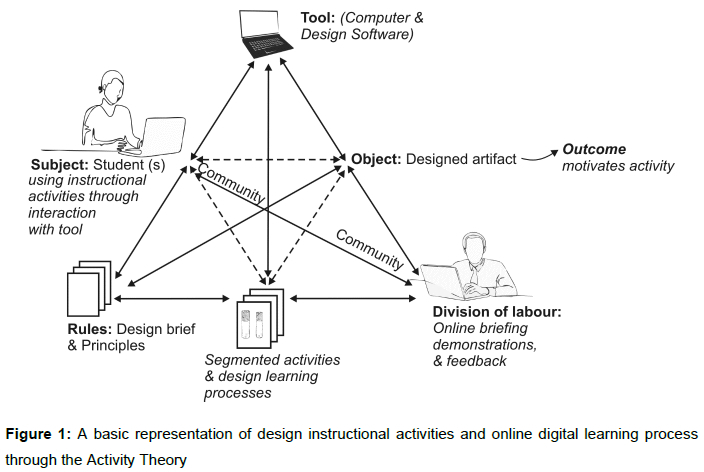
Engeström (1987) suggested a model that conceptualises all determined human activity as the interaction of the following elements: community, object, rules, subject, tools, and division of labour. In applying this activity system in studio practice, the community comprises one or more people who share the objective with the subject (including the primary researcher and the students), and the object cum outcomes are the artefacts expected at the end of the activities. Rules are explicit and implicit instructions within the design brief, and all the design principles are to be followed when doing the activities. Subject included students and the primary researcher/design lecturer). Tools are computers and dynamic communication design software. Division of labour is the role lecturers and students play in the learning activities (see Figure 1).
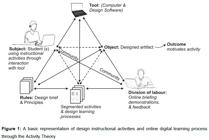
It is a theoretical framework for investigating and understanding human interaction using tools and materials (Scanlon and Issroff, 2002; Brine and Franken, 2006). Researchers have used Activity Theory as a systematic tool in their studies to comprehend the learning experiences of students and teachers in higher education when using technology (Scanlon and Issroff, 2002). Scanlon and Issroff, (2002) found Activity Theory helpful in understanding all facets of interfaces in their modules, which is relevant to this study. Therefore, the instructional design approach in facilitating studio design learning proposed in this article develops a personally meaningful understanding of design content and process by the participants. Similarly, the activities of the design process are achieved through active digital studio experiences using various equipment (such as a computer with access to appropriate design software) and digital art tools (such as digitising tablet for sketching and manipulating shapes), among others (see Figure 1). The digital equipment is used to solve problems in a realistic context by producing design artefacts (the outcomes of the activity). Other activities in this study involve feedback by the primary researcher through multiple platforms during the design processes and assessments of the overall outcomes.
Through the lens of Activity Theory, this study sheds light on ways the teaching and learning in digital environments for communication design can inform learning goals. Our argument is that the manner in which students use their digital tools within assigned activities and timeframes fosters positive learning experiences. Furthermore, this theory offers a valuable framework for contextualising technology usage, taking into account the student's interaction with the technology tool and the broader context in which that interaction occurs. Given the restricted circumstances, online learning was the only viable option for facilitating learning in this instance. Specifically, Activity Theory was instrumental in framing our approach to digital learning in Communication Design in a higher education context. Furthermore, the online teaching and learning engagement of the Studio Practice module during the lockdowns was informed by the e-learning model, which had been widely used for distance learning before the advent of the COVID-19 pandemic lockdowns (Leszczyñski et al., 2018; Kopp, Grõblinger and Adams, 2019). This model is a formal education approach in which students learn through online learning (Staker and Horn, 2012). Janczak (2018) elucidates that e-learning offers a better opportunity and provides students with what they need when connected to the internet. He further explained that the leading role is in the student's hands. Thus, every student is responsible for their learning in choosing the methods, information, and tools. Patrick, Kennedy, and Powell. (2013) explained that e-learning involves much more than just introducing technology; it also demands good teaching and transforms the teacher's role from "sage on the stage to guide on the side" (student-centred). Patrick et al. (2013) further argue that teachers should help students become independent and motivated to learn using the online platform. Teachers should also have self-efficacy related to technology and online communication and engage students in deeper learning.
Teaching and Learning Studio Practice during the COVID-19 Pandemic Lockdowns
Before the pandemic, communication design classes were primarily taught in a physical studio, featuring hands-on activities. In addition, digital learning was also integrated into the curriculum and conducted in computer labs. The university provided dedicated labs for teaching processes that involved water, paints, solvents, cutting machines, and other hardware, all of which were expertly supervised by technicians and assistants. Due to the unpredictable nature of the abrupt interference of the pandemic-imposed restrictions, all tertiary institutions closed, resulting in online learning (Aristeidou and Cross, 2021). Consequently, the above-mentioned learning spaces were no longer accessible to lecturers and students.
In 2020, when online learning was first implemented completely, the primary researcher asked the students how the COVID-19 pandemic lockdowns generally affected their online studies. The consultation with the students was necessary to ascertain their abilities and individual needs to access the proposed online teaching and learning. The responses were overwhelming. The student responses consisted of challenges ranging from "poor connectivity" to "the lack of art materials" due to the closing of bookshops, which were not part of the essentials. Student learning was also affected by the "lack of design software on student personal computers", "data", "lack of private working spaces", "the pressure of unending chores", and "interferences from siblings and little nieces and nephews", "moving out and around their dwelling to get a perfect uninterrupted connectivity spot", to mention a few.
During the 2020 academic year, the transition to complete online learning in this module proved challenging due to inherent student? inequalities. However, in 2021, some of student concerns and challenges were addressed. For instance, laptops were distributed to students. However, some students downloaded free video games and social media applications, thus filling the computer's storage space and rendering the computer slow. Moreover, the national government worked towards improving infrastructure, such as connectivity and access in many areas and the university mitigated the data problem by providing enough data to support students' online learning.
The digital mock-up was first implemented in the 2021 academic year, and continued in 2022, before the semi-structured interviews were conducted with the 2022 group. In 2021, the primary researcher discovered during lesson preparations that Adobe software company had made their software available online for free globally for students to work remotely. Students could log in with their student numbers and credentials. This intervention solved the software licence issues globally and the design students benefitted. These developments informed the restructuring of the practical and studio offerings during the pandemic.
Therefore, virtual teaching of Studio Practice modules is non-negotiable due to various restrictions that made traditional contact and the physical instruction education system impossible (López et al., 2022). Studio Practice in communication design is a project-based learning module that takes place in the digital labs and "wet" studio arenas concurrently. Briefly, the subject refers to the effective communication and presentation of design solutions using diverse graphic design techniques. In this subject, students learn to communicate and present their design solutions and information by applying various 2D and 3D visual communication techniques such as mock-ups, digital drawing/sketching, painting, rendering, and modelling activities. Students must apply multifaceted and professional visual methods and knowledge to communicate a story efficiently to an audience through print advertisements, promotional materials, or television advertisement ideas. Students must prove sufficient skills in advanced visual communication techniques to visually communicate and present detailed visual information to guarantee their employability at the end of their programmes.
The curriculum or learning plan (le Grange, 2010; Marope, Griffin and Gallagher, 2017; le Grange and Ontong, 2018; Pinar, 2019) requirements that guided the learning activities reported in this study are indicated below.
The curriculum requires students to explore and develop design ideas by applying good visual communication and design knowledge and techniques in response to a brief at the second-year level; therefore, the facilitator is expected to provide an opportunity for students:
• To use good presentation techniques that draw on design principles (e.g., proximity, alignment, hierarchy, use of positive and negative space), graphic modes and media (e.g., digital, photography, conventional sketching and drawing methods and digital media) to present design ideas clearly and confidently.
• To experiment and improve design ideas that incorporate professional three-dimensional (3D) design knowledge (e.g., design tools, design processes, sustainability) and graphic techniques (e.g., digital drawings, renderings, modelling) in response to a brief in accordance with the feedback (SAQA, 2015).
Since the university instructed that all academic activities should be delivered online to save the academic year, exploring the online system using the various available digital platforms became imperative to foster teaching, learning, and assessment. Even though concerns were raised about social justice, problems of access to digital devices and internet connectivity (Ramrathan et al., 2020). These issues could potentially jeopardise the online learning process. The attainment of the curriculum objectives became a mandatory objective of the module's facilitator during these prolonged lockdowns and physical restrictions.
COVID-19 Pandemic Lockdown Procedures through the Introduction of Digital Mock-Up Making and Applications (Digital Studio)
Digital mock-up (DMU) is a concept or technique that permits a photorealistic presentation and portrays a product vividly in a 3D format for display or function in the real world (Stark, 2022). DMU is enhanced by all the activities that promote the product description. This technique is mainly used for product design by designers, engineers, and manufacturing support personnel to work together to create and present products clearly (Stark, 2022). One of the objectives of DMU is to have significant knowledge of the future or the supported product to replace any physical prototypes with virtual ones using 3D computer graphics techniques (Stark, 2022). This visual communication design presentation technique allows the designer to create original and reusable mock-ups for a lowered expense incurred at the proposal stage. This design technique is also frequently referred to as digital prototyping or virtual prototyping. The primary researcher, a graphic-design-practising lecturer familiar with digital designs, opined that this part of the curriculum and the associated learning activities could be taught online.
The process of digital mock-up making is creative and an active learning process where each design student is expected to create their models digitally. Therefore, the method requires a design thinking process (Plattner, Meinel and Leifer, 2011). The design thinking process draws on research, conceptualising, ideating, prototyping, testing, adjusting and delivering (Gallanis, 2020). This design thinking process necessitates design students to inquire about possible solutions using creative tools available within the design space. The process also requires ample knowledge of Adobe Illustrator and Photoshop and how to integrate these digital design applications. Similarly, for "custom mock-up making", one needs original photographs. In this case, students were given different pictures they could select from instead of breaking the lockdown rules by going out to take their photographs.
Furthermore, after an online briefing session and online demonstration by the primary researcher on the process, each student researched, brainstormed using a mind map, produced concept sketches, and shared their ideas online with the primary researcher using email, Discord App, and WhatsApp. Then, the primary researcher checked the work, assisted the student in selecting the appropriate design, and advised on which design worked better. The students proceeded to their 2D designs in Adobe Illustrator. After achieving their plans, the students used photo manipulation software (Adobe Photoshop) to integrate their 2D designs into the photographic imagery. The most common software for these design activities is Adobe Illustrator (for 2D design) and Adobe Photoshop (for photo manipulation and editing).
Adobe Illustrator and Photoshop provide a variety of tools and tutorials for achieving realistic results, which include the following:
• Transform tools to fit the 2D design onto a 3D product image
• Blending modes to incorporate texture from the original photo
• Adjustment layers for working with lighting, colour, and contrast
One needs a high-spec desktop computer or laptop, a photograph-editing program (Adobe Photoshop), and a drawing or vector-based program (Adobe Illustrator) to achieve the above design results.
The project's goal was for the students to present their designs as accurately as they would look when put out into the real world or on the shelves using the appropriate digital manipulation means. Students were instructed to use a combination of dedicated graphics software Illustrator and Photoshop. The reasons for these preferences are that Adobe Illustrator provides resolution-independent intuitions, while Photoshop provides two valuable tools for mock-up purposes. These are intelligent or innovative object tools and 3D actions.
Working in Illustrator made the students' design works scalable (they can be scaled to any size without pixelation), making their files relatively small because of the stirring space. Therefore, students created their 2D vector-based project using the necessary design elements in Adobe Illustrator program until they were satisfied with their design's functional and aesthetical look. Their projects were saved as Adobe Illustrator or encapsulated postscript (EPS) files. Then, the students were instructed to open new files in Photoshop and bring in the 3D photo image of what they wanted to mock up or apply their design. Furthermore, the students were told to open a new layer, return to their 2D designs in Illustrator, copy it, and paste it as a "smart object". The students were further instructed to resize if the label-like 2D design was more oversized. Then, select the body shape of their products' photo image and apply the "smart object" to confine to the 3D shape to form their mock-ups. It was necessary to convert the 2D design layer to a "smart object" because the students had to edit the design by distorting it to make it conform to the angle and the position of the 3D packaging imagery. Tweaking the layer's opacity to about 35 per centand resizing the design to align with the packaging was also necessary.
Shadows and highlights can be brought into the design, and the blending mode can be changed and adjusted until one obtains a desirable look. This action was achieved using the liquify tool to fill the corners and angles of the 3D-packaging shapes. At the same time, the show-background option button was selected in the properties of the tool, brush, and reduce the opacity as it suits the design students. Students were also allowed to increase the opacity later to see the changes made.
RESEARCH METHODOLOGYResearch Paradigm
For this study, an interpretivist approach was utilised within a qualitative research methodology. The main focus was to comprehend and interpret subjective responses of students (Kivunja and Kuyini, 2017) towards their learning experiences. The reason behind this approach is that the primary researcher and design students were involved in interactive teaching and learning processes, which necessitates such an approach. This approach enables the researchers to provide interpretive explanations that focus on the perception and meaning from the participants' point of view. Furthermore, all the data were carefully and repeatedly examined to code, categorise, and synthesise the participants' responses.
Method
In assessing the learning that took place as prescribed by the curriculum, the primary researcher, with a background in visual communication design with input from a researcher from a teacher education background, used a reflective approach to obtain learning experience data from the students. Specifically, the qualitative ethnography research design was adopted for this study, using reflection as a data collection method. This approach seeks to describe and systematically understand and analyse the personal cum educational experience of the subjects (Ellis, 2004). This method enables the researchers to better understand the processes, activities, and practices through the researchers' engagement with participants and the setting (Ritchie et al., 2014; Jones and Smith, 2017). An ethnography method is both a process and a product (Jones and Smith, 2017). The process entails students retroactively and selectively reporting on their past learning experiences, while the artefacts they produced through the learning experiences were products. Therefore, the learning experiences in this creative journey are assembled using reflective procedures. In particular, the students tried to remember moments that significantly impacted their learning by responding to questions posted on Blackboard (e-Thuto) that investigated the use of digital space regarding the what, how, and why they learned digital "mock-up making" in studio practice under lockdown. The decision to use this method of data collection in this context was made after careful consideration of the ethical implications and the tension with the principles of good research governance, such as the right to choose whether to participate, providing information, and obtaining consent (Angrosino, 2011, 2014; Jones and Smith, 2017). As a result, the questions were made available only after the project was completed, so as not to influence outcomes or student performance. Participants' rights and privacy were respected, and no other personal information was required. The study adhered to ethical standards for research conducted without direct contact with subjects.
Participants
The participants consisted of twenty-nine (29) second-year students enrolled in 2022 for a Communication Design programme at a university of technology during the COVID-19 pandemic lockdowns. At the time of this intervention, four students were no longer part of the group. The reasons for their disconnection from class activities were unknown at the time. The 25 remaining students were introduced to a "digital mock-up-making" process online.
Data Collection and Analysis
This research required deep reflection and self-assessment about what and how the learning took place. As a result, the researchers followed a qualitative ethnography research design using reflection to determine the success of a "digital mock-up-making" process as an alternative to practical laboratory work. Qualitative data were obtained after posing four open-ended questions. These questions were posed on Blackboard (e-Thuto) learning management system for each student to access and respond to as an extension of the main project. This approach to ethnographic inquiry was informed by structured open-ended questions to manage voluminous textual data (Ritchie et al., 2014). As the researchers were not physically present when the participants responded to the questions there was no interference with their responses. The question encouraged the students to provide information about their learning journey from the brief to the accomplishment of their finished product (batteries and clamp pack only) to confirm whether any learning occurred. The questions were (1) Please provide information about the learning space, that is, the online Studio Practice design process strategies. (2) State how the learning strategy through a project-based approach transferred the required design skills. (3) Highlight the mistakes and lessons learned in your practices that you can take forward. (4) What could be done differently to improve your skills and deliveries in the subsequent design projects?
A qualitative content analysis approach was used to identify themes and patterns (Makura, 2022) and then to categorise and interpret the students' reflections. This method allows for systematic examination and comprehensive data gathering (Leedy and Ormrod, 2015). The analysis involves identifying patterns and themes and interpreting responses rather than a hypothetical deduction (Leedy and Ormrod, 2015; Patton, 2015). The primary researcher conducted the analysis. However, data collection produced voluminous data from various participants. The data helped the primary researcher understand the detailed nature of phenomena associated with the digital mock-up learning process, uncovering the "why" and "how" behind the students' learning experiences during the restriction. These responses revealed themes that reflect the depth of participants' experiences and captured unforeseen phenomena. Atlas.ti software was used to code the words, descriptions, and personal narratives and organise the data into four structured themes with sub-themes relevant to the research questions. Atlas.ti software assisted in creating a systematic approach for sorting collected information.
Samples of Randomly Selected Final Designs Created Digitally by the Students during the COVID-19 Pandemic Lockdowns in 2021 and 2022
FINDINGS AND DISCUSSION
Designing activities for teaching digital mock-up concepts in studio practice (answering research question 1)
The primary researcher used Activity Theory to design suitable learning activities, which helped students engage and successfully achieve their learning outcomes by creating physical artefacts and learning evidence using available digital tools and online learning spaces. With the primary researcher's observation and interaction, step-by-step activities guided students to discover new digital tools and knowledge with minimal guidance. The students were motivated, followed the given rules and parameters, and developed a positive attitude towards learning new things under COVID-19-related circumstances.
Introduction of digital mock-up concepts in studio practice (answering research question 2 and 3)
Amid the COVID-19 pandemic lockdowns, Studio Practice in the Communication Design programme implemented alternative digital studio teaching strategies to ensure uninterrupted acquisition of spatial design knowledge. A qualitative research methodology was employed to analyse the data gathered, adopting an interpretivist approach. The analysis revealed four themes that reflected the subjective responses of students towards their learning experiences.
THEME 1: ONLINE STUDIO PRACTICE DESIGN PROCESS STRATEGIES
Students were asked to describe the learning experience for improvement and an in-depth understanding of their digital tools during the design process and the power of the internet. Six sub-themes were identified under this first theme. It is evident that the students learned about the design process of the brands and became acquainted with how batteries are made and the different types of batteries that are available in the market. In other words, their research process was also strengthened:
Design Process
"This assignment forces you to design your product from scratch, so I can say that it has familiarised me more with my working tools around illustrator; for example, I feel like I have gotten better at using the pen tool, which was a very challenging tool for me at first. I got better at it because since I started my design from scratch, I had to draw everything by only using this tool" (Participant 2).
"Brainstorming is essential, and sketches are more important before you can get to your final design" (Participant 9).
"I realised that whenever designing something, there must first be a layout before designing, making the designing process easier" (Participant 3).
"It is always best to sketch an idea design down on how your final product will look and how the design elements will be presented on the product and have a mock-up that goes along with the design. One challenge I experienced did not have a mock-up that goes along with my design. Therefore, to review and make certain adjustments to my design" (Participant 7).
Product Knowledge
"The first step of this assignment was to conduct a thorough research about the different existing brands of batteries and their packages; the goal was not to copy them but to understand what is required from me and get inspiration for new ideas from the existing product" (Participant 7).
"During this design process, researching batteries showed me how efficient batteries are in our everyday lives and that consumers would normally purchase the brand that provides the best quality, while some would normally go for the one that looks appealing on the grocery store rack. In designing my battery package, I learned the different types of electrolyte volumes, their capacity, and the different types and brands of batteries" (Participant 11).
The researchers noted that the students appreciated this online design learning intervention during the difficult COVID-19 pandemic lockdowns due to the absence of face-to-face interaction. Working online built their confidence.
Confidence Building
"It has been a tough but fruitful journey in doing the Batteries and Clam-Pack designs during this COVID-19 restriction. I wanted to construct a simple but effective design because - simplicity is the ultimate sophistication. My battery's name was Ultron, and I learned to use Adobe Illustrator even more" (Participant 5).
"I'm proud to call myself an artist after the design I created. I even showed my aunty that she did not believe I had designed something like that. It was stunning. I wish one of the company batteries could look for a design, I will not hesitate to submit it, its eye-catching everything about it is just perfect. It blows my mind away" (Participant 20).
"At first, it was quite challenging to sketch my concepts, but I told myself that I'm an artist and everything is possible. To create, only the sky is the limit. I was extremely happy with my outcome design. It came out so perfect and neat. I could not believe I designed it because, at first, I was looking down on myself" (Participant 9).
"I never thought that one day I would do wrapping in one of the objects, but fortunately I have managed, and I am glad that my goal is about to be real of being a branding designer" (Participant 7).
Systematic Approach to Design
"This process taught me that patience is a virtue because rushing things always causes you to make many mistakes, which delays the process even much longer than required. Therefore, it is better to work patiently and do everything correctly the first time than to come back and fix unnecessary mistakes that could have been avoided" (Participant 25).
"I have learnt the principles of design and how a final product should be presented to attract the customer, and the use of Mock-ups is a system that is used. The design is supposed to be attractive, but details and information should be visible and presented in a way that is easy to read, and customers can associate with the brand" (Participant 18).
Developed Digital Design Software Skills
"I developed many skills during the process of using the apps because I learnt how to use new tools, and the great part is I gained knowledge on how to create 3D objects on Adobe Illustrator, and it is amazing to learn new things. I know other tools, but I have never used them, so I got the opportunity to explore Adobe Illustrator now I know a lot, and I can say I got skills" (Participant 13).
"In Photoshop and Illustrator, there are things that I did not understand before. Like the fact that those two apps could work hand in hand with each other to give life to a beautiful outcome. I know that now" (Participant 22).
"The biggest take I took from this assignment is the limitless ability of the software we use, and further improving my software skills will assist in expressing my creative intent more accurately" (Participant 7).
"I have learned how to utilise Illustrator and Photoshop at the same time by transferring designed vectors from Illustrator to Photoshop for editing" (Participant 9)
"This assignment was an interesting one, the part I initially thought the most difficult would be to present the final product realistically on a digital platform" (Participant 22).
Foster Creative Thinking
"I learnt to be open-minded and think out of the box. The battery and clam pack designs require strong creativity because you must come up with the design, add details to it and be able to interpret your design. I love the experience I gained with my battery and clam pack. It opened my eyes to remain focused, not to limit my creativity and always believe I can create something from nothing" (Participant 1).
"This assignment also instilled the ability to work creatively within the required specifications. Being required to include specific information about the product presented a creative challenge. This came in the form of fully expressing your creative intent while not overshadowing the information the consumer has to notice. This was also challenging in terms of placing the different elements in a way that is not only clear but visually pleasing" (Participant 5).
"The second part of this design process was to digitally redraw both the battery and clam pack designs on illustrator and give them colour. This part also came with its challenge because I was only limited to not more than 2 colours. This made things both difficult and easy for me. It was difficult because choosing only 2 colours to work with is not easy at all, as they must complement each other as well as complement the design itself, and it made things easy in a sense that it saved me some time compared to if I was supposed to choose more colours" (Participant 25).
"Doing this project opened my eyes more into the designing and branding world because everything you incorporate into your design must have meaning, and not just a random design. This pushed me to think much harder and become more creative with meaning" (Participant 25).
The above responses from the students demonstrate that digital mock-up making was an accomplishment for these students. The project gave them an in-depth understanding of the Adobe Photoshop and Illustrator programs that are professional entrance prerequisites to the design industry. One participating student mentioned that new skills were developed during the digital design process. The process allowed them to work independently and, when struggling, to watch the video provided by the primary researcher or contact the primary researcher and continue with the design process. In doing so, they were able to construct new knowledge regarding the digital mock-up-making process. These results align with the curriculum's expected outcomes of design engagement. Similarly, the students could practice relevant activities for online-based in-class and out-of-class higher education studio learning.
THEME 2: LEARNING THROUGH A PROJECT-BASED APPROACH TO TRANSFER DESIGN SKILLS
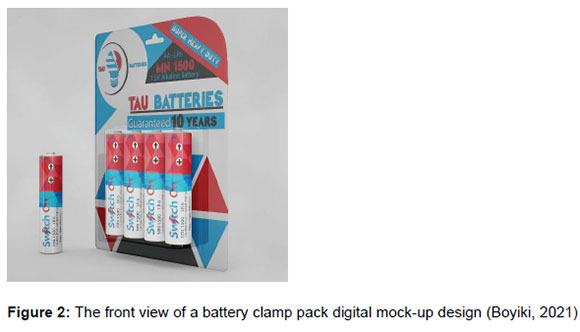
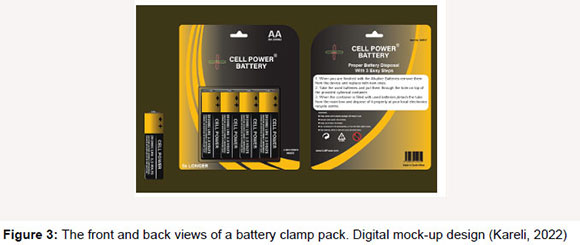
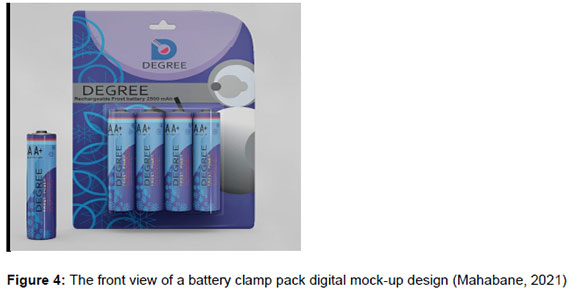
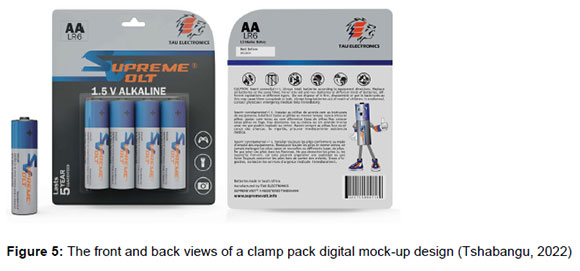
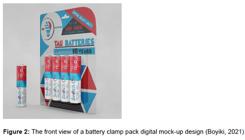
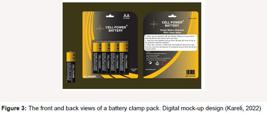
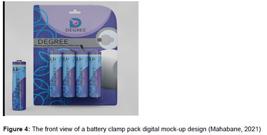
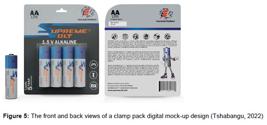
Project-based learning is a learner-centred pedagogy (Ryan et al., 2013). This learning process involves learners engaging in hands-on learning to provide a solution. However, the problem provided in the brief during the study was fictitious. The design solution process followed was the same as if the problem were real. The project span was over the ten-week study course, working on a series of designs as part of the entire project. Therefore, digital artefacts were produced based on students' responses to the brief through their interactions with digital tools (see Figures 2 to 5). Each student designed a set of batteries and a clamp pack (front and reverse sides), applying the lesson and demonstration by the primary researcher. These students' other design units include a point-of-sale display and a mascot to promote their new products. The findings show that the design students varnished their digital skills. Even though they encountered some challenges, they were able to overcome them. They are now more confident after making necessary adjustments, acquiring new digital skills, and constructing new design knowledge when working on the project:
Design Process
"What I have learned in the process of doing this assignment is the ability to design in a product-based mindset; it has improved my ability to work creatively within certain restrictions and the importance of doing extensive research about a product to present it in an informative manner" (Participant 7).
"Using a mock-up was one of the few skills that I enjoyed learning; when I first got introduced to it, I didn't know how to use my designs on it, but when my lecturer showed me how it's used it was like riding a bicycle you must fall a few times before you get your balance" (Participant 5).
"I have to sketch concepts and rough layout of my design before I can continue on Adobe Illustrator, and the other one is that I have to make my work unique from other existing works" (Participant 8).
"I never really have the best of ideas to start with. I started with a simple blank battery sketch, then started making some creative lines to get a few ideas running because the requirement was at least to have 3 different designs for approval, which is exactly what I did. I thought my designs would have somewhat of a relationship with each other, but all 3 were different from each other, so the simplest and less complex design was chosen for approval. This taught me always to keep my designs simple and less busy but ensure they are still aesthetically pleasing" (Participant 3).
Developed Digital Design Software Skills
"I learned to use Adobe Illustrator even more" (Participant 1). "The skills I have gained while doing this project is that product knowledge is key to understanding what the market is doing and how you can add value by creating attractive and appealing visuals" (Participant 7).
"The most learning that took place for me was an improvement in my software skills, specifically my ability to use Adobe Illustrator and Photoshop" (Participant 21).
"Adobe software is one of the main tools we use for our design projects, and I have found myself quite efficient with it. I had a tough time with Adobe Illustrator in the past, but I can see that I have made great progress while working on this project, and I am quite impressed with my improvement" (Participant 24).
"In this project, I picked up new skills I have not utilised. I managed to use Photoshop again, which I have not used in a while, and it has been challenging trying to master it again" (Participant 19).
THEME 3: HIGHLIGHT THE MISTAKES AND LESSONS LEARNED BY THE STUDENTS IN THEIR PRACTICES
Highlighting the mistakes and lessons learned provided the opportunity to identify what the students are still struggling with so that a more effective method that will align with the curriculum can be adapted to teach them. The method could be to scaffold students' tasks to keep them motivated and engaged (Ojo and Ntshoe, 2020). Alternatively, grouping the students to work collaboratively with students with diverse abilities could benefit other students struggling with design processes and time management skills (Ojo and Ntshoe, 2017).
Furthermore, it is evident that the students struggled and made various mistakes at the beginning. They became better as they practised and navigated their methods. However, common mistakes, such as not following instructions and omitting vital packaging elements, such as barcodes, warning signs, user instructions, and incorrect measurements, were prominent among the students' mistakes. Nonetheless, the student's strengths were identified in their submitted digital artefacts through the assessment rubrics. A similar pattern was identified in their comments under this structured theme.
Associated Challenges and Mistakes
Problems with Hardware
"I encountered a problem with Photoshop when I used 3D because my computer kept freezing, so I used Adobe Illustrator for the finished product. I was not thrilled about my outcome because it looked less realistic than expected" (Participant 19).
"While designing my batteries, I encountered different problems, like the computer freezing or locking up due to insufficient random-access memory, which caused me to start over again. I'll need to buy a new computer or a larger random-access memory for future purposes" (Participant 25).
"When I got the software on my laptop, it was still a challenge because my laptop started acting up because that software slowed up the laptop and doing such a project was a bit challenging, especially when the laptop is slow, and I had to make sure that I stay on track and submit on time. Therefore, I will advise my classmates to get a very good computer" (Participant 6).
"As a design student, I learned the importance of a portable storage system, like your hard drive, because we use digital formats all the time it is important to have it sorted somewhere, so you don't have to restart each time" (Participant 3).
Time Management
"From the mistakes I made, the big one being overestimating the time that I had, I ended up with a not-so-very pleasing design, and from that, I have learnt that time management is very important, and as soon as I get a brief for the assignment, I should start on it and not wait until the last minute just because I think that I can be able to make it" (Participant 4).
"My biggest mistake was my time management" (Participant 1).
"I believe I have gotten a bit faster in designing now that I am familiar with my tools. But this, as much as it is an advantage, it also disadvantaged me because after noticing that now I could work faster, I started procrastinating more, saying that I would do the work the next day instead of just doing it and finishing it on time, as a result, I encountered some troubles with my laptop on the last day of submission. This was my first and biggest mistake" (Participant 14).
"I made many mistakes due to rushing the project and just doing it for the sake of finishing the project to submit, but I can proudly say that I have learned from those mistakes and at the same time improved my designing skills" (Participant 25).
Errors, Omissions, or Mistakes
"The project presented many challenges for me, as it was still within my skill to accomplish or execute as close as possible to the brief's requirements. There are significant creative gaps in my work due to my limited experience with the software, which I am working harder on and can tell there are improvements in my approach and skill, having attempted to design a product from scratch" (Participant 22).
"I made errors by picking colours that don't match well in an attempt to stand out and when looking at how the industry uses a limited range of colours making products like these" (Participant 5).
"The second mistake I made was not researching enough how important colour is to one's design" (Participant 5).
"The mistake I made was with the design of the clamp pack back view. My design did not have a barcode or warnings. As a result, it looks incomplete and meaningless because all the products in the store have barcodes to scan from" (Participant 10).
"I have made many mistakes because of the challenges I have faced. Accurate measurements are the most critical issue that I went through a lot. All the measurements for my batteries were incorrect, and I realised it late. What I have learned the most is that time management is important" (Participant 8).
"My mistake was not adding the back part of the Clam-Pack. The part contains all the information on how to use the products and all the other information about the battery, like where it was manufactured and if it is recyclable. Now, it makes the battery and clam-pack feel unfinished. I also did not use photoshop. I believe that had I used that program, it would have come out even better than I had envisioned because I was going to use smart objects, making for more realistic designs" (Participant 8).
"I didn't do some steps in time, which hindered my ability to bring my ideas to life effectively" (Participant 1).
The intervention allowed the student to learn quickly and apply the skills spontaneously. The extract from students' words that follows shows the lesson learned and preparation to apply the lessons in their subsequent projects.
Lesson Learned
"A major lesson I learned from this is that I should trust the process and believe that the outcome will be good because at the start of my design, I felt as though it was not enough and I needed to do more, but when everything came together, I realized that I was going down the right direction. I should believe in my abilities more" (Participant 22).
"I would get the dimensions for my design right on the first go so I could focus all my attention on the design without any underlying uncertainty. I would ask questions more because I believed that some things, I did not understand were for me to figure out on my own. I would also give myself time to do thorough research and planning before giving anything to my lecturer for final approval" (Participant 9).
"If you are struggling, don't be afraid to seek help and try to read your brief clearly and understand it" (Participant 18).
"I learned a lot from my mistakes because I would say time management is something I normally struggle with, and because of that, I'm planning to work differently on my other upcoming assignments and try to keep up" (Participant 25).
"I Will keep practising and ask for advice from my lecturer and experienced designers, and also to check on how they create their works, the skills they applied to their works so that I can have an idea of how some things are designed" (Participant 15).
"I have learned how to extrude 2d to 3d. I used to hate creating three-dimensional" (Participant 10).
Some of the fundamental design requirements are the functional attributes that enable designers to convert ideas into design features (Pfeifer, 2009). Therefore, tools and materials intended to perform specific functional features in any design artefact are non-negotiable in achieving those design goals. Consequently, appropriate tools, materials, and equipment matter and could enhance the quality of the artefact and promote deep learning in design practice. The lack of these devices was problematic for many of these students. It was evident that some students grappled with their gadgets' non-performance, and others did not have appropriate functional gadgets to save their big-file work, influencing the quality and delivery time of the projects.
THEME 4: WHAT WOULD BE DONE DIFFERENTLY TO IMPROVE SUBSEQUENT DESIGN PERFORMANCE?
The responses indicated that there were gaps in the digital tools' knowledge and that confidence was low. Product knowledge and creative knowledge before the commencement of the project were insufficient. To an extent, these gaps were bridged judging by the quality of the artefacts produced. However, there is a difference between the quality (memory) of the digital devices and the storage resources like hard drives with which the students worked. Therefore, providing all the students with the high-spec computers combined with opportunities to learn and practice digitally could produce better results.
Further Action Towards Future Design Accomplishment
"If I were to do this assignment again, I would add more creativity and quality planning, as well as give myself more time to complete it so that I could explore more creativity to achieve the desired result" (Participant 4).
"I'll suggest that future students do as much research as possible to get the idea behind the battery package and understand the whole process of marketing strategies to gain creative ways to design their package to draw attention to consumers" (Participant 1).
"I should've started my project on time because in the end, I was late, and I couldn't achieve some things" (Participant 25).
"Always do your projects on time because time is valuable, learn from your mistakes, never give up and if you don't know something, just ask anybody who knows, like the lecture or a fellow student" (Participant 7).
"If I could do the assignment again, I would spend more time researching before starting with the creative part. I would also provide alternatives to the packaging or a wider range of alternative packaging" (Participant 20).
"What I'll do differently is communicate more with my lecturers and my seniors. I've seen how much easier it is to get a clear perspective when a third party is there to help you" (Participant 13).
"What I will keep on doing is start my work earlier, so I won't be under so much pressure and stress and end up not completing my assignments on time because this is also helping train us for work to be able to submit everything on time" (Participant 8).
"This course requires patience and time, so I need to put in as much time as possible and learn to balance all my modules and social life to be equipped for the future. I also must invest in my design tools each month" (Participant 11).
"I hope that for future reference, I'll be able to work more efficiently and spend more time on my work. Also practising a new set of skills with my software and challenged myself to do better. I also acknowledged how important communicating efficiently is for this course, so I must improve my vocabulary and comprehension" (Participant 2).
This studio-based subject's complete digital facilitation process provided the students with significant online resources and assistance. The primary researcher facilitation process also effectively improved the use of digital design tools through online assistance and interaction during online demonstrations. Tutorial videos were provided when and where necessary. However, the students still need to map out time to access the resources and practice to acquaint themselves with the necessary digital skills.
CONCLUSION
Digital studio intervention temporarily replaced the traditional physical "wet" laboratory or comfort studio facilitation areas due to the COVID-19 pandemic lockdown restrictions. This intervention helped students complete their spatial design curriculum successfully and uninterruptedly as planned. Similarly, the studio virtual learning approach helped students engage with their learning in more profound, adaptable, and circumstance-dependent ways without visiting the university's traditional "wet" laboratory.
Moreover, the students gained new digital-based skills, such as managing large design files for storage and online sharing. Also, their brand knowledge and creative thinking were improved. Furthermore, online-based assessment of design work with rubric via Blackboard orchestrated a paperless advantage compared to the physical studio process.
The use of Activity Theory consists of Subjects, Objects, Tools, Rules, Community, and Division of Labour. The theory assisted in designing the series of digital design activities, and providing constant feedback via multiple digital platforms improved design productivity. However, design students (the subjects) interacted differently in a digital platform environment to a physical studio. It was difficult to interpret their body language and emotions when their videos were turned off during activities. These design activities made the students active learners throughout the project execution and were able to meet the goal and objective of the learning (Object). However, It is important to emphasise that using digital devices (Tools) for school projects is more beneficial than installing various games and social media apps, which can negatively affect the performances of the digital tools. Additionally, as a design student, investing in external hard drives for storage purposes can also be more advantageous than relying solely on the device's internal storage.
Therefore, the digital process lowered or removed students' expenses of buying physical studio materials to complete their tasks. The design project delivery was faster and better than physical prototypes after the students had mastered the digital studio process (Division of Labour). The students attested that the task was challenging and appeared impossible initially, but the end was a fulfilling experience.
This article concludes that the lack of physical tools, art materials, and access to physical studio spaces should not hinder students' accomplishments during the COVID-19 pandemic lockdown restrictions. Moreover, progress monitoring using multiple platforms (Rules) such as email, Discord App and WhatsApp to share drawings and text messages with their lecturers complemented their online practice achievement.
Timely feedback by facilitators fosters a deep approach to learning. This online approach allowed the primary researcher and students (Community) to function well without access to their traditional learning space.
Drawing on an extensive range of ethnographic research literature (Angrosino, 2011, 2014; Jones and Smith, 2017), this study successfully categorised, analysed, and discussed the data gathered. Through careful examination, the researchers identified distinct categories and themes within the data, thereby reinforcing the validity of the study's findings. The data confirmed that the Communication Design programme's alternative digital studio teaching strategies, implemented during COVID-19 pandemic lockdowns, effectively facilitated the uninterrupted acquisition of spatial design knowledge.
This study acknowledged several significant challenges faced by many students globally and especially in African Universities during the disruption of COVID-19. Challenges such as access to technology, economic strain, mental health issues due to isolation, limited support services, delayed graduations, and, in particular, adjustment to new learning environments, among many others, affected students' academic performance (Aristovnik, et al. 2020; Daraku and Hoxha 2020; du Preez and le Grange 2020; López, et al. 2022). However, the response of higher education institutions in South Africa to technological access during the COVID-19 disruption time influenced educational initiatives like this digital studio approach.
To conclude, working via a digital studio can be achieved successfully despite that some students encountered problems with hardware and could not actualise their tasks fully and timeously. Nonetheless, the connection with conventional art and design materials and some technical knowledge dwindled during the pandemic, and the digital studio should not fully replace the traditional "wet" laboratory.
RECOMMENDATIONOnline teaching and learning cannot replace face-to-face studio-based learning completely. However, for studio-based modules, this study recommends that "digital mock-up making" remains part of the period-of-disruption facilitation modules to facilitate the continuity of teaching and learning. However, for digital studio learning to be effectively implemented, students must have access to technology, constant internet connectivity, a steady power supply, and high-performance computers.
Moreover, integrating digital mock-up making into regular curricula will provide flexibility and accessibility; various tools and resources can be accessed to integrate multimedia, and collaboration among the students and their lecturers will be easier. Also, cloud storage of their files and digital portfolio development that could easily be shared with potential clients and employers could sustainably mitigate their lack of storage facilities.
Although this intervention was only applied in the communication design module, implementation is recommended in other art and design-related courses such as Fashion Design, Jewellery Design, and Digital Sculpting.
Digital mock-up making could be an alternative pedagogy during disruptions caused by pandemics, natural disasters, and prolonged student impasses. Moreover, the lack of funds for printing finished projects and purchasing materials for various 2D or 3D projects that students occasionally complain about will be mitigated during the post-pandemic lockdown era.
REFERENCES
- Angrosino, M. 2011 Doing ethnography and observational research. Edited by U. Flick. London: Sage. doi: 10.4135/9781849208932.
- Angrosino, M. 2014. Doing Ethnographic and Observational Research Introduction : ethnography and participant observation. London: Sage.
-
Aristeidou, M. and S. Cross. 2021. "Disrupted distance learning: the impact of Covid-19 on study habits of distance learning university students", Open Learning, 36(3), pp. 263-282. doi: 10.1080/02680513.2021.1973400.
» https://doi.org/10.1080/02680513.2021.1973400 -
Aristovnik, A. et al. 2020. "Impacts of the COVID-19 pandemic on life of higher education students: A global perspective", Sustainability (Switzerland), 12(20), pp. 1-34. doi: 10.3390/su12208438.
» https://doi.org/10.3390/su12208438 - Boyiki, S. 2021. Batteries and clamp pack design. Bloemfontein: Central University of Technology, p. 1.
-
Brine, J. and M. Franken. 2006. "Students' perceptions of a selected aspect of a computer mediated academic writing program: An Activity Theory analysis", Australasian Journal of Educational Technology, 22(1). doi: 10.14742/ajet.1305.
» https://doi.org/10.14742/ajet.1305 -
Czerniewicz, L. et al. 2020. "A Wake-Up Call: Equity, Inequality and Covid-19 Emergency Remote Teaching and Learning", Postdigital Science and Education, 2(3), pp. 946-967. doi: 10.1007/s42438-020-00187-4.
» https://doi.org/10.1007/s42438-020-00187-4 -
Daraku, Z. H. and L. Hoxha. 2020. "The impact of COVID-19 on education and on the well being of teachers, parents, and students: Challenges related to remote (online) learning and opportunities for advancing the quality of education", in. Available at: https://www.researchgate.net/publication/341297812_The_impact_of_COVID-19_on_education_and_on_the_well-being_of_teachers_parents_and_students_Challenges_related_to_remote_online_leaming_and_opportunities_for_advancing_the_quality_of_education.
» https://www.researchgate.net/publication/341297812_The_impact_of_COVID-19_on_education_and_on_the_well-being_of_teachers_parents_and_students_Challenges_related_to_remote_online_leaming_and_opportunities_for_advancing_the_quality_of_education -
Dreyfus, T. 2018. "Learning Through Activity - Basic research on mathematical cognition", The Journal of Mathematical Behavior, 52, pp. 216-223. doi: 10.1016/j.jmathb.2018.04.001.
» https://doi.org/10.1016/j.jmathb.2018.04.001 - Ellis, C. 2004. The ethnographic I: A methodological novel about autoethnography. Walnut Creek, CA: AltaMira Press.
-
Engeström, Y. 1987. Learning by Expanding: An Activity-theoretical Approach to Developmental Research. Helsinki, Finland: Orienta-Konsultit. Available at: http://lchc.ucsd.edu/mca/Paper/Engestrom/Learning-by-Expanding.pdf.
» http://lchc.ucsd.edu/mca/Paper/Engestrom/Learning-by-Expanding.pdf - Gallanis, T. 2020. "An introduction to design thinking and an application to the challenges of frail, older adults", in Leveraging Data Science for Global Health. Cambridge, MA 02139, USA e-mail: Springer International Publishing, pp. 17-33. doi: 10.1007/978-3-030-47994-7.
- le Grange, L. 2010. "Chapter 5 South African Curriculum Studies: A Historical Perspective and Autobiographical Account", in Pinar, W. F. (ed.) Curriculum Studies in South Africa Intellectual Histories and Present Circumstances. New York: Palgrave Macmillan, p. 256. doi: https://doi.org/10.1057/9780230105508.
-
le Grange, L. and K. Ontong. 2018."Towards an Integrated School Geography Curriculum: The Role of Place-based Education", Alternation: Interdisciplinary Journal for the Study of the Arts and Humanities in Southern Africa, SP(21), pp. 12-36. doi: 10.29086/2519-5476/2018/sp21a2.
» https://doi.org/10.29086/2519-5476/2018/sp21a2 -
Hodges, C. S. et al. 2020. "The Difference Between Emergency Remote Teaching and Online Learning", Educause review, 3. Available at: https://er.educause.edu/articles/2020/3/the-difference-between-emergency-remote-teaching-and-online-learning.
» https://er.educause.edu/articles/2020/3/the-difference-between-emergency-remote-teaching-and-online-learning -
Janczak, D. 2018. "Blended learning in Primary School - Looking for a new school formula", in Agnieszka Palalas, H. N. and P. P. (Eds. . (ed.) Blended learning in primary school - Looking for a new school formula. Proceedings of the 3rd World Conference on Blended Learning. Greece: International Association for Blended Learning. Available at: https://www.academia.edu/36497585/A_Proposed_Blended_Educational_Framework_for_Administration_of_Enterprises_in_Nowadays_Greek_Financial_Crisis.
» https://www.academia.edu/36497585/A_Proposed_Blended_Educational_Framework_for_Administration_of_Enterprises_in_Nowadays_Greek_Financial_Crisis -
Jones, J. and J. Smith. 2017. "Ethnography: challenges and opportunities", Evid Based Nurs, 20(4), pp. 98-100. doi: 10.1136/eb-2017-102786.
» https://doi.org/10.1136/eb-2017-102786 - Kareli, T. P. 2022. Batteries and clamp pack design. Bloemfontein: Central University of Technology, p. 1.
-
Kivunja, C. and A. B. Kuyini. 2017. "Understanding and Applying Research Paradigms in Educational Contexts", International Journal of Higher Education, 6(5), p. 26. doi: 10.5430/ijhe.v6n5p26.
» https://doi.org/10.5430/ijhe.v6n5p26 -
Kopp, M., O. Groblinger, and S. Adams. 2019. "Five Common Assumptions That Prevent Digital Transformation At Higher Education Institutions", INTED2019 Proceedings, 1(March), pp. 14481457. doi: 10.21125/inted.2019.0445.
» https://doi.org/10.21125/inted.2019.0445 -
Kwong, C.-Y. C. and D. Churchill. 2023. "Applying the Activity Theory framework to analyse the use of ePortfolios in an International Baccalaureate Middle Years Programme Sciences classroom: A longitudinal multiple-case study", Computers & Education, 200, p. 104792. doi: 10.1016/j .compedu.2023.104792.
» https://doi.org/10.1016/j .compedu.2023.104792 - Leedy, P. D. and J. E. Ormrod. 2015. Practical research planning and design. 11th edn. England: Pearson Education Limited.
-
Leszczynski, P. et al. 2018. "Multimedia and interactivity in distance learning of resuscitation guidelines: a randomised controlled trial", Interactive Learning Environments, 26(2), pp. 151162. doi: 10.1080/10494820.2017.1337035.
» https://doi.org/10.1080/10494820.2017.1337035 -
Loc, N. P. et al. 2022. "Activity theory as a framework for teaching mathematics: An experimental study", Heliyon, 8(10), p. e10789. doi: 10.1016/j.heliyon.2022.e10789.
» https://doi.org/10.1016/j.heliyon.2022.e10789 -
López, L. V. et al. 2022. "The Impacts of COVID-19 on Technological and Polytechnic University Students in Mexico", Sustainability (Switzerland), 14(10), pp. 1-27. doi: 10.3390/su14106087.
» https://doi.org/10.3390/su14106087 - Mahabane, K. 2021. Batteries and clamp pack design. Bloemfontein: Central University of Technology, p. 1.
- Makura, A. H. 2022. South African female academics' work from home experiences during the COVID-19 pandemic: Challenges and opportunities. Journal of Culture and Values in Education, 5(1), 1322.
-
Marope, M., P. Griffin, and C. Gallagher. 2017. "Future competences and the future of curriculum", International Bureau of Education, pp. 1-60. Available at: http://www.ibe.unesco.org/sites/default/files/resources/future_competences_and_the_future_of_curriculumexecsummary.pdf.
» http://www.ibe.unesco.org/sites/default/files/resources/future_competences_and_the_future_of_curriculumexecsummary.pdf -
Meeran, S. and M. N. Davids. 2022. "COVID-19 catalysing assessment transformation: A case of the online open book examination", South African Journal of Higher Education, 36(3), pp. 109-122. doi: 10.20853/36-3-4732.
» https://doi.org/10.20853/36-3-4732 - Ojo, O. A. and Ntshoe, I. 2020. "Using instructional scaffolding to improve teaching and learning in visual communication design education.", Journal of Educational Studies, 19(2), pp. 136-156.
-
Ojo, O. A. and Ntshoe, I. M. 2017. "Efficacy of Collaborative in Improving Learning", South African Journal of Higher Education, 31(3), pp. 172-192. Available at: http://www.joumals.ac.za/index.php/sajhe/article/viewFile/844/1515.
» http://www.joumals.ac.za/index.php/sajhe/article/viewFile/844/1515 -
Patrick, S., K. Kennedy, and A. Powell. 2013. "Mean What You Say: Defining and Integrating Personalized, Blended and Competency Education President and Chief Executive Officer, iNACOL", International Association for K-12 Online Learning. Available at: http://www.inacol.org/.
» http://www.inacol.org/ - Patton, M. Q. 2015. Qualitative reasearch and evaluation methods: Integrating theory and practice. 4th edn. California: Thousand Oaks: Sage Publications.
-
Petrucco, C. and C. Ferranti. 2018. "Activity Theory As Design Tool for Educational Projects and Digital Artifacts", in, pp. 488-294. Available at: https://doi.org/10.38069/edenconf-2018-ac-0063.
» https://doi.org/10.38069/edenconf-2018-ac-0063 - Pfeifer, M. 2009. "Design Requirements", in Materials Enabled Designs. Butterworth: Heinemann, pp. 23-50. doi: 10.1016/b978-0-7506-8287-9.00002-1.
- Pinar, W. F. 2019. What is curriculum theory.pdf. 3rd edn. New York: Routledge.
-
Plattner, H., C. Meinel, and L. Leifer. 2011. Design thinking. Berlin: Springer. Available at: https://doi.org/10.1007/978-3-642-13757-0.
» https://doi.org/10.1007/978-3-642-13757-0 -
du Preez, P. and le Grange, L. 2020. "The COVID-19 Pandemic, Online Teaching/Learning, the Digital Divide, and Epistemological Access", Alternation African Scholarship Book Series (AASBS): Rethinking the Humanities Curriculum in the Time of COVID, 1(December), pp. 90-106. Available at: http://altemation.ukzn.ac.za/Files/books/series-01/01/06-Du-Preez.pdf%0Ahttps://doi.org/10.29086/978-0-9869936-1-9/2020/AASBS01.
» http://altemation.ukzn.ac.za/Files/books/series-01/01/06-Du-Preez.pdf%0Ahttps://doi.org/10.29086/978-0-9869936-1-9/2020/AASBS01 - Ramrathan, L. et al. 2020. Re-thinking the Humanities Curriculum in the Time of COVID-19. Durban: CSSALL. doi: 10.29086/978-0-9869936-1-9/2020/AASBS01.
- Ritchie, J. et al. 2014. Qualitative Research Practice: A Guide for Social Science Students and Researchers. 2nd edn. London: Sage.
- Ryan, B. et al. 2013. The virtual University: The internet and resource-based learning. 1st edn. London: Routledge.
-
SAQA 2015, South African Qualifications Authority registered qualification that has passed the end date. Available at: https://allqs.saqa.org.za/showQualification.php?id=78636 (Accessed: 22 December 2022).
» https://allqs.saqa.org.za/showQualification.php?id=78636 - Scanlon, E. and K. Issroff. 2002. "Using technology in higher education: An Activity Theory perspective", Journal of Computer Assisted Learning, 18(1), pp. 77-83.
- Soudien, C. 2020. "Systemic shock: How Covid-19 exposes our learning challenges in education", Southern African Review of Education, 26(1), pp. 6-19.
-
Staker, H. and Horn, M. B. 2012. "Classifying K-12 Blended Learning", Innosight Institute, (May), p. 22. Available at: http://eric.ed.gov/?id=ED535180%5Cnhttp://files.eric.ed.gov/fulltext/ED535180.pdf.
» http://eric.ed.gov/?id=ED535180%5Cnhttp://files.eric.ed.gov/fulltext/ED535180.pdf -
Stark, R. 2022. "Major technology 6: Digital mock-up-DMU.", in Virtual product creation in industry. Berlin, Heidelberg: Springer, pp. 2003-2005. Available at: https://doi.org/10.1007/978-3-662-64301-3_12.
» https://doi.org/10.1007/978-3-662-64301-3_12 - Tshabangu L. M. 2022. Batteries and clamp pack design. Bloemfontein: Central University of Technology, p. 1.