Study behaviours contributing to performance in each of the modules of postgraduate accountancy studies
Abstract
As prior studies only considered the Certificate of Theory in Accounting (CTA) as a whole, it is uncertain whether the study behaviours associated with performance differ for each module in the CTA (Financial Accounting, Management Accounting, Taxation and Auditing). Therefore, this study's primary objective was to identify study behaviours that could be employed in each module in the CTA programme to enhance performance. Secondary objectives included identifying changes in study behaviours from undergraduate to postgraduate and the effect of online (versus in-person) classes. A student questionnaire, including closed-ended and open-ended questions, was employed to gather data on students' study behaviours, marks and perceptions. A regression analysis revealed that consistently studying Auditing and working in a study group for other modules showed a positive association with CTA performance. Moreover, making mind maps for Financial Accounting and Taxation to gain a holistic view of entire topics aided performance. Thematic analysis of qualitative data showed that practising questions was crucial for all modules. For Financial Accounting and Management Accounting, respondents found it beneficial to understand the principles, while learning the theory was recommended for Taxation and Auditing. Changes in study behaviours from undergraduate to postgraduate included better use of open-book materials. Attending classes in-person (compared to online) was viewed as more beneficial for CTA students. This study identified specific study behaviours on a per-module basis, which can be shared with students to help them improve their performance in CTA. Moreover, it showed that the characteristics of student cohorts change over time and that millennials might value working in study groups more than their predecessors.
Study behaviours; student success; accounting; postgraduate studies; student experiences
INTRODUCTION
A Certificate of Theory in Accounting (CTA) is a prerequisite for South African accountancy students to write the Initial Assessment of Competence1 (board examination) of the South African Institute of Chartered Accountants (SAICA) and to become chartered accountants (CAs). A CTA is well-known to be more challenging than undergraduate studies due to increased workload, integration between modules and emphasis on critical thinking; as a result, a low throughput rate is generally observed (Fouché 2017), and many CTA students find it challenging to complete this programme within the prescribed one-year period (Steenkamp 2012). Upon starting their postgraduate studies, many students enquire whether the study behaviours they employed at the undergraduate level will be equally effective in CTA. According to Fouché (2017), more should be done to support CTA students in developing efficient study behaviours. Previous research on CTA success and study behaviours (Fouché 2017; Steenkamp 2012) did not consider the cumulative effect of various study behaviours on student success on a per-module basis and did not investigate whether changes to study behaviours are needed when transitioning from undergraduate to postgraduate level. Interactions with students have prompted the following research question: which study behaviours should students employ in each module to improve their chances of completing CTA?
Due to COVID-19, educational institutions had to shift to online learning (Dhawan 2020) quickly. As a result, many CTA students were exposed to a blended-learning approach at the time of the study, providing them with the option of online- or traditional in-person class attendance. Previous research which examined the study behaviours that contribute to CTA success (Fouché 2017; Steenkamp 2012) did not consider the influence of online learning. The current study aimed to fill this gap by explicitly focussing on aspects related to online versus in-person learning and gaining an understanding of postgraduate students' preferences.
To answer the research question of the study, the following research objectives were formulated:
Identify the most advantageous study behaviours for each module in CTA.
Per module, identify behavioural changes from an undergraduate to a postgraduate level associated with success in CTA.
Gather students' perceptions on the value of online versus in-person classes during their CTA year.
The study's contribution is that it identified study behaviours per module, which will assist CTA students in completing their qualification, thereby increasing the CTA throughput rate. The results of this study can also better prepare lecturers and other student advisers to offer more pertinent and valuable advice and guidance to CTA students regarding their study behaviours.
Study behaviours are those behaviours used when learning academic material or preparing for assessments (Ayodele and Adebiyi 2013; Credé and Kuncel 2008). Anthony (2013), Fouché (2017) and Steenkamp (2012) researched the study behaviours that contribute to the success of postgraduate accountancy students but did not focus on the cumulative effect of various study behaviours on the different modules in the programme. Other relevant studies focused on success factors for the ITC or limited the scope of their research to the Auditing postgraduate module (Crous and Goodchild 2021; Dehrmann 2013). Thus, limited research investigates the study behaviours that lead to success in each of the modules in the CTA programme.
Steenkamp (2012) found that working throughout the year rather than cramming before a assessment, using good examination techniques, and practising questions under time pressure positively impacted students' marks. Similarly, Fouché (2017) found that doing homework, participating in class, managing time, being focused and having developed a strong work ethic at the undergraduate level showed a significant positive correlation with the accountancy students' performance in postgraduate studies. These study behaviours were determined regarding the CTA programme as a whole, whereas the current study will investigate each module's preferred study behaviour separately.
Fouché's (2017) focus was on study behaviours and time management, as time constraints are one of the biggest concerns of university students (Britton and Tesser 1991). In any learning environment, bad time management is the most evident factor contributing to failure (De Jager 2014). Fouché (2017) found that many students felt they did not procrastinate, yet they spent a significant portion of their day interacting on their cell phones, and few planned their day (Fouché 2017). Other study behaviours found to have a negative correlation with postgraduate performance were not doing homework or not participating in class (Fouché 2017). Steenkamp (2012) also found that attendance of voluntary additional help classes was negatively correlated with the students' performance. This was probably because the students who attended help classes were already struggling academically (rather than the effectiveness of the classes), as proven by the fact that the attendance of help classes was positively correlated with the decrease in marks from undergraduate to postgraduate level (Steenkamp 2012).
Dehrmann (2013) researched the predictors of success in SAICA's ITC, focusing on cognitive and personality traits and study behaviours. The study behaviours were investigated in conjunction with personality traits to determine their effect on CTA academic success, but no correlation was found (Dehrmann 2013). Only third-year accounting results were identified to predict success in CTA. Certain personality traits, such as agreeableness and dutifulness, influenced ITC results, not CTA results (Dehrmann 2013).
Crous and Goodchild (2021) researched the predictors of success in the postgraduate Auditing module by correlating the students' undergraduate marks in the respective four core modules (Financial Accounting, Management Accounting, Taxation and Auditing) with their postgraduate mark in Auditing. It was found that good marks in Financial Accounting (second and third-year modules) and Management Accounting (third-year module) were predictors of success in postgraduate Auditing. Fouché (2017) also found that students who worked hard at the undergraduate level performed well during postgraduate studies. The current study will not examine the correlation between performance in undergraduate modules and postgraduate marks (as this correlation is assumed based on prior studies) but instead employ a regression analysis to control for undergraduate marks and then identify, for each module, which study behaviours contribute to CTA success if undergraduate marks are held constant (ceteris paribus). Furthermore, the current study will enquire whether students changed their study behaviours from undergraduate to postgraduate level, and if so, which changes were made. This will provide valuable insight into the effectiveness of certain study behaviours at the postgraduate level.
The current study further expanded previous research by investigating the impact of online learning on academic performance in CTA. This is relevant as universities were forced to switch to emergency online learning due to the COVID-19 pandemic. At the time of this study, a blended learning approach was followed, whereby CTA students could attend all classes in person or stream the class online. The current study hopes to identify which learning environment is most beneficial for CTA students, as previous research on the effects of online learning on performance had varying findings. Smit and Rossouw (2018) found improved performance when attending online live-streamed classes compared to physically attending classes. In contrast, Spencer and Temple (2021) found students performed better and preferred the traditional in-person format. Ali, Narayan and Sharma (2020) found that a critical challenge in the online learning environment is lower levels of student engagement, especially for those without proper computer equipment, connectivity issues, family responsibilities, etc. Liu and Zainuddin (2020) researched the variables affecting the acceptance shown by accountancy students towards blended learning and found perceived value as the most influential. Furthermore, it was found that postgraduate students accepted the blended learning approach more than undergraduate students (Liu and Zainuddin 2020). Brink (2025) and Mistry, Megally and Aly Rashed (2024) found that accounting students' preferences regarding in-person teaching and streaming lectures online differed. The current study will further understand postgraduate students' preferences by enquiring why online or in-person lecturers were deemed more advantageous.
METHOD
An empirical research methodology using a self-designed questionnaire was used to gather pertinent data. A questionnaire was selected for this study due to its reliability and efficiency in collecting information from numerous respondents quickly and effectively (Kuphanga 2024; O'Cathain and Thomas 2004). Quantitative and qualitative data were collected to obtain comprehensive data for the study. Therefore, the questionnaire (Appendix A) included closed-ended and open-ended questions and gathered student perceptions on study behaviours, self-reported marks in undergraduate and CTA studies, changes made to study behaviours from undergraduate to postgraduate and perceptions relating to the mode of class attendance.
Respondents selected for participation
Stellenbosch University was selected as a single case (Given 2008). Here, both the Bachelor of Accounting Honours (BAccHons) and the Postgraduate Diploma in Accounting (PGDA) qualify as a CTA. In 2022, all students registered for BAccHons and PGDA (a total of 369 students) were purposively selected2 and invited to participate. Selecting students who had recently experienced the phenomenon under study resulted in an information-rich sample from which valuable insights could be gained (Creswell and Guetterman 2019; Merriam and Tisdell 2016). Institutional permission was obtained from the university, and informed consent was obtained from the 40 students who agreed to participate in the study (Project number 25276).
Data collection and analysis
After a thorough analysis of Steenkamp's (2012) and Fouché's (2017) research, as referenced above, the questions were designed to be practical for students and address the research objectives of the study. The study behaviours included in the closed-ended section of the questionnaire were identified from Steenkamp's (2012) study updated based on the study behaviours in the Learning and Study Strategies Inventory (LASSI 2022) scale, but on a per module basis, as it was expected that the most effective study method for each module would differ (Dehrmann 2013).
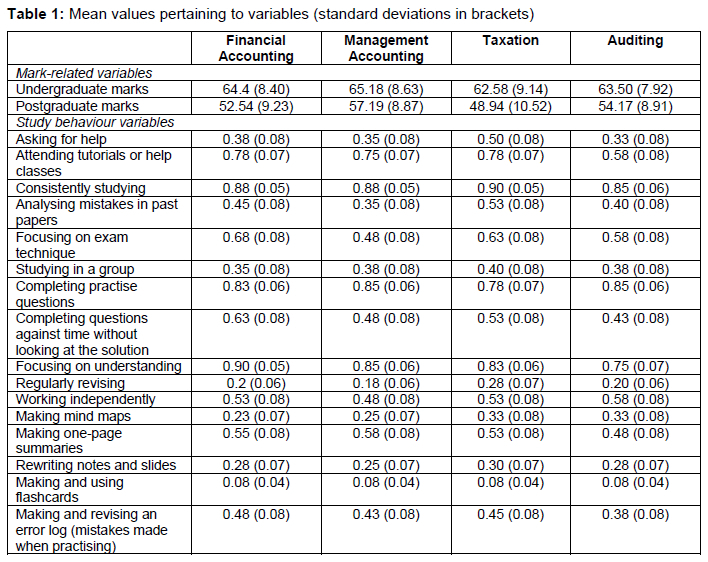
To address the first research objective, namely, to identify the most advantageous study behaviours for each module in CTA, all quantitative data obtained from the closed-ended questions (these related to the marks and study behaviours of respondents) were evaluated using descriptive statistics and regression analyses. The regression analyses were done to identify, on a per module basis, those study behaviours associated with CTA success (using per module postgraduate marks as the dependent variable) while controlling for existing academic strength (by including undergraduate marks as an independent variable). All variables related to respondents' study behaviour were included as independent variables of interest (see Table 1 for the variables collected).
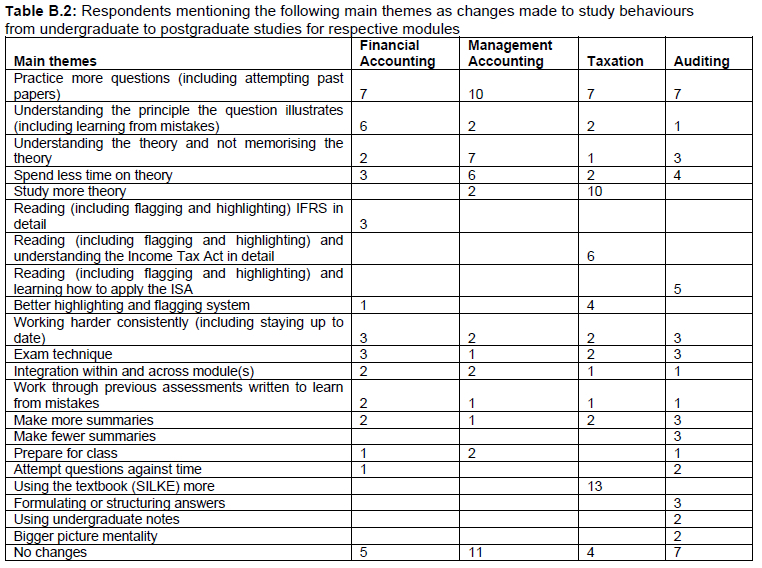
For all research objectives (i.e. to supplement the quantitative data employed to answer research objective 1 and to answer research objectives 2 and 3), thematic analysis was used to analyse the qualitative data obtained from the open-ended questions. This enabled the researchers to recognise themes, codes, and regularities indicated by the respondents regarding the most advantageous study behaviours, changes in their study behaviours and the mode of class attendance. The researchers engaged in coding the data, with codes and themes emerging from the respondents' insights and experiences, following an inductive approach. The data obtained from the first two open-ended questions (refer to Appendix A for survey questions) were analysed by identifying themes across the data set. An advantageous study behaviour (question 1) or a change to study behaviour (question 2) qualified as a theme if more than one respondent mentioned the same theme. For the detailed analysis, refer to Appendix B.
RESULTS AND FINDINGS
This section addresses the research objectives in order. First, the most advantageous study behaviours were identified per module, using both quantitative and qualitative data. Then, qualitative data were employed to determine crucial changes in study behaviours from undergraduate to postgraduate studies and the effect of online versus in-person class attendance.
Most advantageous study behaviours for each module in CTA
This section begins with a statistical analysis of the quantitative data, followed by a thematic analysis of the qualitative data. It concludes with a comparison of the results and findings, emphasising how the quantitative results align with or differ from the qualitative findings. Respondents were asked to indicate, per module, their undergraduate and postgraduate marks and the study behaviours they employed during their CTA year. When a specific study behaviour was used, this was indicated as a "1", while a "0" was indicated when it was not used. Table 1 shows the mean values and standard deviations of the variables separately for each module.
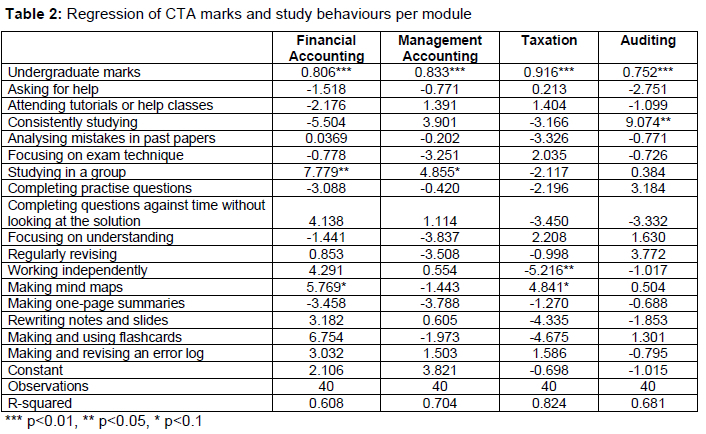
The average postgraduate mark reported by respondents for all modules was above 50 per cent, except for Taxation, which was almost 49 per cent. When comparing the respondents' marks to the overall year group, the respondent group was slightly above average in terms of their progress marks. Most of the study behaviours were relatively constant between modules. However, some differences were noted between modules. Given the lower Taxation marks, it is unsurprising that students were more prone to ask for help with Taxation than the other modules. Students were less likely to attend the tutorials or help classes for Auditing, which indicates they spent less time and effort on this module than others throughout the term. Anthony (2013) also found that students were more inclined to employ a surface learning approach for Auditing than other subjects. Between 35 per cent and 40 per cent of the students stated that they studied in a group, which shows a sharp increase from the 16 per cent reported by Steenkamp (2012). Given that the present study was conducted more than a decade later, it might be that the student characteristics and preferences have changed. Table 2 shows the results from the regression analysis executed to ascertain which study behaviours were associated with increased CTA performance per module while controlling for undergraduate marks.
As expected, respondents' undergraduate marks were positively related to their postgraduate marks (Fouché 2017; Steenkamp 2012). It was, therefore, crucial to include undergraduate marks as a control when identifying advantageous study behaviours, as was done in the regression in Table 2. Consistently studying Auditing had a significant positive association with performance. CTA students often neglect Auditing or "cram" before an assessment. Fouché (2017) also reported that, of all CTA modules, students spent the least time on Auditing, while Barac et al (2016) found that postgraduate students tended to employ a surface learning approach in Auditing. Although Auditing is a practical (application) discipline, students may view it as primarily a theoretical module at the university level (De Villiers and Fouché, 2015) and allocate less study time. Although fewer respondents consistently spent time on Auditing throughout the year, consistent study (as could be expected for any module) was found to be a highly beneficial study behaviour - considering the significantly higher Auditing marks obtained when engaged in this practice.
Respondents' Financial Accounting and Management Accounting marks were positively associated with working in a study group. Moreover, working independently had a negative association with the Taxation marks obtained, indicating that students find the support and help of peers valuable when studying Taxation. The fact that collaborative learning aided academic performance contrasts with Steenkamp's (2012) findings. It might be that, in the decade since Steenkamp's (2012) study, the characteristics of the student cohort have changed, and millennials find collaborative learning more valuable (Karakas, Manisaligil and Sarigollu 2015). Students who make mind maps for Financial Accounting and Taxation reported higher marks. Given these disciplines' detailed and often rule-based nature, students must gain a holistic view of entire topics to do well in integrated assessments.
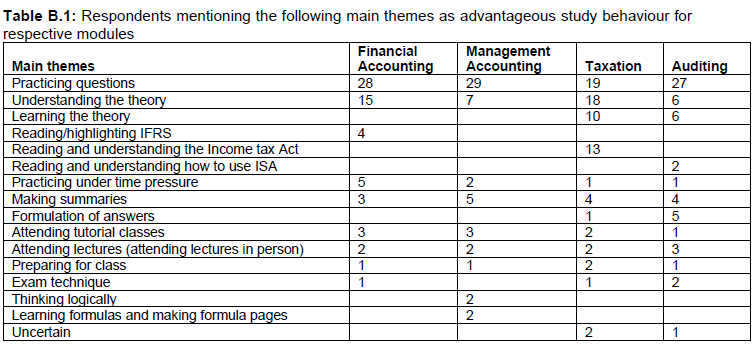
To support and deepen the investigation pertaining to the most advantageous study behaviours (which hereto had only utilised quantitative data), respondents were also asked to explain in their own words which study behaviours they found most advantageous for each module. The analysis of this qualitative data will now be discussed. Respondents identified "practising questions" as an advantageous study behaviour for all four modules.3 This theme was the most popular study behaviour identified, with as many as 29 respondents mentioning this theme for Management Accounting. This theme was similarly popular for Financial Accounting (28 responses) and Auditing (27 responses). Interestingly only 19 respondents identified this theme for Taxation. This might be because Taxation is more theoretical, as substantiated by 28 respondents specifying "understanding the theory" or "learning the theory" as advantageous study behaviours for Taxation. "Understanding the theory" was also regarded as an essential study behaviour for Financial Accounting (15 responses) but less so for Management Accounting (only seven responses). This indicates that Management Accounting is a more practical module (as evidenced by comments such as "[r]eal life scenarios, stay up to date with news") with a greater focus on practising the questions (as indicated by remarks like "Quickly revising and then jumping into questions")4. Additionally, the theme of "thinking logically" emerged uniquely within the context of Management Accounting. In addition to "understanding the theory" (six responses), "learning the theory" (another six responses) was identified as an advantageous study behaviour for Auditing, indicating that theory also plays a vital role in studying Auditing (similar to Taxation). "Learning the theory" was not highlighted as a beneficial study behaviour for either Financial Accounting or Management Accounting, suggesting that success in these modules does not hinge on rote memorisation but rather on a deep understanding of the concepts, as indicated by respondents. Two respondents remarked, "Focusing on understanding, rather than memorisation of facts" (for Financial Accounting) and "Practising questions, practice to think logically (not memorise)" (for Management Accounting). Respondents elaborated on the theme of "practising questions" by emphasising the importance of attempting questions under time pressure, with most responses for Financial Accounting.
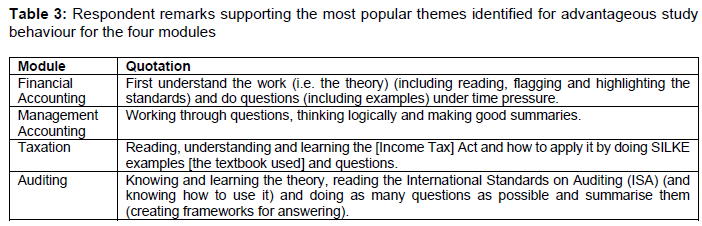
SAICA follows an open-book policy and allows students to use specific reference materials (including Standards and legislation) during examinations. Respondents identified reading, understanding, flagging and highlighting of these allowed materials as an advantageous study behaviour for the modules where these materials are permitted [i.e. Taxation (13 responses); Financial Accounting (4 responses); and Auditing (2 responses)]. Respondents also cautioned against over-reliance on these open-book materials, as evidenced by statements such as "Don't rely on the IFRS books too much" (for Financial Accounting) and "Forget that the module is open-book" (for Auditing). Making summaries was also a theme identified across all four modules (refer to Appendix B for more details). The formulation of answers was explicitly identified as a study behaviour required for Auditing (five responses). Quotes relating to the most popular themes identified for advantageous study behaviours for the four modules are presented in Table 3.
Other behaviours identified by respondents included preparing for lectures, attending lectures and tutorial classes (for all four modules); exam technique (for all modules except Management Accounting), working with a friend (for all four modules except Auditing), using flashcards (for Taxation); learning formulas and making formula pages (for Financial Accounting); and consultations (for Financial Accounting). It was notable that halfway through these respondents' CTA year, some respondents remained uncertain about which study behaviours to recommend for Taxation (2 responses) and Auditing (1 response), as reflected in these quotes: "I actually don't know" (for Taxation) "N/A haven't figured this one out yet" (for Auditing).
While the quantitative data revealed trends in performance outcomes associated with effective study behaviours, the qualitative responses offered deeper insights into students' perceptions of these behaviours. In some instances, the quantitative and qualitative data aligned-such as recognising a study group or working with a friend as beneficial across all four modules, except for Auditing. However, there were cases where the findings diverged. For example, the quantitative data highlighted mind maps as advantageous for Financial Accounting and Taxation, while few qualitative respondents mentioned the importance of summarising, which might indicate that the benefit of making summaries is only recognised by certain students. Additionally, the quantitative data identified consistent study habits in Auditing as advantageous, whereas the qualitative responses did not specifically mention this behaviour.
Changes in study behaviours from undergraduate to postgraduate studies
Respondents were required to indicate the most significant changes made to study behaviours from undergraduate to postgraduate studies for each module. Respondents' feedback confirmed that CTA studies are perceived as more challenging, necessitating students to stay up to date and consistently exert greater effort for all four modules than their undergraduate studies (aligning with Steenkamp (2012)). Across all four modules, the most common change in study behaviour was increased practice of questions. Management Accounting led with ten responses; the other three modules received seven responses. Although mentioned by only three respondents, an intriguing observation regarding practising questions emerged: "Quality over quantity", emphasised in Management Accounting. This approach was similarly echoed for Financial Accounting ("Rather focus on doing fewer questions but really working through them and understanding my mistakes") and Taxation ("Focus on understanding the work rather than just doing as many questions as I can").
Respondents elaborated on the theme of "practising more questions" by emphasising the importance of understanding the principles illustrated by these questions across all four modules. This sentiment is echoed in the following quotes: "Focus more on the principles questions teach me and reflect on questions I do and what it taught me" (Financial Accounting) and "Understanding the "why" of each answer given" (Management Accounting). Financial Accounting received the most attention in this regard, with six responses, while Management Accounting and Taxation received two responses each, and Auditing received one response. This suggests that Financial Accounting questions often present various scenarios or variations that require a deeper understanding, especially considering the increased workload. One respondent highlighted this complexity, stating, "Looking at loss of control/gain in control. Rather than what happens when I->S [an investment becomes a subsidiary] or the other scenarios", focus on understanding is crucial because there are "too many [scenarios] to remember and you will make mistakes".
"Understanding the theory and not just memorising the theory" was identified as a change in study behaviour for all four modules, particularly noted in Management Accounting with seven responses. This coincides with six respondents indicating that respondents spend less time on theory in Management Accounting. These responses align with the findings in Section 4 that Management Accounting, being a practical module, requires a thorough understanding of its principles to ensure success. For instance, respondents remarked: "Practicing more questions, less theory, better grasp of basic concepts used overall in ManAcc" and "Focused more on understanding the work rather than just learning the theory". Illustrating the practicality of Management Accounting, one respondent remarked that he started "thinking practically (putting myself in the business)", and another said that he "started reading news articles".
Understanding the theory versus memorising it (three responses for Auditing and two responses for Financial Accounting) and spending less time on theory (four responses for Auditing and two responses for Financial Accounting) were also evident in adjusted study behaviours within Auditing and Financial Accounting. However, ten respondents indicated that they now spend more time on the theory of Taxation, confirming the finding in Section 4.1 that Taxation is perceived as more theoretical. Respondents indicated that postgraduate studies require students to adapt how they approach and use open-book materials (including IFRS, the Income Tax Act and ISA) allowed in terms of SAICA's open-book policy for applicable modules (illustrated by quotes in Table 4).
Other changes to study behaviours identified by respondents across all four modules included focusing on exam technique, integration within and across module(s) and working through previous assessments written to learn from mistakes. Respondents also indicated that they make more summaries across all four modules. Interestingly, for Auditing, three respondents indicated that they now make more summaries, and three indicated that they try to make fewer summaries. This agrees with the findings of Steenkamp (2012) that not all students prefer to use summaries. Adjusting to CTA, students attempt questions against time (for Financial Accounting and Auditing), attend tutorial classes (for Financial Accounting, Management Accounting and Auditing), and start preparing for class (for Financial Accounting, Management Accounting and Auditing). For Taxation, 13 respondents indicated that they use the textbook (SILKE) much more in postgraduate studies ("I had to start working through SILKE, this I never did in undergrad"). Formulating or structuring answers ("Focus on knowing how to answer the questions rather than studying old question memos"), attending class ("which I never did in undergrad"), having a big picture mentality, and using undergraduate notes were four unique themes within Auditing. Using undergraduate notes linked to a previous theme of making fewer summaries as illustrated in the following two quotes: "I spend less time on making summaries and used my undergrad notes because it's really similar"; "I already summarised most of the work undergrad with mind maps etc., so I just add to them".
Three respondents, specifically for Financial Accounting, Taxation, and Auditing, mentioned that they had to overhaul their entire approach to postgraduate studies. One respondent emphasised the extent of this change, stating: "Everything. I had to redesign my entire study method and relearn the module from the ground up". However, several respondents noted minimal changes in their study behaviour across all four modules. Specifically, Management Accounting received the most mentions, with 11 respondents indicating no significant change. Auditing followed with seven respondents reporting similar habits, while fewer responses (relating to no changes in study behaviours) were received for Financial Accounting (five responses) and Taxation (four responses).
Experiences of attending lectures in-person versus online
The previous two sections investigated the most advantageous study behaviours. While most of these study behaviours will be the same in-person versus online, some study behaviours might be affected by whether a student attends class in-person versus online (eg. asking for help or being able to study in a group). In-person settings often foster immediate interaction with lecturers and peers (Brink 2026; Jaggers 2014; Kemp and Grieve 2014; Meulenbroeks 2020; Quimí and Alexandra 2022), which can enhance collaborative learning and support strategies like active participation and real-time feedback. However, students might feel more pressured in face-to-face environments, potentially affecting their willingness to engage or ask questions (Brink 2023). This section will investigate students' experiences of attending class in-person versus online.
A distinguishing feature of this study was that the respondents were exposed to a blended learning approach and could share their experiences of attending class in person or streaming the lecture online as a study behaviour. The researchers, therefore, included a specific question relating to this study behaviour experience (refer to Appendix A for open-ended survey questions). The main themes identified from analysing the data on this question included fewer distractions during in-person lectures, better focus during in-person lectures, and increased student-student and student-lecturer interaction and engagement during in-person lectures. In-person lectures offer a conducive learning environment, and streaming lectures online offers time efficiency and a cost benefit.
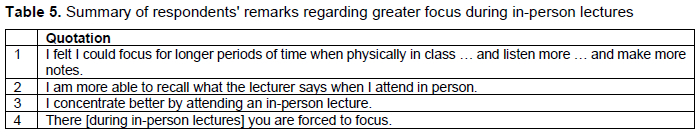
"In-person lectures eliminate the risk of distractions which you may have at home". The theme of "less distractions during in-person lectures" was mentioned by 15 respondents. According to respondents, attending class online provides various opportunities or temptations to get distracted. Specific distractions mentioned include: "go unto social media", "doing other work/chores in the house", and "go on my phone". This theme directly links to the following theme: "focusing better during in-person lectures" as illustrated by the quote "I focus better in person, because there are a lot less distractions". Seventeen respondents mentioned greater focus during in-person lectures in their response ("In-person classes help me to focus better"). The essence of the remarks by respondents is summarised in Table 5.
These responses align with the literature (Brink, 2026; Quimí and Alexandra, 2022; Serhan, 2020), indicating that students focus and concentrate better during in-person lectures. Another advantage of in-person learning is that it forces students to take a break: "During the breaks in person it is also common to stand up and stand outside which really helps with increasing focus on lectures following one another". Interestingly and contradicting the above three respondents mentioned that they focus more during online streamed lectures ("During online lecturers I am able to focus more and write notes better than I do in person"). This indicates that some students' learning preference is attending lectures online (Brink 2026).
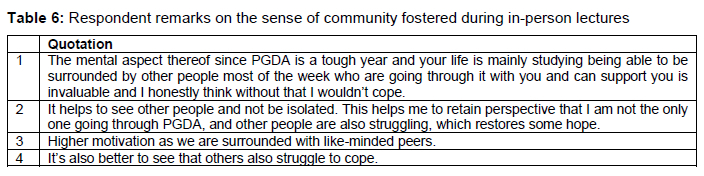
The next theme, namely, increased student-student (mentioned by eleven respondents) and student-lecturer (cited by seven respondents) interaction and engagement occur during in-person lectures. The codes identified for "increased student-student interaction and engagement" included socialising with peers (aligning with Brink (2026), Kemp and Grieve (2014) and Quimí and Alexandra (2022)), having direct access to fellow students to ask questions and clear up uncertainties (as was also mentioned by Brink (2026), Jaggers (2014), Kemp and Grieve (2014) and Meulenbroeks (2020)), and being motivated by being surrounded by other students also experiencing the same challenges (aligning with Brink (2026)). The last code is specific to the CTA year since this postgraduate year is more challenging than the undergraduate period. Table 6 includes quotes from respondents relating to this code.
The codes identified for "increased student-lecturer interaction and engagement" included:
direct access to the lecturer to ask questions (aligning with Brink (2026), Kemp and Grieve (2014), and Quimí and Alexandra (2022))
making it easier to "pick up on queues that lecturers give regarding topics to focus efforts"
"it helps to see the lecturer's body language [also facial expressions and gestures] in order to understand what they are explaining" (as also noted by Brink (2026), Kemp and Grieve (2014), and Paul and Jefferson (2019))
a more personal relationship with the lecturer, providing support and motivation ("there is someone on the "other side" that cares about whether you understand or not") (aligning with Brink 2026).
Most respondents believed it to be more advantageous to attend lectures in person. However, two respondents mentioned that they prefer attending lectures online ("My grades went up on an average of 15 per cent since attending online lectures"). The next theme highlights the advantages of streaming lectures online. Seven respondents mentioned that attending lectures online saves time, which directly links to the following code, namely a financial benefit of not having to drive to campus (mentioned by four respondents)5 (aligning with Brink 2026; Hussein et al. 2020). The following quote encapsulates respondents' perspectives:
"I can work before class starts ... and then I shower and eat during the lecture breaks and I can sleep more. Going to class in person wastes a lot of time as you have to travel, put makeup on, etc."
One respondent mentioned, "Online allows me to have access to everything that I need because I sometimes forget a book or some notes." Adding another advantage of online learning, a respondent stated: "I am more comfortable to ask questions in the MS Teams chat during lectures than asking questions in class". One respondent differentiated between the type of lecture to be presented online: "Some subject areas are better suited to online learning e.g. Auditing than others like Financial Accounting". This might indicate that the theory type of modules leans more online than the practical modules, aligning with Mistry et al. (2024). Interestingly, the findings of respondents' experiences of the study behaviour of attending lectures in-person versus online in a postgraduate setting correlated and confirmed existing literature on undergraduate and postgraduate students' experiences of in-person and online learning (Brink 2025).
CONCLUSION
The CTA (a requirement to qualify as a CA) is a challenging year due to the workload, module integration, and emphasis on critical thinking. The prospective CAs struggle with completing this programme within the prescribed one year. There is a lack of research on the controllable actions per module that will improve students' chances of achieving their CTA. Based on students' experiences and marks, this study identified the critical study behaviours that should be employed to improve student performance in each module of the CTA programme. A questionnaire that included closed-ended (resulting in quantitative data) and open-ended questions (resulting in qualitative data) was used to address this aim. The quantitative data were evaluated using descriptive statistics and regression analysis, while the qualitative data were analysed using thematic analysis.
The regression analysis demonstrated a positive correlation between CTA performance and regular study of Auditing and participation in study groups for other modules. Additionally, creating mind maps for Taxation and Financial Accounting to comprehensively understand whole topics improved performance. Respondents identified practising questions (under time pressure) and understanding the theory as the most advantageous study behaviours for all four modules. For Taxation and Auditing, respondents added that learning the theory is also essential, indicating that these modules require a greater focus on theory. For Management Accounting, respondents placed a greater emphasis on practising questions (compared to learning the theory), indicating that Management Accounting requires a more practical approach. Other advantageous study behaviours identified for all four modules include making summaries, attending lectures and tutorial classes and preparing for class.
Respondents also identified practising more questions as the study behaviour that changed the most from undergraduate to postgraduate studies for all four modules. For Financial Accounting, it was specifically important to understand the principles illustrated within each question, suggesting that Financial Accounting questions often present various scenarios that require a deeper understanding. Understanding the theory and not just memorising the theory was identified as a change in study behaviour for all four modules, particularly noted in Management Accounting. This once again confirms the practical nature of Management Accounting (requiring an understanding of principles to apply it practically). Other changes to study behaviours identified across all four modules included consistently working harder, focusing on exam technique and integration within and across module(s). For Taxation, respondents stated they used the textbook (including theory and examples) much more than their undergraduate studies.
Respondents identified reading, understanding, flagging and highlighting of materials allowed by SAICA's open-book policy as an advantageous study behaviour and an adjusted study behaviour for the modules where these materials are allowed (with most responses for Taxation). For Auditing, respondents identified focusing on the formulation of answers as an advantageous study behaviour and a study behaviour change made in postgraduate studies. Attending lectures in person rather than online is a study behaviour recommended for CTA students based on respondents' experiences.
This study was limited by its small sample size, consisting only of 40 CTA students from a single university in South Africa. Furthermore, the students who completed the questionnaire had a higher average than the total population of CTA students at this particular university in this specific year. While this sample provided valuable insights, the sample size may limit the generalisability of the findings. The relatively small number of participants means that the results may not represent the broader population. To address this in future research, it is recommended to increase the sample size to enhance the robustness of the findings. Additionally, employing a stratified sampling method could ensure a more representative distribution of respondents relating to various demographic and academic variables. Expanding the study to include diverse institutions or settings may further enhance the generalisability of the results. To provide a broader regional perspective, future research could compare the challenges and study behaviours of CTA students in South Africa with those in other African countries that have similarly structured accountancy qualifications, highlighting both differences and common challenges. Furthermore, it would be valuable to explore how socioeconomic factors and access to resources influence study behaviours, particularly in the context of online learning and the availability of study materials.
This study aimed to contribute to accounting education in several ways. It contributes to the literature by responding to calls to elaborate and do follow-up research focussing on study behaviours that contribute to the success of postgraduate accountancy students (Anthony 2013; Fouché 2017). This study shared students' experiences, and the findings could help lecturers and institutions understand students' perspectives regarding study behaviours that should be employed in each module in the CTA programme. The study provided recommended study behaviours tailored to each module to facilitate the successful completion of a CTA. This study also contributed new insights by examining students' perceptions of attending lectures online versus in person, thereby enriching the existing body of accounting knowledge on study behaviours contributing to CTA success. Lecturers and student advisers are encouraged to inform CTA students about the recommended study behaviours identified in this study. Additionally, CTA students should adopt these behaviours early in their academic year to enhance their likelihood of success.
To enhance the practical implications of this study, it is recommended that lecturers integrate the identified advantageous study behaviours into the curriculum through structured study sessions and targeted workshops on effective study strategies tailored for each module. Additionally, it is recommended that universities explore potential partnerships with professional bodies, such as the SAICA, to ensure that the study strategies align with professional standards and expectations, further enhancing the relevance and effectiveness of the CTA programme.
REFERENCES
LITERATURE REVIEW
- Ali, I., A. K. Narayan, and U. Sharma. 2021. "Adapting to COVID-19 disruptions: Student engagement in online learning of accounting." Accounting Research Journal 34(3): 261-269.
- Anthony, J. 2013. "An exploratory investigation of the approaches to learning of accounting students studying toward a professionally accredited post-graduate programme at the University of Cape Town." Master's dissertation. University of Cape Town.
- Ayodele, C. S. and D. R. Adebiyi. 2013. "Study habits as influence of academic performance of university undergraduates in Nigeria." Research journal in organizational Psychology & Educational studies 2(3): 72-75.
- Barac, K., M. Kirstein, R. Kunz, and B. Beukes. 2016. "Factors influencing students' learning approaches in auditing." Meditari Accountancy Research 24(3): 390-413
- Brink, S. M., 2023. "Exploring accounting students' experiences during the COVID-19 pandemic to inform teaching and learning decision-making post pandemic." Journal of Applied Research in Higher Education. DOI: 10.1108/JARHE-08-2023-0324
- Brink, S.M. 2025. "Rethinking teaching modalities: Student experiences from a volatile period and HyFlex-aligned recommendations for future accounting education." The International Journal of Management Education 24(1): 101298
- Brink, S.M. 2026. "Exploring accounting students' experiences of teaching modalities: A self-determination theory lens" Working paper. School of Accountancy, Stellenbosch University, 14 April.
- Britton, B. and A. Tesser. 1991. "Effects of time-management practices on college grades." Journal of Educational Psychology 83(3): 405-411.
- Credé, M. and N. R. Kuncel. 2008. "Study habits, skills, and attitudes: The third pillar supporting collegiate academic performance." Perspectives on Psychological Science 3(6): 425-453.
- Creswell, J. W. and T. C. Guetterman. 2019. Educational Research: Planning, Conducting, and Evaluating Quantitative and Qualitative Research. Boston: Pearson Education.
- Crous, C. and E. Goodchild. 2021. "Predictors of academic success in postgraduate auditing in the chartered accountancy programme at a South African university." South African Higher Education Journal 35(5): 23-47.
- Dehrmann, L. 2013. "Predictors of Examination Success in the SAICA Qualifying Examinations." Master's dissertation. Stellenbosch University.
- De Jager, E. 2014. "Thuthuka students' perceptions of factors influencing success." Journal of Economic and Financial Sciences 7(1): 53-72.
- De Villiers, R. R. and J. P. Fouché. 2015. "The effectiveness of teaching methodologies in audit education: A student perspective." South African Journal of Higher Education 29(6): 58-77.
- Dhawan, S. 2020. "Online Learning: A Panacea in the Time of COVID-19 Crisis." Journal of Education Technological Systems 49(1): 5-22.
- Fouché, J. P. 2017. "The reported study habits and time management trends of postgraduate students in accountancy." South African Journal of Higher Education 31(6): 197-217.
- Given, L. M. 2008. The SAGE encyclopedia of qualitative research methods. California: Sage Publications.
- Hussein, E., S. Daoud, H. Alrabaiah, and R. Badawi. 2020. "Exploring undergraduate students' attitudes towards emergency online learning during COVID-19: A case from the UAE." Children and Youth Services Review (119): 105699.
- Jaggars, S. S. 2014. "Choosing between online and face-to-face courses: Community college student voices." American Journal of Distance Education 28(1): 27-38.
- Karakas, F., A. Manisaligil, and E. Sarigollu. 2015. Management learning at the speed of life: Designing reflective, creative, and collaborative spaces for millennials. The International Journal of Management Education, 13(3): 237-248.
- Kemp, N. and R. Grieve. 2014. "Face-to-face or face-to-screen? Undergraduates' opinions and test performance in classroom vs. online learning." Frontiers in psychology (5): 1278.
- Kuphanga, D. 2024. Questionnaires in Research: Their Role, Advantages, and Main Aspects. DOI:10.13140/RG.2.2.15334.64325
-
LASSI Learning and study strategies: Inventory. 2022. 3rd edition. https://www.hhpublishing.com/ap/_assessments/LASSI-3rd-Edition.html
» https://www.hhpublishing.com/ap/_assessments/LASSI-3rd-Edition.html - Liu, T. and S. Zainuddin 2020. "Extrinsic and intrinsic motivation towards the online component of blended learning in accounting education: evidence from a Malaysian public university." Quality Assurance in Education 29 (2/3): 293-310.
-
Meulenbroeks, R. 2020. "Suddenly fully online: A case study of a blended university course moving online during the COVID-19 pandemic." Heliyon 6(12): https://doi.org/10.1016/j.heliyon.2020.e05728e05728.
» https://doi.org/10.1016/j.heliyon.2020.e05728e05728 - Merriam, S. and E. J. Tisdell. 2016. Qualitative research: A guide to design and implementation. San Francisco: Jossey-Bass.
-
Mistry, U., R. Megally, R. Aly Rashed. 2024. "Students' preferences for teaching and exam delivery modes in accounting education post-COVID-19 pandemic." Accounting Education https://doi.org/10.1080/09639284.2024.2341242
» https://doi.org/10.1080/09639284.2024.2341242 - O'Cathain, A. and Thomas, K. J. 2004. " Any other comments?" Open questions on questionnaires-a bane or a bonus to research?." BMC medical research methodology 4: 1-7.
-
Oliver, P. 2006. Purposive sampling. In V. Jupp (ed.), The SAGE dictionary of social research methods. SAGE [Online]. https://methods-sagepub-com.ez.sun.ac.za/reference/the-sage-dictionary-of-social-research-methods/n162.xml?fromsearch=true
» https://methods-sagepub-com.ez.sun.ac.za/reference/the-sage-dictionary-of-social-research-methods/n162.xml?fromsearch=true - Paul J. and F. Jefferson. 2019. "A comparative analysis of student performance in an online vs. face-to-face environmental science course from 2009 to 2016." Frontiers in Computers 1: 472525.
- Quimí, J. and J. Alexandra. 2022. "Face-to-face vs online learning advantages and disadvantages." Master's dissertation. Universidad Estatal Península de Santa Elena.
- Serhan, D. 2020. "Transitioning from Face-to-Face to Remote Learning: Students' Attitudes and Perceptions of Using Zoom during COVID-19 Pandemic." International Journal of Technology in Education and Science 4(4): 335-342.
- Smit, S. and M. Rossouw. 2019. "An exploratory study: Testing the effectiveness of a live-streamed lecture at tertiary level for accounting students." Journal of Economic and Financial Sciences 12(1): 1-8.
- Spencer, D. and T. Temple. 2021. "Examining Students' Online Course Perceptions and Comparing Student Performance Outcomes in Online and Face-to-Face Classrooms." Online Learning 25(2): 233-261.
- Steenkamp, G. 2012. "The impact of study behaviour on the success of South African CTA students." South African Journal of Accounting Research 26(1): 1-15.
2 Purposive sampling can be defined as a sampling method in which decisions concerning the individuals to be included in the sample are taken by the researcher, based upon a variety of criteria which may include specialist knowledge of the research issue, or capacity and willingness to participate in the research (Oliver, 2006).
3 This was proven in Steenkamp's (2012) study as being a study method that leads to success.
4 Responses for Management Accounting.
5 Many postgraduate students attending this university do not reside on campus.