Opportunity and outcome: a quantitative evaluation of the STEM Extended Curriculum Programme at a research-intensive university
Abstract
Higher education plays a significant role in economic development. The significant growth in the South African higher education system, which nearly doubled since 1994, is therefore promising for long-term economic growth and development. The country further recognised that teaching and assessment practices in higher education needed to adapt to address the needs of thousands of underserved students, to achieve parity in educational outcomes for all students. One intervention to achieve this goal was the founding of the Extended Curriculum Programmes (ECPs) - a systemic intervention to facilitate equitable access and success in higher education, intending to create a curriculum space where talented students that may be underprepared for the challenges associated with studies in higher education, could achieve solid foundations for academic success. This article explores the opportunity and outcome offered by an ECP at a research-intensive university in South Africa over seven cohorts (2010-2016). The main contribution to the research on the criteria of equitable access and success is evidence of the progress that has been made in the outcomes of the STEM ECPs over the last 10 years. The programme has delivered a significant number of additional graduates and postgraduates over the seven years to the three STEM faculties. Moreover, the cohorts included a demographic distribution much closer aligned to the country's demographics, at enrolment as well as graduation, and included a considerable number of female students of all demographic groups. This STEM ECP has therefore facilitated access and success in higher education for a significant number of students from diverse backgrounds via an alternative, enriched route.
STEM; Extended Curriculum Programme; Student Access and Success
INTRODUCTION
The Millennium Sustainable Development Goals of the United Nations acknowledge the crucial role of higher education in development (United Nations 2015). They aspire to ensure opportunities and "equal access for all to affordable and quality technical, vocational and tertiary education, including university" (Sustainable Development Goal 4, Target 4.3). Access and opportunities to study in higher education are also becoming key to social justice and economic development (UNESCO-IESALC 2020, 5). In lower-income countries, it is pivotal that higher education systems expand equitably to reach this objective, despite challenges brought about by funding constraints (Schendel and McCowan 2016, 408). Institutions of higher education have therefore been exploring ways to expand enrolments equitably while maintaining the quality of their academic offering (Schendel and McCowan 2016, 408). South Africa has seen significant growth in the higher education system, which has nearly doubled in size since 1994 (Council on Higher Education 2020, 2). More school leavers believe that a tertiary qualification may improve their social mobility and economic status. There is also an increasing appreciation for the role of higher education in the knowledge economy, while the positive relationship between higher education and development is now also recognized on a macro-level - to contribute to economic growth and the consolidation of public services (National Planning Commission of South Africa 2011, 317). Economic development is, therefore lately regarded as the so called "third mission" of higher education institutions, along with teaching and research (Moore, Sanders, and Higham 2013, ix).
A recent study undertaken by UNESCO IESALC (2020) considered the main trends in access to higher education worldwide over the last two decades. They found that the higher education enrolment rate has doubled in this time (2000 to 2018), from 19 percent to 39 percent globally. Sub-Saharan Africa has seen the highest participation rate increase (125 percent) over this time, although this growth is still insufficient to match the increasing demand in these countries (UNESCO-IESALC 2020, 27). In South Africa, access to public higher education has improved since the 1990s, from 15 percent in 2000 to 18 percent in 2010 (Council on Higher Education 2013, 41) and to 21 percent in 2017 (Essop 2020, 11), but still needs to improve further to meet the country's human resource and skills needs. The National Development Plan for improving education, training and innovation has therefore set the goal of increasing "the participation rate at universities by at least 70 percent by 2030 so that enrolments increase to about 1.62 million from 950 000 in 2020" (National Planning Commission of South Africa 2011; 319).
The UNESCO IESALC (2020) study further highlighted the discrepancy between enrolment rates and graduation rates, when assessing the outcomes of their efforts, which warrants a closer look at student access and success. Student access and success in higher education in South Africa have been found to be complex, multifaceted matters (Nel, Kistner and Van de Merwe 2013; Lewin and Mawoyo 2014, 42; Sehoole and Adeyemo 2016). Student access is about opportunity and placement, but also epistemological access (Muller 2014). Most stakeholders believe that successful students have mastered a certain field or discipline and earned a tertiary qualification from a reputable institution. The end goal is therefore often measured by the number of graduates as this is where the transformative power emerges for individuals and society as a whole (Scott 2018, 3). It has been argued that student success goes beyond graduation rates and encompasses a variety of factors such as the quality of offerings, skills obtained during studies, preparation for the workforce and employability (Lewin and Mawoyo 2014, 9), financial aid and inclusive policies that promote equity and student success (Sehoole and Adeyemo 2016). Unfortunately, in South Africa, the higher education graduate rates are far from ideal at this stage with major shortcomings such as low participation rates, equity issues, and graduate numbers (Fisher and Scott 2011, 1; Council on Higher Education 2013, 42; Sehoole and Adeyemo 2016, 10). Attrition levels are high in South Africa, and although that in itself is not unusual in higher education (globally), most country's high attrition levels are associated with high levels of participation. On the contrary, South Africa's higher education is a low-participation, high-attrition system that does not resemble the country's demographics (Fisher and Scott 2011, 1). The National Planning Commission Development Plan 2030 (2011) consequently recognizes that "high quality knowledge production cannot be fully realized with a low student participation rate". They further support the notion that "higher education provides opportunities for social mobility and simultaneously strengthens equity, social justice and democracy". In pursuit of equity of access and success, the funding framework for public higher education in South Africa (Ministry of Education 2004) includes the National Student Financial Aid Scheme (NSFAS) to facilitate physical access, the Extended Curriculum Programmes (ECPs) intervention to facilitate epistemological access, and the University Capacity Development Grants to facilitate academic success beyond first year through to graduation.
The overall aim of this article is to contribute to research on quantitative criteria for evaluating the impact of ECP initiatives on student access (opportunity) and student success (outcome). We will focus on the STEM ECP initiative for facilitating access to programmes in Natural Sciences, Agricultural Sciences and Engineering at a research-intensive university in South Africa over seven cohorts, from 2010 to 2016. When interrogating the data, we were mindful that the undergraduate programmes in Engineering and Agricultural Sciences are four-year Bachelors degrees, whereas the undergraduate programmes in Natural Sciences are three-year Bachelors degrees, which may be followed by a separate postgraduate Honours year. Our findings showed that the programme plays an important role towards equitable access and success in the three STEM faculties at SU, and adds value towards a more diverse cohort, representative of South Africa's demographics.
The success of STEM ECP initiatives has been evaluated using five quantitative criteria: retention, completion rate, migration to other faculties, enrolment in graduate studies, and benchmarking against other STEM ECP initiatives (Engelbrecht, Harding and Potgieter 2014) and also in terms of the student experience (Potgieter et al. 2015). For this article, the point of departure is the definition of student success as a combination of "academic achievement, engagement in educationally purposeful activities, satisfaction, acquisition of desired knowledge, skills and competencies, persistence, attainment of educational objectives, and post-college performance" (Kuh et al. 2006, 7). A review (York, Gibson and Rankin 2015, 4) of the definitions and measurements of "academic success" found that most research focuses only on academic achievement (in terms of grades and/or GPA), and that "academic success" and "student success" are often used interchangeably to refer to accepted desired outcomes. Their amended theoretically grounded definition of the term academic success is given in terms of six constituents:
• Academic achievement: measured using grades and GPA.
• Satisfaction: measured in terms of contextual elements of the teaching-learning-assessment space through course evaluations or student academic experience surveys.
• Acquisition of skills and competencies: measured by evaluating students' critical thinking skills, reading, writing and mathematical skills.
• Persistence: mostly measured by looking at retention between years (mostly between the first and second years in higher education), and graduation rates.
• Attainment of learning objectives: measured at the course level (in terms of internal/external moderation and course evaluations), at the programme level (by, for example, a professional body) or institutional level (by, for example, a Council of Higher Education audit).
• Career success: measured using intrinsic measures (focussed on each graduate's subjective experience of their career) and extrinsic measures (of tangible outcomes such as job attainment rate, promotion histories, and career advancement).
In this quantitative study, we will illustrate the use of two of these six criteria, academic achievement and persistence, for evaluating the impact of the STEM ECP programme at a research-intensive university on academic success for seven ECP cohorts (2010-2016). More of York et al.'s (2015) constituents of academic success will be employed in a follow-up qualitative study.
The STEM ECP Intervention
The completion rates in STEM programmes are particularly low as is evident from Council of Higher Education data (2013; 2022). Moreover, there continue to be substantial racial disparities in completion rates (Fisher and Scott 2011, 1). Despite numerous interventions and policy changes, this negative trend continues to persist (Scott 2018, 1). Contributing factors include different levels of preparedness, socio-economic factors, cultural differences, language challenges, underserved schooling experiences and articulation problems (De Klerk, Van Deventer, and Van Schalkwyk 2006, 150). Scott (2018, 3) further argues for higher education to prioritize student success and equity in outcomes.
In South Africa, during the period 1994 to 2004, there was a recognition that the teaching and assessment practices in education needed to change to achieve parity in educational outcomes for all students. It was acknowledged that many students were being underserved due to inadequate resources at schools, limiting their chances of success in higher education (Council of Higher Education 2022, 79). The Department of Higher Education pledged public funding in 1997 to achieve redress and equity in higher education, with a focus on quality, as well as addressing high attrition and repetition rates (Higher Education Act [No. 101 of 1997] 1997). This intervention aimed to support the globally desired shift from elitism to mass opportunity in higher education and improve academic opportunities and success for students in South Africa. Institutions of higher education were challenged to address a disconnect between school outcomes and the complex demands of higher education. The ECPs were established with targeted funding, as a systemic intervention to address equitable access and success in higher education in South Africa (Lewin and Mawoyo 2014, 72; Council on Higher Education 2020, 1). These programmes aimed to achieve parity in student educational outcomes, irrespective of race, gender or cultural background by providing "the curriculum space needed to enable talented but underprepared students to achieve sound foundations for success in higher education" (Council on Higher Education 2013, 70). Stellenbosch University (SU) responded to the call by implementing academic development programmes, one of which was the ECP in various faculties, to develop students' skills for academic success in various disciplines. This intervention has offered access to a diverse group of students via an alternative, extended and enriched route since 1995. Students enrolled in the ECP typically take one extra year to complete a degree programme. This extended, enriched route provides students with more time to adjust to the unique demands of higher education, including learning new knowledge and practices. The smaller class sizes allow for closer contact with lecturers and provide students with support in managing their workload and improving their study methods (De Klerk, Van Deventer, and Van Schalkwyk 2006, 164).
The ECP for the STEM fields (Science, Technology, Engineering and Mathematics) at SU involves the faculties of Science, AgriSciences and Engineering. The programme is/was known as the Extended Degree Programme (EDP) at the institution until 2023. This programme aligns with the National Development Plan (National Planning Commission of South Africa 2011), which emphasizes the importance of higher education being underpinned by a strong STEM innovation system to open up opportunities for all. The main purpose of the STEM ECP is to offer opportunities and widen access to a diverse group of students who fell just short of meeting the admission requirements for the degree programmes offered by these three faculties. For example, Mathematics is an admission requirement for degree programmes in the STEM fields. However, there seems to be a declining interest in Mathematics as a school subject in many countries, including South Africa (Department of Basic Education NSC Examination Report 2021; 2022). The number of learners taking Mathematics has dropped 16 percent since 2008. This may negatively affect the pool of potential students for the STEM degree programmes in general. Moreover, the wide range of mathematical proficiency within this pool of students presents an additional challenge in the fields of Science and Engineering. The value of Mathematics at school level will therefore have to be promoted at a national level to address the challenge. This is particularly relevant in the UNESCO International Year of the Basic Sciences for Sustainable Development during which various resources and events emphasize that the applications of the basic sciences are crucial for advances in medicine, industry, agriculture, water resources, energy planning, environment, communications, and culture (UNESCO 2022).
The STEM ECP falls into the "fully foundational courses" model (Council on Higher Education 2020, 3) and therefore includes an additional foundation year for which students may enrol only once. The purpose is to help students acquire the necessary skills and knowledge to succeed in higher education - thus, being and becoming legitimate participants in the learning process in higher education. The foundation year covers soft skills, academic literacy skills and computer skills, as well as fundamental STEM subjects: Mathematics, Physics, Chemistry and Biology or Preparatory Technical Drawings. The goal is to address any gaps in understanding and knowledge and provide a solid foundation before students proceed to the mainstream of their degree programmes. The foundation year also provides students with opportunities to assess their interests, abilities and strengths, and explore the range of degree programmes offered by the institution, which assists students to make informed decisions about their academic path going forward.
METHODOLOGY
Purpose of this research
This study responds to the call to contribute to research about the impact of the ECP on student performance (Council on Higher Education 2020, 13). We therefore examined the opportunities (student access) and outcomes (academic success) of students who were granted an opportunity to study in higher education through the STEM ECP at SU. The study includes a quantitative review of seven STEM ECP cohorts (2010 to 2016) and focuses on academic success as defined by York et al. (2015), including academic achievement and persistence. A subsequent study set within a qualitative paradigm is also in the pipeline and will further inform and enrich the findings of this article.
This article will provide information and insights about the following:
• The profile of the seven STEM ECP cohorts.
• STEM ECP outcomes by considering academic achievement: grades and GPA.
• STEM ECP outcomes by focusing on persistence: retention and graduation rates.
Data Collection and Profiling
Descriptive quantitative data for the seven STEM ECP cohorts (2010 to 2016) was acquired from Information Governance at SU. These seven cohorts were selected based on the likelihood that most of these ECP students would have completed their studies by now. Ethics approval and institutional permission for this research were obtained from the institution (#23018). The acquired data sheets contained the following information: registration (originally and currently), module marks, graduation rates and dates, and information regarding race, home language and residential status. Statistical analyses (descriptive statistics) were done by the Centre for Statistical Consultation at SU: cross tabulation, ANOVA, Levene's Test and ordinal multinomial analyses in R. Graduation and dropout rates were considered, as well as GPA for Grade 12 and the foundation year.
The seven STEM ECP cohorts comprised 1025 students over the three STEM faculties: Science, AgriSciences and Engineering (Figs. 1A and B), and represent approximately 10 percent of the total enrolment of the three faculties. Nearly half of the total group was admitted to the Faculty of Science (48 percent), followed by the Faculties of Engineering (30 percent) and AgriSciences (21 percent) (Fig. 1A). On average, the programme accepted 146.4 students per year, with numbers peaking in 2014 (183) (Fig. 1B). As far as student accommodation was concerned, just over half of this group stayed in a university residence during their studies, while the remainder of the students made use of private accommodation.
One of the goals of the ECP at SU is to provide equitable access to a diverse student group (Guidelines to the Extended Degree Programmes of Stellenbosch University 2010). Student diversity and equity were therefore evaluated using race, home language (Figs. 1C and D) and gender. We found that the seven STEM ECP cohorts included 462 Coloured (C), 272 Black African (BA), 254 White (W) and 37 Indian (I) students (Fig. 1C). Most Black African students specified Xhosa, Zulu or another Black African language as their home language, and some specified English as their home language (Fig. 1D). Coloured and White students mostly indicated English or Afrikaans as their home language (Fig. 1D). In the STEM ECP at SU, all teaching, learning, assessment activities and support opportunities are offered in English and Afrikaans. A significant number of STEM ECP students (> 80 percent) preferred to join the English stream, while a smaller number of students selected the Afrikaans stream.
Limitations of the study
Quantitative data (as presented in this article) provides a clear understanding of the role of the STEM ECP towards equitable access at SU over seven cohorts. However, this data paints only a partial picture of student success. ECP students may leave SU after their ECP foundation year or later for several reasons and continue their studies at other institutions of higher education. The quantitative data simply depicts these students as "dropouts". However, the foundation year may have played a role in them becoming successful students elsewhere. Thus, a follow-up qualitative study to include the student's voice will provide a much better understanding of the additional ECP foundation year's influence on academic success as suggested by York et al. (2015).
RESULTS AND DISCUSSION
Academic achievement: Grades and GPA
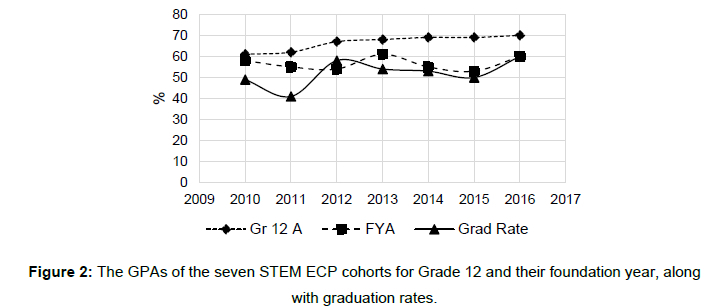
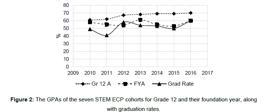
Academic achievement (grades and GPA) shows a student's academic performance and may point towards academic ability. It may also be a good indicator that a student has acquired the necessary skills and competencies, and that they have met the learning objectives (York et al. 2015, 6). The GPA of the seven STEM ECP cohorts for Grade 12 and their foundation year, alongside the graduation rates are shown in Figure 2. Our data analyses suggest that the average foundation year mark is a stronger predictor of academic success, compared to the Grade 12 average marks. Students with an average mark of 62 percent or higher in the foundation year are more likely to graduate, while those with an average mark of 52 percent or lower are more likely to drop out (Figs. 3A and C). In contrast, the Grade 12 average "pointers" only varied by 1.5 percent (Figs. 3B and D) and is therefore not a good indicator of probable success in higher education.
Research has found that grades and GPA may not reflect the students' learning or the growth that has taken place in their cognitive abilities (York et al. 2015, 9). Moreover, individual lecturers change over time, which will affect assessment content and practices and therefore the grades and GPA. We therefore acknowledge the limitations of this measure. However, the curriculum and practices of the STEM ECP foundation year have developed over many years, and even with the variables mentioned, the academic achievement of the students in this crucial year does seem to be a good indication of academic success in the end, reflecting the importance of this extra year.
Persistence: Graduation rates
Persistence captures an "individual students' academic goals across multiple programs of study and in various institutional contexts" (York et al. 2015, 7). Persistence was therefore included in York et al.'s (2015, 7) revised model of academic success to capture a student's "focus, drive and forward progression" to successfully complete their degree programme (York et al. 2015, 7).
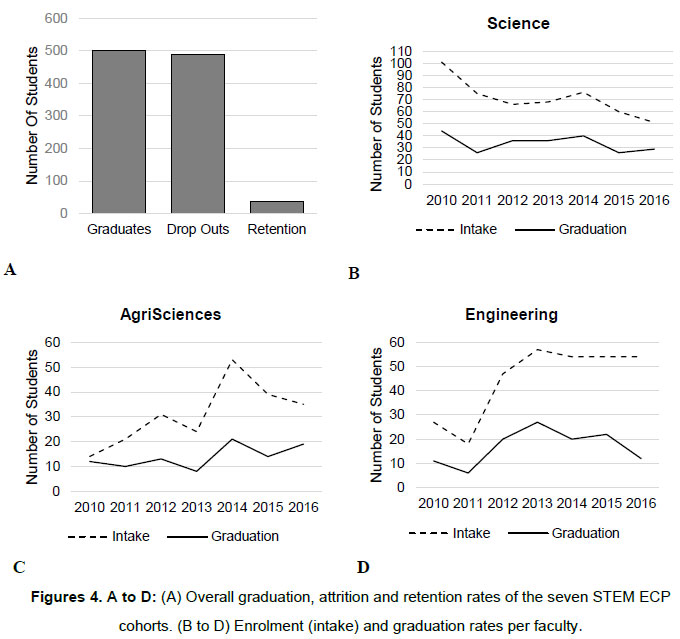
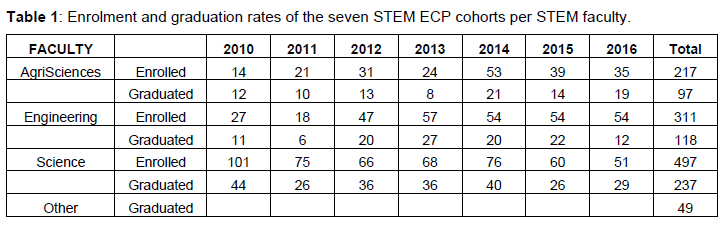
Our graduation rate analysis of the seven STEM ECP cohorts showed that 48.9 percent of the students graduated with a Bachelors degree at SU (Fig. 4A; Table 1). When we separated the three faculties, we found that 47.7 percent of the Science ECP students graduated, followed by 44.7 percent of the AgriSciences and 37.9 percent of the Engineering ECP students (Table 1; Fig. 4 A to D). The graduation rates in Science have been relatively stable over the period of this study, whereas the graduation rates in the Faculty of AgriSciences seem to have improved slightly over this time. However, the ECP graduation rates in the Faculty of Engineering have shown a negative trend, which may warrant attention. An earlier ECP study at SU by De Klerk et al. in 2006 found low graduation rates in the ECP cohorts of 1995 to 2004: Science (16 percent), AgriSciences (15 percent) and Engineering (23 percent). We have therefore made some progress since then, which is encouraging.
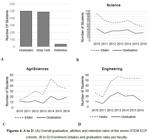
Of the 501 STEM ECP students from these cohorts who graduated (Fig. 4A), the majority completed their degrees in the faculty where they registered at enrolment or in one of the other two STEM faculties. This is interesting since we find that the STEM ECP foundation year allows students to explore STEM programmes while they engage with academics and experience the nature of the various disciplines before committing to a particular programme.
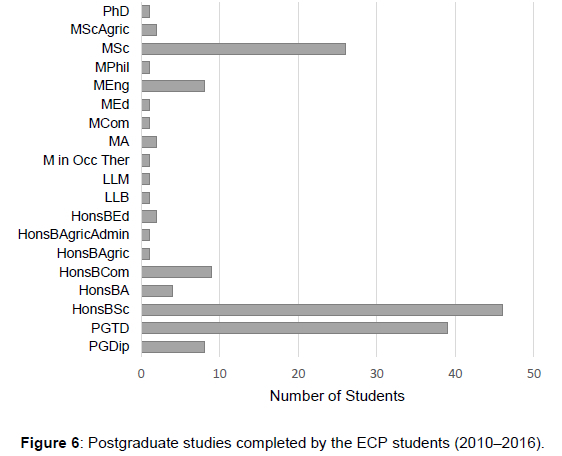
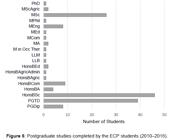
A small group of the initial STEM ECP students (49) from these cohorts graduated in non-STEM faculties (9.8 percent), such as Law or Economical and Management Sciences. We still regard this as academic success, since many of these students excelled during their mainstream undergraduate years and even completed postgraduate studies in the non-STEM faculties (Fig. 6). Another small group of students (36) from these seven cohorts are still enrolled in undergraduate degree programmes (Fig. 4A - Retention), and most of them need to complete only one or two modules to graduate, which may contribute further to the total number of graduates for these ECP cohorts.
We further considered the time the graduates took from enrolment to graduation. We found that a significant number of the STEM ECP students from the seven cohorts in our study graduated within minimum time (35 percent) and minimum time +1 year (34 percent). About 26 percent of the students took longer to graduate, but still successfully completed their studies (Fig. 5A). The study further showed a positive trend from 2010 to 2016, with a slight improvement in the number of STEM ECP students graduating within a shorter time-period (Fig. 5B). No significant differences were noticed among the three faculties regarding time to graduation (Fig. 5C), although students in the Faculty of AgriSciences were marginally more likely to graduate in a shorter time- period (Fig. 5D).
As mentioned before, persistence captures an "individual students' academic goals across multiple programs of study and in various institutional contexts" (York et al. 2015, 7). We, therefore, investigated how many of the STEM ECP graduates from these seven cohorts went on to postgraduate studies. Of the 501 STEM ECP graduates, 155 (30.9 percent) already completed postgraduate studies (Fig 6). These qualifications varied from postgraduate diplomas (e.g. post-graduate teaching diplomas), to one ECP student who already completed a PhD degree by the end of our analyses. Moreover, this post-graduate group included 78 Coloured, 28 Black African, 48 White and 1 Indian student. Thirty-five of the ECP graduates from these cohorts are currently enrolled for postgraduate or further postgraduate studies: 22 students are enrolled for Masters studies and 10 for PhD degrees. When we consider that most of these students would not have had the privilege of studying in higher education if not for the ECP opportunity, these are indeed impressive achievements. This also emphasizes the role and the invaluable contribution of this programme towards producing well-qualified graduates who can contribute to the growth and human capital of the country.
Student diversity and retention
The ECP cohorts represent a relatively small portion of the total enrolment nationally - up to 15 percent (Lewin and Mawoyo 2014, 72). At SU, the STEM ECP cohorts are around 10 percent of the total enrolment into the three STEM faculties. However, when the demographics of the STEM ECP cohorts are compared to those of the mainstream programmes, the ECPs are much more representative of the population of South Africa. As such, they therefore make a significant contribution to equitable access and success for the total cohort (Figs. 7A and 7B). The seven STEM ECP cohorts in this study included a significant portion of Coloured and Black African students. Moreover, we found that the racial diversity profile of the ECP graduates was similar to that of the ECP enrolments (Figs. 7A and 7B). This implies that, for this group of seven ECP cohorts, the racial diversity was retained from enrolment to graduation, which is noteworthy. It was still concerning to notice that higher numbers of Coloured and Black African students dropped out when compared to White students. We found that 48 percent of Coloured, 54 percent of Black African and 38 percent of White ECP students dropped out of their respective degree programmes (Fig. 7C). We therefore decided to take a closer look at dropout rates and home language. Results showed that 48 percent of English-speaking, 69 percent of Xhosa-speaking, 49 percent of students speaking other Black African languages, and 42 percent of Afrikaans-speaking students dropped out (Fig. 7D). The disproportional dropout rate of our Xhosa students is a concern. These trends and the reasons behind them need further investigation and we may have to explore more support or other interventions.
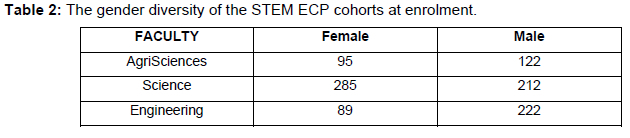
Improving gender diversity is another aspiration of the STEM ECP at SU where we aim to increase the number of female students in the STEM degree programmes. Table 2 shows the gender profile of all the cohorts at enrolment. It is evident that the Faculty of Science has made a significant impact in increasing the number of female students. Figures 8A and 8B show the numbers of female and male graduates per faculty and also race group. The Faculty of Science enrolled more female ECP students than the combined female ECP enrolments of the other faculties. In addition, there were more female ECP graduates than the combined female ECP graduates of the other faculties. Figures 8A and 8B also reveal that the STEM ECP facilitated graduation for many Coloured and Black African women.
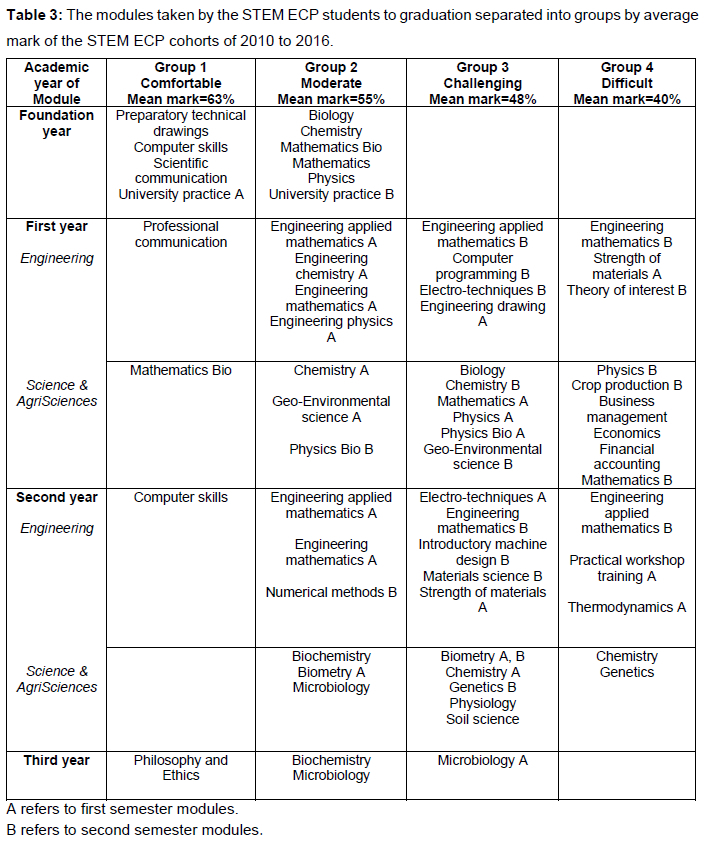
Academic support and skills development plays a significant role in student retention and success (Peach 2005, 3; Suni 2004, 499; Case et al. 2013; UNESCO-IESALC 2020, 52). One such example is support for literacy and language development. According to the Council on Higher Education (2020), universities "need to extend support for literacy and language as far up the curriculum as possible, either through the development of a new programme type or through the use of other funding such as the student support and development programme in the University Capacity Development Grant (UCDG) to provide "in curriculum" development initiatives throughout the undergraduate curriculum". Similarly, academic support in disciplinary subjects also seems to be a requirement for academic success. Presently, academic support and skills development in the STEM ECP is mostly limited to the foundation year, where after ECP students receive the same support as the mainstream students via differentiated academic support initiatives (mostly only in the first year of mainstream). However, this study revealed potential "obstacle" modules that many ECP students found very challenging (Table 3 - groups 3 and 4). Most of the first-year mainstream modules in groups 3 and 4 have support programmes that students can join, but not so much for second-year modules onwards. It is clear from the results that a significant number of second-year modules fall into the "challenging" and "difficult" categories for the ECP students. Further strategic academic support in this part of the curriculum may enable more STEM ECP students to graduate and such options may therefore be worth exploring further.
CONCLUSIONS
The STEM ECP at a research-intensive university in South Africa is in essence an n+1-degree programme that develops students' skills in language and literacies, as well as foundational disciplinary knowledge for STEM programmes. Thousands of students who entered university through the ECPs in South Africa have been able to successfully complete their studies and obtain a degree (Council on Higher Education 2013, 73; Lewin and Mawoyo 2014, 73).
National reports proclaim the solid foundations that the ECPs provide to students who have the potential to become successful graduates, but who would not be accepted into mainstream degree programmes. Moreover, the ECPs have had a particular impact on equity in access, as reflected by a report by the World Bank: "Extended programs have also played a special role in facilitating equity of access in historically white institutions, especially the research universities, because relatively few black students have been competitive on standard entry criteria". For the ECP students, the articulation gap is typically in one of the basic sciences, but this gap is also evident in the students who directly access the STEM mainstream programmes. This is probably why the successes of the ECPs and ECP students are now also being explored to inform structural changes in undergraduate curricula in South Africa, since they may offer possibilities to mitigate the articulation gap for many mainstream students who struggle to find their feet in higher education (Lewin and Mawoyo 2014, 73).
This study showed that the STEM ECP at SU has provided access to STEM programmes for a diverse group of students over seven years, has facilitated success to graduation for a significant percentage of these students, and has even led to postgraduate studies for a noteworthy number of the STEM ECP graduates.
ACKNOWLEDGEMENTS
This work was funded and made possible by the Stellenbosch University Capacity Development Grant and Stellenbosch University Teaching Fellowship. Thank you to Mrs Claudia Swart-Van Vuuren for assistance with the Institutional Permission and Ethics Approval applications.
REFERENCES
- Case, Jennifer, Harro Von Blottnitz, Duncan M Fraser, Hilton Heydenrych and Jochen Petersen. 2013. "Thinking and practising curriculum: A new first year course in chemical engineering at UCT." Proceedings of the 2"dBiennial Conference of the South African Society for Engineering Education: 29-38.
-
Council on Higher Education. 2013. "A Proposal for Undergraduate Curriculum Reform in South Africa: The Case for a Flexible Curriculum Structure." CHE, August 2013. http://www.che.ac.za/sites/default/files/publications/Full_Report.pdf.
» http://www.che.ac.za/sites/default/files/publications/Full_Report.pdf - Council on Higher Education. 2020. "Extended Programmes with an Integrated Foundation Phase : Theoretical Considerations for Curriculum Design. " CHE no. 14, December 2020.
- Council on Higher Education. 2022. "Review of Higher Education in South Africa Twenty-Five Years into Democracy." CHE, July 2022.
-
De Klerk, Edwin, Idilette van Deventer and Susan van Schalkwyk. 2006. "Small Victories over Time: The Impact of an Academic Development Intervention at Stellenbosch University." Education as Change 10 (2): 149-69. https://doi.org/10.1080/16823200609487145.
» https://doi.org/10.1080/16823200609487145 -
Department of Basic Education NSC Examination Report. 2021. Available at https://www.education.gov.za/Resources/Reports.aspx.
» https://www.education.gov.za/Resources/Reports.aspx -
Department of Basic Education NSC Examination Report. 2022. Available at https://www.education.gov.za/Resources/Reports.aspx.
» https://www.education.gov.za/Resources/Reports.aspx - Engelbrecht, Johan, C., Ansie Harding and Marietjie Potgieter. 2014. "Evaluating the success of a science academic development programme at a research-intensive university." African Journal of Research in Mathematics, Science and Technology Education 18(3): 287-298.
- Essop, Ahmed. 2020. "The changing size and shape of the higher education system in South Africa, 2005-2017." University of Johannesburg, Ali Mazuri Centre for Higher Education Studies.
- Fisher, Glen and Ian Scott. 2011. "Background Paper 3: The Role of Higher Education in Closing the Skills Gap in South Africa." Closing the Skills and Technology Gap in South Africa, October: 154.
-
Guidelines to the Extended Degree Programmes of Stellenbosch University. 2010. https://www.sun.ac.za/english/leaming-teaching/ctl/Documents/EDP%20guidelines.pdf.
» https://www.sun.ac.za/english/leaming-teaching/ctl/Documents/EDP%20guidelines.pdf - Higher Education Act [No. 101 of 1997]. 1997.
- Kuh, George D., Jillian Kinzie, Jennifer, A. Buckley, Brian K. Bridges and John C. Hayek. 2006. "What matters to student success: A review of the literature." Commissioned report for the National Symposium on Postsecondary Student Success: Spearheading a Dialog on Student Success. Washington, DC: National Postsecondary Education Cooperative.
- Lewin, Thandi and Monica Mawoyo. 2014. "Student Access and Success : Issues and Interventions in South African Universities." Inyathelo: The South African Institute for Advancement. The Kresge Foundation.
-
Ministry of Education. 2004. "Ministerial Statement on Higher Education Funding: 2004/05- 2006/07. Pretoria." https://www.gov.za/sites/default/files/gcis_document/201409/dohestatementhefunding20042007.pdf
» https://www.gov.za/sites/default/files/gcis_document/201409/dohestatementhefunding20042007.pdf -
Moore, Joanne, John Sanders and Louise Higham. 2013. "Literature Review of Research into Widening Participation to Higher Education'" ARC Network. https://www.offa.org.uk/wp-content/uploads/2013/08/Literature-review-of-research-into-WP-to-HE.pdf.
» https://www.offa.org.uk/wp-content/uploads/2013/08/Literature-review-of-research-into-WP-to-HE.pdf - Muller, Johan. 2014. "Every picture tells a story: Epistemological access and knowledge." Education as Change 18 (2): 255-269.
- National Planning Commission of South Africa. 2011. "National Development Plan 2030. Our Future-Make It Work." ISBN: 978-0-621-41180-5.
- Nel, Celeste, Loumarie Kistner and Elanza van der Merwe. 2013. "Using enrolment trends to facilitate access." Journal of Higher Education Policy and Management 35 (1): 85-94.
- Peach, Deborah. 2005. "Ensuring student success - the role of support services in improving the quality of the student learning experience." Studies in Learning, Evaluation, innovation and Development 2 (3):1-15.
- Potgieter, Marietjie, Ansie Harding, Quenton Kritzinger, Charity Somo and Johann Engelbrecht. 2015. Reflections of science students on their experiences of an academic support programme in South Africa." South African Journal of Higher Education 29 (1): 108-131.
-
Schendel, Rebecca and Tristan McCowan. 2016. "Expanding Higher Education Systems in Low- and Middle-Income Countries: The Challenges of Equity and Quality." Higher Education 72: 40711. https://doi.org/10.1007/s10734-016-0028-6.
» https://doi.org/10.1007/s10734-016-0028-6 -
Scott, Ian. 2018. "Designing the South African Higher Education System for Student Success." Journal of Student Affairs in Africa 6 (1): 1-17. https://doi.org/10.24085/jsaa.v6i1.3062.
» https://doi.org/10.24085/jsaa.v6i1.3062 - Sehoole, Chika and Kolawole Samuel Adeyemo. 2016. "Access to, and success in, higher education in post-apartheid South Africa: Social justice analysis." Journal of Higher Education in Africa 14 (1): 1-18.
- Suni, Ellen Y. 2004. "Academic support at the crossroads: From minority retention to bar pre and beyond - will academic support change legal education or itself be fundamentally changed?" University of Missouri-Kansas City Law Review 73: 497-512.
-
UNESCO. 2022. "Mathematics for action: supporting science-based decision-making." https://unesdoc.unesco.org/in/documentViewer.xhtml?v=2.1.196&id=p::usmarcdef_0000380883&file=/in/rest/annotationSVC/DownloadWatermarkedAttachment/attach_import_ef1a922a-2f9b-467d-a480-0f90572c7f1f%3F_%3D380883eng.pdf&locale=en&multi=true&ark=/ark:/48223/pf0000380883/PDF/380883eng.pdf#MfA_Toolkit_Final_4-6.indd%3A.72234%3A360.
» https://unesdoc.unesco.org/in/documentViewer.xhtml?v=2.1.196&id=p::usmarcdef_0000380883&file=/in/rest/annotationSVC/DownloadWatermarkedAttachment/attach_import_ef1a922a-2f9b-467d-a480-0f90572c7f1f%3F_%3D380883eng.pdf&locale=en&multi=true&ark=/ark:/48223/pf0000380883/PDF/380883eng.pdf#MfA_Toolkit_Final_4-6.indd%3A.72234%3A360 -
UNESCO-IESALC. 2020. "Towards Universal Access to Higher Education: International Trends Report." https://www.iesalc.unesco.org/en/2020/11/17/iesalc-launches-towards-universal-access-to-higher-education-international-trends-report/.
» https://www.iesalc.unesco.org/en/2020/11/17/iesalc-launches-towards-universal-access-to-higher-education-international-trends-report/ -
United Nations. 2015. "Transforming Our World: The 2030 Agenda for Sustainable Development." https://doi.org/10.1201/b20466-7.
» https://doi.org/10.1201/b20466-7 - York, Travis T., Charles Gibson and Susan Rankin. 2015. "Defining and Measuring Academic Success." Practical Assessment, Research and Evaluation 20 (5): 1-20.