Examining the teaching, assessment and research activities of the south african economics departments
Abstract
This study examined the staff profile, as well as teaching, assessment and research activities of 17 Economics Departments in recent years by consulting information from various sources. The results showed there has been an improvement in the staff qualifications such as a higher proportion of staff with a Doctorate degree and a higher number of departments with at least one staff getting the National Research Foundation rating. As far as the courses offered are concerned, at undergraduate level, along with Microeconomics and Macroeconomics, other commonly offered modules included Econometrics, Mathematical Economics, Development Economics, Labour Economics, Public Economics and International Economics. At Honours level, only five departments offered the Research Methods module, whereas Development Economics, Mathematical Economics, Public Economics, Monetary Economics and Labour Economics were offered by many departments. Furthermore, the results of the primary survey questionnaire on first-year Economics teaching and assessment practices showed that pre-recorded videos were used to complement face-to-face contact, while many departments had tutorials as one of the continuous assessment tasks. Lastly, upon examining five departments with 5-year (2016-2020) accredited journal article publications information available, it was found that collaboration amongst staff and/or with students represented the biggest proportion of these publications.
Economics departments; research; teaching; learning and assessment; South Africa
INTRODUCTION
The Fourth Industrial Revolution and COVID-19-driven lockdown have gradually changed the way people work, and it is no exception in academia. Whilst the core work duties of an academic remain the same (learning and teaching, research, postgraduate supervision, community engagement and professional leadership, amongst others), many work tasks may now be performed differently, and the "new normal" could be the "permanent normal".
With regards to teaching, learning and assessment (TLA), academics no longer teach in the same conventional way as they did before 2020 (i.e. face-to-face lectures by teaching all the prescribed content) as more flexibility is allowed. The introduction of pre-recorded videos and live lecture streaming (along with other learning materials tools such as study guides and podcast), as well as more frequent use of online consultation tools such as discussion forums and chat rooms to supplement face-to-face classes is a shift from the conventional learning and teaching pedagogy. This systematic blend of different pedagogical approaches, teaching methodologies and digital technologies combined with face-to-face interaction is referred to as blended learning. It can be seen as a broad understanding of contemporary TLA (Hrastinski, 2019), which can inform, enrich or mediate the curriculum design process for face-to-face, hybrid learning and fully online learning. Additionally, blended learning can also influence the place (in the classroom or an electronic space) and the medium of instruction (i.e. whether the technology used will be internet dependent or internet supported) (Czerniewicz and Carvalho, 2022). This blended learning and teaching approach enables deeper engagement with students in the face-to-face context with other activities (academics might not have sufficient time to do so before 2020) taking place, such as providing detailed feedback on continuous assessments and having regular in-class practicals or quizzes. In this way, the notion of blended learning is expanded with a focus on enhancing the learning experience both in physical and digital spaces.
Similarly, assessment methodology has been adjusted in response to the above-mentioned changes in TLA. Even though the more frequent use and even abuse of artificial intelligence tools (e.g. Chat GPT) may have led the lecturers to opt to revert back to sit-down format in tests and examinations, it is still undeniable that sit-down format is no longer the status quo, as alternative assessments such as take-home practical projects, essays, online tests and even e-portfolios take place more regularly.
When it comes to research, it is now possible to participate in virtual research conferences without necessarily needing to attend local or international flights. It is also possible to consult students in postgraduate supervision by means of online meetings (with the aid of Zoom, Google Meet or Microsoft Teams). Therefore, the saved time can be spent constructively to improve our TLA practice as well as postgraduate supervision and research output.
It is a well-known fact that academics either "publish or perish". However, academics differ a lot in their characteristics, such as age, highest qualification, years of work experience in academia, whether they have received guidance from the more experienced colleagues. In fact, there is no guarantee that one person publishes all the time while another person is inactive continuously. Thus, academics may transition between the "publish and "perish" states. In addition, there has been more focus from the tertiary institutions on internalisation of research as well as involvement of various stakeholders in the community in research activities (Hart, Daniels and September-Brown, 2023). Thus, it is important to examine the nature of collaboration in the publications.
Whilst lone-authored publications could prove the academics' ability to conduct research independently, collaboration has become more prevalent. Van Rijnsoever and Hessels (2021) suggested the existence of four types of research collaboration relationships: independent research (the lone researcher has complete autonomy); contract research (two parties agree on a research question before the researcher conducts research), joint research (both parties conduct the research) and consulting (one party has a question that can be addressed without any original research). Amundsen, Ballam and Cosgriff (2019) mentioned five types of research collaboration: between scholars, disciplines, institutions, sectors and countries. Shagrir (2017) also asserted that there are three means of research collaboration: carry out an academic research project, write academic publications and present at conferences.
Collaboration helps promote new ideas, create new knowledge, improve access to research funds and assets, make broader impact and greater coverage in the media, increment wealth in terms of patents and new technology, reduce competitiveness, advance professional development and even promote the profession (Abramo et al., 2009; Bozeman, Fay and Slade, 2013; Shagrir, 2017; Van Rijnsoever and Hessels, 2021). Nonetheless, transaction costs may be involved as the collaborators have different identities and missions. Communications, meetings and co-ordinations incur additional costs as well.
This discussion on collaboration contributes to a new conceptual understanding by highlighting the diverse forms and benefits of collaborative research. Moving beyond the traditional view of lone-authored work as a mark of independent academic capability, the various types of collaboration-ranging from independent research to joint efforts across disciplines, institutions, and sectors-demonstrate how collaboration fosters innovation, access to resources, and professional development. This broader understanding positions collaboration not just as a strategic partnership, but as a critical avenue for creating new knowledge, making a greater societal impact, and advancing the Scholarship of Teaching and Learning.
It has been seven years since a study was conducted to examine the research activities of the South African Economics Departments. This study, unlike Luiz (2004 & 2009) and Yu, Kasongo and Moses (2017) which focused primarily on ranking these departments by examining the quantity and quality of accredited publications, rather adopts a different approach by placing primary focus on the nature of collaboration of the publications (to be explained later), as well as TLA activities, with more emphasis on undergraduate first-year level, which is the foundational level where students develop their interests to pursue further economics studies.
The specific research objectives of the study are as follows: (1) examine the staff profile (job rank and highest qualifications); (2) investigate the undergraduate and postgraduate courses offered by each department; (3) find out the TLA practices in undergraduate first-year economics modules; (4) distinguish different types of accredited publications.
Building on these objectives, the primary research question is: How do the staff profile, course offerings, (TLA) practices, and types of accredited publications vary across Economics Departments in South African universities, and what new TLA practices have emerged since the Covid-19 lockdown? We refer to TLA in an integrated manner. Let us briefly explain.
Teaching, learning, and assessment (TLA) are interconnected processes aimed at providing students with the best opportunities to learn. Rather than focusing solely on teaching content, teaching academics should design environments that facilitate student-driven learning (Barr and Tagg, 1995). Learning is understood as a social, collaborative process grounded in constructivist theory, where students actively contribute to their own education. Assessment, as an integral part of this process, systematically evaluates student achievements based on predefined criteria and serves as a continuous learning tool, enhancing student outcomes throughout the educational journey.
THEORETICAL FRAMINGWe employ Activity Theory (AT) as a theoretical lens. AT is a way of thinking that connects imagined, planned, and real-life situations. It emphasizes how people interact with objects and other people in ways that are shaped by future goals or plans (Nussbaumer, 2012). In the case of this study, it would be to try and understand new transformational TLA practices that have emerged in South African universities' Economics Departments post-Covid, illustrating how teaching academics interact with Economics curricula in their TLA.
The key components of Activity Theory include several interconnected elements. The subject refers to the individual or group involved in the activity, such as the faculty, Economics Department and students. The object is the goal or motive driving the activity, such as improving teaching quality, conducting research, or enhancing student learning outcomes. The tools are the mediating artifacts or instruments used to achieve these objectives, which can include teaching materials, online TLA tools, research funding, pre-recorded videos and tutorials. The community encompasses the broader context or group involved, such as the university, other departments, the National Research Foundation (NRF) and academic peers. The division of labour describes how roles and responsibilities are distributed among participants, such as faculty members engaged in TLA, and research activities. Finally, rules refer to the norms, guidelines, or regulations that shape the activity, including curriculum standards, accreditation requirements and institutional research priorities.
Applied to this study, the primary subjects are the faculty members in the Economics Departments, with specific reference to their TLA practices, bearing in mind the main objective, which is to improve student learning outcomes and advance knowledge in the field of Economics. Different tools are used to mediate the TLA process. The adoption of these tools, particularly in the post-pandemic context where blended learning has become more common, has significantly impacted the TLA processes. The community includes not only the Economics Departments but also the broader university structure, students and external stakeholders like accreditation bodies such as the NRF. These broader academic and research communities influence and support the TLA activities within the departments. The division of labour refers to how tasks and responsibilities are distributed, with faculty members balancing teaching, research, and administrative duties. Some may take on leadership roles, while others focus on undergraduate TLA. Additionally, research collaborations between different role players could reveal patterns of division of labour in knowledge creation. The rules governing these TLA activities include both explicit and implicit norms, such as academic policies, accreditation standards, and national research frameworks, which shape decisions around curriculum design, research agendas, and publication practices. For instance, National Research Foundation ratings may influence the focus of research within departments.
There is an abundance of studies on research publications. In some studies, publications in local journals are distinguished clearly from those in international journals, with greater weight being allocated to the latter. For example, both the 2004 and 2009 Luiz studies on Economics publications adopted a 1:3 weighting in favour of accredited international journal publications. Both studies found that the University of Cape Town (UCT) and University of Pretoria (UP) were the top performing Economics Departments. Some other studies even took citations statistics and impact factor into consideration by assigning different "journal quality weights" to each journal, such as Laband (1985), Tschirhart (1989), Miller, Tien and Peebler. (1996) and Yu et al. (2017). In particular, the latter study found that UP, UCT and Rhodes University (RU) were the top-three performing South African Economics Departments.
Three international studies primarily focused on publications arising from student dissertations. First, Santos, Willett and Wood (1998) found that 66 out of 137 students who completed their Masters by full thesis and Doctorate studies at a university in UK in 1968-1996 took part in a survey, and a total of 393 publications were produced from their theses. Anwar (2004) specifically examined the publication output of 54 USA Doctorate graduates who graduated in 1995, during the 1991-1995 research-in-progress period and 1996-2000 postdoctoral period. The author found that only half (27) of the graduated published articles out of their dissertations. Also, the mean number of publications derived from their dissertations was 0.85 for all 54 graduates but 1.7 items per dissertation if only the above-mentioned 27 publishing graduates were included. The study also found that 17 out of 27 (63%) publishing graduates produced only one publication each from their respective dissertation. Evans et al. (2018) examined 910 peer-reviewed publications arising from Doctorate Psychology dissertations in the USA, and the empirical findings showed that only 25.6 per cent of dissertations were published within 0-7 years following completion of studies, with significant variations across sub-fields.
Only one study explicitly examined why research collaboration took place; Melin (2000) interviewed 195 academics, and found that "co-author has special competence" was the top reason for collaboration. Moreover, the survey participants indicated that two main benefits arising for collaboration were "increased knowledge" and "higher scientific quality". Moving on to studies that investigated if collaboration led to improved productivity, Lee and Bozeman (2005) analysed data on a sample of 443 academics, and found the mean number of collaborators equalled 13.8 while only 16 per cent of research time was spent working alone. The authors proceeded to find that when publishing productivity was measured by "normal count" (i.e. the academic's total number of publications), collaboration was found to be a strong predictor of publishing productivity. However, when such productivity was rather measured by "fractional count" (dividing credit by the number of co-authors), collaboration and publishing productivity were not significantly related.
Moving to other studies relating to publishing productivity, Ductor (2015) investigated Economics publications in USA in 1970-2011, and found that the effect of collaboration on individual performance was positive, even after discounting by the number of authors who worked on an article. This finding was in contrast with the above-reviewed Lee and Bozeman (2005) study. In fact, Ductor (2015) found that authors whose first publication's productivity was above the 75th percentile could exploit the positive externalities obtained from collaboration to a relatively greater extent, as it was possible that they successfully collaborated with authors of a similar type. Next, Abramo et al. (2017) investigated the relationship between collaboration and research productivity at numerous Italian universities. The authors found that only collaboration at intra-university and domestic levels had a significantly positive impact on research productivity, whereas collaboration at international level had a negative but insignificant impact on research productivity.
For the remaining past empirical studies relating to research collaboration, Van Rijnsoever and Hessels (2021) used a sample of 3 100 researchers from North America and Western Europe, and found that for most researchers, the expected publication in scientific journals deriving from a research project was the most decisive factor to drive their collaboration choices. It was also found that common collaboration partners included fellow academics, governments, non-governmental organisations (NGOs) and commercial enterprises.
Abramo, D'Angelo, Di Costa and Solazzi (2011) investigated research collaboration between universities and private sector, and found that out of 68 Italian universities with research staff, 10 did not collaborate with private sector at all. Also, the number of collaborations was strongly and positively correlated to the staff size of the university. On the other hand, Rørstad, Aksnes and Piro (2021) examined the relationship between age and international research collaboration. Using the data for 5 600 Norwegian researchers and their publication output (44 000 total) in 2015-2017, it was found that international collaboration probability declined with increasing age.
To the author's knowledge, only three local studies examined economics TLA activities. First, Yu et al. (2017) found that Development Economics and Mathematical Economics were popular electives at second-year level whereas International Economics, Labour Economics and Monetary Economics were common electives at third year level. Also, many departments did not offer a research methods course work module in their Honours programs.
Dos Reis et al. (2022) analysed undergraduate first-year modules' final examination papers of departments (including economics) from the Commerce Faculty of a university, before deriving a revised Bloom's taxonomy level of difficulty index. The findings indicated that these assessment papers mainly asked questions at levels two (understand) and three (apply) of the taxonomy. Moreover, the authors did not find a significant correlation between the level of difficulty index and pass rates. Lastly, Yu et al. (2023) considered eight indicators (e.g. number of continuous assessments, number of weeks these assessments took place during the semester, length of assessments in terms of total marks) to derive a multidimensional assessment index for all undergraduate economics modules at a university, and found a moderately strong and negative correlation between this index and pass rates. That is, the higher the index, the greater the assessment loads and the lower the pass rate of the module concerned.
Upon reviewing the past empirical studies, numerous research gaps are identified. First, none of them conducted a detailed breakdown of publications by distinguishing lone authored articles from the co-authored articles. The identity of collaborators was also not investigated in great detail. Lastly, there was a serious shortage of empirical studies on TLA activities in the South African Economics Departments, especially at undergraduate first-year level. Hence, the study aims to fill the above-mentioned research gaps by comparing the TLA and research activities of the Economics Departments.
METHODOLOGY
To guide the analysis of TLA and research activities across South African Economics Departments, we used the Activity Theory lens. The activity theory approach enables us to capture the dynamic interactions between individual faculty members, their departments, and the broader educational environment, offering a nuanced understanding of how Economics Departments function to achieve their academic and research goals.
The TLA and research activities of 17 Economics Departments in recent years are examined. These departments come from either traditional (or theoretically-oriented) or comprehensive (both theoretically- and vocational-oriented) universities. That is, universities of technology are excluded from the analysis.
Data on courses offered at both undergraduate and postgraduate levels in 2022 was obtained from the commerce (or economic and management sciences) faculty prospectus of each university or the websites of the departments. In addition, information on the 2023 first-year economics TLA practices was obtained by contacting the relevant lecturing staff directly with the aid of a survey questionnaire. Ethics clearance was obtained from the Human Social Sciences Research Ethics Committee of the author's institution of affiliation.
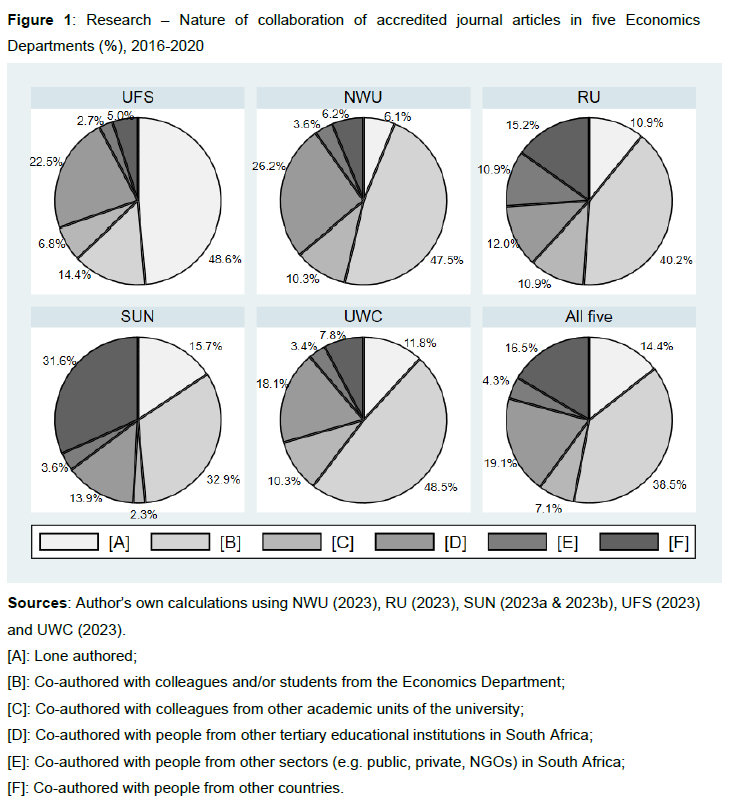
This study would focus on the 2016-20201 journal articles accredited by the Department of Higher Education and Training (DHET), by classifying them into six groups:
• [A]: Lone authored;
• [B]: Co-authored with colleagues and/or students from the Economics Department;
• [C]: Co-authored with colleagues from other academic units of the university;
• [D]: Co-authored with people from other tertiary educational institutions in South Africa;
• [E]: Co-authored with people from other sectors (e.g. public, private, NGOs) in South Africa;
• [F]: Co-authored with people from other countries.
Data on [A] suggests the presence of independent research, [B] indicates whether internal collaboration amongst economics staff and/or students happened, while [C] suggests the presence of interdisciplinary collaboration across academic units at a university. Data on external collaboration is broken down into categories [D], [E] and [F] to better identify the Economics Departments' engagement with numerous external research networks, such as academics from other universities, public sector and private sector.2
There are numerous limitations in this study. First, the author assumes the information on the department websites and departmental/faculty prospectus are accurate and up to date. Secondly, whilst the contributions of visiting, emeritus and extraordinary academics cannot be overlooked, it would be time-consuming to compile the information which is not available in the websites and prospectus of many departments under study. Hence, these academics are excluded in the forthcoming "staff profile" table (Table 1), but their contributions on research would still be counted (as long as the cover page of the journal article clearly shows they are affiliated with the Economics Department of the relevant universities). Thirdly, results of Tables 3 and 4 on undergraduate and Honours modules offered should be interpreted with some caution, as some modules are compulsory whilst others are optional, but for the latter group of modules, it is not possible to know from the websites and prospectus if these electives are "active" on paper but were not offered in the year of investigation (2022) or are only offered every two or three years. In fact, some of the modules in question may not been offered at all for the period under consideration - if not longer.
Moreover, the information compiled on Table 5 involves the use of a primary survey questionnaire which was sent out to the relevant first-year lecturing staff. A total of 18 responses was received from 11 departments, thus the results may not fully reflect what has been happening in each department (for example, it is possible that for department X, response was received from the Microeconomics staff but not from the Macroeconomics staff). Next, this study would not examine workload model, workload allocation and "trade off between teaching and research, as the study is not about each staff's assigned workload and work output. We are also mindful workload models can be a confidential, human resources related document that was approved at the university's higher-level committee(s), so it is not publicly available. Furthermore, the various models may be of a divergent nature, making comparisons ineffective.
Lastly, the author was only able to obtain the 5-year accredited research output of five departments (but only too short 2- or 3-year information on another four departments). In particular, the author noted that the annual research reports of some institutions no longer explicitly listed the accredited publication details of each academic department. Thus, in the forthcoming Table 6, only the five departments with the full 5-year publication information will be looked at, with primary focus on the nature of collaboration instead of per capita output or even ranking of each department (these calculations or ranking exercises were already done comprehensively in three past local studies, even though these exercises could be repeated in future research to see how the landscape has changed over time or not).
FINDINGS AND DISCUSSION
Staff profile
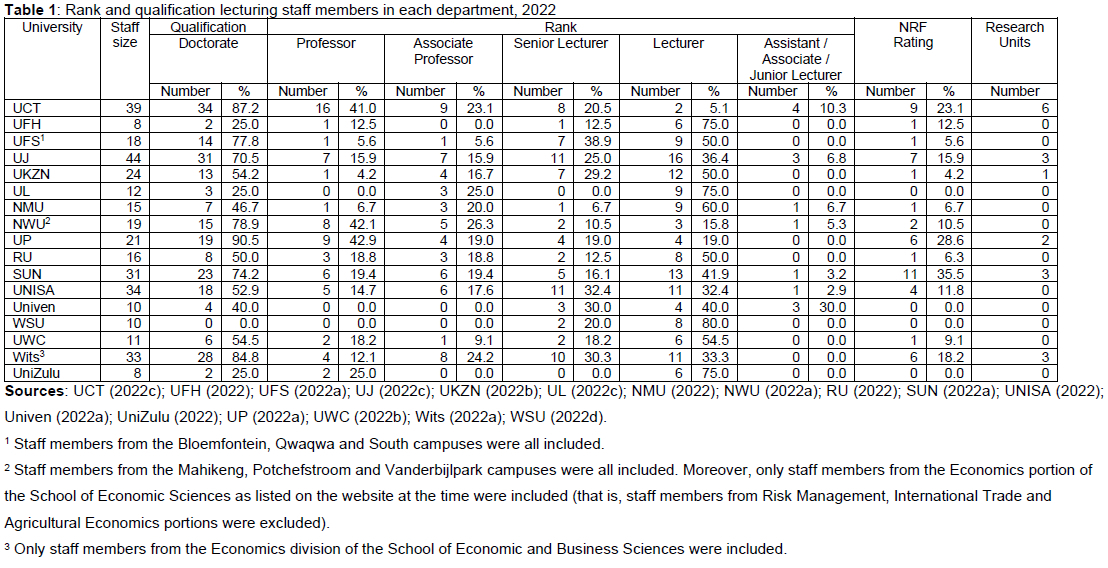
Table 1 shows the data relating to the lecturing staff in 2022, putting aside the unfilled vacancies (if any - but it is not possible to obtain such information), as well as Emeritus, extraordinary and visiting academics. The lecturing staff size was as low as eight at the University of Fort Hare (UFH) and University of Zululand (UniZulu) but as high as 44 at the University of Johannesburg (UJ).
In addition, comparing the findings of this table with the results derived by Yu et al. (2017), two noticeable improvements have been made. First, the number of departments with at least 75 per cent of lecturing staff having a Doctorate qualification increased from only two in 2014 to five in 2022 (note that the sixth ranked department - Stellenbosch University (SUN) - attained 74.2 per cent, which is very close to the 75 per cent threshold). This finding means that progress has been made by the departments to achieve the "75 per cent lecturing staff with Doctorate qualification" international benchmark. In fact, upon focusing on the 16 departments with staff's highest qualification information available in both Yu et al. (2017) and this study, the "mean" proportion of staff with Doctorate qualification increased from 47.1 per cent to 57.0 per cent.
Secondly, more than 40 per cent of lecturing staff were employed as Professors, namely UCT, North-West University (NWU), and UP. Next, the number of departments with at least one staff being NRF rated researcher increased from nine to 13, as UFH, University of KwaZulu-Natal (UKZN), RU and University of the Western Cape (UWC) also had NRF-rated lecturing staff in 2022.
Lastly, whilst it was not thoroughly investigated by Yu et al. (2017), Table 1 shows that in 2022, six Economics Departments had affiliated research units, with UCT leading with the presence of six research units.3
Courses and curriculum
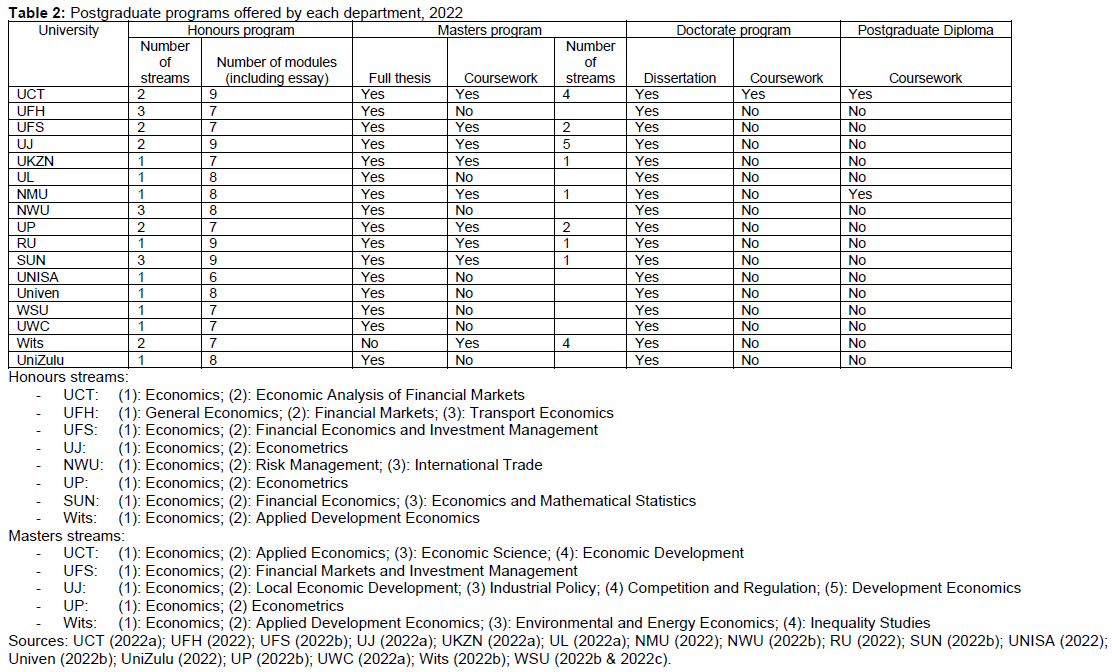
Table 2 presents the information about the postgraduate programs offered by all 17 departments under study in 2022. For the Honours program, the number of modules (including the long research essay module) ranged between six and nine. Moreover, it is encouraging that eight departments offered at least two streams (i.e. general stream and at least one specialised stream). All these departments except the UFH that offered at least two Honours streams had relatively larger lecturing staff size of at least 18 (UFH was the only exception with only eight lecturing staff).
As far as the Masters studies are concerned, all but one department offered the full thesis program while nine departments also offered the course work program (with five of them offering at least two streams). All departments offered the Doctorate dissertation program, while UCT remained the only university that offered the Doctorate by course work program. Lastly, only UCT and Nelson Mandela University (NMU) offered the Postgraduate Diploma in Economics program.
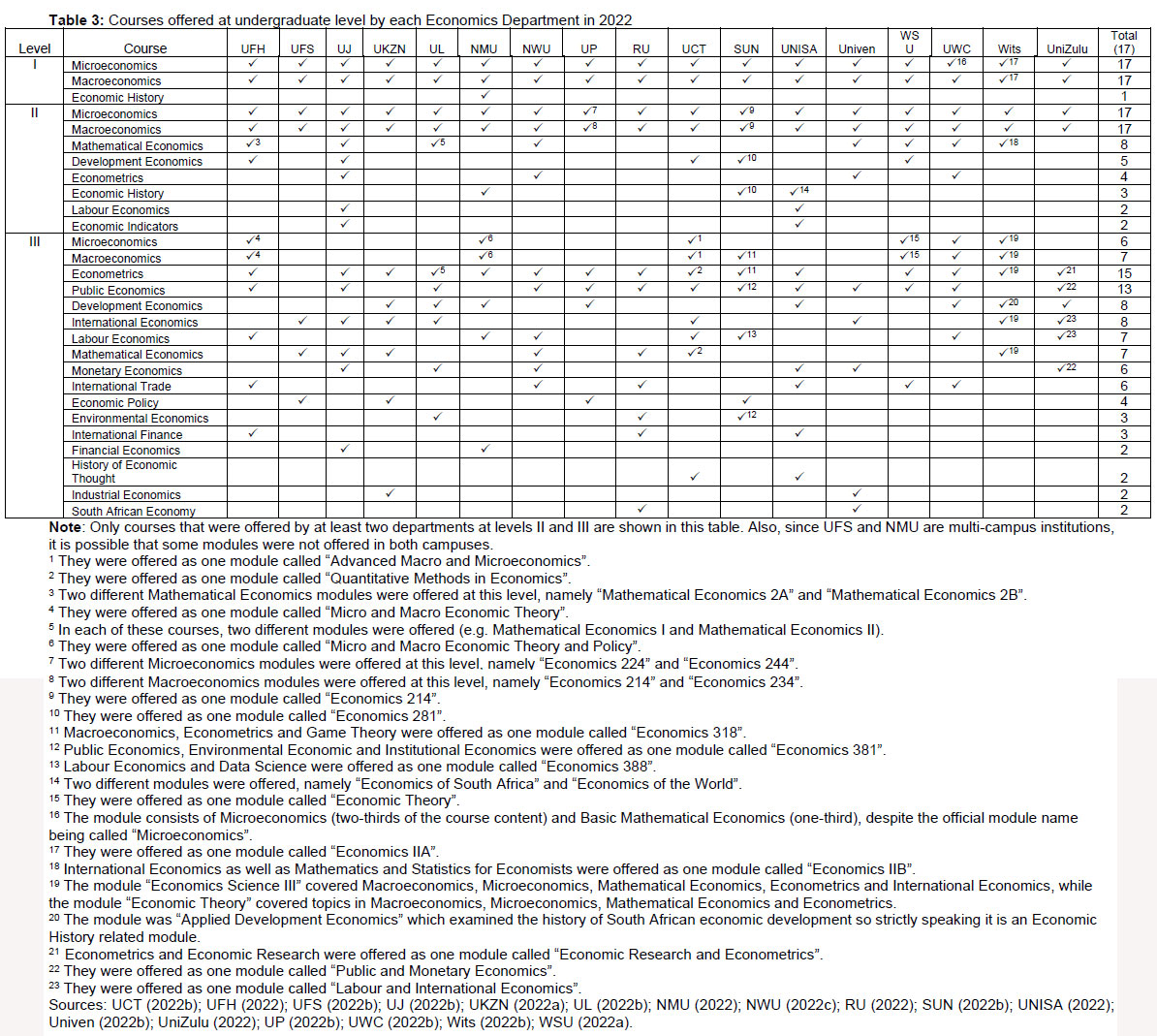
Moving on to the courses offered at each undergraduate level (only courses that were offered by at least two departments are shown), Table 3 shows that all 17 departments offered both Microeconomics and Macroeconomics at Level I. However, NMU also offered Economic History. At Level II, all 17 departments offered Microeconomics and Macroeconomics.
Some interesting findings are also observed at this level; first, the number of departments offering Mathematical Economics increased from five to eight whereas the number of departments offering Econometrics increased from three to four, after comparing Table 3 with what was found by Yu et al. (2017). These two findings are not surprising because Economics as a discipline has evolved to become more quantitative. Also, Development Economics was offered by many departments.
At Level III, just like what was founded by Yu et al. (2017), the number of departments that offered Microeconomics and Macroeconomics remained low (six and seven respectively). However, some departments offered other modules that are strongly related to Microeconomics and Macroeconomics. For example, UP offered two Microeconomics and two Macroeconomics at Level II, while the microeconomic-intensive Game Theory module was offered at SUN (despite not shown in the table). Also, almost all departments offered Public Economics and Econometrics, while other commonly offered modules included Development Economics, International Economics, Labour Economics and Mathematical Economics.
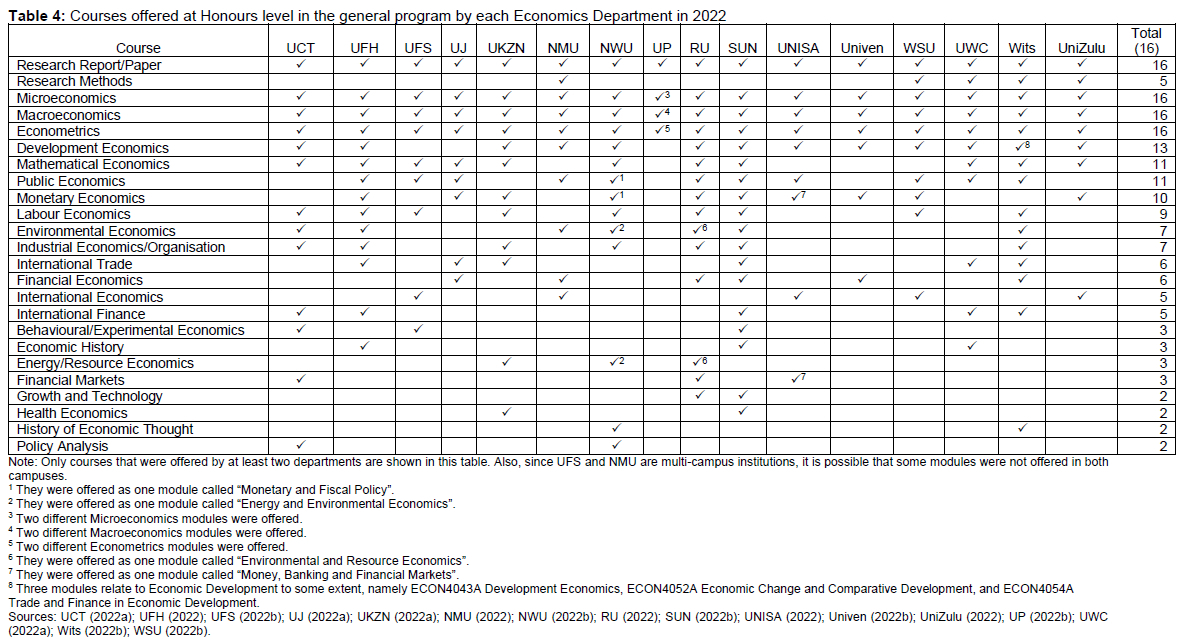
Table 4 examines what happened at Honours level in 2022. Again, only courses that were offered by at least two departments are shown in the table, and information on University of Limpopo (UL) is not available. The results show that all 16 departments under study offered the Microeconomics, Macroeconomics, Econometrics and Research Report/Paper modules, while Development Economics, Mathematical Economics, Public Economics, Monetary Economics and Labour Economics were offered by at least eight departments.
One concerning finding is that only five departments offered the Research Methods module (the same result was derived by Yu et al. (2017)). It is not known if some departments offered some unofficial, zero-credit intensive research methods "block teaching" classes or ad-hoc writing workshops during the academic year to help students learn the long research essay writing skills, which are highly important for students to cope with the more demanding Masters and even Doctorate thesis research.
First-year TLA practices
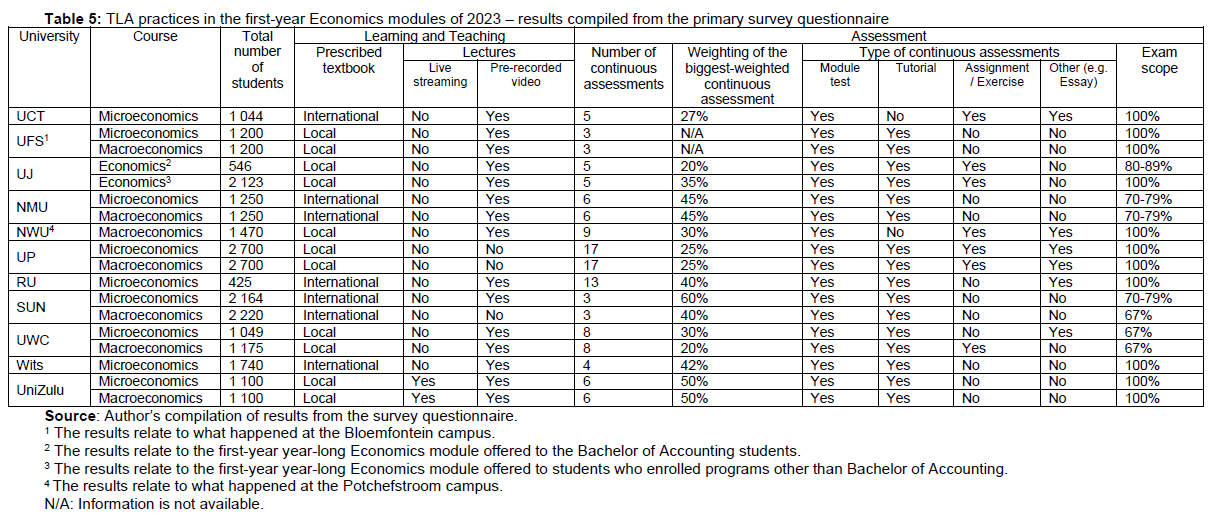
Table 5 presents what happened to the first-year first-semester Economics modules' TLA practices in 2023 across the Economics Departments upon contacting them directly with the aid of a primary survey questionnaire and responses were received from a total of 11 departments. The results show that the student class size was the greatest at UP (2 700); some departments used local textbooks whereas others rather used international textbooks. Next, the majority of departments uploaded pre-recorded lecture videos on the e-teaching site while a few departments had live streaming of face-to-face lectures. This finding suggests that the academics took advantage of technological advancement to provide additional and more efficient academic support to students to facilitate their learning, for example, in case some students were unable to attend face-to-face lectures due to financial reasons as well as unreliable or non-available transport mode, the pre-recorded videos would be helpful to them. Furthermore, the number of continuous assessments during the semester - before the final examination took place - was as low as three at SUN but as high as 17 at UP.
Next, while module tests featured as an assessment in all departments that took part in the survey, tutorials and assignments (or exercises) were the other two popular types of assessments before final examination. Some departments even had other assessments such as assignments, in-class exercises (they were known as quizzes or whiteboard sessions in some departments), essays and online multiple-choice question tests as additional opportunities for students to improve their marks during the semester. Lastly, with regard to the percentage of the prescribed chapters being included as scope of the final examination, it was as low as 67% in SUN and UWC but as high as 100% in many other departments such as the University of Free State (UFS), UCT and NWU.
Publications on accredited journals
To conclude the empirical analysis, Figure 1 shows a detailed breakdown on the nature of the 2016-2020 accredited journal articles. Information was collected from the following sources: (1) Annual research reports (RU); (2) Research output list on the department's website (UFS, SUN and UWC); (3) Direct contact with the department (NWU and SUN). Refer to the earlier discussion in the limitations section on why only information of five departments was analysed.
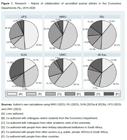
The results showed that in general, internal collaboration amongst staff and with students represented the majority of the accredited journal article publications in all departments except UFS (lone authored publications rather accounted for the greatest share). In addition, more than 20% of publications at both NWU and UFS involved collaboration amongst academics across different tertiary institutions, RU had a relatively high proportion of publications (10.9%) involving collaboration with non-academic sectors in the country (that is, evidence of collaboration with various external stakeholders in the community), while SUN was the strongest in internationalisation of research (31.6% share).
Last but not least, whilst not shown in Figure 1, if the short-term information on accredited journal publications of the other four departments are taken into consideration (NMU: 20192020; UKZN: 2018-2020; UNISA: 2018-2020; UP: 2016-2017), the "collaboration amongst staff and students from the same department" share remained most dominant (despite dropping slightly from 38.5% in Figure 1 to 33.4%), while the "international collaboration" share increased from 16.5% to 28.8%. The latter increase was primarily driven by UP and UNISA.
CONCLUSION AND RECOMMENDATIONS
This study investigated the TLA and research activities of the South African Economics Departments, with greater emphasis being place on the first area compared with the past studies. The findings showed there was an improvement in the proportion of staff with Doctorate qualifications and number of departments with at least one NRF-rated staff. While there were no significant changes in the undergraduate and Honours courses offered as well as the type of programs offered at all three postgraduate levels, there were changes in TLA practices, as technology was taken advantage of (e.g. pre-recorded lecture videos were uploaded on the e-teaching site).
In addition, this study did not focus on ranking the departments by means of per-capita research output, but rather adopted a new approach by breaking down the accredited journal articles by nature of collaboration, and it was found that, in general, internal collaboration amongst staff and/or with students represented the greatest proportion of publications.
As the COVID-19 lockdown may have unintentionally sped up the way academics change their practice to do research, as well as teach, assess and supervise students, it is important to conduct this type of study regularly to better understand what has been happening to the TLA, research and supervision practices in the Economics Departments, so they can learn from one another and better identify gaps for further improvement. To conclude the study, there are three areas that can be examined in future. First, postgraduate supervision, but it is extremely difficult to obtain the data from the departments. Secondly, the proportion of Masters theses and Doctorate dissertations that were eventually converted into accredited publications, as it would be interesting to find out if a high proportion of these theses and dissertations only ended up as e-thesis files in the university library website as the "final product" but failed to turn out to be accredited journal articles or book chapters. Again, it is quite challenging to obtain the required data from the Economics Departments.
Thirdly, since COVID was being controlled and the remaining lockdown restrictions were fully abolished, there is a possibility that some universities no longer uses live streaming but has returned to 100% face-to-face contact since the aforementioned primary survey was sent out in 2023. In a few years' time, especially from 2027 when the Council on Higher Education's extension of the concession on remote online and/or blended modes of provisioning of accredited contact-mode programmes will come to an end (CHE, 2024), it would be important to conduct a follow-up study to investigate whether the hybrid or blended modes of TLA would still be in place.
This study is significant as it contributes to knowledge by filling the empirical gap in understanding the TLA practices, and research activities within South African Economics Departments. By providing a comprehensive analysis of staff profiles, course offerings and TLA strategies across multiple institutions, it offers valuable insights into the current state of Economics education in the country. The findings have practical implications for future curriculum design and the enhancement of TLA practices, particularly in light of recent shifts towards blended learning. Additionally, the study's insights into research collaboration patterns can guide efforts to foster stronger inter-institutional and international partnerships, ultimately contributing to the development of the Economics discipline in South Africa.
DISCLOSUREIn acknowledgment of assistance with improving the clarity and wording of the text, an AI-based language model was consulted, which provided suggestions for refining the phrasing and structure of various sections of this article.
REFERENCES
ACKNOWLEDGEMENTS
The author would like to thank Sophia du Plessis, Doluntu Dyubhele, Jan Janse van Rensburg, Irrshad Kaseeram, Lyndal Keeton, Nico Keyser, Johann Kirsten, Waldo Krugell, Kholekile Malindi, Josue Mbonigaba, Mthokozisi Mlilo, Nisreen Narker, Sandie Phakathi, Andrew Phiri, Naiefa Rashied, Andrea Saayman, Carina Smit, Jen Snowball, Fortunate Tarwireyi, Corné van Walbeek, Anton van Wyk and Talent Zwane for the data assistance. All errors and omissions remain the author's responsibility.
LITERATURE REVIEW
-
Abramo, Giovanni, Ciriaco Andrea D'Angelo, and Flavia Di Costa. 2011. "University-industry research collaboration: a model to assess university capability." Higher Education 62(2): 163-181. https://doi.org/10.48550/arXiv.1811.01763
» https://doi.org/10.48550/arXiv.1811.01763 -
Abramo, Giovanni., Ciriaco Andrea D'Angelo, Flavia Di Costa, and Marco Solazzi. 2009. "University-industry collaboration in Italy: a bibliometric examination." Technovation 29(6-7): 498-507. https://doi.org/10.1016/j.technovation.2008.11.003
» https://doi.org/10.1016/j.technovation.2008.11.003 -
Abramo, Giovanni, Ciriaco Andrea D'Angelo, and Gianluca Murgia. 2017. "The relationship among research productivity, research collaboration, and their determinants." Journal of Infometrics 11(4): 1016-1030. https://doi.org/10.1016/j.joi.2017.09.007
» https://doi.org/10.1016/j.joi.2017.09.007 -
Amundsen, Diana, Nadine Ballam, and Marg Cosgriff. 2019. "The ABCs of collaboration in academia." Waikato Journal of Education 24(2): 39-53. https://doi.org/10.15663/wje.v24i2.667
» https://doi.org/10.15663/wje.v24i2.667 -
Anwar, Mumtaz. 2004. "From doctoral dissertation to publication: a study of 1995 American graduates in Library and Information Sciences." Journal of Education for Library and Information Science 37(3): 250-271. https://doi.org/10.1177/0961000604050565
» https://doi.org/10.1177/0961000604050565 - Barr, Robert, and John Tagg, J. 1995. "From teaching to learning." Change: the Magazine of Higher Learning. 27(6): 12-26.
-
Bozeman, Barry, Daniel Fay, and Catherine Slade. 2013. "Research collaboration in universities and academic entrepreneurship: the-state-of-the-art." Journal of Technology Transfer 38(1): 1-67. https://doi.org/10.1007/s10961-012-9281-8
» https://doi.org/10.1007/s10961-012-9281-8 - Czerniewicz, Laura, and Lucila Carvalho. 2022. "Open, distance, and digital education (ODDE) - An equity view". In Handbook of open, distance and digital education. Singapore: Springer Nature Singapore: 1-20.
-
Council on Higher Education (CHE). 2024. "Communiqué 3 of 2024: Extension of the concession for programmes accredited for the contact mode of provisioning to continue to be offered through remote online distance and/or blended modes of provisioning, the development of a Higher Education Practice." [Online.] Available: https://www.che.ac.za/sites/default/files/inline-files/Communique%CC%81%203%20of%202024_Extension%20of%20the%20concession%20for%20contact%20programmes%20to%20be%20offered%20through%20other%20modes.pdf [Accessed 24 May 2024.
» https://www.che.ac.za/sites/default/files/inline-files/Communique%CC%81%203%20of%202024_Extension%20of%20the%20concession%20for%20contact%20programmes%20to%20be%20offered%20through%20other%20modes.pdf -
]
» https://doi.org/10.1371/joumal.pone.0192219 -
Dos Reis, Karen, Christie Swanepoel, Derek Yu, and Fiona Anciano. 2022. "Exploring the alignment of first-year summative assessments with Bloom's Taxonomy: a longitudinal study." South African Journal of Higher Education 36(5): 37-57. https://doi.org/10.20853/36-5-4784
» https://doi.org/10.20853/36-5-4784 -
Ductor, Lorenzo. 2015. "Does co-authorship lead to higher academic productivity?." Oxford Bulleting of Economics and Statistics 77(3): 385-407. https://doi.org/10.1111/obes.12070
» https://doi.org/10.1111/obes.12070 -
Hart, Cornel, Priscilla Daniels, and Pearl September-Brown. 2023. "A model for scholarship of engagement institutionalisation and operationalisation." South African Journal of Higher Education 37(1): 224-242. https://doi.org/10.20853/37-1-5677
» https://doi.org/10.20853/37-1-5677 -
Hrastinski, Stefan. 2019. "What do we mean by blended learning?" TechTrends 63(5): 564-569. https://doi.org/10.1007/s11528-019-00375-5
» https://doi.org/10.1007/s11528-019-00375-5 -
Laband, David. 1985. "An evaluation of 50 ranked economics departments: by quantity and quality of faculty publications and graduate student placement and research success." Southern Economic Journal 52(1): 216-240. https://doi.org/10.2307/1058817
» https://doi.org/10.2307/1058817 -
Lee, Sooho, and Barry Bozeman. 2005. "The impact of research collaboration on scientific productivity." Social Studies of Science 35(5): 673-702. https://doi.org/10.1177/0306312705052359
» https://doi.org/10.1177/0306312705052359 -
Luiz, John. 2004. "State of economics at South African universities." South African Journal of Economics 72(1): 183-202. https://10.1111/j.l813-6982.2004.tb00109.x
» https://10.1111/j.l813-6982.2004.tb00109.x -
Luiz, John. 2009. "Evaluating the performance of South African economics departments." South African Journal of Economics 77(4): 591-602. https://doi.org/10.1111/j.1813-6982.2009.01228.x
» https://doi.org/10.1111/j.1813-6982.2009.01228.x -
Melin, Goran. 2000. "Pragmatism and self-organization: Research collaboration on the individual level." Research Policy 29(2000): 31-40. https://doi.org/10.1016/S0048-7333(99)00031-1
» https://doi.org/10.1016/S0048-7333(99)00031-1 -
Miller. Arthur, Charles Tien, and Andrew Peebler. 1996. "Department rankings: an alternative approach." Political Science and Politics 29: 704-717. https://doi.org/10.2307/420798
» https://doi.org/10.2307/420798 -
Nelson Mandela University. 2022. Department of Economics. [Online.] Available: https://economics.mandela.ac.za/ [Accessed 1 March 2022.
» https://economics.mandela.ac.za/ - ]
-
North-West University. 2022a. Department of Economics. [Online.] Available: https://commerce.nwu.ac.za/economic-sciences. [Accessed 1 February 2022.
» https://commerce.nwu.ac.za/economic-sciences -
]
» https://www.ru.ac.za/economics/ - North-West University. 2022b. "Faculty of Economic and Management Sciences 2022 Postgraduate Yearbook". Potchefstroom: North-West University.
- North-West University. 2022c. "Faculty of Economic and Management Sciences 2022 Undergraduate Yearbook". Potchefstroom: North-West University.
-
Nussbaumer, Doris. 2012. "An overview of cultural historical activity theory (CHAT) use in classroom research 2000 to 2009". Educational Review 64(1): 37-55. https://doi.org/10.1080/00131911.2011.553947
» https://doi.org/10.1080/00131911.2011.553947 -
]
» https://doi.org/10.2307/1182735 -
Rhodes University. 2023. Annual research reports, various years. [Online.] Available: https://www.ru.ac.za/researchgateway/researchexcellence/annualresearchreports/ [Accessed 15 March 2023.
» https://www.ru.ac.za/researchgateway/researchexcellence/annualresearchreports/ - ]
-
Rørstad, Kristoffer., Dag Aksnes, and Fredrick Piro. 2021. "Generational differences in international research collaboration: A bibliometric study of Norwegian university staff." PLoS ONE 16(11): e0260239. https://doi.org/10.1371/joumal.pone.0260239
» https://doi.org/10.1371/joumal.pone.0260239 -
Santos, Maite, Peter Willett, and Frances Wood. 1998. "Research degrees in librarianship and information science: A survey of master's and doctoral students from the Department of Information Studies, University of Sheffield." Journal of Librarianship and Information Science 30(1): 49-56. https://doi.org/10.1177/096100069803000105
» https://doi.org/10.1177/096100069803000105 -
Shagrir, Leah. 2017. "Collaborating with colleagues for the sake of academic and professional development in higher education." International Journal for Academic Development 22(4): 331342. https://doi.org/10.1080/1360144X.2017.1359180
» https://doi.org/10.1080/1360144X.2017.1359180 -
Stellenbosch University. 2022a. Department of Economics. [Online.] Available: https://www.ekon.sun.ac.za/ [Accessed 15 February 2022.
» https://www.ekon.sun.ac.za/ - ]
- Stellenbosch University. 2022b. "Faculty of Economic and Management Sciences 2022 Yearbook." Stellenbosch: Stellenbosch University.
-
Stellenbosch University. 2023a. Department of Economics: Recent publications (2016-2019). [Online.] Available: https://www.ekon.sun.ac.za/recentpubl/ [Accessed 15 September 2022.
» https://www.ekon.sun.ac.za/recentpubl/ -
]
» https://www.uj.ac.za/faculties/college-of-business-and-economics/schools/school-of-economics-and-econometrics/ - Stellenbosch University. 2023b. Department of Economics: 2020 publications. Information obtained from the administrators.
-
Van Rijnsoever, Frank, and Laurens Hessels. 2021. "How academic researchers select collaborative research projects: a choice experiment." Journal of Technology Transfer 46(6): 1917-1948. https://doi.org/10.1007/s10961-020-09833-2
» https://doi.org/10.1007/s10961-020-09833-2 - University of Cape Town. 2022b. "Commerce Undergraduate 2022 Handbook." Rondebosch: University of Cape Town.
-
University of Cape Town, 2022c. School of Economics. [Online.] Available: http://www.economics.uct.ac.za/home-367 [Accessed 15 February 2022.
» http://www.economics.uct.ac.za/home-367 - ]
-
University of Fort Hare. 2022. Department of Economics. [Online.] Available: https://www.ufh.ac.za/faculties/commerce/departments/economics [Accessed 15 April 2022.
» https://www.ufh.ac.za/faculties/commerce/departments/economics -
]
» https://www.univen.ac.za/faculties/management-commerce-and-law/economics/ -
University of Free State. 2022a. Department of Economics. [Online.] Available: https://www.ufs.ac.za/econ/departments-and-divisions/economics-home [Accessed 1 May 2022.
» https://www.ufs.ac.za/econ/departments-and-divisions/economics-home -
]
» https://www.wits.ac.za/sef/ -
University of Free State. 2023. Economics and Finance Home: Articles. [Online.] Available: https://www.ufs.ac.za/econ/departments-and-divisions/economics-home/research/articles [Accessed 15 August 2023.
» https://www.ufs.ac.za/econ/departments-and-divisions/economics-home/research/articles -
]
» https://wsu.ac.za/index.php/departments-and-programmes/department-of-economic-and-business-sciences/programmes-in-economics-unit/bachelor-of-commerce-general - University of Johannesburg. 2022a. "College of Business and Economics Postgraduate Studies 2022" Johannesburg: University of Johannesburg.
- University of Johannesburg. 2022b. "College of Business and Economics Undergraduate Studies 2022." Johannesburg: University of Johannesburg.
- ]
-
University of KwaZulu-Natal. 2022a. Programmes. [Online.] Available: https://saef.ukzn.ac.za/programmes/ [Accessed 1 March 2022.
» https://saef.ukzn.ac.za/programmes/ - ]
-
University of KwaZulu-Natal. 2022b. School of Accounting, Economics and Finance. [Online.] Available: https://saef.ukzn.ac.za/ [Accessed 15 September 2022.
» https://saef.ukzn.ac.za/ - ]
- University of Limpopo. 2022a. "Postgraduate Prospectus 2022."" Polokwane: University of Limpopo.
- University of Limpopo. 2022b. "Undergraduate Prospectus 2022." Polokwane: University of Limpopo.
-
University of Limpopo. 2022c. School of Economics and Management. [Online.] Available: https://www.ul.ac.za/index.php?Entity=School%20Main%20Menu&school_id=5 [Accessed 1 July 2022.
» https://www.ul.ac.za/index.php?Entity=School%20Main%20Menu&school_id=5 - ]
-
University of Pretoria. 2022a. Department of Economics. [Online.] Available: https://www.up.ac.za/economics [Accessed 1 August 2022.
» https://www.up.ac.za/economics - ]
- University of Pretoria. 2022b. "Faculty of Economic and Management Sciences 2022 Yearbook." Pretoria: University of Pretoria.
-
University of South Africa. 2022. Department of Economics. [Online.] Available: https://www.unisa.ac.za/sites/corporate/default/Colleges/Economic-and-Management-Sciences/Schools,-departments,-bureau,-centres-&-institutes/School-of-Economic-and-Financial-Sciences/Department-of-Economics [Accessed 1 August 2022.
» https://www.unisa.ac.za/sites/corporate/default/Colleges/Economic-and-Management-Sciences/Schools,-departments,-bureau,-centres-&-institutes/School-of-Economic-and-Financial-Sciences/Department-of-Economics - ]
- University of the Western Cape. 2022a. "Faculty of Economic and Management Sciences 2022 Postgraduate Calendar." Bellville: University of the Western Cape.
-
University of the Western Cape. 2023. Department of Economics: Research. [Online.] Available: from https://www.uwc.ac.za/study/all-areas-of-study/departments/department-of-economics/research [Accessed 1 July 2023.
» https://www.uwc.ac.za/study/all-areas-of-study/departments/department-of-economics/research - ]
- ]
- University of Venda. 2022b. "2022 Prospectus'". Thohoyandou: University of Venda.
- ]
- University of Witwatersrand. 2022b. "University rules and syllabuses for Degrees and Diplomas. Faculty of Commerce, Law & Management offered in the for the 2022 Academic Year." Braamfontein: University of Witwatersrand.
-
University of Zululand. 2022. Department of Economics. [Online.] Available: http://www.fcal.unizulu.ac.za/economics-2/ [Accessed 1 March 2022.
» http://www.fcal.unizulu.ac.za/economics-2/ - ]
-
Van Rijnsoever, Frank, and Laurens Hessels. 2021. "How academic researchers select collaborative research projects: a choice experiment." Journal of Technology Transfer 46(6): 1917-1948. https://doi.org/10.1007/s10961-020-09833-2
» https://doi.org/10.1007/s10961-020-09833-2 - ]
-
Walter Sisulu University. 2022b. Bachelor of Commerce Economics Honours. [Online.] Available: https://www.wsu.ac.za/index.php/departments-and-programmes/department-of-economic-and-business-sciences/programmes-in-business-management-unit/bachelor-of-commerce-honours-economics [Accessed 1 March 2023.
» https://www.wsu.ac.za/index.php/departments-and-programmes/department-of-economic-and-business-sciences/programmes-in-business-management-unit/bachelor-of-commerce-honours-economics - ]
-
Walter Sisulu University. 2022c. Master of Commerce. [Online.] Available: https://www.wsu.ac.za/index.php/departments-and-programmes/department-of-economic-and-business-sciences/programmes-in-economics-unit/master-of-commerce [Accessed 1 March 2023.
» https://www.wsu.ac.za/index.php/departments-and-programmes/department-of-economic-and-business-sciences/programmes-in-economics-unit/master-of-commerce - ]
- Walter Sisulu University. 2022d. "Komani Campus: Faculty of Economics and Information Technology Systems Prospectus." Mthatha: Walter Sisulu University.
-
Yu, Derek, Atoko Kasongo, and Mariana Moses. 2017. "Examining the performance of the South African economics departments, 2005-2014'." South African Journal of Economics 85(1): 138158. https://doi.org/10.1111/saje.12139
» https://doi.org/10.1111/saje.12139 -
Yu, Derek, Christie Swanepoel, Danica Sims, and Fiona Anciano. 2023. "Do assessment loads affect student success? An investigation at an Economics Department at the undergraduate level." South African Journal of Higher Education 37(5): 237-259. https://doi.org/10.20853/37-5-5397.
» https://doi.org/10.20853/37-5-5397
2 If more than one type of collaboration is involved, equal weights are assigned to each type. For example, if a journal article involves co-authorship of person X who works at the Department of Economics, person Y who works at the Department of Management of the same university and person Z who works at the Western Cape Provincial Government, 0.5 unit is allocated to group [C] and the other 0.5 unit is allocate to group [E].
3 The names of research units per department are: (1) UCT: Development Policy Research Unit, Environmental Policy Research Unit, Policy Research in International Services and Manufacturing, Research on the Economics of Excisable Products, Research Unit in Behavioural Economics and Neuroeconomics, Southern Africa Labour and Development Research Unit; (2): UJ: Centre for Competition, Regulation and Economic Development, Centre for Local Economic Development, Research Centre for Public and Environmental Economics; (3): UKZN: Macroeconomics Research Unit; (4) UP: African Tax Institute, Research in Energy and Environmental Economics and Modelling, Research into Health, Households and Behaviours; (5): SUN: Bureau for Economic Research, Centre for Competition Law and Economics, Laboratory for the Economics of Africa's Past, Research on Socioeconomic Policy; (6): University of Witwatersrand (Wits): African Microeconomic Research Umbrella, Institutions and Political Economy Group, Macro-Finance Analysis Group.